A Very Compact FPGA Implementation of LED and PHOTON
N. Nalla Anandakumar1,2, Thomas Peyrin1and Axel Poschmann1,3
1 Division of Mathematical Sciences, School of Physical and Mathematical Science, Nanyang Technological University, Singapore
2 Hardware Security Research Group, Society for Electronic Transactions and Security, India
3 NXP Semiconductors, Germany
[email protected], [email protected], [email protected]
Abstract. LED and PHOTON are new ultra-lightweight cryptographic algorithms aiming at resource-constrained devices. In this article, we describe three different hardware architectures of the LED and PHOTONfamily optimized for Field-Programmable Gate Array (FPGA) devices. In the first architecture we propose a round-based implementation while the second is a fully serialized architecture performing operations on a single cell per clock cycle. Then, we propose a novel architecture that is designed with a focus on utilizing commonly available building blocks (SRL16). This new architecture, organized in a complex scheduling of the operations, seems very well suited for recent designs that use serial matrices. We implemented both the lightweight block cipher LED and the lightweight hash function PHOTON on the Xilinx FPGA series Spartan-3 (low-cost) and Artix-7 (high-end) devices and our new proposed architecture provides very competitive area-throughput trade-offs. In comparison with other recent lightweight block ciphers, the implementation results ofLED show a significant improvement of hardware efficiency and we obtain the smallest known FPGA implementation (as of today) of any hash function.
Keywords:FPGA, lightweight cryptography,LED,PHOTON, SRL16.
1
Introduction
Lightweight devices such as RFID tags, wireless sensor nodes and smart cards are increasingly common in applications of our daily life. These smart lightweight devices might manipulate sensitive data and thus usually require some security. Classical cryptographic algorithms are not very suitable for this type of ap-plications, especially for very constrained environments, and thus many lightweight cryptographic schemes have been recently proposed (block ciphers [20, 30, 16, 11, 39, 36, 5] or hash functions [2, 19, 6]). The main fo-cus of lightweight cryptography research has been on the trade-offs between cost, security and performance in terms of speed, area and computational power. These primitives can be implemented either in software or in hardware platforms such as Field-Programmable Gate Array (FPGA) and Application Specific Inte-grated Circuit (ASIC). Compared to ASICs, FPGAs offer additional advantages in terms of time-to-market, reconfigurability and cost.
Recently, Guo et al. proposed the lightweight block cipher LED [20] and the lightweight family of hash functionsPHOTON[19], for which the hardware performance has only been investigated on ASICs.LEDis based onAES-like design principles with a very simple key schedule. The internal unkeyed permutations ofPHOTON
can also be seen as anAES-like primitive. Up to now, no design space exploration ofLEDon FPGAs has been published. The proposed architecture is suited for the applications where low-cost FPGAs are deployed such as FPGA-based RFID tags [15] and low-power FPGAs [38] are deployed for battery powered applications such as FPGA-based wireless sensor nodes [14]. Hence, they represents popular platforms (FPGA-based RFID tags, FPGA-based wireless sensor nodes) for lightweight cryptographic applications.
Our contributions. In this study, we propose three architectures optimized for the implementation of theLEDblock cipher and the five different flavors of the PHOTONhash functions family on FPGAs. The first architecture computes one round per clock cycle, while the second is based on the architecture presented in LED[20] and PHOTON [19] for ASIC, and adapted in this paper to FPGA with slight modifications. Our most interesting contribution is the third architecture, also serial by nature, which performs theLED and
PHOTONcomputations based on shift registers (SRL16), thanks to a non-trivial scheduling of the successive operations. This structure is actually strictly better than the second one since it achieves lower area and better throughput.
ranging from low-cost (Spartan-3) to high-end (Artix-7). Using our novel architecture, based on SRL16, one requires only 77 slices forLED-64 and 112 slices forPHOTON-80 on a Xilinx Spartan 3 (XC3S50) device, and 40 slices forLED-64 and 58 slices forPHOTON-80 on an Artix-7 (XC7A100T) device (while achieving reasonable throughput of 9.93 Mbps and 22.93 Mbps forLED-64, 6.57 Mbps and 18.33 Mbps forPHOTON-80). To the best of our knowledge, it represents the most compact hash function implementations on FPGAs.
The article is structured as follows. First we provide the description of LED and PHOTON in Section 2. Then, we provide in Section 3 and Section 4 our architectures and FPGA implementations of LED and
PHOTONrespectively. We finally draw conclusions in Section 5.
2
Algorithms descriptions
In this section, we describe the different versions ofLEDblock cipher [20] and thePHOTON[19] family of hash functions.
2.1 LED
LEDis a 64-bit block cipher based on a substitution-permutation network (SPN). It supports any key lengths from 64 to 128 bits. In this article, we will focus on a few main versions: 64-bit keyLED(namedLED-64) and 128-bit keyLED (named LED-128). The number of rounds N depends on the key size, LED-64 has N = 32 rounds whileLED-128 hasN = 48 rounds.
One can view the 64-bit internal state as a 4×4 matrix of 4-bit nibbles and the round function as an
AES-like permutation composed of the following four operations:
• AddConstants: the internal state is bitwise XORed with a round-dependent constant (generated with an LFSR);
• SubCells: thePRESENT[7] S-box is applied to each 4-bit nibble of the internal state;
• ShiftRows:nibble rowiof the internal state is cyclically shifted byipositions to the left;
• MixColumnsSerial: each nibble column of the internal state is transformed by multiplying it once with MDS matrixχ4 (or two times with matrixχ2, or four times with matrixχ).
χ=
0 1 0 0 0 0 1 0 0 0 0 1 4 1 2 2
; (χ)2=
0 0 1 0 0 0 0 1 4 1 2 2 8 6 5 6
; (χ)4=
0 1 0 0 0 0 1 0 0 0 0 1 4 1 2 2
4 =
4 1 2 2 8 6 5 6
B E A 9 2 2 F B
The key schedule of LED is very simple. In the case of LED-64, the key K is repeatedly XORed to the internal state every 4 rounds (with whitening key operation). In the case ofLED-128, the keyK is divided into two 64-bit subpartsK =K1||K2, each XORed alternatively to the internal state every 4 rounds. The 4-round operation between two key addition is called a step.
2.2 PHOTON
In this section we describe thePHOTONfamily of hash functions, for which five versions exist with digest sizes of 80, 128, 160, 224 and 256 bits.PHOTONis based on the sponge construction. First, after padding, the input message is divided into blocks ofr-bit each. At each iteration, thet-bit internal state (t =r+c) absorbs the incoming message block by simply XORing it to ther-bitbitrate part (the remainingc-bit part is called the capacity). Then, after the absorption of the message block, one applies a t-bit permutation P to the internal state. Once all message blocks have been processed the squeezing phase starts. During this phase, for each iterationr0 bits are output from the internal state and the permutationP is applied. One continues to squeeze until the proper digest sizenis reached.
The PHOTON internal permutation P is also AES-like and consists of 12 rounds. The internal state is represented as a (d×d) matrix of s-bit cells and each round is defined as the application of 4 operations:
• AddConstants: the internal state is bitwise XORed with a round-dependent constant (generated with an LFSR);
• SubCells: the S-box is applied to each s-bit nibble of the internal state (thePRESENTS-box [7] if s= 4, theAESS-box [9] if s= 8);
• ShiftRows:nibble rowiof the internal state is cyclically shifted byipositions to the left;
• MixColumnsSerial: each nibble column of the internal state is transformed by multiplying it once with MDS matrixχd (or two times with matrixχd/2, ... , ordtimes with matrixχ).
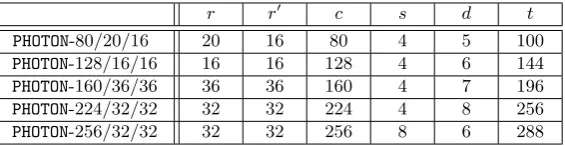
The values oft,c,r,r0,sandddepend on the hash output sizenand we give in Table 1 the 5 versions of
Table 1.The 5 versions ofPHOTONparameters
r r0 c s d t
PHOTON-80/20/16 20 16 80 4 5 100
PHOTON-128/16/16 16 16 128 4 6 144
PHOTON-160/36/36 36 36 160 4 7 196
PHOTON-224/32/32 32 32 224 4 8 256
PHOTON-256/32/32 32 32 256 8 6 288
3
LED
implementations
In this section, we present three different architectures for the FPGA implementation of the lightweight block cipher LED. The first one is a round-based implementation, while the second one is a fully serialized implementation, performing operations on a single cell during each clock cycle. The third one is a novel architecture, also fully serial, but based on the SRL16s and aiming at the smallest area possible. As we are interested in the performance of the plain LED core, we did not include any I/O logic implementation such as a UART interface.
We have also investigated the performance of theLEDcipher with different trade-offs. Indeed, the diffusion matrix being serial inLED, one can view theMixColumnsSerial diffusion layer as a single application of (χ)4, or two successive applications of (χ)2 or four successive applications of (χ).
We have implemented bothLEDversions (the 64-bit key versionLED-64 and the 128-bit key versionLED -128) in VerilogHDL and targeted Xilinx FPGAs Spartan-3 [23] and Artix-7 [25]. We used Mentor Graphics ModelSimPE for simulation purposes and Xilinx ISE v14.4 WebPACK for design synthesis. In Xilinx ISE the design goal is kept balanced and strategy is kept default (unlocked) and the synthesis optimization goal is set to area.
3.1 Round-based
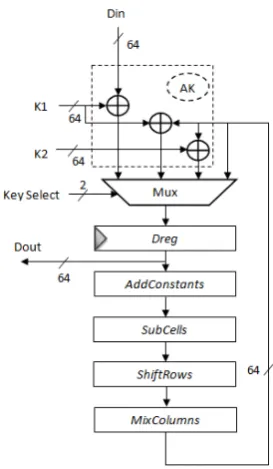
We give in Figure 1 the block diagram of the round-based implementation ofLED. Naturally, the data register (Dreg) is updated after every round operation. The keys are selected according to the key length (K1 is loaded without modification every four rounds inLED-64, while K1 and K2 are loaded alternatively every four rounds forLED-128). Table 2 provides the detailed results of our round-based FPGA implementations ofLEDwith three different approaches concerning the computation of the diffusion matrix: we compute χ4
by either applying 4 times the matrixχ, or by applying 2 times the matrix χ2, or by directly applying the
entire matrixχ4. As expected, the last option provides a higher throughput (since we directly compute the
entire diffusion matrix), but for the price of higher resource consumption. In contrary, the first option allows to save resources, but at the expense of a lower throughput. The second option offers a trade-off in between.
We also added in Table 2 a comparison with known round-based FPGA implementations of other (lightweight) block ciphers on the same FPGA device. One can see that ourLED-64 andLED-128 proposed round-based implementations outperform all the previous works in term of area.
3.2 Serialized
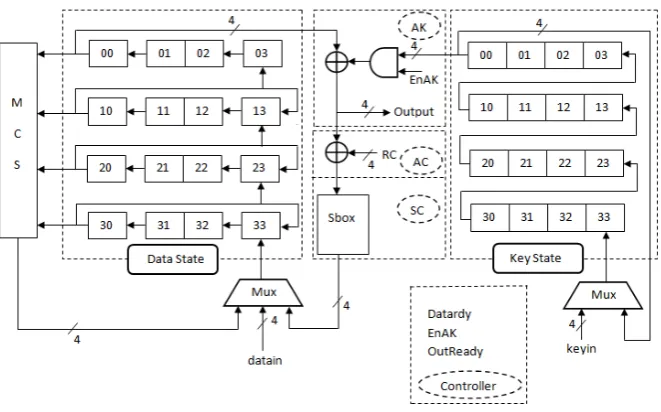
Our first serialized implementation ofLEDis derived from the architecture proposed in [20] for ASICs, but with some architectural modifications for the MCS state operations in order to improve the performance. This implementation stores the data and key in the registers (FF) and it has a 4-bit wide datapath, i.e. only 4 bits are processed in one clock cycle (see Figure 2). It consists of 4 states:Init,Sbox,Srow andMCS:
The Init state initial data and key values are stored in the data registers and key registers, respectively.
The Sbox state is for the simultaneous execution of the SubCells (SC) operations, AddConstants (AC) operations and XORing the roundkey (AK) every fourth round. It requires 16 clock cycles.
Fig. 1.Architecture of theLEDround based encryption module
Table 2.FPGA round-based implementation results ofLEDblock cipher with different approaches for diffusion matrix computation.
Design MDS
Block Key
No. of No. of No. of Clock Max. freq T/put Eff.
FPGA Device approach Size Size slices FFs LUTs Cycles (MHz) (Mbps) (Mbps/slices)
(bits) (bits)
(χ) 64 64 170 74 326 32 78.78 157.56 0.93
Spartan-3 XC3S50-5
128 199 76 391 48 78.79 104.8 0.53
(χ)2 64 64 198 74 379 32 87.63 175.3 0.89
128 227 76 444 48 87.63 116.54 0.51
LED
(χ)4 64 64 204 74 391 32 98.67 197.35 0.97
our paper 128 233 76 456 48 98.7 131.2 0.56
(Section 3.1)
(χ) 64 64 102 74 206 32 282.77 565.54 5.50
Artix-7 XC7A100T-3
128 158 76 261 48 282.43 376.57 2.39
(χ)2 64 64 110 74 216 32 290.46 580.97 5.28
128 163 76 281 48 291.89 389.18 2.40
(χ)4 64 64 136 74 231 32 334.85 669.7 4.92
128 168 76 292 48 333.73 444.97 2.65
PRESENT[35] 64 128 202 — — 32 254 508 2.51 Spartan-3 XC3S400-5
AES[17] 128 128 17,425 — — — 196.1 25,107 1.44 Spartan-3 XC3S2000-5
AES[8] 128 128 1800 — — — 150 1700 0.90 Spartan 3
ICEBERG[37] 64 128 631 — — — 254 1016 1.61 Virtex-II
SEA[31] 126 126 424 — — — 145 156 0.37 Virtex-II XC2V4000
The MCS state is for the execution of the MixColumnsSerial operation. It calculates the result fully serialized, that is one cell in each clock cycle. It first calculates the topmost cell of the leftmost column (cell
00) by storing the result in the last row of the rightmost column (cell33) in Figure 2. At the same time, the entire state array is shifted to the left by one position, where the leftmost cells in every row are shifted into the rightmost cells of the row located on top. This way in the subsequent clock cycle the topmost cell of the second column is processed, leading to a serializedrow-by-row calculation of theMixColumnsSerial.
It is to be noted that during the MixColumnsSerial operation in the architecture proposed in [20], the result is stored in the last row of the leftmost column (cell 30), leading to a serialized column-by-column calculation. Our new architecture is strictly better as it saves both area and time: As the leftmost column requires only 1-input FFs instead of 2-input FFs the area requirement is reduced significantly. Our proposed architecture has similarities with the work from [33], regarding the way the storing and rotating of matrices are implemented. Furthermore, it takes only 16 clock cycles to perform theMixColumnsSerial instead of the usual 20 clock cycles [20]. This new architecture is applicable to allAES-like permutations that use a serialized MixColumns operation and we will also use it for thePHOTONimplementations described in Section 4.
Fig. 2.A serialized architecture of theLEDencryption module
proposed in [20]. We give in the first row of Table 3 the detailed results of our serialized implementations. For a (χ) version of the diffusion matrix computation, we obtain forLED-64 andLED-128 140 slices and 167 slices respectively, while the throughput reaches 9.11 Mbps and 5.2 Mbps, respectively. One can see that
LED-64 and LED-128 seem to require much less area than most ciphers [27, 21, 10, 28] while having a higher throughput thanSIMON [3]. Furthermore, an increased throughput can be reached by scaling the datapath to 16 bits and by computing the diffusion matrix in a less serial manner, i.e. by applying two times (χ)2 or
direct (χ)4. Moreover, our proposed serialized implementations when using directly (χ)4 outperforms most
ciphers [28, 3] implementations in terms of throughput per area ratio (Eff.). Using device-dependent building blocks, such as BRAMs and DSPs, are a great way to enhance performance and optimize implementations for a specific target device. However, it also, obviously, makes a fair comparison of the hardware costs (area) much more difficult. Therefore we do not use any additional building blocks and instead compare the number of slices. In the next section we will explain how to further reduce area and latency.
3.3 Serialized using SRL16s
Our second serialized implementation of LED is based on the use of a building block of Xilinx Spartan-3 FPGAs called SRL16s [24]. More precisely, SRL16 are look up tables (LUT) that are used as 16-bit shift registers that allow to access (or output) bits of its internal state in two ways (as shown in Figure 3): the last bit of its 16 stages (Q15) is always available, while a multiplexer allows to access one additional bit from
any of its internal stages.
Fig. 3.LUT configured as a shift register
Table 3.FPGA serialized implementation results ofLEDblock cipher with different approaches for diffusion matrix computation.
Design MDS
Data- Block Key
Area No. of No. of Clock Max. freq T/put Eff.
FPGA Device approach path Size Size (slices) FFs LUTs Cycles (MHz) (Mbps) (Mbps/
(bits) (bits) (bits) slices)
(χ) 4 64 64 140 151 255 1120 159.43 9.11 0.07
Spartan-3 XC3S50-5 (χ)2
128 167 216 302 1680 137.34 5.2 0.03
8 64 64 169 157 332 608 157.43 16.6 0.10
(χ)4
128 203 219 388 912 142.01 9.97 0.05
LED 16 64 64 180 162 342 352 137.5 24.99 0.14
our paper 128 219 227 414 528 128.73 15.6 0.07
(Section 3.2)
(χ) 4 64 64 37 52 78 1120 378 21.6 0.58
Artix-7 XC7A100T-3
128 40 57 82 1680 368 14.02 0.35
(χ)2 8 64 64 58 95 135 608 380.3 40.03 0.69
128 61 104 141 912 356.5 25.02 0.41
(χ)4 16 64 64 78 110 162 352 367.4 66.8 0.86
128 82 175 188 528 375.6 45.53 0.56
(χ) 16 64 64 111 80 215 640 119.62 11.96 0.11
Spartan-3 XC3S50-5
128 122 72 233 960 118.25 7.88 0.06
(χ)2 8 64 64 77 44 148 768 119.19 9.93 0.13
128 86 48 167 1152 120.75 6.71 0.08
LED
(χ)4 16 64 64 119 76 228 256 119.27 29.82 0.25
our paper 128 127 70 248 384 117.87 19.65 0.15
(Section 3.3)
(χ) 16 64 64 51 45 113 640 303.9 30.39 0.60
Artix-7 XC7A100T-3
128 59 55 121 960 308.5 20.57 0.35
(χ)2 8 64 64 40 36 100 768 275.2 22.93 0.57
128 50 40 107 1152 302.64 16.81 0.34
(χ)4 16 64 64 63 43 133 256 284.83 71.21 1.13
128 69 53 138 384 286.5 47.75 0.70
PRESENT[40] 64 128 117 — — 256 114.8 28.46 0.24 Spartan-3 XC3S50-5
HIGHT[40] 64 128 91 — — 160 163.7 65.48 0.72 Spartan-3 XC3S50-5
xTEA[27] 64 128 254 — — 112 62.6 35.78 0.14 Spartan-3 XC3S50-5
PRESENT[21] 64 80 271 — — — — — — Spartan-3E XC3S500
SIMON[3] 128 128 36 — — — 136 3.60 0.10 Spartan-3E XC3S500
AES[10] 128 128 184 — — 160 45.6 36.5 0.20 Spartan-3 XC3S50-5
AES[28] 128 128 393 — — 534 — 16.86 0.04 Spartan-3 XC3S50-5
is described in generic HDL code with the global reset signal, it has no impact on shift registers and synthesis tools infer the use of the SRL16s. Moreover, SRL16 is present in almost all XILINX FPGA families and [22] describes a way to use SRL16s on ALTERA devices.
We have investigated possible area reductions by scaling the 64-bit implementation to an 8-bit (when using (χ)2) and 16-bit datapath (when usingχ and (χ)4) using SRL16s. As MixColumnsSerial requires
16-bit inputs (4 times 4-16-bit) in every clock cycle, but each SRL16 only allows access to 2 16-bits, we have to use eight and sixteen SRL16s to store the state, respectively.
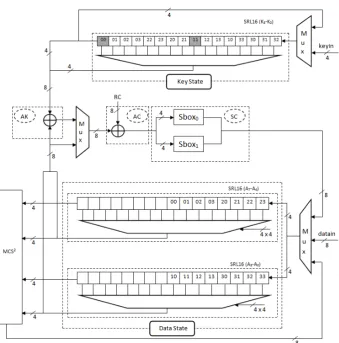
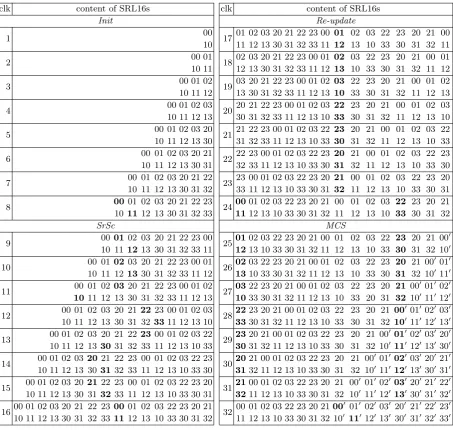
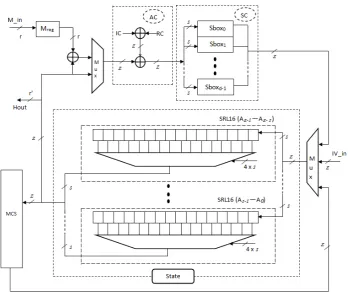
Figure 4 shows the block diagram for the SRL16s based implementation ofLEDwith 8-bit datapath when using (χ)2. It consists of 4 states: Init, SrSc, Re-update and MCS, where the content of each SRL16 is
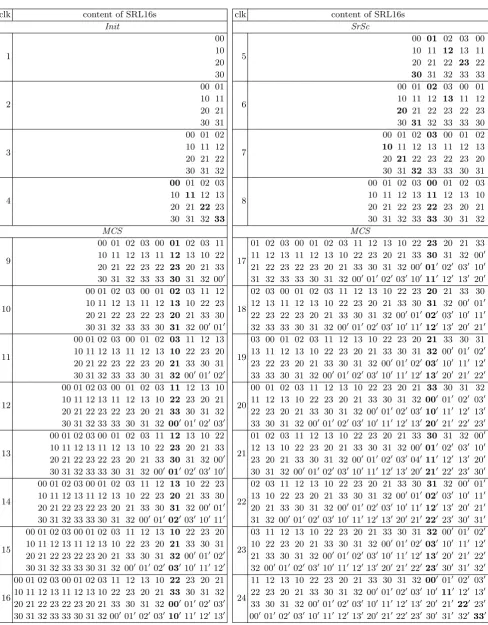
indicated in Table 4 for all the state operations. We also give in Table 7 and 8 of Appendix A the SRL16 content for 16-bit datapath implementations when usingχ and (χ)4respectively.
TheInit state: initial data and key values are stored in the data SRL16s and key SRL16s, respectively. A special ordering of the nibbles is required as shown in Table 4 and in Figure 4.
TheSrSc state: performs ShiftRows,SubCells,AddConstants andAddRoundKey simultaneously by clever memory (SRL16) addressing schedule. Table 4 depicts in bold the bits that are selected in every clock cycle to achieve this. The round operation starts by bitwise XORing the incoming data with the round key and round constants, then applying this result to two S-boxes (8-bit datapath) or four S-boxes (16-bit datapath), respectively. The first nibbles processed are 00 and 11 (8-bit datapath) and 00, 11, 22, and 33 (16-bit datapath), respectively. In order to performShiftRows, SubCells, AddConstants and AddRoundKey operations on the whole state, it takes 8 clock cycles (clk 9-16 in Table 4) using an 8-bit datapath, and 4 clock cycles (clk 5-8 in Table 8) using a 16-bit datapath, respectively.
The Re-update state: when using the 8-bit datapath, the 8-bit output from the S-boxes needs to be
Fig. 4.The block diagram for the SRL16s based implementation ofLEDwith 8-bit datapath when using (χ)2
The MCS state: the 4 x 4-bit input data is read from the bits indicated in bold in Table 4. It starts with the four 4-bit blocks 00, 11, 22 and 33, and using (χ)2, the resulting 8-bit output is stored in the SRL16s labeled as 000, 100 (and 200, and 300, respectively) to indicate the indices of the next round. In the next clock cycle, the input data is 01, 12, 23, and 30, and the corresponding result is labeled as 010, 110 (and 210, and 310) and so on. In total 8 clock cycles (clk 25-32) are required to complete theMixColumnsSerial layer using (χ)2, 4 clock cycles (clk 9-12 in Table 8) when using (χ)4, and 16 clock cycles (clk 9-24 in Table 7) when
using (χ), respectively. The next round starts with theSrSc state (clk 9) and inputs 000 and 110.
Concerning the key incorporation, we give in Table 9 (resp. Table 10) of Appendix A the SRL16s positions for the key when using 8-bit datapath with (χ)2 (resp. when using (χ)4 or (χ) for the 16-bit datapath).
For the 8-bit datapath, four and eight SRL16s are required in order to store the entire 64-bit and 128-bit key, respectively. The keys are always read 8-bit at a time from the 4-bit blocks indicated in bold in Table 9 with a grey background in Figure 4. Then, the key blocks of SRL16s are rotated by one position. Eight clock cycles (clk 17-24 in Table 9) are required for the 8-bit datapath, but extra 8 clock cycles (clk 25-32 in Table 9) are required for 64-bit key blocks so as to reach the initial position. The nextAddRoundKey starts with the SrScstate (clk 17 in Table 9) and inputs 000 and 110.
We have used sixteen SRL16s in order to store the 64-bit or 128-bit key for the 16-bit datapath. Initially, the key values are stored in the key SRL16s 4 times for the 64-bit (2 times for the 128-bit). 16 clock cycles (clk 1-16 in Table 10) are required for this step. The keys are read 16-bit at a time from the 4-bit blocks of SRL16s by selecting address taps based on theShiftRows position (clk 17-20 in Table 10). After every 16-bit keys read, the key blocks of SRL16s are rotated by one position. The next AddRoundKey starts with the SrScstate (clk 17 in Table 10) and inputs 000, 110, 220 and 330.
For the 8-bit datapath, 24 clock cycles are required in order to complete one round ofLED (clk 9-32 in Table 4), resulting in a total latency of 768 clock cycles forLED-64 and 1152 clock cycles forLED-128. Table 3 shows the detailed results of our implementations ofLEDbased on SRL16s for various MDS matrix compu-tation approaches. Our design (χ)2 only occupies 77 slices for LED-64 and 86 slices for LED-128 respectively,
Table 4.Content of SRL16s for one round ofLEDwhen using (χ)2 for the 8-bit datapath. Every cell of the content shows the index of a nibble of the state. Printed in bold is the input to the subsequent operation (see also Figure 4). The indices of the next round are indicated with a0.
clk content of SRL16s clk content of SRL16s
Init Re-update
1 00 17 01 02 03 20 21 22 23 00 01 02 03 22 23 20 21 00
10 11 12 13 30 31 32 33 11 12 13 10 33 30 31 32 11
2 00 01 18 02 03 20 21 22 23 00 01 02 03 22 23 20 21 00 01 10 11 12 13 30 31 32 33 11 12 13 10 33 30 31 32 11 12
3 00 01 02 19 03 20 21 22 23 00 01 02 03 22 23 20 21 00 01 02 10 11 12 13 30 31 32 33 11 12 13 10 33 30 31 32 11 12 13
4 00 01 02 03 20 20 21 22 23 00 01 02 03 22 23 20 21 00 01 02 03 10 11 12 13 30 31 32 33 11 12 13 10 33 30 31 32 11 12 13 10
5 00 01 02 03 20 21 21 22 23 00 01 02 03 22 23 20 21 00 01 02 03 22 10 11 12 13 30 31 32 33 11 12 13 10 33 30 31 32 11 12 13 10 33
6 00 01 02 03 20 21 22 22 23 00 01 02 03 22 23 20 21 00 01 02 03 22 23 10 11 12 13 30 31 32 33 11 12 13 10 33 30 31 32 11 12 13 10 33 30
7 00 01 02 03 20 21 22 23 23 00 01 02 03 22 23 20 21 00 01 02 03 22 23 20 10 11 12 13 30 31 32 33 11 12 13 10 33 30 31 32 11 12 13 10 33 30 31
8 0001 02 03 20 21 22 23 240001 02 03 22 23 20 21 00 01 02 03 22 23 20 21 101112 13 30 31 32 33 1112 13 10 33 30 31 32 11 12 13 10 33 30 31 32
SrSc MCS
9 000102 03 20 21 22 23 00 250102 03 22 23 20 21 00 01 02 03 22 23 20 21 00 0
10 111213 30 31 32 33 11 1213 10 33 30 31 32 11 12 13 10 33 30 31 32 100
10 00 010203 20 21 22 23 00 01 260203 22 23 20 21 00 01 02 03 22 23 20 21 00 0
010 10 11 121330 31 32 33 11 12 1310 33 30 31 32 11 12 13 10 33 30 31 32 100 110
11 00 01 020320 21 22 23 00 01 02 270322 23 20 21 00 01 02 03 22 23 20 21 00 0
010 020 1011 12 13 30 31 32 33 11 12 13 1033 30 31 32 11 12 13 10 33 20 31 32 100110 120
12 00 01 02 03 20 212223 00 01 02 03 282223 20 21 00 01 02 03 22 23 20 21 00 0
010020 030 10 11 12 13 30 31 323311 12 13 10 3330 31 32 11 12 13 10 33 30 31 32 100110120 130
13 00 01 02 03 20 21 222300 01 02 03 22 292320 21 00 01 02 03 22 23 20 21 00 0
010020030 200 10 11 12 133031 32 33 11 12 13 10 33 3031 32 11 12 13 10 33 30 31 32 100110120130 300
14 00 01 02 032021 22 23 00 01 02 03 22 23 302021 00 01 02 03 22 23 20 21 00 0
010020030200 210 10 11 12 13 303132 33 11 12 13 10 33 30 3132 11 12 13 10 33 30 31 32 100110120130300 310
15 00 01 02 03 202122 23 00 01 02 03 22 23 20 312100 01 02 03 22 23 20 21 00 0
010020030200210 220 10 11 12 13 30 313233 11 12 13 10 33 30 31 3211 12 13 10 33 30 31 32 100 110120130300310 320
1600 01 02 03 20 21 22 230001 02 03 22 23 20 21 32 00 01 02 03 22 23 20 2100 0
010 020030 200 210220 230 10 11 12 13 30 31 32 331112 13 10 33 30 31 32 11 12 13 10 33 30 31 32 100 110120130 300 310320 330
to 29.82Mbps by scaling the 8-bit to a 16-bit datapath and by directly computing the (χ)4 matrix. It is noteworthy to point out that our SRL16 based implementation on Artix-7 FPGA only occupies 40 slices for
LED-64 and 50 slices for LED-128, respectively, with a throughput almost three times increased compared to Spartan-3 devices.
We also give in Table 3 the performance of existing FPGA implementations of some other lightweight block ciphers. As can be seen from the table, our work seems to require much less area than most ciphers [40, 27, 21, 10, 28] while having a higher throughput thanAES[28] implementations and also yields a better throughput per area ratio (Eff.) compared to most ciphers [27, 28]. Compared to FPGA implementations of the lightweight block cipherSIMON [3], we get bigger area requirements but for a higher throughput (and also achieves the better throughput per area ratio (Eff.) when using direct matrix (χ)4). We remark that HIGHT [40] has a
4
PHOTON
implementations
In this section, we present three different architectures for the FPGA implementation of the lightweight hash function PHOTON. As in the previous section, the first architecture is a round-based implementation, the second one a fully serialized implementation, and the third one our new serial architecture based on SRL16s. The diffusion layer in PHOTON is based on a similar serial MDS matrix as in LED, thus we also tested different trade-offs concerning its implementation. We have implemented allPHOTONversions (PHOTON -80/20/16,PHOTON-128/16/16,PHOTON-160/36/36, PHOTON-224/32/32 andPHOTON-256/32/32) in VerilogHDL and targeted Xilinx FPGAs Spartan-3 [23] and Artix-7 [25]. Again, we used Mentor Graphics ModelSimPE for simulation purposes and Xilinx ISE v14.4 WebPACK for design synthesis.
4.1 Round-based
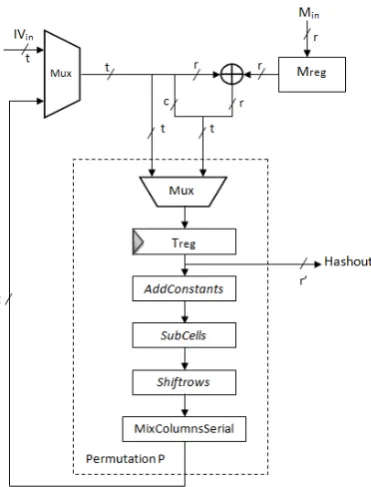
In order to fully implement the sponge construction, the input data must be padded according to the sponge padding rule [19], and this is handled by the padding unit. A 2×1 multiplexer drivesrbits of the data input from message registers and applies the XOR operation with r bits of the input blocks. After the padding procedure, this multiplexer operates as a feedback multiplexer in order to apply the 12 rounds of the internal permutation ofPHOTON. The data registerTregis updated every round, that is after processingAddConstants, SubCells,ShiftRows, andMixColumnsSerial in one clock cycle. Another 2×1 multiplexer is devoted to drive either the IV value or the internal state. Finally, during the squeezing phase, r0 bits are output from the internal state after every application of the permutation P, until the length of the hash digest size n is reached.
Fig. 5.Architecture of thePHOTONround-based implementations.
The round-based hardware architecture of thePHOTONhash function implementations is shown in Figure 5. The architectures were optimized for high throughput and minimal FPGA area resource consumption. The resulting design fits in the smallest Xilinx devices such as Spartan-3 XC3S50 for variantsPHOTON-80/20/16,
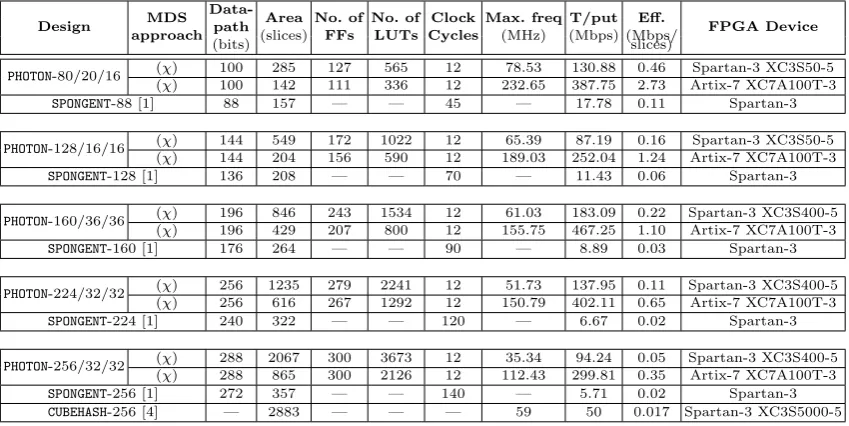
PHOTON-128/16/16 and Spartan-3 XC3S400 for variantsPHOTON-160/36/36, PHOTON-224/32/32 andPHOTON -256/32/32 (because Spartan-3 XC3S50 has only 768 Slices). The major interest was to examine if this method is appropriate to obtain a high throughput implementation ofPHOTONhash function. In Table 5, our results are compared to other hardware implementations [1, 4]. One can see that our proposed round-based implementations outperform all the previous works in terms of throughput per area ratio (Eff.).
4.2 Serialized
Similarly to our work onLEDin Section 3.2, we have built a serialized implementation of the differentPHOTON
Table 5.FPGA round-based implementation results ofPHOTONhash function.
Design MDS
Data-Area No. of No. of Clock Max. freq T/put Eff.
FPGA Device approach path (slices) FFs LUTs Cycles (MHz) (Mbps) (Mbps/
(bits) slices)
PHOTON-80/20/16 (χ) 100 285 127 565 12 78.53 130.88 0.46 Spartan-3 XC3S50-5
(χ) 100 142 111 336 12 232.65 387.75 2.73 Artix-7 XC7A100T-3
SPONGENT-88 [1] 88 157 — — 45 — 17.78 0.11 Spartan-3
PHOTON-128/16/16 (χ) 144 549 172 1022 12 65.39 87.19 0.16 Spartan-3 XC3S50-5
(χ) 144 204 156 590 12 189.03 252.04 1.24 Artix-7 XC7A100T-3
SPONGENT-128 [1] 136 208 — — 70 — 11.43 0.06 Spartan-3
PHOTON-160/36/36 (χ) 196 846 243 1534 12 61.03 183.09 0.22 Spartan-3 XC3S400-5
(χ) 196 429 207 800 12 155.75 467.25 1.10 Artix-7 XC7A100T-3
SPONGENT-160 [1] 176 264 — — 90 — 8.89 0.03 Spartan-3
PHOTON-224/32/32 (χ) 256 1235 279 2241 12 51.73 137.95 0.11 Spartan-3 XC3S400-5 (χ) 256 616 267 1292 12 150.79 402.11 0.65 Artix-7 XC7A100T-3
SPONGENT-224 [1] 240 322 — — 120 — 6.67 0.02 Spartan-3
PHOTON-256/32/32 (χ) 288 2067 300 3673 12 35.34 94.24 0.05 Spartan-3 XC3S400-5
(χ) 288 865 300 2126 12 112.43 299.81 0.35 Artix-7 XC7A100T-3
SPONGENT-256 [1] 272 357 — — 140 — 5.71 0.02 Spartan-3
CUBEHASH-256 [4] — 2883 — — — 59 50 0.017 Spartan-3 XC3S5000-5
ShR, andController. These modules and the general hardware architecture that we propose are almost the same as the one described in [19] for ASICs. Yet, we applied the same optimization forMixColumnSerial that we have described forLEDin detail in Section 3.2. It takes d·dclock cycles to perform MixColumnsSerial operation instead of the usuald·(d+ 1) clock cycles [19].
Fig. 6.A serialized architecture of thePHOTONhash function.
Overall, our implementation requiresd·d+ (d−1) +d·dclock cycles to perform one round of thePHOTON
Table 6.FPGA serialized implementation results of thePHOTONhash function.
Design impl. MDS
Data-Area No. of No. of Clock Max. freq T/put Eff.
FPGA Device approach approach path (slices) FFs LUTs Cycles (MHz) (Mbps) (Mbps/
(bits) slices)
PHOTON-80/20/16
serial (χ) 4 146 137 256 648 100.43 3.10 0.02
Spartan-3 XC3S50-5
SRL16 (χ) 20 112 68 203 360 118.19 6.57 0.06
serial (χ) 4 67 134 167 648 329.51 10.17 0.15
Artix-7 XC7A100T-3
SRL16 (χ) 20 58 89 144 360 329.95 18.33 0.32
serial (χ) 4 82 135 188 648 302.68 9.34 0.11
Virtex-5 XC5VLX50-1
SRL16 (χ) 20 69 89 159 360 285.2 15.84 0.22
PHOTON-80/20/16 [13] 4 149 — — 708 250 7 0.05 Virtex-5
SPONGENT-88 [1] 4 116 — — 900 — .81 0.01 Spartan-3
PHOTON-128/16/16
serial (χ) 4 183 173 317 924 101.60 1.76 0.01
Spartan-3 XC3S50-5
SRL16 (χ) 24 137 79 250 504 115.67 3.67 0.03
serial (χ) 4 84 179 212 924 360.33 6.24 0.07
Artix-7 XC7A100T-3
SRL16 (χ) 24 72 99 137 504 342.36 10.87 0.20
PHOTON-128/16/16 [32] 4 469 — — 948 30.2 .551 0.001 Spartan-3
SPONGENT-128 [1] 4 144 — — 2380 — .34 0.002 Spartan-3
PHOTON-160/36/36
serial (χ) 4 233 257 407 1248 72.4 2.01 0.01
Spartan-3 XC3S50-5
SRL16 (χ) 28 164 138 314 672 122.76 6.58 0.04
serial (χ) 4 117 252 296 1248 328.52 9.47 0.08
Artix-7 XC7A100T-3
SRL16 (χ) 28 89 135 204 672 328.17 17.58 0.20
SPONGENT-160 [1] 4 193 — — 3960 — .2 0.001 Spartan-3
PHOTON-224/32/32
serial (χ) 4 274 311 493 1620 69.04 1.36 0.005
Spartan-3 XC3S50-5
SRL16 (χ) 32 176 135 339 864 123.33 4.57 0.03
serial (χ) 4 130 305 328 1620 382.52 7.55 0.06
Artix-7 XC7A100T-3
SRL16 (χ) 32 96 131 181 864 327.28 12.12 0.13
SPONGENT-224 [1] 4 225 — — 7200 — .11 0.0005 Spartan-3
GRØSTL-224 [26] 64 1276 — — — 60 192 — Spartan-3
PHOTON-256/32/32
serial (χ) 8 327 335 577 924 42.56 1.47 0.004
Spartan-3 XC3S50-5
SRL16 (χ) 48 416 160 806 504 58.95 3.74 0.009
serial (χ) 8 157 331 373 924 132.49 4.59 0.03
Artix-7 XC7A100T-3
SRL16 (χ) 48 159 100 384 504 166.41 10.75 0.07
SPONGENT-256 [1] 4 241 — — 9520 — 0.08 .0003 Spartan-3 XC3S200-5
SHABAL-256 [12] — 499 — — — 100 .8 1.60 Spartan-3 XC3S200-5
BLAKE-256 [29] — 631 — — — — 216.3 0.34 Spartan-3 XC3S50-5
GRØSTL[29] — 766 — — — — 192.6 0.25 Spartan-3 XC3S50-5
JH[29] — 558 — — — — 63.7 0.11 Spartan-3 XC3S50-5
KECCAK[29] — 766 — — — — 46.2 0.06 Spartan-3 XC3S50-5
SKEIN[29] — 766 — — — — 16.6 0.02 Spartan-3 XC3S50-5
SHA-2 [29] — 745 — — — — 137.8 0.19 Spartan-3 XC3S50-5
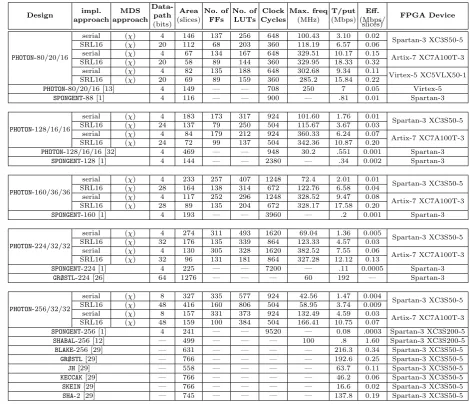
implementations [1] of the lightweight hash functionSPONGENT[6], we get bigger area requirements but for a much higher throughput per area (Eff.). We will see in the next section that SRL16 based implementations ofPHOTONwill lead to lower area and much higher throughput and yield a better throughput per area ratio (Eff.) thanSPONGENT.
4.3 Serialized using SRL16s
As forLEDin Section 3.3, we considered a second serialized implementation ofPHOTONhash function based on the use of SRL16s [24]. Our architecture is based on a 20-bit datapath that usesχ. It it is depicted in Figure 7 and consists of 3 states: Init, SrSc and MCS, where the content of each SRL16 is indicated in Table 11 of Appendix B for all the state operations.
The Init state: after the padding procedure, theIV value is stored into the data SRL16s (z =s·dbits) using a 3×1 multiplexer which drives either theIV input value, updatesSrSc state value, or updates MCS
state value.
TheSrScstate: it reads the data values from SRL16s by selecting address taps according to theShiftRows
positions. The round operation starts by bitwise XORing the incoming data withrbits of the message input if applicable, and then adding the constants (round constants and internal constants). Next, the result goes throughdS-boxes for az-bit datapath. Finally, the output of the 4-bit S-boxes is given as input to the blocks 00, 11, 22, 33 and 44 of SRL16s forPHOTON-80/20/16, to the blocks 00, 11, 22, 33, 44 and 55 of SRL16s for
Fig. 7.A serialized architecture of thePHOTONhash function based on SRL16s
d clock cycles (clk 6-10 in Table 11 for PHOTON-80/20/16) for a z-bit datapath to perform AddConstants, ShiftRows andSubCells operations on the entire state.
TheMCS state: thez-bit data is read from the bits indicated in bold in Table 11 forPHOTON-80/20/16. It starts with the five 4-bit blocks 00, 11, 22, 33 and 44, and using (χ), the resulting 20-bit output is stored in the SRL16s labeled as 11, 22, 33, 44 and 000. In the next clock cycle, the input is 01, 12, 23, 34 and 40, and the corresponding result is labeled as 12, 23, 34, 40, 010 and so on similar to Table 7. In total 25 clock cycles (clk 11-35 in Table 11) are required to complete theMixColumnsSerial operation forPHOTON-80/20/16. We have also implemented the remaining 4 versions ofPHOTON using same architecture and give below the MCS
state input(x) SRL16s labeled and output(y) SRL16s labeled for the first clock cycle.
• PHOTON-128/16/16:x= 00, 11, 22, 33, 44, 55;y = 11, 22, 33, 44, 55, 000
• PHOTON-160/36/36:x= 00, 11, 22, 33, 44, 55, 66; y= 11, 22, 33, 44, 55, 66, 000
• PHOTON-224/32/32:x= 00, 11, 22, 33, 44, 55, 66, 77 ; y= 11, 22, 33, 44, 55, 66, 77, 000
• PHOTON-256/32/32:x= 00, 11, 22, 33, 44, 55;y = 11, 22, 33, 44, 55, 000
d·dclock cycles are required for az-bit datapath in order to complete theMixColumnsSerialoperation. Overall, we required+d·d clock cycles to compute a single round. SincePHOTON has 12 rounds, the total number of cycles required to process one block of message is 12(d+d·d). Table 6 describes the performance results of our implementations and compares it with existing FPGA implementations of PHOTONand other lightweight hash functions. ConcerningKECCAK-f[200], perhaps we just add thatKECCAK-f[200] is not included in this table as no FPGA implementation of this function has been published so far. As seen from the table, our work provides the smallest area among all known implementations of lightweight hash functions while having a higher throughput and yields a better throughput per area ratio (Eff.) thanPHOTON-80/20/16 [13],
PHOTON-128/16/16 [32] and the implementation ofSPONGENT [1]. We remark that SHABAL [12] has a better throughput per area ratio than PHOTON, but in this article our goal with serialised implementations is to reduce area, and not to improve throughput per area ratio.
5
Conclusion
In this paper, we have analyzed the feasibility of creating a very compact, low cost FPGA implementation of
several possible tradeoffs when computing the diffusion matrix. In particular, we proposed an SRL16 based architecture, that seems to be very well suited for all cryptographic primitives that use serial matrices. Our results show thatLEDandPHOTONare very good candidates for lightweight applications, our implementations yield for example the best area of all lightweight hash functions implementations published so far. Future work will include the investigation of side-channel analysis on our implementations and apply countermeasures [18, 34, 33] in order to resist these attacks.
Acknowledgements
Authors would like to thank the anonymous reviewers for their helpful comments. The first author wishes to thank Prof. R. Balsubramanian, Executive Director (SETS) and Sri. S. Thiagarajan, Registrar (SETS) for their support. Thomas Peyrin is supported by the Singapore National Research Foundation Fellowship 2012 (NRF-NRFF2012-06).
References
1. Marwan Adas. On The FPGA Based Implementation of SPONGENT, 2011. http://ece.gmu.edu/ coursewebpages/ECE/ECE646/F11/project/F11_presentations/Marwan.pdf.
2. Jean-Philippe Aumasson, Luca Henzen, Willi Meier, and Mar´ıa Naya-Plasencia. Quark: A Lightweight Hash.
Journal of Cryptology, 26(2):313–339, 2013.
3. Aydin Aysu, Ege Gulcan, and Patrick Schaumont. SIMON Says, Break the Area Records for Symmetric Key Block Ciphers on FPGAs. IACR Cryptology ePrint Archive, 2014, Available at:. http://eprint.iacr.org/2014/237. 4. Brian Baldwin, Andrew Byrne, Mark Hamilton, Neil Hanley, Robert P McEvoy, Weibo Pan, and William P
Marnane. FPGA Implementations of SHA-3 Candidates: CubeHash, Grøstl, LANE, Shabal and Spectral Hash. InDigital System Design, Architectures, Methods and Tools, 2009. DSD’09. 12th Euromicro Conference on, pages 783–790. IEEE, 2009.
5. Ray Beaulieu, Douglas Shors, Jason Smith, Stefan Treatman-Clark, Bryan Weeks, and Louis Wingers. The SIMON and SPECK Families of Lightweight Block Ciphers. IACR Cryptology ePrint Archive, 2013, Available at:. http://eprint.iacr.org/2013/404.
6. Andrey Bogdanov, Miroslav Kneˇzevi´c, Gregor Leander, Deniz Toz, Kerem Varıcı, and Ingrid Verbauwhede. SPON-GENT: A Lightweight Hash Function. InCryptographic Hardware and Embedded Systems–CHES, pages 312–325. Springer, 2011.
7. Andrey Bogdanov, Lars R Knudsen, Gregor Leander, Christof Paar, Axel Poschmann, Matthew JB Robshaw, Yannick Seurin, and Charlotte Vikkelsoe. PRESENT: An Ultra-Lightweight Block Cipher. In Cryptographic Hardware and Embedded Systems-CHES 2007, pages 450–466. Springer, 2007.
8. Philippe Bulens, Fran¸cois-Xavier Standaert, Jean-Jacques Quisquater, Pascal Pellegrin, and Ga¨el Rouvroy. Im-plementation of the AES-128 on Virtex-5 FPGAs. InProgress in Cryptology–AFRICACRYPT 2008, pages 16–26. Springer, 2008.
9. David Canright. A Very Compact S-Box for AES. In Cryptographic Hardware and Embedded Systems–CHES 2005, pages 441–455. Springer, 2005.
10. Junfeng Chu and Mohammed Benaissa. Low area memory-free FPGA implementation of the AES algorithm. InField Programmable Logic and Applications (FPL), 2012 22nd International Conference on, pages 623–626. IEEE, 2012.
11. Christophe De Canniere, Orr Dunkelman, and Miroslav Kneˇzevi´c. KATAN and KTANTAN – A Family of Small and Efficient Hardware-Oriented Block Ciphers. InCHES 2009, pages 272–288. Springer, 2009.
12. J´er´emie Detrey, Pierrick Gaudry, and Karim Khalfallah. A Low-Area Yet Performant FPGA Implementation of Shabal. InSelected Areas in Cryptography - 17th International Workshop, SAC, pages 99–113. Springer, 2010. 13. Susana Eiroa and Iluminada Baturone. FPGA implementation and DPA resistance analysis of a lightweight
HMAC construction based on photon hash family. InFPL, pages 1–4. IEEE, 2013.
14. Andreas Engel, Bj¨orn Liebig, and Andreas Koch. Feasibility Analysis of Reconfigurable Computing in Low-Power Wireless Sensor Applications. InARC, pages 261–268. Springer, 2011.
15. Martin Feldhofer, Manfred Josef Aigner, Thomas Baier, Michael Hutter, Thomas Plos, and Erich Wenger. Semi-passive RFID development platform for implementing and attacking security tags. InICITST, pages 1–6. IEEE, 2010.
16. Zheng Gong, Svetla Nikova, and Yee Wei Law. KLEIN: A New Family of Lightweight Block Ciphers. InRFID. Sec, pages 1–18. Springer, 2012.
17. Tim Good and Mohammed Benaissa. AES on FPGA from the Fastest to the Smallest. InCryptographic Hardware and Embedded Systems–CHES 2005, pages 427–440. Springer, 2005.
18. Tim G¨uneysu and Amir Moradi. Generic Side-Channel Countermeasures for Reconfigurable Devices. In Crypto-graphic Hardware and Embedded Systems–CHES 2011, pages 33–48. Springer, 2011.
19. Jian Guo, Thomas Peyrin, and Axel Poschmann. The PHOTON Family of Lightweight Hash Functions. In
20. Jian Guo, Thomas Peyrin, Axel Poschmann, and Matt Robshaw. The LED Block Cipher. In Cryptographic Hardware and Embedded Systems–CHES 2011, pages 326–341. Springer, 2011.
21. Xu Guo, Zhimin Chen, and Patrick Schaumont. Energy and Performance Evaluation of an FPGA-Based SoC Platform with AES and PRESENT Coprocessors. InEmbedded Computer Systems: Architectures, Modeling, and Simulation, pages 106–115. Springer, 2008.
22. Xilinx Inc. AN 307: Altera Design Flow for Xilinx Users, March, 2013. Available at:. http://www.altera.com/ literature/an/an307.pdf.
23. Xilinx Inc. Spartan-3 Generation FPGA User Guide, August, 2010. Available at:. http://www.xilinx.com/ support/documentation/user_guides/ug331.pdf/.
24. Xilinx Inc. Using Look-Up Tables as Shift Registers (SRL16) in Spartan-3 Generation FPGAs, May, 2005. Available at:.http://www.xilinx.com/support/documentation/application_notes/xapp465.pdf.
25. Xilinx Inc. Xilinx 7 Series FPGAs FPGA User Guide, February, 2014. Available at:. http://www.xilinx.com/ support/documentation/data_sheets/ds180_7Series_Overview.pdf.
26. Bernhard Jungk and Steffen Reith. On FPGA-based implementations of Grøstl. InIACR Cryptology ePrint Archive, volume 2010, Available at:. http://eprint.iacr.org/2010/260.
27. Jens-Peter Kaps. Chai-Tea, Cryptographic Hardware Implementations of xTEA. In Progress in Cryptology-INDOCRYPT 2008, pages 363–375. Springer, 2008.
28. Jens-Peter Kaps and Berk Sunar. Energy Comparison of AES and SHA-1 for Ubiquitous Computing. InEUC Workshops, pages 372–381. Springer, 2006.
29. Jens-Peter Kaps, Panasayya Yalla, Kishore Kumar Surapathi, Bilal Habib, Susheel Vadlamudi, and Smriti Gurung. Lightweight Implementations of SHA-3 Candidates on FPGAs. InThe Third SHA-3 Candidate Conference, 2012. 30. Lars Knudsen, Gregor Leander, Axel Poschmann, and Matthew JB Robshaw. PRINTcipher: A Block Cipher for
IC-Printing. InCryptographic Hardware and Embedded Systems, CHES 2010, pages 16–32. Springer, 2010. 31. Fran¸cois Mac´e, Fran¸cois-Xavier Standaert, and Jean-Jacques Quisquater. FPGA Implementation(s) of a Scalable
Encryption Algorithm.Very Large Scale Integration (VLSI) Systems, IEEE Transactions on, 16(2):212–216, 2007. 32. Pavan Kumar Malka. Compact Hardware Implementation of PHOTON Hash Function in FPGA, 2011. http:
//ece.gmu.edu/coursewebpages/ECE/ECE646/F11/project/F11_presentations/Pavan.pdf.
33. Amir Moradi, Axel Poschmann, San Ling, Christof Paar, and Huaxiong Wang. Pushing the Limits: A Very Compact and a Threshold Implementation of AES. InAdvances in Cryptology–EUROCRYPT 2011, pages 69–88. Springer, 2011.
34. Axel Poschmann, Amir Moradi, Khoongming Khoo, Chu-Wee Lim, Huaxiong Wang, and San Ling. Side-Channel Resistant Crypto for Less than 2,300 GE. Journal of Cryptology, 24(2):322–345, 2011.
35. Axel York Poschmann. LIGHTWEIGHT CRYPTOGRAPHY: Cryptographic Engineering for a Pervasive World. InPH. D. THESIS. Citeseer, 2009.
36. Kyoji Shibutani, Takanori Isobe, Harunaga Hiwatari, Atsushi Mitsuda, Toru Akishita, and Taizo Shirai. Piccolo: An Ultra-Lightweight Blockcipher. InCryptographic Hardware and Embedded Systems–CHES, pages 342–357. Springer, 2011.
37. Fran¸cois-Xavier Standaert, Gilles Piret, Ga¨el Rouvroy, and Jean-Jacques Quisquater. FPGA implementations of the ICEBERG block cipher. Integration, the VLSI Journal, 40(1):20–27, 2007.
38. Tim Tuan, Arif Rahman, Satyaki Das, Steven Trimberger, and Sean Kao. A 90-nm Low-Power FPGA for Battery-Powered Applications. IEEE Trans. on CAD of Integrated Circuits and Systems, 26(2):296–300, 2007.
39. Wenling Wu and Lei Zhang. LBlock: A Lightweight Block Cipher. InApplied Cryptography and Network Security, pages 327–344. Springer, 2011.
A
SRL16s positions for
LED
Table 7.Content of SRL16s after every state ofLEDwhen using (χ) for the 16-bit datapath. Every cell of the content shows the index of a nibble of the state. Printed in bold is the input to the subsequent operation. The indices of the next round are indicated with a0.
clk content of SRL16s clk content of SRL16s
Init SrSc
1
00
5
00 01 02 03 00
10 10 11 12 13 11
20 20 21 22 23 22
30 30 31 32 33 33
2
00 01
6
00 01 02 03 00 01
10 11 10 11 12 13 11 12
20 21 20 21 22 23 22 23
30 31 30 31 32 33 33 30
3
00 01 02
7
00 01 02 03 00 01 02
10 11 12 10 11 12 13 11 12 13
20 21 22 20 21 22 23 22 23 20
30 31 32 30 31 32 33 33 30 31
4
00 01 02 03
8
00 01 02 03 00 01 02 03
10 11 12 13 10 11 12 13 11 12 13 10
20 21 22 23 20 21 22 23 22 23 20 21
30 31 32 33 30 31 32 33 33 30 31 32
MCS MCS
9
00 01 02 03 00 01 02 03 11
17
01 02 03 00 01 02 03 11 12 13 10 22 23 20 21 33 10 11 12 13 11 12 13 10 22 11 12 13 11 12 13 10 22 23 20 21 33 30 31 32 000 20 21 22 23 22 23 20 21 33 21 22 23 22 23 20 21 33 30 31 32 000010 020 030 100 30 31 32 33 33 30 31 32 000 31 32 33 33 30 31 32 000 010 020030100110 120 130 200
10
00 01 02 03 00 01 02 03 11 12
18
02 03 00 01 02 03 11 12 13 10 22 23 20 21 33 30 10 11 12 13 11 12 13 10 22 23 12 13 11 12 13 10 22 23 20 21 33 30 31 32 000 010 20 21 22 23 22 23 20 21 33 30 22 23 22 23 20 21 33 30 31 32 000010020 030 100 110 30 31 32 33 33 30 31 32 000 010 32 33 33 30 31 32 000 010 020 030100110120 130 200 210
11
00 01 02 03 00 01 02 03 11 12 13
19
03 00 01 02 03 11 12 13 10 22 23 20 21 33 30 31 10 11 12 13 11 12 13 10 22 23 20 13 11 12 13 10 22 23 20 21 33 30 31 32 000 010 020 20 21 22 23 22 23 20 21 33 30 31 23 22 23 20 21 33 30 31 32 000010020030 100 110 120 30 31 32 33 33 30 31 32 000 010 020 33 33 30 31 32 000 010 020 030 100110120130 200 210 220
12
00 01 02 03 00 01 02 03 11 12 13 10
20
00 01 02 03 11 12 13 10 22 23 20 21 33 30 31 32 10 11 12 13 11 12 13 10 22 23 20 21 11 12 13 10 22 23 20 21 33 30 31 32 000 010 020 030 20 21 22 23 22 23 20 21 33 30 31 32 22 23 20 21 33 30 31 32 000 010020030100 110 120 130 30 31 32 33 33 30 31 32 000 010 020 030 33 30 31 32 000 010 020 030 100 110120130200 210 220 230
13
00 01 02 03 00 01 02 03 11 12 13 10 22
21
01 02 03 11 12 13 10 22 23 20 21 33 30 31 32 000 10 11 12 13 11 12 13 10 22 23 20 21 33 12 13 10 22 23 20 21 33 30 31 32 000010 020 030 100 20 21 22 23 22 23 20 21 33 30 31 32 000 23 20 21 33 30 31 32 000 010 020030040110 120 130 200 30 31 32 33 33 30 31 32 000010 020 030 100 30 31 32 000 010 020 030 100 110 120130200210 220 230 300
14
00 01 02 03 00 01 02 03 11 12 13 10 22 23
22
02 03 11 12 13 10 22 23 20 21 33 30 31 32 000 010 10 11 12 13 11 12 13 10 22 23 20 21 33 30 13 10 22 23 20 21 33 30 31 32 000010020 030 100 110 20 21 22 23 22 23 20 21 33 30 31 32 000 010 20 21 33 30 31 32 000 010 020 030100110120 130 200 210 30 31 32 33 33 30 31 32 000010020 030 100 110 31 32 000010 020 030 100 110 120 130200210220 230 300 310
15
00 01 02 03 00 01 02 03 11 12 13 10 22 23 20
23
03 11 12 13 10 22 23 20 21 33 30 31 32 000 010 020 10 11 12 13 11 12 13 10 22 23 20 21 33 30 31 10 22 23 20 21 33 30 31 32 000010020030 100 110 120 20 21 22 23 22 23 20 21 33 30 31 32 000 010 020 21 33 30 31 32 000 010 020 030 100110120130 200 210 220 30 31 32 33 33 30 31 32 000010020030 100 110 120 32 000010020 030 100 110 120 130 200210220230 300 310 320
16
00 01 02 03 00 01 02 03 11 12 13 10 22 23 20 21
24
Table 8.Content of SRL16s after every state ofLEDwhen using (χ)4for the 16-bit datapath. Every cell of the content shows the index of a nibble of the state. Printed in bold is the input to the subsequent operation. The indices of the next round are indicated with a0.
clk content of SRL16s clk content of SRL16s clk content of SRL16s
Init SrSc MCS
1
00
5
000102 03 00
9
00 01 02 03 00 01 02 03 000 10 10 111213 11 10 11 12 13 11 12 13 10 100 20 20 21 222322 20 21 22 23 22 23 20 21 200 30 3031 32 33 33 30 31 32 33 33 30 31 32 300
2
00 01
6
00 010203 00 01
10
00 01 02 03 00 01 02 03 000 010 10 11 10 11 121311 12 10 11 12 13 11 12 13 10 100 110 20 21 2021 22 23 22 23 20 21 22 23 22 23 20 21 200 210 30 31 303132 33 33 30 30 31 32 33 33 30 31 32 300 310
3
00 01 02
7
00 01 020300 01 02
11
00 01 02 03 00 01 02 03 000 010 020 10 11 12 1011 12 13 11 12 13 10 11 12 13 11 12 13 10 100 110 120 20 21 22 202122 23 22 23 20 20 21 22 23 22 23 20 21 200 210 220 30 31 32 30 313233 33 30 31 30 31 32 33 33 30 31 32 300 310 320
4
0001 02 03
8
00 01 02 030001 02 03
12
00 01 02 03 00 01 02 03000 010 020 030 1011 12 13 10 11 12 131112 13 10 10 11 12 13 11 12 13 10 100 110 120 130 20 2122 23 20 21 22 232223 20 21 20 21 22 23 22 23 20 21 200 210 220 230 30 31 32 33 30 31 32 333330 31 32 30 31 32 33 33 30 31 32 300 310 320 330
Table 9.Content of KEY SRL16s after every state ofLED-64 when using (χ)2 for the 8-bit datapath. Every cell of the content shows the index of a nibble of the state. Printed in bold is the input to the subsequent operation (see also Figure 4). The indices of the next round are indicated with a0.
clk content of SRL16s clk content of SRL16s
Init Init
1 00 9 00 01 02 03 22 23 20 21 11
2 00 01 10 00 01 02 03 22 23 20 21 11 12
3 00 01 02 11 00 01 02 03 22 23 20 21 11 12 13
4 00 01 02 03 12 00 01 02 03 22 23 20 21 11 12 13 10
5 00 01 02 03 22 13 00 01 02 03 22 23 20 21 11 12 13 10 33 6 00 01 02 03 22 23 14 00 01 02 03 22 23 20 21 11 12 13 10 33 30 7 00 01 02 03 22 23 20 15 00 01 02 03 22 23 20 21 11 12 13 10 33 30 31 8 00 01 02 03 22 23 20 21 16 00 01 02 03 22 23 20 21 11 12 13 10 33 30 31 32
SrSc MCS(Rotate)
Table 10.Content of KEY SRL16s when using (χ)4 or (χ) for the 16-bit datapath. Every cell of the content shows the index of a nibble of the state. Printed in bold is the input to the subsequent operation. The indices of the next round are indicated with a0.
.
clk content of SRL16s clk content of SRL16s
Init Init
1
00
9
00 01 02 03 00 01 02 03 00
10 10 11 12 13 10 11 12 13 10
20 20 21 22 23 20 21 22 23 20
30 30 31 32 33 30 31 32 33 30
2
00 01
10
00 01 02 03 00 01 02 03 00 01 10 11 10 11 12 13 10 11 12 13 10 11 20 21 20 21 22 23 20 21 22 23 20 21 30 31 30 31 32 33 30 31 32 33 30 31
3
00 01 02
11
00 01 02 03 00 01 02 03 00 01 02 10 11 12 10 11 12 13 10 11 12 13 10 11 12 20 21 22 20 21 22 23 20 21 22 23 20 21 22 30 31 32 30 31 32 33 30 31 32 33 30 31 32
4
00 01 02 03
12
00 01 02 03 00 01 02 03 00 01 02 03 10 11 12 13 10 11 12 13 10 11 12 13 10 11 12 13 20 21 22 23 20 21 22 23 20 21 22 23 20 21 22 23 30 31 32 33 30 31 32 33 30 31 32 33 30 31 32 33
5
00 01 02 03 00
13
00 01 02 03 00 01 02 03 00 01 02 03 00 10 11 12 13 10 10 11 12 13 10 11 12 13 10 11 12 13 10 20 21 22 23 20 20 21 22 23 20 21 22 23 20 21 22 23 20 30 31 32 33 30 30 31 32 33 30 31 32 33 30 31 32 33 30
6
00 01 02 03 00 01
14
00 01 02 03 00 01 02 03 00 01 02 03 00 01 10 11 12 13 10 11 10 11 12 13 10 11 12 13 10 11 12 13 10 11 20 21 22 23 20 21 20 21 22 23 20 21 22 23 20 21 22 23 20 21 30 31 32 33 30 31 30 31 32 33 30 31 32 33 30 31 32 33 30 31
7
00 01 02 03 00 01 02
15
00 01 02 03 00 01 02 03 00 01 02 03 00 01 02 10 11 12 13 10 11 12 10 11 12 13 10 11 12 13 10 11 12 13 10 11 12 20 21 22 23 20 21 22 20 21 22 23 20 21 22 23 20 21 22 23 20 21 22 30 31 32 33 30 31 32 30 31 32 33 30 31 32 33 30 31 32 33 30 31 32
8
00 01 02 03 00 01 02 03
16
00 01 02 03 00 01 02 03 00 01 02 03 00 01 02 03 10 11 12 13 10 11 12 13 10 11 12 13 10 11 12 13 10 11 12 13 10 11 12 13 20 21 22 23 20 21 22 23 20 21 22 23 20 21 22 23 20 21 22 23 20 21 22 23 30 31 32 33 30 31 32 33 30 31 32 33 30 31 32 33 30 31 32 33 30 31 32 33
SrSc SrSc
17
01 02 03 00 01 02 03 000102 03 00 01 02 03 00
19
03 00 01 02 03 00 01 02 03 00 01 02 03 00 01 02 11 12 13 10 11 12 13 10 111213 10 11 12 13 10 13 10 11 12 131011 12 13 10 11 12 13 10 11 12 21 22 23 20 21 22 23 20 21 222320 21 22 23 20 23 20 21 22 23 202122 23 20 21 22 23 20 21 22 31 32 33 30 31 32 333031 32 33 30 31 32 33 30 33 30 31 32 33 30 3132 33 30 31 32 33 30 31 32
18
02 03 00 01 02 03 00 010203 00 01 02 03 00 01
20
B
SRL16s positions for
PHOTON
-80/20/16
Table 11.Indicates the SRL16s position after every state ofPHOTON-80/20/16. Every cell of the content shows the index of a nibble of the state. Printed in bold is the input to the subsequent operation (see also Figure 7). The indices of the next round are indicated with a0.
clk content of SRL16s clk content of SRL16s
Init SrSc
1
00
6
00 01 02 03 04 00
10 10 11 12 13 14 11
20 20 21 22 23 24 22
30 30 31 32 33 34 33
40 40 41 42 43 44 44
2
00 01
7
00 01 02 03 04 00 01
10 11 10 11 12 13 14 11 12
20 21 20 21 22 23 24 22 23
30 31 30 31 32 33 34 33 34
40 41 40 41 42 43 44 44 40
3
00 01 02
8
00 01 02 03 04 00 01 02
10 11 12 10 11 12 13 14 11 12 13
20 21 22 20 21 22 23 24 22 23 24
30 31 32 30 31 32 33 34 33 34 30
40 41 42 40 41 42 43 44 44 40 41
4
00 01 02 03
9
00 01 02 03 04 00 01 02 03
10 11 12 13 10 11 12 13 14 11 12 13 14
20 21 22 23 20 21 22 23 24 22 23 24 20
30 31 32 33 30 31 32 33 34 33 34 30 31
40 41 42 43 40 41 42 43 44 44 40 41 42
5
0001 02 03 04
10
00 01 02 03 04 00 01 02 03 04 101112 13 14 10 11 12 13 14 11 12 13 14 10 20 2122 23 24 20 21 22 23 24 22 23 24 20 21 30 31 32 33 34 30 31 32 33 34 33 34 30 31 32 40 41 42 43 44 40 41 42 43 44 44 40 41 42 43
MCS MCS
11
00 01 02 03 04 000102 03 04 11
34
20 21 33 34 30 31 32 44 40 41 42 43 000 010 020 030 10 11 12 13 14 111213 14 10 22 31 32 44 40 41 42 43 000010020030040 100 110 120 130 20 21 22 23 24 222324 20 21 33 42 43 000010020030040100110120130140 200 210 220 230 30 31 32 33 34 333430 31 32 44 030040100110120130140200210220230240 300 310 320 330 40 41 42 43 44 444041 42 43 000 130140200210220230240300310320330340 400 410 420 430
12
00 01 02 03 04 00 010203 04 11 12
35