Sentiment Analysis of Twitter by using Apache Flume
Y.Sushmitha ReddyP 1
P
, M.PadmaP 2
P
1
P
Computer Science and Engineering Dept, GPREC,
Kurnool (District), Andhra Pradesh-518007, INDIA. [email protected]
P
2
P
Asst.Prof. at Computer Science and Engineering Dept, GPREC, Kurnool (District), Andhra Pradesh-518007, INDIA. [email protected]
Abstract
Now-a-days social media is playing a key role in all aspects of life. Identifying and classifying views expressed in source text are organized by twitter analysis. Organizations use twitter analysis to understand how the public feels about something at a particular moment in time, and also to track how those opinions change over time. In the form of tweets, status updates and blog posts a huge volume of twitter rich data is being created in social media. User generated data is very useful in knowing the attitude of the crowd. The presence of shortcut words and misspellings makes twitter analysis a bit difficult when compared to general sentiment analysis.
The two strategies used for analyzing twitter application from the text are Machine learning approach and Knowledge base approach. By using log analysis we are able to obtain opinions of a particular group or a particular person. Log files from web servers represent a treasure of data that can be used to gain a deep understanding of anything. Here in this paper, we analyze about any type of tweets in twitter on basis of timestamp (like seconds, minutes, hours, days etc.). Standford-corenlp (natural language processing) is used for classifying the tweets in providing twitter application by using Apache flume in Hadoop
Keywords:24TAnalysis, Hadoop,BIGDATA, Comment, Flume, Hive,
HQL, Sentiment Analysis, Structured, Semi-Structured, Twitter, Tweets, Un-Structured.
1. Introduction
Hadoop is a project from the Apache Software Foundation
written in Java. It enables management of petabytes of data
in thousands of machines. The motivation comes from
Google’s MapReduce and Google File System
identification. Hadoop’s biggest contributor has been the
search giant Yahoo [1]. In recent years Hadoop has
become a widely used platform and runtime surroundings
for the deployment of Big Data applications.
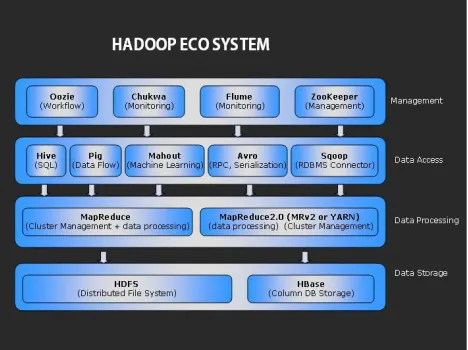
Fig. 1: Describes clearly Apache Hadoop Ecosystem.
Big data is a collection of large data sets that include
different types such as structured, unstructured and
semistructured data. This data can be generated from
different sources like social media ( Facebook, Twitter,
YouTube etc.), audios, images, log files, sensor data, stock
market exchanges, transactional applications, sensor web
etc. are the main contributors of these data [2]. These large
data sets are called Big Data. In terms of relational
databases, moving and modifying large volumes of
Transformation, Loading (ETL) can be both costly and
timeconsuming. To process or analyze this huge amount of
data or extracting meaningful information is a challenging
task now a days. Big data exceeds the processing
capability of traditional database to capture, manage, and
process the voluminous amount of data. Falling storage
costs and access to better compute power for less money
have made the software more attractive as datasets
continue to grow, As a result, many companies are
rethinking their move toward to traditional enterprise
storage and architecture to leverage big data [3]. Hadoop is
best suited for Processing unstructured data, Complex
parallel information processing, Large Data Sets/Files,
Machine Learning serious fault tolerant data processing,
Reports not needed in real time, Queries that cannot be
expressed by SQL and Data processing Jobs needs to be
faster. These are the key reasons why Hadoop platforms so
attractive [4]. II. OVERVIEW OF HADOOP PLATFORM
1.0 Hadoop 1.0 popularized MapReduce programming for
batch jobs and demonstrated the potential value of large
scale, distributed processing. MapReduce, as implemented
in Hadoop 1.0, can be I/O intensive, not suitable for
interactive analysis [5]. In Hadoop 1.0, a single Namenode
managed the entire namespace for a Hadoop cluster
2. Problem Statement
2.1 Existing System
Previously they used Lexicon-based which belong to
unsupervised techniques, this method classify the data into
two classes of positive or negative. This lexicon-based
method uses the help of dictionary to classify the tweet into
positive sentiment or negative sentiment. There are some
steps of lexicon-based that is used in this research, such as
determining the polarity of words, negation handling, and
also giving score to every each entity in the tweet.
For those they are going to download the libraries that
are provided by the twitter guys by using this they are
crowded the data that we want predominantly. After
getting raw data they will filter it and they will find out the
constructive, negative and moderate words from the list of
collected words in a text file. All these words should be
collected by us to filter out or do some twitter analysis on
the filtered data. These words can be called as a dictionary
set by which they will perform twitter analysis.
Also, after performing all these things and they will
store these in a database and coming to that they will use
RDBMS. Where they are having limitations in creating
tables and also accessing the tables effectively.
2.2 Proposed System
To overcome the drawbacks of existing system we are
using Big Data problem statements. By using Hadoop and
its Ecosystems, for getting raw data from the Twitter by
using Hadoop online streaming tool called Apache Flume.
By using this tool we are going to configure everything
that we want to get data from the Twitter. For this we want
to set the configuration and also want to define what
information that we want to get from Twitter.
All these will be saved into HDFS (Hadoop Distributed
File System) in our prescribed format. From this raw data
we are going to filter the information that is needed for us.
And from that we are going to perform the twitter Analysis
by using some UDF’s (User Defined Functions) by which
we can perform twitter analysis by taking Stanford Core
NLP as the data dictionary so that by using that we can
decide the list of words that coming under constructive,
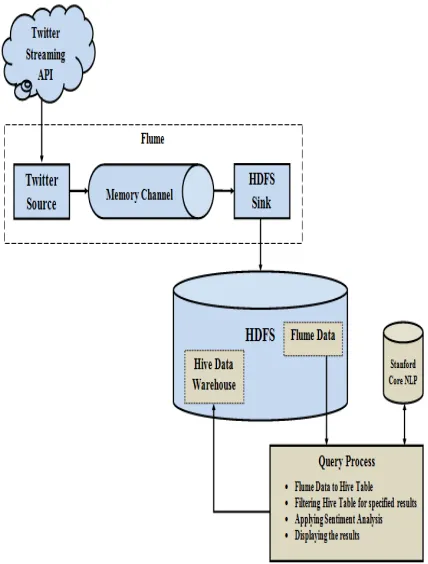
The subsequent figure shows clearly the architecture view
for the proposed system by this we can understand how our
project is effective using the Hadoop ecosystems and how
the data is going to store from the Flume, also how it is
going to create tables using Hive also how the sentiment
analysis is going to perform[8].
Fig. 2: Architecture diagram for proposed system.
3. Methodology
3.1. Extracting Twitter Data with Apache
Flume
Apache Flume is one of the distribution
frameworks which have the capability to use
HDFS,HBase, Mongo DBetc., as Sink. As, the
Twitter [4] Streaming API gives a constant stream
of tweet data coming from the application it must
reside in HDFS securely. The security can be
ensured by the generation of keys at the time of
creating an application in twitter.
3.2 Querying JSON Data with Hive
Hive will
expect the input data in adelimited row format. But the twitter data will be
in a JSON [28], format. So to handle this type of
data hive will use Hive SerDe interface to
interpret the data which comes through twitter.
SerDe stands for Serializer and Deserializer, these
are the interfaces that make Hive to translate the
data into the form that Hive can process. The
Deserializer interface is used when we read data
from the disk, and converts the data into format
where Hive knows how to manipulate. The data
has some structure and sometimes it don’t even
have a structure, but certain fields may or may not
exist. This semi-structured nature of the data
makes the data very hard to query in a traditional
RDBMS. Hive can handle this data. So,
eventually Hive can also handle the log files of
web servers which may be in CSV, TSV or any
unstructured, semi-structured formats.
3.3 PLAN OF WORK
This project involves the following modules:
• Collecting the required input data
[ Module I]
• Setting the cluster to store the data
[ Module II ]
• Transfers the data into hive
datawarehouse [Module III ]
3.3.1 Collecting the required
By application of twitter JSON format
files are generated which have to be
dumped into the hdfs file system of
Hadoop.Tweeted, Re-tweeted and
commented data regarding to particular
issue, individual’s opinion, trending
issues, website popularity clicks from
Twitter for Twitter. Sentiment analysis
[21] and log file from webserver for log
analysis.
3.3.2 Setting the cluster to store
the data [Module II]
In this module, a cluster has been created,
to store the metadata (namespace of all
files) that will be stored in one node,
backup of metadata in another node, to
assign the jobs (job tracker) for
execution will be in another node. To
store the data and processing, remaining
nodes have to be there. The architecture
of the cluster [18] will be like the
following
Fig. 4: Describes clearly of HDFS
3.3.3 Transfers the data into
cluster [Module III]
Dumping the chunks of data from
module I to the cluster [18] file system in
all data nodes (hdfs, Hadoop distributed
file system) using flume from the name
node by forming the data pipeline
between them as shown below: Fig. 5:
Describes clearly of data
flow
The Log file will also be dumped in hdfs
through Hadoopfile system command.An
external source like a web server delivers
events to get consumed by Flume source.
Format of events sent by the external
source to the target flume source should
be recognized by it. If we consider an
example, Avro events can be received by
an Avro Flume source from Avro clients
or other Flume agents from an Avro sink
in the flow that send events. Using a
Thrift Flume Source a similar flow can
be defined to receive events from a
Thrift Sink or a Flume Thrift Rpc Client
or Thrift clients written in any language
generated from the Flume thrift protocol.
Event is stored into one or more
channels when a Flume source receives it.
sink it is kept by the passive store named
channel. For example, file channel is one
which is backed by the local file system.
Event is removed by the sink
from the channel and kept into an
external repository like HDFS (via
Flume HDFS sink) or it can also be
forwarded in the flow to the Flume
source of the next Flume agent (i.e., next
hop). With the events staged in the
channel the source and sink within the
given agent run asynchronously.
A critical-flow open flume with a
constricted flow which causes a drop in the
hydraulic grade line, creating a critical depth
is a Venturi flume. For very large flow rates,
usually given in millions of cubic units
Venturi flume is used in flow measurement.
Measurement by venture meter would
normally measure in millimetres, but for
venturi flume it is in metres.
If the flow passes in a subcritical state
through the flume, measurement of discharge
with venturi flumes requires two
measurements, one upstream and one at the
throat (narrowest cross-section). A single
measurement at the throat (which in this case
becomes a critical section) is sufficient for
computation of discharge, if the flumes are
designed so as to pass the flow from sub
critical to supercritical state while passing
through the flume. The flumes are usually
designed in such way as to form a hydraulic
jump on the downstream side of the structure
to ensure the occurrence of critical depth at
the throat. These types of flumes are known
as 'standing wave flumes' Sources
It is a part of Flume that is connected to
a source of data and which starts the data
along its travel through a Flume [30]
dataflow. By sending the events into a
channel a source processes and moves them
along. The sources function by collecting
discrete pieces of data, transforming the data
into single events, and then by using the
channel processes events one item at a time,
or as a group.
Event-driven or poll able are two flavors
of sources. The basic difference between
event-driven and poll able sources is how
events are generated and processed. Through
mechanismslikecallbacks orRPC calls
event-driven sources typically receive events. In
contrast, poll able sources, operate by polling
differentiation can be framed in another way
as a push-versus-pull model, where
event-driven sources have events pushed to them,
and pollable sources pull events from a
generator.
Channels
Between the sources and sinks Channels
act as a pathway. By sources events are
added to channels and later by sinks removed
from the channels. Multiple channels can
actually support Flume data flows, which
enables data flows, such as fanning out for
replication purposes that are more
complicated. For a Twitter example, we have
defined a memory channel:
TwitterAgent.channels.MemChannel.type =
memory
In-memory queue is used to store events
until they’re ready to be written to a sink by
Memory channels. For data flows that have a
high throughput Memory channels are useful.
If the agent experiences a failure events may
be lost, since they are stored in memory of
the channel. Using a different type of channel,
this situation can be remedied, if the risk of
data loss is not tolerable.
Sinks
Sink is the final piece of the Flume
dataflow. Sinks take Events are taken by sink
and send to a resting location or forward
them on to another agent. An HDFS sink,
which writes events to a configured location
in HDFS is utilized in Twitter example.
A number of things are done by the
HDFS sink configuration we used: First, with
the roll Count Parameter it defines the size of
the files, so each file will end up containing
10,000 tweets. By setting the file Type to
DataStream and setting write Format to Text
it also retains the original data format.
Instead of storing the data as a Sequence File
or some other format this has been done. The
most interesting piece, however, is the file
path:
TwitterAgent.sinks.HDFS.hdfs.path =
hdfs://hadoop1:8020/user/flume/tweets/%Y/
The file path, as defined, uses some
wildcards to specify that the files will end up
in a series of directories for the year, month,
day and hour during which the events occur.
For example, an event that comes in at
8/20/2016 3:00PM will end up in HDFS at
hdfs://hadoop1:8020/user/flume/tweets/2014/
09/20/16/.Where does the timestamp
information come from? If you’ll recall, we
added a header to each event in the Twitter
[5] Source:
headers.put ("timestamp", String.valueOf
(status.getCreatedAt ().getTime ()));
To determine the timestamp of the event this
timestamp header is used by Flume, and the
full path where the event should end up also
resolved.
4. Conclusions
For getting raw data from the Twitter, Hadoop
online streaming tool using Apache Flume is
considered. In this tool everything that is needed
to get data from the Twitter is configured. The
proposed system collects data from Twitter social
network site and does NLP techniques to extract
features from the tweets. Word Sense
Disambiguation and Word Net signets are used to
increase the accuracy of prediction. Then various
assortment methods of classification are applied
to classify the data as Positive, Negative and
Neutral. Analyzed that in twitter data, the posted
comments are either positive or negative and also
have proved that hive is the best method suited
for doing this. It has been observed that the
ensemble method outperforms the traditional
classification methods. Of the ensemble methods
Extremely Randomized Trees classification
performs better than others.
5. Future Work
In this paper it has shown the way for responsibility
sentiment analysis for Twitter data. Also, we can do this by
a time slang such that it will work based upon that time we
allocated for performing a particular work. Also at last we
can also visualize the word map i.e., the most frequent
words that are used in positive, moderate and negative
fields by using R language to visualize.
Acknowledgments
We are grateful to express sincere thanks to our faculties
who gave support and special thanks to our department for
providing facilities that were offered to us for carrying out
this project.
References
[1] Go, A., Bhayani, R., & Huang, L. (2009). Twitter sentiment classification using distant supervision. CS224N Project
Report, Stanford, 1-12.
[2] Tang, H., Tan, S., Cheng, X., A survey on sentiment detection of reviews, Expert Systems with Applications: An International Journal, v.36 n.7, p.10760-10773, September, 2009.
[3] A. Pak and P. Parouek, “Twitter as a corpus for sentiment analysis and opinion mining,” in Proceedings of LREC, vol. 2010.
[4] J. Dean and S. Ghemawat, “MapReduce: Simplified Data Processing on Large Clusters,” Communications of the ACM, Vol. 51, Iss. 1, pp. 107-113, January 2008.
[5] S. Ghemawat, H. Gobioff and S-T. Leung, “The Google File System,” ACM SIGOPS Operating System Review, Vol. 37, Iss. 5, pp. 29-43, December 2003.
[6] K. Shvachko, H. Kuang, S. Radia, and R. Chansler, “The Hadoop Distributed File System,” in the 26P
th
P
IEEE Symposium on Mass Storage Systems and Technologies, pp. 1-10, May 2010.
[7] Bahrainian, S.A., Dengel, A., Sentiment Analysis using Sentiment Features, In the proceedings of WPRSM Workshop and the Proceedings of IEEE/WIC/ACM International Conference on Web Intelligence, Atlanta, USA, 2013.
[8]“Sentimental Analysis”, Inc. [Online]. Available: http://www.cs.uic.edu/~liub/FBS/sentiment-analysis [Accessed 23 March 2013].
[9] (Online Resource) Hive (Available on:http://hive.apache.org/).
[10] (Online Resource)22TUhttp://jsonlint.com/U22T
[11] (Online
Resource)22TUhttp://nlp.stanford.edu/software/corenlp.shtmlU22T.
[12]T. White, "The Hadoop Distributed Filesystem," Hadoop: The Definitive Guide, pp. 41-73, Gravenstein Highwa North, Sebastopol: O’Reilly Media, Inc., 2010.
[13] (Online Resource) 22TUhttp://flume.apache.org/U22T
[14]S. W. Ambler. Relational databases 101: Looking at the whole picture.www.AgileData.org, 2009.
[15] J. Manyika, M. Chui, B. Brown, J. Bughin, R. Dobbs, C. Roxburgh, and A. H. Byers, “Big Data: The Next Frontier For Innovation, Competition, And Productivity”, May 2011.
First Author: Sushmitha Reddy was born in Andhra Pradesh, India. She received the B.Tech Degree in Computer Science and Engineering from Jawaharlal Nehru Technological University Anantapur branch, India in 2014 and M.Tech Degree in also same branch and University. Her research interests are in the area of Semantic Web and Big Data Analytics.
Second Author: Smt.M. Padma M.E. was born in Andhra Pradesh, India. She is working as Asst.Prof. in Computer Science & Engineering Dept, GPREC