Application of Value Engineering for Cost
Reduction of Household Furniture Product
- A Case Study
Chougule Mahadeo Annappa
1, Dr. Kallurkar Shrikant Panditrao
2Principal, A.G. Patil Polytechnic Institute, Vijapur Road, Solapur (Maharashtra), India.1
Principal, AET‟s Atharva College of Engineering, Charkop Naka, Malad (West) Mumbai, India.2
ABSTRACT: Value Engineering is a proven management technique that can make valuable contributions to value
enhancement and cost reduction in furniture industry. A case study of furniture industry is discussed in which the material size of the product is changed according to the value engineering methodology. M/s Gayatri Industries, Sangli (Maharashtra) has been manufacturing different types furniture products and supplying to local dealers and customers directly. This paper introduces how to apply theories and methods of Value Engineering in the industry. Value engineering with its different phases can be implemented in any product to reduce the cost. The material is chosen such that the cost is reduced without affecting the value of the product and its design. To find the best possible alternative from the choices, we have used the tools such as Function analysis, Functional Evaluation and Decision Matrix, which gives the most appropriate results.
KEYWORDS: Value Engineering, Functional analysis, Function Evaluation, Decision Matrix, Furniture Industry.
I. INTRODUCTION
Lawrence D. Miles established the Value Engineering in the monograph of “Techniques of Value Analysis and Engineering” in 1947. In the monograph he pointed out that success of a free enterprise in the overall long-term competition lay in continuously selling the best value to customers and evoking expected price, and the best value is function and cost. Value Engineering can help to determine the best scheme that meets all the needs of the customers with the lowest cost. Since 1978, the theory of Value Engineering was introduced into China, it has been widely adopted by many companies and made great economic benefits. With 35 years‟ practice, the theory and methodology of Value Engineering has been recognized by the academic community, especially the business circles, which has been one of the significant methods to improve product quality, reduce product cost. However, in India, VE is mostly associated to any alternative design with the intention of cost cutting exercise for a project, which is merely one of the initial intentions of the VE. This paper outlines the basic frameworks of Value Engineering and presents a case study showing the cost reduction of Value Engineering in a Furniture Manufacturing Industry.
The practice of VE doesn't imply that there may be intentional "gold plating," conscious neglect of responsibility, or unjustifiable error or oversight by the design team. VE simply recognizes that social, psychological, and economic conditions exist that may inhibit good value. The following are some of the more common reasons for poor value:
Wrong beliefs, insensitivity to public needs or unfortunate experience with products or processes used in unrelated prior applications.
Lack of information, usually caused by a shortage of time. Too many decisions are based on feelings rather than facts.
Habitual thinking, rigid application of standards, customs, and tradition without consideration of changing function, technology, and value.
Reluctance to seek advice, failure to admit ignorance of certain specialized aspects of project development.
Over specifying, costs increase as close tolerances and finer finishes are specified. Many of these are unnecessary
Negative attitudes, failure to recognize creativity or innovativeness.
Poor human relations, lack of good communication, misunderstanding, jealousy, and normal friction between people are usually a source of unnecessary cost.
II. OPTIMIZATIONOFFURNITUREPRODUCT(DIVAN):ACASESTUDYANALYSIS
In this paper we have discussed the furniture product, a Divan manufactured in Gayarti Industries, Sangli, Maharashtra (India) since 5 years. The major products of the industry are Different types of Computer work stations, Office Tables, Bed, Benches, Wardrobe, Study Table, TV Stand, and Stools etc. currently supply to local dealers and customers.
i. Value Engineering is applied as pre the following steps to the furniture product:- ii. Functional Analysis Worksheet is prepared for the different parts of the product. iii. Functional Evaluation is done of each part
iv. Numerical Evaluation Sheet is prepared v. Creativity Worksheet
vi. Selection of alternative is done through Decision Matrix vii. Finding and Recommendation
viii. Conclusion
DIVAN
Figure No.1 „Divan‟ Manufactured in Gayatri Industries, Sangli
Detailed function analysis of different parts of furniture product (Divan) as shown in the table below
Part Name/
Description Quantity
Function Part Assembly
Verb Noun Basic Secondary Basic Secondary
Steel Frame
(Complete) 1
Hold Assembly X X
Hold Parts X
Provide Strength X
Provide Grip X
Bed Top
(Diwan Top) 1
Holds Material X
Provide Surface X Improve Appearance X Side Strip
(Long) 2
Support Frame X
Improve Appearance X Side Strip
(Short) 1
Support Frame X
Improve Appearance X
Leg Strip 1 Support Frame X
Improve Appearance X Table-1 Functional Analysis Worksheet
Costing of different parts of furniture product (Divan) as shown in the table below
Sr. No. Part Quantity Cost in Rs
A Steel Frame (Complete) 1 495.00
B Bed Top (Diwan Top) 1 465.00
C Side Strip (Long) 2 380.00
D Side Strip (Short) 2 111.00
E Leg Strip 4 75.00
Graph 1. Cost of each part of divan (In Rupees)
Detailed functional evaluation of different parts of furniture product (Divan) with weight and percentage cost in the product as shown in the table below
Key Letter Part Function Weight % Cost
A Steel Frame (Complete) Hold Assembly 12 32.43% B Bed Top (Diwan Top) Provide Surface 06 30.47%
C Side Strip (Long) Support Frame 02 24.90%
D Side Strip (Short) Support Frame 01 7.28%
E Leg Strip Improve Appearance 01 4.92%
Table-3 Functional Evaluation
Graph 2. Component‟s Weight and % Cost
Numerical Evaluation Sheet
B C D E
A A3 A3 A3 A3 12
B B2 B2 B2 06
C C1 C1 02
D D1 01
E 01
Major Performance-3
0 200 400 600
Steel Frame (Complete)
Bed Top (Diwan Top)
Side Strip (Long)
Side Strip (Short)
Leg Strip
Cost in Rs.
Cost in Rs.
0 5 10 15
A B
C
D
E
Weight
IV.CREATIVEPHASE
The central theme of the creative phase is “what else could do the same needed function?” the ranking of the function based on the value gap in descending order, is the indicator to which one must pinpoint in order to get the maximum advantages. In order to more ideas, the group restored to the brainstorming technique. The following ideas were generated during this phase,
1. Make the design simpler 2. Use the wheels for movement 3. Make it in powder coating 4. Reduce the thickness of the board
5. Use waste pieces of required size in some places 6. Reduce the size of the board in same places 7. Reduce the gauge of the pipe
The first phase of brainstorming usually result in quantity generation and the second phase generates a qualitative evaluation. The ideas are evaluated against five parameters as shown in table of feasibility ranking matrix.
No. of Comparison
Parameters 1 2 3 4 5 Total
%
Durability 1 1 0 0 0 2 20
Maintenance Cost 0 0 1 1 0 2 20
Stability 1 0 1 1 0 3 30
Compactness 1 0 0 0 0 1 10
Appearance 0 0 1 1 0 2 20
Table 4 Forced Decision Matrix
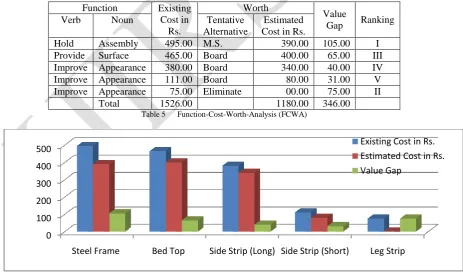
Function-Cost-Worth-Analysis (FCWA) is prepared by using function of product, existing and estimated cost of product, tentative alternatives and value gap.
Function Existing Cost in
Rs.
Worth
Value
Gap Ranking
Verb Noun Tentative
Alternative
Estimated Cost in Rs.
Hold Assembly 495.00 M.S. 390.00 105.00 I Provide Surface 465.00 Board 400.00 65.00 III Improve Appearance 380.00 Board 340.00 40.00 IV Improve Appearance 111.00 Board 80.00 31.00 V Improve Appearance 75.00 Eliminate 00.00 75.00 II
Total 1526.00 1180.00 346.00
Table 5 Function-Cost-Worth-Analysis (FCWA)
Graph 3. Existing Cost, Estimated Cost and Value Gap
0 100 200 300 400 500
Steel Frame Bed Top Side Strip (Long) Side Strip (Short) Leg Strip
V. EVALUATIONPHASE
Parameters
a) Rigidity b) Light Weight c) Durability d) Appearance Alternative –I Change gauge of material (Pipe)
Alternative –II Reduce thickness of Board (Wherever Required)
B C D RAW
SCORE
FINAL SCORE
A A3 A2 A2 07 7
B B2 B2 04 4
C C1 01 1
D 01 1
Table 6 Weightage of the Parameters
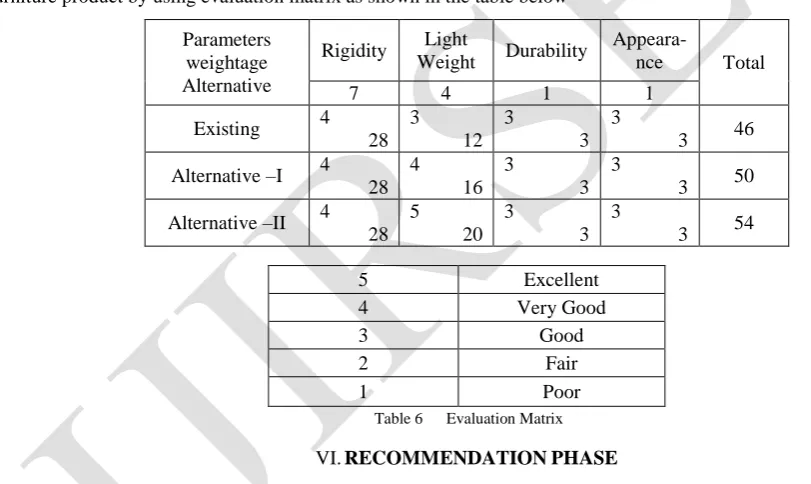
Different parameters i.e. Rigidity, weight, durability and appearance are calculated for existing and proposed
furniture product by using evaluation matrix as shown in the table below
Parameters weightage Alternative
Rigidity Light
Weight Durability
Appeara-
nce Total
7 4 1 1
Existing 4 28
3 12
3
3 3
3 46
Alternative –I 4 28
4 16
3
3 3
3 50
Alternative –II 4 28
5 20
3
3 3
3 54
5 Excellent
4 Very Good
3 Good
2 Fair
1 Poor
Table 6 Evaluation Matrix
VI.RECOMMENDATIONPHASE
The evaluation Matrix indicates that the second alternative is better than the existing as well as first alternative. The cost benefit analysis is also done for both alternatives along with the existing one as shown below.
Table 8 Cost Benefit Matrix
Sr. No Parameters Existing Alternative I Alternative II
1 Steel Frame 495.00 297.00 297.00
Based on Evaluation Matrix as well as the cost benefit analysis, alternative-II is recommended.
VII. IMPLEMENTATIONPHASE
Subsequently, the samples as per alternative-I & alternative-II are manufactured and are tested with the costumer. Feedback/reports are found to be satisfactory for both alternatives.
In Alternative-I and Alternative-II, weight reduction is found with cost reduction.
VIII. AUDITPHASE
The proposal is put up to the management / finance department for approval, mentioning the price of the product before and after the value engineering test was conducted and the final implementation of the proposal.
IX.CONCLUSION&FUTURESCOPE
From this Case Study it is observed that how the value engineering is used for the cost reduction without the change in the product design & its value. A proper decision matrix is prepared for choosing the appropriate alternative from the feasible choices available. The total saving which can be incurred per product by the implementation of above recommendations are 19.60% for alternative-II and 14.61% for alternative-I.
The Value Engineering process and procedures are generally well defined and well-understood at all levels in the industry. VE is recognized as an effective way to improve the performance of a product with reduction in cost. The quality (qualifications and experience) of the team leader and specialists is a key ingredient to the success of the VE program. It is more effective and influential on the performance, quality, and cost of a product when done relatively early in the production schedule.
In future, furniture product design can be modified so that the value of the product can be enhanced. Also other Industrial Engineering techniques can be used for further improvement in the product.
REFERENCES
[1] Amit Sharma and Harshit Srivastava “A Case Study Analysis through the Implementation of Value Engineering” International Journal of Engineering Science and Technology (IJEST), Vol. 3 No. 3 March 2011 pp 2204-2213
[2] Habibollah Najafi, Amir Abbas Yazdani, Hosseinali Nahavandi, “Value Engineering and Its Effect in Reduction of Industrial Organization Energy Expenses” World Academy of Science, Engineering and Technology pp 62, 2010.
[3] Hisaya Yokota, “Why Problems Cannot Be Solved and Why VE Is Effective?” Value Engineering Center Sekido 1-7-5, Tama-shi, Tokyo, 206-8550, Japan 042/372-0111.
[4] Xu Jun “Application Research on Value Engineering in Link Chain Enterprise” International Conference on Computer Science and Software Engineering, 2008
[5] Jin Wang, Lufang Zhang, Xiaojian Liu, “Material Application and Innovation in Furniture Design.” ©2009 IEEE
[6] P. F. THEW, “Value Engineering in the Electronic Industry” paper presented at a Joint I.E.R.E.-I.E.E. Conference at Nottingham in July 1967 [7] Don J. Gerhardt, Ingersoll Rand, “Managing Value Engineering in New Product Development.”
[8] L.D. Miles “Techniques and Approaches of Value Engineering,” A Reference Book.
[9] Dr. Habil. Ferenc Nádasdi , CVS, Ph.D., FSAVE, College of Dunaújváros Hungary, Dunaújváros, Táncsics M. u. 1/a., “Can Value Added Strategies Enhance the Competitiveness Of Products?”
BIOGRPHY
Mr. M.A. Chougule (Ph.D. Scholar in Mechanical Engg.) Principal, A.G. Patil