Copyright to IJIRSET DOI:10.15680/IJIRSET.2015.0409165 7959
Brain Tumor Classification using Probabilistic
Neural Network
S.U.Sumathi
1, S. Geetha*
2Assistant Professor, Dept. of Biomedical Engineering, Jerusalem College of Engineering, Chennai, Tamil Nadu, India1 Assistant Professor, Dept. of Biomedical Engineering, Bharath University, Chennai, Tamil Nadu, India2
* Corresponding Author
ABSTRACT: In this paper, Probabilistic Neural Network with image and data processing techniques was employed to implement an automated brain tumor classification. The conventional method for medical resonance brain images classification and tumors detection is by human inspection. Operator-assisted classification methods are impractical for large amounts of data and are also non-reproducible. Medical Resonance images contain a noise caused by operator performance which can lead to serious inaccuracies classification. Hence such noises are removed using median filtering algorithm. Decision making was performed in two stages: feature extraction using the principal component analysis and the Probabilistic Neural Network (PNN).
KEYWORDS: PNN, Principal component analysis, Median-filtering algorithm, Classification
I. INTRODUCTION
Automated classification and detection of tumors in different medical images is motivated by the necessity of high accuracy when dealing with a human life. Also, the computer assistance is demanded in medical institutions due to the fact that it could improve the results of humans in such a domain where the false negative cases must be at a very low rate. It has been proven that double reading of medical images could lead to better tumor detection. But the cost implied in double reading is very high, that’s why good software to assist humans in medical institutions is of great interest nowadays. Conventional methods of monitoring and diagnosing the diseases rely on detecting the presence of particular features by a human observer. Due to large number of patients in intensive care units and the need for continuous observation of such conditions, several techniques for automated diagnostic systems have been developed in recent years to attempt to solve this problem. Such techniques work by transforming the mostly qualitative diagnostic criteria into a more objective quantitative feature classification problem [1,2]. In this paper the automated classification of brain magnetic resonance images by using some prior knowledge like pixel intensity and some anatomical features is proposed. Currently there are no methods widely accepted therefore automatic and reliable methods for tumor detection are of great need and interest. The application of PNN in the classification of data for MR images problems are not fully utilized yet. These included the clustering and classification techniques especially for MR images problems with huge scale of data and consuming times and energy if done manually. Thus, fully understanding the recognition, classification or clustering techniques is essential to the developments of Neural Network systems particularly in medicine problems.
II. PREPROCESSING
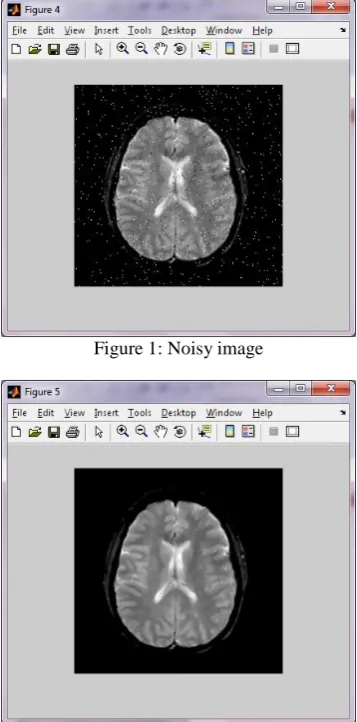
In this paper preprocessing of MRI images are done using median filtering algorithm in order to enhance the quality of the image. Since the brain MRI will be taken from different scanning machine, the chances of noises in those images will be more.
Copyright to IJIRSET DOI:10.15680/IJIRSET.2015.0409165 7960
pixel and its value is left unchanged. If Pij=0 or Pij=255 then Pij is a corrupted pixel then sort the pixel values of 3x3
window in the ascending order.
Find the median value of pixels for replacing the corrupted pixel from the image. Repeat steps 1 to 4 until all the pixels in the entire image are processed. By applying these steps for all the images the database for training set was formed.
Figure 1: Noisy image
Figure 2: Noiseless image after Preprocessing Using Median filtering Algorithm
III. FEATURE EXTRACTION USING PRINCIPAL COMPONENT ANALYSIS (PCA)
In this paper, the principal component analysis (PCA) is used as a feature extraction algorithm. The principal component analysis (PCA) is one of the most successful techniques that have been used in image recognition and compression. The purpose of PCA is to reduce the large dimensionality of the data.
Copyright to IJIRSET DOI:10.15680/IJIRSET.2015.0409165 7961
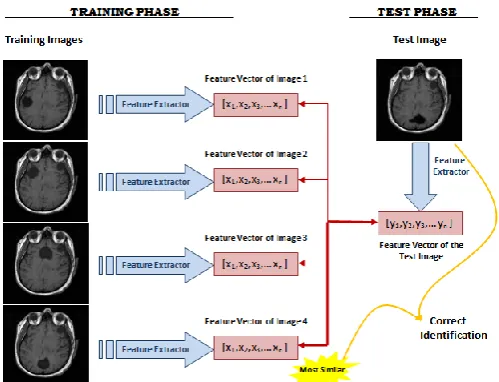
In the training phase, feature vectors are extracted for each image in the training set. Convert the 2D images into one dimensional image using reshape function-for both test image and database images. Then, find the mean value for each one dimensional image by dividing the sum of pixel values and number of pixel values and difference matrix for each images denoted by [A].
[A]= (Original pixel intensity of 1D image) – (mean value)
After that the covariance matrix was formed by multiplying the difference matrix with its conjugate matrix denoted by [L].
Covariance (L) =A *A’
Then, Find the Eigen vector and Eigen Face for 1D image by, Eigen face = (Eigen vector)’ * A
By using this principal component, we can identify the image from database which is similar to the features of test image. In the testing phase, the feature vector of the test image is computed using PCA. In order to identify the test image the similarities between the test image and all of the feature vectors in the training set are computed. The similarity between feature vectors is computed using Euclidean distance.
Figure 3: Schematic diagram of a MR image recognizer III.PROBABILISTICNEURALNETWORK
The probabilistic neural network was developed by Donald Specht. This network provides a general solution to pattern classification problems by following an approach developed in statistics, called Bayesian classifiers [3,4]. PNN is adopted for it has many advantages. Its training speed is many times faster than a BP network. PNN can approach a Bayes optimal result under certain easily met conditions [4]. Additionally, it is robust to noise examples.
Copyright to IJIRSET DOI:10.15680/IJIRSET.2015.0409165 7962
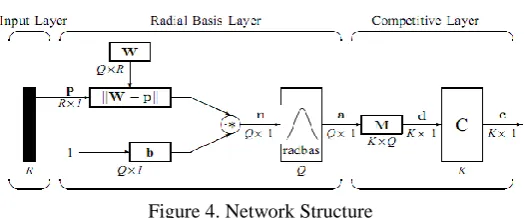
Figure 4. Network Structure
In this paper, the PNN has three layers: the Input layer, Radial Basis Layer and the Competitive Layer. Radial Basis Layer evaluates vector distances between input vector and row weight vectors in weight matrix [11-12].
These distances are scaled by Radial Basis Function nonlinearly. Then the Competitive Layer finds the shortest distance among them, and thus finds the training pattern closest to the input pattern based on their distance. The network structure is illustrated in Fig. 4. The symbols and notations are adopted as used in the book Neural Network Design [6]. These symbols and notations are also used by MATLAB Neural Network Toolbox. Dimensions of
Arrays are marked under their names.
1) Input Layer: The input vector, denoted as p, is presented as the black vertical bar in Fig. 2. Its dimension is R × 1. In this paper, R = 3.
2) Radial Basis Layer: In Radial Basis Layer, the vector distances between input vector p and the weight vector made of each row of weight matrix W are calculated. Here, the vector distance is defined as the dot product between two vectors [8]. Assume the dimension of W is Q×R. The dot product between p and the i-th row of W produces the i-th element of the distance vector
||W−p||, whose dimension is Q × 1, as shown in Fig. 4.
Then, the bias vector b is combined with ||W− p|| by an Element-by-element multiplication, represented as “.∗”.The result is denoted as n = ||W− p|| .∗p. The transfer function in PNN has built into a distance criterion with respect to a center. In this paper, it is defined as
radbas(n) =e−n2 (1)
Each element of n is substituted into Eq. 1 and produces corresponding element of a, the output vector of Radial Basis Layer. The i-th element of a can be represented as
ai = radbas(||Wi − p|| .∗bi) (2)
where Wi is the vector made of the i-th row of W and bi is the i-th element of bias vector b.
3) Some characteristics of Radial Basis Layer: The i-th element of a equals to 1 if the input p is identical to the ith row of input weight matrix W [9]. A radial basis neuron with a weight vector close to the input vector p produces a value near 1 and then its output weights in the competitive layer will pass their values to the competitive function. It is also possible that several elements of a are close to 1 since the input pattern is close to several training patterns.
Copyright to IJIRSET DOI:10.15680/IJIRSET.2015.0409165 7963
IV.METHODOLOGY
A description of the derivation of the PNN classifier was given in Chettri and Cromp [7]. PNNs had been used for classification problems. The PNN classifier presented good accuracy, very small training time, robustness to weight changes, and negligible retraining time.
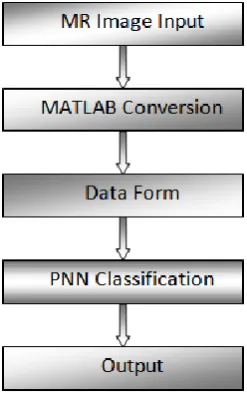
There are 5 stages involved in the proposed model which are starting from the data input to output. The first stage is should be the image processing system. Basically in image processing system, image acquisition and image enhancement are the steps that have to do [10]. In this paper, these two steps are skipped and all the images are collected from available resource. The proposed model requires converting the image into a format capable of being manipulated by the computer. The MR images are converted into matrices form by using MATLAB. Then,
the
PNN is used to classify the MR images.Figure 5:The proposed system V. RESULTSANDDISCUSSION
The data set was divided into two separate data sets – the training
data set (20 subjects) and the testing data set (15 subjects).The training data set was used to train the network, whereas the testing data set was used to verify the accuracy and the effectiveness of the trained network for the classification of brain tumors.T he classification output was designed using GUI (Graphical User Interface).
VI.CONCLUSION
In this paper, PNN has been implemented for classification of MR brain image. PNN is adopted for it has fast speed on training and simple structure. Twenty images of MR brain were used to train the PNN classifier and tests were run on different set of images to examine classifier accuracy.
ACKNOWLEDGMENT
Copyright to IJIRSET DOI:10.15680/IJIRSET.2015.0409165 7964 REFERENCES
[1] N. Kwak, and C. H. Choi, “Input Feature Selection for Classification Problems”, IEEE Transactions on Neural Networks, 13(1), 143–159, 2002.
[2] Jayalakshmi T., Krishnamoorthy P., Ramesh Kumar G., Sivamani P., "Optimization of culture conditions for keratinase production in Streptomyces sp. JRS19 for chick feather wastes degradation", Journal of Chemical and Pharmaceutical Research, ISSN : 0975 – 7384, 3(4) (2011) PP.498-503.
[3] E. D. Ubeyli and I. Guler, “Feature Extraction from Doppler Ultrasound Signals for Automated Diagnostic Systems”, Computers in Biology and Medicine, 35(9), 735–764, 2005.
[4] Lydia Caroline M., Vasudevan S.,"Growth and characterization of l-phenylalanine nitric acid, a new organic nonlinear optical material", Materials Letters, ISSN : 0167-577X, 63(1) (2009) pp. 41-44.
[5] D.F. Specht, “Probabilistic Neural Networks for Classification, mapping, or associative memory”, Proceedings of IEEEInternational Conference on Neural Networks, Vol.1, IEEE Press, New York, pp. 525-532, June 1988.
[6] Jebaraj S., Iniyan S., "Renewable energy programmes in India", International Journal of Global Energy Issues, ISSN : 0954-7118, 26(4Mar) (2006) PP.232-257.
[7] D.F. Specht, “Probabilistic Neural Networks” Neural Networks, vol. 3, No.1, pp. 109-118, 1990.
[8] Langeswaran K., Gowthamkumar S., Vijayaprakash S., Revathy R., Balasubramanian M.P., "Influence of limonin on Wnt signalling molecule in HepG2 cell lines", Journal of Natural Science, Biology and Medicine, ISSN : 0976-9668, 4(1) (2013) PP. 126-133.
[9] Georgiadis. Et al, “Improving brain tumor characterization on MRI by probabilistic neural networks and non-linear transformation of textural features”,Computer Methods and program in biomedicine, vol 89, pp24-32, 2008.
[10] M. T. Hagan, H. B. Demut, and M. H. Beale, Neural Network Design, 2002.
[11] Gopalakrishnan K., Prem Jeya Kumar M., Sundeep Aanand J., Udayakumar R., "Thermal properties of doped azopolyester and its application", Indian Journal of Science and Technology, ISSN : 0974-6846, 6(S6) (2013) PP. 4722-4725.
[12] Chettri, S.R. and Cromp, R.F. “Probabilistic neural network architecture for high-speed classification of remotely sensed imagery”, Telematics and Informatics, Vol. 10, pp. 187-98, 1993.
[13] K. I. Diamantaras and S. Y. Kung, “Principal Component Neural Networks: Theory and Applications”, Wiley, 1996.
[14] AR.Arunachalam, Imperceptible Digital Image Watermarking, International Journal of Innovative Research in Computer and Communication Engineering, ISSN(Online): 2320-9801, pp 1321-1326, Volume 1, Issue 6, August 2013.
[15] AR.Arunachalam, Spectrum Reuse in MultiplePrimaryUser Environment, International Journal of Innovative Research in Computer and Communication Engineering, ISSN(Online): 2320-9801,pp 1475-1480, Volume 1, Issue 7, September 2013
[16] B.Sundar Raj, A Third Generation Automated Teller Machine Using Universal Subscriber Module with Iris Recognition, International Journal of Innovative Research in Computer and Communication Engineering, ISSN (Online): 2320 – 9801,pp 565-571, Vol. 1, Issue 3, May 2013
[17] B.Sundar Raj, The Efficiency of the Scalable Architecture for Revealing and Observing the Environment using Wireless Sensor, International Journal of Innovative Research in Computer and Communication Engineering, ISSN (Online): 2320 – 9801,pp 63-67, Vol. 1, Issue 1, March 2013