Abstract
Pamali, Abhinand P. Using Clothoidal Spirals to Generate Smooth Tool Paths For High Speed Machining. (Under the direction of Dr. Yuan-Shin Lee.)
USING CLOTHOIDAL SPIRALS TO GENERATE
SMOOTH TOOL PATHS FOR HIGH SPEED MACHINING
By
Abhinand P Pamali
A thesis submitted to the Graduate Faculty of
North Carolina State University
in partial fulfillment of the requirements for the Degree of
Master of Science
Industrial Engineering
Raleigh Spring-2004
Approved by:
__________________________ _____________________ Dr.Yuan-Shin Lee Dr.Ezat Sanii
Chair of Advisory Committee
Dedication:
Biography:
Acknowledgments:
Table of Contents
Page
List of Figures………vii
List of Tables……….ix
1. Introduction……….1
1.1. Pocket Milling………...1
1.2. Organization of Thesis………..4
2. Literature Review………...5
2.1. High Speed Machining……….5
2.2. High Speed Machining and Pocket Geometry………..6
2.3. Tool Path Planning………....7
2.4. Summary………...15
3. Clothoidal Spirals and Their Use in Generating Planar Curves………...16
3.1. Introduction to the Problem………..16
3.2. Clothoidal Curves………...17
3.3. Computation of Fresnel Integrals……….20
3.4. Connecting Two Straight Lines with a Pair of Clothoidal Curves…………...23
3.5. Summary………...26
4. Boundary Parallel Tool Path Generation Using Clothoidal Spirals………….27
4.1. Using Clothoidal Curves for High Speed Tool Machining Tool Path Generation……….27
4.2. Tool Path Generation For Convex Corner………...27
4.4. Proposed Clothoid Curve Tool Path Algorithm……….36
5. Computer Implementation and Examples………40
5.1. Computer Implementation……….40
5.2. Summary………48
6. Conclusion………....49
6.1. Conclusion……….49
6.2. Future Work………...50
List of Figures:
Figure 1-1 Graphical representation of pocket milling operation………...2
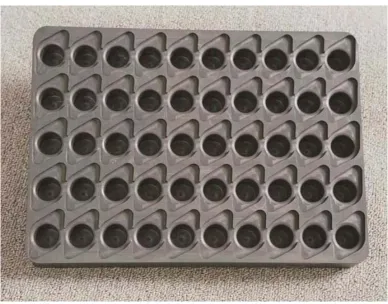
Figure 1-2 Mechanical part that has large number of pockets in it………2
Figure 2-1 Example of Zig tool path………..8
Figure 2-2 Example of Zig-Zag tool path………...8
Figure 2-3 Example of Smoot Zig-Zag tool path...…….9
Figure 2-4 Example of Contour Parallel Tool Path...…….9
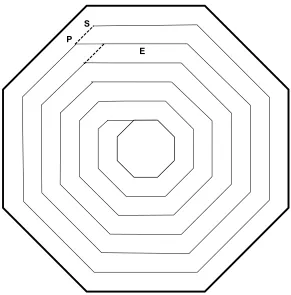
Figure 2-5 Example of Spiral Tool Path………10
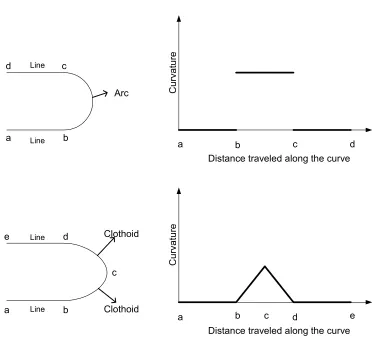
Figure 2-6 The curvature of line-arc-line tool paths has discontinuities at junction points, while the curvature of Bi-clothoidal splines changes continuously………14
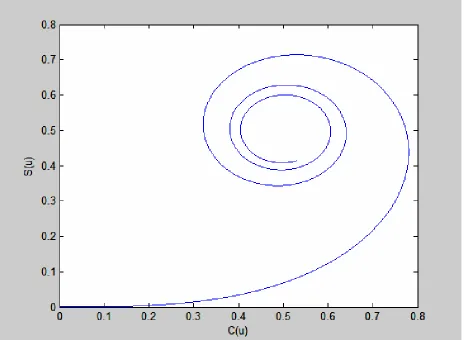
Figure 3-1 Example of a Clothoid curve...…….19
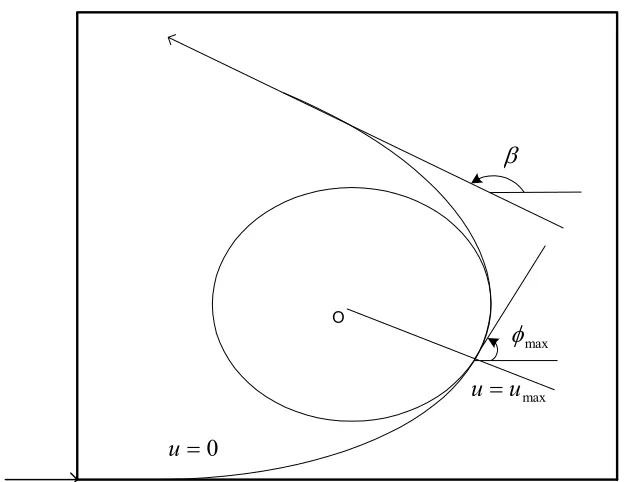
Figure 3-2 Maximum tangent angle φmax and angle between two linesα ………..24
Figure 3-3 Symmetric half Clothoids being used to connect two straight lines…25 Figure 3-4 Smooth corner between two straight lines formed by Clothoidal interpolation………... 25
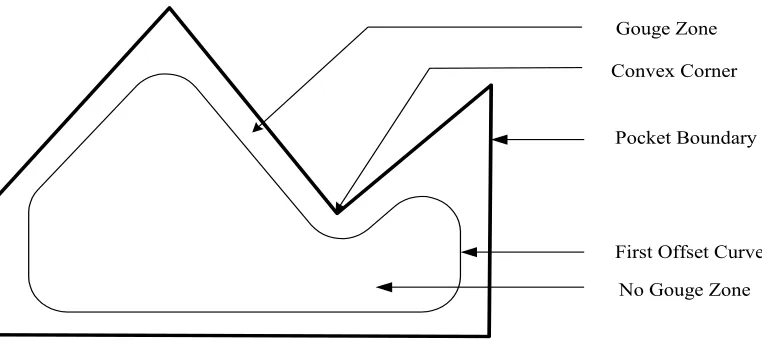
Figure 4-1 A pocket with a convex corner ...…….28
Figure 4-2 Line-Line tool path at concave corner………28
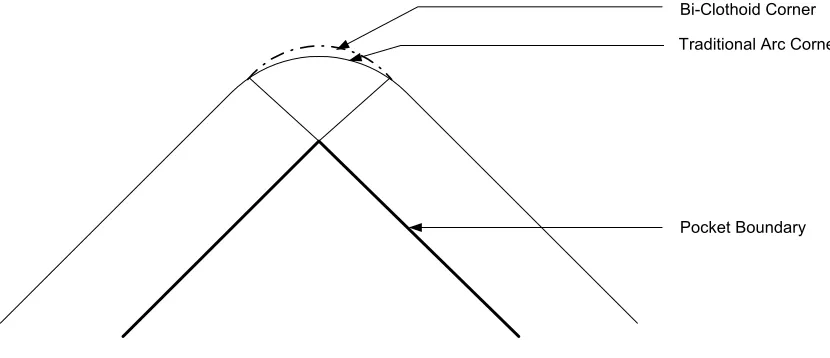
Figure 4-3 Line-arc-line tool path at concave corner and Line-Bi-Clothoid-Line conversion………..29
Figure 4-4 Gouging due to distant Clothoid start points………31
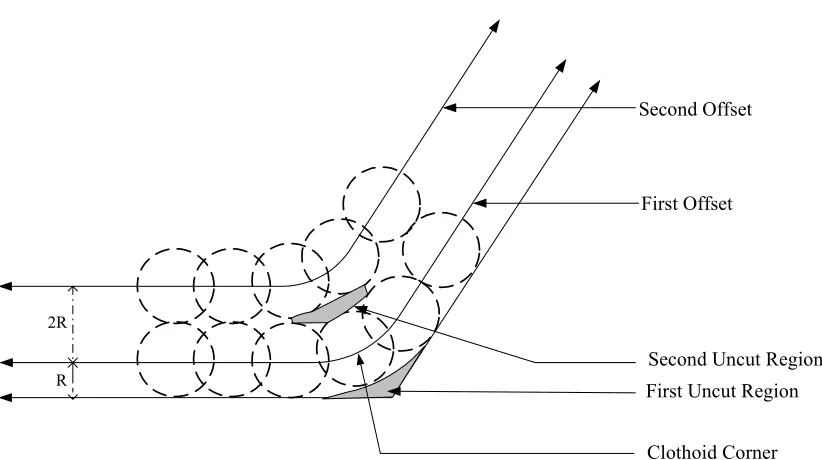
Figure 4-5 Uncut regions at the Concave Clothoid corners……….…..32
Figure 4-7 Curve showing the change in the distance between the Clothoids
at the corners………..………….…………35
Figure 5-1 A five sided concave polygonal pocket……….……...41
Figure 5-2 Traditional boundary parallel spiral tool path for concave polygonal pocket...41
Figure 5-3 Half width cut becoming a full width cut in the corner………...42
Figure 5-4 First offset and Clothoid start points with initial Clothoids...…...43
Figure 5-5 Changing the scaling factor to connect the Clothoids...…...44
Figure 5-6 Increasing curvature of the Clothoid as the starting point is moved nearer to the corner of the offsets………..………..46
Figure 5-7 Bi-Clothoids for the second boundary offsets...…..47
Figure 5-8 The Spiral tool path with smooth corners………...47
List of Tables:
Chapter 1. INTRODUCTION
Pocket milling represents an important task in machining of mechanical parts,
dies and moulds. We propose a new method of generating boundary parallel tool paths
for 2.5D high speed pocket milling using Clothoidal Spirals. A Clothoidal Spiral also
known as Cornu Spiral or a Clothoid is frequently used in high-way design. The
curvature of the Clothoid is proportional to the length of the curve measured from the
origin of the curve. In this thesis we provide a method to generate Boundary Parallel Tool
Path with smooth Clothoid Corners for High Speed Machining. As a result of this
method, it is expected to achieve faster continuous path motion.
1.1Pocket Milling
Manufacture of various mechanical parts such as aircraft parts, molds and dies,
etc involves high intensity 2.5D pocket milling operations. In 2.5D pocket machining, a
pocket is excavated by removing layer(s) of material as shown in Figure 1.1. The tool
path for a layer of a pocket is line along which the center of the tool –an end mill, travels
as its rotating teeth cut the material. Most machining of aerospace parts can be brought of
as pocket machining [Bieterman 02]. An aerospace vehicle needs to be smooth, strong
and light weight. Pocket machining with the support structure it leaves between pockets,
helps achieve these properties. A typical example of the importance and extensiveness of
Figure 1.1 Graphical representation of pocket milling operation
Due to the large amount of pocket milling needed on many complex mechanical
parts, reducing the machining cycle time by even small amounts could bring a significant
payback. For the last few years High Speed Machining tools has been vigorously used for
large scale pocket milling operations, especially in aerospace and die/mold
manufacturing industry.
Although machine tools of very high spindle speeds are available in the market,
various machining constraints such as, motion restrictions due to pocket geometry,
motion restrictions due to the tool paths, cutting tool strength, effect of the resultant
forces on the machine tool, etc keep the users from taking use of the full capabilities of
the available High Speed Machine tools.
Tool path generation for pocket milling is mostly done with NC programming, in
which a person provides a part description and feed rate requirements to a computer aided
manufacturing software package also know as CAM. The CAM package then produces a
file with path and feed-rate data that are post processed into a form a controller can
understand and use to drive the machine tool. In this thesis, we propose a new method of
tool path planning using Clothoidal spirals for smoothening the corners, for pocket
1.2 Organization of Thesis
In Chapter 2, a survey of previous work done in high speed machining for pocket
milling and tool path generation is provided. Chapter 3 presents the definition and the
theory behind the Clothoidal spirals. In Chapter 4, we present the proposed method of
smoothing the corners of the boundary parallel offset tool paths and the algorithm used to
generate the tool path using the proposed method. In, Chapter 5 shows the computer
implementation and some practical examples are discussed. Chapter 6 presents the
Chapter 2. LITERATURE REVIEW
In this chapter we introduce, previous work done by various researchers in the
field of High Speed Machining, Pocket Milling, Tool path planning etc.
2.1High Speed Machining
High Speed Machining offers a way to mill complex structures that were never
practical before. High Speed Machining has enabled users to replace many complex
assemblies into a single machined part. Reducing the role of assembly removes cost and
lead time from the manufacturing process.
The productivity of a machining operation is often characterized by the metal
removal rate. One reason to consider high speed machining applications is to increase
productivity without sacrificing part quality. The term ‘High Speed Machining (HSM)’ is
widely accepted and common place in modern machine shops. What is ‘High Speed
Machining’?
Various sources define High Speed Machining in many different ways. High
Speed Machining is a powerful machining method that combines high feed rates with
high spindle speeds, specific tools, and specific tool motion. Typically High speed
machining uses spindles with high speed and power (generally greater than 10,000 rpm
and 10 hp) to remove metal at rates of orders of magnitude higher than by conventional
techniques. High Speed Machining addresses part design flexibility, weight savings, part
accuracy and part quality, all accomplished while maintaining a high degree of
process constraints in pocket milling the user is discouraged from taking the complete use
of the capabilities of the machine tool.
High Speed Machining makes the tool path a more significant factor in the
process. Taking lighter cuts with a smaller step-over increment is only one consideration.
An effective tool path also protects the cutting tool by keeping cutting load steady and
maintains a high feed rate by avoiding sharp changes in direction.
Decisions made during programming can also affect the quality of the work piece.
If the purpose of HSM is to machine a smooth surface, the tool path may contribute to
this goal. There are a variety of ways to machine with smoother motion. Possibilities
include rounding corners, smoothing reversals and even machining in circles.
Another approach to keeping the feed rate high doesn’t involve direction changes,
but instead involves changing the feed rate more often. Feed rate optimization may allow
the program to maintain a higher average feed rate where the profile of the cut frequently
changes.
2.2High Speed Machining and Pocket Geometry
More and more complex mechanical parts that were earlier being assembled or
manufactured by other process such as casting etc, are now being machined for various
reasons, some of which have been briefly discussed previously. Majority of these parts
require lots of pocketing operations. Pocketing operations involve removal of large
pocketing operations High Speed Machines are being used for pocket milling of complex
parts.
The complexity of the geometry of the pockets greatly reflects on the machining
speed that is achieved. Appropriate tool path planning suitable for high speed operations
is an important issue in the High Speed Machining Industry. In this report we address this
issue of improving the traditional tool paths.
2.3 Tool Path Planning
Two tool path topologies commonly used in milling operations are direction
parallel tool path and the contour parallel tool paths, also known as boundary parallel tool
paths. The direction parallel tool paths are linear tool paths that can further be classified
as, one-way or zig tool path, zig-zag tool path and smooth zig-zag. Figures 2.1, 2.2, and
2.3 show the three different types of direction parallel tool path plans.
The one-way direction parallel tool path system is a uni-directional cutting path,
and hence a consistent up-cut or down-cut chip removal can be maintained. However,
there is a considerable amount of non-productive time involved in returning the cutter to
the start- cut position at the end of each cutting path.
On the other hand, the zig-zag path is a bi-directional cutting path in which
material is removed both in the forward and the backward paths. Although the zig-zag
Figure 2.1 Example of Zig tool path
Figure 2.3 Example of Smoot Zig-Zag tool path
E1 S
P S
E
Figure 2.5 Example of Spiral tool path
up-milling and down-milling methods are alternately applied. This will lead to problems
such as machine chatter and shorter tool life.
Examples of non-linear tool paths are the contour parallel tool paths and the
parametric based tool paths. In contour parallel tool path planning, series of offset
contours of the pocket boundary are first generated. The tool travels along these offsets
one by one, until the entire pocket is machined. One method of connecting the subsequent
contours is shown in Figure 2.4 where the tool begins at the start point, S, goes around
the outermost loop, and the moves across the edge marked E1 to reach the next contour.
A common variation of this is spiral paths, where the move from one contour to the next
Figure 2.5), is extended outwards until it intersects the outer loop (at e.g. point P in
Figure 2.5). The tool leaves the outer loop at this point P, and moves first along the
extension to reach the inner loop.
Parametric based tool path is frequently used as a finishing tool path for
machining parametric surfaces as the tool path is driven directly along the u-v parametric
curves of the surface itself. As shown in Figure 2.4, contour parallel tool path pattern is
derived from the boundary of the concerned machining region. It is a coherent tool in the
sense that the cutter is kept in contact with the cutting material most of the time. So it
incurs less idle times such as those spent in lifting, positioning and plunging the cutter. At
the same time it can also maintain the consistent use of either up-cut or down-cut method
throughout the cutting process. Contour-parallel tool path is therefore widely used as a
cutting tool path especially for large-scale material removal. A study of machining
efficiency comparison of the direction parallel tool paths over the contour parallel tool
paths has been done by [Choi 00]. It was found that the smooth zig-zag tool path was
most efficient method, closely followed by contour parallel tool path which had sharp
corners.
The contour-parallel tool path can be divided into three different approaches: (1)
‘pair-wise intersection’ [Hansen 92], (2) ‘Voronoi Diagram’ [Persson 78], (3)
‘Pixel-based’ [Choi 97]. In the first approach, the boundaries of a machining region are offset
inwards by a step over distance. At concave corners the offset segments intersect with
each other and hence they need to be trimmed to form the resultant contour profiles. At
convex corners, the offset segments are extended and connected to produce the resultant
on each layer of the offset segments until sufficient layers of contour profiles are created
for covering the entire machining volume. However eliminating self-interactions is time
consuming and the removal of the invalid loops may lead to numerical errors.
In the second approach, individual offset segments are trimmed to their
intersections using the Voronoi diagram of the original pocket boundary. This approach
is known to be more efficient and robust since the steps in offsetting the tool path
segments can be subdivided in a more organized manner. However, as pointed out in
[Choi 99], it may also incur numerical instability if it is applied to a boundary of point
sequence curve (PS-curve) containing near circular portions.
The third approach of pixel based method requires a large amount of memory and
long computation time to achieve a desired level of precision due to its dependence on
the resolution of the Z-map.
A new pair-wise offset algorithm based on pair-wise interference detection test
was proposed in [Park 01] for removing local invalid loops from the input PS-curve
before constructing a raw offset curve. This algorithm has a near O(n) time-complexity,
where n is the number of points in the PS-curve. It can avoid the near –circular
singularity condition that exists in the traditional pair-wise approach.
No matter which one of the above three approaches is used for tool path
generation, concave and convex corners can be found in offset contours by the
intersection of the different types of geometric entities such as lines and arcs. The
corner-cutting problem provoked by concave and convex corners has not been sufficiently
produce small amount of uncut material at the corner regions when the step over is
greater than the cutter.
Also the traditional offsets contours, used directly as tool path have a drawback
because when a cutter moves into a corner region, the cutter contact length increases.
Consequently, this causes a momentary rise of cutting load, producing undesirable effects
such as shorter tool life, machine chatter and even cutter breakage. In a machining
process, it is apparent that excessive plunging and slotting, sharp velocity discontinuities,
and changing cut geometry limit production rates, increase tool wear, and reduce part
quality. To overcome some of these drawbacks, [Chan 01] have proposed a special tool
path pattern to machine a concave corner progressively using looping knots. Although the
looping knots reduce to some extent, the instant change in acceleration at the corners, the
tool path length is increased therefore affecting the efficiency of the process.
Various other researchers have worked on cutting load regularization that is
basically classified into (a) online monitoring and control and (b) prediction of cutting
loads by cutting load models as an offline approach. Tlusty and Smith (1997) address
issues of stability in end milling and the importance of the selecting the proper axial and
radial depths of cut for chatter free machining. They avoid over engagement while
cornering by adopting a spiral-in approach. Some researchers have used Bezier and
B-Spline curves for tool path generation. The Bezier and B-B-Spline curves are non-linear
functions of its parameter, hence an undesirable oscillation may occur [Walton 90].
Walton and Meek (1989) have developed methods to interpolate lines and circular
arcs with Clothoidal splines. A Clothoidal curve is unique in the sense that its curvature is
Use of Clothoidal splines in the pocket corners can therefore reduce the
drawbacks such as instantaneous variation in acceleration and feed rate at pocket corners
(Figure 2.6). a b c d a b c d e a a b b c c d d e
Distance traveled along the curve
Distance traveled along the curve
Curvatu re Cur vature Arc Clothoid Clothoid Line Line Line Line
Figure 2.6 The curvature of line-arc-line tool paths has discontinuities at junction points,
Jirawan (2003), a former member of our group had attempted to use the
Clothoidal curves for tool path generation. Jirawan’s use of Clothoids in tool path plans
showed that Clothoids allow higher feed rates and reduced total machining time. The
results of her work involved some uncut regions in the pocket between the contour
parallel offsets. To avoid the uncut regions the step distance of the contour offsets was
decreased. This resulted in longer tool path, there by affecting its efficiency.
The objective of this thesis is to design optimal contour offset tool path planning
using Clothoidal cornering that are guaranteed to avoid undercuts and gouging without
reducing the step distance.
2.4 Summary
In this chapter, various traditional tool paths were introduced. We saw that the
traditional offsets contours used directly as tool path have various drawbacks, that result
in momentary rise of cutting load, producing undesirable effects such as shorter tool life,
machine chatter and even cutter breakage. We will discuss our new method to reduce
Chapter 3. CLOTHOIDAL SPIRALS AND THEIR USE IN
GENERATING PLANAR CURVES
In this chapter, the Clothoidal curves also known as Cornu spirals are introduced.
The mathematical theory behind the Clothoidal curves and the current applications of the
Clothoidal curves are discussed. The nature of the Clothoidal curves along with its
advantages over other curves is presented. The problem for whose solution we are using
the Clothoidal curves is also introduced.
3.1 Introduction to the Problem
High Speed Machining (HSM) involves very high cutting speeds. The cutting
tool, the tool stock and the machine tool in general are affected by high forces at the
corners while making transition from one geometric shape to another due to the sudden
and irregular change in the curvature. This results in increasing wear of the cutting
tool/machine tool and hence reducing their life spans and also an inferior surface finish.
A reduction in cutting speeds at the corners will result in increased machining time,
hence reducing the efficiency.
Traditionally a pair of lines has been cornered by interpolating circular arcs
between two sides to obtain a smooth transition between the sides. Circular arc is not
sufficient for this problem because at the connecting point with the line there occurs a
discontinuous change of curvature. In the next sections of this chapter the Clothoidal
introduced. A detailed explanation of the nature of the Clothoid curves along with the
method to compute them is provided.
3.2 Clothoidal Curves
The Spiral of Cornu is named for the French scientist Marie Alfred Cornu (1841 -
1902). He studied this curve, also known as a Clothoid or Euler's Spiral, in connection
with diffraction. Euler applied a similar figure while measuring the elasticity of a spring.
The characteristic property of Clothoid spirals shown in Figure 3.1 is that their
curvature is a linear function of the arc length, or in other words the curvature of the
curve is proportional to the length of the curve measured from the origin of the spiral.
The Clothoid is a planar curve, which is frequently used in highway and railroad designs.
A Clothoid is needed to make the gradual transition from a highway, which has zero
curvature, to the midpoint of a freeway exit, which has non-zero curvature. A Clothoid is
clearly preferable to a path consisting of straight lines and circles, for which the curvature
is discontinuous.
The generalization of the Clothoid is given by the following parametric equation
as defined in [Gray 97],
Clothoid [n, a](t) =
+ +
∫
∫
+ + dun u du n u a t n t n 0 1 0 1 1 cos , 1
sin (3.1)
where n is any positive natural number a and u are scaling factor and parameter,
The standard Clothoid is defined by Fresnal Integrals invented by Augustine Jean
Fresnel (1788-1827) and they are given by,
C
u
Cos
u
du
u
2
)
(
2
0
π
∫
=
(3.2)du
u
Sin
u
S
u
2
)
(
2
0
π
∫
=
(3.3)where u is a non-negative parameter. Plotting C (u) on the abscissa axis and S (u) on the
3.3 Computation of Fresnal Integrals
The Fresenal Integrals shown in equations (3.2 and (3.3) cannot be solved
analytically. We therefore use numerical methods to solve them. Various researchers
have proposed numerical methods to approximate the Fresnal integrals. Some of the well
known ones being from [Boersma 60, Cody 68, Hastings, Jr 56, Mielenz 97]. In this
report we use the Rational Approximations method proposed by [Heald 85] which can
approximate the Fresnel Integrals with maximum errors between 1.7×10⁻³and 4×10⁻⁸.
The Fresnel Integrals are recast into the polar form shown below,
)] ) ( ( 2 1 sin[ ) ( 2 1 )
(u R x A x x2
C = − lm π jk − (3.4)
)] ) ( ( 2 1 cos[ ) ( 2 1 )
(u R x A x x2
S = − lm π jk − (3.5)
where the Rlm and Ajk functions are rational approximations of the form,
∑
∑
= = = m i i i l i i i lm u d u c R 00 (3.6)
∑
∑
= = = k i i i j i i i jk u b u a A 00 (3.7)
An index of orthogonal error in the plane of Cornu spiral which is the diagonal
distance between approximated and exact points is given by,
( ) ( )
[
]
21 2 2
A
R δ
δ
ε = + (3.8)
where,
δR=Rlm −R0 (3.9)
0
(
0)
21
A A R
A= π jk −
δ (3.10)
The maximum errors within the range of 1.7×10⁻³and 4×10⁻⁸have been show in
R A
0
c =1 d0= 2 a0=1 b0=2
max
ε
1
c =0.506 d1=2.054
2 d =1.79 1 b =2.524 2 b =1.886 3 b =0.803 3 10 7 .
1 × −
1 c =0.5083 2 c =0.3569 1 d =2.1416 2 d =1.8515 3 d =1.11021 1
a =0.1765 b1=2.915
2 b =2.079 3 b =1.519 4 10 5 .
1 × −
1 c =0.60427 2 c =0.41159 3 c =0.1917 1 d =2.26794 2 d =2.15594 3 d =1.26057 4 d =0.60353 1 a =0.08218 2 a =0.15108 1 b =2.7097 2 b =2.3185 3 b =1.2389 4 b =0.6561 6 10 9× −
1 c =0.698773 2 c =0.537836 3 c =0.246758 4 c =0.09458 1 d =2.40251 2 d =2.45425 3 d =1.647924 4 d =0.77829 5 d =0.297058 1 a =0.1446 2 a =0.17182 3 a =0.056405 1 b =2.83577 2 b =2.498595 3 b =1.61391 4 b =0.69638 5 b =0.28781 7 10 6× −
1 c =0.7769507 2 c =0.6460117 3 c =0.3460509 4 c =0.1339259 5 c =0.0433995 1 d =2.5129806 2 d =2.7196741 3 d =1.9840524 4 d =1.0917325 5 d =0.4205217 6 d =0.13634704 1 a =0.1945161 2 a =0.2363641 3 a =0.068324 4 a =0.0241212 1 b =2.9355041 2 b =2.7570246 3 b =1.875721 4 b =0.978113 5 b =0.356681 6 b =0.118247 8 10 4× −
Table 3.1 Table of values to calculate functions of rational approximations
3.4 Connecting Two Straight Lines with a Pair of Clothoidal Curves
To connect two directed straight lines, a pair of symmetrical Clothoid curves is
used [Walton 89, Makino 88]. Given two lines making an angle α in between them, a
pair of symmetric Clothoids with equal scaling parameters is used to plot a corner making
a smooth transition from the end point of the first line to the beginning point of the
second line. The two Clothoidal curves start from the end point and the beginning point
of the first and second straight lines respectively. The curves join the lines at a minimum
parameter value u= 0 i.e. the straight line and the Clothoid have the same curvature equal
to zero at the point where they meet each other. Let umaxbe the value of the parameter at
which the two spirals meet i.e. at the point where the curvatures of the two symmetrical
Clothoids are maximum and equal.
max
u can be calculated using the Equations (3.11) and (3.12) shown below.
2
max
β
φ = (3.11)
where φmaxshown in Figure 3.2 is the maximum tangent angle of the Clothoid at the point
of intersection of the pair of Clothoids. β , also shown in Figure 3.2 is the maximum
tangent angle made by the complete curve (combination of both the symmetrical
Clothoids).
90
max max
φ
=
0
=
u
max
φ
max
u u =
O
β
Fig 3.2 Maximum tangent angle φmax and angle between two linesα
An example of two straight lines connecting using a pair of symmetric Clothoid
curves is shown in Figure 3.3 and Figure 3.4. Figure 3.3 shows a pair of Clothoids
emerging from two lines making an angle α between them. The scaling factor in this
case is 1. The increase in the scaling factor results in the increase of the size of the
Clothoidal Curve. By applying the right scaling factor the pair of the half Clothoids can
Figure 3.3 Symmetric half Clothoids being used to connect two straight lines.
3.5 Summary
In this chapter the Clothoidal spirals were introduced. The method of generating
Clothoidal spirals was discussed. The definitions of Clothoidal spirals cannot be solved
numerically. Therefore a simple numerical method known as rational approximation
method that is proposed to solve the equations defining the Clothoidal spirals was
discussed. The application of these Clothoidal curves in contour parallel tool path
Chapter 4. BOUNDARY PARALLEL OFFSET TOOL PATH
GENERATION USING CLOTHOIDAL SPIRALS
The goal of this research is to use Bi-Clothoid curves to join boundary parallel
offset lines of polygonal pockets to ensure that the tool path generated has a continuous
curvature function over the entire cutting plan and the generated tool path does not leave
any uncut regions in between adjacent tool path offsets. Detailed procedure and algorithm
are presented in this chapter.
4.1 Using Clothoid Curves for High Speed Tool Machining Tool Path Generation
For the purpose of this discussion, we shall always assume that the Clothoid curve
undergoes a maximum angle of π/2. Further, in each case, the objective is to replace a
tool path sequences as per the schedule below:
Line-Line Æ Line- Bi-Clothoid – Line [Figure 4.2a]
Line-Arc-Line Æ Line – Bi-Clothoid – Line [Figure 4.2b]
In order to use these Splines, we consider two cases: Pocket corners of Concave
and Convex shapes. Details are discussed in the following sub-sections.
4.2 Tool Path Generation for Convex Corner
For a convex corner shown in Figure 4.1 the traditional tool path plans use
circular arc connectors between the boundary parallel offset lines to guarantee that the
tool path is C1 continuous. In this work we replace the circular arc by a pair of
symmetric Clothoids. Figures 4.2 and 4.3 show the two possible traditional tool paths at a
Pocket Boundary
First Offset Curve Gouge Zone
No Gouge Zone Convex Corner
Figure 4.1 A pocket with a convex corner
Pocket Boundary Line Line tool
path corner Convex Corner
Bi-Clothoid Corner
Traditional Arc Corner
Pocket Boundary
Figure 4.3 Line-arc-line tool path at convex corner and Line-Bi-Clothoid-Line conversion
4.2.1Lemma 1.
Replacing a Line-Line or a Line-arc-Line type of tool path at a convex corner
with a Bi-Clothoidal path will result in neither gouging, nor undercuts.
We consider the line-arc-line case. Certainly, the Clothoid cannot begin at a point earlier
than the end point of the line segment in the traditional plan. This is because moving an
infinitesimal amount along the Clothoid will result in a tool movement towards the
pocket boundary (since the clothoid has finite curvature at this point), and therefore the
4.2.2Observation 1.
A Bi-Clothoid(a pair of symmetrical Clothoids) constructed as described earlier
([Chapter 3]), and starting precisely where the circular arc begins does not
intersect the circular arc. It is easy to see that initially, the clothoid has curvature
smaller than that of the interpolating circular arc, and hence travels to the interior
of the pocket, away from the circular arc as shown in Figure 4.3.
The curvature,cv, of the clothoid is given by
a u
cv =π (4.1)
where a is the scaling factor and u is the parameter.
Since a is computed numerically for different values of tool radius, R, and
included angle,α , therefore one can plot ‘safe’ regions (values of R and α ) for which we
can replace precisely the circular arc with a bi-clothoid without any gouging.
For an unsafe combination of R andα , the Clothoid intersects with the circular
arc resulting in gouging. This is shown in the Figure 4.4. In such a case, we need to
continue along the straight line a little further, before we embark upon the clothoid. i.e.
the starting points of the Clothoid are to be taken closer to the corner to obtain a gouge
Circular arc Clothoid Start
Point
Clothoid crossing circular arc
α
α
Figure 4.4 Gouging due to distant Clothoid start points.
4.2.2 Observation 2.
Since the convex pocket corner is machined precisely by the offset lines, thus in
both the above possibilities, there will be no undercut at a convex corner.
4.3 Tool path generation for Concave corner
We now focus our analysis to concave corners. In this case, due to the geometry,
it is possible that the designed Clothoids may leave some un-cut material in the interior of
the pocket as shown in Figure 4.5 (Second uncut region). Such un-cut regions are
obviously undesirable.
First Uncut Region Second Uncut Region First Offset
Second Offset
2R
R
Clothoid Corner
Fig 4.5 Uncut regions at the Concave Clothoid corners
In this section, we shall concentrate on the proper selection of Bi-Clothoids that
can avoid such uncut regions. There are two ways to solve this problem.
One way is that, we can reduce the offset distance until there is no remaining
uncut area. However, this approach will result in (possibly) more number of offsets and
therefore increase the resulting tool-path’s length and machining time. We therefore
concentrate on the other way which involves selecting a proper Clothoid for the corners
It is clear that in any scheme, there is some area at the pocket boundary corners as
shown in Figure 4.5 (First uncut region) due to the cylindrical shape of tool. This is
usually removed by the finishing operations. Our goal is to ensure that the subsequent
uncut areas are completely eliminated.
To analyze this we shall distinguish between the first offset and the subsequent
offsets.
4.3.1 First offset curve
The only decisions are the selection of the start point of the Clothoid, and,
subsequently, the determination of the scaling factor. The start point is user defined based
on the tool size and the machine tool capabilities. The amount of leftover material (first
uncut region) at the pocket corners that will be removed in the finishing operation shown
in Figure 4.5 is also taken into consideration while deciding the start points for the
Clothoids of the first boundary offset.
4.3.2Subsequent Offset Curve
Let A and A′ be the starting points of the Clothoid cornering the first and
subsequent offset lines respectively as shown in Figure 4.6. Let B be a point on the inner
A
B A′ First Offset
Second offset
Pocket Boundary
Figure 4.6 Clothoid start point search on second offset
A reasonable location for the Clothoid starting point A′ is beyond point B on the
inner offset. Any Clothoid starting before B will leave some uncut region between the
first offset and the subsequent offset of the type ‘second uncut region’ shown in Figure
4.5
Consider an arbitrary location for A′ on the subsequent offset beyond B as shown
in Figure 4.6. Let R be the perpendicular distance between the first and the second
offsets. As we proceed along the Clothoid starting fromA′, the distance between the two
offsets gradually reduces to a value below R (distance between parallel offsets) along the
R
M
Q L
Figure 4.7 Curve showing the change in the distance between the Clothoids at the
corners.
that the Clothoid starting point A′lies beyond point B, hence, there is a certain delay in
the curvature of second offset Clothoid starting from A′ as compared to the outer offset
Clothoid starting from A.
Now since the curvature of the Clothoid on the second offset is greater then the
curvature of the Clothoid on the first offset, because of the smaller scaling factor, the
higher curvature of the Clothoid on the second offset (starting from pointA′) overrides
the initial delay factor as we proceed further along the length of the first offset Clothoid
corresponding to the curve beyond point M inFigure 4.7 thereby gradually increasing the
distance between the two Clothoids of the offsets to a value more then R.
Therefore the starting point for the Clothoid for an inner offset should lie at some
distance away from the corner such that the connecting point between two symmetrical
But a point very close to L on curve part Q in figure (4) means that the starting
point A′is too close to the corner of the second offsets resulting in a very small radius of
curvature at the corner which will cause a jerk effect on the machine tool. It is therefore
obvious that the starting point A′ should lie at such a location which will result in the
longest possible curve part Q in Figure 4.7 and A′corresponds to point M in Figure 4.7.
4.4 Proposed Clothoid Curve Tool Path Generation Algorithm
Based on the discussions provided in this chapter we now propose a Clothoid
curve tool path generation algorithm that uses the Bi-Clothoids to obtain a smooth,
Clothoid Curve Tool Path Generation Algorithm
Input
Polygonal Pocket Geometry Cutting tool diameter, d
Initial Scaling Factor (Default Scaling Factor is 1)
Output
Boundary Parallel Offset tool paths Start
Step 1. Calculate the slopes and angles formed by all the sides of the polygon Step 2. Generate first boundary parallel offset polygon with a step distance of d/2 Step 3. Generate subsequent successive boundary offsets with step distance, d
Step 4. Calculate the starting point of the Clothoids at each corner of the first offset polygon.
Typically the distance for starting point of this Clothoid =2*d. It is also affected by the machine tool specifications and the amount of corner left over material that will be removed in the finishing operations.
Step 5. Calculate the value of the maximum parameter,umax for all of the corners
on the first boundary offset using Equation 3.12
The value of the umaxremains the same for the entire subsequent
boundary offsets.
Step 7. Check if the symmetric Clothoids meet, if yes, proceed to Step 8, else proceed to Step 7.1
Step 7.1 Increase the scaling factor if the symmetric Clothoids cross each other or decrease the scaling factor if the symmetric Clothoids are short of meeting each other.
Step 7.2 Recalculate the Clothoids and repeat Step 7 until the symmetric Clothoids meet.
Step 8. Repeat Step 6 for all the corners of the boundary offset.
Step 9. Search for Clothoid starting point on the second boundary offset point. Step 9.1 Select a corner of the second boundary offset
Step 9.2 Initial Clothoid starting point for the respective corner is a point on the second boundary offset that is normal to the starting point of the Clothoid on the first boundary offset
Step 9.3 Calculate the symmetric Clothoids
Step 9.4 Check if the symmetric Clothoids meet, if yes, proceed to step 10, else, change the parameter as explained in Step 7.1 and repeat the process from Step 9.3.
Step 10 Verify for any islands of the type second uncut region shown in Figure 4.4 and explained in Case 4.3.2. If there is no island proceed to Step 11, else, proceed to Step 10.1
Step 10.1 As explained in Case 4.3.2, move the starting point further towards the corner of the second boundary offset and repeat the process from Step 9.3
Step 12. Consider the next boundary offset (third boundary offset) and let, First boundary offset = Second boundary offset,
Second boundary offset = Third boundary offset. Repeat the procedure starting from step 9.
Step 13. Repeat the Steps 9 to 12 until the corner Clothoids for all the boundary offsets have been calculated.
Step 14. Plot the offsets with the continuous corners formed by Clothoids. End
The above presented algorithm can be used to generate smooth Clothoid curve
tool paths for 2.5D high speed milling of polygonal pockets. With the smooth curvature
transition at the corners formed by the Bi-Clothoids, the generated tool paths can be used
for high speed machining with lesser acceleration variation of the cutter and the resultant
Chapter 5. COMPUTER IMPLEMENTATION AND
EXAMPLES
In this chapter, the computer implementation of the proposed boundary offset tool
path generation algorithm using Clothoidal curves is demonstrated. A step-by-step
explanation of the tool path generation process is explained along with some
computer-generated images of the tool path.
5.1 Computer Implementation
The proposed algorithm was implemented in MATLAB Version 6.5 programming
tool. The program was run on a 1.63 GHz personal computer.
For a concave pocket example we considered polygonal pocket geometry of five
sides shown in Figure 5.1. The tool path was generated using a cutting tool of radius 0.25
inches.
The traditional boundary offset spiral tool path for this kind of pocket in Figure
5.1 is shown in Figure 5.2. It can be clearly seen in the traditional tool paths that the
corners make extremely sharp turns. As the cutting tool moves into these sharp corners,
the acceleration of machine has to be instantly reduced resulting in a jerk motion effect
on the machine tool. The radial depth of cut and chip sizes increase rapidly at the sharp
corners. The cutting force and material removal rate is also very high in these areas which
tend to reduce the productive life of the cutter and the machine tool. We expect our
method of corner smoothing with the help of Clothoidal spirals will reduce all the above
0 2 4 6 8 10 12 14 16 18 20 22 -2
0 2 4 6 8 10 12
Figure 5.1 A five sided concave polygonal pocket
0 2 4 6 8 10 12 14 16 18 20 22 -2
0 2 4 6 8 10 12
For our discussion we will consider only one corner of the polygonal pocket to
demonstrate how the tool path was generated. The same process can be repeated for each
of the corners to obtain the complete tool path. The maximum parameter, u, for the given
dimensions of the pocket was calculated to be equal to 0.5.
For High Speed Machining it is important to use the full tool diameter for the
width of cut in pocketing. Any smaller width of cut will strain the tool, because width of
cut will increase as the tool enters a corner as shown in Figure 5.3. For example, a
half-width cut becomes a full-half-width cut in the corner. Therefore An offset distance of 0.5*d,
where d is the diameter of the cutting tool, was taken for the first offset.
Depth of Cut
Depth of Cut
Stock Removed
The offset distance for the subsequent offsets is taken as diameter d. The starting
point for the pair of Bi-Clothoids which is user defined as taken at a distance of 2*d on
the offset lines from the corner. The first offsets along with the initial Bi-Clothoids for
an initial scaling factor of a=1, is shown in Figure 5.4.
Figure 5.4. First offset and Clothoid start points with initial clothoids.
Since the two initial Clothoids do no meet each other the scaling factor is
gradually increased until the Clothoids just meet at the ends. . If the initial Clothoids over
cross each other, the scaling factor is gradually decreased till they just meet at the ends.
The behavior of the initial clothoid with the gradual increase in scale factor is shown in
Figure 5.5. Note that when the scaling factor is increased the curvature of the clothoids is
a u
cv =π (5.1)
where scaling factor a is in denominator, thereby increasing the curvature, cv every time
the scaling factor is decreased.
Figure 5.5. Changing the scaling factor to connect the Clothoids
In Figure 5.7, the second boundary offset is shown along with the Bi-Clothoids at
the corner. Initial starting points for the Bi-Clothoids were the points lying on the second
offset which are normal to the starting points on the first offset. The Bi-Clothoids starting
from the initial starting points tend to leave some uncut region. This is because the
Clothoids on the second offsets have higher curvature due to lower scaling factor. The
curl of the Clothoids on the first boundary offsets. As a result the distance between the
uncut Clothoids of first boundary offset lines and the Clothoids of the second boundary
offset lines is more at the tips of the Clothoids as compared to the start point of the
Clothoids.
To avoid this kind of uncut region the Clothoids have to be moved further near to
the corner as explained in the previous chapter. An example indicating the behavior of
the Bi-Clothoid as it’s starting point is moved nearer to the corner is show in Figure 5.5
In Figure 5.7 this is shown by another Clothoid on the second boundary offset which is
slightly nearer to the corner as compared to the initial Clothoid that was plotted on the
second boundary offsets. This new Clothoid is also tested for any uncut regions. The
testing is done by measuring the distance between the connecting point of the
Bi-Clothoids on the second boundary offsets and the connecting point on of the Bi-Bi-Clothoids
on the first boundary offsets. As discussed in the previous chapter the distance between
these Bi-Clothoid connecting points tends to be the maximum. If this maximum distance
is lesser then or equal to the offset distance d, then it indicates that there is no uncut
region in that corner and therefore the current pair of Bi-Clothoids can be accepted as the
tool paths cornering the current boundary offset lines. Similarly Bi-Clothoids are
calculated for all the corners for the current offset as well as the subsequent offsets.
Figure 5.8 shows the contour parallel spiral tool path for the polygonal pocket
shown in Figure 5.1 developed using the proposed algorithm. The entire boundary
smooth continuous corners. Figure 5.9 shows another example of smooth cornered tool
path for a polygon.
Figure 5.6 Increasing curvature of the Clothoid as the starting point is moved nearer to
Figure 5.7. Bi-Clothoids for the second boundary offsets.
Figure 5.8 The spiral tool path with smooth corners
Figure 5.9 Another example of spiral tool path with smooth corners
5.2 Summary
In this chapter the implementation of our proposed algorithm for using Clothoidal
splines (Bi-Chlothoids) for contour parallel tool path cornering was demonstrated. Tool
path by the proposed method for an example part has also been presented. The important
Chapter 6. CONCLUSION
6.1 Conclusion
In this paper a new and non conventional method to generate contour parallel
offset tool paths for 2.5D pocket milling has been introduced. We have used the
Clothoidal curves which have traditionally been used in the Highways and Rail tracks
construction to replace the sharp corners in 2.5D polygonal pockets.
The proposed algorithm to generate the new type of tool path has been discussed.
The algorithm presented does not leave any uncut regions in between the contour parallel
offset tool paths. The algorithm uses an iterative method to determine suitable symmetric
Bi-clothoids to make sure that no uncut regions are left behind in the interior of the
pocket. To reduce the number of iterations needed to determine the right Clothoids a start
point of search was identified based on certain logical observations.
The proposed algorithm was programmed and run on example polygonal pockets
to generate a spiral tool path. The resultant corners are smooth and continuous in nature.
The unique property of the linear curvature variation along the length of curves will be
extremely useful for high speed motion of the cutting tool along the corners of these
pockets. The smooth Clothoidal Corners are intended to result in smoother machine tool
acceleration and deceleration at the corners as compared to conventional Circular Arc
Corners. The stresses and forces induced on the cutter and the machine tool spindle will
corner resulting in longer cutting tool and machine tool, life. Better acceleration at the
corners will also help in reducing the overall cycle times of machining.
6.2 Future Work
The proposed method can be further extended for pockets of more complex
boundaries, pockets with islands, etc. Methods for connecting other geometric curves
such as a circle with a circle or a line with a circle have already been published been
published by [Meek and Walton, 1989] giving us an opportunity to try more complicated
pocket geometries. There is also a lot of scope to combine this method of tool path
generation with online federate optimization to take maximum use of the capabilities of
the available high speed machine technology.
The proposed method may also be useful in Robots for painting and welding
References
1. Bae S, Ko K, Kim B, Choi B, “Automatic federate adjustment for pocket
milling”, Computer-Aided Design vol.35, (2003), 495-500.
2. Bieterman M and Sandstrom D, “A curvilinear tool-path method for pocket
machining”, Proceedings of IMECE 2002, ASME, Nov 17-22, 2002, New
Orleans, Louisiana, USA.
3. Boersma J, “Computation of Fresnel Integrals,” Math. Comp, vol. 14, (1960), p.
380.
4. Chan K W and Choy H S, “A corner looping based tool path for pocket milling”,
Computer Aided Design, vol.35, (2001), 155-166.
5. Choi B K and Kim B H, “Die Cavity pocketing via cutting simulation”, Computer
Aided Design, vol.29, no.12, (1997), 837-846.
6. Choi B K and Kim B H, “Machining efficiency Comparison, Direction parallel
with contour parallel tool path”, Computer Aided Design, vol.34, (2002), 89-95.
7. Choi B K and Park S C, “A pair-wise offset algorithm for 2D point-sequence
curve,” Computer Aided Design, vol.31, no.12, (1999), 735-745.
8. Choi B K and Park S C, “Uncut-free pocketing tool paths generation using
pair-wise offset algorithm,” Computer Aided Design, vol.33, no.10, (2001), 739-746.
9. Cody W J, “Chebysev approximation for the Fresnel Integrals,” Math. Comp, vol.
22, (1968), 450-453
10.Dagiloke I, Kaldos A, Douglas S, Mills B, “High speed machining: an approach
to process analysis”, Journal of Materials Processing Technology, 54, (1995),
11.Dey T, Zhao W, “Approximate medial axis as a Voronoi sub complex”,
Computer-Aided Design, (2003)
12.Fallbohmer P, Altan T, Tonshoff H, Nakagawa T, “Survey of the die and mold
manufacturing industry’, Journal of Materials Processing Technology, vol. 59,
(1996), 159-168
13.Farouki R, Tsai Y, Wilson C, “Physical constraints on federates and feed
accelerations along curved tool paths”, Computer-Aided Design vol.75, (2000),
337-359.
14.Flutter A, Todd J, “A machining strategy for tool making”, Computer-Aided
Design vol.33, (2001), 1009-1022.
15.Gray A, Modern Differential Geometry of Curves and Surfaces with
Mathematica, Second Edition, (1997), 64-66.
16.Hansen A and Arbab F, “An algorithm for generation of NC tool paths for
arbitrarily shaped pockets with islands”, ACM Trans Graph , Vol.11,
No.2,(1992), 152-158.
17. Hastings C, Jr, “Approximations for calculating Fresnel Integrals,” Math. Comp.
[MTAC], vol. 10, (1956), p. 173.
18.Hatna A, Grieve R, Broomhead P, “Automatic CNC milling of pockets: geometric
and technological issues”, Comp. Intergraded Manufacturing Systems, vol.11, No.
4, (1998), 309-330.
19. Heald M, “Rational Approximations for Fresnel Integrals,” Math. Comp, vol. 44,
20. Heald M, “Rational Approximations for the Fresnel Integrals”, Mathematics of
Computation, Vol.44, Issue 170 (1985), 459-461.
21.Held M, “Voronoi Diagrams and offset curves of curvilinear polygons”,
Computer-Aided Design vol.30,no.4, (1998), 287-300.
22.Held M, Lukacs G, Andor L, “Pocket machining based on contour –parallel tool
paths generated by means of proximity maps”, Computer-Aided Design
vol.26,no.3, (1994), 189-203.
23.Held M, “VRONI: An engineering approach to the reliable and efficient
computation of the Voronoi diagrams of points and line segments”,
Computational Geometry, vol.18, (2001), 95-123.
24.Ibaraki S, Ogawa T, Matsubara A, Kakino Y, “Model based learning of cutting
forces in end milling processes”, Japan-USA Symposium of Flexible Automation,
(2002)
25.Jayaram S, Kapoor S, DeVor R, “Estimation of the specific cutting pressures for
mechanistic cutting force models”, International Journal of Machine Tools and
Manufacture, vol. 41, (2001), 265-281.
26.Kakino Y, Saraie H, Ohtsuka H, Nakagawa H, “Intelligent end milling system and
its application to internal cylindrical machining with spiral curves”, Japan-USA
Symposium of Flexible Automation, (2002)
27.Klaus D M, “Computation of Fresnel Integrals,” J. Res. Natl. Inst. Stand. Techno.
vol.102, (1997), p. 363
28.Ko J, Yun W, Cho D, “Off-Line feed rate scheduling using virtual CNC based on
29.Lee E, “Contour offset approach to spiral tool path generation with constant
scallop height”, Computer-Aided Design vol.35, (2003), 511-518.
30.Makino H, “Clothoidal Interpolation – A New Tool for High-Speed Continuous
Path Control”, Annals of CIRP, vol. 37, no. 1, (1988), 25-28.
31.Meek D S and Thomas R S D, "A guided clothoid spline", Computer Aided
Geometric Design vol.8, (1991), 163-174.
32.Meek D S and Walton D J, "Offset curves of Clothoidal splines",
Computer-Aided Design 22(1990), 199-201.
33.Meek D S and Walton D J, "The use of Cornu spirals in drawing planar curves of
controlled curvature", Journal of Computational and Applied Mathematics
25,(1989), 69-78.
34. Narita H, Shirase K, Wakamatsu H, Tsumaya A and Arai E, “Autonomous
milling process control based on real time cutting simulation”, Japan-USA
Symposium of Flexible Automation, (2002)
35.Otsuka H, Yamazi I, Ito T, Ihara Y, Kakino Y, Matsubara A, “Advanced feed
forward control for constant cutting forces in die machining”, Japan-USA
Symposium of Flexible Automation, (2002)
36.Park S, “Tool-path generation for Z-constant contour machining”,
Computer-Aided Design vol.35, (2003), 27-36.
37.Park S, Choi B, Chung Y, “Contour-parallel offset machining without
tool-retractions”, Computer-Aided Design vol.35, (2003), 841-849.
38.Persson H., “NC machining of arbitrarily shaped pockets”, Computer Aided
39.Renton D, Elbestawi M A, “ High speed servo control of multi axis machine
tools”, International Journal of Machine Tools and Manufacture, vol. 40, (2000),
539-559
40.Richards N, Fussel B, Jerard R, “Efficient NC machining using off-line optimized
feedrates and on-line adaptive control”, Symposium on Process Planning and
Process Optimization, (2002), IMECE, New Orleans, 1-11.
41.Roth D, Ismail F, Bedi S, “Mechanistic modeling of the milling process using an
adaptive depth buffer”, Computer-Aided Design,vol.35, no.14, (2003),
1287-1303.
42.Stori J A and Wright P K, “A constant engagement offset for 2-1/2D tool path
generation”, Proceedings of the ASME, MED, vol.8, (1998), 475-481.
43.Tlusty J and Smith S, “Current trends in high speed machining”, Transactions of
ASME, vol.119, (1997), 664-666.
44.Walton D J and Meek D S, "Clothoidal splines", Computers and Graphics vol.14,
(1990), 95-100.
45.Wang J, Ravani B, “Computer aided contouring operation for traveling wire
electric discharge machining (EDM)”, Computer-Aided Design vol.35, (2003),
925-934.
46.Wang L, Miura K, Nakmae E, Yamamoto T, Wang T, “An approximation
approach of the clothoid curve defined in the interval [0, pi/2] and it’s offset by
free form curves”, Computer-Aided Design, vol.33, (2001), 10419-1058.
47.www.mathworld.wolfram.com
49.Xu H, “Line and angular federate interpolation for planar implicit curves”,
Computer-Aided Design vol.35, (2003), 301-317
50.Yong T, Narayanaswami R, “A Parametric interpolator with confined chord
errors”, acceleration and deceleration for NC machining”, Computer-Aided
Design, (2003).
51. Zhang L, Fhu J, Nee A, “Tool path regeneration for mold design modification”,
Computer-Aided Design vol.35, (2003), 813-823.
52.Zhao M, Balchandran B, “Dynamics and stability of milling process”, Intl. J.