TALGO, KEVIN D. Tropical Atlantic Vertical Wind Shear Variability in a Future Climate. (Under the direction of Assistant Professor Anantha R. Aiyyer).
Simulations from a suite of 21 fully-coupled global climate models (GCMs)
col-lected for the International Panel on Climate Change’s Fourth Assessment Report
(IPCC-AR4) provide a unique opportunity to explore the effects of climate change on tropical
cyclone (TC) activity. Vertical wind shear is a key environmental variable that has a
detri-mental effect on the genesis and intensification of TCs. Variability of shear in the Atlantic
is influenced by changes in the large-scale background circulation, forced by teleconnections
such as the El Ni˜no-Southern Oscillation and the West African monsoon system.
Spatio-temporal variability of ENSO and West African (Sahel) rainfall in the 20th
century is examined for the suite of GCMs. This serves as a basis to determine which models
have the most reasonable simulations of the 20th century so that they can be used to make
predictions about changes to Atlantic vertical wind shear in the 21st century under global
warming conditions. Model simulations of the 20th century are compared to observations
gathered from various datasets. The models exhibit a wide range of skill in simulating the
various features that modulate shear in the tropical Atlantic. Several models have deficient
simulations of ENSO and Sahel rainfall in their 20th century simulations. Five models are
determined to have accurate simulations of the 20th century climate and will be most useful
for making predictions about shear changes in the 21st century.
Long-term trends of July-September Sahel rainfall and tropical Atlantic shear
under 21st century global warming conditions simulated by the GCMs are examined. There
is a strong disagreement across the full suite of models as to the changes in shear and Sahel
rainfall in the 21st century. However, four out of the five models determined to have the most
accurate simulations of the 20th century climate predict a significant increase in shear in
the tropical Atlantic. A statistical approach is used to investigate whether the dichotomy in
shear trends in the tropical Atlantic is related to a similar split in the model projections for
future rainfall trends in the Sahel. It is suggested that the spread in projections of future
Sahel rainfall variability contributes significantly to the uncertainty in tropical Atlantic
seasonal TC activity into the 21st century. It appears that the 21st century shear trend is
at least partially explained by changes in Sahel rainfall, especially in the eastern tropical
Atlantic, closest to the monsoonal forcing in West Africa. However, the degree of
associ-ation is unclear. It is speculated that other teleconnections, such as ENSO, are becoming
by Kevin D. Talgo
A thesis submitted to the Graduate Faculty of North Carolina State University
in partial fulfillment of the requirements for the Degree of
Master of Science
Marine, Earth, and Atmospheric Sciences
Raleigh, North Carolina
2009
APPROVED BY:
Anantha R. Aiyyer Chair of Advisory Committee
Biography
My childhood was spent in Stony Point, NY, a northern suburb of New York City set in the
Hudson River valley. Most meteorologists have a specific weather event that they look back
on, but for me it was the thrill of impending Nor’easter snowstorms that really got me into
weather. I couldn’t sleep at night until I saw the first snowflake fall under the streetlight
outside my window. From that point on, my fate was sealed as a meteorologist.
I went off to college at University at Albany in August 2003. Through four years
of math and science, I graduated magna cum laude in May 2007 and finally emerged as
a degreed meteorologist. In the process, I interned at the National Weather Service office
in Albany, won the Best Forecaster award in the Albany Weather Forecasting contest,
and made some great friends along the way. Twenty-two years of New York winters was
enough for me, so I then enrolled at North Carolina State University in August 2007 to
pursue my Master’s degree. I will begin working as a Research Associate at the Center
for Environmental Modeling for Policy Development (CEMPD) at UNC Chapel Hill in
September 2009.
In my spare time, I enjoy hiking, playing sports, traveling, and hanging out with
friends. Anyone who knows me can tell that I’m a huge Yankees fan. It is my life goal to
Acknowledgements
First and foremost, I would like to thank my advisor, Anantha Aiyyer, for taking me on
as a graduate student and giving me the opportunity to work on this project. Anantha
has gone above and beyond to provide dedicated support and worthy advice during my
graduate career. His perpetual optimism gave me the extra push to stay focused down
the stretch. Thanks to my commitee members, Gary Lackmann and Fred Semazzi, for
their feedback and beneficial discussions. Thanks to the past and present members of the
Tropical Meteorology Group (Nate Hardin, Steve Harville, and Bryce Tyner) for their help
with coursework and programming.
My parents, Keith and Carol, have nurtured my interest in meteorology and
sup-ported me through all these years. Without them, none of this would have been possible.
Thanks to my fellow MEAS graduate students and all the great friends that I have made
in the past two years for providing me with a distraction from work. Finally, I would like
to thank my beautiful girlfriend, Lara, for her unbelievable support and for sticking with
me through those long days and nights spent in the office. I am forever in debt to you.
I would also like to acknowledge the modeling groups, the Program for Climate
Model Diagnosis and Intercomparison (PCMDI) and the WCRP’s Working Group on
Cou-pled Modeling (WGCM) for their roles in making available the WCRP CMIP3 multi-model
dataset. Support of this dataset is provided by the Office of Science, U.S. Department
of Energy. This work is supported by Department of Energy grant ER64448, awarded to
Table of Contents
List of Figures . . . vi
List of Tables . . . x
1 Introduction . . . 1
1.1 Motivation . . . 1
1.2 Climatic Forcings Modulating Atlantic Vertical Wind Shear . . . 3
1.2.1 West African rainfall . . . 3
1.2.2 El Ni˜no-Southern Oscillation . . . 5
1.3 Objectives . . . 6
2 Data and Methodology . . . 15
2.1 Data . . . 15
2.2 Domains . . . 16
2.3 Methods . . . 17
3 Model Validation . . . 22
3.1 Introduction . . . 22
3.2 El Nino-Southern Oscillation . . . 22
3.2.1 Annual Cycle . . . 22
3.2.2 Statistical Analysis of Observations vs. Model Simulations . . . 23
3.2.3 Observed vs. Simulated ENSO Skewness and Kurtosis . . . 24
3.2.4 ENSO Wavelet and Spectral Analysis . . . 25
3.2.5 Shear-ENSO Regression and Correlation . . . 27
3.3 Sahel Rainfall . . . 28
3.3.1 Annual Cycle . . . 28
3.3.2 Observed vs. Simulated Sahel Skewness and Kurtosis . . . 29
3.3.3 Sahel Wavelet and Spectral Analysis . . . 30
3.3.4 Shear-Sahel Regression and Correlation . . . 31
3.4 Circulation . . . 32
3.4.1 Streamfunction and Velocity Potential . . . 32
3.5 Summary and Discussion . . . 36
4 21st Century Shear Variability . . . 67
4.1 Introduction . . . 67
4.2 21st Century Trends . . . 68
4.4 Comparison of Long-Term Trends . . . 70
4.5 Selected Models . . . 71
4.6 Summary and Discussion . . . 72
5 Summary and Conclusions . . . 85
5.1 Summary . . . 85
5.2 Discussion . . . 88
5.3 Suggestions for Future Work . . . 89
List of Figures
Figure 1.1 (a) NCEP/NCAR reanalysis shows mean direction (vectors) and magnitude (shaded contours) of 200-850 hPa shear during JASO 1948-2003. (b) Relationship of mean shear (magnitude, sheaded contours) to historial TC genesis locations (dots). Image courtesy of Anantha Aiyyer. . . 8
Figure 1.2 Visible satellite imagery depicting an Atlantic tropical wave in a heavily sheared environment on 2007 September 29 at 0300 UTC. . . 9
Figure 1.3 Tracks of Atlantic tropical cyclones during the 24-year period between 1944-1967 when the Sahel region experienced relatively wet conditions (left panel) and the following 24-year period between 1968-1991 when the Sahel was relatively dry. Image from Landsea and Gray (1992). . . 10
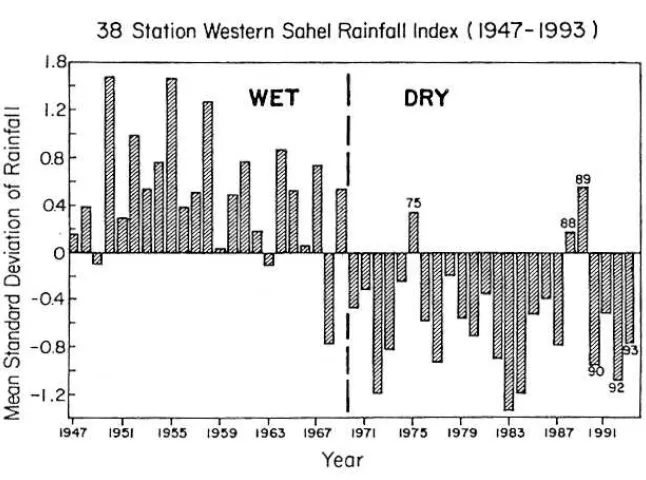
Figure 1.4 Mean standard deviations of rainfall for the 38-station June-September western Sahelian index. The boldface line indicates the least-squares best fit line to the data. Data presented are from 1949 to 1990. Figure from Landsea and Gray (1992).. . . 11
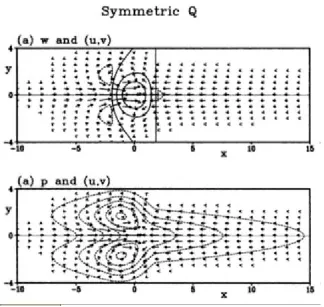
Figure 1.5 Solution for heating symmetric about the equator in a shallow-water model. (top) Contours of vertical velocity w (positive w solid; negative w dashed) super-imposed on the velocity field (vectors) for the lower layer. The field is dominated by the upward motion in the heating region where it has approximately the same shape as the heating function. Elsewhere there is subsidence with the same pattern as the pressure field. (bottom) Contours of pressure purturbation p in the lower layer which is negative everywhere. Two cyclones are found on the northwest and southwest flanks of the forcing region. Image from Gill (1980). . . 12
Figure 1.6 Idealized portrayal of upper level wind patterns during wet (upper panel) versus dry (lower panel) Western Sahel years. Image from Landsea and Gray (1992). 13
simulated by the GFDL (solid line) and MIROC (dashed line) models. Anomalies are in mm day−1. Image from Biasutti et al. (2008). . . 14
Figure 2.1 Carbon emission scenarios from the Special Report on Emissions Scenarios (SRES) for the International Panel on Climate Change’s Fourth Assessment Report (IPCC-AR4). Carbon concentrations are expressed in parts per million (ppm). . . 18
Figure 2.2 Domains used in this study. Also shown are the locations of all tropical cyclones during the months of July through October 1958-2003 when they were first named. Image from Aiyyer and Thorncroft (2006). . . 19
Figure 3.1 Annual cycle of Ni˜no-3 SST (degrees K) in observations (Kaplan dataset, solid black line) and in model simulations of the 20th century (20C3M simulation, red dashed line) and 21st century (A1B simulation, blue dashed line). . . 39
Figure 3.2 Wavelet and spectral analysis of Ni˜no-3 SST for the Hadley SST dataset (top left) and 21 IPCC GCMs. . . 42
Figure 3.3 Plots of correlation (shaded) and regression (vectors, ms−1
) of JAS shear and the Ni˜no-3 index. . . 45
Figure 3.4 Annual cycle of Sahel rainfall (mm month−1
) in observations (Hulme dataset, solid black line) and in model simulations of the 20th century (20C3M simulation, red dashed line) and 21st century (A1B simulation, blue dashed line). . 48
Figure 3.5 Wavelet and spectral analysis of Sahel precipitation for the Hulme precip-itation dataset (top left) and 21 IPCC GCMs.. . . 51
Figure 3.6 Plots of correlation (shaded) and regression (vectors, ms−1) of JAS shear
and the Sahel index. . . 54
Figure 3.7 Idealized illustration showing two circular wind gyres (vectors) and their corresponding streamfunction fields (contours). H stands for high pressure and L stands for low pressure. Winds around the left gyre are rotating in a clockwise sense and are represented by circular streamfunction contours that are increasing towards the center. Winds around the right gyre are rotating in a counterclockwise sense and are represented by circular streamfunction contours that are decreasing towards the center. . . 57
Figure 3.8 Streamfunction (contour interval 2.5 X 10⁻⁶
m2
s−1
Figure 3.9 Velocity potential (contour interval 1.0 X 10⁻⁶
m2
s−1
) and irrotational wind (vectors) at 200 hPa for July-September 1948-1999 for the NCEP/NCAR reanalysis (top left) and 20C3M model simulations. Positive velocity potential depicted by blue solid contours; negative velocity potential depicted by red dashed contours. . . 61
Figure 4.1 IPCC-AR4 multi-model projections of June-November vertical wind shear change. (a) The 18-model ensemble-mean change in June-November 850-200 hPa vertical wind shear (shaded, m s−1 ◦ C−1 warming), contours show ensemble-mean
background shear (2001-2020 average, m s−1); (b) Number of models (out of 18)
showing positive change in shear. Box indicates the MDR. Figure from Vecchi and Soden (2007). . . 74
Figure 4.2 IPCC-AR4 multi-model projections of July-September vertical wind shear change. Number of models (out of 21) showing an (a) increase, (b) decrease, and (c) no significant change in 850 hPa-200 hPa shear (m s−1). Significance determined
at the 95% confidence level using the Student’s t-test. Dots indicate locations of tropical cyclone genesis over the period 1948-2004; box indicates a region of frequent tropical cyclone development (MDR). . . 75
Figure 4.3 IPCC-AR4 multi-model projections of July-September vertical wind shear change. Number of models (out of 21) showing an increase, decrease, and no change in three sections of the MDR. Trends averaged for all gridpoints throughout each section. . . 76
Figure 4.4 Same as in Figure 4.2, but for precipitation (kgm−2
s−1
). Box indicates Sahel region in West Africa. . . 77
Figure 4.5 Linear correlations between the IPCC-AR4 model projections of July-September vertical wind shear timeseries versus the Sahel rainfall timeseries before (blue bars) and after (red bars) linearly regressing the ENSO timeseries out of the MDR shear data. . . 78
Figure 4.6 IPCC-AR4 multi-model projections of July-September Sahel rainfall anoma-lies versues 850 hPa-200 hPa vertical wind shear anomaanoma-lies. Each dot represents a model-projected JAS seasonal anomaly of Sahel rainfall versus MDR shear. Linear regression plotted as red line; percentage of seasonal anomalies in each quadrant given in corners of plot. . . 79
Figure 4.7 IPCC-AR4 model projections of July-September vertical wind shear changes in the MDR (red lines) and Sahel rainfall changes (blue lines). Trends are normalized to the mean. . . 80
versus 850 hPa-200 hPa vertical wind shear change in the (a) western MDR, (b) central MDR, and (c) eastern MDR. Each dot represents one model in the ensemble. Linear regression plotted as red line. . . 81
Figure 4.9 Same as Figure 4.2, but for the GFDL-20, GFDL-21, HADCM, MIROC-HI, and INGV models only. . . 82
Figure 4.10 Same as Figure 4.4, but for the GFDL-20, GFDL-21, HADCM, MIROC-HI, and INGV models only. . . 83
List of Tables
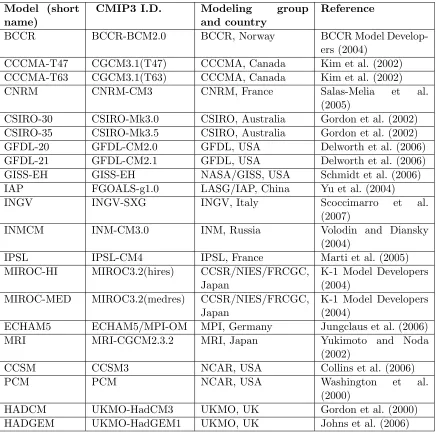
Table 2.1 List of the models used in this study. . . 20
Table 2.2 Atmospheric and oceanic resolutions of the models used in this study (in degrees). . . 21
Table 3.1 Calculated skewness and kurtosis values of JAS Ni˜no-3 SST for 20th century observations (Hadley SST) and the 20th and 21st century simulations of 21 IPCC AR4 GCMs. Kurtosis values are calculated by subtracting the kurtosis of the normal distribution (kurtosis = 3) to obtain a kurtosis relative to the normal distribution. 64
Table 3.2 Calculated skewness and kurtosis values of Sahel precipitation for 20th cen-tury observations (Hulme precipitation) and the 20th and 21st cencen-tury simulations of 21 IPCC AR4 GCMs. Kurtosis values are calculated by subtracting the kurtosis of the normal distribution (kurtosis = 3) to obtain a kurtosis relative to the normal distribution. . . 65
Chapter 1
Introduction
1.1
Motivation
The concentration of greenhouse gases in the atmosphere, particularly carbon
diox-ide, has been increasing since the onset of the industrial revolution in the late 18th and early
19th centuries (IPCC 2001). Through the well-understood process of absorbing terrestrial
radiation emitted by the Earth and transmitting it back to the surface as longwave
radia-tion, greenhouse gases like carbon dioxide act to increase the global-mean tropospheric air
temperature.
The Third Assessment Report of the United Nations Intergovernmental Panel
on Climate Change (IPCC-AR3) concluded that most of the observed warming in recent
decades is likely due to a rapid increase in anthropogenic greenhouse gas concentrations.
Furthermore, the IPCC’s Fourth Assessment Report (IPCC-AR4) suggests that the
warm-ing associated with increased greenhouse gas concentrations has penetrated into the global
oceans in the past 40 years, supported by an observed 0.25 - 0.5 degree C increase in SST
over most tropical ocean basins (Webster et al. 2005).
Tropical cyclones (TCs) are one of the most destructive natural phenomena and
impact a significant portion of the world’s population (e.g. Pielke and Landsea 1998). A
major problem, that has been well recognized, is the potential for increased vulnerability
of coastal areas in a warmer climate. Scientists have debated the implications of climate
through the transfer of latent and sensible heat from the oceans, an initial concern is
that increased sea surface temperature (SST) due to anthropogenic forcing will lead to
more frequent and intense hurricanes (Houghton et al. 1990). However, SST is only one
factor in the development and intensification of tropical cyclones, and the numerous other
thermodynamical and dynamical processes that govern tropical cyclone activity cannot
be overlooked. These processes vary on interannual to multidecadal timescales, and the
variability of tropical cyclone genesis frequency is driven in part by the spatio-temporal
variability of these environmental factors.
Among these factors, vertical wind shear is a key environmental variable that
exerts a direct influence on seasonal tropical cyclone activity. On interannual time scales,
vertical wind shear explains 30 to 50% of the variability of tropical cyclones within the main
development region (MDR) of the tropical North Atlantic, the area where the majority of
Atlantic tropical cyclones form (Aiyyer and Thorncroft 2006). Tropical cyclones in all basins
historically tend to form where shear is low, as depicted in Figure 1.1.
It is well understood that the presence of substantial (at least 10ms−1
) deep-layer
vertical wind shear in the background environment has a detrimental effect on the genesis
and intensification of tropical cyclones by inhibiting the organization of convection needed
to maintain tropical cyclones (e.g. Ramage 1959). Figure 1.2 shows how in a heavily sheared
environment, convection is displaced from the center of the storm, leaving the center of
low-level circulation exposed. The physical mechanism for the effect of shear on tropical cyclones
is usually understood in terms of ’ventilation’, where differences in upper- and lower-level
flow advect heat and moisture away from the system, effectively inhibiting intensification
of the disturbance (Gray 1968). An alternate explanation given by DeMaria (1996) is one
of ’tilting and stabilization’ in which shear causes potential vorticity (PV) associated with
the circulation to become tilted in the vertical. This induces mid-level warming near the
center of the vortex, which acts to reduce convective activity and inhibit intensification.
Simulations from a suite of fully-coupled global climate models collected for the
International Panel on Climate Change’s Fourth Assessment Report (IPCC-AR4) provide
an unparalleled opportunity to explore the effects of climate change on tropical cyclone
activity. To fully understand the model-predicted changes in vertical wind shear in the
tropical Atlantic. This study takes a statistical approach to investigate whether predictions
in vertical wind shear trends over the MDR are related to model projections for future
rainfall trends in the Sahel. We examine trends and correlations between summertime Sahel
rainfall and vertical wind shear in the MDR over the 21st century. It is hypothesized that
the spread in projections of future Sahel rainfall variability contributes to the uncertainty
in MDR shear predictions.
1.2
Climatic Forcings Modulating Atlantic Vertical Wind Shear
Variability of vertical wind shear in the MDR is influenced by changes in the
large-scale background circulation, forced by teleconnections such as the El Ni˜no-Southern
Oscillation (ENSO) and the West African monsoon system (e.g. Landsea and Gray 1992;
Goldenberg and Shapiro 1996; Aiyyer and Thorncroft 2006). These teleconnections directly
impact the vertical wind shear over the MDR through alterations of the upper-level flow in
the tropical Atlantic basin on interannual to multidecadal timescales.
While the interannual variability of shear is better understood, the absence of
ac-curate observational datasets before the mid 20th century greatly limits our understanding
of fluctuations on longer timescales. In the first half of the 20th century, we relied on
mili-tary aircraft reconnaissance and land and ship observations to detect and observe tropical
cyclones. Observations were random and spotty, thus the accuracy of early observational
datasets is called into doubt (Landsea 1993; Landsea et al. 1999). However, the revolution
of satellite technology in the 1960’s has greatly improved our understanding of tropical
cy-clone activity. Despite the relatively short period of reliable TC records, we are coming to a
better understanding of the processes that influence vertical wind shear, and subsequently,
tropical cyclones in the tropical Atlantic basin. This section details some of these processes.
1.2.1 West African rainfall
The Sahel region of West Africa is a semi-arid transitional zone, bounded to the
north by the Sahara Desert and to the south by rainforests that flourish from the humid
equatorial tropical climate. The Sahel experiences rather extreme decadal fluctuations in
debated to this day. Some argue that this can be explained by land surface use (e.g.
deforestation) and its feedback on atmospheric radiation and precipitation (Charney et al.
1977), while others believe that Sahel rainfall variability is governed by fluctuations in
global sea surface temperatures (Palmer 1986; Folland et al. 1986). The latter theory is
currently favored to be the main cause of 20th century Sahel rainfall variability thanks
to recent modeling studies employing coupled GCMs (e.g. Giannini et al. 2003; Lu and
Delworth 2005; Hoerling et al. 2006), while changes in vegetation and land surface likely
act to amplify Sahel precipitation anomalies (e.g. Zeng and Neelin 2000).
A strong multidecadal relationship between West African rainfall and Atlantic
hur-ricane activity is evident in the 20th century observational dataset (e.g. Gray 1990; Landsea
and Gray 1992). For example, there were significantly fewer Atlantic major hurricanes
dur-ing the period 1947 to 1969 which coincided with a severe drought in the Sahel region, and a
marked uptick in Atlantic major hurricane frequency between 1970 to 1987 when the Sahel
region experienced plentiful rainfall. This is particularly evident when comparing the
num-ber of tropical cyclone tracks between the two 24-year periods of 1944-1967 (relatively wet
Sahel period) and 1968-1991 (relatively dry Sahel period) in Figure 1.3. Note the drastic
shift from wet to dry conditions in the Sahel in the late 1960’s in Figure 1.4, one example
how the Sahel region experiences large swings in precipitation over decadal timescales.
One physical mechanism in which Sahel rainfall relates to tropical cyclone activity
in the Atlantic is through the modification of vertical wind shear in the main development
region (MDR) of the tropical Atlantic, a region where tropical cyclone development is
climatologically favored. The Sahel-MDR shear relationship can be understood in terms of
the tropical atmospheric response to steady monsoonal thermal forcing as in the
Matsuno-Webster-Gill mechanism. Upper-level anticyclonic gyres to the west of the Sahel monsoon
region represent the stationary Rossby wave driven by persistent diabatic thermal forcing
(Gill 1980). This is illustrated in Figure 1.5 but for the lower levels where cyclonic gyres
result to the west of the forcing. The net effect is anomalous upper-level easterly flow
over the central and eastern MDR in conjunction with a wetter Sahel, which acts to cancel
some of the climatological upper-level westerly flow and reduce vertical wind shear in those
regions. Figure 1.6 shows an idealization of the differences in flow in the tropical Atlantic
As depicted in previous studies (e.g. Held et al. 2005; Biasutti et al. 2008;
Cook and Vizy 2006), the outlook for Sahel rainfall in a warming climate as depicted by
global climate models is very uncertain. Figure 1.7 puts this in perspective, showing how
two GCMs from the IPCC-AR4 archive (the GFDL and MIROC models) produce widely
varying solutions for 21st century Sahel rainfall. This is surprising given that the very same
models were robust in replicating 20th century precipitation patterns in the Sahel when
forced with historic time series of sea surface temperatures (Giannini et al. 2003; Tippett
and Giannini 2006; Lu and Delworth 2005; Hoerling et al. 2006).
1.2.2 El Ni˜no-Southern Oscillation
The El Ni˜no-Southern Oscillation is the largest system of climate variability in the
world, influencing global weather on interannual to multidecadal timescales. The theoretical
framework of ENSO can be understood through the work of Bjerknes (1966) who described
the positive feedback loop that drives ENSO in the tropical Pacific Ocean. Wind anomalies
in the central equatorial Pacific generate thermocline anomalies which travel to the east
towards the coasts of Peru and Chile. In the eastern equatorial Pacific these upwell as
warm SST anomalies, which in turn give rise of wind anomalies in the central Pacific.
Later work by Wyrtki (1975) and Picaut et al. (1996) describe a secondary feedback loop
in the central Pacific whereby SST is affected directly by wind anomalies via advection,
anomalous upwelling, evaporation, and mixed-layer depth anomalies. These SST anomalies
in turn influence the wind.
The work of Gray (1984) documents how ENSO serves as a teleconnection for
vertical wind shear in the tropical Atlantic. During the El Ni˜no phase of ENSO, warmer
than average SSTs in the eastern Pacific shift convective activity to the east. This in
turn leads to westerly upper-level wind anomalies over the tropical Atlantic, which acts to
strengthen the climatological westerly upper-level flow in the Atlantic. Vertical wind shear
in the Atlantic is thus enhanced during El Ni˜no years. During La Ni˜na years, convection
over the eastern Pacific is suppressed due to cooler than average SSTs. Thus, the westerly
upper-level flow over the tropical Atlantic is comparatively weaker, and shear is reduced.
As evident in many observational datasets, the El Nino-Southern Oscillation
ability (or lack thereof) of coupled global climate models (GCMs) to simulate ENSO’s
vari-ability has been the focus of recent studies (e.g. van Oldenborgh et al. 2005; Lin 2007a).
Using wavelet analysis, Lin (2007a) compared 20th century observational datasets to the
20th century output from the suite of IPCC GCMs and found that the models display a
wide range of skill in simulating the interdecadal variability in ENSO’s amplitude and
pe-riod. The suite of models can be broken into three groups according to whether the model
has a pronounced spectral peak shorter than, greater than, or similar to that of the 20th
century observations. It was found that 8 of the 21 models in the IPCC-AR4 archive
dis-play significant interdecadal variability of ENSO in both amplitude and period (Lin 2007a).
Furthermore, Lin (2007a)a concludes that only one model (MPI) is able to reproduce the
observed eastward shift of the westerly anomalies in the low-frequency regime of ENSO.
It is of interest to examine how and if the spatio-temporal variability of ENSO
changes under projected global warming conditions in the 21st century. van Oldenborgh
et al. (2005) selects six models in the IPCC archive that seem to best simulate ENSO in
the 20th century and then analyzes output from the years 2051-2100 under various global
warming scenarios (but mainly the A2 scenario). By analyzing projected changes in the
mean state, amplitude, and skewness (a comparison of the magnitude of anomalies between
El Ni˜no and La Ni˜na phases), their study finds that these six most realistic models show no
statistically significant changes in the spatial structure or temporal variations in ENSO in
the latter half of the 21st century. Thus, they conclude that there is very little evidence from
the IPCC models that support a major change in the ENSO phenomenon in the 21st century
under global warming conditions. Additionally, Collins and the CMIP Modeling Groups
(2005) finds that GCMs show no trend in the mean state of ENSO towards more El Ni˜
no-like or La Ni˜na-like conditions when forced with 80 years of the 1% per year CO2 increase
scenario.
1.3
Objectives
Simulations from a suite of fully-coupled global climate models collected for the
International Panel on Climate Change’s Fourth Assessment Report (IPCC-AR4) provide
To fully understand the model-predicted changes in vertical wind shear in the MDR, we
must examine the numerous mechanisms that influence circulation patterns in the tropical
Atlantic. This study takes a statistical approach to investigate whether model predictions
in vertical wind shear trends over the MDR is related to model projections for future rainfall
trends in the Sahel. We examine trends and correlations between summertime Sahel rainfall
and vertical wind shear in the MDR over the 21st century. It is suggested that the spread in
projections of future Sahel rainfall variability contributes to the uncertainty in MDR shear
predictions.
Our goal is to address the following questions:
• Which (if any) GCMs in the IPCC-AR4 archive are able to accurately replicate
well-known features of the 20th century climate like ENSO and the West African monsoonal
system so that those models can be used to form conclusions about changes to our
climate in the 21st century?
• Do the best models exhibit a consistent MDR shear trend in the 21st century?
• Does the spread in projections of future Sahel rainfall variability contribute to the
uncertainty in MDR shear projections in the 21st century?
In the following chapter a description of data and methods used to study these
questions will be presented. First, spatio-temporal characteristics for the West African
monsoon and ENSO cycle for the entire 21-member IPCC model suite will be analyzed.
Based on model performace in simulating the familiar patterns associated with the ENSO
cycle and West African monsoon, each model will be assigned a confidence level for the
reliability of their 20th century predictions. Next, a statistical approach will be used to
gauge the relative roles of various teleconnections in modulating vertical wind shear in the
tropical Atlantic under 21st century warming conditions. Results will be presented for the
full suite of models, as well as the group of models selected from the previous chapter for
their reliable simulations of the 20th century climate. Last, all findings will be summarized,
Chapter 2
Data and Methodology
2.1
Data
This study utilizes gridded monthly-averaged data from a 21-member suite of
fully-coupled ocean-atmosphere global climate models collected for the Intergovernmental
Panel on Climate Change 4th Assessment Report (IPCC-AR4). The model outputs, made
available by various modeling groups around the world, were extracted from the Program
for Climate Model Diagnosis and Intercomparison (PCMDI) website. See Tables 2.1 and
2.2 for a complete list of the models used in this study, along with their atmospheric and
oceanic resolutions. It should be noted that there is a wide range in atmospheric and oceanic
resolutions across the suite of models. Multiple simulations for the same period for each
model are available, but for the sake of simplicity, only the first simulation (run1) of each
model is used here. A handful of models from the IPCC archive (GISS-AOM, GISS-ER,
MIUB-ECHO) were omitted from this study due to data availability and processing issues
at the time of publication, but the exclusion of these models should not affect the outcome
of this study. It is hopeful that the models selected for this study are representative of the
multi-model ensemble provided for the IPCC.
Two different model simulations are used: the 20C3M simulation for the 20th
century and the SRES-A1B scenario for the 21st century. The 20C3M simulations are
the best efforts of the modeling groups to simulate the climate of the 20th century using
emission scenarios from the Special Report on Emissions Scenarios (SRES) prepared by
the IPCC for the Third Assessment Report (IPCC-AR3) in 2001. Because climate change
depends heavily on human activity, the climate models must be forced with future scenarios
of greenhouse gas (e.g. carbon dioxide, aerosols) concentrations to make predictions of
what lies ahead in terms of climate change. The A1B scenario assumes a future world of
extensive economic growth, rapid development of new and more efficient technologies, and
a global population that peaks around 2050 and declines afterwards. In the A1B scenario,
concentrations of emissions experience a steep increase in the first few decades of the 21st
century before leveling off around the year 2050 and declining thereafter. It is assumed to
be a ’middle-of-the-road’ approach to climate change, assuming that there will be moderate
progress in the 21st century to curb greenhouse gas emissions. The A1B scenario was
chosen over the other available scenarios because it appears to be the most widely accepted
scenario across literature dealing with climate change based on a review of past studies. See
Figure 2.1 for a comparison of the different SRES scenarios in terms of their greenhouse gas
forcings.
To characterize the present climate and to validate model simulations for the 20th
century, we employ several monthly-averaged observational datasets. The Hulme
observa-tional dataset (Hulme 1992), covering the years 1900-1998 with a resolution of 2.5◦ latitude
by 3.75◦ longitude, is used to obtain historial precipitation totals from the Sahel region
of West Africa. Historial sea surface temperatures for the Nino3 region in the Pacific are
obtained from the Met Office Hadley Centre’s Sea Ice and SST (HADISST) (Rayner et al.
2003), covering the years 1890-1999 with a resolution of 1◦ latitude by 1◦ longitude. Wind
data are from the NCEP/NCAR reanalysis (Kalnay et al. 1996), spanning 1948-1999 on a
2.5◦ x 2.5◦ global grid.
2.2
Domains
Figure 2.2 highlights the domains used in this study. The domains are as follows:
the MDR (7.5◦-20◦N, 80◦-20◦N); the Sahel region (10◦-20◦N, 20◦-20◦E); and the Ni˜
no-3 region (5◦N-5◦S, 150◦-90◦W). The Ni˜no-3 region is used to represent SST fluctuation
summertime monsoonal precipitation. The MDR is a section of the tropical North Atlantic
that is climatologically favored for tropical cyclone development.
2.3
Methods
To capture the climatological peak of the Atlantic hurricane season, we use
July-September (JAS) mean data over the respective region for each year. Vertical wind shear
in the MDR is defined as the vector difference between the winds at 850 hPa and 200 hPa,
consistent with previous literature. Both the zonal and meridional components of the wind
field are used to derive the shear vector for each month, and each component of the total
wind shear vector is examined to see their individual contribution to the total wind shear
Table 2.1: List of the models used in this study.
Model (short name)
CMIP3 I.D. Modeling group and country
Reference
BCCR BCCR-BCM2.0 BCCR, Norway BCCR Model
Develop-ers (2004)
CCCMA-T47 CGCM3.1(T47) CCCMA, Canada Kim et al. (2002) CCCMA-T63 CGCM3.1(T63) CCCMA, Canada Kim et al. (2002)
CNRM CNRM-CM3 CNRM, France Salas-Melia et al.
(2005)
CSIRO-30 CSIRO-Mk3.0 CSIRO, Australia Gordon et al. (2002) CSIRO-35 CSIRO-Mk3.5 CSIRO, Australia Gordon et al. (2002)
GFDL-20 GFDL-CM2.0 GFDL, USA Delworth et al. (2006)
GFDL-21 GFDL-CM2.1 GFDL, USA Delworth et al. (2006)
GISS-EH GISS-EH NASA/GISS, USA Schmidt et al. (2006)
IAP FGOALS-g1.0 LASG/IAP, China Yu et al. (2004)
INGV INGV-SXG INGV, Italy Scoccimarro et al.
(2007)
INMCM INM-CM3.0 INM, Russia Volodin and Diansky
(2004)
IPSL IPSL-CM4 IPSL, France Marti et al. (2005)
MIROC-HI MIROC3.2(hires) CCSR/NIES/FRCGC, Japan
K-1 Model Developers (2004)
MIROC-MED MIROC3.2(medres) CCSR/NIES/FRCGC, Japan
K-1 Model Developers (2004)
ECHAM5 ECHAM5/MPI-OM MPI, Germany Jungclaus et al. (2006)
MRI MRI-CGCM2.3.2 MRI, Japan Yukimoto and Noda
(2002)
CCSM CCSM3 NCAR, USA Collins et al. (2006)
PCM PCM NCAR, USA Washington et al.
(2000)
HADCM UKMO-HadCM3 UKMO, UK Gordon et al. (2000)
Table 2.2: Atmospheric and oceanic resolutions of the models used in this study (in degrees).
Model Atmos. resolution Ocean resolution BCCR 2.81◦ x 2.79◦ 0.5-1.5◦ x 1.5◦
CCCMA-T47 3.75◦ x 3.71◦ 1.85◦ x 1.85◦
CCCMA-T63 2.81◦ x 2.79◦ 1.4◦ x 0.9◦
CNRM 2.81◦ x 2.79◦ 2◦ x 0.5◦
CSIRO-30 1.88◦ x 1.87◦ 1.88◦ x 0.84◦
CSIRO-35 1.88◦ x 1.87◦ 1.88◦ x 0.84◦
GFDL-20 2.5◦ x 2◦ 1◦ x 1/3◦
GFDL-21 2.5◦ x 2◦ 1◦ x 1/3◦
GISS-EH 5◦ x 4◦ 2◦ x 2◦
IAP 2.81◦ x 3.05◦ 1◦ x 1◦
INGV 1.125◦ x 1.125◦ 2◦ x 1◦
INMCM 5◦ x 4◦ 2.5◦ x 2◦
IPSL 3.75◦ x 2.54◦ 2◦ x 1◦
MIROC-HI 1.13◦ x 1.12◦ 0.28◦ x 0.19◦
MIROC-MED 2.81◦ x 2.79◦ 1.4◦ x 0.5◦
ECHAM5 1.88◦ x 1.87◦ 1.5◦ x 1.5◦
MRI 2.81◦ x 2.79◦ 2.5◦ x 0.5◦
CCSM 1.41◦ x 1.4◦ 1.13◦ x 0.27◦
PCM 2.81◦ x 2.79◦ 1.13◦ x 0.27◦
HADCM 3.75◦ x 2.5◦ 1.25◦ x 1.25◦
Chapter 3
Model Validation
3.1
Introduction
In this chapter, various properties of 20th century simulations of ENSO, Sahel
precipitation, and 200-850 hPa wind fields will be examined for the 21-member suite of
IPCC GCMs selected for this study. Understanding individual model behavior and biases
is important before using the model outputs to make any predictions about the future
climate. This is especially important given the rather coarse resolution of these GCMs
which could possibly hinder model performance on simulating the variability of various
atmospheric and oceanic phenomena, such as the West African monsoon.
Are the current GCMs ready to be used to make predictions about changes in
tropical Atlantic vertical wind shear and its associated teleconnections in a future climate?
The goal of this section is to identify and analyze the wide range of behavior exhibited
across the suite of models, and then select the models that produce realistic simulations of
the 20th century climate to make predictions about the future climate in the next chapter.
3.2
El Nino-Southern Oscillation
3.2.1 Annual Cycle
We begin our analysis by comparing the annual cycle of SST variations in the
monthly SST in the Ni˜no-3 region for the 20th century (20C3M; dashed red line) and 21st
century (A1B; dashed blue line) simulations for each of the models. The modeled annual
cycles are plotted against years 1901-1999 of the Hadley SST dataset (solid black line) to
compare and contrast model performance.
Observations show a peak in eastern Pacific SSTs in the spring months (maximum
in April) and a gradual decrease in SST through the summer months beforing bottoming
out in the late summer to fall months. There is an approximately 2.5 degree Kelvin seasonal
difference between the peak in the spring and the minimum in the fall. The models have
a wide range of skill in capturing this pattern of seasonal variability in the 20th century
simulations. IAP is nearly devoid of any seasonal fluctuation of SST in the eastern Pacific.
Several models (e.g. BCCR, INMCM, ECHAM5) delay the springtime peak in SST to
varying degrees. Other models depict more than one distinct SST peak throughout the
year (GISS-EH, PCM). GISS-EH has a primary peak in March and a secondary peak in
October, while PCM has two peaks of roughly the same magnitude in June and December.
It also appears that a large number of the models have a cold bias throughout the year when
compared to the observations, which in some cases is rather drastic (e.g. BCCR, INGV).
Lin (2007b) attributes this cold bias to the ’double ITCZ’ problem that plagues many of the
GCMs, where excessive precipitation over much of the tropics causes stronger than normal
trade winds, excessive SST-surface latent heat flux, and insufficient SST-surface shortwave
flux. This results in a mean cold bias across much of the tropical ocean basins in the GCMs.
Overall, only a handful of models (both GFDL models, both MIROC models, MRI, and
HADCM) have reasonable simulations of the observed seasonal cycle of SST in the East
Pacific.
3.2.2 Statistical Analysis of Observations vs. Model Simulations
Hoerling et al. (2001) concluded that the tropical and extratropical atmospheric
response to opposite phases of ENSO is nonlinear. In other words, El Ni˜no and La Ni˜na
events of equal magnitudes do not have an equal effect on the upper tropospheric flow over
the tropical Atlantic. Thus, it is important for GCMs to simulate the correct number and
distribution of warm vs. cold events in the eastern Pacific to ensure that their atmospheric
matter.
There are several statistical measures that are useful for gauging the relative
mag-nitude and quantity of warm vs. cold ENSO events in the eastern Pacific as simulated by
the GCMs. Skewness is a statistical measure that gauges the asymmetry of the distribution
of a dataset. A normal distribution, or one that is perfectly symmetric about the mean, has
a skewness of zero. For unimodal distributions, positive skewness indicates that the ’tail’
of the distribution is more stretched on the positive side of the mean. Negative skewness
indicates that the tail is more stretched below the mean. Kurtosis, on the other hand,
measures the normality of a distribution. A normal distribution, or one whose distribution
is bell-shaped and peaked at the mean, has a kurtosis of 3. We subtract this value from the
calculated kurtosis to give us values that are relative to the normal distribution. Positive
values of kurtosis indicate that the distribution is more sharply peaked than the normal
distribution (leptokurtic), and negative values result from a distribution that is ’flatter’
than the normal distribution (platykurtic).
3.2.3 Observed vs. Simulated ENSO Skewness and Kurtosis
The skewness and kurtosis of the detrended 20th century (years 1901-1999) JAS
seasonal mean Ni˜no-3 timeseries from the Hadley SST dataset is calculated. The calculated
skewness from the observations is 0.64, meaning that SST anomalies in the Ni˜no-3 region
are generally larger during El Ni˜no years than La Ni˜na years. This result is consistent with
van Oldenborgh et al. (2005), where a skewness of 0.54 was determined from the Kaplan
SST dataset using an EOF analysis. van Oldenborgh et al. (2005) did not calculate kurtosis,
so from the Hadley SST dataset we determine that the Ni˜no-3 kurtosis for the 20th century
is 0.61. A leptokurtic kurtosis such as this indicates that the distribution of seasonal means
in the 20th century is relatively sharply peaked.
Skewness and kurtosis calculations are then repeated for the detrended 1901-1999
JAS Ni˜no-3 timeseries for each of the 20th century (20C3M) IPCC GCM simulations. The
resulting values for each model are listed in Table 3.1. As a whole, the models do not produce
a realistic asymmetry of positive El Ni˜no vs. negative La Ni˜na events in the simulations, as
evident from the negative values of skewness that are returned by several GCMs. Eight out
CCSM, HADGEM) display a negative skewness, meaning that SST anomalies are generally
larger during La Ni˜na years rather than El Ni˜no years. This is uncharacteristic of the 20th
century observations, which exhibit a large positive skewness. Only three models
(GFDL-21, MIROC-HI, and HADCM) produce realistic positive skewnesses (0.67, 0.38, and 0.58,
respectively). The remaining 10 models (CNRM, CSIRO-35, GFDL-20, GISS-EH, IAP,
INGV, INMCM, ECHAM5, MRI, and PCM) have weakly positive skewnesses.
Kurtosis values for the 20th century Ni˜no-3 model simulations are then calculated
and analyzed. The models exhibit a diverse variety of distributions evident from the wide
range of calculated kurtosis. For example, the nature of the distributions ranges from very
platikurtic with the IAP model (relative kurtosis of -1.35) to relatively sharply peaked
with the CCCMA-T63 model (relative kurtosis of 0.91). The three models that have the
most realistic 20th century skewnesses from the previous section (GFDL-21, MIROC-HI,
HADCM) also have leptokurtic distributions, consistent with observations.
For completeness, the raw observed timeseries and the simulated timeseries are
correlated for each model (not shown). The two timeseries are not very well correlated at
all, with some models even being anticorrelated with the observations. This is not surprising,
given that is unlikely for individual El Ni˜no or La Ni˜na events in the observations to correlate
with those from a free-running climate model.
Thus, we can conclude from our statistical analysis of Ni˜no-3 skewness and kurtosis
that only three models (GFDL-21, MIROC-HI, and HADCM) have realistic distributions
of simulated seasonal mean JAS Ni˜no-3 SST compared to the 20th century observations
from the Hadley SST dataset. The distributions of seasonal averages for each of these
models are asymmetric, skewed towards positive (El Ni˜no) anomalies, and are leptokurtic,
consistent with the 20th century observed climate. These three models have been assigned
a higher confidence level for their 20th century simulations. Several other models have poor
statistical representation of ENSO variability and thus have been assigned lower confidence
levels.
3.2.4 ENSO Wavelet and Spectral Analysis
As evident in many observational datasets, the El Ni˜no-Southern Oscillation
Here we utilize wavelet and spectral analyses to compare and contrast the modeled ENSO
variability in the 20th century simulations with observations. Spectral analysis allows us
to determine the prominent peaks of variability over a given period of time. An even more
useful tool is wavelet analysis where we can not only determine different peaks of variability,
but also see how the different modes of variability change with time (Torrence and Compo
1998).
The Hadley SST observational dataset depicts a wide range of interdecadal
vari-ability in Ni˜no-3 SST (Figure 3.2). Spectral analysis reveals a rather broad peak between
2-6 years, with the highest peak around 3 years. Wavelet analysis shows that most of the
variability is concentrated before 1920 and after 1950, with a relative lull in amplitude
between the years 1920-1950. From 1900-1950, the dominant period fluctuates greatly
be-tween 2-8 years. Bebe-tween 1950-1960, longer timescales dominate with a period bebe-tween 5-7
years. After 1960 until the end of the 20th century, there is a marked shift towards shorter
periods (2-5 years).
Next, spectral and wavelet analyses are performed on the model simulations of
the 20th century in Figure 3.2. We are looking for models that have realistic simulations
of ENSO variability, i.e., models whose variability differs in both amplitude and period
throughout the 20th century. It is evident that the models have a wide range in skill in
simulating the interdecadal variability of ENSO observed in the 20th century, consistent
with Lin (2007a). Some models (IAP, CNRM) have constant amplitude and near-biennial
ENSO oscillations throughout the entire course of the 20th century, which is quite
unre-alistic. Yu et al. (2004) determined that the cause of the very strong and regular ENSO
oscillations in the IAP model is due to the ’double ITCZ’ problem in GCMs where cold
biases in the tropical Pacific are amplified through the air-sea coupling in the models. Other
models have spectral peaks that are significantly shorter (e.g. CCSM, GFDL-20) or longer
(e.g. CCCMA-T63, MIROC-MED) than the observations. However, it is encouraging to see
that a number of models (e.g. BCCR, GFDL-21, HADCM, HADGEM, ECHAM5, INGV,
MIROC-HI) simulate the interdecadal variability of ENSO to some degree, in both
ampli-tude and period. Take for example the BCCR model, which has significant episodes of 3-6
year variability between 1900-1920, 5-7 year variability between 1940-1950, and 2-5 year
3.2.5 Shear-ENSO Regression and Correlation
In this section we use plots of linear correlation and regression to analyze the
spatial relationship between Ni˜no-3 SST and JAS shear. The regression analysis is useful
for determining the pattern of anomalous shear that arises from warm SST episodes in
the eastern Pacific. Figure 3.3 shows correlations and regression between JAS vertical
wind shear and the Ni˜no-3 index in the 20th century observations and the model 20C3M
simulations. Historical wind data are obtained from the NCEP/NCAR reanalysis and SST
data are from the Hadley SST dataset. The observations reveal a broad swath of regressed
westerlies and generally positive correlations across much of the MDR. The anomalous
westerly shear over the MDR is in response to enhanced convective activity from warm
events (El Ni˜no) in the eastern Pacific. The direct relationship between Ni˜no-3 SST and
shear over the tropical Atlantic is highlighted by the zonally elongated strip of positive
correlation across the MDR. This westerly shear is most pronounced in the Carribean
western MDR which is closer to the SST forcing. Thus, we can see that increased westerly
shear in the MDR is associated with anomalously warm SST in the eastern Pacific, consistent
with Goldenberg and Shapiro (1996) and Aiyyer and Thorncroft (2006).
GISS-EH and HADGEM show very little relationship between shear and ENSO
across the tropical Atlantic. These two models have no distinct pattern of significant
cor-relations in the MDR (MDR-averaged shear-ENSO correlation values of -0.16 and 0.15 for
GISS-EH and HADCM, respectively), and there is little evidence of anomalous westerly
shear across the tropical Atlantic stemming from warm ENSO anomalies. BCCR is nearly
devoid of any significant positive correlation in the MDR. The tongue of negative correlation
that extends off the coast of West Africa is missing in the IPSL model. The response in
the IAP is much stronger most likely due to its highly regular ENSO oscillation as disussed
in previous sections. However it is encouraging to see that several models (e.g. HADCM,
GFDL-21, CSIRO-35) seem to simulate the 20th century shear-ENSO relationship across
the tropical Atlantic to a high degree of accuracy. These models show mainly positive
cor-relation across the MDR and include the tounge of negative corcor-relation extending off the
West African coast. The regressed shear is westerly across much of the tropical Atlantic,
implying that warm SST anomalies in the eastern Pacific result in increased westerly shear
forcing.
3.3
Sahel Rainfall
3.3.1 Annual Cycle
Figure 3.4 shows the annual cycle of monthly precipitation in the Sahel for the 20th
century (20C3M; dashed red line) and 21st century (A1B; dashed blue line) simulations for
each of the models. The modeled annual cycles are plotted against the Hulme precipitation
dataset (solid black line) to compare and contrast model performance. It should be noted
that due to the coarse and widely varying atmospheric resolutions of these models, the exact
areas of West Africa sampled to obtain a measure of Sahel precipitation will likely vary from
model-to-model. Discrepencies between the resolutions of the model and Hulme dataset will
also lead to differences in the areas sampled for the model-to-observation comparison.
The observations show a rapid onset of the West African monsoon in the spring
months, with maximum rainfall in the summer months (peaking in August), and a sharp
de-crease thereafter. In the 20th century simulations, the models do reasonably well capturing
the pattern of the seasonal cycle, with rainfall peaking in the summer months and a rapid
increase/decrease in the transitional seasons, despite several models simulating the onset of
the monsoon too early in the spring (e.g. CCSM, HADCM, GFDL-20, GFDL-21).
MIROC-MED shows a dip in rainfall in June in both the 20th and 21st century simulations, which is
suspect. The greatest problem lies in the tendency for the models to greatly underestimate
summertime precipitation. IAP, IPSL, and INMCM all significantly underestimate rainfall
in the Sahel to a degree that would greatly hinder their usefulness in the analysis presented
in the next chapter. Only GFDL-20, GFDL-21, and MIROC-HI produce summer
rain-fall peaks to the same level as the observations, and the rest underestimate precipitation to
varying degrees. The 21st century simulations in most models show little departure from the
previous century. The exceptions are GFDL-20 and GFDL-21 which show a robust decrease
in rainfall in the summer months into the 21st century and MIROC-MED, MIROC-HI, and
CCSM which depict relatively smaller, yet notable increases in summertime rainfall in their
3.3.2 Observed vs. Simulated Sahel Skewness and Kurtosis
The skewness and kurtosis of the detrended 20th century (years 1901-1998) JAS
Sahel timeseries is calculated from the Hulme precipitation dataset. The calculated skewness
from the observations is -0.46, meaning that seasons with below average rainfall (drought
years) are more extreme than seasons with anomalously high rainfall. Given the extreme
droughts that the Sahel region is known for in the 20th century (e.g. Nicholson 1980),
a negative skewness seems practical here. The distribution is slightly platikurtic with a
calculated relative kurtosis value of -0.10, indicating a nearly normal distribution of seasonal
means in the 20th century.
Skewness and kurtosis are calculated from 99 years (1901-1999) of the 20C3M
simulations for the suite of IPCC models. Individual values for each model can be found
in Table 3.2. Only one-third (7 out of 21) of the models produce negative skewnesses. The
GFDL-20 and CCCMA-T47 have skewnesses of -0.23 and -0.22, respectively, and seem to do
the best job in simulating the 20th century Sahel climate. Several of the models
(CCCMA-T63, GISS-EH, IAP, MIROC-MED) have very unusually high values of skewness, which is
uncharacteristic of the 20th century climate.
Next, the values of kurtosis of the 20C3M simulations are analyzed. Fifteen out
of 21 models have negative values of kurtosis relative to the normal distribution, indicating
platikurtic distributions. Some values are as low as -0.89, as in the HADCM model. Two
models (IAP and CCCMA-T63) are outliers with much sharper distributions relative to the
rest of the models (kurtosis values of 1.68 and 0.86, respectively).
From our statistical analysis of the distribution of 20C3M seasonal means for
each model, we conclude that the following models have reasonable simulations of the
20th century Sahel rainfall climatology: CCCMA-T47, GFDL-20, GFDL-21, CSIRO-30,
and CCSM. These models have negative skewnesses, indicating that years with drought
are more extreme than years with plentiful rainfall. Many of the models do not produce
reasonable simulations. Some models, namely the CCCMA-T63 and IAP models, have
positive skewness and much higher values of kurtosis relative to the observations and the
rest of the models. One possible reason for the models’ poor representation of variability
in the Sahel is the rather course nature of the resolutions of the models. A documented
tropics due to the double-ITCZ problem in the GCMs which causes excessive precipitation
in much of the tropics (Lin 2007b). Perhaps this tendency for models to have a wet bias
is the cause of the unusually high skewness values in many of the models in the 20C3M
simulations.
3.3.3 Sahel Wavelet and Spectral Analysis
The West African monsoonal system experiences significant variability, the cause
of which has been linked to fluctuations in SST (Cook and Vizy 2006, Biasutti et al. 2008).
Here we explore the variability of summertime Sahel rainfall through a spectral and wavelet
analysis. From 98 years worth of the Hulme precipitation dataset (1901-1998), we can
see that Sahel rainfall generally varies on much longer timescales relative to ENSO in the
previous section, as evident by the broad spectral peak clustered around 8-10 years (Figure
3.5). The amplitude of the Sahel variability is considerably less pronounced than ENSO
variability. It should be noted that due to the rather short time period of the observations,
it would be rather difficult to clearly detect fluctuations in Sahel rainfall on multidecadal
timescales. However, the analysis is still useful for detecting the interdecadal and decadal
variability of the monsoonal cycle. From our wavelet analysis of the observational timeseries,
we can see that rainfall in the Sahel experiences significant variability in both amplitude
and period throughout the 20th century. There are 2-4 year fluctuations from 1900-1910
and 6-8 year fluctuations from 1910-1920. 3-5 year fluctuations are dominant towards the
end of the 20th century (1975-2000).
The analysis is then performed on the suite of GCMs in Figure 3.5. IAP,
CCCMA-T63, and CSIRO-30 have pronounced spectral peaks around 2-4 years, which is much shorter
than observed. Much of the variability in those models is concentrated in shorter timescales
through the course of the 20th century. Many models produce episodes at varying timescales
throughout the course of the 20th century with the spectral peaks centered in decadal
timescales (e.g. CCCMA-T47, ECHAM5, HADGEM, MIROC-MED, MRI). This behavior
3.3.4 Shear-Sahel Regression and Correlation
Figure 3.6 shows correlations and regression between JAS vertical wind shear and
the Sahel index in the 20th century observations and the model 20C3M simulations. In
the NCEP/NCAR reanalysis, we can see that Sahel rainfall is largely correlated with shear
in the tropical Atlantic, especially in areas closer to West Africa. There is a narrow,
zon-ally elongated axis of significant negative correlation centered around 20◦N sandwiched
between two bands of positive correlation to the north and to the south. Correlations in
the eastern portion of the MDR are generally positive, whereas negative correlations dip
southward into the western portions of the MDR. This pattern of correlation follows the
tropical atmospheric response to steady monsoonal forcing as described in Gill (1980). The
zonally-elongated strip of negative correlation centered near 20◦N results from the
east-erly upper-level flow around the southern portion of the anticyclonic gyre. The area of
positive correlation to the north of this feature represents the return westerly upper-level
flow around the northern portion of the gyre. Just to the south of the equator we can
see the field of negative correlation associated with easterly flow from the northern fringe
of the anticyclonic gyre in the Southern Hemisphere. The area of positive correlation off
the southern West African coast and Gulf of Guinea is associated with the westerly flow
from the West African monsoon. The regressed vector field shows anomalous easterly shear
from approximately 20◦N extending southward across the equator. We can glean from the
regression and correlation field that shear in the MDR is greatly influenced by the West
African monsoon, and that wet anomalies in the Sahel result in anomalous easterly shear
across much of the MDR which opposes the climatological westerly shear. These results are
consistent with those of Goldenberg and Shapiro (1996) and Aiyyer and Thorncroft (2006).
Shear-Sahel correlations and regression are plotted for each of the model 20C3M
simulations in Figure 3.6. ECHAM5, IPSL, and PCM show no semblance of the correlation
pattern seen in the reanalysis data, nor do the regressed shear vectors show significant
anomalous easterly shear across the MDR. GFDL-20 has positive correlation and westerly
regressed shear in the western tropical Atlantic, which is uncharacteristic of the 20th century
observations. However many models (e.g. CCCMA-T47, CCCMA-T63, GFDL-21,
MIROC-HI, MIROC-MED) closely resemble the pattern of correlation and regression observed in the
the MDR, meaning that wet anomalies in the Sahel result in anomalous easterly shear in
the tropical Atlantic. This anomalous easterly shear compensates for the climatological
westerly shear, thus reducing the total shear in the MDR.
3.4
Circulation
3.4.1 Streamfunction and Velocity Potential
When examining a wind field, it is meaningful to analyze the individual
com-ponents of the wind field: the two-dimensional non-divergent component and the
three-dimensional irrotational component. We use streamfunction to analyze the non-divergent
component, which is normally much larger in nature than the irrotational component
(Sardeshmukh and Hoskins 1988). The non-divergent part of the wind blows along
function contours, so that the direction of the wind is oriented with higher values of
stream-function to the right and lower values to the left. Thus, as seen in Figure 3.7, a local
maximum in the streamfunction field corresponds to a clockwise-rotating gyre (cyclonic in
the Northern Hemisphere) and a local minimum in the streamfunction field corresponds to
a counterclockwise-rotating gyre (anticyclonic in the Northern Hemisphere). The strength
of the flow can be deduced from the gradient of streamfunction contours, with a tighter
gradient meaning stronger flow, similar to a height field gradient. Streamfunction analysis
is very useful for analyzing wind fields in the tropics, where height gradients are
compara-tively smaller and not as useful for visualizing wind flow around cyclonic and anticyclonic
gyres.
Here, the 200 hPa JAS average streamfunction and non-divergent winds are
an-alyzed and plotted to visualize the spatial pattern of upper-level flow, and thus shear, in
the tropics for the suite of models. 200 hPa is chosen since flow at that level is typically
dominant in determining the magnitude and direction of the shear vector. It is anticipated
that this analysis will render a better understanding of the circulation patterns in the 20th
century (20C3M) model simulations and allow for an assessment of model performance.
Figure 3.8 shows the 1948-1999 JAS average climatological streamfunction and
non-divergent winds for the NCEP/NCAR reanalysis dataset. The climatology from this
feature in this climatology is the broad, zonally enlongated upper-level anticyclonic
cir-culation and associated streamfunction maxima centered over the Tibetan Plateau. This
feature extends westward across Africa and into the tropical Atlantic. A secondary weaker
anticyclone exists in the tropical East Pacific, just south of Mexico’s Baja California. These
features combine with the tropical mid-Atlantic upper tropospheric trough to produce an
area of strong confluent westerly flow across the tropical Atlantic (Sadler 1976), especially
north of 20N. It is in this region that we find the axis of maximum shear in the tropical
Atlantic.
To gauge model performance, the analysis of streamfunction and non-divergent
winds is repeated for the years 1948-1999 in the 20th century (20C3M) simulations of the
IPCC GCMs (Figure 3.8). We are mainly interested in how well the models can simulate
the large-scale anticyclonic circulation over the Tibetan Plateau and the mid-Atlantic upper
tropospheric trough, since the combination of these features is the dominant influence
im-pacting upper-level flow, and thus shear, over the tropical Atlantic. As a whole, the models
appear to be reasonable in replicating the climatological streamfunction and nondivergent
winds of the 20th century. All of the models depict the local maxima in streamfunction
as-sociated with the dominant upper-level anticyclonic gyre over Asia to varying degrees when
compared to the observations. The obvious outlier (IPSL) develops this feature too far to
the south and east of the Tibetan Plateau, and its anticyclonic circulation is considerably
weaker than the observations and the rest of the model simulations. This allows strong
upper-level westerly flow associated with the mid-Atlantic tropospheric trough to encroach
much further south than expected. In fact, the upper-level westerlies with this model dip
as far south as approximately 10◦N across much of the tropical Atlantic and even across
Africa, a region where easterly flow typically dominates. The erroneous flow in this model
would most likely result in artifically high values of westerly shear in the tropical Atlantic,
and thus, should not be used in future climate predictions. In the HADGEM simulation,
the circulation from the Tibetan anticyclone is not as zonally elongated as the climatology,
and thus does not extend far enough west into the tropical Atlantic. Instead, deep
trough-ing exists rather far south into the tropical Atlantic, enhanctrough-ing the westerly flow in that
region. This would likely result in atypically large values of shear in the MDR, so this model