ABSTRACT
AWAD, AMRO JIHAD. Towards Efficient Integration of Emerging NVM Technologies in Future Systems. (Under the direction of Dr. Yan Solihin.)
As emerging Non-Volatile Memory (NVM) technologies are expected to take place in future systems, many challenges raise up. Some of these challenges are due to inherent NVMs’ characteristics and limitations. Specifically, NVMs have relatively slower writes than DRAM. Furthermore, they have limited number of writes, which can significantly shorten the lifetime of NVM-based memory systems. Moreover, NVMs are non-volatile, thus data remenance attacks are much easier; stealing NVM-based DIMM chips and scanning them can reveal the memory data. Accordingly, using NVMs as main memory is expected to be paired with some kind of encryption.
Furthermore, we investigate further on improving performance via OS-level prefetching. As emerging NVMs are extremely encouraging for replacing Flash-based SSDs as I/O devices, we also model the state-of-art NVM host controller interface, and study the expected impact of using it with very fast NVM technologies. We identified several bottlenecks that could hinder the expected returns of such technologies. Specifically, we found that the current I/O software layer overhead can be very limiting for emerging NVMs.
© Copyright 2016 by Amro Jihad Awad
Towards Efficient Integration of Emerging NVM Technologies in Future Systems
by
Amro Jihad Awad
A dissertation submitted to the Graduate Faculty of North Carolina State University
in partial fulfillment of the requirements for the Degree of
Doctor of Philosophy
Computer Engineering
Raleigh, North Carolina
2016
APPROVED BY:
Dr. James Tuck Dr. Huiyang Zhou
Dr. Xipeng Shen Dr. Yan Solihin
BIOGRAPHY
I was born in a small town in Kansas, USA. Later on, my family moved to Germany where I spent good duration from my childhood. I did my undergraduate study at Jordan University of Science and Technology in Jordan, where I graduated with the top rank of my class. I joined NC State University in Spring 2012, working on interesting aspects of system-level optimizations and computer architecture. My research work appeared on top venues: HPCA, ISPASS, ASPLOS and ICS. I have more than five pending U.S patent applications.
ACKNOWLEDGEMENTS
I am thankful to all the great people helped me during my PhD. I would like to thank my advisor, Dr. Yan Solihin, for his help and guidance over the last couple of years. His hardworking inspired me the most. I am thankful for all your great help, brainstorming, insightful and inspiring discussions. I would also like to extend my thanks for my committee members, Dr. Huiyang Zhou, Dr. James Tuck and Dr. Xipeng Shen for their insightful feedback. I also would like to thank Dr. Gregory Byrd for his feedback about organizing the thesis and insightful discussions.
During my PhD work, I had the chance to intern under the mentorship of great people in Los Alamos Nationl Lab, HP Labs and AMD Research. I would like to thank all of my mentors and collaborators including Brett Kettering, Pratyusa Manadhata, Stuart Haber, William Horne, Sergey Blagodurov, Arkaprava Basu and Gabriel Loh.
TABLE OF CONTENTS
LIST OF TABLES . . . viii
LIST OF FIGURES. . . ix
Chapter 1 Introduction and Background. . . 1
1.1 Introduction . . . 2
1.1.1 Utilizing Emerging NVMs as Main Memory . . . 3
1.1.2 Utilizing NVMs as Memory Extension . . . 5
1.1.3 Utilizing NVMs as I/O Devices . . . 6
1.1.4 Utilizing NVMs as Part of the Main Memory . . . 7
1.1.5 Low-Cost and NVM-Friendly Access Pattern Obfuscation . . . 8
1.2 Organization of the thesis . . . 8
Chapter 2 Reducing Writes on Secure Non-Volatile Main Memories . . . 10
2.1 Introduction . . . 10
2.2 Background . . . 15
2.2.1 Non-Volatile Memories (NVMs) . . . 15
2.2.2 Memory Encryption . . . 16
2.2.3 Data Shredding . . . 18
2.3 Motivation . . . 20
2.4 Silent Shredder Design . . . 24
2.4.1 Attack Model . . . 24
2.4.2 Skipping the Zeroing Writes . . . 25
2.4.3 Silent Shredder’s Design . . . 29
2.5 Evaluation Methodology . . . 33
2.6 Evaluation . . . 35
2.6.1 Write Reduction . . . 36
2.6.2 Read Traffic Reduction . . . 37
2.6.3 Overall Performance Improvement . . . 38
2.6.4 Counter Cache Size . . . 39
2.7 Discussion . . . 40
2.7.1 Security Concerns . . . 41
2.7.2 Other Use Cases for Silent Shredder . . . 42
2.8 Related Work . . . 44
2.9 Conclusion . . . 47
Chapter 3 Utilizing Emerging Non-Volatile Memories as Main Memory Extensions 48 3.1 Introduction . . . 49
3.3 Related Work . . . 51
3.4 Methodology . . . 53
3.4.1 Emulation Infrastructure . . . 53
3.4.2 System Configuration . . . 55
3.4.3 NVM Device Model . . . 55
3.4.4 Applications . . . 56
3.5 Evaluation and Analysis . . . 56
3.5.1 Write-aware Memory Management . . . 57
3.5.2 The Impact of DRAM to Memory Extension Ratio on Performance . 66 3.5.3 OS-level Page Prefetching . . . 68
3.5.4 Page Replacement Policy . . . 72
3.6 Conclusion . . . 74
Chapter 4 Utilizing Emerging Non-Volatile Memories as I/O Devices . . . 75
4.1 Introduction . . . 75
4.2 Prior Work . . . 76
4.3 Non-Volatile Memory Express (NVMe) . . . 77
4.3.1 NVMe Memory Structures . . . 77
4.3.2 NVMe Controller . . . 78
4.3.3 System Overview . . . 81
4.3.4 NVMe Operation Scenario . . . 83
4.4 Evaluation Methodology . . . 84
4.4.1 Simulator . . . 84
4.4.2 NVMe Controller Model . . . 85
4.5 Study and Analysis . . . 86
4.5.1 Scalability and Queuing Model . . . 87
4.5.2 Technology Impact on Overall Performance . . . 92
4.5.3 Periodic Interrupts . . . 93
4.5.4 Polling vs Interrupt . . . 95
4.5.5 Protocol data traffic overhead . . . 97
4.6 Discussion . . . 98
4.7 Conclusion . . . 99
Chapter 5 Low-Overhead Access Obfuscation for Trusted Memories . . . 101
5.1 Introduction . . . 101
5.2 Background and Assumptions . . . 105
5.2.1 Threat Model . . . 105
5.2.2 Logic in Memory Modules . . . 106
5.2.3 Access Pattern Obfuscation . . . 107
5.2.4 Memory Encryption . . . 110
5.3.1 Trust Architecture . . . 111
5.3.2 Access Pattern Obfuscation . . . 114
5.3.3 Obfuscating the Type of Memory Requests . . . 117
5.3.4 Obfuscating Inter-Channel Access Pattern . . . 119
5.3.5 Integrity Verification of Processor-Memory Communication . . . 120
5.4 Methodology . . . 123
5.5 Evaluation . . . 126
5.5.1 Performance Overhead . . . 126
5.5.2 Impact on Memory Energy and Lifetime . . . 130
5.6 Security Analysis and Discussion . . . 131
5.6.1 Security Analysis . . . 131
5.6.2 Discussion . . . 134
5.7 Related Work . . . 135
5.8 Conclusion . . . 136
Chapter 6 Avoiding TLB Shootdowns through Self-invalidating TLB Entries . . . 137
6.1 Introduction . . . 138
6.2 Background and Motivation . . . 140
6.2.1 TLB Shootdown . . . 140
6.2.2 Heterogeneous Memory Systems . . . 142
6.2.3 Shootdowns vs. Migration . . . 143
6.3 Self-invalidating TLB Entries (SITE) . . . 146
6.3.1 Design Considerations for SITE . . . 148
6.4 Implementation: Putting it All Together . . . 155
6.4.1 Hardware Modifications . . . 155
6.4.2 OS Modifications . . . 157
6.5 Evaluation and Analysis . . . 157
6.5.1 Simulation Model . . . 158
6.5.2 Workloads . . . 160
6.5.3 Performance Evaluation . . . 160
6.5.4 Sensitivity Studies . . . 164
6.6 Discussion . . . 167
6.6.1 Energy Efficiency of SITE . . . 167
6.6.2 Scalability of SITE . . . 168
6.6.3 Timestamp Overflow . . . 169
6.7 Related Work . . . 169
6.8 Conclusion . . . 172
Chapter 7 Conclusion . . . 173
7.1 Research and Personal Reflections . . . 175
7.1.2 Personal Reflections . . . 177
LIST OF TABLES
Table 1.1 Comparison between emerging NVMs, DRAM and Nand-Flash. . . 3
Table 2.1 Configurations of the baseline system. . . 35
Table 2.2 Comparison between Silent Shredder and other initialization tech-niques. . . 44
Table 3.1 Summary of the proxy applications we use. . . 54
Table 4.1 Configurations for the baseline system. . . 86
Table 5.1 Characteristics of the evaluated benchmarks. . . 124
Table 5.2 Configuration of the simulated system. . . 125
Table 5.3 Execution time overhead comparison of ORAM vs. ObfusMem . . . 127
Table 5.4 Comparing ORAM and ObfusMem. . . 132
Table 6.1 Configuration of the simulated system. . . 158
LIST OF FIGURES
Figure 1.1 NVM as main memory. . . 4
Figure 2.1 Example of duplicate data sherdding. . . 12
Figure 2.2 State of the art counter mode encryption. AES is shown for encryp-tion/decryption but other cryptographic algorithms are possible. . . 17
Figure 2.3 A code sample for initializing allocated memory. . . 20
Figure 2.4 The impact of kernel zeroing on performance. . . 22
Figure 2.5 Impact of zeroing on the overall number of writes to the memory. . . 23
Figure 2.6 Silent Shredder’s shredding mechanism. . . 31
Figure 2.7 Silent Shredder’s mechanism for servicing an LLC miss. . . 32
Figure 2.8 Savings on writes to the main memory. . . 36
Figure 2.9 Percentage of the saved main memory read traffic. . . 38
Figure 2.10 The speed up of the main memory reads. . . 39
Figure 2.11 Overall IPC improvement. . . 40
Figure 2.12 The impact of cache size on miss rate. . . 40
Figure 3.1 Example of handling accesses to the memory extensions. . . 49
Figure 3.2 The expected lifetime of memory extensions (log scale). . . 50
Figure 3.3 Handling page eviction in inclusive memory extensions. . . 58
Figure 3.4 The impact of inclusion property on number of writes. . . 59
Figure 3.5 The Most Frequent Word Reduction (MFWR) technique. . . 60
Figure 3.6 The impact of MFWR technique on number of writes. . . 61
Figure 3.7 The impact of DCW technique on number of writes. . . 63
Figure 3.8 Summary of the impact of write reduction schemes on number of writes. . . 64
Figure 3.9 The impact of write reduction schemes on lifetime. . . 64
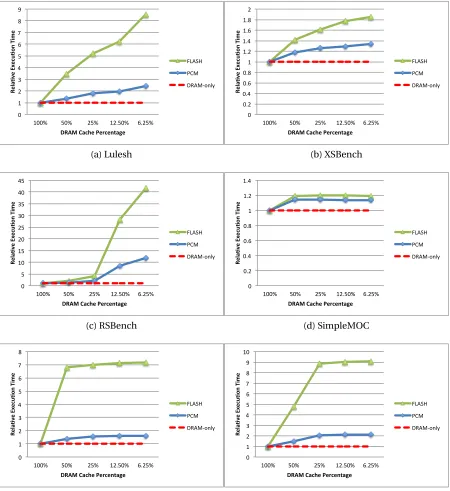
Figure 3.10 The Impact of DRAM:NVM Ratio on Performance of using PCM vs. Flash. . . 67
Figure 3.11 Summary of DRAM:NVM Ratio Impact on Performance. . . 68
Figure 3.12 Synchronous vs. Asynchronous Prefetching. . . 69
Figure 3.13 The Impact of OS-Level Prefetching. . . 70
Figure 3.14 The Impact of Replacement Policy. . . 72
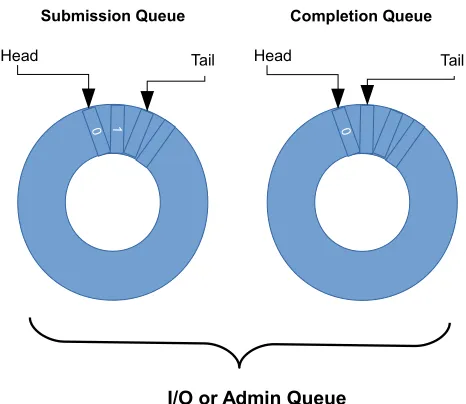
Figure 4.1 NVMe Queue Memory Structure. . . 78
Figure 4.2 NVMe I/O command stages. . . 79
Figure 4.3 NVMe controller’s Outstanding Requests Tracker (ORT). . . 79
Figure 4.4 NVMe Physical Region Descriptor Table (PRDT). . . 80
Figure 4.5 Overview of a system that uses an NVMe controller. . . 82
Figure 4.7 Different IO submission/completion queuing models. . . 87
Figure 4.8 Queuing model impact on overall execution time. . . 88
Figure 4.9 The number of row buffer misses for different queuing models. . . 90
Figure 4.10 Command submission time for various queuing models. . . 91
Figure 4.11 Command completion time for various queuing models. . . 91
Figure 4.12 NVM latency impact on performance. . . 93
Figure 4.13 Using periodic interrupt with different periodτlengths. . . 94
Figure 4.14 Periodic interrupt impact on performance. . . 95
Figure 4.15 Polling impact on performance. . . 95
Figure 4.16 Polling impact on traffic. . . 96
Figure 4.17 The traffic overhead of the NVMe protocol. . . 97
Figure 5.1 An example implementation of PCM-based DIMM[109]. . . 106
Figure 5.2 Example of counter mode memory encryption[8, 153]. . . 110
Figure 5.3 Part (a): ObfusMem access pattern obfuscation for a write request (a write back of the LLC block). A read request due to read/write miss of the LLC is handled similarly in the reverse direction (not shown). Part (b): Illustration of dummy request generation. . . 116
Figure 5.4 The execution time overhead of ObfusMem, normalized to unpro-tected system. . . 128
Figure 5.5 The impact of the number of channels on ObfusMem performance, compared to unprotected system with equal number of channels. . . 129
Figure 6.1 A scenario demonstrating the process of TLB Shootdown. . . 141
Figure 6.2 The impact of the migration threshold on fast memory miss rate and number of migrations. . . 143
Figure 6.3 A scenario demonstrating the Self-Invalidating TLB system. . . 146
Figure 6.4 Number of TLB shootdown normalized to the baseline (no self inval-idation) with varying lease length. . . 149
Figure 6.5 Impact of the lease length on execution time, normalized tonon self-invalidating TLB . . . 150
Figure 6.6 Desirable lease length for a given PTE. . . 151
Figure 6.7 Algorithms for dynamic lease length assignment. . . 153
Figure 6.8 Lookup of Expiration Time Table (ETT) as an extension to x86-64 page table. Entry for ETT is outlined in dotted lines.In x86-64, CR3 keeps the pointer to the root of the page table. . . 154
Figure 6.9 The impact of self-invalidating TLB entries (SITE) on performance of a system with heterogeneous memory (Page migration threshold=10).161 Figure 6.10 Normalized TLB shootdown count with varying lease assignment policy of SITE . . . 162
Figure 6.12 The impact of migration threshold on SITE’s performance. . . 164
Figure 6.13 The impact of TLB shootdown latency on SITE’s performance. . . 165
Figure 6.14 Impact of page table walk latency on SITE’s performance. . . 166
CHAPTER
1
INTRODUCTION AND BACKGROUND
Section 1.1.5, we discuss the challenges of current access pattern obfuscation techniques and how they are exacerbated when used with emerging NVMs.
1.1
Introduction
While the memory requirements for applications are continuously increasing, scaling down DRAM devices is becoming more difficult for several reasons. First, DRAM scalability is limited by the difficulty of fabricating small cylindrical cells for the capacitors. Second, future DRAM systems are expected to suffer from very high error rate, and hence an increase cost of error detection and correction logic. Finally, DRAM is volatile and needs refreshing cells frequently to overcome the capacitors charge leak. However, the refresh power has been shown to contribute to up to 40-50% of the overall power of the memory system[84, 99].
Due to DRAM scalability limitations, the research community has already started looking for other alternatives, such emerging Non-Volatile Memories (NVMs). Emerging NVMs are very promising candidates for replacing DRAM for several reasons: very fast, non-volatile and have promising scalability potentials. Furthermore, such emerging NVMs are orders of magnitudes faster than current technologies used in storage systems, e.g., NAND-Based Flash Solid-State Drives (SSDs).
Table 1.1: Comparison between emerging NVMs, DRAM and Nand-Flash.
Technology Features
Read Latency Write Latency Write
En-durance
Cell Size
Non-Volatility
Static Power
DRAM 10-60 ns 10-60 ns >1015 6-8F2 No Yes
Nand-Flash
20-100 us 200 us 104 4-5F2 Yes No
PCM 50-80 ns 150 ns 107−108 6-16F2 Yes No
STT <10 ns 12.5 ns >1015 37F2 Yes No
Memristor <10 ns 200 ns 1010 >5F2 Yes No
From the table, we can observe that PCM can be looked at as the most promising replacement for DRAM; denser with almost similar read latency. We can also observe that PCM is orders of magnitude faster than NAND-Flash and hence a good candidate for replacing NAND flash.
One important aspect to note about emerging NVMs is their relatively limited write endurance. As example, PCM can wear out tens of millions of times faster than DRAM. Furthermore, the writes to NVM devices are relatively slow and power consuming. Accord-ingly, the lifetime of NVMs is expected to affect directly the expected lifetime of the whole memory system.
1.1.1
Utilizing Emerging NVMs as Main Memory
NVM Memory
CPU 0 CPU 1 CPU 2 ... CPU N-1
Figure 1.1: NVM as main memory.
devices, it is better to have it directly accessible from the cache hierarchy rather than going through expensive software layers. One disadvantage of this scheme is the real need for wear-leveling and write reduction. Fortunately, several techniques and proposals have been proposed to tackle such problems[28, 110, 159]. However, the other disadvantage of this scheme is the security and data remenance. Unlike DRAM, NVMs keep data for long time after powering off the system, and hence any physical access to the machine can reveal processes’ data, e.g., a repairman can simply obtain a NVM chip, and later it can be scanned to reveal data. Therefore, using NVMs as main memory has been paired with encryption[27, 159].
to find which cells didn’t have their values changed since the last write and hence avoid writing them again[28].
Unfortunately, as observed by Young et al.[159], the encryption can significantly reduce the effectiveness of write reduction schemes. Accordingly, reducing the number of writes in encrypted NVM systems is of paramount importance. Later on this thesis, we present a novel approach the takes advantage of encryption to reduce one of the most expensive system-level operations and hence reduce the number of writes.
1.1.2
Utilizing NVMs as Memory Extension
fol-lowing questions. How can memory extensions affect the performance? How to maximize their performance? Most importantly, how fast can they wear out, and can we improve their lifetime?
1.1.3
Utilizing NVMs as I
/
O Devices
Emerging NVMs are very promising candidates for replacing NAND-Flash Solid-State Drives (SSDs) and Hard Disk Drives (HDDs) for many reasons. First, their read/write latencies are orders of magnitude faster. Second, some emerging NVMs, such as memristors, are expected to have very high densities, which allow deploying a much higher capacity without requiring increased physical space.
While the percentage of time taken for data movement over low-speed buses, such as PCI, is negligible for the overall read/write latency in HDDs, it could be dominant for emerging fast NVMs. Therefore, the trend has moved toward using very fast interconnect technologies, such as PCIe[105]which is hundreds of times faster than the traditional PCI[90]. Accordingly, new host controller interfaces are used to communicate with I/O devices, to exploit the parallelism and low-latency features of emerging NVMs through high-speed interconnects[2]. To understand the impact of using NVMs as I/O devices, we need to investigate the system bottlenecks and the communication protocol overhead.
overcome them.
Most of the recent studies focus on the implementation of the software layer of host controller interfaces[17]. They highlight a specific implementation changes and rarely discuss the bottlenecks in the architecture and hardware level.
Later in this thesis, we study the impact of using fast NVMs through high speed intercon-nects on the overall system performance. We discuss different possible implementations for the host controller interface and compare them from a system-level perspective. We also show how different implementations can impact performance when used with different latencies of NVM devices. Furthermore, we expose the host controller interface overhead in terms of the size of data transferred to and from the controller. The main purpose of this part of the thesis is to give insights for system architects and the NVMs’ host controller interface developers about what to consider when designing and optimizing future systems and interfaces.
1.1.4
Utilizing NVMs as Part of the Main Memory
and more flexible management of heterogeneous memory systems.
1.1.5
Low-Cost and NVM-Friendly Access Pattern Obfuscation
While encrypting data is expected with the adoption of NVMs, hiding the access patterns is also required. Hiding the access pattern has recently received attention from the computer architecture community. For instance, several proposals have focused on obfuscating the access pattern by using random shuffling of memory locations, namely Oblivious RAM (ORAM)and its hardware realization Path ORAM[136]. Unfortunately, many limitations hinder the deployment of ORAM on real system for several reasons. First, ORAM has non-zero failure probability. Second, the amount of wasted memory to keep failure probability reasonable can be up to 50% of the overall memory. Third, reshuffling the data on each access, by reading and then writing a large number of blocks, e.g., 25 buckets (100 cache blocks), can affect both of the performance and the lifetime of emerging NVMs.
Later in this thesis, we discuss and propose new mechanism for hiding the access pattern at extremely cheap cost. Our proposed solution is inspired by the current trend of designing memory modules for future technologies.
1.2
Organization of the thesis
CHAPTER
2
REDUCING WRITES ON SECURE
NON-VOLATILE MAIN MEMORIES
2.1
Introduction
81, 110, 156, 163]. Another serious challenge is the data remanence vulnerability, where NVMs retain data for NVMs a long time after a system is powered off whereas DRAM loses data quickly. Obtaining an NVM chip and scanning it can reveal data in memory. Memory encryption has been proposed to ward off data remanence attacks[27, 159]. While effective in dealing with the vulnerability, memory encryption worsens the write endurance problem. A good encryption scheme must have thediffusionproperty; the change in one bit in original data should change many bits in the encrypted data[135]. However, as pointed out by Young et al.[159], techniques to reduce the number of writes in NVMs, such as Data Comparison Write (DCW) and Flip-N-Write (FNW), lose effectiveness due to diffusion because these techniques are inspired by the observation that few bits will have their values changed after successive cache line writes.
Therefore, with memory encryption, reducing the number of writes is of paramount importance. The goal of this work is to find opportunities to reduce the number of writes to an encrypted NVM used as main memory. Specifically, we focus on the problem of data
shredding, which is one of the most frequent operating system (OS) operations[24]. Data
NVM
Virtual Machine
B
Hypervisor Kernel
Virtual Machine
A Process 0
Process 1 1
2 3
4
Main Memory
Virtual Machines Request
Request Zeroing
Zeroing
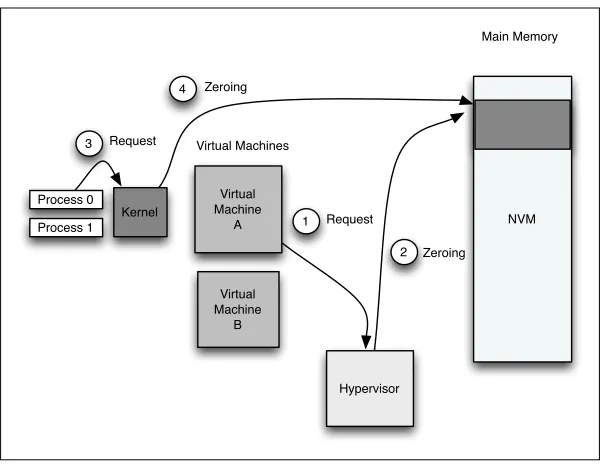
Figure 2.1: Example of duplicate data sherdding.
Virtual machines and local nodes’ kernels may prefer to request memory allocations with large granularity, for several reasons. The hypervisor or resource manager does not need to go through a large number of extra page table walks beyond the page table walks that occur at the virtual machine or local node level, hence reducing the cost of address translation misses. Another reason is to reduce the intervention between virtual machines or local nodes and resource managers, hence a better scalability. Accordingly, for instance, assume a system with hundreds of terabytes of memory and a large number of nodes, memory allocations can be in order of gigabytes or terabytes. Zeroing out such large amount of memory would be very slow. Furthermore, there is a chance that the virtual machine or the local node never writes the whole space, but shredding the whole assigned physical space is still required.
Previous work targeted speeding up zeroing pages in the context of DRAM main mem-ory[66, 124, 158]. However, since writes to DRAM are cheap, these studies proposed speed-ing up the zerospeed-ing operation, but not eliminatspeed-ing it. For example, Jiang et al.[66]suggest offloading the zeroing to a DMA engine, while Sehsadri et al.[124]shift the zeroing to within the DRAM. However, in both studies, the writes to the main memory still occur, and hence these methods are not suitable for use in NVM-based main memory.
unin-telligible when the page is allocated to another process. By making the page uninunin-telligible rather than zeroing it, the old data of a process is protected from being read by another process. The second insight is that when data in a newly allocated page is read, for software compatibility, the controller should skip the actual reading from NVM and instead should supply a zero-filled block to the cache. Silent Shredder achieves these goals by repurposing the IVs: it manipulates IVs to render data pages unintelligible and to encode the shredded state of a page. Note that Silent Shredder works with all modes of symmetric encryption that use IVs, including the counter mode used in recent secure NVM proposals. By avoiding shredding-related writes to NVM and the subsequent reads from NVM, Silent Shredder improves NVM’s write endurance, increases read performance, and reduces power con-sumption. All these are achieved using low-cost modifications to a standard counter-mode encrypted memory system.
To evaluate our design, we use gem5, a detailed full-system simulator, to run 3 graph analytics applications from the PowerGraph framework and 26 multi-programmed work-loads from the SPEC 2006 benchmark suite. Silent Shredder eliminates abouthalf(48.6%, on average) of the writes in the initialization and graph construction phases. Furthermore, it speeds up the memory reads by an average of 3.3 times and improves the instructions per cycle (IPC) by an average of 6.4%.
at zero cost when using secure NVMM controllers. We introduce our evaluation method-ology in Section 5.4 and present evaluation results and a parameter sensitivity study in Section 6.5. In Section 5.6, we discuss several use cases, security concerns, and remediation for Silent Shredder. We discuss related work in Section 5.7 and conclude with a summary in Section 5.8.
2.2
Background
In this section, we briefly describe emerging NVM technologies, memory encryption, and data shredding in OSes.
2.2.1
Non-Volatile Memories (NVMs)
Phase-Change Memory (PCM), Spin-Transfer Torque (STT-RAM) and Memristor are among emerging non-volatile memory technologies, some of which are considered as candidates for replacing DRAM for use as the main memory. Their read latencies and densities are either competitive or comparable with DRAM, and they may scale better than DRAM. However, NVMs suffer from slow and power consuming writes, and generally have limited write endurance, e.g., 10-100 million writes with Phase Change Memory[110]).
When an application or a VM requests and uses a persistent page, the OS should guarantee that its page mapping information is kept persistent, so the process or the VM can remap the page across machine reboots[96, 148]. There has been research on explicit software programming frameworks for exploiting persistent memory, e.g., ATLAS [26].
However, NVMM suffers from a serious security vulnerability: it retains data long after a system is powered off. Obtaining physical access to NVMM (through theft, repair, or improper disposal) allows attackers to read the plaintext of data[27, 159]. Accordingly, NVMM should be paired with at least some form of memory encryption.
2.2.2
Memory Encryption
There are two general approaches for encrypting NVMM. One approach assumes the processor is not modified, and the NVMM controller encrypts the main memory content transparently to the processor[27]. To minimize performance overheads, cold data, i.e, infrequently used data, stays encrypted, but hot data is proactively decrypted and stored in plaintext in memory. Another approach assumes that the processor can be modified and the processor chip is the secure base. Any data sent off chip in the main memory is encrypted. There are many example systems using the latter approach, including some recent studies[117, 153, 159].
AES-ctr mode
Page ID
Page Offset
Major Counter
Minor Counter Padding
IV
Key
Block to Write Back
Fetched Block (from memory) Ciphertext
(to memroy)
Plaintext (to cache) Counter Cache
Major
Ctr Minor counters
Pad
XOR XOR
Figure 2.2: State of the art counter mode encryption. AES is shown for encryption/decryption but other cryptographic algorithms are possible.
miss latency. Another mode iscounter modeencryption, where the encryption algorithm is applied to aninitialization vector(IV) to generate a one-time pad. This is illustrated in Figure 5.2. Data is then encrypted and decrypted via a simple bitwise XOR with the pad. With counter mode, decryption latency is overlapped with LLC miss latency, and only the XOR latency is added to the critical path of LLC miss. In state-of-the-art design, the IV of a counter mode encryption consists of a unique ID of a page (similar to a page address, but is unique across the main memory and swap space in the disk), page offset (to distinguish blocks in a page), a per-blockminorcounter (to distinguish different versions of the data value of a block over time), and a per-pagemajorcounter (to avoid overflow in counter values).
wherever they occur in memory; vulnerabilities include dictionary and replay attacks. Memory-side encryption, e.g. with secure DIMMs, is vulnerable to bus snooping attacks. In addition, processor-side encryption makes it easier to interface with the OS, use per-user and per-application keys, and expose key management to users and applications (where appropriate).
Counters are kept in the main memory, but are also cached on chip with one major counter of a page co-located in a block together with all minor counters of a page. For example, in[153], a 4KB page has a 64-bit major counter that is co-located with 64 7-bit minor counters in a 64-byte block. Any parts of the IV are not secret and only the key is secret. The security of counter mode depends on the pad not being reused, hence at every write back, a block’s minor counter is incremented prior to producing a new IV to generate a new pad. When a minor counter overflows, the major counter of the page is incremented and the page is re-encrypted[153]. Finally, counter mode integrity needs to be ensured to avoid attackers from breaking the encryption. While counters are not secret, they must be protected by Merkle Tree to detect any tampering to their values[117].
2.2.3
Data Shredding
of the zeroed physical pages[43]. In Linux, the kernel guarantees that a newly allocated virtual page is initially mapped to a special physical page called the Zero Page. The Zero Page is shared by all new allocated pages. The actual allocation of a physical page happens when the process writes to the page for the first write, using a mechanism referred to as copy-on-write (COW). During COW, a physical page (from another process) is zeroed out and the virtual page is remapped to it[20]. Similar mechanisms are deployed by hypervisors to avoid data leak between virtual machines[142].
The zeroing step itself can be implemented with different mechanisms[30]. One mech-anism relies on using temporal store instructions, e.g.,
movq
in the x86 instruction set, which brings each block into the cache before writing zero to it. The use of temporal store can cause cache pollution, where useful blocks are evicted and cause subsequent cache misses. The impact of cache pollution increases when dealing with large pages, such as 2MB and 1GB size pages. In addition, the mechanism works well if all cache blocks of the page are used shortly after zeroing; however, often this is not the case. Also, without additional mechanisms, zeroing blocks of the page in the cache is not secure as it does not persist the modifications to the NVMM right away. Hence, upon system failures, the zeroing may be lost, and data leak may occur.Another zeroing mechanism is using non-temporal store instructions, such as
movntq
There have been proposals to improve zeroing performance. Some studies have pro-posed offloading the zeroing step to the DRAM controller or the DMA engine, so that the CPU time is not wasted in zeroing pages and cache pollution is avoided[30, 66, 124]. Such techniques are effective in DRAM main memory, but with NVMM, the zeroing still results in high performance overheads due to high power consumption and latency of writes in NVMs, and reduced write endurance. Since our work targets memory controllers for NVMM, we consider techniques that zero out pages in main memory and bypass the caches entirely, but with a significant reduction in the actual zeroing operations.
2.3
Motivation
We start with an example to study the impact of kernel shredding on system performance. Assume a simple code that allocates and initializesS I Z E bytes of memory, as shown in the code snippet in Figure 2.3. As explained earlier in Section 5.2, the Linux kernel allocates and
// Allocating SIZE bytes
char ALLOC=(char) malloc(SIZE);
// Setting all allocated memory to 0
// Point 0
memset(ALLOC,0,SIZE);
// Point 1
memset(ALLOC,0,SIZE);
// Point 2
zeroes out a physical page right after the first write. Accordingly, the first store instruction in the first
memset
causes a page fault, the page fault handler then allocates a new physical page and zeroes it out, and finally maps it to the application process. As the application’smemset
resumes after the page fault, if the region is the size of a page, page zeroing isredundantly repeated. Overall, the first memset incurs the following delay: kernel page allocation, kernel zeroing, and program zeroing. In contrast, the second memset only has the program zeroing delay. Since program zeroing follows a similar mechanism as kernel zeroing, the second
memset
’s delay is a good proxy of kernel zeroing latency.memset
is more optimized than the kernel zeroing process- it uses non-temporal stores when the size of the memory to be initialized is bigger than the LLC, and hence avoids cache pollution. Hence it takes less time than kernel zeroing and in our experiments,memset
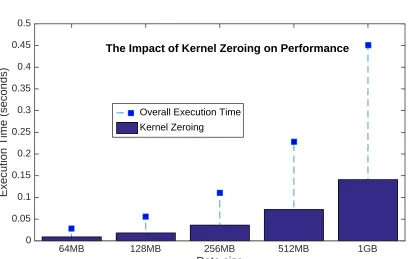
’s time is a conservative proxy for kernel zeroing time. Figure 2.4 shows the time spent to execute the first vs. the secondmemset
.The overall execution time is the time taken by the first memset (which includes page zeroing, page faults, and program zeroing), and the height of the blue bars is the time taken by the second memset (which only incurs program zeroing). We observe that on average, roughly 32% of the first
memset
time is spent in kernel zeroing. Our observation is consistent with previous studies that showed that up to 40% of the page fault time is spent in kernel zeroing[144]. Note that writing latency for NVMs is multiple times slower than that of DRAM, and hence the page zeroing is expected to become dominant and to contribute for most of the page fault time.Data size
64MB 128MB 256MB 512MB 1GB
Execution Time (seconds)
0 0.05 0.1 0.15 0.2 0.25 0.3 0.35 0.4 0.45 0.5
The Impact of Kernel Zeroing on Performance
Overall Execution Time Kernel Zeroing
number of writes was collected using performance counters. A system call was added to collect the number of times the kernel calls the
clear_page
function. For all real system experiments, we use Linux kernel 3.16.2 on a 12-core Intel Xeon E5-2620 CPU machine with 16GB main memory. The data sets we use are publicly released data sets from Netflix and Twitter[13, 160].0 0.2 0.4 0.6 0.8 1 1.2
su_tr iangle
_cou nt
simple _colo
ring pageran
k
d_ord ered_c
olorin g
ud_tr iangle
_cou nt
d_trian gle_c
ount kcore als
wals sgd sals Averag
e
Re
la
%v
e
nu
m
be
r o
f w
rit es (r ela% ve
to
the
unm
odifi
ed)
Benchmark
The impact of alloca%on schemes on # Writes
Unmodified Non-‐Temporal No-‐Zeroing
Figure 2.5: Impact of zeroing on the overall number of writes to the memory.
overall number of writes to the main memory is caused by kernel zeroing. The main reason behind this is that many data analytics applications exhibit a write-once read-many times behavior, where the graph is rarely modified after the graph construction phase.
In summary, we found that kernel zeroing can contribute very significantly to the execution time and the number of main memory writes, regardless of whether temporal or non-temporal writes are used. While such overheads are costly with DRAM main memory, they are multiple times more costly with NVMM due to the slow and power consuming nature of writes, and the reduction in NVMs’ lifetime until write endurance limit is reached.
2.4
Silent Shredder Design
In this section, we explore several design alternatives for data shredding and motivate the design choices in Silent Shredder.
2.4.1
Attack Model
or repairmen. Attackers may insert a bus snooper or a memory scanner to read out data communicated off the processor chip. They may also insert devices to overwrite the content of the main memory, or act as a man in the middle by returning false data requested by the processor chip. They may conduct known-plaintext attacks by observing the encrypted value of an expected data item, or employ dictionary-based attacks by guessing original values according to encrypted values’ frequency.
We leave out side-channel attacks because they are beyond the scope of this work and there are many side-channel protection mechanisms in the literature that can be added to Silent Shredder as needed.
Silent Shredder requires the OS to communicate page zeroing to hardware. This re-quires minimal modifications to the OS’s page fault handler; however, it rere-quires the OS to be trusted, as an untrusted OS can maliciously avoid page zeroing in order to cause data leak between processes. If the OS is not trusted, then processes must run in secure enclaves. Although beyond the scope of this work, we believe that Silent Shredder can be adapted relatively easily to work with secure enclaves. For example, the hardware can notify Silent Shredder directly when a page from an enclave is going to be deallocated. Further discussion about several security concerns when using counter-mode encryption and their remediations can be found in Section 2.7.1.
2.4.2
Skipping the Zeroing Writes
prevent data leakage. Writing any unintelligible or random content into the page before the page is reused achieves the same goal, as the process which gets the page will not be able to read any meaningful data from the page. In traditional (non-encrypted) memory, however, there is no advantage to writing a random pattern to a page compared to writing zeros to the page. In fact, writing zeros to a page is more efficient as various instruction sets may provide a special instruction to zero an entire cache block (e.g.,
dcbz
in PowerPC).However, in encrypted memory, the nature of cryptographic encryption can be exploited to initialize a reused page with a random patternfor free. For example, consider a page of data encrypted with the keyK1. Before the page is reused, if we change the key to a
different one,K2, then subsequent decryption of the page will result in unintelligible data.
The nature of encryption ensures that the new decrypted data is not correlated with the initial data, nor is it any easier to break encryption when attackers read data decrypted with a different key. Most importantly, the entire initialization writes to the reused page are completely eliminated, resulting in significant performance improvement, power savings, and write endurance improvement.
Addressing this requires the process ID or the process-specific key to be passed along with every memory request.
These challenges make the deployment of such a design costly. Thus, in Silent Shredder, we assume that processes share a single cryptographic key. In order to provide a way to initialize a reused page with a random pattern without using process-specific keys, we exploit the feature of counter-mode encryption where the initialization vector (IV) is what is encrypted to generate a pad. Essentially, if a block is encrypted with an IV,I V1, but decrypted
with a different IV,I V2, then even when the two IVs differ by just one bit, the decrypted
data is unintelligible. This is becauseD a t a 6=DK(I V2)⊕ EK(I V1)⊕D a t a
whereEK and
DK are encryption and decryption using the keyK. Therefore, to initialize a reused page
with unintelligible random data, it is sufficient to modify the page’s IVs. Note that this is true of any encryption mode that uses IVs, though we focus on counter mode in this work.
The next logical question is which parts of the IV should be modified. The page ID and the page offset components in an IV should not be modified as they ensure spatial uniqueness of the IV of a block. This leaves us with the per-page major counter and the per-block minor counter. We now discuss several possible approaches with different trade offs. One option is to increment all the minor counters in a page. This changes the IVs of all blocks in a page and avoids actual page zeroing. However, this option has drawbacks. One drawback is that since minor counters are typically small, e.g., 7 bits are recommended[153], incrementing minor counters induces a high probability of minor counter overflow, which causes expensive page re-encryption. Essentially, a block in a page can only be written back from the LLC to the NVMM 27=128 times before the page needs to be re-encrypted.
incrementing the page’s major counter, resetting all minor counters of the page, and writing back all blocks of the page from the cache to the NVMM. Page re-encryption is an expensive operation in DRAM main memory and is significantly more expensive in NVMM. Hence it should be avoided whenever possible.
To avoid increasing the frequency of page re-encryption, we can pursue a second option, where we increment the major counter and leave all minor counters unchanged. Since the major counter of a page is used to encrypt or decrypt all blocks in the page, incrementing the major counter is sufficient to initialize a reused page to a random pattern. Accordingly, we do not increase the frequency of page re-encryption since minor counters are unchanged.
A major drawback with both of these techniques is that they assume that the OS or applications are not implemented with the expectation that a newly-allocated page will have zero values. However, our observation is that this assumption is not valid in modern systems. For example, in Linux, we find that the
libc
system library’s runtime load (rtld
) code contains an error-checking assertion that verifies that pointer variables in a newly-allocated page have the value of zero (NULL
). Hence the two techniques give rise to software compatibility challenges.counter is not used during regular page re-encryption; for example, when a minor counter overflows, the minor counter will be reset to 1 instead of zero. Upon an LLC miss, the minor counter value for the block is checked. If it is zero, then the cache block is not fetched from memory. Instead, a zero-filled block is allocated in the cache, and returned to the
ld
orst
instruction that accesses the block. This approach has the side benefit of reducing page re-encryption frequency as it lengthens the time until page re-encryption. For the rest of the chapter, we use the third option to accomplish page shredding, where the major counter is incremented and minor counters are reset.
Note that without the Silent Shredder mechanism, shredding a memory page in con-ventional NVMM will cause every minor counter on a page to be incremented,in addition towriting zeros to the main memory. Thus, Silent Shredder does not increase the number of writes to counters, but it completely avoids page zeroing writes.
2.4.3
Silent Shredder’s Design
necessary for keeping the caches coherent, even though the blocks will not be actually written. When a remote core has a cache miss, it will be forced to reload updated counters for the page and the missing block in the page.
After the invalidation, the counters can be changed (Step 3) by incrementing the major counter of the pagep and resetting all the minor counters to zero. Finally, the counter cache controller acknowledges (Step 4) the completion of updating counters, and the MC signals the completion to the processor. At this time, the zeroing is completed without any blocks in the page ever written to the NVMM.
Note that steps 2, 3, 4 and 5 are correctness requirements for any kind of bulk zeroing that bypasses the cache hierarchy, e.g., non-temporal zeroing and DMA engine support. Most modern integrated memory controllers have the ability to invalidate and flush cache lines; DMA region writes should invalidate any stale data in the cache hierarchy[61, 124]. Furthermore, a simple serializing event, e.g.,
sfence
, can be implemented to ensure that all invalidations have been posted and that the counter values have been updated. For example, in Linux, non-temporal zeroing stores are followed bysfence
to guarantee that all writes have been propagated to main memory. A similar approach can be adopted in Silent Shredder, e.g., following shredding the command withsfence
orpcommit
, where the memory controller guarantees that serializing events such assfence
orpcommit
Counter Cache
Major
Ctr Minor counters
p
Tag
Proc
Cache and Coherence Controller Memory
Controller 1. Shred p
+1
0 0 0 0 0 0 0
3. Increment M reset m1...m64
2. Invalidate p
4. Ack 5. Done
Figure 2.6: Silent Shredder’s shredding mechanism.
the memory controller (Step 3a), which then obtainsx from the NVMM, decrypts it, and returns it to the LLC (Step 4). On the other hand, if the value of the minor counter is zero, then a zero-filled block is returned to the LLC.
Overall, Silent Shredder’s mechanism achieves the following savings compared to tradi-tional page zeroing mechanisms:
1. During page shredding, none of the cache blocks of the page are written.
2. When any of the 64 blocks in a shredded page is read for the first time, the NVMM is not accessed, and instead a zero-filled block is installed in the cache.
Both of these savings improve performance, both during and after shredding. Further-more, the first item reduces power consumption and improves write endurance of NVMM due to skipping writes.
Counter Cache
Major
Ctr Minor counters Tag
NVMM LLC
=0?
1. Miss x
MC
00..0 2. Read the minor
counter of the block x
3a. No: fetch x 3b. Yes
4. Return the fetched block or a zero-filled block
Dk
Figure 2.7: Silent Shredder’s mechanism for servicing an LLC miss.
mode that uses IVs: CBC, PCBC, CFB, OFB, and CTR. Such encryption modes have the well-known property that encrypted data cannot be decrypted without both the encryption key and the IV that were used to encrypt it. In our scheme, Silent Shredder zeros out the minor counter and increments the major counter in the IV, thereby changing the IV originally used for encryption, making the encrypted data totally irrecoverable.
Data Recovery:In our case, recovering data in case of disasters is the same as with secure DIMMs. For security reasons, encryption keys need to be stored outside the DIMM or stored securely in the DIMM, e.g. encrypted with a master recovery key. Similar mechanisms to recover keys apply to both cases. In addition, the IVs must be backed up to NVMM. Once the keys and the IVs are obtained, the data can be recovered. In addition, redundancy and key sharing can be used for recovery.
2.5
Evaluation Methodology
We use a modified version of Linux kernel 3.4.91 in our experiments. Specifically, we replace
the
clear_page
function used to clear new physical pages with our shreddingmecha-nism. We use a memory-mapped I/O register for writing the physical address of the page to be shredded. We use the default page size of 4KB. Shredding any page larger than 4KB, such as 2MB and 1GB, can be done by sending a shred command for each 4KB of the large page. In Linux, the function for clearing large pages,
clear_huge_page
, already callsthe
clear_page
function for each 4KB. Therefore, no more modifications are needed.We run our modified Linux kernel on gem5, a full system cycle-accurate simulator[16]. We extended gem5’s memory controller to include a counter cache and a memory-mapped I/O register. We run 26 SPEC CPU2006 benchmarks with the reference input[134]. We also run 3 benchmarks from PowerGraph benchmark suite: page rank, simple coloring and kcore[47]. All benchmarks were compiled with default settings and optimizations.
PowerGraph benchmarks at the beginning of the graph construction phase, and the SPEC benchmarks at the beginning of the initialization phase. In the baseline configuration without Silent Shredder, we assume that when receiving a shred command, shredded cache blocks are invalidated and written back (if dirty) to the main memory. In other words, the baseline shredding uses non-temporal stores. Such an assumption guarantees that similar number of instructions are executed when comparing Silent Shredder with the baseline; similar kernel binary and checkpoints are used. For fair comparison, we assume that for both the baseline and Silent Shredder, invalidation of all cache blocks is sent right after receiving the shredding command.
We warm up the system caches for 1 billion cache accesses and then run the applications until at least one core has executed 500 million instructions (a total of approximately 4 bil-lion instructions for an 8-core system). Since the shredding operation is microarchitecture-independent operation and given the impractical simulation time of detailed microar-chitecture CPU model along with full-system simulation and modern kernel, we use the SimpleCPU model of Gem5 to run our modified kernel. For SPEC benchmarks, we run an instance of the benchmark on each core.
The system configuration used in our simulations is shown in Table 6.1. Similar to the expected trend of modern cache hierarchies, our system has a 4-level cache hierarchy[137]. L4 and L3 caches are shared among all cores, while L1 and L2 caches are private for each core. We also assume a battery-backed writeback counter cache.
Table 2.1: Configurations of the baseline system.
Processor
CPU 8 cores x86-64 processor, 2GHz clock
L1 Cache 2 cycles, 64KB size, 8-way, LRU, 64B block size
L2 Cache 8 cycles, 512KB size, 8-way, LRU, 64B block size
L3 Cache 25 cycles, 8MB size, 8-way, LRU, 64B block size
L4 Cache 35 cycles, 64MB size, 8-way, LRU, 64B block size
Coherency Protocol MESI
Main Memory
Capacity 16 GB
# Channels 2 channels
Channel bandwidth 12.8 GB/s
Read Latency 75 ns
Write Latency 150 ns
Counter Cache 10 cycles, 4MB size, 8-way, 64B block size
Operating System
OS Gentoo
Kernel Version 3.4.91
choice of the capacity of the counter cache to be 4MB. The latency of the counter cache was obtained using the CACTI 6.0 tool[97].
2.6
Evaluation
2.6.1
Write Reduction
The main goal of Silent Shredder is to reduce the number of writes occurring as a result of the kernel zeroing process for shredding previous data. We find that an average of 48.6% of the main memory writes in the initialization phase could be eliminated. Figure 2.8 shows the percentage of writes to the main memory that we could save by using Silent Shredder.
0.00% 10.00% 20.00% 30.00% 40.00% 50.00% 60.00% 70.00% 80.00% 90.00% 100.00%
H264 LBM LESLIE3D
LIBQU ANTU
M MILC NAMD OMN ETPP PERL POVRAY SJENG
SOPLEX SPHINIX XAL AN ZEUS
ASTAR BZI P
BWAV ES MCF
CACTU S
DEAL
GAME SS
GCC GEMS GO GRO
MAC S
HMME R
PAG ERAN
K
SIMP LE_C
OLORI NG
KCORE
Avera ge
Wri
te sa
vi
ngs
Benchmark Write savings
Figure 2.8: Savings on writes to the main memory.
count all kernel shredding writes, regardless of the semantics of the program.
Eliminating a significant number of writes is very important; it reduces the memory traffic, increases performance by eliminating slow and power consuming NVMM writes, and increases the lifetime of the NVMM. Our evaluation focuses on the start up or graph initialization phase which is important because the graphs get rarely modified after initial-ization, hence significant percentage of the main memory writes occur at this phase. The startup phase is not the only scenario where Silent Shredder is effective. In a system that is highly loaded, data shredding will occur frequently because the high load from multiple workloads are placing a high pressure on the physical memory. For example, most data center servers today are not very good in terms of energy proportionality (idle power is approximately 50% of peak power), and therefore peak energy efficiency is achieved when the data centers are highly loaded resulting in very high processor utilization rates[38]. A highly loaded system will suffer from a high rate of page faults, and page fault latency is critical in this situation.
2.6.2
Read Traffic Reduction
Another important advantage of using Silent Shredder is the ability to recognize shredded cache blocks from their minor counter values. Once a read to a shredded block is detected, a zero-filled block will be returned to the cache hierarchy without the need to read the invalid data from the main memory. We find a surprisingly large percentage of the initialization read traffic can be eliminated.
0.00% 10.00% 20.00% 30.00% 40.00% 50.00% 60.00% 70.00% 80.00% 90.00% 100.00%
H264 LBM LESLIE3D
LIBQU ANTU
M MILC NAMD OMN ETPP PERL POVRAY SJENG SOPLEX SPHINIX XAL
AN ZEUS ASTAR BZI
P BWAV
ES MCF
CACTU S
DEAL GAME
SS
GCC GEMS GO GRO
MAC S HMME
R
PAG ERAN
K
SIMP LE_C
OLORI NG
KCORE Avera
ge
Re ad s av in gs
Benchmark
Read traffic savings
Figure 2.9: Percentage of the saved main memory read traffic.
run memory-intensive benchmarks with limited memory bus bandwidth. Identifying that a block is shredded happens quickly: any shredded block read request can be completed once its minor counter value is read. Figure 2.10 shows the speed up ratio of the average memory read latency for each benchmark. On average, Silent Shredder achieves an average memory read speed up ratio of 3.3×across the benchmarks.
2.6.3
Overall Performance Improvement
As mentioned earlier, in addition to eliminating shredding writes, Silent Shredder also speeds up reading shredded cache lines. These two improvements together improve the IPC. Figure 2.11 shows the relative IPC when using Silent Shredder (higher is better), normalized to the baseline.
0 2 4 6 8 10 12
H264 LBM LESLIE3D
LIBQU ANTU
M MILC NAMD OMN ETPP PERL POVRAY SJENG
SOPLEX SPHINIX XAL AN ZEUS
ASTAR BZI P
BWAV ES MCF
CACTU S
DEAL
GAME SS
GCC GEMS GO GRO
MAC S
HMME R
PAGERAN K
SIMP LE_C
OLORI NG
KCORE
Avera ge
Me
m
or
y
Re ad S pp ed u
p
Benchmark
Memory Read Speedup
Figure 2.10: The speed up of the main memory reads.
instructions that access either main memory or shredded cache blocks.
2.6.4
Counter Cache Size
The IV cache should be fast enough so that encryption, specifically OTP generation, starts as soon as possible. Accordingly, the IV cache needs to be as small as possible while achieving a high hit rate.
1 1.05 1.1 1.15 1.2 1.25 1.3 1.35
H264 LBM LESLIE3D
LIBQU ANTU
M MILC NAMD OMN ETPP PERL POVRAY SJENG
SOPLEX SPHINIX XAL AN ZEUS
ASTAR BZI P
BWAV ES
MCF CACTU
S DEAL
GAME SS
GCC GEMS GO GRO
MAC S
HMME R
PAGERAN K
SIMP LE_C
OLORI NG
KCORE
Avera ge
Re
la
Gv
e
IP
C
Benchmark
RelaGve IPC when using Silent Shredder
Figure 2.11: Overall IPC improvement.
IV Cache size
32KB 64KB 128KB 256KB 512KB 1MB 2MB 4MB 8MB 16MB 32MB
IV Cache miss rate
0.02 0.03 0.04 0.05 0.06 0.07 0.08 0.09
The impact of IV cache size on miss rate
Figure 2.12: The impact of cache size on miss rate.
2.7
Discussion
extra cost.
2.7.1
Security Concerns
Several security concerns can arise when using counter-mode encryption in general. Other concerns arise when relying on hardware to achieve operating system privileged tasks. In this section, we discuss the concerns and their remediations.
• Tampering with Memory and Encryption Counter Values: Since data is already
encrypted, tampering with the memory values can cause unpredictable behavior. However, tampering with or replaying the counter values can be a security risk. While out of the scope of this paper, to avoid such risk, techniques such as Bonsai Merkle Trees can be used for authenticating the counter values with low overhead (about 2%) [117, 153]. The only information that could be leaked to an adversary is whether a page is shredded or not; a minor counter of 0 will indicate shredding, however, such information is useless. If we want to hide such information, the only modification needed is to encrypt the IV counters when writing to the main memory.
• Losing Counter Cache Values in Case of Power Loss: In counter-mode encryption,
Another way for achieving persistence of the counter cache would be a write-through implementation, i.e., any update to the counter cache is also updated in NVMM. In the latter case, non-temporal stores or DMA engine zeroing write zeros to NVMMin
addition tothe counter cache block. However, in Silent Shredder only the counter
cache block is written to NVMM.
• Using the Shred Command from User Space: As explained earlier, the Shred
com-mand hints the memory controller with a physical page address to shred. Allowing user-space applications to issue shred commands can be a security risk. Accordingly, we implement the shred command so that it can be executed only by the kernel (kernel-mode) and only when the kernel allocates a new physical page to a process. Any attempt to write the memory-mapped I/O register of the memory controller from a user-space process will cause an exception.
2.7.2
Other Use Cases for Silent Shredder
While our main goal in this paper is data shredding, Silent Shredder can be used in other areas.
• Virtual Machine Isolation in Virtualized Environments: In VMs, zeroing out pages
of translation and hence speed up the page table walk process[107]. Furthermore, large allocations can reduce the number of hypervisor interruptions. Silent Shredder can speed up the VM requests by completely avoiding zeroing out pages. In case of highly-shared systems, the hypervisor continuously reclaims physical memory pages from VMs in a process called memory ballooning, in order to be able to satisfy requests from VMs with higher memory demand[142]. Accordingly, data shredding will be very frequent and hence Silent Shredder can be of substantial use.
• Initializing Large Blocks of Memory: Some applications tend to zero out large
amount of allocated memory, e.g., a sparse matrix, as part of the initialization phase. Such initialization can benefit from the hardware support provided by Silent Shred-der. Applications would invoke a system call to provide the kernel with the starting virtual address and the number of pages to be zeroed out. The system call would be translated by the kernel shred command with the corresponding physical address.
• Zero Initialization in Managed Programming Languages: In managed languages,
Table 2.2: Comparison between Silent Shredder and other initialization techniques.
Mechanism Features
No Cache
Pollution
Low Proces-sor Time
Fast to
Read-/Write
No Memory Writes
Persistent No Memory
Bus Writes
Non-temporal stores
3 7 7 7 3 7
Temporal stores
7 7 3 7(indirectly) 7 7(indirectly)
DMA bulk
zeroing engine
3 3 7 7 3 7
RowClone (DRAM-specific)
3 3 7 7 3 3
Silent Shredder
3 3 3 3 3 3
2.8
Related Work
In this section, we discuss prior work related to our work. Since our work is interdisciplinary and has intersections with different research problems, we summarize previous work by the problems they addressed.
Data Shredding: Data shredding is the process of erasing data previously written by
a process to prevent inter-process data leak. Chow et al.[30]discuss the importance of shredding data during page deallocation and investigate both temporal and non-temporal ways to zero out pages for shredding purposes. Currently, modern operating systems deploy shredding by zeroing out pages[20, 43, 119, 129]. Our work achieves the shredding process at zero-cost by eliminating the need to write to the main memory.
process to a dedicated DMA engine close to the memory controller. Their design reduces both cache pollution and wasted processor time. Seshadri et al.[124]observe that significant memory bus bandwidth could be wasted by initialization. Accordingly, they suggest the zeroing operation to occur within DRAM by dedicating a zero row inside each DRAM subarray. Their design, RowClone, efficiently reduces the fraction of bus bandwidth used for initialization. However, in both the previously mentioned work, writes to the memory cells still occur. Lewis et al.[79]propose reducing the memory access required to fetch uninitialized blocks on a store miss by using a specialized cache to keep track of uninitialized regions of memory. While their work and Silent Shredder have similar advantages, our design’s main goal is to efficiently protect applications’ data. Speeding up applications and reducing memory traffic are additional advantages of the way we shred data. Yang et al.
[158]study the performance implications when using temporal versus non-temporal stores
will be impossible.
Secure Non-Volatile Memory Controllers: Chhabra & Solihin[27]propose encrypting
cache lines when writing to the main memory. Their design aims to efficiently avoid reveal-ing data when NVMM chips get stolen. However, their implementation does not protect from bus-snoop, dictionary-based and replay attacks. Later, Young et al.[159]propose a design that uses counter-mode based encryption that eliminates bus-snoop attacks, replay attacks, dictionary-based attacks, and physical NVM access attacks. Their design, DEUCE, uses AES counter mode for encrypting cache lines before writing back to the main memory. Our secure NVMM controller is based on a design similar to the one in DEUCE. Accordingly, it prevents all the previously mentioned attacks.
Write-aware Non-Volatile Memory Controllers: Writes to NVM-based main memory
work is orthogonal and can be easily integrated with their design, DEUCE. DEUCE targets reducing the need for changing cells’ values when a cache line write is certain to occur. However, Silent Shredder eliminates the cache line writes completely when shredding new pages.
2.9
Conclusion
CHAPTER
3
UTILIZING EMERGING NON-VOLATILE
MEMORIES AS MAIN MEMORY
3.1
Introduction
The chapter is organized as follows. In Section 3.2, we discuss how memory extensions work and their expected impact on lifetime. We present the related work in Section 5.7. Later, we discuss our emulation methodology and assumptions in Section 3.4. In Section 6.6, we discuss and study our memory extension emulation. We also propose and study several performance optimizations and write reduction techniques. Finally, we conclude our work in Section 5.8.
3.2
Memory Extensions
Memory extensions are those memories dedicated for extending memory capacity. At any instance of time, a memory page can be either in the DRAM or the NVM. However, any access to an NVM page will be handled by the OS and this results in moving the page to DRAM, as shown in Figure 3.1.
NVM DRAM
Accessing page X in NVM X
NVM DRAM
X
Page fault handler moves page X to DRAM and evict page Y to NVM
Y Y
NVM DRAM
X Y
Unmap page Y and map page X
1 2 3