CHAPTER
8
FOOD
PROCUREMENT
After water! man!s most urgent requirement is food. In con-templating virtually any hypothetical survival situation! the mind immediately turns to thoughts offood. Unless the situa-tion occurs in an arid environment! even water! which is more important to maintaining body functions! will almost always follow food in our initial thoughts. The survivor must remember that the three essentials of survival-water! food! and shelter-are prioritized according to the estimate
of the actual situation. This estimate must not only be
timely but accurate as well. Some situations may well dic-tate that shelter precede both food and water.
ANIMALS FOR FOOD
Unless
you have
the chance
to take large game! concentrate your efforts
.
species are also easier to prepare. You must not know all the animal species that are suitable as food. Relatively' few are poisonous, and they make a smaller list to remember. What is important is to learn the hao-its and behavioral patterns of classes of animals. For example, animals that are excellent choices for trapping, those that inhabit a particular range and occupy a den or nest, those that have somewhat fixed feeding areas, and those that have trails leading from one area to another. Larger, herding animals, such as elk or caribou, roam vast areas and are somewhat more difficult to trap. Also, you must understand the food choices of a particular species.
You can, with relatively few exceptions, eat anything that crawls, swims, walks, or flies. The first obstacle is overcoming your natural aversion to a particular food source. Historically, people in starvation situations have resorted to eating everything imaginable for nourishment.
A
person who ignores an otherwise healthy food source due to a personal blas, or because he feels it is unappetizing, is risking his own survival. Although it may prove difficult at first, a survivor must eat what is available to maintam his health.Insects
The most abundant life-form on earth, insects are easily caught. Insects provide 65 to 80 percent protein compared to 20 percent for "beef. This fact makes insects an important, if not overly appetizing, food source. Insects to avoid include all adults that sting or bite, hairy or brightly colored insects, and caterpillars and insects that have a pungent odor. Also avoid spiders and common disease carriers such as ticks, flies, and mosquitoes.
Rotting logs lying on the ground are excellent places to look for a variety of msects including ants, termites, beetles, and grubs, which are beetle larvae. Do not over1ook insect nests on or in the ground. Grassy
.
You can grind a collection of insects into a paste. You can mix them with edible vegetation. You can cook them to improve their taste.
Worms
Worms
(Annelidea)
are an excellentprotein source. Dig for them in
damp humus soil or watch for them on the ground after a rain. After capturing them, drop them into clean, potable water for a few minutes. The worms will naturally purge or wash themselves out, after which you can eat them raw.
Crustaceans
Freshwater shrim}?range in size from 0.25 centimeter up to 2.5 centi-meters. They can form rather large colonies in mats of floating algae
or in mud bottoms of ponds and fakes.
Crayfish are akin to marine lobsters and crabs. You can distinguish
them by their hard exoskeletonand five pairs of leRs,the front pair
having oversized pincers. Crayfish are active at nignt, but you can
locate them in the daytime by looking under and around stones in
streams. You can also find them by looking in the soft mud near the
chimneylikebreathing holes of their nests.Y'ou can catch crayfish by
tying bIts of offal or mternal organs to a string. When the crayfish
graDsthe bait, pull it to shore Deforeit has a chance to release
the bait.
You find saltwater lobsters, crabs, and shrimp from the surf's edge out to water 10 meters deep. Shrimp may come to a light at night wnere you can scoop them up with a net. You can catch lobsters and crabs with a baited trap or a baited hook. Crabs will come to bait placed at the edge of the sud, where you can trap or net them. Lobsters and crabs are nocturnal and caught best at night.
Mollusks
.
River
snails
or freshwater p'eriwinkles are plentiful in rivers, streams, and lakes of northern coniferous forests. These snails may be pencil point or globular in shape.""" """." ".."." """.,,,, ,,",,.~ """
" ,....
' """"""''''''''n..'''''''''''''''''""""""""" u... CLAM
SEA CUCUMBER
, ,...,
SQUID
.
In fresh water, look for mollusks in the shallows, especially in water with a sandy or muddy bottom. Look for the narrow trails they leave in the mud or for the dark elliptical slit of their open valves.
Near the sea, look in the tidal pools and the wet sand. Rocks along beaches or extending as reefs into deeper water often bear clinging
shellfish. Snails and 1impets cling to rocks and seaweed from the low water mark upward. Large snails, called chitons, adhere tightly to rocks above the surI line.
Mussels usually form dense colonies in rock pools, on logs, or at the base of boulders.
CAUTION
Mussels may be poisonous in tropical zones during the summer!
Steam, boil, or bake mollusks in the shell. They make excellent stews in combination with greens and tubers.
CAUTION
Do not eat shellfish that are not covered by water at high tide!
Fish
Fish represent a good source of protein and fat. They offer some distinct advantages to the survivor or evader. They are usually more abundant than mammal wildlife, and the ways to get them are silent. To be suc-cessful at catching fish, you must Know their habits. For instance, fish tend to feed heavily before a storm. Fish are not like~y to feed after a storm when the water is muddy and swollen. Light often attracts fish at night. When there is a heavy current, fish will rest in places where there is an eddy, such as near rocks. Fish will also gather where there are deep pools, under overhanging brush; and in and around submerged foliage, logs, or other objects That ofter them shelter.
.
Cook all freshwater
fish to
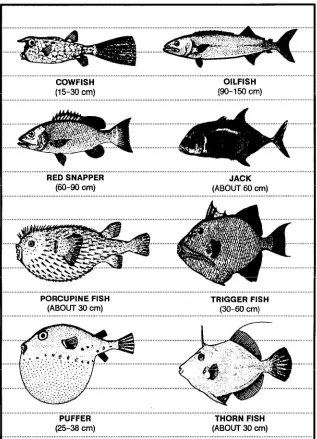
kill parasites. Also cook saltwater fish caught within a reef or within the influence of a freshwater source as a precau-tion. Any marine life obtained farther out in the sea will not contain parasites because of the saltwater environment. You can eat these raw. Certain saltwater species of fish have poisonous flesh. In some species the poison occurs seasonally in others, it is permanent. Examples of p'oisonous saltwater fish are the porcupine fish, triggerfish, cow fish, thorn fish, oilfish, red snapper, Jack, and puffer (Figure 8-2). The barracuda, while not actually poisonous ifself, may transmit ciguatera(fish poisoning) if eaten raw.
Amphibians
Frogs and salamanders are easily found around bodies of fresh water. Frogs seldom move from the safety of the water's edge. At the first sign of danger, they plunge into the water and bury themselves in the mUG and debris. There are few poisonous species of frogs. Avoid any brightly colored frog or one that has a distincflX" mark on it's back. Do not confuse toaas with frogs. You normally find toads in drier environments. Several species of toaas secrete a poisonous substance through their skin as a defense against attack. Therefore, to avoid poisoning, do not handle or eat toads.
Salamanders are nocturnal. The best time to catch them is at night using a light. They can range in size from a few centimeters
to
well over60
centimeters in length. Look in water around rocks and mud banks for salamanders.Reptiles
Reptiles are a good protein source and relatively easy to catch. You should cook tnem, but in an emergency, you can eat them raw. Their raw flesh may transmit parasites, out because reptiles are cold-blooded, they do not carry the blood diseases of the warm-blooded animals. The box turtle is a commonly encountered turtle that you should not eat. It feeds on poisonous mushrooms and may build up a highly toxic poison in its flesh. Cooking does not destroy this toxin. Avoid tfte hawks-bill turtle, found in the At1antic Ocean, because of its poisonous thorax
.
m~
',;'
,...,-...
COWFISH (1"-~ t'm\ \''''' -.."
OILFISH (90-150 em)
"""...
'.:...
'
,.., "'.n ','",,,,',",",,',,,,,"",,,, RED SNAPPER
(60-90 em)
JACK (ABOUT 60 em) .., ,", ", """"""""""""""""""""""""'"''''...
...
, ,...
PORCUPINE FISH (ABOUT 30 em)
TRIGGER FISH (30-60 em)
,' ' '
... PUFFER
(25-38 em)
THORN FISH (ABOUT 30 em) ...
Types of Birds Frequent Nesting Places Nesting Periods
Inland birds Trees. woods, or fields Spring and early summer
in temperate and arctic regions: year round in the tropics
Cranes and herons Mangrove swamps or Spring and early summer high trees near water
Some species of owls High trees Late December through March
Ducks. geese. and Tundra areas near ponds. Spring and early summer swans rivers. or lakes in arctic regions
Some sea birds Sandbars or low sand Spring and early summer islands in temperate and arctic
regions
Gulls, auks, murres, Steep rocky coasts Spring and early summer and cormorants in temperate and arctic
regions
.
Birds
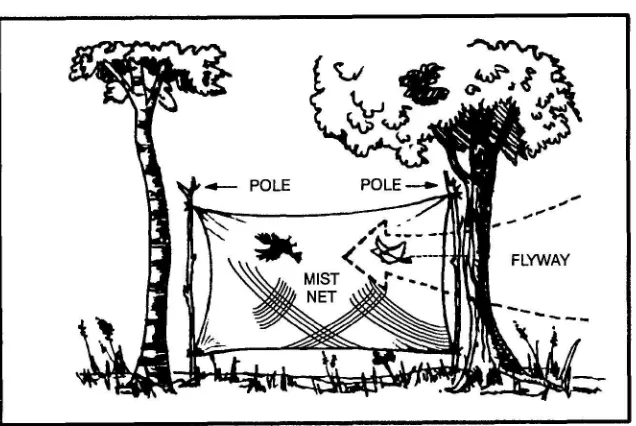
All species of birds are edible, although the flavor will vary considerably. You may skin fish-eating birds to improve their taste. As with any wild animal, you must understand birds' common habits to have a realistic chance of capturing them. You can take pigeons, as well as some other species, from their roost at night by hand. During the nesting season, some species will not leave the nest even when approached. Knowinj!; where and when the birds nest makes catching them easier (Fig1!re if-3). Birds tend to have regular fl~ays going from the roost to a feeding area, to water, and so forth. Carefur observation should reveal where these flyways are and indicate good areas for catching birds in nets stretched across the flyways (Figure 8-4). Roosting sites and waterholes are some of the most promising areas for trapping or snaring.
Nesting birds present another food source-eggs. Remove all but two or three eggs from the clutch, marking the ones at you leave. The bird will contmue to lay more eggs to filr the clutch. Continue removing the fresh eggs, leaving the ones you marked.
.
Mammals
Mammals are excellent protein sources and, for Americans, the most tasty food source. There are some drawbacks to obtaining mammals. In a hostile environment, the enemy may detect any traps or snares placed on land. The amount of injury an animal can inflict is in direct
propor-tion to its size.All mammalsnave teeth and nearly all will bite
illself-defense. Even a squirrel can inflict a serious wound and any bite presents a serious risK of infection. Also, a mother can be extremely aggre.ssive in defense of her young. Any animal with no route of escape Win fight when cornered.
All mammals are edible; however, the polar bear and bearded seal have toxic levels of vitamin A in their livers. The platypus, native to Australia and Tasmania, is an egg-laying, semiaquatic mammal that has p'oisonous glands. Scavenging mammals, such as the opossum, may carry aiseases.
TRAPS AND SNARES
For an unarmed survivor or evader, or when the sound of a rifle shot could be a problem, trapping or snaring wild game is a good alternative.
.
Several well-placed traps have the potential to catch much more game than a man with a rifle is likely to Shoot. To be effective with any type of trap or snare, you
must-.
Be familiar with the species of animal you intend to catch..
Be capable of constructing a proper trap..
Not alarm the prey by leaving signs of your presence.There are no catchall traps you can set for all animals. You must deter-mine what species are in a given area and set your traps specifically with those animals in mind. LOOK for the following
.
Runs and trails..
Tracks..
Droppings..
Chewed or rubbed vegetation..
Nesting or roosting sites..
Feeding and watering areas.Position your traps and snares where there is proof that animals pass through. You must determine if it is a "run" or a "traiL"
A
trail will
show signs of use by several species and will be rather distinct. A run is usualry smaller and less distinct and will only contain signs of one species. You may construct a perfect snare, but it will not catch anything if haphazardly placed in the woods. Animals have bedding areas, water-holes, and feedmg areas with trails leading from one to another. You must place snares and traps around these areas to be effective.
.
mammals
depend
on smelleven more than on sight. Even the slightest
human scent on a trap will alarm the prey and cause it to avoid tne area. Actually removing the scent from a trap is difficult but masking it is relatively easy. Use the fluid from the gall and urine bladders of pre-vious kills. Do not use human urine. Mud, particularly from an area with plenty of rotting vegetation, is also good. Use it to coat your hands when handling the trap and to coat the tra
y
when setting it. ill nearly all partsof the world, ammals know the smel of burned vegetation and smoKe.It is only when a fire is actually burning that they become alarmed. There-fore, smoking the trap parts is an effective means to mask your scent. If one of the a130vetecnmgues is not practical, and if time permits, allow a trap to weather for a few days and then set it. Do not nandle a trap while it is weathering. When you position the trap, camouflage it as naturally as possible to prevent detection by the enemy and to avoid alarming the prey.
Traps or snares placed on a trail or run should use channelization. To buiId a channel, construct a funnel-shaped barrier extending from the sides of the trail toward the trap, with the narrowest part nearest the trap. Channelization should be mconspicuous to avoid alerting the prey. As the animal gets to the trap, it cannot turn left or right amf contmues into the trap. Few wild animals will back up, preferring to face the direc-tion of travel. Channelizadirec-tion does not have to be an impassable barrier. You only have to make it inconvenient for the animal to go over or through the barrier. For best effect, the channelization snould reduce the trail's width to just slightly wider than the targeted animal's body. Maintain this constriction at least as far back from the trap as the ani-mal's body length, then begin the widening toward the mouth of the funnel.
Use of Bait
.
strange food. Under such circumstances it may not go for the bait. One bait tnat works well on small mammals is the peanut butter from a meal,
ready-to-eat
(MRE)
ration. Salt is also a good bait. When using such
baits, scatter bits of it around the trap to give the prey a chance to sam-ple it and develop a craving for it. Tne ammal will then overcome some of its caution before it gets to the trap.
If you set and bait a trap for one species but another species takes the batt without bein~ caught, try to determine what the animal was. Then set a proper trap 10r tnat ammal, using the same bait.
Note: Once you have successfully trapped an animal, you will not only' gain confidence in your ability, you also will have resupplied yourself with bait for several more traps.
Trap and Snare Construction
Traps
and snares
crush, choke, hang, or entangletheprey.A singletrap or
snare will commonly incorporate two or more of tnese principles. The mechanisms that provide power to the trap are almost always very sim-ple. The strug~ling victim, the force of gravity, or a bent sapling's ten-sion provides the power.The heart of any trap or snare is the trigger. When planning a trap or snare, ask yourself now it should affect the prey, wnat is the source of power, and what will be the most efficient tngger. Your answers will help you devise a specific trap for a specific species. Traps are designed to catch and hold or to catch and kill. Snares are traps that incorporate a noose to accomplish either function.
Simple Snare
A simple snare (Figure 8-5) consists of a noose placed over a trail or den
hole and attached to a firmly planted stake. If the noose is some type of
cordage placed upright on a game trail, use small twigs or blades
of
grass.
DragNoose
Use a drag noose on an animal run (Figure 8-6). Place forked sticks on either side of the run and lay a sturdy crossmember across them. Tie the noose to the crossmember and hang it at a height above the animal's head. (Nooses designed to catch by the head snould never be low enough for the prey to step into with a foot.) As the noose tightens around the animal's neck, the animal pulls the crossmember from the forked sticks and drags it along. The surrounding vegetation quickly catches the crossmemoer and The animal becomes entangled. Twitch-Up
A twitch-up is a supple sapling, which, when bent over and secured with a triggering device, will provide power to a varietY of snares. Select a harawood sapling along the trail. A twitch-up will work much faster and with more force if you remove all the brancnes and foliage.
Twitch- Up Snare
A simple twitch-up snare uses two forked sticks, each with a long and
short reg (Figure 8-7). Bend the twitch-up and mark the trail below it.
Drive tRelong leg of one forked stick firmly into the ground at that
point. Ensure the cut on the short leg of thiS stick is parallel to the
111
nQQ
u u
'"'.1
I
,
.
.
DOUBLE WIRE LOCKING LOOP UNDER OVER
WIRE IS TWISTED TO ITS ENDS
~F,
~-FUNNELING
Figure 8-6.Drag noose.
-. -" ~~
.
ground. Tie the long leg of the remaining forked stick to a piece of cord-age secured to the twitch-up. Cut the short leg so that it catches on the snort leg of the other forked stick. Extend a noose over the trail. Set the trap by'bending the twitch-up and engaging the short legs of the forked stiCks.When an animal catcnes its head in the noose, it pulls the forked sticks apart, allowing the twitch-up to spring up and hang the prey.
Note: Do not use green sticks for the trigger. The sap that oozes out could glue them together.
Squirrel Pole
A squirrel pole is a long role placed against a tree in an area showing a lot of squirrel activity (rigure 8-8). Place several wire nooses along the top and sides of the pole so that a squirrel trying to go up or down the
~
ole will have to pass through one or more of tnem. Position the nooses 5 to 6 centimeters in diamerer) about 2.5 centimeters off the pole.
lace the top and bottom wire nooses 45 centimeters from the top
Figure8-8. Squirrel pole.
.
and bottom of the pole to prevent the squirrel from getting its feet on a solid surface. If this nappens, the squirrel will cnew tRrough the wire. Squirrels are naturally curious. After an initial period of caution, they wiIl try to go up or down the pole and will get caught in a noose. The struggling animal will soon fall from the pore and strangle. Other squirrels will soon follow and, in this way, you can catch several squirrels. You can emplace multiple poles to increase the catch.
Ojibwa Bird Pole
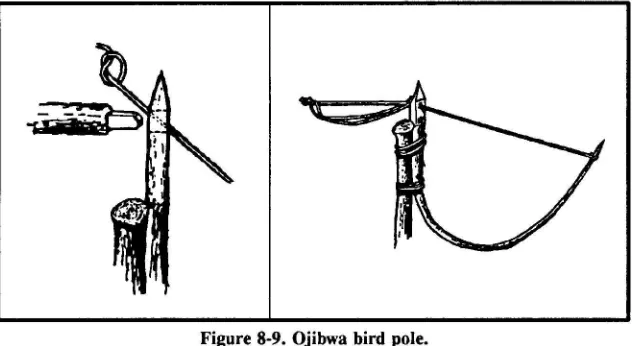
An Ojibwa bird pole is a snare used by native Americans for centuries (Figure 8-9). To De effective, p'lace it in a relatively open area away from talf trees. For best results, p'ick a spot near feeding areas, dusting areas, or watering holes. Cut a
r
ole 1.8 to 2.1 meters long and trim away alllimbs and foliage. Do no use resinous wood such as pine. Sharpen the upper end to a point, then drill a small diameter hole 5 to 7.5 centi-me1ers down from the top. Cut a small stick 10 to 15 centimeters long and shape one end so that it will almost fit into the hole. This is the perch. Plant the long pole in the ground with the pointed end up. Tie a small weight, about equal to the weight of the targeted species, to a length of cordage. Pass the free end ofthe cordage through the hole, ana tie a slip noose that covers the p'erch. Tie a smgle overhand knot in the cordage and place the perch against the hole. Allow the cordage to slip through the hole until the overhand knot rests against the pole and the top of the perch. The tension of the overhand kriot against the pole
.
and perch will hold the perch in position. Spread the noose over the percli.,ensuring it covers the perch and drapes over on both sides. Most birds prefer to rest on sometnmg above ground and will land on the perch. As soon as the bird lands, the perch will fall, releasing the over-hand knot and allowing the weight to drop. The noose will tighten around the bird's feet, capturing it. If the weight is too heavy, it will cut the bird's feet off, allowing it to escape.
Noosing Wand
A
noose stick or "noosing wand" is useful for capturing roosting birds orsmall mammals (Figure 8-10). It requires a patient operator. This wand is more a weapon tllan a trap. It consists of a pole (as long as you can effectively handle) with a shp noose of wire or stift cordage at the small end. To catch an animal, you slip the noose over the neck of a roosting bird and pull it tight. You can arso place it over a den hole and hide in a nearby bfmd. When the animal emerges from the den, you jerk the pole to tighten the noose and thus capture the animal. Carry a stout club to kill tne prey.
Treadle Spring Snare
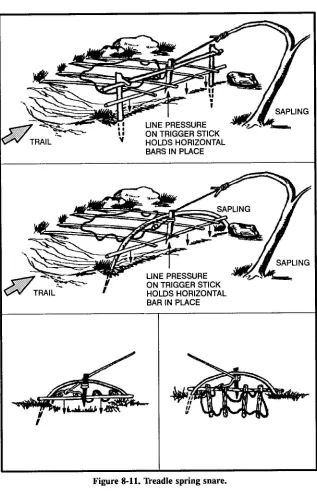
Use a treadle snare against small game on a trail (Fi~re 8-11). Dig a shallow hole in the trail. Then drive a forked stick (fork down) into the ground on each side of the hole on the same side of the trail. Select two fairly straight sticks that span the two forks. Position these two sticks so that their ends engage the forks. Place several sticks over the hole in the trail by positioning one end over the lower horizontal stick and the other on the ground on the other side of the hole. Cover the hole with enough sticks so that the prey must step on at least one of them to set off the snare. Tie one end of a piece of cordage to a twitch-up or to a weight suspended over a tree hmb. Bend the twitch-up or raise the sus-penaed weight to determine where You will tie a 5 centimeter or so long trigger. Form a noose with the other end of the cordage. Route and
IT - .-...- ~--
.c
l((.
LINE PRESSURE ON TRIGGER STICK HOLDS HORIZONTAL BARS IN PLACE
LINE PRESSURE ON TRIGGER STICK HOLDS HORIZONTAL BAR IN PLACE
.
spread
the noose over the top of the sticks over the hole. Place the trigger stick against the horizontal sticks and route the cordage behind the sticks so tnat the tension of the power source will hold it in place. Adjust the bottom horizontal stick so that it will barely hold agamst the trigger. A the animal places its foot on a stick across the "hole, the bottom norizontal stick moves down, releasing the trigger and allowingthe noose to catch the animal by the foot. Because of the disturbance on the trail, an animal will be wary. You must therefore use channelization.
Figure
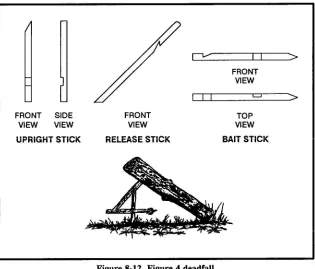
4 Deadfall
The figure 4 is a trigger used to drop a weight onto a prey and crush it (Figure 8-12).The type of weight used may vary, but it should be heavy enough to kill or inc~pacitate the prey immediately. Construct the figure 4 using three notchecf sticks. These notches hold the sticks together m a figure 4 pattern when under tension. Practice making this trigger before-hand; it requires close tolerances and precise angles m its construction.
f"Lo-""" I I
FRONT VIEW
"'>
I I I I..-J "'>
FRONT SIDE VIEW VIEW
FRONT VIEW
TOP VIEW
.
'''''''''''''LJT~ u " urn,un I
"II"""
n~. ~A~~ ~"'I""U'
nI:.L~"1:.
" II"""
DA'T ~T'I"""
gK11 ~II,",,"
.
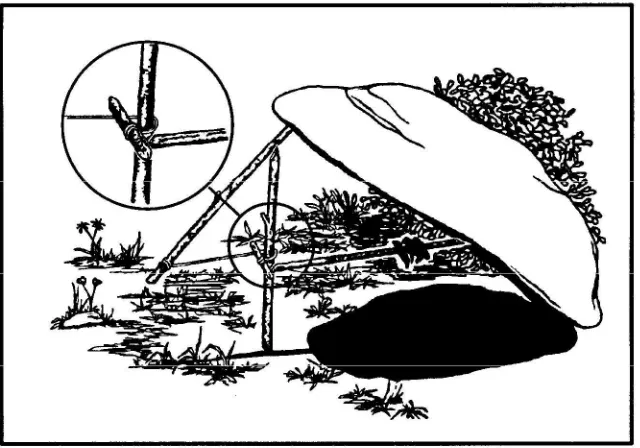
Paiute Deadfall
The Paiute deadfall is similar to the figure 4 but uses a piece of cordage
and a catch stick (Fi~re 8-13). It has the advantage of 15eingeasier to
set than the figure 4. Tie one end of a piece of cordage to tfie lower end of the diagonal stick. Tie the other end of the cordage to another stick about 5 centimeters long. This 5-centimeter stick is the catch stick. Bring the cord halfway around the vertical stick with the catch stick at a 90-degree angle. Place the bait stick with one end against the drop weight, or a peg driven into the ground, and the other against the catch sticK.When a prey disturbs the Eait stick, it falls free, releasing the catch stick. As the diagonal stick flies up, the weight falls, crushing the prey.
Bow Trap
A bow trap is one of the deadliest
traps. It is dangerousto man as
well as ammals (Figure 8-14).To construct this trap, build a bow and anchor it to the ground with pegs. Adjust the aimmg point as you anchor the bow. Lash a toggle stick to the trigger stick. Two upright sticks driven into the ground hold the trigger stick in place at a point where
the toggle stick will engage the pul1edbow string. Place a catch stick
.
between the toggle stick and a stake driven into the ground. Tie a trip wire or cordage to the catch stick and route it around stakes and across
the game trair where you tie it off (as in Fi~re
8-14).When the prey
trips the trip wire, the bow looses an arrow into it.
A
notch in the bowserves to he1p aim the arrow.
WARNING
This is a lethal trap. Approach it with caution and from the rear only!
Pig Spear Shaft
To construct the"pig spear shaft, select a stout pole about 2.5 meters long (Fig1}re8-lJ). At the smaller end, firmly lash several small stakes. Lash the large end tightly to a tree along the game trail. Tie a length of cordage to another tree across the trail. Tie a sturdy, smooth stick to the other end of the cord. From the first tree, tie a trip wire or cord low to the ground, stretch it across the trail, and tie it to a catch stick. Make a slip ring from vines or other suitable material. Encircle the trip wire and
.
the smooth stick with the slip ring. Emplace one end of another smooth stick within the slip ring and its other end against the second tree. Pull the smaller end of the spear shaft across the trail and position it be-tween the short cord ana the smooth stick. As the animal trips the trip wire, the catch stick pulls the slip ring off the smooth sticks, releasing the spear shaft that springs across the trail and impales the prey against the tree.
WARNING
This is a lethal trap. Approach it with caution!
Bottle Trap
A bottle trap
is a simple trap for mice and voles (Figure8-16).Dig a
hole 30 to 45 centimeters deep that is wider at the Dottom than at the top. Make the top of the hole as small as possible. Place a piece of bark or wood over the hole with small stones under it to hold it up 2.5 to 5 centimeters off the ground. Mice or voles will hide under the cover to escape danger and fall into the hole. They cannot climb out because of the wall's backward slope. Use caution when checking this trap; it is an excellent hiding place for snakes.
.,--'- 1
.
KILLING DEVICES
There are several killing devices that you can construct to help you obtain small game to help' you survive. The rabbit stick, the spear, the bow and arrow, and the sling are such devices.
Rabbit Stick
One of the simplest and most effective killing devices is a stout stick as long as your arm, from fingertip to shoulder, called a "rabbit stick." You can throw it either overhand or sidearm and with considerable force. It is very effective against small game that stops and freezes as a defense.
Spear
You can make a spear to kill small game and to fish. Jab with the spear, do not throw it. See spearfishing on page 8-29.
Bow and Arrow
A good bow is the result of many hours of work. You can construct a smtable short-term bow fairly easily. When it loses its spring or breaks, you can replace it. Select a hardwood stick about one meter long that is
~s~~-~~.
---30-45 em DEEP
.
free
of knots or
limbs. Carefully scrape the largeend downuntil
it has
the same
pull
as the small end. Careful examination will show thenatu-ral curve of thestick. Always scrape
from the side that
facesyou, or the
bow will break the first time you pull it. Dead, dry wood is preferable to green wood. To increase the pull, lash a second bow to the first, front to
front, formingan "X" when viewed from the side.
Attachthe
tips of the bowswith cordageand onlyuse a bowstringon onebow.
Select arrows from the straightest dry sticks available. The arrows should be about half as long as theDOW.Scrape each shaft smooth all around. You will probably have to straighten the shaft. You can bend an arrow straight by heating the shaft over hot coals. Do not allow the shaft to scorChor Dum. Hold the shaft straight until it cools.
You can make arrowheads from bone, glass, metal, or pieces of rock. You can also sharpen and fire harden the end of the shaft. To fire harden wood, hold it over not coals,being careful not to bum or scorch the wood.
You must notch the ends of the arrows for the bowstring. Cut or file the notch; do not split it. Fletchin~ (adding feathers to the notched end of an arrow) improves the arrow s flight cnaracteristics, but is not necessary on a field-expedient arrow.
Sling
You can make a sling by tying two pieces of cordage, about sixty
centi-meters long, at opposite ends of a palm-sized pieceof leather
or
cloth.Place a rock
in tne cloth and wrap one cord around the middle finger
and hold in your palm. Hold the other cord between the forefinger and
thumb. To throw the rock,
spin the sling severaltimes in a circleand
release the cord between the thumb ana forefinger. Practice to gain
proficiency.
The
sling is very effective against small game.FISHING DEVICES
You can make your ownfishhooks,
nets and
traps and use severalmeth-ods to obtain fish in a survival situation.
Improvised
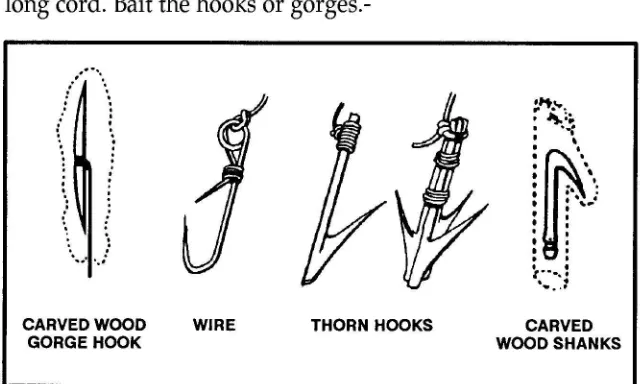
Fishhooks
You can make field-expedient fishhooks
from
pins, needles, wire, small.
thorns, flint, seashell, or tortoise shell. You can also make fishhooks from any combination of these items (Figure 8-17).
To make a wooden hook, cut a piece of hardwood about 2.5 centimeters long and about 6 millimeters in diameter to form the shank. Cut a notch in one end in which to Rlace the point. Place the point (piece of bone, wire, nail) in the notch. Hold the point in the notch and tie securely so that it does not move out of p'ositlOn.This is a fairly large hook. To make smaller hooks, use smaller material.
A gorge is a small shaft of wood, bone, metal, or other material. It is sharp on both ends and notched in the middle where you tie cordage. Baitthe gorge by placing a piece of bait on it lengthwise. When the fish swallows the batt, it also swallows the gorge.
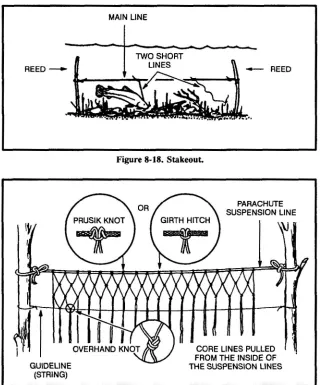
Stakeout
A
stakeout is a fishing device you can use in a hostile environment(Figure 8-18).To construct a sfakeout, drive two supple saplings into the bottom of the lake, pond, or stream with their tops just be10w the water surface. Tie a cord Between them and slightly below the surface. Tie two short cords with hooks or gorges to this cord, ensuring that they cannot wrap around the poles or eacn other. They should also not slip along the long cord. Bait the hooks or
gorges.-".~.
, .
: .
!
\
.
.
I.
f.
.
I.
.
.
.
"..' ,.,' CARVED WOOD GORGE HOOKWIRE THORN HOOKS
Figure 8-17. Improvised fishhooks.
~Jt
,.
f .1\.'" . ..:,
.
II
",
. '. " ..' .
. ,..
,
.
.
..
.
,. .
. .
t, ..
.
.." CARVED
.
Gill Net
If a gill
net is not available, you can make one using parachutesuspen-sion line or similar material (Figure 8-19). Remove tfie core lines from the suspension line and tie the easing between two trees. Attach several core lines to the easing by doubling tnem over and tying them with
- -
-REED
---
--
REED...
Figure 8-18. Stakeout.
GUIDELINE
(STRING)
CORE LINES PULLED
FROM THE INSIDE OF
THE SUSPENSION LINES
.
prusik knots or girth hitches. The length of the desired net and the size of the mesh determine the number of core lines used and the space between them. Starting at one end of the easing, tie the second and the
third core lines together using an overhand knot. Then tie the fourth and fifth, sixth ana seventh, and so on, until you reach the last core line. You should now have all core lines tied in pairs with a single core line hanging at each end. Start the second row with the first core line, tie it to tfie second, the third to the fourth, and so on.
To keep the rows even and to re~late the size of the mesh, tie a guide-line to the trees. Position the gulaeguide-line on the opposite side of the net you are working on. Move the ~ideline down after completing each row. The lines will always hang in pairs and you always he a cord from one pair to a cord from an adjoining pair. Continue tying rows until the net ISthe desired width. Thread a suspension line easing along the bot-tom of the net to strengthen it. Use tli:egill net as shown in FIgure 8-20.
~
\~~
~
,,~
( 11'~\~
\\\~
~~\\\\~:
I~~QQ
J
.
'f
\'
~A
/'::J-
.
Fish Traps
You may trap
fishusing
several methods (Figure 8-21). Fish baskets are one method. You construct them by lashing several sticks together with vines into a funnel shape. You close the top, leaving a hole rarge enough for the fish to swim through.BASKET FISH TRAP
.;'W
POOL OR SHORE FISH TRAP
.-:t'-TIDAL FLAT FISH TRAP
.
You can also use traps to catch saltwater fish, as schools regularly approach the shore with the incoming tide and often move parallel to tne shore. Pick a location at high tide and build the trap at row tide. On rocky shores, use natural rock _pools. On coral islands, use natural pools on tne surface of reefs by blocKing the openings as the tide recedes. On sandy shores, use sandbars and tne ditcli:es they enclose. Build the trap as a row stone wall extending outward into the water and forming an angle with the shore.
Spearfishing
If y-ou are near shallow water (about waist deep) where the fish are large and plentiful, you can spear them. To make a spear, cut a long, straight saplmg (Figure 8-22). Sharpen the end to a point or attach a Rnife, jagged piece of bone, or sharpened metal. You can also make a spear
by
srlltting the shaft a few inches down from the end and inserting a piece ot woo a to act as a spreader. You then sharren the two separated halves to points. To spear fish, find an area where tish either gatl1er or where there is a fish run. Place the spear point into the water and slowly move it toward the fish. Then, with a sudden push, impale the fish on the
- .
1r1Jr
-w-BAMBOO METAL
V.! 0
""
rrt._--- _If!
-- --- -
_!_...-I'lgure l)-~~. .ypes UI spear pUIDIS.
.
stream bottom. Do not try to lift the fish with the spear, as it with proba-bly slip off and you will lose it; hold the spear with one hand and grab and hold the fish with the other. Do not throw the spear, especially if the point is a knife. You cannot afford to lose a knife in a survival situa-tion. Be alert to the problems caused by light refraction when looking at objects in the water.
Chop Fishing
At night, in an area with a good fish density, you can use a light to attract fish. Then, armed with a machete or similar weapon, you can gather fish using the back side of the blade to strike them. Do not use fhe sharp side as you will cut them in two pieces and end up losing some ofthe fish.
Fish Poison
Another way to catch
fish is by using poison.Poisonworks quickly.It
allows you to remain concealed while it takes effect. It also enables you to eaten several fish at one time. When using fish poison, be sure to gather all of the affected fish, because many dead fish floating down-stream could arouse suspicion. Some plants that grow in warm regions of the world contain rotenone, a substance that stuns or kills cold-blooded animals but does not harm persons who eat the animals. The best place to use rotenone, or rotenone-p'roducin~ plants, is in ponds or the head-waiters of small streams containing fisn. Rotenone works quickly on fish in water 21 degrees C (70 degrees F) or above. The fish rise helplessly
to the surface. It works slowly inwater 10 to 21 degrees C (50 to 70
degrees F) and is ineffectivem water below 10 degrees C (50 degrees
F).
The following plants, used as indicated, will stun or kill fish:
.
Anamirta cocculus
(Figure 8-23).This woody vinegrows
in southern
Asia and on islands of the South Pacific. Crush the bean-shaped seeds and throw them in the water..
Croton tiglium
(Figure8-23).
Thisshrub or smalltree
growsin waste
areas on islands of the South Pacific. It bears seeds in three angled capsules. Crush the seeds and throw them into the water.
.
Barringtonia (Figure 8-23).These large trees.grow near the sea inMalayaand parts of Polynesia.
They Dear a fTeshy one-seeded fruit.Crush the seeds and bark and throw into the water.
.
Derris eliptica
(Figure 8-23).This large genus of tropical shrubs andANAMIRTA COCCULUS
BARRINGTONIA
DUBOISIA
.
CROTON TIGLIUM
DERRIS ELiPTICA
TEPHROSIA
.
Grind the roots into a powder and mix with water. Throw a large quantity of the mixture into the water.
.
Duboisia
(Figure 8-23).This shrub grows in Australia and bears white clusters of flowers and berrylike fruit. Crush the plants and throw them into the water..
Tephrosia
(Figure 8-23).This species of small shrubs, which bears beanlike pods, grows throughout the tropics. Crush or bruise bundles of leaves and stems and throw them into the water..
Lime. You can get lime from commercial sources and in agriculturalareas that use large quantities of it. You may produce your own by burning coral or seaShells. Throw the lime mto the water.
.
Nut husks. Crush green husks from butternuts or black walnuts.Throw the husks into the water.
PREPARA TION OF FISH AND GAME
FOR COOKING AND STORAGE
You must know how to prepare fish and game for cooking and storage in a survival situation. Improper cleaning or storage can result in inedi15le fish or game.
Fish
Do not eat fish that appears spoiled.Cookingdoes not ensure that
spoiledfish will be edible.Signsof
spoilageare-.
Sunken eyes..
Peculiar odor..
Suspicious color. (Gills should be red to pink. Scales should be apronounced shade of gray, not faded.)
.
Dents stay in the fish's flesh after pressing it with your thumb..
Slimy, rather than moist or wet body..
Sharp or peppery taste..
Fishspoilsquickly
after death, especially' on a hot day. Prepare fishfor eafing as soon as possible after catcning it. Cut out the gills and large blood vessels iliat lie near the spine. Gut fish that is more than
10 centimeters long. Scale or skin the fish.
You can impale a whole fish on a stick and cook it over an open fire. However, boiling the fish with the skin on is the best way to get the most food value. The fats and oil are under the skin and, by boiling, you can save the juices for broth. You can use any of the methods used to cook plant food to cook fish. Pack fish into a ball of clay and bury it in the coals of a fire until the clay hardens. Break open the clay ball to get to the cooked fish. Fish is done when the meat flakes off. If you plan to keep the fish for later, smoke or fry it. To prepare fish for smoking, cut off the head and remove the backoone.
Snakes
To skin a snake,first cut off its head and bury it. Then cut the skin down
the body 15to 20 centimeters (Figure8-24).Peel the skin back, then
First, kill the snake.
then-1 Grip the dead snake firmly behind the head.
~
"
3 Siftbelly:d
'""""'" innards.
~&
~j
--;:}
4 Skin.
.
grasp
the skin in one hand and the body in the other and pull apart. On rarge, bulky snakes it may be necessary to slit the belly skin. Cook snakes in the same manner as small game. Remove the entrails and discard. Cut the snake into small sectlOnsand boil or roast it.Birds
After killing the bird, remove its feathers by either plucking or skinning. Remember, skinning removes some of the food value. Open up the boay cavity and remove its entrails, saving the craw (in seed-eating oirds), hearf, and liver. Cut off the feet. Cook by boiling or roasting over a spit. Before cooking scavenger birds, boil them at least 20 minutes to kill parasites.
Skinning and Butchering Game
Bleed
the animal by cutting its throat. If possible, clean the carcass near a stream. Place the carcass Delly up and split the hide from throat to tail, cutting around all sexual organs (Figure 8-25). Remove the musk glands at points A and B to aVOlatainting the meat. For smaller mam-mals, cut the hide around the body and insert two fingers under the hide on both sides of the cut and pull both pieces off (Figure 8-26).Note: When cutting the hide, insert the knife blade under the skin and turn the blade up so that only the hide gets cut. This will also prevent cutting hair and getting it on the meat.
.8... ..
..
....
.
.
.;;;::::. i
:,
{....~~
:>-
".
.
..
.
Remove
the entrailsfrom smallergameby splittingthe body open and
pulling them out with the fingers. Do not forget tne chest cavity. For larger ~ame, cut the gullet away from the diaphragm. Roll the entrails out of Thebody. Cut around the anus, then reach mto the lower abdomi-nal cavity, grasp the lower intestine, and pull to remove. Remove the urine bladaer by pinching it off and cutting it below the fin~ers. If you spill urine on tne meat, wash it to avoid tainting the meat. Save the heart and liver. Cut these open and inspect for signs of worms or other parasites. Also inspect the hver's color; it could indicate a diseased ani-mal. The liver's surface should be smooth and wet and its color deep red or purple. If the liver appears diseased, discard it. However, a diseased liver ooes not indicate you cannot eat the muscle tissue.
Cut alon~ each leg from above the foot to the previously made body cut. Remove Thehide DYpulling it away from the carcass, cutting the
connec-tive tissue where necessary. Cut off the head and feet.
Cut larger game into manageable pieces. First, slice the muscle tissue connectmg the front legs to the boay. There are no bones or joints connecting the front legs to the body' on four-legged animals. Cut the hindquarters off where they join the body. You must cut around a large Done at the top of the leg and cut to the ball and socket hip joint. Cut the ligaments arouna the joint and bend it back to separate
it. Remove the large muscles (the tenderloin) that lie on either side of the spine.
1 Cut the hide around the body.
§~
--
I -'-'-.
---""'"
,..
,
-'--
,
2 Insert two fingers under the hide on both sides of the cut and pull both pieces off.
.
Separate
the ribs from the backbone.There is less work and less wear
on your knife if you break the ribs first, then cut through the breaks.
Cook large meat pieces over a spit or boil them. You can stew or boil smaller pieces, particularly those that remain attached to bone after the initial butchering, as soup or broth. You can cook body organs such as the heart, liver, pancreas, spleen, and kidneys using the same methods as for muscle meat. You can also cook and eat the brain. Cut the tongue out, skin it, boil it until tender, and eat it.
Smoking Meat
To smoke meat'
J
repare an enclosure around a fire (Figure 8-27). Two ponchos snappe together will work. The fire does not need to be big orPONCHO SHELTER OR
PARACHUTE HALF
(
-STRIPS OF MEAT
TO BE SMOKED
f
FIRE PIT
TEPEE SMOKER
.
hot. The intent is to produce smoke, not heat. Do not use resinous wood in the fire because its smoke will ruin the meat. Use hardwoods to p'ro-duce good smoke. The wood should be somewhat green. If it is too ary, soak It. Cut the meat into thin slices, no more than 6 centimeters thick, and drape them over a framework. Make sure none of the meat touches another piece. Keep the poncho enclosure around the meat to hold the smoke and keep a close watch on the fire. Do not let the fire get too hot. Meat smoked overnight in this manner will last about 1 week. Two days of continuous smokmg will p,reserve the meat for 2 to 4 weeks. Properly smoked meat willlook lIke a dark, curled, brittle stick and you can eat it without further cooking. You can also use a pit to smoke meat (Figure 8-28).
Drying Meat
To preserve meat
by drying, cut it into 6-millimeterstrips with the
gram. Hang the meat strips on a rack in a sunny location with good air flow. Keep the strips out of the reach of ammals and cover them to keep blowflies off. Allow the meat to dry thoroughly before eating. Properly dried meat will have a dry, crisp texture and will not feeTcool to the touch.
PONCHO COVER
I
.
.
Other Preservation Methods
You can also preserve meats using the freezing or brine and salt methods.
Freezing
In cold climates, you can freeze and keep meat indefinitely. Freezing is not a means of preparing meat. You must still cook it before eating. Brine and Salt
You can preserve meat