Enabling Operations
Part Four discusses operational-level enabling operations. Commanders direct ena-bling operations to support offensive, defensive, stability, and support operations. Enabling operations are usually shaping or sustaining; they may be decisive in some military operations other than war.
Chapter 11 addresses how Army forces conduct operations to gain and maintain information superiority. It describes the necessity for Army forces to be able to see their battlespace, understand the situation in their battlespace, and act before their opponent. It outlines the characteristics of information superiority and the information environment. It discusses the contributors to information superiority: intelligence, surveillance, and reconnaissance operations; information management; and information operations, to include its related activities. It describes the aspects of the operations process important to achieving information superiority. It concludes by outlining the impact of technology on the contributors to information superiority.
Chapter 12 addresses combat service support (CSS). It presents the purpose and characteristics of CSS and lists the CSS functions. It describes the factors that affect conducting CSS operations to support the four types of Army operations. The dis-cussion addresses the support provided by national providers, CSS operations in joint and multinational environments, and the factors affecting operational reach and sustainability. Chapter 12 ends by describing the effect of technology on CSS opera-tions.
Information
Superiority
To guess at the intention of the enemy; to divine his opinion of your-self; to hide from both your intentions and opinion; to mislead him by feigned manoeuvres; to invoke ruses, as well as digested schemes, so as to fight under the best conditions-this is and always was the art of war.
Napoleon
11-1. The side possessing better information and using that information more effectively to gain
understanding has a
major advantage over its opponent. A force that achieves this advantage and effectively uses it to affect enemy perceptions, attitudes, decisions, and actions has exploited in-formation superiority. Information superior-ity is the operational
advantage derived
from the ability to col-lect, process, and dis-seminate an uninter-rupted flow of infor-mation while
exploit-ing or denyexploit-ing an adversary's ability to do the same. Commanders ex-ploit information superiority to accomplish missions. Information superiority is not static. During operations, all sides attempt to secure its advantages and deny them to adversaries and enemies. The operational advantages of information superiority can take several forms, ranging from the ability to create a better operational picture and understand it in context, to the ability to shape the environment with offensive information operations (10).
11-2. At its essence, information superiority is about Army forces being able to see first, understand first, and act first. Army forces cannot develop information superiority if they are constantly reacting to enemy operations. Information superiority requires commanders who are proactive, view information as an element of combat power, trust their subordinates to provide relevant information, and conduct (plan, prepare, execute, and con-tinuously assess) operations accordingly. To achieve information superiority,
CONTENTS Characteristics of Information
Superiority 11-3
The Information Environment 11-4
Contributors to Information Superiority.. 11-5 Intelligence, Surveillance, and
Reconnaissance 11-7
Information Management 11-11
Information Operations 11-16
Planning and Preparing to Achieve
Information Superiority 11-20
Continuous Coordination 11-21
Information Superiority and
Strategic Responsiveness 11-21
Information Superiority Execution 11-22 Operations in Noncontiguous
Areas of Operations 11-23
Subordinate Initiative 11-23
commanders synchronize and target information as intensely as they do fires and maneuver. They seek to make better use of their information and information systems than adversaries or enemies do of theirs. These information systems include the analysis, procedures, and training necessary to extract and exploit intelligence and other critical information from raw data, and present it in a form in which it can be quickly understood. Successful commanders are those who see, understand, and then exploit the situation.
CHARACTERISTICS
OF INFORMATION SUPERIORITY
11-3. Gaining and exploiting information superiority demands effective doc-trine, training, leadership, organization, materiel, and soldiers. It puts a premium on the commander's ability to visualize, describe, and direct opera-tions. Effective use of advanced information systems, procedures, and train-ing allows commanders to achieve and maintain situational understanding. Modern information technologies help commanders lead more effectively and consistently make better decisions than those opposing them.
11-4. Commanders manage their information resources, combine their judg-ment with the knowledge of their staffs and subordinates, and use informa-tion systems to understand their battlespace better than their adversaries or enemies do. Commanders require relevant information about the factors of METT-TC to exercise effective command and control (C2). From the initial warning order to completion of redeployment, Army forces use every means, including force, to acquire that information. At the same time, they attempt to deny adversaries and enemies information about friendly forces and ac-tively degrade their ability to collect, process, store, display, and disseminate information. Effective friendly use of information, complemented with active measures that prevent enemies from using information effectively or coun-tering friendly information use, creates conditions for achieving information superiority. Army forces use the qualitative advantages of information supe-riority as a springboard for decisive operations.
11-5. The operational and tactical implications of information superiority are profound. Rapid seizure and retention of the initiative becomes the distin-guishing characteristic of all operations. Information superiority allows com-manders to make better decisions more quickly than their enemies and ad-versaries. Unable to keep pace, enemies and adversaries must deal with new problems before they can solve current ones. In combat, a rapid tempo--sustained by information superiority--can outpace enemy's ability to make decisions contribute to his destruction. In stability operations and sup-port operations, information superiority helps deploying forces anticipate problems and requirements. It allows commanders to control events and situations earlier and with less force, creating the conditions necessary to achieve the end state.
assess the quality of their information against their decision making re-quirements. Against that assessment, they estimate the quality of the enemy's operational picture. Commanders avoid any complacency associated with relative levels of military technology. They are aware that their enemy may, by chance or countermeasures, uncover the sources of friendly informa-tional advantage, block them, or use them to deceive.
11-7. Commanders recognize that unless they envision and direct oper-ations designed to achieve and main-tain information superiority, they may lose it. Commanders exploit any advantages in information capability and intelligence to increase the ef-fects of combat power. They
constant-ly seek to improve their situational understanding and to assess that of their enemy. They know that losing information superiority may result in losing the initiative.
Nations do not go to war because they think war is safe. They go to war because they think they will Wln.
Richard M. Swain
Lucky War
THE INFORMATION ENVIRONMENT
11-8. The information environment is the aggregate of individuals, organiza-tions, or systems that collect, process, or disseminate information; also in-cluded is the information itself. The climate, terrain, and weapons effects (such as electromagnetic pulse or blackout) affect the information environ-ment but are not part of it. The information environment includes the C2 sys-tems of friendly and enemy forces and those of other organizations and groups. Commanders consider the explosive growth of information and the pervasive nature of the information environment when they visualize an op-eration. They include that part of the information environment that affects their operation in their battlespace.
11-9. Most of the information environment is not under military control, adding to the challenges commanders face. While they cannot control the en-tire information environment, they must be prepared to operate within it. In-teraction with the information environment increases the complexity of Army operations. More than ever, commanders consider how factors outside their area of operations (AO) may affect their operations. 10 often requires coordi-nation with governmental and nongovernmental agencies. Legal limitations on 10 vary according to the situation. This interaction may affect the impact of tactics on operations and strategy. Military actions that are tactically or operationally insignificant may influence strategy, or even national policy, when highlighted by the media. Therefore, operational commanders consider more than the military conditions of the end state of a campaign. They con-sider the comprehensive diplomatic, political, and social aspects of it as well.
11-10. Army forces increasingly rely on the unrestricted use of the informa-tion environment. Commanders and staffs need to understand its effects on
operations and develop C2 systems that support their operational needs and
intelligence requirements. Distance has little meaning in the information en-vironment. Army information systems are "in contact" with enemy
operation ends. Commanders understand that there is no sanctuary for friendly information. Before Army forces arrive in theater, the battle for information superiority begins. Commanders and staff conduct operations accordingly.
Information Superiority in the Gulf
In the opinion of many observers, the Gulf War emphasized integrating infor-mation systems, operations, and management in ways that heralded a new form of warfare. Air operations struck C2 nodes throughout Iraq and occupied Kuwait, disabling the air defense network and slowing operational and tactical response. Until the air operation started, Third Army restricted preparations to areas well south of the border. Under cover of intense air bombardment, Saudi and French units secured areas along the border while the powerful US forces shifted west. Even as the Third Army's VII and XVIII Corps moved into attack positions, the US Central Command conducted military deception operations at sea and on land, culminating with the feint by 1st Cavalry Division in the Wadi al-Batin area. As the ground offensive neared, tactical reconnaissance and surveillance confirmed that the Iraqi Army had its right flank exposed to the west of Kuwait. Special Operations Forces and tactical air reconnaissance complemented these efforts. By 23 February 1991, both corps had secured the border area and extended ground and air reconnaissance well inside Iraq. Intense air attacks fixed and decimated the Iraqi army. The Marine deception and 1st Cavalry Division feint continued to draw Iraqi attention eastward. Third Army moved to attack positions west of the Wadi al-Batin to exploit the Iraqi mistake. At 0400 hours on 24 February 1991, coalition ground forces struck into Kuwait and Iraq. They ended their offensive four days later, having decisively defeated the once fourth-largest army in the world.
Speaking after the war, LTG S. Bogdanov, Chief of the General Staff Center for Operational and Strategic Studies of the former Soviet Union, stated, "Iraq lost the war before it even began. This was a war of intelligence, electronic warfare, command and control, and counterintelligence. Iraqi troops were blinded and deafened. ..."
CONTRIBUTORS
TO INFORMATION
SUPERIORITY
11-11. Commanders direct three interdependent contributors to achieve in-formation superiority (see Figure 11-1, page 11-6):
.
Intelligence, surveillance, and reconnaissance (ISR)..
Information management (1M)..
10 (to include related activities).These contributors enable and complement full spectrum operations. Specific objectives that contribute to information superiority include the following:
.
Develop and maintain a comprehensive picture of enemies and adver-saries; forecast their likely actions..
Influence enemy and adversary leader perceptions, plans, actions, and will to oppose friendly forces..
Influence noncombatants and neutrals to support friendly missions or not to resist friendly activities..
Inform noncombatant and neutral organizations so they can better support friendly policies, activities, and intentions..
Protect friendly decision making processes, information, and informa-tion systems..
Continually provide relevant information (including intelligence) to the commander and staff in a useable form..
Destroy, degrade, disrupt, deny, deceive, and exploit enemy decision making processes, information, and information systems, and influence those of adversaries and others.. Better, faster friendly
decisions
Operational Advantages:
.
Degrade enemy decisionsand actions
.
Impact enemy and other perceptions and attitudes
I
Relevant information
I
I
0
I...
Int~gration).. .
Interation)..
IEnemy PIR and IR II
Other IR I I
FFIR I I
EEFI I
.
Fight for informationI.
Focus relevant 1~~~-~!!.~-~~-~-~~!~!!~_i_!~JQ and developintelligenceI
informationand build i Public Affairs and CMO.
Fuse intelligencei
COPI
.
Shape adversary and developed across i.
Enhance knowledge, i other perceptions/actionsechelons and BOS
I
u.nder~ta~ding, and I I d C2 dI t
I.
mpact a versary an.
Predict threat COAsI
vlsua Iza Ion I information systems and environmental I.
Improve quality andI.
Protect friendly effects/activities
I
speed of decisionI making
I
information, informationI
I
systems, and C2Information Systems
Figure 11-1. Information Superiority
actions within single contributors are ineffective. Information superiority results when commanders synchronize all three contributors. Figure 11-2 illustrates the nature of the struggle for information superiority.
When the effects produced by synchronizing friendly ISR, 10, and 1M are greater than those produced by the enemy, friendly forces gain information superiority.
0
0 0
Q
~~~
~~
FriendlyCommander
Friendly offensive
~SSc
~
IT-';A
ISR
;
~~W
.
EnemyCommander
,
I
~
10\
\
~
C2 Systems (Information Management) Defensive
10
Figure 11-2. Information Operations and Information Superiority
INTELLIGENCE, SURVEILLANCE, AND RECONNAISSANCE
11-13. ISR integration is fundamental to information superiority. Thoroughly integrated ISR operations add many collection sources. ISR integration eliminates unit and functional "stovepipes" for planning, reporting, and proc-essing information and producing intelligence. It provides a common mecha-nism for all units to conduct ISR operations in a coordinated, synergistic way.
Intelligence
11-15. The complexity of the operational environment re-quires sharing intelligence from the national level to the tactical level and among headquarters at each level. Analysis is a com-plex task that requires fusing information and intelligence from each ISR discipline and asset into an all-source product. Analysis is increasingly distrib-uted and collaborative. Ana-lysts who are closest to the
point of collection enter data and perform initial processing one time for the entire force. Modern information systems allow analysts to collaborate on the overall analysis without degrading support to their own commanders, regard-less of their geographic dispersion. This distributed, collaborative analysis process starts with the initial intelligence preparation of the battlefield (IPB) and continues throughout operations.
11-16. The commander drives the intelligence system. Managing the ISR ef-fort
entails--.
Requirements visibility. Intelligence personnel use procedures and information systems to monitor and display the status of information requirements..
Asset visibility. Intelligence personnel use procedures and informa-tion systems to monitor and display collection asset status, location, and activities..
ISR assessment capability. Intelligence personnel use procedures and information systems to assess the effectiveness of the ISR effort and the operational impact of ISR results (such as its success or gaps in collection), and to task collection assets.11-17. Intelligence provides critical support to all operations,
including 10. It supports
planning, decision making, target development, targeting, and protecting the force. It is a con-tinuous process for any operation. Surveillance and reconnaissance
are the primary means of
collecting information used to produce intelligence. A thorough
understanding of joint ISR
capabilities allows commanders
to prepare complementary
collection plans. Surveillance and reconnaissance assets focus
primarily on collecting
Intelligence is (1) the product resulting from the collection, processing, integration, analy-sis, evaluation, and interpreta-tion of available information concerning foreign countries or areas; (2) information and
know-ledge about an adversary
ob-tained through observation, investigation, analysis, or un-derstanding.
Surveillance
Reconnaissance
information about the enemy and the environment to satisfy the priority intelligence requirements (PIR). In the end, the art of intelligence and its focus on supporting the commander are more important than any information system. This art includes an understanding of intelligence, analysis, the enemy, operations, and the commander's needs.
11-18. IPB is the first step toward placing an operation in context. It drives the process that commanders and staff use to focus information assets and to integrate surveillance and reconnaissance operations across the AO. IPB pro-vides commanders with information about the enemy and environment, and how these factors affect the operation. In most cases, IPB allows commanders to fill gaps in information about the enemy with informed assessments and predictions. IPB is also the starting point for situational development, which intelligence personnel use to develop the enemy and environment portions of the common operational picture (COP). As such, IPB is important to the commander's visualization. The commander drives IPB, and the entire staff assists the intelligence staff with continuous updates. All staff officers de-velop, validate, and maintain IPB components relating to their areas of ex-pertise. For example, the engineer contributes and maintains current mobil-ity and counter mobilmobil-ity situation overlays.
11-19. Surveillance involves con-tinuously observing an area to collect information. Wide-area and focused surveillance provide valuable information.
Surveillance is the systematic observation of aerospace,
sur-face or subsurface areas,
places, persons, or things, by visual, aural, electronic, photographic or other means. 11-20. Army forces at all echelons
receive intelligence based on
infor-mation from national, joint, Army, and commercial surveillance systems. National and theater surveillance systems focus on information requirements for combatant commanders and provide information to all services for theater-wide operations. Continuous theater surveillance helps analysts determine the location and approximate dispositions of enemy land forces. When available, near real-time surveillance platforms--such as the joint surveillance, target attack radar system (JSTARS)- provide moving target indicators. Additionally, long-range surveillance units can provide extremely accurate and valuable information.
11-21. Although the US may enjoy an advantage in surveillance assets, commanders should assume that enemies also have adequate surveillance means. For example, an enemy may purchase high-resolution imagery from commercial space-based systems. Alternatively, the local populace may report Army force actions through the civilian police to enemy intelligence agencies.
11-23. Information collected by means other than recon-naissance has great opera-tional and tactical value. However, those assets may not be able to meet some re-quirements or collect infor-mation with adequate accu-racy and level of detail. Operational priorities within the theater may limit ground
commanders' ability to task theater surveillance systems. Therefore, Army commanders complement surveillance with aggressive and continuous recon-naissance. Surveillance, in turn, increases the efficiency of and reduces the risk to reconnaissance elements by focusing their operations.
11-24. In some situations, the firepower, flexibility, survivability, and mobil-ity of reconnaissance assets allow them to collect information where other assets cannot. Reconnaissance units obtain information on adversary and po-tential enemy forces as well as on the characteristics of a particular area. Reconnaissance missions normally precede all operations and begin as early as the situation, political direction, and rules of engagement permit (see FM 5-0). They continue aggressively throughout the operation. Reconnaissance can locate mobile enemy C2 assets, such as command posts, communication nodes, and satellite terminals for neutralization, attack, or destruction. Commanders at all echelons incorporate reconnaissance into the conduct of operations (see FM 3-90).
Reconnaissance is a mission un-dertaken to obtain by visual obser-vation or other detection methods, information about the activities and resources of an enemy or po-tential enemy, or to secure data concerning the meteorological, hy-drographic, or geographic charac-teristics of a particular area.
11-25. Continuous and aggressive reconnais-sance does more than collect information. It may also produce effects or prompt enemy ac-tions. The enemy may take forces needed elsewhere to counter friendly reconnaissance efforts. Hostile forces sometimes mistake
re-connaissance units for the decisive operation and prematurely expose their dispositions or commit their reserves. Friendly commanders may exploit opportunities revealed by friendly reconnaissance, often using the reconnaissance force as the spearhead. Information from reconnaissance missions allows commanders to refine or change plans and orders, preclude surprises, and save the lives of soldiers.
11-26. Reconnaissance elements may have to fight for information. However, the purpose of reconnaissance is to gain information through stealth, not ini-tiate combat. Reconnaissance operations that draw significant combat power into unplanned actions not in line with the commander's intent may jeopard-ize mission accomplishment.
You can never do too much reconnaissance.
General George S. Patton Jr.
War As I Knew It
INFORMATION MANAGEMENT
11-28. Information management is the provision of relevant informa-tion to the right person at the right time in a usable form to facilitate situational understanding and decision making. It uses procedures and information systems to collect, process, store, display, and dis-seminate information (see FM 6-0). 1M is far more than technical control of data flowing across networks. It communicates decisions that initiate effec-tive actions to accomplish missions and fuses information from many sources. Successful 1M adds meaning to information as it is processed, so decision makers can focus on achieving understanding instead of processing or evalu-ating information. 1M consists of two supporting components: information systems and relevant information.
11-29. Successful 1M includes processing. Processing adds meaning to rele-vant information through progressively higher-level and complex cognitive methods to create a COP. Among other aspects, processing includes lower-level mechanical and mechanistic methods, such as organizing, collating, plotting, and arranging. However, effective processing requires analysis and evaluation (higher-level cognitive methods) to convert information into knowledge and knowledge into understanding. This aspect of processing de-pends on the insight and flexibility of well-trained and adaptive analysts.
11-30. Commanders and staffs assess the effectiveness of 1M by considering how information contributes to lessening the "fog of war." First, untimely in-formation or unusable data has the same effect as not having the informa-tion. It either arrives too late or cannot be understood in time to affect the commander's decision. Second, incomplete or imprecise information is better than no information. While not perfect, it contributes to the commander's grasp of the situation and may assist decision making. Finally, irrelevant or inaccurate information is worse than no information. Irrelevant information distracts and delays; inaccurate information may lead to an inappropriate de-cision. Computers and software cannot make these qualitative distinctions; making them requires soldiers with good judgment.
Information Systems
11-31. Information systems are the equipment and facilities that col-lect, process, store, display and disseminate information. These
in-clude computers-hardware and software-and communications, as
well as policies and procedures for their use. Information systems are integral components of C2 systems. Effective information systems automati-cally process, disseminate, and display information according to user re-quirements. 1M centers on commanders and the information relevant to C2. Commanders make the best use of information systems when they determine their information requirements and focus their staffs and organizations on meeting them.
Relevant Information
need to successfully conduct operations, that is, all elements necessary to ad-dress the factors of METT-TC. The intelligence system, for example, provides intelligence that constitutes relevant information on the enemy, terrain and weather, time available (to the enemy), and civil considerations.
11-33. Relevant information results from assigning meaning to data to assist understanding. Processing changes raw data into information by assigning meaning to it. Analysis and evaluation transform information into knowl-edge, which is presented to commanders as relevant information. When commanders apply judgment to knowledge, it becomes understanding. Un-derstanding enables making informed decisions with less-than-perfect data. Combined with will, understanding generates effective action.
11-34. Relevant information is perishable. If not delivered and acted upon quickly, it may become outdated (no longer relevant) and distort the com-mander's situational understanding. Masses of data and information may overwhelm the command post. Without effective 1M, critical information will be misrouted, delayed, or buried in routine data and overlooked. Information systems can assist in managing volumes of data, but will not do so unless commanders define their information requirements, tie them to their intent, and update them asexecution unfolds.
Categories of Information
11-35. 1M narrows the gap between available information and information commanders require. Effective 1M facilitates rapid dissemination of relevant information. 1M assigns information into four categories: specified require-ments, implied requirerequire-ments, gaps, and distractions.
.
Specified requirements. Specified requirements are requirements the commander specifically identifies. This information may take the form of facts, estimates, or assumptions..
Implied requirements. Implied requirements are important pieces of information that commanders have not specifically requested. Full spectrum operations may place Army forces in situations that lie outside the commander's experience. Commanders may not know to obtain some elements of information. They may not know that theyneed a piece of information or may not recognize its importance. Effective staffs develop and recommend these additional information requirements. Commanders encourage intellectual versatility and agility within their staff and examine recommendations carefully.
.
Gaps. Gaps are elements of information commanders need to achieve situational understanding but do not have. Ideally, analysis identifies gaps and translates them into specified requirements. To fill gaps, com-manders and staffs make assumptions, clearly identifying them as.
Distractions. Distractions include information commanders do not need to know but continue to be told. Excessive distractions result in information overload.11-36. Information is further classified as facts, estimates, and assumptions. Facts are information commanders want to know and can know with cer-tainty. A fact must be confirmed or come from a reliable source. Estimates and assumptions are information commanders want to know but cannot know with certainty. Commanders and staffs must use discipline in separating fact from assumption; otherwise they are vulnerable to deception or risk inaccu-rate situational understanding. Estimates and assumptions primarily include information about the enemy, the future, or factors over which commanders have little or no control.
11-37. Facts, estimates, and assumptions can be either relevant information or distractions. They are relevant information if the commander both wants and needs to know the information. They are distractions if the commander wants to know but does not need to know the information. Photographs, for example, can be distractions. Unless the commander clearly understands the imagery, demands for photos only clog overloaded information systems. Effec-tive 1M filters distractions from relevant information.
Quality of Information
11-38. Sources of information are imperfect and susceptible to distortion and deception. Soldiers processing information use these qualities to evaluate it:
.
Accuracy. The information conveys the actual situation; in short, it is fact..
Timeliness. The information has not been overtaken by events..
Usability. The information is easily understood or displayed in a for-mat that immediately conveys the meaning..
Completeness. The information contains all required components..
Precision. The information has the required level of detail, no more and no less..
Reliability. The information is trustworthy, uncorrupted, and undis-torted.Effective 1M keeps commanders and staffs aware of the quality of their in-formation as they use it to build situational understanding.
Commander's Critical Information Requirements
11-39. Commanders channel information processing by clearly expressing which information is most important. They designate critical information that derives from their intent-the commander's critical information re-quirements (CCIR). The commander's critical information require-ments are elements of information required by commanders that
di-rectly affect decision making and dictate the successful execution of military operations. The key to effective 1M is answering the CCIR.
of information commanders require to support decisions they antici-pate. Information collected to an-swer the CCIR either confirms the commander's vision of the fight or indicates the need to issue a frag-mentary order or execute a branch or sequel. CCIR directly support the commander's vision of the bat-tle---commanders develop them personally. Once articulated, CCIR normally generate two types of sup-porting information requirements: friendly force information require-ments (FFIR) and PIR.
11-41. CCIR must be focused enough to generate relevant information. Unfo-cused requests, such as "I need to know if the enemy moves," may provide data but not much useable information. However, "I need to know when the enemy lead brigade reaches Named Area of Interest 2" or "I need to know if the multinational unit on our right flank advances beyond Phase Line Blue" are examples of CCIR specific enough to focus collection and 1M priorities.
Essential Elements of Friendly Information
11-42. Although essential ele-ments of friendly information (EEFI) are not part of the CCIR, they become a commander's pri-orities when he states them. EEFI help commanders understand what enemy commanders want to know about friendly forces and why (see FM 6-0). They tell com-manders what cannot be
compro-mised. For example, a commander may determine that if the enemy discovers the movement of the reserve, the operation is at risk. In this case, the loca-tion and movement of the reserve become EEFI. EEFI support defensive 10, and as such may become information requirements. EEFI provide a basis for indirectly assessing the quality of the enemy's situational understanding: if the enemy does not know an element of EEFI, it degrades his situational understanding.
Priority intelligence require-ments are those intelligence
requirements for which a
commander has an
antici-pated and stated priority in his task of planning and de-cision making.
Friendly force information requirements are informa-tion that the commander and staff need about the forces available for the operation.
Essential elements of friendly information are the critical aspects of a friendly opera-tion that, if known by the ene-my, would subsequently com-promise, lead to failure, or limit success of the operation, and therefore must be pro-tected from enemy detection.
Common Operational Picture
echelon. C2 systems fuse information from a variety of sources, while infor-mation systems facilitate its rapid distribution in usable displays that facili-tate understanding.
11-44. Different echelons require different information at different levels of precision and detail. The presentation of information in meaningful images assists its assimilation. 1M provides relevant information as meaningful dis-plays rather than masses of data. The COP allows collaborative interaction and real-time sharing of information among commanders and staffs without providing them with too much or too little information.
11-45. The Army continues to invest in technologies and develop procedures that increase commanders' ability to understand their battlespace. These modernizing efforts will increase the capability of Army forces to share a full-dimensional, highly accurate COP and rapidly disseminate guidance, orders, and plans. Technological applications that help visualize, illustrate, brief, and rehearse options contribute to a common understanding of the com-mander's intent and concept of operations. Increasing the speed of analysis, compilation, and communication leaves more time for synthesis--assigning meaning to information and generating potential options.
Situational Understanding
11-46. Situational understanding is the product of applying analysis and judgment to the common operational picture to determine the relationships among the factors of METT-TC (see FM 6-0). It enhances decision making by identifying opportunities, threats to the force or mission accomplishment, and information gaps. It helps commanders identify enemy options and likely future actions, the probable consequences of proposed friendly actions, and the effects of the environment on both. Situational un-derstanding based on a COP fosters initiative in subordinate commanders by reducing, although not eliminating, uncertainty (see Figure 11-3, page 11-16).
11-47. Situational understanding has limits. It is imperfect, particularly with respect to the enemy situation. It requires constant verification. Situational understanding focuses on the current situation. It can reduce the friction caused by the fog of war. However, achieving accurate situational under-standing depends at least as much on human judgment as on machine-proc-essed information-particularly when assessing enemy intent and combat power. Simply having a technologically assisted portrayal of the situation cannot substitute for technical and tactical competence. Additionally, por-tions of the force will not be modernized for some time. The level of situ-ational understanding between modernized and less modernized units may vary over time. Commanders recognize the disparity between organizations and adjust procedures and subordinate unit missions accordingly.
Information Management in Full Spectrum Operations
CCIR Relevant Information
Information Systems
What do I need to know to win?
Commander
~OC\Js Assets
Constant updates I I
Information Systems
V
Situational Understanding
.d9
Figure 11-3.Situational Understanding
INFORMATION OPERATIONS
11-49. 10 are primarily shaping operations that create and pre-serve opportunities for decisive op-erations. 10 are both offensive and defensive. Related activities---public affairs and civil-military operations (CMO)-support 10.
11-50. The value of 10 is not in their effect on how well an enemy
transmits data. Their real value is measured only by their effect on the enemy's ability to execute military actions. Commanders use 10 to attack enemy decision making processes, information, and information systems. Effective 10 allow commanders to mass effects at decisive points more quickly than the enemy. 10 are used to deny, destroy, degrade, disrupt, deceive, exploit, and influence the enemy's ability to exercise C2. To create this effect, friendly forces attempt to influence the enemy's perception of the situation.
Information operations are actions taken to affect adver-sary, and influence others', decision making processes, information and information
systems while protecting
one's own information and
11-51. Similarly, 10 and relat-ed activities affect the percep-tions and attitudes of a host of others in the AO. These include the local population, displaced persons, and civilian leaders. 10 are shaping operations that help commanders create favor-able conditions for not only decisive operations but also sustaining operations. Com-manders use 10 and related activities to mitigate the effects of enemy 10, as well as adverse effects stemming from misin-formation, rumors, confusion, and apprehension.
11-52. Successful 10 require a thorough and detailed IPB. IPB includes information about en-emy capabilities, decision making style, and information systems. It also considers the effect of the media and the
attitudes, culture, economy, demographics, politics, and personalities of people in the AO. Successful 10 influences the perceptions, decisions, and will of enemies, adversaries, and others in the AO. Its primary goals are to produce a disparity in enemy commanders' minds between reality and their perception of reality and to disrupt their ability to exercise C2 (see FM 3-13).
Offensive information opera-tions are the integrated use of assigned and supporting capa-bilities and activities, mutually supported by intelligence, to affect enemy decision makers or to influence others to achieve or promote specific objectives.
Defensive information opera-tions are the integration and coordination of policies and pro-cedures, operations, personnel, and technology to protect and defend friendly information and information systems. Defensive information operations ensure timely, accurate, and relevant information access while deny-ing adversaries the opportunity to exploit friendly information
and information systems for
their own purposes.
11-53. Offensive and defensive operations use complementary, reinforcing, and asymmetric effects to attack enemies, influence adversaries and others, and protect friendly forces. On a battlefield where concentrating forces is hazardous, 10 can attack enemy C2 systems and undermine enemy capabili-ties and will to fight. It can reduce friendly vulnerabilities and exploit enemy weaknesses. Where the use of force is restricted or is not a viable option, 10 can influence attitudes, reduce commitment to a hostile cause, and convey the willingness to use force without actually employing it. Information used in this manner allows friendly forces to accomplish missions faster, with fewer casualties.
Offensive Information Operations
Defensive Information Operations
11-55. Defensive 10 protect friendly access to relevant information while de-nying adversaries and enemies the opportunity to affect friendly information and information systems. Defensive 10 limit the vulnerability of C2 systems.
Information Operations Elements
11-56. Integrating offensive and defen-sive 10 is essential to success. Many activities or operations comprise 10. Each element may have offensive or de-fensive applications (see FM 3-13).
11-57. Military Deception. Military deception includes measures designed to mislead adversaries and enemies by manipulation, distortion, or falsifica-tion. Its aim is to influence the enemy's situational understanding and lead him to act in a manner that favors friendly forces.
Information Operations
Elements
.
Military deception.
Counterdeception.
Operations security.
Physical security.
Electronic warfare. Electronic attack . Electronic protection . Electronic warfare
support
.
Information assurance.
Physical destruction.
Psychological operations.
Counterpropaganda.
Counterintelligence.
Computer network attack.
Com puter networkdefense 11-58. Counterdeception.
Counterde-ception includes efforts to negate, neu-tralize, or diminish the effects of, or gain advantage from, a hostile deception operation. Counterdeception supports offensive 10 by reducing harmful effects of enemy deception. Defensively, counterdeception identifies enemy attempts to mislead friendly forces.
11-59. Operations Security. Operations security (OPSEC) denies the en-emy information critical to the success of friendly military operations. It con-tributes to the security of Army forces and their ability to surprise enemies and adversaries. OPSEC identifies routine activities that may telegraph friendly intentions, operations, capabilities, or military activities. It acts to suppress, conceal, control, or eliminate these indicators. OPSEC includes counter surveillance, signal security, and information security.
11-60. Physical Security. Physical security prevents unauthorized access to equipment, installations, and documents. It safeguards and protects informa-tion and informainforma-tion systems.
11-61. Electronic Warfare. Electronic warfare (EW) is military action in-volving the use of electromagnetic and directed energy to control the electro-magnetic spectrum or to attack the enemy. EW can cause an enemy to misin-terpret the information received by his electronic systems. EW
.
Electronic protection. Electronic protection involves actions taken to protect friendly use of the electronic spectrum by minimizing the effects of friendly or enemy EW. Actions may include radio silence and antijamming measures..
Electronic warfare support. Electronic warfare support involves de-tecting, identifying, locating, and exploiting enemy signal emitters. It contributes to achieving situational understanding, target development and acquisition, damage assessment, and force protection.11-62. Information Assurance. Information assurance protects and de-fends information systems. Threats to information systems include physical destruction, denial of service, capture, environmental damage, and malfunc-tions. Information assurance provides an enhanced degree of confidence that information and information systems possess the following characteristics: availability, integrity, authentication, confidentiality, and nonrepudiation. Computer network defense is part of this element.
11-63. Physical Destruction. Physical destruction applies combat power against 10-related targets. Targets include information systems, EW sys-tems, and command posts. Physical destruction that supports 10 is synchro-nized with other aspects of the operation. For example, when deciding whether to destroy an enemy command post, the friendly commander weighs the advantages gained from disrupting enemy C2 against those gained from collecting information from the command post's radio traffic.
11-64. Psychological Operations. Psychological operations (PSYOP) are planned operations that influence the behavior and actions of foreign audi-ences by conveying selected information and indicators to them (see JP 3-53; FM 3-05.30). The aim of PSYOP is to create behaviors that support US na-tional interests and the mission of the force. PSYOP are closely integrated with OPSEC, military deception, physical destruction, and EW to create a perception of reality that supports friendly objectives.
11-65. Counterpropaganda. Counterpropaganda includes activities di-rected at an enemy or adversary conducting PSYOP against friendly forces. Counterpropaganda can contribute to situational understanding and expose enemy attempts to influence friendly populations and military forces. Preven-tive actions include propaganda awareness programs that inform US and friendly forces and friendly populations about hostile propaganda.
11-66. Counterintelligence. Counterintelligence consists of activities that identify and counteract threats to security posed by espionage, subversion, or terrorism. It detects, neutralizes, or prevents espionage or other intelligence activities. Counterintelligence supports the commander's requirements to preserve essential security and protect the force.
11-67. Computer Network Attack. Computer network attack consists of operations that disrupt, deny, degrade, or destroy information resident in computers and computer networks. It may also target computers and net-works themselves. Although theater or national elements normally conduct computer network attack, the effects may be evident at corps and below.
interconnected in electronic telecommunications networks against computer network attacks by an adversary. Such measures include access controls, detection of malicious computer code and programs, and tools to detect intrusions. Army forces use inherent capabilities and accomplish specific computer network defense actions to defend computer networks from unauthorized users.
Related Activities
11-69. Public affairs and CMO are activities related to 10. Both communicate information to critical audiences to influence their understanding and perception of military operations. Related activities are distinct from 10 because they do not manipulate or distort information; their effectiveness stems from their credibility with the local populace and news media. Public affairs and CMO-prime sources of information-link the force, the local populace, and the news media. They also provide assessments of the impact of military operations on civilians, neutrals, and others within the battlespace.
11-70. Public Affairs. Public affairs operations influence populations by transmitting information through the news media. They fulfill the Army's obligation to keep the American people and the Army informed. Public affairs help to establish conditions that lead to confidence in the Army and its readi-ness to conduct operations in peace, conflict, and war. Disseminating this in-formation is desirable and consistent with security. Information disseminated through public affairs counters the effects of propaganda and misinformation.
11-71. Civil-Military Operations. CMO applies civil affairs to military op-erations. It encompasses activities that commanders take to establish, main-tain, influence, or exploit relations between military forces and civil authori-ties--both governmental and nongovernmental-and the civilian populace. Commanders direct these activities in friendly, neutral, or hostile AOs to fa-cilitate military operations and consolidate operational objectives. Civil af-fairs may include performance by military forces of activities and functions normally the responsibility of local government. These activities may occur before, during, or after other military actions. They may also occur as stand-alone operations. CMO is the decisive and timely application of planned ac-tivities that enhance the relationship between military forces and civilian authorities and population. They promote the development of favorable emo-tions, attitudes, or behavior in neutral, friendly, or hostile groups. CMO range from support to combat operations to assisting countries in establish-ing political, economic, and social stability (see JP 3-57).
PLANNING
AND PREPARING
TO ACHIEVE
INFORMATION
SUPERIORITY
11-72. Information superiority requires extensive planning and preparation. It cannot be an afterthought. As an element of combat power, information re-quires the same attention as the other elements.
particular, offensive 10 follow a common theme and are directed against sup-porting objectives. If not integrated, 10 at different echelons may counteract each other.
11-74. Preparation focuses on 1M and deploying the right ISR assets to sup-port the force. Because Army forces are in varying states of modernization, the integration of information systems requires not only careful planning but also rehearsal and testing, whenever time permits. 1M planning ensures that Army forces are able to disseminate relevant information vertically and hori-zontally. Commanders assess their information requirements against collec-tion capabilities and tailor the force accordingly.
CONTINUOUS COORDINATION
11-75. Continuous coordination distinguishes effective C2. The impact of in-formation technologies increases the importance of coordination. There is an unfortunate tendency to accept everything that appears on a computer screen. Coordination, focused by CCIR, verifies information. Constant coordi-nation identifies friction in 1M and develops solutions. Coordination between humans becomes the lubricant that drives 1M within each headquarters. Commanders emphasize the necessity of coordination between higher and lower units as well as adjacent and supporting units. Commanders coordinate with other commanders; they understand that coordination, while primarily the task of the staff, is not solely a staff responsibility.
INFORMATION SUPERIORITY AND STRATEGIC RESPONSIVENESS
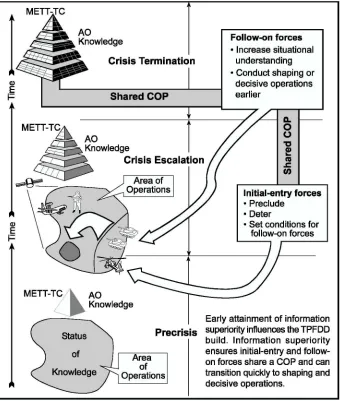
11-76. Deploying forces may not have information superiority at deployment. The commander's information needs, coupled with an understanding of METT-TC, influence force tailoring and the deployment sequence. ISR assets deploy to the theater ahead of or with initial-entry forces, depending on en-emy. In areas where Army forces are already deployed and surveillance sys-tems are established and collecting, available information may be adequate. However, crises often occur where forces are not forward deployed and intel-ligence is relatively sparse. In those cases, getting additional surveillance and reconnaissance assets immediately into theater becomes critical. Command-ers deploy ISR and information systems with habitually supported forces. Assets assigned to early deploying units reinforce assets already deployed to or covering the theater.
11-77. The available intelligence on potential AOs may have limited tactical use. Commanders and staffs often find they must develop intelligence on an AO while their units are deploying there. To answer some specified and im-plied requirements, commanders may use subject matter experts. Subject matter experts understand the terrain, culture, enemy capabilities, and civil considerations of the AO and can help staffs develop estimates. Contingency operations in response to unanticipated crises are usually conducted under time constraints. It is critical that commanders and staffs consult subject matter experts familiar with the AO while developing the commander's vi-sion, establishing CCIR, and refining situational understanding.
existing intelligence. Persistent gaps may require additional collection assets. In a low-threat environment, host nation assets may provide significant augmentation and reduce requirements for US assets. In a high-threat envi-ronment, extensive reconnaissance and surveillance may be required before the main body deploys. All these factors influence how commanders tailor their forces (see Figure 11-4).
I
Crisis TerminationCD
E
i= Shared COP
Follow-on forces
.
Increase situational understanding.
Conduct shaping or decisive operations earliera.
0 0'tJ
e
ell .s:: tJ)
Initial-entry forces
.
Preclude.
Deter.
Set conditions for follow-on forcesMETT-TC~ AO
~
KnowledgePrecrisis
Early attainment of information
superiority influences the TPFDD
build. Information superiority
ensures initial-entry and
follow-on forces share a COP and can transition quickly to shaping and
decisive operations.
Area of Operations
Figure 11-4. Information Superiority and Strategic Responsiveness
INFORMATION SUPERIORITY EXECUTION
OPERATIONS IN NONCONTIGUOUS AREAS OF OPERATIONS
11-80. Noncontiguous areas of operations challenge commanders to use in-telligence elements, reconnaissance units, and surveillance systems effi-ciently and imaginatively. When operating in noncontiguous AOs, command-ers focus collection operations on areas between formations. Surveillance and reconnaissance assets cover areas between noncontiguous AOs. When the area requiring coverage exceeds the capabilities of reconnaissance units, commanders coordinate for additional coverage, with joint elements if avail-able. When necessary, commanders task other forces to complement surveil-lance and reconnaissance assets.
SUBORDINATE INITIATIVE
11-81. Commanders depend on subordinate initiative to accomplish missions, even in the absence of orders or a COP. Information technology enhances Army operations but does not govern them. Inevitably, some information sys-tems will fail---either of their own accord or because of enemy action. Com-manders develop and communicate their vision to subordinates with enough clarity to allow them to act when this happens. Subordinates complement ini-tiative with constant coordination and by keeping their higher commanders informed. Because Army forces must be able to execute in the absence of a COP, senior commanders avoid the temptation to overcontrol subordinates.
11-82. The capabilities of new information systems encourage subordinates to exercise disciplined initiative. A COP gives subordinates access to the same information as their commanders and tailors it to subordinate needs. Subordinates who know their commander's intent can act based on the COP, confident that their commander will understand what they are doing and why. More complete information allows well-trained leaders to make better decisions. A force in which commanders make good decisions at the lowest level will operate faster than one where decisions are centralized. Such a force is agile and can exploit opportunities as soon as they occur. As subordi-nates report their actions, those reports become part of the COP. Elements of the force affected by the action learn of it and can synchronize their actions with it. Properly used, modern information systems allow commanders to is-sue mission orders and control the battle through empowered subordinates. These subordinates can make decisions that fit both their immediate circum-stances and the mission of the force as a whole.
THE IMPACT OF TECHNOLOGY
11-84. Information technology helps commanders lead by allowing them more freedom to move around the battlefield while remaining connected electroni-cally to the command post. This capability allows commanders to add their personal observations and feel for the ongoing operation to the synthesized information in the COP. Commanders can increase face-to-face contact with subordinates at decisive points without losing sight of the overall situation.
11-85. Technology is creating new techniques for displaying and disseminat-ing information. Imagery, video, color graphics, digital maps and overlays all present relevant information faster and more precisely than analog methods. These new capabilities allow greater understanding by different audiences. Today, for example, commanders use collaborative planning across data networks to link subordinates with commanders throughout the operations process. Displays of information tailored to suit the audience, reduce acronyms, and eliminate jargon are particularly important when dealing with joint, multinational, and interagency participants. Technology allows staffs to
quickly produce such tailored displays.
11-86. Modern technology provides a variety of means for commanders to see and engage the enemy in depth. Sensor-to-shooter links used with precision weapons enable forces to strike multiple targets simultaneously in near real-time with little regard for distance or geography. What these systems hit and when they hit it are important decisions. The results are in the effects they create, not solely in the targets they destroy. Systematic lethal attacks on en-emy C2 systems provide leverage for air and ground forces and help create the conditions for success. By their nature, these effects are temporary; com-manders must exploit them with maneuver to make them permanent.
Combat Service Support
Before acommander can even start thinking of maneuvering or giving
battle, of marching this way and that, of penetrating, enveloping, en-circling, of annihilating or wearing down, in short of putting into practice the whole rigmarole of strategy, he has---or ought-to make sure of his ability to supply his soldiers with those 3,000 calories a day without which they will very soon cease to be of any use as soldiers; that roads to carry them to the right place at the right time are avail-able, and that movement along these roads will not be impeded by ei-ther a shortage or a superabundance of transport.
12-1. Combat service sup-port (CSS), like all other battlefield operating sys-tems, is commanders' business. Commanders view operations and CSS as interdependent. CSS is an enabling operation that generates and sus-tains combat power for employment in shaping and decisive operations at the time and place the
force commander
re-quires. Commanders lay the groundwork to seize the initiative, maintain momentum, and exploit success by combining and balancing mission and CSS requirements.
12-2. The force commander is responsible for integrating CSS into the overall operation. The CSS commander, as the force commander's primary CSS op-erator, assists in this. Operators and CSS planners view complex military problems from different perspectives. Without integration, the overall opera-tion and CSS proceed along separate paths that may not support each other. With integration, the operational and CSS perspectives both contribute to the common operational picture (COP) that supports continuous assessment, planning, preparation, and execution.
Martin Van Creveld
Supplying War
CONTENTS
Purpose of Combat Service Support 12-2
CSS Characteristics 12-3
CSS Functions 12-4
CSS Planning and Preparation 12-5
CSS Planning 12-6
CSS Preparation 12-7
CSS Execution 12-11
CSS in Offensive Operations 12-11
CSS in Defensive Operations 12-12
CSS in Stability Operations 12-13
CSS in Support Operations 12-13
Tactical Combat Service Support 12-14 Army CSS Within Joint Operations 12-14 National Providers and National
Strategic Support 12-15
Extending Operational Reach and
Sustainability 12-16
PURPOSE
OF COMBAT SERVICE
SUPPORT
12-3. ess is a major component of sustaining operations. The art of ess in-volves projecting a strategically responsive force that generates decisive com-bat power. Successful application of the art of ess requires proper synchroni-zation between operational and tactical commanders and their ess commands. Effective synchronization of operational and tactical require-ments enables force commanders to initiate and sustain operations and ex-tend their operational reach.
12-4. Combat service support reach operations involve the opera-tional positioning and efficient use of all available ess assets and capabilities, from the industrial base to the soldier in the field (see Figure 12-1). They enable force commanders to extend operational reach and to deploy and employ the force simultaneously, without pause. ess reach op-erations merge operational art and science into an opop-erations enabler. They minimize the ess footprint in theater by deploying the minimum essential ess elements to the area of operations (AO) and establishing links to and fully exploiting all available sources of support. ess reach operations include the use of intermediate staging bases (ISBs), forward-deployed bases, Army pre-positioned stocks, and continental US (CONUS) resources. ess reach op-erations capitalize on split-based and modular opop-erations; they take maxi-mum advantage of all available sources of support for follow-on sustainment.
Intermediate Staging Base
CSS reach extends operational reach and enhances sustainability.
12-5. ess is integrated at all levels of war through a seamless distribution system. Active and reserve component, DOD and DA civilian, contractor, joint, and multinational assets all provide ess from CONUS to and within the theater of operations. ess operations enable the commander to generate combat power for employment in conducting shaping and decisive operations within the required time and at a tempo faster than the enemy can react.
COMBAT SERVICE SUPPORT CHARACTERISTICS
12-6. Force commanders visualize and describe the concept of ess together with their ess commanders. To help them describe the considerations re-quired to conduct (plan, prepare, execute, and assess) successful operations, commanders view ess characteristics from the perspective of the overall op-eration. ess characteristics are integrated throughout the operational framework, guide prudent planning, and assist the staff in developing the support plan. (FM 4-0 discusses the relationship between joint logistic and joint personnel principles and the US Army ess characteristics). ess
char-acteristics seldom exert equal influence, and their importance varies by situa-tion. The commander identifies ess characteristics having priority during an operation; they become the foundation for preparing the concept of ess. The ess characteristics
are--.
Responsiveness. Responsiveness is the crucial characteristic of ess. It means providing the right support in the right place at the right time. Responsiveness includes the ability to foresee operational re-quirements. It involves identifying, accumulating, and maintaining the minimum assets, capabilities, and information necessary to meet support requirements. On the other hand, the force that accumulates enough material and personnel reserves to address every possible contingency usually cedes the initiative to the enemy..
Simplicity. Simplicity means avoiding complexity in both planning and executing ess operations. Mission orders, drills, rehearsals, and standing operating procedures (SOPs) contribute to simplicity..
Flexibility. The key to flexibility lies in the expertise for adapting ess structures and procedures to changing situations, missions, and con-cepts of operations. ess plans and operations must be flexible enough to achieve both responsiveness and economy. Flexibility may include improvisation. Improvisation is the ability to make, invent, or arrange for what is needed from what is at hand. Improvised methods and sup-port sources can maintain ess continuity when the preferred method is undefined or not usable to complete the mission..
Attainability. Attainability is generating the minimum essential sup-plies and services necessary to begin operations. Commanders deter-mine minimum acceptable support levels for initiating operations..
Sustainability. Sustain ability is the ability to maintain continuoussupport during all phases of campaigns and major operations. ess planners determine ess requirements over time and synchronize the delivery of minimum sustainment stocks throughout the operation.
.
Survivability. Being able to protect support functions from.
Economy. Resources are always limited. Economy means providing the most efficient support to accomplish the mission. Commanders con-sider economy in prioritizing and allocating resources. Economy re-flects the reality of resource shortfalls, while recognizing the inevitable friction and uncertainty of military operations..
Integration. Integration consists of synchronizing CSS operations with all aspects of Army, joint, interagency, and multinational opera-tions. The concept of operations achieves this through a thorough un-derstanding of the commanders' intent and synchronization of the CSS plan. Integration includes coordination with and mutual support among Army, joint, multinational, and interagency CSS organizations. CSS characteristics are integrated throughout the operational framework. They guide prudent planning and assist the staff in developing the CSS plan (see JP 1-0; JP 4-0; FM 4-0).COMBAT
SERVICE
SUPPORT
FUNCTIONS
12-7. CSS consists of many interrelated functions. Planning, managing, and executing support involves synchronizing and integrating them. At all levels of operations, the key CSS functions
include---.
Maintenance. Keep materiel in a serviceable, operational condition, return it to service, or update and upgrade its capability (see FM 3-04.500; FM 4-30.2)..
Transportation. Move and transfer units, personnel, equipment, and supplies to support the concept of operations (see JP 4-01; FM 4-01)..
Supply. Acquire, manage, receive, store, and issue all classes of supply(except Class VIII) required to equip and sustain Army forces. Supply also covers the turn-in, exchange, and/or disposition of items (see JP 4-0; JP 4-03; FM 4-20).
.
Combat health support. Maintain the force by preventing disease nonbattle injury (DNBI) casualties; clearing the battlefield of casual-ties; providing forward medical treatment; providing en route care during medical evacuation; ensuring adequate Class VIII supplies and medical equipment are available; and providing veterinary, dental, and laboratory services (see JP 4-02; FM 4-02)..
Field services. Feed, clothe, and provide personal services for sol-diers. Field services include clothing exchange, laundry, shower, textile repair, mortuary affairs, aerial delivery, and food services (see JP 4-06; FM 4-20)..
Explosive ordnance disposal. Neutralize domestic or foreign con-ventional, nuclear, chemical, and biological munitions and devices that present a threat to military operations and civilian facilities, materiel, and personnel (see FM 3-100.38; FM 4-30.12)..
Financial management operations. Financial management opera-tions provide finance and resource management services to command-ers. Finance services include pay for vendors, services, accounting, cen-tral funding, technical advice, and policy guidance. Resource management services include technical advice to commanders on re-source management implications and on the costs of preparing and conducting operations (see JP 1-06; FM 1-06)..
Religious support. Provide and perform religious support operations for the commander to protect the soldiers', family members', and auth-orized civilians' free exercise of religion. This includes the personal delivery of rites, sacraments, ordinances, spiritual care, religious coun-seling, spiritual fitness training and assessment, religious worship ser-vices, and advice to the command on matters of religion, morals, morale, and coordination with nongovernmental organizations (NGOs) and private voluntary organizations as appropriate (see JP 1-05; FM 1-05)..
Legal support. Perform operational law duties and provide advice and services in military justice, international law, administrative law, civil law, claims, and legal assistance in support of the command, con-trol, and sustainment of operations (see FM 1-04)..
Band Support. Provide music to enhance unit cohesion, morale, and to musically support the entire spectrum of military operations. Sup-port information operations, and should be integrated into public af-fairs, civil afaf-fairs, and psychological operations plans. When the musi-cal mission of bands is no longer feasible due to the intensity of conflict, augment security operations for command posts, or augment perimeter security for enemy prisoner of war and civilian internee operations (see FM 1-08).12-8. General engineering and contract support also support sustaining op-erations. General engineering involves constructing, repairing, operating, and maintaining infrastructure and facilities to enhance provision of sus-tainment and services (see JP 4-04; FM 3-34.250). Contracting support ob-tains and provides supplies, services, and construction labor and materiel. Contracting often provides a responsive option or enhancement to support the force (see FM 4-100.2).