INVESTIGATING THE ADOPTION AND IMPACT OF
E- LEARNING IN KSA: PRINCE SATTAM BIN ABDULAZIZ
UNIVERSITY CASE STUDY
1TARIG MOHAMED AHMED, 2MOHAMED E. SELIAMAN
1
Assoc. Prof., Department of MIS, Prince Sattam Bin Abdalaziz University, Saudi Arabia Assoc. Prof., Department of Computer Sciences, University of Khartoum, SUDAN 2
Assoc. Prof., Department of Information Systems, King Faisal University, Saudi Arabia
E-mail: 1[email protected], 2[email protected]
ABSTRACT
The kingdom of Saudi Arabia has given high priorities to the use of ICT to enhance teaching and learning processes in national institutes of higher education. E-learning has recently received intensive research attention. This research aims to identify the predictors of learners’ continuance intention to use E-learning systems in the Kingdom of Saudi Arabia based on the Unified Theory of Acceptance and Use of Technology (UTAUT), DeLone and McLean IS success model and the Technology Fit Model. The survey questionnaire measurement tool used included 34 items forming twelve latent variables. Based on the SEM analysis, fourteen out of seventeen research hypotheses were supported leaving three hypotheses not supported in this research. Study results show that the most significant the predictors of learners’ continuance intention to use E-learning systems are Perceived Benefits, Perceived Satisfaction and Academic Motivation. The influence of each of Task-technology fit, Performance expectancy, Knowledge Quality and Information Quality on user’s Perceived Satisfaction with using E- learning systems was also significant.
Keywords: Technology acceptance model, e-learning systems
1. INTRODUCTION
The kingdom of Saudi Arabia has given high priorities to the use of ICT to enhance teaching and learning processes in national institutes of higher education. Electronic Learning or e-learning for short is one area which received intensive attention from the institutions of higher education. In particular, huge investments have been allocated to provide the necessary resources for successful
adoption and implementation of e-learning
initiatives and strategies in the country. This is mainly due to the valuable advantage of education systems as reported by several researches and practical experiences [1]. The e-learning is mainly based on using specialized web-based systems as Learning Management Systems. This presents are remarkable shift from traditional learning to the built-learning, which is the modern approach to
learning. The e-learning system generally
connected with other academic systems. E-learning usually includes several relevant products such as following: Blackboard, E-Test, Virtual classroom and Short Message Service.
e-learning system [3]. A questionnaire survey was used to collect data from students and instructors. The reliability and validity of the questionnaire will be tested then strength of correlation between the different constructs will be examined. Further, structural equation model and path analysis was applied to determine the most influential driving factors for students acceptance and successful of e-learning.
2. THEORETICAL BACKGROUND
2.1 The E-learning
The kingdom of Saudi Arabia has given high priorities to the use of ICT to enhance teaching and learning processes in national institutes of higher education. Electronic Learning or e-learning for short is one area which received intensive attention. In particular, huge investments have been allocated to provide the necessary resources for successful adoption and implementation of e-learning initiatives and strategies in the country. This is mainly due to the valuable advantage of education systems as reported by several researches and practical experiences [1]. The e-learning is mainly based on using Blackboard system as Learning Management System. This is an effort to contribute to the shift from traditional learning to the built-learning, which is the modern approach to learning. Prince Sattam bin Abdlaziz University (PSAU) has a strong infrastructure for e-learning. The e-learning system in PSAU is directly connected with academic systems. PSAU has worked on the preparation of an awareness training program through training courses, workshops and awareness-raising work. To deliver E-learning services, PSAU has lunched several products related to e-learning systems such as following: Blackboard, E-Test, Virtual classroom and Short Message Service Academy (Connect). This research aims to identify the learners’ adoption factors of E-learning systems in PSAU based on the use of Unified Theory of Acceptance and Use of Technology (UTAUT) and DeLone and McLean IS success model [2] , UTAUT uses four core factors of intention and usage, and four moderators of key relationships. It helps to assess the chance of success for new technology such as e-learning. The research model also used Technology Fit to test factors that motivate students to use the e-learning system[3]. A questionnaire survey was used to collect data from students and instructors. The reliability and validity of the questionnaire will be tested then strength of correlation between the
different constructs was examined. Further, structural equation model and path analysis was applied to determine the most influential driving factors for students acceptance and successful of E-learning.
2.2 The Unified Theory of Acceptance and Use
UTAUT was developed by Venkatesh et al. [2] as extension of TAM to explain perceived usefulness and usage intention. UTAUT is based on information system adoption research. It could be used to measure user intention of using information system and subsequent usage behavior. UAUT consists of constructs to measure the usage intention behavior such as performance expectancy, effort expectancy, social influence, and Self-Efficacy(not from UTAUT). In this paper adapted these constructs to the students’ technology acceptance and use the Blackboard as e-learning information systems. The performance expectancy was used to measure how the Blackboard will provide benefits and increase the activities performance in learning environment. The effort expectancy was used to measure the degree of free effort and how much it does not require a great mental effort when student are using Blackboard. The Social influence was used to measure the impact of those around the student on the use of Blackboard such as students or friends or family. The Self-Efficacy construct was used to measure the degree of difficulties and self-trust of using Blackboard.
2.3 The IS success model
Delone and McLean IS success model [4] is an information systems theory which is used to understand of (Information Systems) IS success by describing the relationship between information, system and service quality on onside and the usage intention and user satisfaction on the other side. In this paper IS Success Model was used to measure how the knowledge and information quality intention the student to use Blackboard. It also measures the relationship between the knowledge and information quality and perceived benefit of
using Blackboard.[11]
2.4 The task-technology fit model
impact the user performance. In this paper, TTF was used to measure how Blackboard is good as mediation to deliver the courses’ content and facilitate the communication between students and instructors.[12]
3. RESEARCH MODEL AND HYPOTHESES
3.1 Task-technology fit
Several research studies has reported that Task-technology fit has positive influence on user’s acceptance of E-learning Systems [6]
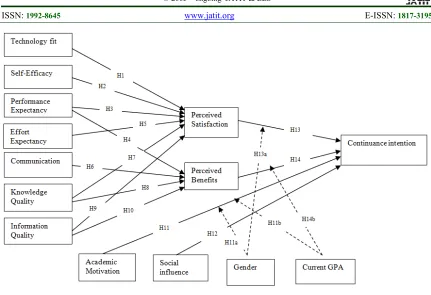
H1: Task-technology fit is positively related to user’s Perceived Satisfaction with using E- learning systems
H2: Self Efficacy is positively related to user’s Perceived Benefits of using E- learning systems
3.2 The Unified Theory of Acceptance and Use of Technology
Venkatesh et al., [2] reported the
performance expectancy can predict users’
intention to accept the use technology. In addition, [7] found that effort expectancy positively influences user’s continuance intention to use E-learning systems. Therefore, we hypothesized the following:
H3: Performance expectancy is positively related to user’s Perceived Satisfaction with using E- learning systems
H4: Performance expectancy is positively related to user’s Perceived Benefits of using E- learning systems
H5: Effort expectancy is positively related to user’s Perceived Satisfaction with using E- learning systems
H6: Communication is positively related to user’s Perceived Benefits of using E- learning systems.
H7: Knowledge Quality is positively related to user’s Perceived Satisfaction with using E- learning systems
H8: Knowledge Quality is positively related to user’s Perceived Benefits of using E- learning systems.
H9: Information Quality is positively related to user’s Perceived Satisfaction with using E- learning systems
H10: Information Quality is positively related to user’s Perceived Benefits of using E- learning systems.
H11: Academic Motivation is positively related to user’s continuance intention to use E-learning systems.
H12: Social Influence is positively related to user’s continuance intention to use E-learning systems.
H13: Perceived Satisfaction is positively related to user’s continuance intention to use E-learning systems.
H14: Perceived Benefits of is positively related to user’s continuance intention to use E-learning systems.
The moderating effect of Gender and GPA
H11a: The gender moderates the relationship between Academic Motivation and to user’s continuance intention to use E-learning systems.
H13a: The gender moderates the relationship between Perceived Satisfaction and user’s continuance intention to use E-learning systems.
H11b: The student GPA moderates the relationship
between Academic Motivation and user’s
continuance intention to use E-learning systems.
Figure1. Research Model
Table 1. Research Model Constructs
Constructs Number of items References
Performance expectancy 3 Unified Theory of Acceptance (UTAUT) was
introduced by Venkatesh (2003).
Effort expectancy 3 Unified Theory of Acceptance (UTAUT) was
introduced in 2003 by Venkatesh.
Social Influence 2 Unified Theory of Acceptance (UTAUT) was
introduced in 2003 by Venkatesh.
Academic Motivation 2 Developed by the authors
Technology Fit 2 (Lin & Wang, 2012)
Communication 4 Developed by the authors
Perceived Satisfaction 3 Delone and McLean IS success model (2003)
Net benefits 4 Delone and McLean IS success model (2003)
Knowledge Quality 4 Delone and McLean IS success model (2003)
information Quality 5 Delone and McLean IS success model (2003)
4. METHOD
4.1 Sampling method and participants
[image:5.612.81.527.173.474.2]Table 2 illustrates the sample demographic characteristics.
Table 2. Demographic characteristics of the respondents
Measure Item Frequency Percentage
Gender 1
141 53.4
2
119 45.1
Age 1
117 44.3
2
109 41.3
3
28 10.6
4
2 .8
5
8 3.0
Educ 1
80 30.3
2
6 2.3
3
36 13.6
4
75 28.4
5
66 25.0
CGPA 1
83 31.4
2
64 24.2
3
46 17.4
4
39 14.8
5
29 11.0
4.2. Reliability and validity of the measurement
The survey questionnaire measurement tool included 34 items forming twelve latent variables.
Cronbach’s alpha was used for testing the internal consistency reliability of the scale. As shown in Table 3, only the self-efficacy construct reported a low Cronbach’s alpha but its Composite Reliability was within the acceptable range. All other constructs reported alpha value above the acceptable threshold of 0.7.
Table 3.Reliability Statistics for the constructs
Construct Alpha
Cronbach's
Composite Reliability
TecFit 0.919 0.961
SE 0.433 0.706
PE 0.898 0.936
EE 0.834 0.901
SI 0.706 0.872
Com 0.879 0.917
PSat 0.856 0.913
NetB 0.902 0.932
KQ 0.876 0.915
INFQ 0.904 0.929
CI 0.922 0.945
AcaM 0.882 0.944
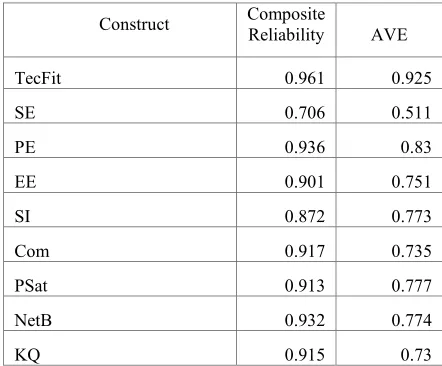
[image:5.612.306.527.536.719.2]Convergent validity was assessed by calculating composite reliability and the Average Variance Extracted (AVE) for each latent construct. Indicates composite reliability coefficients for constructs all are greater than the critical value of 0.7. In addition, all constructs reported an AVE score exceeding 0.5 as in Table 4.
Table 4. Convergent validity Statistics for the constructs
Construct Composite
Reliability AVE
TecFit 0.961 0.925
SE 0.706 0.511
PE 0.936 0.83
EE 0.901 0.751
SI 0.872 0.773
Com 0.917 0.735
PSat 0.913 0.777
NetB 0.932 0.774
INFQ 0.929 0.723
CI 0.945 0.812
AcaM 0.944 0.895
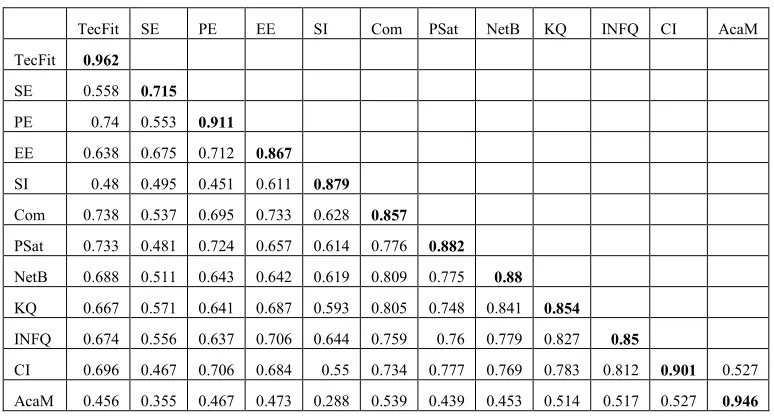
Discriminant validity was assessed by calculating the square root of the Average Variance
Extracted (AVE) for each latent construct and comparing it with the other latent constructs correlations. All constructs reported an AVE score exceeding 0.5. In addition, the square root of AVE for each construct is greater than all correlations of other constructs supporting the measurement
[image:6.612.113.500.197.406.2]discriminant validity (Table 5).
Table 5- Discriminant validity Statistics for the constructs
TecFit SE PE EE SI Com PSat NetB KQ INFQ CI AcaM TecFit 0.962
SE 0.558 0.715
PE 0.74 0.553 0.911
EE 0.638 0.675 0.712 0.867
SI 0.48 0.495 0.451 0.611 0.879
Com 0.738 0.537 0.695 0.733 0.628 0.857
PSat 0.733 0.481 0.724 0.657 0.614 0.776 0.882
NetB 0.688 0.511 0.643 0.642 0.619 0.809 0.775 0.88
KQ 0.667 0.571 0.641 0.687 0.593 0.805 0.748 0.841 0.854
INFQ 0.674 0.556 0.637 0.706 0.644 0.759 0.76 0.779 0.827 0.85
CI 0.696 0.467 0.706 0.684 0.55 0.734 0.777 0.769 0.783 0.812 0.901 0.527 AcaM 0.456 0.355 0.467 0.473 0.288 0.539 0.439 0.453 0.514 0.517 0.527 0.946
5. THE STRUCTURAL MODEL RESULTS
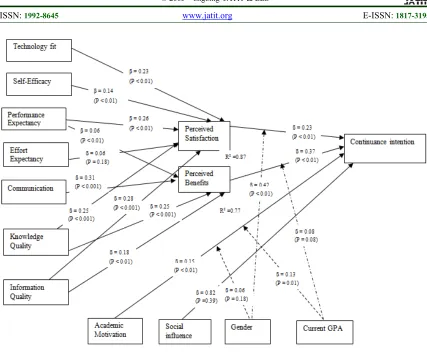
Structural Equation Modeling (SEM) technique was used to test the model hypotheses to
investigate relationships between variables.
Figure 2: Model with analysis result
Table 6: Model Result
Hypothesis Test result Conclusion
H1: Task-technology fit is positively related to user’s Perceived Satisfaction with using E- learning systems
(beta= 0.23, p<0.01)
Supported
H2: Self Efficacy is positively related to user’s Perceived Benefits of using E- learning systems
(beta= 0.14, p<0.01)
Supported
H3: Performance expectancy is positively related to user’s Perceived Satisfaction with using E- learning systems
(beta= 0.26, p<0.01)
Supported
H4: Performance expectancy is positively related to user’s Perceived Benefits of using E- learning systems
(beta= 0.06, p<0.01)
Supported
H5: Effort expectancy is positively related to user’s Perceived Satisfaction with using E- learning systems
(beta= 0.06, p=0.18)
Not supported
H6: Communication is positively related to user’s Perceived Benefits of using E- learning systems.
(beta= 0.31, p<0.001)
Supported
H7: Knowledge Quality is positively related to user’s Perceived Satisfaction with using E- learning systems
(beta= 0.25, p<0.001)
Supported
H8: Knowledge Quality is positively related to user’s Perceived Benefits of using E- learning systems.
(beta= 0.44, p<0.001)
Supported
H9: Information Quality is positively related to user’s Perceived Satisfaction with using E- learning systems
(beta= 0.28, p<0.001)
Supported
H10: Information Quality is positively related to user’s Perceived Benefits of using E- learning systems.
(beta= 0.16, p=0.004)
Supported
H11: Academic Motivation is positively related to user’s continuance intention to use E-learning systems.
(beta= 0.15, p<0.01)
Supported
H12: Social Influence is positively related to user’s continuance intention to use E-learning systems.
(beta= 0.82, p=0.39)
H13: Perceived Satisfaction is positively related to user’s continuance intention to use E-learning systems.
(beta= 0.23, p<0.01)
Supported
H14: Perceived Benefits is positively related to user’s continuance intention to use E-learning systems.
(beta= 0.37, p<0.01)
Supported
H11a: The gender moderates the relationship between Academic Motivation and to user’s continuance intention to use E-learning systems.
(beta= 0.13, p=0.01)
Supported
H13a: The gender moderates the relationship between Perceived Satisfaction and user’s continuance intention to use E-learning systems.
(beta= 0.42, p<0.01)
Supported
H11b: The student GPA moderates the relationship between Academic Motivation and user’s continuance intention to use E-learning systems.
(beta= 0.13, p=0.01)
Supported
H14b: The student GPA moderates the relationship between Perceived Benefits and user’s continuance intention to use E-learning systems.
(beta= 0.08, p=0.08)
Not supported
6. RESULT DISCUSSION
Based on the SEM analysis, fourteen out of seventeen research hypotheses were supported leaving three hypotheses not supported in this research. The influence of each of Task-technology fit, Performance expectancy, Knowledge Quality and Information Quality on user’s Perceived Satisfaction with using E- learning systems were supported at the p<0.01. Effort expectancy was not positively related to user’s Perceived Satisfaction with using E- learning systems. Social Influence was not positively related to user’s continuance intention to use E-learning systems. The student GPA was not moderated the relationship between Perceived Benefits and user’s continuance intention to use E-learning systems. The others fourteen research hypotheses were supported according to the results.
7. CONCLUSION AND FUTURE WORK
This research aimed to identify the learners’ adoption factors of E-learning systems in PSAU based on the use of Unified Theory of Acceptance and Use of Technology (UTAUT) and DeLone and McLean IS success model, the research model also used Technology Fit to test factors that motivate students to use the e-learning system. The survey questionnaire measurement tool included 34 items forming twelve latent variables. Based on the SEM analysis, fourteen out of seventeen research hypotheses were supported leaving three hypotheses not supported in this research. The influence of each of Task-technology fit, Performance expectancy, Knowledge Quality and Information Quality on user’s Perceived Satisfaction with using E- learning systems were supported at the p<0.01. Effort expectancy was not positively related to user’s Perceived Satisfaction with using E- learning systems. Social Influence was not positively related to user’s continuance intention to use E-learning systems. The student GPA
was not moderated the relationship between Perceived Benefits and user’s continuance intention to use E-learning systems. The others fourteen research hypotheses were supported according to the results
As future work, a new factors will be used to build a strong model that can help to support using the e-learning systems in universities.
ACKNOWLEDGEMENT
This project was supported by the Deanship of Scientific Research at Prince Sattam Bin Abdulaziz
University under the research project #
2015/02/4696
REFRENCES:
[1] Persico, Donatella, Stefania Manca, and Francesca Pozzi. "Adapting the Technology Acceptance Model to evaluate the innovative potential of e-learning systems." Computers in Human Behavior 30 (2014): 614-622.
[2] Venkatesh, Viswanath, et al. "User acceptance of information technology: Toward a unified view." MIS quarterly (2003): 425-478.
[3] Lin, Wen-Shan, and Chun-Hsien Wang. "Antecedences to continued intentions of adopting e-learning system in blended learning instruction: A contingency framework based on models of information system success and task-technology fit." Computers & Education 58.1 (2012): 88-99.
[4] Delone, William H., and Ephraim R. McLean. "The DeLone and McLean model of information systems success: a ten-year update." Journal of management information systems 19.4 (2003): 9-30.
[5] Goodhue, Dale L., and Ronald L. Thompson.
"Task-technology fit and individual
performance." MIS quarterly (1995): 213-236. [6] Lin, W., & Wang, C. (2012). Antecedences to
contingency framework based on models of information system success and task-technology fit. Computers & Education, 58(1), 88-99.
[7] Chiu, C., & Wang, E. T. (2008). Understanding web-based learning continuance intention: The role of subjective task value. Information & Management, 45(3), 194-201
. [8] Dishaw, M. T., & Strong, D. M. (1999). Extending the technology acceptance model with task–technology fit constructs. Information & Management, 36(1), 9-21.
[9] Venkatesh, V., Morris, M. G., Davis, G. B., & Davis, F. D. (2003). User acceptance of information technology: Toward a unified view. MIS Quarterly, , 425-478.
[10] Wu, J., & Wang, Y. (2006). Measuring KMS success: A respecification of the DeLone and McLean's model. Information & Management, 43(6), 728-739.
[11] Wang, Yi-Shun, Hsiu-Yuan Wang, and Daniel Y. Shee. "Measuring e-learning systems success in an organizational context: Scale development and validation." Computers in Human Behavior 23.4 (2007): 1792-1808.
[12] D'Ambra, John, Concepción S. Wilson, and
Shahriar Akter. "Application of the
task‐technology fit model to structure and
evaluate the adoption of E‐books by