annotation standard to the curator
Vasundra Touré1, John Zobolas1, Martin Kuiper1 and Steven Vercruysse1
1 Department of Biology, Norwegian University of Science and Technology (NTNU),
Trondheim, Norway.
Abstract
Summary: Molecular causal interactions are defined as regulatory connections between biological components. They are commonly retrieved from biological experiments, and can be used for connecting biological molecules into regulatory computational models that represent biological systems. However, including a molecular causal interaction into a model requires assessing its relevance to that model, based on detailed knowledge about the biomolecules, interaction type, and biological context. In order to standardize the representation of this knowledge in ‘causal statements’, we recently developed the MI2CAST guidelines. Here we introduce causalBuilder: an intuitive web-based curation interface for the annotation of molecular causal interactions that comply with the MI2CAST standard. The causalBuilder prototype essentially embeds the MI2CAST curation guidelines in its interface, and makes its rules easy to follow by a curator. In addition, causalBuilder serves as an original application of the VSM general-purpose curation technology, and provides both curators and tool developers with an interface that can be fully configured to allow focusing on selected MI2CAST concepts to annotate. After information is entered, the causalBuilder prototype produces genuine causal statements that can be exported in different formats.
Availability and implementation: The causalBuilder application is available at
https://mi2cast.github.io/causalBuilder and the source code is available at
https://github.com/mi2cast/causalBuilder under the AGPL-3.0 license.
Supplementary information: Further information on causalBuilder, MI2CAST, and VSM is
available at https://mi2cast.github.io/causalBuilder/documentation,
https://github.com/MI2CAST/MI2CAST, and https://vsmjs.github.io.
Contacts: [email protected], [email protected].
Keywords: causal statement, metadata, curation guidelines, curation web interface, VSM, MI2CAST.
Introduction
A molecular causal interaction describes the regulatory effect of a biological ‘source’ entity on the activity of a biological ‘target’. It represents a specific molecular event that has been interpreted or translated into a statement, providing details about the involved biomolecules and their interaction. Such ‘causal statements’ correspond to experimentally verifiable regulatory hypotheses that can form the basis for studying the behavior of highly complex biological networks. Causal statements can include diverse contextual information that detail the specifics of the activity states of the biomolecules involved and the biological background in which an interaction was observed and therefore can be assumed to be true (e.g., phosphorylations, taxon, tissue type, cell line, experiment). The availability of these details provides data users with better criteria for deciding which causal interactions to include in their studies. For example, when computational modelers assemble the regulatory network of a specific cancer type, they can only determine which interactions are relevant when the metadata describing the exact biological context information supports that the causal statement is valid in the modeling context.
Recently, the Minimum Information about a Molecular Interaction Causal Statement (MI2CAST) has been developed to guide the curation of causal statements (1). The MI2CAST checklist serves as a framework for standardising the production of high-quality causal interaction information, in several ways. First, it guides the biocurators who examine publications and extract knowledge about causal interactions, to create high-quality, context-rich annotations (2). Second, it helps experimental biologists to consider a list of criteria related to experimental design and reporting, so that they can maximize the usefulness of their data. Third, it helps computational biologists, by declaring and formalizing the contextual information that is relevant for their models.
The process of biocuration is commonly performed with curation tools customized to capture the curation details associated with one specific database (3,4). In principle, data generated with another curation interface can also be added to this database, provided that all mandatory annotation details are included by that curation interface in a format that can be mapped to this database. This has for example been realized by the PSI-MI (Proteomics Standards Initiative, Molecular Interaction (5)) with the development of the CausalTAB standard (also called, PSI-MITAB2.8 (6)) for exchanging curated causal information.
This inspired us to move the MI2CAST checklist from theory to practice, by implementing the MI2CAST standard in a user-friendly, customizable, and database-independent curation tool: the causalBuilder prototype. This tool can be configured to cover both the essential metadata needed for a causal statement, and any relevant subset of its many non-mandatory features. Furthermore, causalBuilder can export the full set of annotated details for a curated molecular interaction into a format that is compliant with several major data repositories.
In addition, causalBuilder functions as one of the first test-case applications that utilizes VSM (Visual Syntax Method (7)), a new curation technology that enables annotation of information of any type, and of any complexity. VSM represents information in a form that is both intuitive for curators, and semantically precise for computer processing. It uses an elementary conceptual
model, combined with a general-purpose user interface, called ‘vsm-box’
structured language, each vsm-box can hold a single unit of information: a VSM-sentence. A vsm-box allows a curator to enter VSM-terms (interface elements that represent entities, relations, numbers, etc.) and connect them with VSM-connectors (specifying a syntax of how VSM-terms interrelate). Specifically, a VSM-term couples a human-friendly representation (readable text) with a unique identifier (stored in the background) taken from ontologies (e.g., Gene Ontology (9)), controlled vocabularies (e.g., PSI-MI (10)), and collections of biological entities or relations (e.g., UniProt (11) or Relation Ontology (12)). To facilitate curation, a vsm-box may be pre-filled with a VSM-template: a combination of pre-generated VSM-terms, -connectors, and empty input-fields. Empty fields are VSM-term elements that still need to be filled in, and they provide auto-complete assistance that can be configured for term and identifier lookup from specific lists. Templates can resemble readable sentences in which curators only need to fill the empty fields, supported by semantic autocomplete lookup.
CausalBuilder’s main feature is the dynamic generation of VSM-templates that conform to the MI2CAST standard, and that can be tailored to the particular needs of a causal-interaction curation task as mandated by the available experimental detail. The causalBuilder prototype presents the generated templates in a vsm-box where they can be evaluated by curation-tool developers or filled in by curators. Additionally, it already supports the export of annotated data for individual causal statements into the VSM-JSON, causal-JSON or CausalTAB (PSI-MITAB2.8) format.
Implementation and use
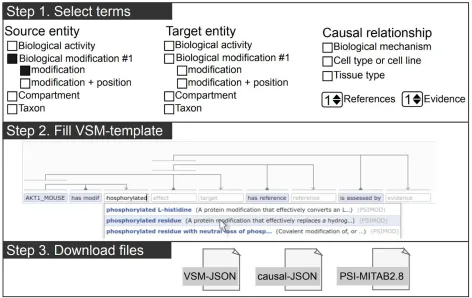
Figure 1. Steps for building a causal statement in causalBuilder. In Step 1, the different annotation features supported by MI2CAST can be selected in causalBuilder’s interactive selection panel (larger than shown). Here, just one ‘biological modification’ for the source entity is selected. In Step 2, the VSM-template that is created based on these selections contains the requested fields that need to be filled with annotations. The panel shows the mandatory field for ‘source entity’(already filled with an ‘AKT1_MOUSE’ annotation), and other empty fields for ‘[biological] modification’, ‘causal relation’, ‘target [entity]’, ‘reference [paper]’, and ‘evidence’ (hinted in lightgrey). Some VSM-terms are pre-filled (e.g., ‘has modif.’) and define the relation between empty fields. On top, pre-added VSM-connectors assign each term to one or more semantic subunits (all groups of three here); and note that connectors always attach to terms, not to other connectors. As text is being typed in a VSM-term, an auto-complete panel appears. It presents matching terms and their description (a combination of definition, identifier, etc.), fetched from online controlled vocabularies relevant for that field. In Step 3, after the template is filled, the resulting causal statement can be downloaded in several formats.
Step 1: Selection of the types of information to annotate
provided in a paper.
Depending on the information a user discovers while curating a paper, he/she can decide for each non-mandatory feature whether or not to include it for an annotation task, by selecting the corresponding checkbox or choice-list in causalBuilder’s configuration panel. Based on the selected features, this panel will dynamically generate additional choices for subfeatures when these become relevant (e.g., a phosphorylation’s position). Through this panel, the user determines the addition or removal of specific VSM-terms (filled or still empty) in the generated VSM-template placed in the vsm-box underneath. Hence, causalBuilder allows for a flexible selection of any amount of these non-mandatory terms, tailored to the annotation task.
In the generated template, the way that terms relate to each other is made clear by connectors (see Figure 1). For example, if ‘source’ and ‘target’ are each given their own ‘modification’ field, then each will be visually connected to the specific one that pertains to it. Likewise, if an entity has multiple ‘modification’ fields (e.g. for multiple phosphorylations), and these all have their own combination of ‘residue’ and/or ‘position’ subfeatures, then each subfeature will be linked to the correct ‘modification’ through a VSM-connector and a VSM-term that makes the relation explicit and precise. This makes it easy for curators (and data users) to see what field belongs together with what other field, and how.
Step 2: Adding annotations into the VSM-template
When the types of information to annotate are selected, a user can fill in the resulting template with appropriate annotation terms. Each empty VSM-term contains a placeholder that hints what type of annotation should be filled in. Each empty field is also configured to perform term-lookup in appropriate biological vocabularies. This means that when a user starts typing text in a field, an autocomplete panel appears that offers annotation options filtered down to term lists recommended by MI2CAST. For example, in the field for ‘causal relationship’, which expects the causal interaction’s regulation type, the autocomplete lookup is limited to terms from the PSI-MI controlled vocabulary (13) and Relation Ontology (12); so it could present for example ‘up-regulates (MI_2235)’, which is a term+identifier couple from PSI-MI. This enables fast and error-proof annotation by the curator.
Step 3: Exporting the annotated causal statement
The VSM-template or -sentence in the vsm-box can be downloaded at all times during the curation task, in the VSM-JSON format. Once the VSM-template is completely filled with the proper annotations, the curated causal statement can be downloaded as causal-JSON (https://github.com/vtoure/causal-json) as well, a format that can hold causal statements with all MI2CAST-supported annotation details. In addition, a standard PSI-MITAB2.8 (6) file can be generated, containing the subset of data supported by PSI-MI.
Discussion
CausalBuilder advances the field of biocuration in several ways. First, being aimed at biocurators, it shows in practice how the concepts defined in MI2CAST can be invoked to describe all aspects and context of molecular causal interactions through a simple user-interface. Second, it may serve as a demonstration for web-developers, who work on an existing or new database’s curation tool. CausalBuilder could be adapted with ‘one-click presets’ that configure the entire selection panel, or more precisely, that generate templates that include the specific features and vocabularies supported or required by that database. Also, note that our project does not have the objective to develop and maintain a new and separate database service for storing causal statements. Rather, the export to the CausalTAB (PSI-MITAB2.8) format enables the entrustment of individual, annotated causal statements to existing databases, such as SIGNOR (16,17) and IntAct (3). Future work could include export to MI-JSON (schema available at:
https://github.com/MICommunity/psi-jami/blob/master/jami-interactionviewer-json/schema/mi-j son-schema.json, accessed the 24.07.2020) that also enables storage of causalities; although, in its current state, not as effectively as causal-JSON. For instance, the use of ontologies is not as extensible in MI-JSON as in causal-JSON, and annotation of some terms is not yet supported. We are collaborating with the MI community to improve these gaps in order to provide users with a single JSON (standard) format enabling the support of causality that complies with MI2CAST.
Third, causalBuilder constitutes an early-adopter application of the VSM knowledge representation and curation technology, and demonstrates a particular, template-based use. This may inspire future curation projects to start by designing a VSM-template, and so effectively obtain a ready-to-use curation interface; one that is still easily extensible later on.
Conclusion
In summary, causalBuilder offers an intuitive, web-based prototype for the curation of a MI2CAST-compliant, molecular causal interaction and for the production of an annotated causal statement. The two major achievements of causalBuilder are to provide a MI2CAST-based testing ground for biocurators and software developers and to form a reference basis for new applications and developments of VSM.
Funding
This work was supported by the Norwegian University of Science and Technology’s Strategic Research Area "NTNU Health" [to VT], the ERACoSysMed grant COLOSYS [to VT, JZ and MK], the Gene Regulation Ensemble Effort for the Knowledge Commons [CA15205 to VT, JZ and MK], and the Research Council of Norway [project number 247727/O70 to MK and SV].
Conflict of interest. None declared.
Acknowledgements
The authors would like to acknowledge Noemi del-Toro for helping with data format compliance and updating the MI-JSON format.
References
1. Touré, V., Vercruysse, S., Acencio, M. L., et al. (2020) The Minimum Information about a Molecular Interaction Causal Statement (MI2CAST). Bioinformatics.
2. International Society for Biocuration (2018) Biocuration: Distilling data into knowledge. PLOS Biol., 16, e2002846.
3. Orchard, S., Ammari, M., Aranda, B., et al. (2014) The MIntAct project—IntAct as a common curation platform for 11 molecular interaction databases. Nucleic Acids Res., 42, D358–D363.
4. Strasser, C., Kunze, J., Abrams, S., et al. (2014) DataUp: A tool to help researchers describe and share tabular data. F1000Research, 3, 6.
5. Kerrien, S. and Hermjakob, H. (2006) Development and Implementation of the PSI MI Standard for Molecular Interaction. Proceedings of the 2006 Winter Simulation Conference, pp. 1587–1594.
6. Perfetto, L., Acencio, M. L., Bradley, G., et al. (2019) CausalTAB: the PSI-MITAB 2.8 updated format for signalling data representation and dissemination. Bioinformatics, 35, 3779–3785.
8. Vercruysse, S., Zobolas, J., Touré, V., et al. (2020) VSM-box: General-purpose Interface for Biocuration and Knowledge Representation. Preprints.
9. The Gene Ontology Consortium (2019) The Gene Ontology Resource: 20 years and still GOing strong. Nucleic Acids Res., 47, D330–D338.
10. Mayer, G., Jones, A. R., Binz, P.-A., et al. (2014) Controlled vocabularies and ontologies in proteomics: Overview, principles and practice. Biochim. Biophys. Acta BBA - Proteins Proteomics, 1844, 98–107.
11. Bateman, A., Martin, M. J., O’Donovan, C., et al. (2017) UniProt: the universal protein knowledgebase. Nucleic Acids Res., 45, D158–D169.
12. Chris Mungall, David Osumi-Sutherland, James A. Overton, et al. (2019)
oborel/obo-relations: 2019-09-25 release. oborel/obo-relations: 2019-09-25 release; Zenodo, (2019) .
13. Kerrien, S., Orchard, S., Montecchi-Palazzi, L., et al. (2007) Broadening the horizon – level 2.5 of the HUPO-PSI format for molecular interactions. BMC Biol., 5, 44.
14. Zobolas, J., Touré, V., Kuiper, M., et al. (2020) UniBioDicts: Unified access to Biological Dictionaries. Preprints.
15. Whetzel, P. L., Noy, N. F., Shah, N. H., et al. (2011) BioPortal: enhanced functionality via new Web services from the National Center for Biomedical Ontology to access and use ontologies in software applications. Nucleic Acids Res., 39, W541–W545.
16. Perfetto, L., Briganti, L., Calderone, A., et al. (2016) SIGNOR: a database of causal relationships between biological entities. Nucleic Acids Res., 44, D548-554.