Licensed under Creative Common Page 266
http://ijecm.co.uk/
ISSN 2348 0386
USABILITY EVALUATION OF INTERFACE DESIGN FOR
ONLINE ROOM RESERVATION PLATFORM
Yu-Cheng Chuang
Department of Creative Product Design,
Southern Taiwan University of Science and Technology, Taiwan, R.O.C. [email protected]
Chia-Hui Feng
Department of Creative Product Design,
Southern Taiwan University of Science and Technology, Taiwan, R.O.C. [email protected]
Rain Chen
Department of Visual Communication Design,
Southern Taiwan University of Science and Technology, Taiwan, R.O.C [email protected]
Yu-Chen Huang
Department of Creative Product Design,
Southern Taiwan University of Science and Technology, Taiwan, R.O.C. [email protected]
Abstract
Self-service travelers often use the online reservation service to find the information and select
the hotels. If the operation of the interface could be designed from the view of user experience,
it could help to improve the commercial competitiveness of the online service platform. This
study applies four tasks (including: registration, searching, screening, and reservation) to
perform usability evaluation of three different online room reservation platforms (A, B and C).
This study has applied SPSS to perform paired sample t-test in order to explore if there is
Licensed under Creative Common Page 267 reservation and interface. It mainly measures the time operation performance for different
interfaces of online reservation platforms so that the result could be used as the reference for
interface design of related platform. The result of this study shows that Interface C is
significantly better than Interface B or Interface A because compared to Interfaces A and B,
Interface C has a simpler structure, can be more easily operated, and has easier to read
information. A practical recommendation from this study is that when designing an interface for
an online room reservation platform, the designer should work on simplifying the web page
structure, reducing operating complicity, and providing easy to read information for user to
complete room reservation tasks intuitively.
Keywords: Online Reservation Platform, Interface Design, Usability Evaluation, Operation
Performance
INTRODUCTION
As the usage of mobile device continue to increase, browsing the web through the mobile devices becomes the mainstream. If the traditional website is not updated to Responsive Web Design (RWD), it will lose the users and potential customers (Chiang, 2018; Hsu, 2017). The screen boundary of the Responsive Web Design is judged according to the screen resolution of the device. When the width of the screen is less than 480 pixels, it is applicable for mobiles and will be automatically converted to single-column presentation. When the width is between 768 pixels and 480 pixels, it is applicable for tablets, and the layout will be converted into two columns. When the width is greater than 768 pixels, it is applicable for computer screens, and the screen display will be presented in three columns (Peterson, 2014).
Licensed under Creative Common Page 268 Designers must have detailed understanding of the process for user operating the interface (Hsu, 2006). When the operating mode of the system is closer to the mental mode of the users, the designed system will have excellent usability. The interface usability is to ensure that the interactive products can quickly be learned and used effectively (Rogers, 1995). An enjoyable experience during operation involves the way of interaction between users and the product. This can be divided into usage objective and user experience objective. The usability objective is to evaluate the technology of the product. The product is operated by users in order to identify the problems with the system. The user experience objective is to understand the psychological feelings, emotions and preferences of the users when they operate the system (Norman, 2013).
The objectives of this study include: (1) understanding the user necessity for Responsive Web Design for online room reservation. (2) Implementing usability evaluation for three different interface designs for online room reservation, and exploring whether there is significant difference for the operation performance of users completing the experimental task.
RESEARCH METHOD
Subjects
This study has invited six subjects with experience on online room reservation platform (3 male and 3 female), and six subjects without experience on online room reservation platform (3 male and 3 female). There are totally 12 subjects participating in the experiment. The ages of the subjects are 20 to 35. In order to avoid learning effect impacting the accuracy of the evaluation, subjects must draw the testing order of the operating platform before the experiment so that they will test with the random sample of the operating interface.
Sampling Design
Licensed under Creative Common Page 269 Figure 1. Interface design of the three online room reservation design
Tasks
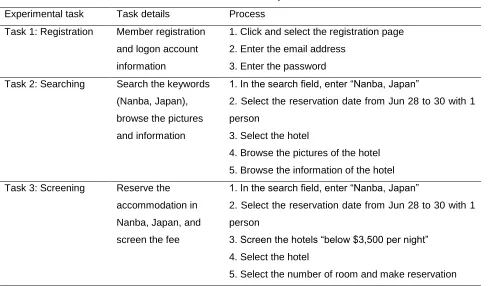
This study has four tasks, including: registration, searching, screening, and reservation to perform usability evaluation of three different online room reservation platforms (A, B and C). The task description is shown in Table 1.
Table 1. Task description Experimental task Task details Process
Task 1: Registration Member registration and logon account information
1. Click and select the registration page 2. Enter the email address
3. Enter the password Task 2: Searching Search the keywords
(Nanba, Japan), browse the pictures and information
1. In the search field, enter “Nanba, Japan”
2. Select the reservation date from Jun 28 to 30 with 1 person
3. Select the hotel
4. Browse the pictures of the hotel 5. Browse the information of the hotel Task 3: Screening Reserve the
accommodation in Nanba, Japan, and screen the fee
1. In the search field, enter “Nanba, Japan”
2. Select the reservation date from Jun 28 to 30 with 1 person
3. Screen the hotels “below $3,500 per night”
4. Select the hotel
Licensed under Creative Common Page 270 Task 4: Reservation Search the hotels in
Nanba, Japan, and make reservation
1. In the search field, enter “Nanba, Japan”
2. Select the reservation date from Jun 28 to 30 with 1 person
3. Use the “Search by map” function to search the
hotels in Nanba, Japan
4. Select the accommodation that is closer to Nanba Station, Japan
5. Select the hotel
Experiment equipment
This study is to understand the difference in usability between the existing two major online room reservation platforms (interface A and interface B) and the platform designed for this study (interface C). The user interface has been drawn by Sketch 3. The interface simulation has applied Axure RP as the major website simulation platform. The Apple iPad Air has been applied as the testing device.
RESULTS
This study has conducted usability evaluation of three different interfaces for online room Reservation platform. The experimental data has been analyzed by UBM SPSS Statistics Version 22. The fours tasks are: registration, searching, screening, and reservation.
Task 1
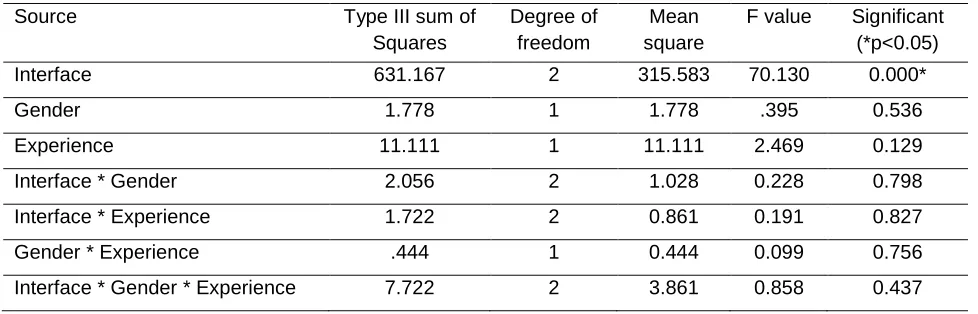
This task is to test the operation performance of the member registration function. The operation time and process of subjects using interface A, B and C have been recorded respectively. The significant correlation between the experimental interfaces, gender of subjects and the operation experience on online room reservation are shown in Table 2.
Table 2: Task 1 Result of Analysis of Variance
Source Type III sum of
Squares
Degree of freedom
Mean square
F value Significant (*p<0.05)
Interface 631.167 2 315.583 70.130 0.000*
Gender 1.778 1 1.778 .395 0.536
Experience 11.111 1 11.111 2.469 0.129
Interface * Gender 2.056 2 1.028 0.228 0.798
Interface * Experience 1.722 2 0.861 0.191 0.827
Gender * Experience .444 1 0.444 0.099 0.756
Interface * Gender * Experience 7.722 2 3.861 0.858 0.437
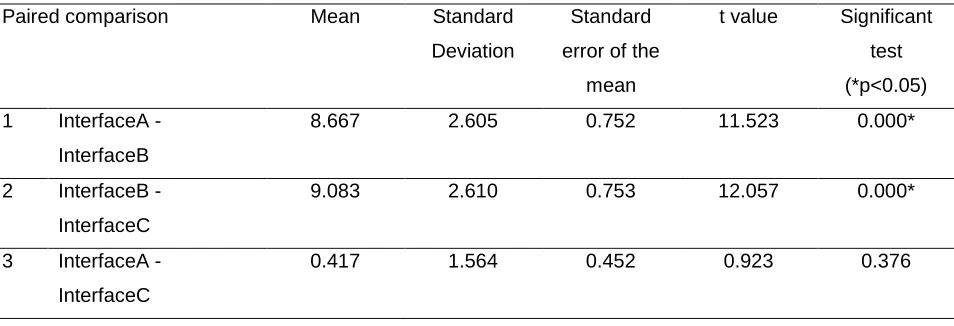
Licensed under Creative Common Page 271 The evaluation of Task 1 is the comparison between different gender, operation experience and the three interfaces (2*2*3) The significance between interface and gender is 0.798 (P>0.05). Therefore, there is no significant difference on task completion time between male and female. The significance between interface and operation experience is 0.827 (P>0.05). Therefore, there is no significant difference on task completion time with different operation experience. The significance between gender and experience is 0.756 (P>0.05). Therefore, there is no significant difference on task experience with different gender and experience. Only interface is significant(0.000).Next, the paired sample t-test has been applied for analysis. The result is shown on Table 3 and Table 4.
Table 3. Task 1 Paired Sample Statistics
Paired comparison Mean Number Standard
Deviation
Standard error of the mean
1 Interface A 26.58 12 2.151 0.621
Interface B 35.25 12 2.050 0.592
2 Interface B 35.25 12 2.050 0.592
Interface C 26.17 12 1.801 0.520
3 Interface A 26.58 12 2.151 0.621
Interface C 26.17 12 1.801 0.520
Table 4. Task 1 Paired Sample t-test Paired comparison Mean Standard
Deviation
Standard error of the
mean
t value Significant test (*p<0.05) 1 InterfaceA -
InterfaceB
8.667 2.605 0.752 11.523 0.000*
2 InterfaceB - InterfaceC
9.083 2.610 0.753 12.057 0.000*
3 InterfaceA - InterfaceC
0.417 1.564 0.452 0.923 0.376
Licensed under Creative Common Page 272 password are required to complete the registration. Users can complete the account registration more smoothly during the operation. However, the operation of interface B is a bit complicated. After clicking member registration, users have to switch to another registration page. Users have to further enter the email address, password and name to complete the account registration.
Task 2
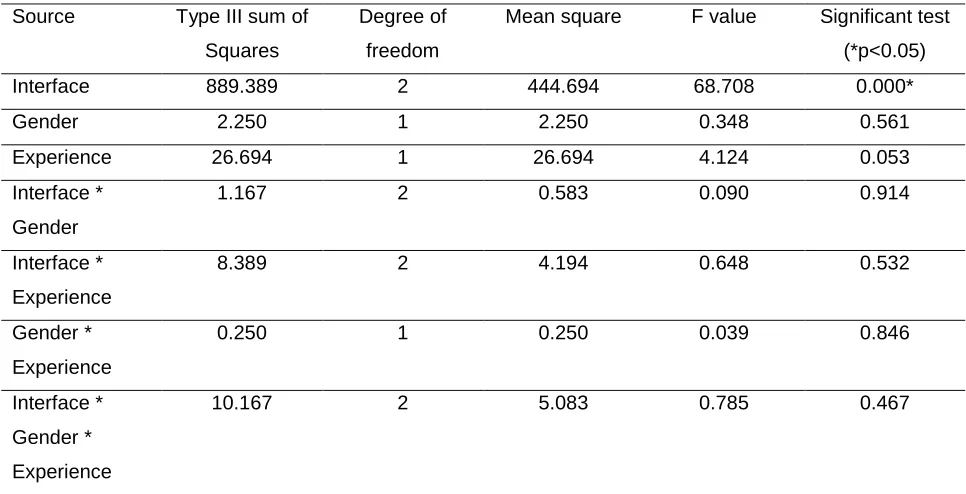
This task is to test the operation performance of searching the hotel with the keywords, and browsing the pictures and information of the hotel. The operation time and process of subjects using interface A, B and C have been recorded respectively. The significant correlation between the experimental interfaces, gender of subjects and the operation experience on online room reservation are shown in Table 5.
Table 5: Task 2 Result of Analysis of Variance Source Type III sum of
Squares
Degree of freedom
Mean square F value Significant test (*p<0.05)
Interface 889.389 2 444.694 68.708 0.000*
Gender 2.250 1 2.250 0.348 0.561
Experience 26.694 1 26.694 4.124 0.053
Interface * Gender
1.167 2 0.583 0.090 0.914
Interface * Experience
8.389 2 4.194 0.648 0.532
Gender * Experience
0.250 1 0.250 0.039 0.846
Interface * Gender * Experience
10.167 2 5.083 0.785 0.467
Licensed under Creative Common Page 273 significant(0.000).Next, the paired sample t-test has been applied for analysis. The result is shown on Table 6 and Table 7.
Table 6. Task 2 Paired Sample Statistics
Paired comparison Mean Number Standard
Deviation
Standard error of the mean
1 Interface A 63.42 12 1.621 0.468
Interface B 63.17 12 2.725 0.787
2 Interface B 63.42 12 1.621 0.468
Interface C 73.83 12 2.918 0.842
3 Interface A 63.17 12 2.725 0.787
Interface C 73.83 12 2.918 0.842
Table 7. Task 2 Paired Sample t-test Paired comparison Mean Standard
Deviation
Standard error of the
mean
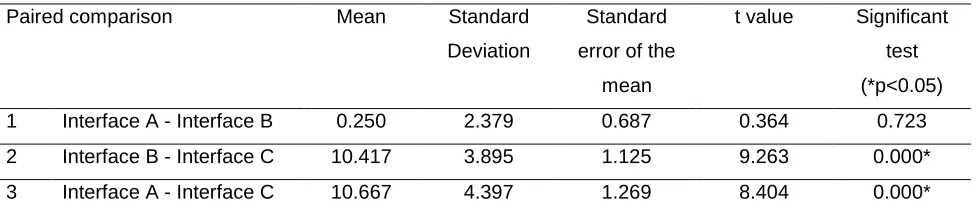
t value Significant test (*p<0.05) 1 Interface A - Interface B 0.250 2.379 0.687 0.364 0.723 2 Interface B - Interface C 10.417 3.895 1.125 9.263 0.000* 3 Interface A - Interface C 10.667 4.397 1.269 8.404 0.000*
The average operation time for Interface A, B and C are 63.42s, 63.17s, and 73.83s respectively. According to the paired comparing, the result shows that: operation time between B-C and A-C is significantly correlated (p<0.05). To compare with interface A and B, interface C has additional room type video introduction, surrounding restaurants and attractions, and similar accommodations. Therefore the operation speed of users is reduced
Task 3
Licensed under Creative Common Page 274 Table 8: Task 3 Result of Analysis of Variance
Source Type III sum of Squares
Degree of freedom
Mean square F value Significant test (*p<0.05)
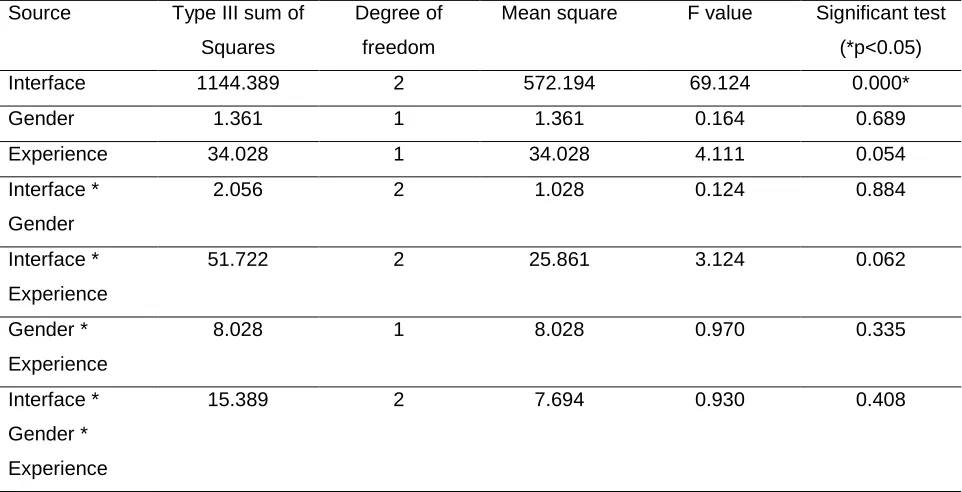
Interface 1144.389 2 572.194 69.124 0.000*
Gender 1.361 1 1.361 0.164 0.689
Experience 34.028 1 34.028 4.111 0.054
Interface * Gender
2.056 2 1.028 0.124 0.884
Interface * Experience
51.722 2 25.861 3.124 0.062
Gender * Experience
8.028 1 8.028 0.970 0.335
Interface * Gender * Experience
15.389 2 7.694 0.930 0.408
The evaluation of Task 3 is the comparison between different gender, operation experience and the three interfaces (2*2*3) The significance between interface and gender is 0.884 (P>0.05). Therefore, there is no significant difference on task completion time between male and female. The significance between interface and operation experience is 0.062 (P>0.05). Therefore, there is no significant difference on task completion time with different operation experience. The significance between gender and experience is 0.335 (P>0.05). Therefore, there is no significant difference on task experience with different gender and experience. Only interface is significant(0.000).Next, the paired sample t-test has been applied for analysis. The result is shown on Table 9 and Table 10.
Table 9. Task 3 Paired Sample Statistics
Paired comparison Mean Number Standard
Deviation
Standard error of the mean
1 Interface A 60.33 12 3.367 0.972
Interface B 72.17 12 2.918 0.842
2 Interface B 72.17 12 2.918 0.842
Interface C 60.08 12 2.906 0.839
3 Interface A 60.33 12 3.367 0.972
Licensed under Creative Common Page 275 Table 10. Task 3 Paired Sample t-test
Paired comparison Mean Standard Deviation
Standard error of the
mean
t value Significant test (*p<0.05) 1 Interface A - Interface B 11.833 4.896 1.413 8.373 0.000* 2 Interface B - Interface C 12.083 4.358 1.258 9.605 0.000* 3 Interface A - Interface C 0.250 3.361 0.970 0.258 0.801
The average operation time for Interface A, B and C are 60.33s, 72.17s, and 60.08s respectively. According to the paired comparing, the result shows that: operation time between A-B and B-C is significantly correlated (p<0.05). The price screening function of Interface B is hidden under the screening button so it is not obvious. Besides, the users have to complete one more step during the operation. Although interface B moves multiple functions under the screen button in order to provide more simple reservation approach, users have to complete one more step and increase the operation time. Besides, three subjects made mistake during operation. They sorted by price instead of screening by the price. Therefore, hiding the function under the screening button may increase the operation time and possibility of mistake of the users. Interface A provides fixed value for user to select for screening. Although this could speed up the operation, users could not precisely select the range of prices. Interfaces C applies Drag for users to select the price. Although the operation is convenience, it is suitable for blurred amount. If precise amount is required, then longer operation time is required.
Task 4
This task is to test the operation performance of using keywords for searching and then applying map to search the hotels. The operation time and process of subjects using interface A, B and C have been recorded respectively. The significant correlation between the experimental interfaces, gender of subjects and the operation experience on online room reservation are shown in Table 11.
Table 11: Task 4 Result of Analysis of Variance Source Type III sum of
Squares
Degree of freedom
Mean square F value Significant test (*p<0.05)
Interface 8904.389 2 4452.194 98.030 0.000*
Gender 455.111 1 455.111 10.021 0.004*
Licensed under Creative Common Page 276 Interface *
Gender
468.389 2 234.194 5.157 0.014*
Interface * Experience
663.389 2 331.694 7.303 0.003*
Gender * Experience
69.444 1 69.444 1.529 0.228
Interface * Gender * Experience
92.056 2 46.028 1.013 0.378
Task 4 is to evaluate between different gender, operation experiences and comparing between the three interfaces (2*2*3). According to the result in Table 11: the significant factors have 5 items, including interface, gender, experience, interface and gender, and interface and
experience. The significance is 0.000 (P<0.05)、0.004 (P<0.05)、0.000 (P<0.05)、0.014
(P<0.05) and 0. 003 (P<0.05) respectively. The operation time of the experienced subjects is 74.5s, which is significantly lower than the operation time of the inexperienced subjects of 83.61s. That means the experienced subjects operating the interface faster. Besides, the operating time of male is 75.5s, which is lower than the operation time of female of 82.61s. That means male operating the interface is faster than female. Moreover, different genders and experiences will make a significant difference when operating with different interface samples. Since the interface factor has reached significant difference, the subsequent analysis is tested by paired samples t. The result is shown in Table 12 and Table 13.
Table 12. Task 4 Paired Sample Statistics Paired comparison Mean Number Standard
Deviation
Standard error of the
mean
1 Interface A 97.92 12 16.550 4.778
Interface B 79.83 12 6.699 1.934
2 Interface B 79.83 12 6.699 1.934
Interface C 59.42 12 2.678 0.773
3 Interface A 97.92 12 16.550 4.778
Interface C 59.42 12 2.678 0.773
Licensed under Creative Common Page 277 Table 13. Task 4 Paired Sample t-test
Paired comparison Mean Standard Deviation
Standard error of the
mean
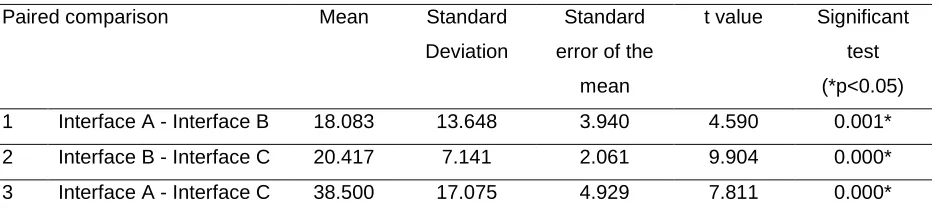
t value Significant test (*p<0.05) 1 Interface A - Interface B 18.083 13.648 3.940 4.590 0.001* 2 Interface B - Interface C 20.417 7.141 2.061 9.904 0.000* 3 Interface A - Interface C 38.500 17.075 4.929 7.811 0.000*
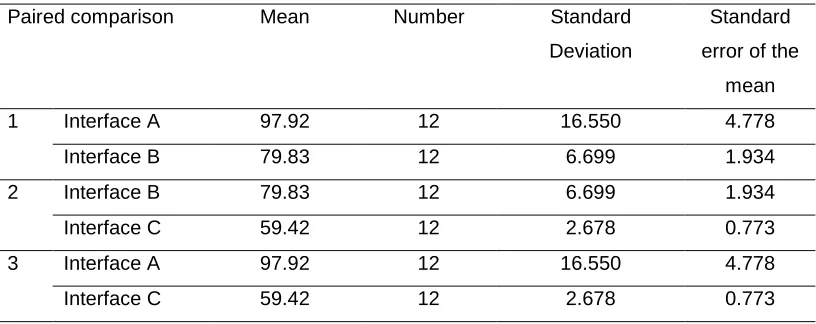
The average operation time of interface A, B and C is 97.92s, 79,83s and 59.42s respectively. According to the paired comparison results, the interface operation time of A-B, B-C and A-C is significantly correlated (p<0.05). Therefore, the interface A, B and C have significant difference. The search by map function in interface A is not significant. Users have to swipe to the bottom of the interface to find this function. Therefore, all subjects spent the longest time to find this function. Four subjects encountered setbacks at this stage and were unable to find this function in the interface. Therefore, the tester was required to assist in finding this function. The search by map function in interface B is located in the upper left corner of the interface so that users can operate intuitively. However, the information displayed on the map is too complicated. Not only the range of the map is more extensive, but it also displays both the bookable and un-bookable hotel icons on the map. Too much hotel information causes the users spending more time looking for the hotel at the designated location in the task. The search by map function of interface C is the most intuitive. The big icon is shown on the right hand side of the interface. Users can find this function obvious at a glance. Users do not need to switch to another page for operation and the information shown on the map is concise. It only shows the location and the price of the bookable hotels so that user can clearly identify the hotel information during operation.
DISCUSSION
Licensed under Creative Common Page 278 users do not only find this function quickly, but they can also operate quickly without triggering the page. Therefore, the operation performance of interface C is higher than other samples.
The online room reservation design (interface C) of this study has the advantages of simple structure, easy operation and easy reading the information. Therefore, the subjects can complete the operation quickly and intuitively. They also think that this function is helpful to understand the room information than just showing the image.
CONCLUSION AND RECOMMENDATIONS
The objective of this study is to explore the usability of online room reservation platform. It focuses on the entire reservation function and interactive process. In the future, researchers may focus on icon design, theme marketing, community sales, overall arrangement, and official website of the hotels. It is expected the result of this study could be the reference for the online room reservation and related industries.
This study would explore the usability of the online room reservation platform interface on a tablet device. Since the scope of design of the room reservation system across the platforms is wide, and considering the factors of environment and human resources, this study has applied tablet device iPad mini as the experimental size. The design of other devices is not explored. But this also limits the development of this research. Researchers suggest that future research can further explore the interface of other devices, such as cell phones. It will enable a wider range of relevant interface experiments and discussions.
Self-service travelers often use the online reservation service to find the information and select the hotels. If the operation of the interface could be designed from the view of user experience, it could help to improve the commercial competitiveness of the online service platform. This study applies four tasks (including: registration, searching, screening, and reservation) to perform usability evaluation of three different online room reservation platforms (A, B and C).
The result of this study shows that Interface C is significantly better than Interface B or Interface A because compared to Interfaces A and B, Interface C has a simpler structure, can be more easily operated, and has easier to read information. A practical recommendation from this study is that when designing an interface for an online room reservation platform, the designer should work on simplifying the web page structure, reducing operating complicity, and providing easy to read information for user to complete room reservation tasks intuitively.
Licensed under Creative Common Page 279 REFERENCES
Booking (2018). Home page. Retrieved October 19, 2018, from https://www.booking.com.
Boring, R. L. (2002). Human-Computer Interaction as Cognitive Science. Human Factors and Ergonomics Society Annual Meeting Proceedings, 46(21), 1767-1771.
Chiang, L. H. (2018). A Usability Study of Responsive Web Design. Master Thesis of National Taiwan University of Arts.
Hotels.com (2018). Home page. Retrieved October 19, 2018, from https://www.hotels.com.
Hsu, C. C. (2017). A Study of the Effect of Design Elements of Responsive Web Design on the User Experience. Master Thesis of National Taichung University of Education.
Hsu, W. C. (2006). Design of User Interfaces for Digital Games: A Case Study of Mobile Devices. Master Thesis of National Taipei University of Education.
Norman, D. (2013). The design of everyday things: Revised and expanded edition. Basic Books (AZ). Peterson, C. (2014). Responsive Web Design. O’REILLT Press.
Rogers, E. M. (1995). Diffusion of innovations. 4th ed., New York: The Free Press.