The Development Of Management Control
Systems Framework In Public-Private
Partnerships
Sevar NeamatAbstract: This study has developed a Public Private Partnership (PPP) framework in order to analyze a Management Control System (MSC). This is being specified relying on the basis of Transaction Cost Economics (TCE) and organizational theory. Moreover, in this research, an approach is proposed that could theoretically be resulted in the reduction of relational and performance risks by joining the three control standards called the marketplace, administrative and clan, and combining them with control strategies, called Performance Evaluation Strategy (PES) and Trust-Based Strategy (TBS). The framework aspiration is to achieve the Value for Money (VFM). Finally, specialists might use the identified links of this study in order to improve the MCS of PPPs.
Index Terms: Public-Private Partnerships; management strategies; MCS PPPs; Relational Risk; behavioral Risk.
————————————————————
1. INTRODUCTION
About twenty years ago, there was a considerable increase in the PPPs of the industrialized and developed financial prudence. Despite appearing the PPPs in these two decades, it appears vigorously in some other places since the 1990s [1]. Generally, PPPs usage added many services to infrastructures such as healthiness, teaching, confinements, transportations, power sources and water treatment plans, those are conventionally used as a public sector responsibility.The private partner‘s involvement might contain the design, finance and other parts and services for public infrastructure. Although the stages of PPPs are related to the life cycle by projects, a usual PPP project includes four levels, specifically choosing, constructing, operating and terminating. In the choosing phase, some useful events are commenced to carry the probable amenities. In certain, Australia and the United Kingdom (UK) are attained a substantial achievement with the producing of PPPs [2], [3].In contrast, a vast part of the review showed that a lot of PPPs have not obtained the predicted VFM objective [4]. Risk in PPPs appears principally resulted in the incongruence between partners and surge the probability of working unscrupulous for partners [5], [6]. These behaviors are possibly to impair the difficulty connected with PPPs (as noted by [4]), resulted in increasing the risk. Because of the nature of PPP engagements, a mixture of controls can be used to impact the behavior of the associates included. The utilizing level and the kind of these controls would differ through various stages of a PPP plan based on the probability of the possible risk related to those stages.
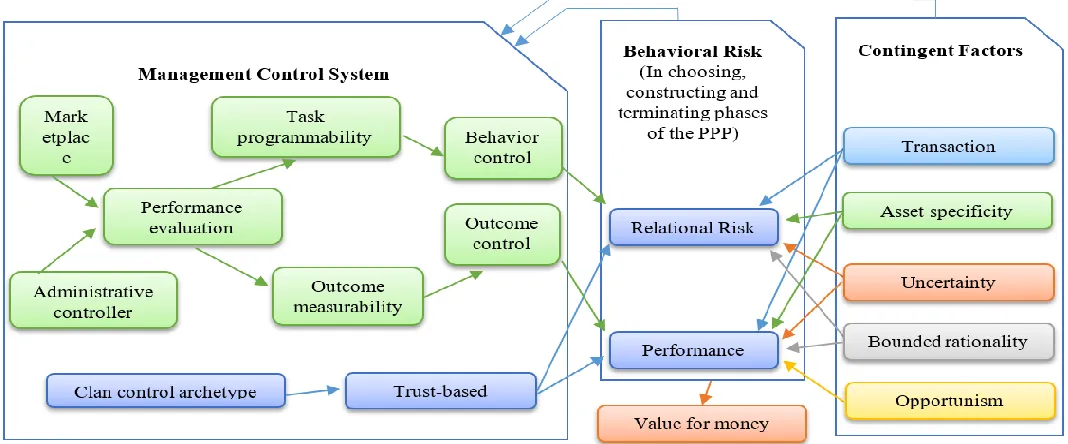
Some researches has underlined the necessity for operative to administrate the risks in PPPs [7] with using management control system of that purpose [8].The flowchart is advanced by sketching on (TCE) and the organizational theory with the notion of trust. A number of contingent factors have been investigated in this research which impacts the attainment of the VFM objective of PPPs. These influences impacted from different levels of behavioral risk produced by one of these
dependent features. The projected framework is intended to observe the administration controls in PPPs from the communal companion‘s viewpoint, basically due to the public partner which repeatedly tolerates the final possession and risk of the PPP.A study focus on three regulator models, namely marketplace, administrative and clan. Also, it helps an involvement on the review on controls in PPPs at a theoretical level by concentrating on how three control models, in combination with two control approaches, might be prepared to the public sector to aid in minimizing the behavioral risk, thus reaching VFM objective.
2
LITERATURE
REVIEW
2.1 Risks related to PPPs
The risk phrase was seen as enormous care in the literature on the inter-organizational relationships (IQRs) and in the specific PPPs. Consequently, it considered as an important way in understanding and analyzing the operations of these organizations [9], [10] [7], [11].The word ‗risk‘ mentioned to bad probabilities outcome from the unforeseen behavior of people which impact the VFM purpose of PPPs [11]. Additionally, the literature displays a wide range of bases of risk which impact the performance of PPPs in the zones of scheming, funding, building, working, repairs and request for service area. In PPPs, both the public sector and private sector estimated to search in the reaching the VFM (value of money) detached of the partnership [12]. On the other hand, it is frequently thinkable, the followers will not act in the best concern of the company, foremost to the ―planned of experiencing enlarged costs‖ which is stated to as behavioral risk [13].The behavioral danger in PPPs is related to the suitable focus of worsen places inducing the risks of various objectives [14]. Also, the risk might be happened due to the compressibility of activities decomposition together with activities of various events and through different stages in PPPs [15].The cost competence above the lifetime cycle of PPPs (hence accomplishing VFM) mainly based on the private partners‘ behavior reminting of experience and information [15], and the capability to compact with numerous doubts and difficulties. Principally, the behavioral risk rises for the reason of goal incongruence among the followers.As of the previous is named ‗relational risk‘, considered the likelihood of opportunistic manners which might ascend in the method of ————————————————
• Sevar Neamat is currently a faculty member at the department of Mechanical Engineering, College of Engineering, University of Zakho, Kurdistan Region - Iraq, PH-009647507644716.
300 ―shirking, cheating, misrepresenting info, arranging the profits,
and subsequently‖. The risk producing out of concluding is named ‗performance risk‘, is the opportunity the followers be unsuccessful to work or abandonment to get the most concentration of the organization.The avoidance of opportunistic existence appeared from the availability of many factors containing uncertainties environment [6]. So, opportunism is the basic aspect which splits the relational risk from performance risk. Both relational and performance risk can occur through various stages in a PPP plan in changing the grades relying on the natural surroundings and the extent of the influence of numerous dependent featuresDepending
features producing behavioral risk in PPPs Behavioral risk might be affected by five contingent factors, specifically, opportunism, bounded rationality, uncertainty, asset specificity, and transaction frequency. On the other hand, as seen in Fig. 1., the constituent of behavioral risk - relational risk - might be impacted by all five dependent features, the performance risk impacted through all excluding opportunism.
2.2 Conditional features making behavioral risk in
PPPs
There are five emergent factors participated in behavioral risk which are specifically opportunism, restricted rationality, uncertainties, asset specificity, and transaction frequency [16]. There are two factors which are human characteristics such as Opportunism and limited rationality are preserved as transparent behavioral expectations [17]. On the other hand, indecision, asset specificity, and transaction frequency are transaction features. As shown in Fig. 1., though the constituent of behavioral and relational risk might be impacted via emergent features, the other constituent - performance risk - might be exaggerated via all.Opportunism in private sectorOpportunism is particularly to compute efforts to misrepresent, falsify, disguise, obscure or otherwise confusing. Humans have a tendency to involve in behavior that helps their personal benefits when they see an occasion to do so. Transaction cast of economic believes that opportunism might ensue whenever [18].According to the PPP framework, private partner opportunism considered the central feature that generates the relational risk. Moreover, they may do things that ‗they shouldn‘t‘ do it. A typical example is by providing inaccurate info of technological information.Bounded rationality of the public partnerPeople are characteristically unable to obtain the best information with treating most info that would support optimization. Generally, are powerless in the identification of the alternatives, and have only imperfect data about the environmental variables, current and forthcoming, that will regulate the concern of their selections. Additionally, throughout the construction and working levels, the public companion is predictable to guarantee that the private partner transmits the essential job up to the concessionaire contract. Though, incomplete reasoning aptitude and the follow-on ―bounded rationality‖ which create it hard for the community sector to predict all the likely relational factors.UncertaintyAccording to [7], it is been noted that wherever there is no option of assigning an arithmetical likelihood on to a certain extent happening or not, the indistinct upcoming public is mentioned to as an uncertainty‖. PPPs might be influenced by uncertainties correlated to diagram connected with plan precise landscapes. These uncertainties resulted in increasing the PPP. For example, a private partner may act opportunistically to achieve the individual aids of the inexact atmosphere (i.e., relational risk), or could be unsuccessful in taking the essential procedures in order to minimize or to remove the destructive attitude of uncertainty on the VFM objective of the PPP (i.e., performance risk) [19].The need on the private partner advantage which might result in a ―lock-in‖ condition and transmission the power to the private companion [19], [20].Transaction frequencyIt illustrates the frequencies of a specific transaction in an assumed date [21]. Up to PPPs, transaction frequency describes the number of PPP projects/ transactions commenced by similar parties. If the events have a long-term history, recurrence agreements will be substantially little meanwhile the events are aware with and comprehend every moderately fine. It oppositely reacted if the private sector is unidentified to the public sector.
2.3 Control archetypes
During of last period of time, the TCE has added the visions into both the organizational and management secretarial literature [22]. The goal of TCE in recognizing the certain Fig. 1. Contingent factors leading to behavioral risk
method of organizational structure is extra suitable to perform the transactions than other purposes [21].
2.4 Strategical control to minimize risks
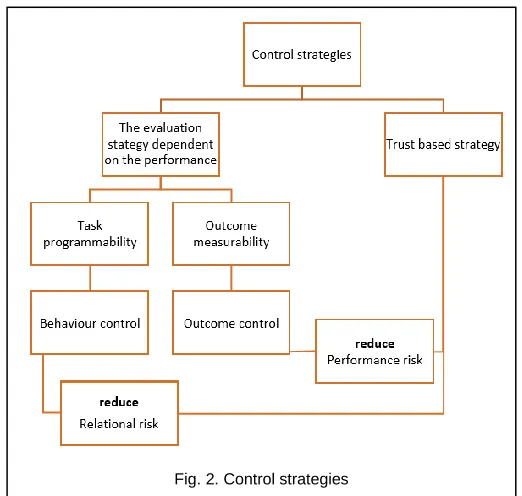
Goal dissimilar behavior caused by behavioral risk, and hence it is compulsory that the public partner presents suitable methods to efficiently minimize goal incongruence and linked risks. Classifies two approaches, specifically the performance evaluation strategy (PES), which persuades objective absorbed behavior and the trust-based strategy (TBS) (see Fig. 2.)The strategy evaluation depended on the performanceIt is the method of ―checking with fulfilling performance‖ to encourage the required behavior. This plan includes goal line setting, presentation measurement, checking, and providing of response. It is realistic if the performance is computable. Performance can be restrained a foundation of behavior of persons and the result of these behaviors [23] as in Fig. 3.
Therefore, PES may be produced by means of two styles of controller specifically, performance controls and outcome controls [24].The strategy depended on the trustIt includes ‗changeless the way of thinking in a discrete to report the problem in a behavioral risk rising from goal incongruence. Whereas PES supports in diminishing the effect of objective disagreement, this aids in inspiring aim disagreement and therefore minimizing the relational risks and performance risks.Some other researches such as [25]–[28] use technologies of semantic web to find control strategies.
3The Management Controls Usage In PPPs
The management control system MSC worked by the public partner to accomplish behavioral risk through the life cycle of the PPP scheme might comprise three categories of control models.Fig. 3. Analytical framework to examine MCS in PPPs
3.1 The marketplace controller model
Dependent features resulted in controlling the marketplace controller. An efficiency of market controls relies on the environment with a degree of reliant features affecting the state to be skillful. Market control is extra suitable for transactions connected to non-specific. As the benefit identified surges, marketplace controls develop less real, exit room for opportunism [29].The marketplace controller model with strategical evaluation performance The markets are working as a hidden indicator to protect events from the opportunism through the addition to the chance to use the replacements in a stumpy cost [30]. In PPPs, in the time when the collection is prepared depending on the modest bids, the private partners have restricted area for opportunism, therefore the relational risk linked with choosing stage is negligible.The necessity of the PES to diminish relational risk at a low level. It is applicable for the public sector to make the marketplace controller model in three different stages of the PPP includes constructing, functioning and ending. The community sector might request in place of offers thru the constructing and functioning stages of a PPP project [2]. In spite that the market switch can be used in all four levels of PPP, it is further usually recycled in the choosing phase.
3.2 The bureaucratic control archetype
302 TABLE 1
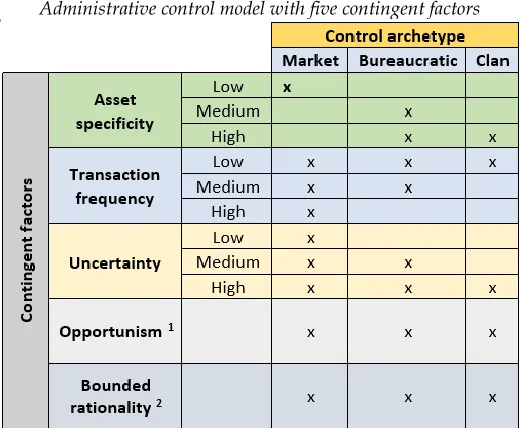
Administrative control model with five contingent factors
1 Opportunism resulted along time since there is a variance honesty and transparency and occur in the same way under each control model 2 As an essential human characteristic, limited rationality happens under each control model correspondingly [16], [17]
The administrative controller model with the performance evaluation strategy to minimize risks
PES opinions suitable for reducing the behavioral risk once accepting an administrative controller model. Rendering to [33] as a portion of the administrative control, PPPs are faced with ―difficult performance assessment‖ to safeguard that the behavioral risk. The PES in combination with administrative controls might stay founded in behavior with product controls and might minimize both relational and performance risks. The specification of the key performance factors connected with the behavior and outcomes which is vigorous when retaining the PES. Conferring to the HM Treasury Taskforce (undated) in the UK, the standards for performance factors should remain built on the probable risk zones or actions [22]. ―Poor products can arise regardless of the good hard work‖ [8]. Furthermore, if both relational risk and performance risk stay low, the public partner is uninterested and could use may use the performance evaluation system PES on the base of whichever result or behavior controls. The public partner cooperates with PES in using the administrative control for all four various levels of PPPs. At the collection level, the public partner may monitor a demanding governmental control process as a fragment of the PES in choosing a non-public as in Table 2.
TABLE 2
Relationships Summery
3.3 The clan controller model
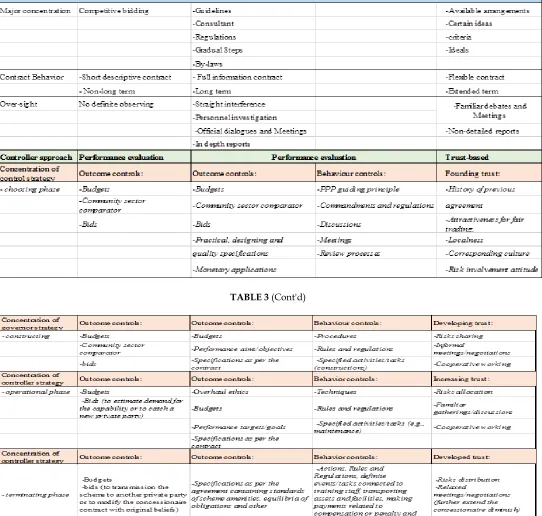
Dependent features resulting in the clan controller model In PPPs, usually, there might be dealings, actions and behaviors which could not be measured efficiently by any marketplace or administrative controller models. The administrative control model, for example, is inoperative in the case of having high behavioral risk range connected with five depending factors.The concessionaire agreement, which offers a foundation of administrating control model, has inadequate usage below great stages of uncertainty and opportunism. Moreover, according to the complex matter associated with long-standing PPP agreements, public sectors might discover it problematic to postulate assessable performance [34] as in Table 1.The clan controller model with the strategy based on the trust in minimizing the risksTrust is the principal and the base point of the controller strategy in the clan controller model. It grows from public organizations of ideals with standards advanced by the clan control archetype. A contract can progress trust by instructing ethical standards constructed on ―socialization and learning‖. The works propose of the public sector in a PPP often workouts the clan controller model by smearing the [2], [8].By the TBS, both events might take a great promise to the company resulting in a discount of a relational and performance risks. The groups which consume a strong trust -depended relations are working in the greatest beneficial environment of the PPP, even though in the lack of a PES built on the performance or result. In the selecting phase, to decrease both risks, a public partner might desire to choice a private partner whomever could be reliable or by whomever belief association can be established, regardless the cost of the offer [35]. We can see the details in the Table 3.
TABLE 3.
TABLE 3 (Cont'd)
4
DISCUSSION
In spite of having enormous growing of PPPs of industrialized and developing economies, an increasing frame of the working on PPPs proposes of a substantial amount of PPPs unsuccessfully reach the VFM objective almost according to the incapability of preparing a behavioral risk. The study grows
304 behavioral risk (i.e., relational risk and performance risk) in
PPPs. It demonstrates the natural surroundings and range of behavioral risk is dependent on some issues, covering restricted rationality, opportunism, unwillingness, transaction frequency and asset specificity. Furthermore, it displays the approach of in what way MCS assistant to gain the VFM objective of PPPs. All control outlines (control archetypes, control strategies and control modes) of the scheduled framework are focused at clarifying the struggle of PPP arrangements resulting in the certain features which are altered from other inter-organizational preparations, an example is combined schemes molded between private parties. Some properties can add various purposes such as (public companion has social purposes and private partner has income objects), long-time span (typically more than 25 years), and the environment of facilities (public infrastructure). The frameworks advanced to study strong points in other inter-organizational relationships are characteristically less compound than those advanced for PPPs and focus on either control models or control modes [36].
CONCLUSION
The conclusion of this study recommends that to arrange the behavioral risk in a PPP, the public sector must first recognize the depending features with comparative strong points. After that, deliberate the behavioral risk of a specific combination of emergent features is possibly held on a plan underneath evaluation, and lastly estimate a suitable MCS. The framework advanced in this research to simplify the methodical investigation of MCS in PPPs. The likewise to propose a suitable MCS for PPPs. The upcoming enquiry might inspect the proposal sketched in the particular study via means of planned framework.
REFERENCES
[1] J.-E. De Bettignies and T. W. Ross, ―The economics of public-private partnerships,‖ Can. Public Policy, vol. 30, no. 2, pp. 135– 154, 2004.
[2] L. English and J. Baxter, ―The changing nature of contracting and trust in public‐ private partnerships: The case of Victorian PPP prisons,‖ Abacus, vol. 46, no. 3, pp. 289–319, 2010. [3] A.-G. N. S. Wales, ―The new schools privately financed project,‖
2006.
[4] P. Edwards and J. Shaoul, ―Partnerships: for better, for worse?,‖ Account. Audit. Account. J., vol. 16, no. 3, pp. 397–421, 2003. [5] C. Lonsdale and G. Watson, ―Managing contracts under the
UK‘s Private Finance Initiative: evidence from the National Health Service,‖ Policy Polit., vol. 35, no. 4, pp. 683–700, 2007. [6] K. Langfield-Smith, ―Strategic management accounting: how far
have we come in 25 years?,‖ Account. Audit. Account. J., vol. 21, no. 2, pp. 204–228, 2008.
[7] J. Broadbent, J. Gill, and R. Laughlin, ―Identifying and controlling risk: The problem of uncertainty in the private finance initiative in the UK‘s National Health Service,‖ Crit. Perspect. Account., vol. 19, no. 1, pp. 40–78, 2008.
[8] J. Zheng, J. K. Roehrich, and M. A. Lewis, ―The dynamics of contractual and relational governance: evidence from long-term public–private procurement arrangements,‖ J. Purch. Supply Manag., vol. 14, no. 1, pp. 43–54, 2008.
[9] S. Neamat and I. Yitmen, ―Factors Affecting the Innovation and Competitiveness in Kurdistan Region of Iraq Construction Industry,‖ Int. J. Adv. Eng. Res. Sci., vol. 4, no. 2.
[10]S. D. Salahaddin, ―Factors Affecting the Competitiveness and
Innovation in Northern Iraq Construction Industry,‖ 2016. [11]J. Froud, ―The Private Finance Initiative: risk, uncertainty and the
state,‖ Account. Organ. Soc., vol. 28, no. 6, pp. 567–589, 2003. [12]J. F. Koppenjan, ―The formation of public‐ private partnerships:
lessons from nine transport infrastructure projects in the Netherlands,‖ Public Adm., vol. 83, no. 1, pp. 135–157, 2005. [13]X. Jin and H. Doloi, ―Interpreting risk allocation mechanism in
public–private partnership projects: an empirical study in a transaction cost economics perspective,‖ Constr. Manag. Econ., vol. 26, no. 7, pp. 707–721, 2008.
[14]J. Johnston and S. P. Gudergan, ―Governance of public—private partnerships: lessons learnt from an Australian case?,‖ Int. Rev. Adm. Sci., vol. 73, no. 4, pp. 569–582, 2007.
[15]M. R. Hayllar, ―Public‐Private Partnerships in Hong Kong: Good Governance–The Essential Missing Ingredient? 1,‖ Aust. J. Public Adm., vol. 69, pp. S99–S119, 2010.
[16]O. E. Williamson, The mechanisms of governance. Oxford University Press, 1996.
[17]O. E. Williamson, ―Transaction cost economics and business administration,‖ Scand. J. Manag., vol. 21, no. 1, pp. 19–40, 2005.
[18]O. Williamson, ―The Economic Institutions of Capitalism the Free Press New York,‖ Williamson OE 1993 Calc. Trust Econ. Organ. Law Econ., vol. 36, pp. 453–486, 1985.
[19]C. Lonsdale, ―Post‐contractual lock‐ in and the UK private finance initiative (PFI): the cases of National Savings and Investments and the Lord Chancellor‘s Department,‖ Public Adm., vol. 83, no. 1, pp. 67–88, 2005.
[20]P. Bloomfield, ―The challenging business of long‐ term public– private partnerships: Reflections on local experience,‖ Public Adm. Rev., vol. 66, no. 3, pp. 400–411, 2006.
[21]R. F. Speklé, ―Explaining management control structure variety: a transaction cost economics perspective,‖ Account. Organ. Soc., vol. 26, no. 4–5, pp. 419–441, 2001.
[22]H. C. Dekker, ―Control of inter-organizational relationships: evidence on appropriation concerns and coordination requirements,‖ Account. Organ. Soc., vol. 29, no. 1, pp. 27–49, 2004.
[23]S. Neamat, ―Factors Affecting Project Performance in Kurdistan Region of Iraq,‖ Int. J. Adv. Eng. Res. Sci., vol. 4, no. 5.
[24]M. Hernández-Espallardo and N. Arcas-Lario, ―Outcome-and behaviour-control in distribution partnerships: the role of trust and dependence and their effects on performance,‖ Int. Rev. Retail Distrib. Consum. Res., vol. 18, no. 1, pp. 63–86, 2008. [25]K. Jacksi, N. Dimililer, and S. R. M. Zeebaree, ―A Survey of
Exploratory Search Systems Based on LOD Resources,‖ in PROCEEDINGS OF THE 5TH INTERNATIONAL CONFERENCE ON COMPUTING & INFORMATICS, COLL ARTS & SCI, INFOR TECHNOL BLDG, SINTOK, KEDAH 06010, MALAYSIA, 2015, pp. 501–509.
[26]K. Jacksi, N. Dimililer, and S. R. Zeebaree, ―State of the Art Exploration Systems for Linked Data: A Review,‖ Int. J. Adv. Comput. Sci. Appl. IJACSA, vol. 7, no. 11, pp. 155–164, 2016. [27]K. Jacksi, S. R. Zeebaree, and N. Dimililer, ―LOD Explorer:
Presenting the Web of Data,‖ Int. J. Adv. Comput. Sci. Appl., vol. 9, no. 1, pp. 45–51, 2018.
[28]R. Ibrahim, S. Zeebaree, and K. Jacksi, ―Survey on Semantic Similarity Based on Document Clustering,‖ Adv. Sci. Technol. Eng. Syst. J., vol. 4, no. 5, pp. 115–122, 2019.
[29]K. Sartorius and J. Kirsten, ―The boundaries of the firm: why do sugar producers outsource sugarcane production?‖ Manag. Account. Res., vol. 16, no. 1, pp. 81–99, 2005.
management control in inter-firm relationships: Achievements and future directions,‖ Account. Organ. Soc., vol. 33, no. 7–8, pp. 865–898, 2008.
[31]D. Parker and K. Hartley, ―Transaction costs, relational contracting and public private partnerships: a case study of UK defence,‖ J. Purch. Supply Manag., vol. 9, no. 3, pp. 97–108, 2003.
[32]J. Van der Meer-Kooistra and E. G. Vosselman, ―Management control of interfirm transactional relationships: the case of industrial renovation and maintenance,‖ Account. Organ. Soc., vol. 25, no. 1, pp. 51–77, 2000.
[33]D. S. Chow, C. Humphrey, and J. Moll, ―Developing whole of government accounting in the UK: Grand claims, practical complexities and a suggested future research agenda,‖ Financ. Account. Manag., vol. 23, no. 1, pp. 27–54, 2007.
[34]S. Neamat, ―Models Developed for Creep of High Strength Concrete,‖ Infogain Publ, vol. 3, no. 3, pp. 174–80, 2017. [35] ―van Marrewijk, A., Clegg, S.R., Pitsis, T.S. and Veenswijk, M.,
2008, ‗Managing Public-Private Megaprojects: Paradoxes, Complexity, and Project Design‘, International Journal of Project Management, 26, 6: 591-600.‖