Title:
Maximizing organizational performance and goal-achievement through
competency-based education
Author:
King Costa (PhD)
Affiliation:
Global Centre for Academic Research, 385 Boundary Road, Akasia,
Pretoria, South Africa. www.researchglobal.net
: [email protected]
Orcid ID
: https://orcid.org/0000-0001-9132-9132
Key Words
: leadership, management, competency-based learning, organizational
performance, institutions of higher learning, university, education
ABSTRACT
This paper presents a brief account and rationale for implementation of competency based
learning in any form of management and leadership development programmes in South Africa.
The fact that competency-based learning (CBL) , also known as outcomes-based learning has
been scrapped from the schooling system in South Africa is unfortunate as this method enhances
critical thinking skills and practical problem solving skills. This paper presents CBL as a model of
meta-cognitive approach to learning that integrates both theory and practice into experiential
learning through six dimensions, namely, active learning, constructive learning, cumulative
learning, goal-oriented learning, learner-centered and curriculum design strategies. In the advent
of the fast-paced global economy, managers and leaders need to seek those business schools
that value real-time practical approach to curriculum for relevance and to maximize shareholder
value through human resource development. This brief presentation ends by recommending an
approach through CBL that fosters three critical pillars of leadership development, namely:
intellectual, behavioral and emotional agenda.
1. INTRODUCTION
Current global practices in learning across all disciplines and in particular Organisational
Leadership & Management have proved to be inefficient and non-responsive to real world needs
in that that they are underpinned by too much theoretical foundations devoid of practical
constructs and dictates of business (Mahomed,2004). In trying to find a perfect way, Australia and
New Zealand have been leaders in implementing Outcomes-Based Education (OBE) system,
followed by other countries of the world including UK, South Africa and even the US. Many
countries of have since adopted outcomes based learning in their educational policies.
Whereas in South Africa the OBE model has since been phased out in public schools (Krishna,
2013), it is still used in all occupational/vocational and learning programmes. In this presentation,
the author briefly discusses OBE as a model of instruction that is central to learning delivery and
teaching maximises contribution at workplaces. Those institutions who employ principles of OBE
will see more impactful results than those which do not use OBE, sometimes called Competency
Based Learning.
Competency Based Learning (CBL) builds a framework for the role of competency modeling in
both undergraduate and postgraduate Organisational Leadership & Management education
which dove-tails seamlessly into practical workplace scenarios. On its own it clearly creates a role
for Business & Leadership School that is consistent with practices helping to prepare learners for
the real business world after graduation.
As a basis of this proposal, the author’s hypothesis is that, “If properly implemented, CBL/OBE
as a conceptual model of Organisational Leadership & Management education and training will
transform the African learners into entrepreneurial thought leaders and authentic venture
creators who will revive and restore African economies and livelihoods.” It should therefore be
noted that the key words in this presentation are proper implementation.
Below is an abridged summary of how the author define CBL/OBE and what its implementation
should comprise. The conclusion remarks of this presentation makes suggestions of what
curriculum designers at business schools should look out for when designing a learning
2. DEFINING CBL/OBE
There are many definitions of CBL that can be found in many publications and information
portals like google etc, but here the author will be providing a perspective on interpretation
based on his own practical experience in business facilitation/teaching and also evidenced by
research on the topic, as emphasised by Boyatzis (2008). CBL is a model of meta-cognitive
approach to learning that integrates both theory and practice into experiential learning that is
founded on the following six (6) key learning paradigms (Boyatzis, 2002):
a) Active learning– From day one learners are encouraged to participate in the learning
process and teaching practices that includes in-class participation, peer-to-peer
engagements, group work, learning expeditions and independent research.
b) Constructive learning– creative thinking and entrepreneurial trait-building is facilitated
and innovation encouraged to allow learners to produce authentic and practical ideas and
models of business applications
c) Cumulative learning – learning content and facilitation methods build on existing
knowledge and experience, merging the two aspects of learning to form new value and
thinking.
d) Goal oriented learning– Learners are introduced to engage in tasks and projects that
are goal oriented towards measurable outcomes.
e) Learner- centered approach – Learning programmes in Organisational Leadership &
Management should stimulate learners and “push” them beyond what is known (concrete)
to what is not yet known (abstract) in order to help them craft meaningful visions of their
future entities. This practice on its own will develop the student’s self-awareness, social
intelligence and leadership readiness skills to run an enterprise.
f) The Design -characteristic: Curriculum design, aims and objectives contain three characteristics :
• Cognitive– foundational competence translated in linguistics (knowing);
• Demonstrated through the Psychomotor – practical competence (doing)
and;
3. RATIONALE FOR IMPLEMENTING CBL IN ORGANIZATIONAL LEADERSHIP AND
MANAGEMENT TRAINING.
In preparation of a 21st Organisational Leadership & Management degree programme both at
undergraduate and postgraduate, the focus and emphasis should be totally androgogical and
problem-field centred as opposed to content focus, putting the learner as the champion of their
own development towards mastery of the outcomes, in a very meta-cognitive approach. Focus in
facilitation and teaching should be on building business acumen and competency as fundamental
in both curriculum design, instruction and assessment.
A business school’s choice of OBE/CBL model should be based on the premise that business
and organisational leadership education in tertiary schools should involve learners in the planning
and instruction of their learning while at the same time giving them a practise of the real business
world through syndications and simulations.
The dynamic nature and dictates of the real business world demands employees who can adapt
and apply themselves to learn new knowledge and capabilities in order to compete. Learning
design should be underpinned by strong belief that Organisational Leadership & Management
programmes need to foster OBE or CBL philosophical constructs as a response to business
environment needs, where graduates will ultimately be released to practice. Demonstration of
such a response in designing learning programmes, delivery and assessment instruments should
on its own support applied experiential learning through practice more than just traditional passive
learning.
Those institutions of higher learning who have leadership that are fully persuaded by CBL/OBE
and its benefits to learning and mainstream economy should adopt a learning delivery philosophy
that is premised on the following five (5) basic constructs:
a) Learners will advance upon demonstrated discovery and ultimate self-mastery in relation
to the subject matter through application of robust knowledge development skills.
b) To be declared competent, outcomes should include explicit, measurable, and portable
learning objectives (goals) that will empower learners in achieving those outcomes.
c) Assessment practices should create robust, dynamic and meaningful positive learning
d) Although being on a facilitated front end - learners should receive rapid, differentiated
support based on their personal learning needs.
e) Specific learning outcomes put emphasis on demonstrable competencies premised on
knowledge, comprehension, ability, application along with development of meta-skills.
In-depth review of these principles will seamlessly integrate well with a business school or
institution of higher learning who’s core objective is learner’s practical knowledge development
and its pursuit is to produce a caliber of learners that understand the real world and how it
evolves, embraces the archetypes of economics of the information age and reconstruction and
development opportunities in Africa (Abraham,2009).
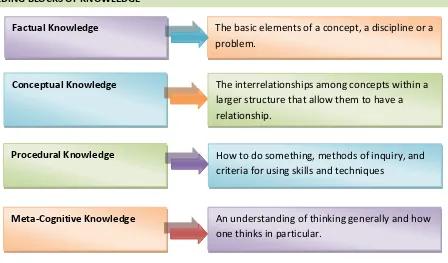
BUILDING BLOCKS OF KNOWLEDGE
Factual Knowledge The basic elements of a concept, a discipline or a problem.
Conceptual Knowledge The interrelationships among concepts within a larger structure that allow them to have a relationship.
Procedural Knowledge How to do something, methods of inquiry, and criteria for using skills and techniques
Meta-Cognitive Knowledge An understanding of thinking generally and how one thinks in particular.
4. APPLICATION OF CBL/OBE TO ORGANISATIONAL LEADERSHIP & MANAGEMENT
Drivers of business in the real world are key to developing learning practices for Organisational
Leadership & Management education that is relevant and responsive (Shuayto, 2013).
Curriculum specifications should seek to clearly demonstrate the three key foundations of
OBE/CBLE, namely:
a) Explain or demonstrate what actions must the learner perform to achieve the desired
outcome.
b) Clarify the process map for attainment of these outcomes.
c) Demonstrate critical success factors and performance indicators attributable to
attainment of outcomes.
When designing Curriculum, a business school’s focus should bear in mind the changing needs
of the business world and information age, with special attention to the archetypes of Millennial
and Centennial generations as obvious entry level participants into the mainstream business
environment. Curriculum design focus needs to encourage self-reliance, innovation and creativity
– desire to explore economic sustenance of communities and job creation modalities, (Kee et Al
2006). Key design focus area needs to align OBE/CBL approach to the following basic
imperatives:
a) Learning modules should be synergistic with the entire programme of Organisational
Leadership & Management faculty. They should create a seamless fit with other
modules as part of a “whole”.
b) Learning design should identify and develop a competency framework/model with
clear behavioural indicators (outcomes) that encapsulate the cognitive content
requirement of the subject.
c) Competency framework should have four quadrants underpinning programme
design, namely:
I. problem solving;
II. communicating for impact;
III. team building and cohesion; and lastly
5. CONCLUSION AND RECOMMENDATIONS
OBE Curriculum Designers should bear in mind the changing needs of the business world
and information age, tap into the archetypes of Millennials and Centennials as key focus of
learning institutions but also entry level into the mainstream economic activity. Curriculum
should encourage self-reliance, innovation and creativity – desire to explore economic
sustenance of communities and job creation modalities. The model of teaching and instruction
should encourage learners to be at the fore-front and cutting edge of their learning
development. This model is now adopted by many forward thinking institutions and commonly
known as “flipped classroom” concept.
Flipped methods focus on flipping the traditional pedagogical approach in adult learning where
teaching instruction focuses on content delivery as opposed to androgogical approach that
focuses on facilitating knowledge acquisition by putting the learner at the fore-front – learner
centeredness. It is interesting to note that way back to the time of the Stoics, Socrates down
to Aristotle and other notable ancient philosophers; education was always structured in an
outcome based approach. If implemented well, OBE is transformative, innovative and
encourages leaner creativity through experiential learning.
Taking it back to Aristotle, your curriculum design must have three main agendas:
a) Logos (intellectual agenda): this fosters transfer of skills and knowledge through clear
understanding of application of basic linguistic concepts.
b) Ethos (Behavioral agenda): the programme design must recognize that human beings
are likely prone to act their way into a new way of thinking than think their way into
a new way of acting. The programme structure needs to engage participants to learn
practical leadership experiences that are fully enriched by diverse and multiple
behavioral reviews and feedback. Ethics must be core foundation of the programme
in order to transform leaders to be generators of a new breed of global business
pioneers and change agents.
c) Pathos (Emotional agenda): The design of the programme should produce 21st
century leaders who are emotionally intelligent to understand that followers prefer
leaders who practice acceptable engagement methods that stimulate them both
REFERENCES
Abraham, S.E. and L.A. Karns (2009) “Do Business Schools Value the Competencies that Businesses Value?” Journal of Education for Business, vol. 84(6), p. 350-356.
Boyatzis R.E., E.C. Stubbs and S.N. Taylor (2002) “Learning Cognitive and Emotional Intelligence Competencies through Graduate Management Education,” Academy of
Management Learning and Education, vol. 1(2), p. 150-162.
Boyatzis, R.E. (2008) “Competencies in the 21st Century,” Journal of Management
Development, vol. 27 (1), p. 5-12.
Kee,J., Rodrigues,P., Kundu,S., Racine,J.L.(2006)Entrepreneurial Curriculum – Project Report
for JIP Grant.
Krishna ,A.R. (2013) From OBE to CAPS: Educator’s Experiences of the new Life Skills
Curriculum in the Foundation Phase, University of Kwazulu-Natal.
Mokhaba, M.B.(2005) Outcomes-Based Education in South Africa Since 1994: Policy
Objectives and Implementation Complexities, University of Pretoria.
Mahomed, H. (2004) “Challenges in Curriculum Transformation in South Africa” Fifth Annual
Educationally Speaking Conference, Boksburg.