Volume 2, No. 6, Nov-Dec 2011
International Journal of Advanced Research in Computer Science
RESEARCH PAPER
Available Online at www.ijarcs.info
Unified Technique for DOA Estimation using Real Antenna Array in presence of
Environmental Objects
Ahmed A. Yahia*
Department of Electronics & Communication Faculty of Engineering, Alexandria University
Alexandria, Egypt [email protected]
Hassan M. Elkamchouchi
Department of Electronics & Communication Faculty of Engineering, Alexandria University
Alexandria, Egypt
Abstract: A new technique is presented to optimize the Direction of Arrival (DOA) estimation of the desired signals using a real
antenna array affected by various electromagnetic (EM) effects. It is considered to be an amendment of non conventional least squares optimization algorithm for DOA estimation. This technique uses genetic algorithm procedures as tools to randomize the selection of receiving elements through real uniform linear array and optimizing a predefined cost function to avoid unwanted received multipath components. This idea is the key of the new technique to minimize the probability of fine and gross errors which is considered as a cost function. So, we can get rid off the resultant spectrum’s distortion for DOA estimation by using the results of this unified technique in hardly EM affected signals’ environment.
Keywords: Direction of Arrival (DOA); genetic algorithm; non conventional least squares optimization algorithm
I. INTRODUCTION
The Direction of Arrival (DOA) estimation algorithm is one of the most effective methods at the smart antenna systems. These algorithms are often used in the antenna arrays and wireless communication systems to increase the capacity and throughput of a network. The non conventional least squares optimization method (NCLS) is one of the non adaptive and subspace methods for DOA estimation. In latter researches, this method became an efficient tool to define the DOAs of the targets at the real and practical signals’ environment. This method succeeded to compensate the mutual coupling effects due to real antenna array's usage and presence of environmental objects. But in some cases, it fails to estimate the correct DOAs spectrum as shown at the latest simulation of [1]. The basic cause of this spectrum’s distortion is the large incident multipath component at the receiving real antenna array (AA). So, we proposed a new calibration technique by using multiple optimization algorithms (i.e. NCLS and genetic algorithm (GA)) to compensate the resultant spectrum’s distortion of the DOA. The idea is usage of the genetic algorithm as a switching tool to select the receiving antenna elements as a random linear array. One of the most important steps of the genetic algorithm is the cost function which minimizes the later discussed error function.
Finally, the combined technique defines the correct DOA estimation spectrum. antenna array (AA). So, we proposed a new calibration technique by using multiple optimization algorithms (i.e. NCLS and genetic algorithm (GA)) to compensate the resultant spectrum’s distortion of the DOA. The idea is usage of the genetic algorithm as a switching tool to select the receiving antenna elements as a random linear array. At each cycle of the new algorithm, we generate a chromosome as a real non uniform linear array (NULA) to
detect the correct DOAs through an array of resultant spectrums' peaks above predefined threshold. One of the most important steps of the genetic algorithm is the cost function which minimizes the probability of fine and gross errors.
In section 2, the signal model is introduced by defining some of the necessary parameters and vectors of the received signals at the AA. In section 3, a brief introduction to genetic algorithm is presented as an adequate algorithm and a numerical optimization method. In section 4, the unified technique for the DOA estimation algorithm of the NCLS optimization method and the GA is implemented. In section 5, numerical results are presented using a signals’ environment in the presence of two large near-field scatterers and by using multiple algorithms to get accurate DOAs of the desired signals. In section 6, the conclusion of the new technique is discussed.
II. SIGNALMODEL
Where M is the number of the calibration plane waves incident on the array system. For the mth plane wave, let N × 1 vector a(θm) be the true steering vector when the wave is
incident from the true direction θm with a complex amplitude Sm. ω is an N × 1 vector of generated noise at the load ports of loaded segments of the antenna dipoles X, we want to estimate the direction of arrival of the incident wave θ = [θ1 θ2 … θM] T. For the estimation of θ in the processing mode of the AA, first, we calibrate the whole system of the AA and environmental objects by measuring the relative-phased voltages induced on the elements due to Q calibration sources positioned in the far field of the antenna system at well known calibration angles (certain angular directions) and in presence of mutual coupling and all other near field effects. We define the calibration angles according to the field of view of the array (i.e. if the field of view Q = [1° … 180°], we call the known directions of calibration sources by a vector θ = [θ1 θ2 … θQ] T = methods which work with numerically generated data, experimental ones, or analytical functions [2]. This advantage has been capitalized by many phased array researchers. So, we use the procedures of this algorithm as tools for switching on some of the antenna elements of the ULA and switching off others. This step is done by applying the population process on the ULA. Then, we are collecting the resultant induced voltages on the switched-on elements as a new NULA (i.e. one chromosome) at each cycle of the whole new technique's applying. A cost function is one of the most important steps of the new technique which determines the group of the resultant DOAs estimation spectrums'. So, we proposed to have a metric function B which could be minimized by GA procedures to minimize the probability of the gross errors generated in the DOA estimation due to some of the positioned elements of the ULA and the presence of the EM-near field scatterers. The value of B function equals to one by using omnidirectional antenna array (i.e. ideal case) and in presence of a single source located at any angle of arrival (AOA) in the far region. So, the minimization of this function achieves the required estimation of the correct DOAs of the desired sources.
IV. PROPOSEDMETHOD
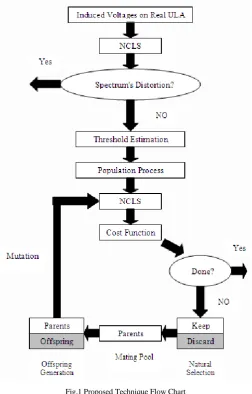
The new unified technique is considered as a bulk of collected procedures of the bulk NCLS optimization method and steps of the GA procedure. The new technique consists of four main stages: threshold's determination stage, NCLS optimization algorithm, population process and the core of GA procedure. This new unified procedure can be shown in figure (1). First, we apply the NCLS optimization algorithm which is later discussed on the whole induced voltages on the real ULA [1]. If the resultant spectrum is distorted by presence of side lobes due to the received multipath components, we determine an appropriate threshold limit of this spectrum to be later applied on the final resultant DOAs estimation spectrums. This threshold can be determined by the following MATLAB command:
>> Threshold = ceil(max(Spectrumfunc/2));
Then, we apply the initial population process which
depends on chromosomes' generation (e.g. eight
chromosomes). It is the first stage of the proposed method to randomize the selection of the receiving antenna elements. It converts the real uniform linear array (ULA) to non uniform linear array (NULA) of randomly selected elements at each generated chromosome. Then, we apply the NCLS procedure by four steps. First, we replace DFT-based equation with a new equation which is adequate for this problem [1]:
S
NCLSA
(
C)
X
Then, we can solve the second term of the right hand side of the equation using the singular value decomposition (SVD) [1]. To apply this method, we decompose the following matrix as follows:
Fig.1 Proposed Technique Flow Chart
The inverse of the previous equation can be written as:
[
A
~
(
C)
A
~
H(
C)
]
1V
~
~
1U
~
H (5) Where V~ and U~ are obtained from V and U using the first k columns, respectively. Finally, we can compute the pseudoinverse of A~( C) after obtaining the matrix inversion in (5).We note that pseudoinverse matrix can be calculated offline when setting up the antenna in an operating environment or online in the presence of the desired signals by applying the GA tool. Then the DOA estimation problem in real time is reduced its computation to only a matrix multiplication in (2).
Then, we proposed to have a metric function B as a cost function which could be minimized by GA procedure to minimize the probability of the gross errors generated in the DOA estimation due to some of the positioned elements of the ULA and the presence of the EM-near field scatterers. So, we showed metric function as follows:
2
2
)
,
(
~
)
(
~
N
A
A
B
H
(6)
Where N is the number of new NULA at every generated chromosome (i.e. every generated NULA). Then, we continue the new algorithm using the other steps of the GA as shown in figure (1). Finally, we will have many DOAs spectrums corresponding to the applying of the new technique. We will get the correct DOAs by applying the threshold constraint of the resultant spectrums.
In the next section, we propose the numerical results ofthe new technique using an appropriate study case.
V. SIMULATION RESULTS
In this section, we will simulate the new unified technique for the DOA algorithm using the neoclassical least squares optimization method and the GA. The simulation is using calibration incident waves generated from far field sources at 1.5 GHz and a range of calibration angles [1° 180°]with an angular stepping of 2° incorporating all the EM effects have been carried out using an EM software modeling code (SuperNEC) [1]. So, we consider a uniform linear array of 20 thin half-wavelength dipoles with half wavelength spacing.
Figure.2 An array of 20 half-wavelength dipoles with two large near-field scatterers
Each dipole of the ULA has a 7-segments construction. It is loaded with a 50 Ω resistance at its centre. It has a radius a = 0.01 . The antenna spacing is /2. In the antenna environment, we introduce two large near-field scatterers (i.e., a conducting cube and a sphere). The cube has dimension of (0.4 m 0.4 m 0.4 m) or 2 in size which is located at (-0.5 m , (-0.5 m, 0 m) and the sphere is 0.4 m or 2 in diameter which is located at (0.5 m, 0.85 m, 0 m). The array and the EM near-field scatterers are operated in the presence of three signals coming from 45°, 90° and 135°. It is important note that the cube is still along one of the signal directions (135°) and the sphere is along 53.9°. Fig.1 shows the array configuration with the near-field scatterers.
0 20 40 60 80 100 120 140 160 180
Fig.3 Ideally Estimated DOAs using whole array of Omnidirectional elements
Without using the switching on the AA elements’ and applying the GA procedure on the NCLS optimization algorithm, the resultant DOA estimation is hardly distorted due to the high effects of mutual coupling between the AA and the obstacles as shown in Fig.4. This optimization method fails at detection of the correct DOAs due to the presence of complex EM-Obstacles and hardly-effects by multipath or reflection waves incident on the AA [1].
DOA Estiomation w obstacles, All AA elements are switching-on [11111111111111111111]
A
Figure.4 Real distorted DOA Estimation of three signals at angles 45°, 90° and 135° and large multipath component using at angle 79° using
NCLS optimization method only on whole real ULA
So, due to the resultant distortion of the previous DOAs estimations in Fig.4, we use the unified technique between GA and NCLS optimization method as shown in Fig.1 to minimize this distortion by minimization the probability of gross and fine errors as a cost function to have the best DOA estimation spectrum as shown in Fig.5. The threshold limiting factor is determined by the previous mentioned MATLAB command and is calculated to be value of (3).
We simulate the new technique through eight
chromosomes or eight different NULAs plus two offsprings
DOA estimation spectrum is shown in Fig.5 achieves the best minimized cost function of the new method.
But, some results are some distorted but achieve the correct desired DOAS by using the proposed threshold limit of 3 as shown in Fig.6 as an example of resultant DOAs estimation results.
The other high-cost functions achieve hardly-distorted DOAs estimation spectrums due to the switching-on process on few elements only of the whole twenty elements ( i.e. < ten switched on elements) as shown in Fig.7.
Finally, we discard all the distorted spectrums except the best DOA estimation algorithm which will be the correct information to the communication system (e.g. RADAR SYSTEM) as achieved in Fig.5
0 20 40 60 80 100 120 140 160 180
DOA Estimation w Obstacles, Switching AA at Sequence [10010011100111111101]
Angle (degree)
Figure.5 Real corrected DOAs Estimation of three signals at angles
45°, 90° and 135° using proposed technique and applying of threshold level
which is equal 3. which achieves optimized cost function
0 20 40 60 80 100 120 140 160 180
DOA Estimation w obstacles, Switching AA at Sequence[11011010110011001111]
Figure.6 Another Real DOAs estimation of 3 signals at angles 45°, 90° and
135° using proposed technique and applying of threshold level which is equal
0 20 40 60 80 100 120 140 160 180 0
10 20 30 40 50 60 70
Distorted DOA Estimation w obstacles, Switching AA at Sequence [01110001000101101001]
A
b
s
o
lu
te
V
a
lu
e
o
f
O
u
tp
u
t
S
Angle (degree)
Figure.7 Real hardly distorted DOA spectrum using nine elements only
VI. CONCOLUSION
In this paper, we propose a new technique to determine various DOAs of the far field signal sources which use a real ULA in the presence of large environmental objects. This technique uses the switching between the receiving elements to select a group of antenna elements corresponding to genetic algorithm procedure to have the best DOA estimation. The nonconventional least squares algorithm is used after the switching process to get rid off the hardly EM effects such as the mutual coupling between elements and between the elements and the EO (Environmental objects). The simulation results describe the ability of the new technique for DOA estimation at the hardly-EM affected signals’ environments
comparing with the applying of the NCLS optimization method at such signals’ environments.
VII. REFERENCES
[1]. Tapan K. Sarkar and Magdalena S. Palma, “Nonconventional least squares optimization for DOA estimation “, IEEE Trans. On Antennas Propag. vol. 55, NO.3, Mar. 2007.
[2]. R.L. Haupt, D. H. Werner, Genetic algorithms in Electromagnetics, 1st ed. New Jersy: Wiley, 2007
[3]. L.Landesa, F. Obellelro, and J. L. Rodriguez, “ Practical improvement of array antennas in the presence of environmental objects using genetic algorithms” Inc. Microwave Opt Technol Letter 23:324-325, 1999.
[4]. T. Birinci, “Optimization of nonuniform array geometry for DOA estimation”, Ph.D., Department of Electrical and Electronics Engineering, the graduate school of natural and applied sciences of middle east technical university
[5]. J. Foutz, A. Spanias, M.K. Banavar, Narrowband Direction of Arrival Estimation for Antenna Arrays, Morgan and Claypool 2008
[6]. G.H. Gloub and C.F. Van Loan, Matrix Computations,3rd ed. Baltimore, MD: Johns Hopakins Univ. press, 1996