103-113. ISSN 1872-8219 DOI: https://doi.org/10.1016/j.ergon.2016.08.003 Link to Leeds Beckett Repository record:
http://eprints.leedsbeckett.ac.uk/2979/
Document Version: Article
The aim of the Leeds Beckett Repository is to provide open access to our research, as required by funder policies and permitted by publishers and copyright law.
The Leeds Beckett repository holds a wide range of publications, each of which has been checked for copyright and the relevant embargo period has been applied by the Research Services team.
We operate on a standard take-down policy. If you are the author or publisher of an output and you would like it removed from the repository, please contact us and we will investigate on a case-by-case basis.
UK Rail Workers’ Perceptions of Accident Risk Factors: An Exploratory Study James I. Morgana and Judith Ramsaya
Leeds Beckett University Rachel Abbottb and Penny Furnessb
Sheffield Hallam University
Author Note
aPsychology Group, Leeds Beckett University, Leeds, UK
bDepartment of Psychology, Sociology, and Politics, Sheffield Hallam University,
Sheffield, UK
Correspondence concerning this article should be addressed to Dr Jim Morgan, Psychology Group, Leeds Beckett University, Leeds LS1 3HE, United Kingdom.
Tel: +44 113 225 2290
UK Rail Workers’ Perceptions of Accident Risk Factors: An Exploratory Study
Abstract
Although non-fatal injuries remain a frequent occurrence in Rail work, very few studies
have attempted to identify the perceived factors contributing to accident risk using qualitative
research methods. This paper presents the results from a thematic analysis of ten interviews with
On Track Machine (OTM) operatives. The inductive methodological approach generated five
themes, of which two are discussed here in detail, ‘Pressure and fatigue’, and ‘Decision making and errors’. It is concluded that for companies committed to proactive accident risk reduction, irrespective of current injury rates, the collection and analysis of worker narratives and broader psychological data across safety-critical job roles may prove beneficial.
UK Rail Workers’Perceptions of Accident Risk Factors: An Exploratory Study
1. Introduction
The UK Network Rail workforce safety statistics for the five years preceding, and including 2013/2014, show that while fatal worker injury rates have remained consistently low with three deaths in both 2009/10 and 2013/14, major injuries have risen over this period, from 96 to 122, and lost time injuries have risen from 146 in 2009/10 to 310 in 2013/14 (Network Rail, 2014). In addition to the pain and suffering caused, the financial cost of workplace injuries and illness is high for both individuals and for companies, estimated at £14.3 billion in 2013/14, of which workplace injuries (including deaths) cost £4.9 billion (HSE, 2015). Network Rail has identified three principal safety risks for rail workers; being hit by a train, on-track plant, or a road rail vehicle; electrocution from overhead power lines or conductor rails; and trips and falls. The seriousness of these risks alongside injury rates consistently above zero provides a clear rationale for further research to identify, examine and understand the factors that influence accident risk in railway work.
Accident prediction is complex, largely due to the number of potential contributing factors. Since the early 1990’s safety-critical industries (including healthcare and aviation) have adopted a “systems”approach to safety management (Reason, 1995). This approach is important because it recognises that although frontline employees are prone to human error, this is
studying work systems have been proposed (e.g. System Engineering Initiative for Patient Safety, Carayon et al. 2006; Yorkshire Contributory Factors Framework, Lawton et al., 2012b).
such as social norms were associated with violations. While this study is one of very few to apply a contributory factors framework to rail accident data, it is notable that the findings were comparable with those of previous research exploring the relationships between errors and contributing factors in non-rail incidents and accidents (e.g. Hobbs and Kanki, 2008; Hobbs and Williamson, 2003).
The utilisation of contributory factor frameworks in rail safety management represents a considerable move forward and has provided the rail industry with some general guidance with respect to the role of system features, such as the importance of equipment reliability as well as worker condition, knowledge, and training. However, there are a number of limitations
associated with the methods and tools used. In particular, the subjective, reductionist, and reactive nature of the factor identification process can be questioned. For example, not all of the accident investigations analysed in these studies have followed the same methodologies, and the way in which the evidence has been interpreted is dependent on a particular investigator’s background and prior experience (Read et al., 2012).
A largely overlooked alternative means of examining contributory factors is to use
interviews to explore worker perceptions of the causes of past adverse incidents or accidents, and to gather information about system conditions that are perceived to heighten current and future accident risk. The underutilisation of this qualitative approach is surprising given that the acknowledgement of, and use of frontline worker knowledge and experience is thought to be a central component in High-Reliability Organizations (HROs), and positive safety-cultures (Jeffcott, Pidgeon, Weyman, & Walls, 2006). In other high-risk domains such as healthcare, researchers have begun to recognise the effectiveness of interview techniques in gaining rich information regarding causes of patient safety breaches (e.g. Lawton, Curruthers, Gardner, Wright and McEachan, 2012a; Silen-Lipponen, Tossavainen, Turunen, & Smith, 2005). To our knowledge, however, there is only one published journal article, to date, that describes the use of interviews within the area of rail safety research (see Farrington-Darby, Pickup, and Wilson, 2005).
example, if one were to use the categorisation of system conditions described by Wiegmann and Shappell (2003) as a guiding framework, Farrington-Darby et al.’s list of forty factors include those that could be classified as environmental factors such as “physical conditions”, and
“working hours”, as well as operator conditions, such as “individual perception of what safe is”, “knowledge and understanding”, and “fatigue, concentration, ability to function”. Their list also
contains personnel factors like “inconsistent teams/subcontractors”, “communication on the job (excessive and poor quality)”, and “training methods”. Factors that, using a systems approach could be categorised under unsafe supervision were also listed, such as “setting up site safety on the day”, “supervisors technical competencies”, and “supervisors presence”. A number of factors could also be described as wider organisational influences. For example, “rule dissemination”, “equipment (condition, appropriateness and availability)”, “methods for reporting”, “feedback
cycle”, “information/communication route clarity”, and “rule book usability and availability”. The Farrington-Darby et al. (2005) study has informed the work of rail safety
in the analysis of accident and incident data (Baysari et al., 2008; Read, et al., 2012; Reinach and Viale, 2006).
2. Research aims
The present paper documents an exploratory interview study conducted in collaboration with a rail engineering company with a good safety record and low accident rates. The principal aim was to proactively identify the factors contributing to accident risk in On Track Machine (OTM) operation as perceived by a specialist group of rail safety workers –On Track Machine Workers. Our study attempted to overcome some of the limitations of previous rail safety work by collecting prospective data about current and future accident risk (rather than retrospectively coding accident and incident data some time after an event occurrence). Our inductive
methodological approach reflects the assumption that individuals are capable of both giving rich, detailed accounts of their experiences and of making sense of those experiences. Rather than relying on existing a priori explanatory frameworks and subject matter expert knowledge we adopted a grounded approach (Glaser and Strauss, 1967) to the data collection. We did this in order to remove (as far as it is possible to do so) any potential preconceptions, assumptions and expectations that might influence our subsequent analysis of the voiced experiences of our participants.
paperwork. To do this, they wear high visibility clothing, ear defenders, safety helmet and safety goggles. The Driver Maintainer Operator- OTM drives the machine on the tracks and maintains
and operates the regulators and tempers. The Machine Supervisor-OTM oversees the operational
delivery and management of staff. Given the highly specialised and specific nature of this type of
work, which takes place at night, in the dark, on the tracks and using machinery, and given that our concern is safety, it was essential that a truly inductive approach was taken to allow
perceptions of safety issues to emerge without any potential distortion or occluding by prior expectations.
Our aim was to establish those accident risk issues that were of immediate concern for On Track Machine workers in the first instance and consequently provide the impetus for potential system and process changes, and/or the necessity for further research.
3. Method
3.1 Participants and recruitment
Information about the study was sent to employees by email, by letter and was also made available on the organisation’s intranet site. There were sixteen fully qualified OTM workers employed in the Plant division of the company at this time. Those workers workers who wished to take part in the study contacted their manager and these names were sent in turn to the OTM business manager who arranged times for participation. Time was also granted to consider participation and ask questions of the research team, after which ten participants consented to be interviewed Arrangements were then made with the employer for the ten male On Track Machine (OTM) operatives to have one-to-one interviews timetabled into their future work plans.
A semi-structured interview schedule was developed and utilised, thus each participant was asked the same open-ended questions but not necessarily in the same order, and there was scope for participants to talk about relevant issues of concern to them. In keeping with our study aim, the interview schedule was designed to examine the factors that are perceived to heighten current and future accident risk in On Track Machine (OTM) operation. Participants were asked to describe their work, what their job entails on a day-to-day basis, to describe the training they had received in order for them to do their job (including health and safety training), to outline any health and safety risks associated with their work, and to outline their experience of circumstances in which this risk is heightened. They were also asked to describe the ways in which they manage these safety-critical risks. Participants were also asked to describe the role of their work supervisor and their co-workers in promoting safe working practices and to indicate if they had ever witnessed any unsafe work practices. In particular, participants were asked to consider a time when they felt most vulnerable in their work, when safety had perhaps been compromised, or could potentially have been compromised. Participants were questioned about what they do to keep themselves safe at work and how they cope with working in a safety critical environment.
3.3 Procedure
Ethical approval for the study was obtained from the University Research Ethics
one and two and a half hours in duration, during which participants were offered refreshments. Each interview was audio-recorded, transcribed verbatim and anonymised, to protect participant identity. In keeping with the interview schedule, each participant was first asked to describe their job and daily duties. This served as a warm up question and set the scene for later questions around safety, training and risk. At the end of the interview, participants were invited to ask any questions they had about the study and to add any further details that they had not had the opportunity to discuss during the course of the interview.
4. Data analysis and discussion
Two researchers experienced in qualitative research (RA and PF) analysed all 10 transcripts using thematic analysis. This involved the careful reading and re-reading of each transcript line-by-line, initially identifying descriptive codes. Codes provide labels for aspects of the data which are potentially relevant to the research question. (Braun and Clark, 2006; Clarke and Braun, 2013). Based upon a process of comparative analysis, codes were grouped according to similarities and differences, resulting in themes which expressed patterns across the dataset. Both researchers initially analysed the same two transcripts, compared the codes and themes each had generated, resolving any differences through discussion, and then developed a thematic framework. This framework comprised a number of overarching themes and sub-themes, each of which was described according to its constituent codes, and was used to code the remaining eight transcripts, with each researcher coding four transcripts.
decision to move from four to a final five themes. One of the initial four themes was titled 'Responsibility and Risk', and included subthemes of 'Safety Culture,' 'Bending and Breaking Rules,' 'Making Mistakes and Having Accidents,' 'Reporting Concerns, Incidents and Near Misses' and 'Managing Fatigue and Pressure.' This theme was split to reflect the sense that some subthemes were related to the heightening of accident risk and others to reducing or managing it. Hence, 'Safety Culture' was separated to form its own theme and, in order to reflect the
complexity within that theme, subthemes were identified, namely, 'Safety and the Employer,' 'Safety Conscious Teams' and 'Individual Responsibility for Safety'.
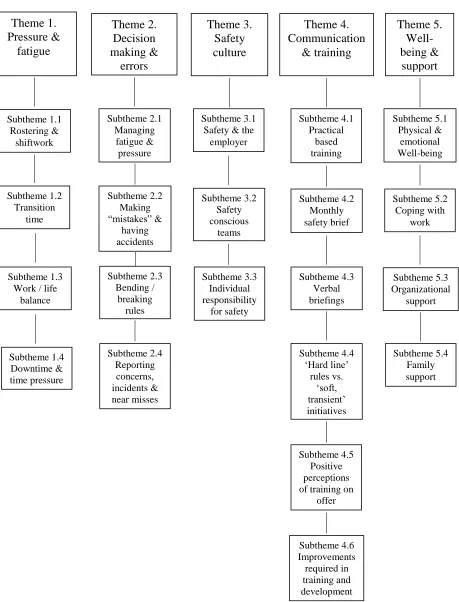
Five overarching themes were generated. These are presented as a thematic map in Figure 1., and with respective definitions, constituent subthemes and illustrative data excerpts in
Appendix 1. These themes were entitled ‘Pressure and Fatigue,’ ‘Decision making and Errors,’ ‘Safety Culture,’‘Communication and Training,’and ‘Wellbeing and Support.’For the purposes
of the present paper, the first two themes, ‘Pressure and fatigue’, and ‘Decision making and errors’are discussed in detail. The rationale for this is three-fold. Firstly, these were the strongest two themes to emerge from the data and as such warrant detailed consideration. Secondly, it appears that these themes define the factors that contribute to heightened accident risk for OTM operatives. In contrast, rather than identifying contributing factors, the other three themes appear to describe the factors that have the potential to attenuate accident risk and are reported
elsewhere (Morgan, Abbott, Furness, & Ramsay, 2016, in preparation). Thirdly, the practical consideration of paper length. To explore all themes in sufficient depth here would create a rather cumbersome task for the reader, thus potentially reducing the utility of the findings described.
Fatigue was referred to as extreme tiredness or weariness and associated difficulties in responding to the changing requirements of the job. Pressure was described as the burden of mental stress associated with demands, which were difficult to meet, especially within imposed time constraints. Fatigue and pressure were discussed by participants as a daily challenge of working life and were linked to the sub-themes of shift work and rostering, transition time (between home and work), work-life balance, and the perceived inefficiency of ‘downtime’ during working hours.
4.1.1 Shiftwork and rostering
Hedges and Sekscenski (1979) define shiftwork as a work pattern that requires at least half of the work to take place after 4pm and before 8am. More recently, the UK Health and Safety Executive (HSE) have defined shiftwork as “a work activity scheduled outside standard daytime hours, where there may be a handover of duty from one individual or work group to another; a pattern of work where one employee replaces another on the same job within a 24-hour period”(HSE, 2006, p.6). Frequent transitions between day and night shifts and the practice of working one night on, one night off, described by some workers, caused problems in getting enough sleep, resulting in tiredness and impacting on safety: "so you're laid in bed, thinking, go to sleep, go to sleep, go to sleep and it's hard... you're fit to do a job but not as fit as you should
in falling asleep and somnolence at work (Åkerstedt, 2003). These findings are compounded by recent evidence that indicates that there is no difference in shiftwork tolerance between those new to shiftwork (in a sample of nurses) and those who have been doing it for six years
(Saksvik-Lehouillier et al, 2013): age (being younger) rather than experience lends resilience, as does hardiness.
In an exploration of one particular type of rail shiftwork for Network Rail, Cebola, Golightly, Wilson, & Lowe (2012) conducted a digital diary study of “distal”on call work in infrastructure maintenance managers, where employees are on call from their homes for 24 hours a day for seven days at a time before coming off shift. They found that anxiety and fatigue were worse during on call weeks when compared to off call weeks. Indeed, it has been demonstrated that the specific chronotype of shift (morning, day or evening) influences ratings of quality of life and sleep in Brazilian train drivers (de Araújo Fernandes et al, 2013). It has been shown that permitting breaks for sleep during nursing nightshifts can assist recovery from shifts (Silva-Costa, Rotenberg, Griep, & Fischer, 2011) however it is insufficient on its own to guarantee recovery. In their coverage of fatigue management systems for rail workers, the Office of Rail Regulation (ORR; 2012) recognise the rise in risk of accidents towards the end of shift and beyond and recommend reducing workers’involvement in safety critical work towards the end of their shift along with the provision of additional supervision, amongst other recommendations.
Certain shift patterns caused stress and resentment among workers, and participants perceived that staff charged with shift scheduling duties, who did not themselves work shifts, had little appreciation of their effect: “They don’t seem to put any thought into your welfare. See, the roster clerk works Monday-Friday, 9-5. I don’t think she has any idea what it’s like to work the
found that control over shifts worked impacted upon tiredness levels, with work life conflict being the strongest predictor of “concurrent fatigue”(p. 773) in a sample of nurses. In our own study, participants also described being asked, and often expected to, take on additional shifts on a regular basis ("if we don't ask not to be rostered an extra, we will"), which some perceived was due to understaffing, hence extending their working hours and compounding the problems.
4.1.2 Transition time
Workers were often required to travel to jobs at considerable distance from their home, resulting in lengthy journeys of several hours' duration to and from work. This caused most problems at the end of some shifts when workers were faced with a long drive when over-tired and with depleted levels of concentration. Participants spoke of feeling unsafe in these situations, as demonstrated in Appendix 1. They sometimes had an option of an overnight hotel stay, but often chose to go straight home to family instead. Some spoke of taking a sleep break on the journey, but others, keen to get to home and bed as quickly as possible, opted to keep driving despite the risks: "I don't want to be away. I'm sick of being away lots, so I just drive home."
common after their night shifts than before them. “Shift workers were over eight times more likely to experience hazardous driving events […] during commutes home following an 8–10-h shift, compared with during their drive to work.” (Ftouni et al, 2013, p.64).
4.1.3 Work-life balance
According to participants, shift work, overtime and home-work travel negatively impacted on family life, through either reduced or poor quality time (when exhausted and
irritable) with loved ones, as shown in Appendix 1. One interviewee commented: "I've got a nice house but I'm never in it." Some spoke of being rostered to work extra weekends above their contractual obligations, and being unable to make plans beyond the two weeks of rostered shifts: "Personal life? Nobody's got a life at [company name]." Participants described being obliged to check for shift changes via email and to make or receive telephone calls when at home, which meant they could never truly switch off: “There is times [on days off] when I come back the phone after 12 hours and I’ll have 8-9 missed calls, a lot of texts, a lot of emails (Interviewer:
work related?), work related stuff.”
The psychological contract –based on the beliefs about the nature and form of the exchange between employee and employer - plays a central role in the relationship between the two parties with breaches proving difficult to repair (Rousseau, 2011). This difficulty of repair might stem from breaches being demonstrated as being taken personally (Rodwell and Gulyas, 2013). Fulfilment of the psychological contract is associated with positive work engagement, reduced intention to leave the job, and positive health outcomes (Parzefall and Hakanen, 2010). Breaches of the psychological contract are not necessarily individual events (Parzefall and Coyle-Shapiro, 2011) and might arguably lead to disengagement: it has been shown that
turn more likely when an employee’s intention to leave the job is already high (Christian and Ellis, 2014).
4.1.4 Downtime and time pressure
This describes the time workers spent waiting for a job to be ready for them whilst on duty. In many cases, participants reported sitting around for hours into their shift, waiting to begin work on a repair or maintenance task, and "nine times out of ten, they are always running late." This is typically followed by intense pressure to complete the work in order to get the job done quickly for the company and/or to finish their shift on time and avoid working longer hours, getting home later, and feeling even more fatigued. As one participant observed, "it depends what sort of job it is: say if it's a renewal and you're sat for hours, you know you're
going to be overrun, and you know you've got, someone's obviously got to do the job, otherwise
they can't have their track back, so yeah, there is pressure in that response (Interviewer: To get
every job done on time?) to get it done on time".
While there is no research that has dealt with the problem of downtime in safety-critical work, a number of studies have found that people working in other industries also experience an underlying pressure to complete a job before the end of a work shift. For example, for the nurses in Lawton et al.’s (2012) study, this was due to an unspoken expectation that tasks would be completed within the shift so that the next shift could start with a clean slate, to give the
impression they could manage their workload under pressure, leading inevitably to corners being cut in order to get the job done.
contributory factor in perceived heightened accident risk for OTM workers (see Appendix 1.). Cavanaugh, Boswell, Roehling, and Boudreau (2000) distinguish between “hindrance”job demands, and “challenge”job demands. In a later study of nurses (Bakker and Sanz-Vergel, 2013) work pressure was perceived as a hindrance demand (as opposed to the emotional demands which were perceived as a change demand).
Time pressure of the type experienced by the workers in our study can be conceptualised as a hindrance demand. Time pressure has been identified as one of several key psychosocial demands, along with workload and working long hours facing workers in the construction industry (Boschman, van der Molen, Sluiter, & Frings-Dresen, 2011; Sluiter, 2006) and which are associated with poorer health outcomes. It is considered a form of psychosocial workload and is linked to an increase in mental health problems (Zoer, Ruitenburg, Botje, Frings-Dresen, & Sluiter, 2011). Furthermore, workplace hindrance stressors are associated with a reduced likelihood of safety policy compliance and an increase in near-misses (Clarke, 2012).
The relationship between type of workplace demand (hindrance or challenge) and behavioural outcomes is not a direct one, however, as it has been demonstrated that employee appraisal mediates the relationship (Webster et al, 2011). Participants spoke of their frustration at the waste and inefficient use of their work time, described as "madness", feeling tired when in “switched off mode”, but needing to stay alert whilst waiting, and the pressure to complete the
4.2 Superordinate theme two: Decision making and errors
Whilst the first superordinate theme identified and characterised the influence of two factors, pressure and fatigue upon worker performance, the second superordinate theme described the impact of these factors with specific reference to workers’ability to make good decisions, act safely and avoid accidents at work. Decision making involves an individual weighing potential costs against potential gains (Kahneman and Tversky, 1979). Decision-making referred to workers' ability to do this, i.e. to select between appropriate alternative potential courses of action when at work. Errors included lapses of attention, and unintentional and intentional procedural violations made by workers, typically through lack of knowledge, concentration, or care. For the most part, decision making problems and errors occurred in high-pressure situations and when fatigued. Sub-themes reflected strategies the workers used to manage fatigue, the likelihood of making “mistakes”1, the tendency to bend or break rules, and decisions surrounding reporting of accidents, incidents, and close calls.
4.2.1 Managing fatigue and pressure
As indicated above, workers often experienced considerable fatigue at work for various reasons, and they were typically proactive in being aware of and taking responsibility for both their own and colleagues' tiredness and concentration levels: "If someone's tired it's - as long as it's not ridiculously tired before they come to shift, then they're not fit for duty really - but if
they're getting tired…they maybe just want to carry on and carry on …you've got to be able to
say, no, that's enough, we'll just go and have a cup of tea, take twenty minutes." The problem of fatigue was compounded by long periods of downtime, during which concentration and alertness would wane. Workers had little power over these factors, but most spoke of using various coping
strategies to keep control of the situation in order to remain alert so that an awaited job could be completed successfully, safely and within challenging time constraints. These include drinking caffeinated drinks, taking short naps, getting fresh air, keeping the mind occupied with puzzles, reading and chatting with colleagues: "You just have to like get a bit of fresh air pick yourself up and get on with it so but it’s not ideal but there’s nothing we can do about it ya know it’s part
and parcel of the job". It seemed most were successful in staying awake during downtime, but found it difficult to manage the changes of pace during their shift, moving rapidly from
downtime to demanding tasks. Gander et al (2012, p. 574) refer to fatigue as “the inability to function at the desired level due to incomplete recovery from the demands of prior work and other waking activities. Acute fatigue can occur when there is inadequate time to rest and recover from a work period. Cumulative (chronic) fatigue occurs when there is insufficient recovery from acute fatigue over time. Recovery from fatigue, i.e. restoration of function, (particularly of cognitive function), requires sufficient good quality sleep.”Our finding that fatigue is implicated in error making is in accordance with the wider finding that shift work-induced fatigue is
implicated in an increased risk of accidents (Åkerstedt, 1988; Violanti et al, 2012).
often take place informally with workers merely declaring they are fatigued to colleagues or using hand signals and requesting call-backs from colleagues. They argue that this is an approach that is useful for those work domains where restricting the hours of work is operationally
challenging and is strengthened by its ecological validity. More recently still, Dawson, Searle, and Paterson (2014) offer a set of specific criteria to assist organisations in evaluating fatigue detection technologies which identify behavioural signs of fatigue.
Whilst Gander et al (2012) assert that the responsibility for managing fatigue lies not only with the employer but also with employees, it is important to recognise that errors caused by fatigue-inducing work factors have consequences for the employee that are not inconsiderable from both a practical and emotional perspective. In a consideration of such consequences, Mankaka, Waeber, and Gachoud (2014) used a qualitative approach to explore post-error coping in nurses in Switzerland and found that whilst fatigue, poor communication and work overload were perceived as leading to errors, discussing the error with others formed the primary coping mechanism.
Regarding pressure more generally, Nevalainen, Kuikka, and Pitkäl (2014) found that
4.2.2 Making “mistakes” and having accidents
Although their employer had a good safety record within the industry and low accident rates, participants spoke of living with the daily risk associated with safety-critical work, and specifically the impact of their errors on the risk of fatal or serious accidents, such as being hit by a train, getting trapped or having a limb amputated by machinery, slips and falls, and skeletal or muscular injuries through heavy lifting.
Consistent with Read et al.’s (2012) findings concerning the role of human error in Australian rail accidents, the perception amongst our participants was that accidents and incidents occurred as an indirect result of inexperience and lack of safety awareness
(inexperienced workers were considered less “safety savvy”). It was suggested that accidents could happen as a result of mistakes (defined in the research literature as errors of intention or knowledge- or rule-based errors, see Rasmussen, 1983) made by novice workers with gaps in knowledge and/or shortfalls in training. Evidence of errors of action commonly referred to as slips or lapses (see Reason, 1990) were evident in the data (e.g. failing to look for moving stock when getting out of the cab). Again, in line with Read et al. (2012), task demand factors,
specifically fatigue and time pressure were often associated with these skill-based errors with participants highlighting the occurrence of errors of action (such as flicking the wrong switches, as described in Appendix 1.), even for diligent, experienced staff. For example, one participant who experienced a near miss put this down to lapses in concentration through fatigue and said, "if I were fully switched on, safety conscious all the time, I would have looked before I got off the
machine." Another commented, “if you feel under pressure you’re trying to think of everything you need to be doing, who you need to contact, whatever, there’s lot more risk of forgetting
problematic: "when I first went out on the machine…you just start rushing flabbergasted and you're all over the place, then it's like you might as well sit back and have ten minutes for the
amount of time you have been rushing about."
4.2.3 Bending and breaking rules
Participants were very mindful of the rules and procedures in place to protect them and their fellow workers (as indicated in Theme 3, Appendix 1.) and described being largely very safety conscious as individuals and having an employer who espoused a strong safety culture. Crucially, rule violations can be either intentional or unintentional (Dahl, 2013). They can also be viewed as either behaviours that need to be eradicated or as inevitable responses to emergent local situations (Hale and Borys, 2013). Interviews suggested that workers took safety seriously, refused to take on unsafe tasks and followed the rules and procedures set out by the company. However, this did not always happen, and workers were mindful of the costs, in money and time, of following every rule, so sometimes took the decision to bend or violate procedures, or take short cuts. One participant described running a signal to clear the mainline when his machine failed, rather than stopping and costing the company money by having to be pulled off: "I was thinking, well, if I can save ten grand and delays because we've stopped on the mainline, I'll just
go straight in, great. I won't do that again (laughs)." In addition, participants described cutting corners or breaking rules to reduce the time costs, and to get a job done quickly, especially after long periods of downtime and towards the end of a shift: “Because it’s the end of a shift, 90% of the time when it’s getting done [breaking rules/not following procedures], people are wanting to get home”(see also Appendix 1.). Participants also stated that rule breaking was often an
thinking about it but that was down to erm when a machine failed as I was driving it so I ran the
signal I…cos you’re not meant to use the phone when you’re driving…but I’d done that cos a
similar thing had happened when I was train driving a similar thing had happened and the guy
who was teaching me to drive did exactly the same thing [Interviewer: ok] I was sort of learning
by proxy rather than…doing it the proper way". These testimonies are equivalent to the findings of a number of studies that have used contributory factors frameworks applied to both non-rail accident data (e.g. Hobbs and Kanki, 2008; Hobbs and Williamson, 2003), and data from the rail industry. Specifically, Read et al. (2012) found that rail incidents and accidents attributed to violations of rules and procedures were significantly associated with social environmental factors, such as social norms. Similarly, Dahl (2013), in a qualitative study of Norwegian petroleum workers, identified three factors that influence workers’awareness of rules: work characteristics, the safety management system and social interaction. This latter category comprised interaction both with leadership and with co-workers. This is in accordance with previous findings into the predictors of safety violations which include individual traits, the organisational safety climate and the demands of competing goals (Alper and Karsh, 2009). Recently, work has been undertaken in the development of new ways of promoting and
encouraging safe behaviours on construction sites through the application of a “behaviour-based
safety (BBS)” approach (Choudhry, 2014). This approach involves managers and construction
in safety compliance and safety participation behaviours in a sample of nuclear power plant control room workers. They suggest this finding might be used in selection and safety training programmes.
4.2.4 Reporting
Within the safety culture of the employer, it was expected that accidents and near misses would be reported so that action could be taken to lower the risk of future negative events. Participants described completing paperwork and reporting problems to the company, however they also spoke of times when they or others had decided not to report, personally or ‘as a favour’to a colleague: "I hit a few cables or whatnot, it's never got reported, it's just got fixed, but that's between me and the tech that's on there, that's our relationship, you know: I'm not
dropping you in shit and he's not dropped me in shit, kind of thing." One of the key elements of Reason’s safety culture framework is an organisation’s ‘reporting culture’, as to whether workers are prepared to report accidents and near misses. In the interviewee’s example, above, the
incident was not reported as the negative outcome could be fixed immediately. This is analogous to the findings of Lawton et al. (2012a), who found that the nurses they interviewed were
unwilling to report errors where no harm was caused. Our participants stated that sometimes worker teams would decide against reporting in order to avoid wasting precious time and effort, and in the desire to finish, get home and to bed on time: “I didn’t report it, I should have done. (Interviewer: Why didn’t you?) Because we were already late and I was already into that period
where we were going over our shift, you know. You start reporting things like that and it takes
workplace, and these data suggested that under-reporting was relatively commonplace and was often linked to pressure and the desire to limit fatigue.
5. Concluding Discussion
The aim of this exploratory interview study was to proactively identify the perceived factors contributing to accident risk for On-Track Machine operatives. Our inductive
methodological approach generated five themes, of which two have been described in detail, supported by evidence from both the transcripts and existing literature. The first of these themes, Pressure and Fatigue, demonstrated the pervasive nature of fatigue in the working lives of the participants, and the impact of shift working, transition time to and from work, interference with home life, and downtime upon the perceived pressures of the job. The second, Decision-Making and Errors focused upon participants’behaviours and cognitions as they manage and respond to workplace pressures and fatigue. This demonstrated that, while they identify strategies to cope with the need to remain alert during downtime, workers’decision-making and risk-management abilities are nevertheless challenged and impaired by tiredness and the demands of completing work when time pressured. This results in the increased likelihood of errors, corner-cutting, and accident, incident, and near-miss occurrence and under-reporting.
attention lapses). In addition, Read and colleagues found that social environmental factors such as social norms were most likely to be associated with procedural violations. Our data also revealed that workarounds can become generally accepted amongst workers and in some cases even passed on by supervisors during training. Using Schein’s (1990) organisational culture model to build a conceptual framework to guide the design of their interview schedule and analysis of their data, Farrington-Darby and colleagues (2005) identified forty underlying factors that influence safe behaviour and a safe culture for railway maintenance workers. Their list of forty factors included those that can be considered inversely related to our themes and sub-themes, namely “physical conditions”, “working hours”, “individual perception of what safe is”, “knowledge and understanding”, and “fatigue, concentration, ability to function”.
5.1 Implications
After considering the existing research evidence and the OTM interview responses an overview of our findings and a number of recommendations were presented to the company. The organisation reacted quickly in order to reduce accident risk for their workers.
Beyond the immediate implications for the company we suggest that the replication of our approach more widely, for other job roles may help organisations better understand how frontline safety-critical workers negotiate accident risk on a day-to-day basis, and the challenges they face in doing this. The proactive use of psychological research methods to collect bottom-up data from frontline workers is in line with Hollnagel’s (2013) Safety II paradigm which suggests that safety researchers and practitioners should adjust their focus to examine Work-As-Done rather than Work-As-Imagined. Hollnagel argues that the definition of safety should be changed from ‘avoiding that something goes wrong’, the traditional Safety I perspective, to ‘ensuring that
conditions, so that the number of intended and acceptable outcomes (in other words, everyday activities) is as high as possible. The basis for safety and safety management must therefore be an understanding of why things go right, which means an understanding of everyday activities” (Hollnagel, Leonhardt, Licu, & Shorrock, 2013, p.17). According to Safety-II, the everyday performance variability needed to respond to varying conditions is the reason why things go right. Humans are consequently seen as a resource necessary for system flexibility and resilience. This is in contrast to the assumptions (or myths; see Besnard & Hollnagel, 2014) that underpin Safety I which describe well-tested and well-behaved systems where human performance variability clearly is a liability and where the human inability to perform in an expected manner is a risk. The acceptance of these assumptions has stimulated the use of top-down, reactive approaches to safety, including root cause, incident and accident analyses, the criticisms of which we have described above. The use of our inductive approach in the present study, and more broadly the adoption of employee-focused data collection methods allows for alternative explanations of how complex socio-technical systems actually work, such as Safety II, and can explore the ways in which workers have the potential to be flexible and adaptive when systems may not have been perfectly thought out and designed, or when conditions are difficult or challenging.
In line with Safety II we propose the following potential benefits associated with the analysis of frontline worker data in addition to traditional methods: more validity in risk
assessments, additional leading safety indicators, identification of ‘blunt-end’support needs for ‘sharp-end’ adaptations or coping, promotion of learning (from top performers), enhanced
recruitment and selection tools, training need identification and tailored training design,
capacity, improved two-way management-worker communication and shared commitment to safety (safety-culture).
In summary, our study demonstrates the potential utility of qualitative research in the identification of accident risk antecedents for safety-critical workers. It also highlights the importance of company engagement in proactive initiatives designed to further reduce accident risk and enhance safety-culture, irrespective of recent accident frequency.
5.2 Potential Limitations and Future Research
Our qualitative interview methodology was not novel. However, this was the first study to apply such an approach in this specific domain (Rail work and OTM operations), and to utilise qualitative research methods to identify the perceived factors contributing to accident risk for frontline rail workers. A further distinct feature of our design was the use of an inductive approach, although we recognise that our interview protocol may have biased workers towards
predefined responses. We suggest that this was not the case in that the interview schedule was
semi-structured to allow for open-ended answers and that interviewers were non-subject matter
experts not involved in interview design. In addition, we included an open question at the end of
the schedule to allow workers the opportunity to provide additional narrative about risk, not
covered in the previous questions.
The scope of our study could be considered limited in that we were primarily interested in the perceptions and experiences of a very specific group of workers rather than exploring the attitudes of employees from the wider work system, including managers and support staff. Also, we have perhaps not taken account of all of the system factors, which can contribute to accident risk for these workers. Indeed a whole system approach may have been useful, as would
However, we posit that by adopting a top-down approach, previous studies have assumed that managerial and contributory factor frameworks can accurately define the system factors that influence accident risk for frontline workers. Unfortunately this approach bypasses the frontline workers themselves. While our bottom-up approach cannot encapsulate all system risks it can illuminate those most salient for those working closest to the risk, the workers, which in our view is a valid and interesting alternative starting point.
In accordance with most applied studies our design was somewhat restricted by operational logistics. While it may have been useful to widen the focus beyond our study population, our access was limited to OTM operatives for this project. Project logistics and scope also restricted the capacity to evaluate the usefulness of our findings for the company over the longer-term in relation to organisational safety indicators such as accident frequency. It is recommended that, if resources allow, future research should widen the focus beyond OTM rail workers, be
References
de Araújo Fernandes Jr. S, Stetner Antonietti L, ·Saba A, ·Paulino de Faria A.,·Maculano Esteves A. ·Tufik . and Túlio de Mello, M. (2013). The Impact of Shift Work on Brazilian Train Drivers with Different Chronotypes: A Comparative Analysis through Objective and Subjective Criteria. Med Princ Practice, 22, 390-396.
Åkerstedt, T. (1988). Sleepiness as a consequence of shift work. Sleep, 11, 17-24.
Åkerstedt, T. (2003). Shift work and disturbed sleep/wakefulness. Occupational Medicine, 53(2), 89-94.
Alper, S. and Karsh, B. (2009). A systematic review of safety violations in industry. Accident Analysis and Prevention, 41, 739-754.
Bakker, A.B, and Sanz-Vergel, A.I. (2013). Weekly work engagement and flourishing: The role
of hindrance and challenge job demands. Journal of Vocational Behavior, 83, 397-409.
Barger LK, Cade BE, Ayas NT, Cronin JW, Rosner B, Speizer FE, Czeisler CA. (2005). Extended work shifts and the risk of motor vehicle crashes among interns. New England Journal of Medicine, 352(2), 125-34.
Baysari, M. T, McIntosh, A. S and Wilson, J. R. (2008). Understanding the human factors contribution to railway accidents and incidents in Australia. Accident Analysis and Prevention, 40 (5), 1750 – 1757.
Besnard, D., Hollnagel, E., (2014). I want to believe: some myths about the management of industrial safety. Cognition, Technology and Work 16 (1), 13–23.
systematic review. American Journal of Industrial Medicine, 54, 55–77. doi: 10.1002/ajim.20899
Braun, V., & Clarke, V. (2006) Using thematic analysis in psychology. Qualitative Research in Psychology, 3 (2). pp. 77-101.
British Psychological Society (2009) Code of Ethics and Conduct: Guidance published by the Ethics Committee of the British Psychological Society. London: BPS
Carayon P, Hundt, A. S, Karsh, B-T, Gurses, A. P, Alvarado, C. J, Smith, M. and Flatley Brennan, P. (2006). Work system design for patient safety: the SEIPS model Quality and Safety in Health Care, 15, 50-58.
Cavanaugh, M.A., Boswell, W.R., Roehling, M.V., and Boudreau, J.W. (2000). An Empirical examination of self-reported work stress among US managers. Journal of Applied Psychology, 85, 65-74.
Cebola, N, Golightly, D. Wilson, J. and Lowe, E. (2013). Fatigue, anxiety and performance for on-call safety critical decision makers in rail maintenance –a diary study. In N. Dadashi, A. Scott, J. R Wilson and A. Mills (eds) Rail human factors: supporting reliability, safety and cost reduction. CRC Press: London.
Choudhry, R. (2014). Behavior-based safety on construction sites: A case study. Accident Analysis and Prevention, 70, 14-23.
Christian, J. S. and Ellis, A. P. J. (2014). The crucial role of turnover intentions in transferring moral disengagement into deviant behaviour at work. Journal of Business Ethics, 119, 193-208.
Clarke, V. and Braun, V. (2013) Successful qualitative research: A practical guide for beginners. London: Sage.
Colley, S. K. and Neal, A. (2012). Automated text analysis to examine qualitative differences in safety schema among upper managers, supervisors and workers. Safety Science 11/2012, 50(9), 1775–1785.
Dahl, O. (2013). Safety compliance in a highly regulated environment: A case study of ... within the petroleum industry. Safety Science, 60, 185-195
Dawson, D, Chapman, J. and Thomas, M. J.W. (2012). Fatigue- proofing: a new approach to reducing fatigue-related risk using the principles of error management. Sleep Medicine Reviews, 16(2), 167-17
Dawson, D, Searle, A.K, Paterson, J. L. (2014). Look before you (s)leep: evaluating the use of fatigue detection technologies within a fatigue risk management system for the road transport industry. Sleep Med Review18(2), 141-52.
Farrington-Darby, T, Pickup, L. and Wilson, J. R. (2005). Safety culture in rail maintenance. Safety Science 43, (1), 39-60.
Ftouni S, Sletten TL, Howard M, Anderson C, LennéMG, Lockley SW. and Rajaratnam SM. (2013). Objective and subjective measures of sleepiness, and their associations with on-road driving events in shift workers. Journal of Sleep Research, 22(1), 58–69.
Gander, P, Hartley, L, Powell, D, Cabon, P, Hitchcock, E, Mills, A. and Popkin, S. (2011). Fatigue risk management: Organizational factors at the regulatory and industry/company level, Accident Analysis & Prevention, 43(2), 573 - 590.
Working to rule, or working safely. In C. Bieder and M. Bourrier (eds), Trapping safety into rules: How desirable or avoidable is proceduralization? Farnham: Ashgate Publishing Limited.
Hale, A. R. and Borys, D. (2013) Working to rule, or working safely? Part 1: A state of the art review. Safety Science, 55, 207-221.
Hedges, J. N. and Sekscenski, E. S. (1979). Workers on late shifts in a changing economy. Monthly Labor Review, 10, 431–436.
Hobbs, A. N. and Kanki, B. G. (2008) Patterns of error in confidential maintenance incident reports, International Journal of Aviation Psychology, 18, (1) 5-16.
Hobbs, A. N. and Williamson, A. (2003). Associations between errors and contributing factors in aircraft maintenance, Human Factors, 45, 186-201.
Hollnagel, E. (2013). A tale of two safeties. Nuclear Safety and Simulation 4 (1), 1–9.
Hollnagel, E., Leonhardt, J. Licu, T., Shorrock, S. (2013). From Safety-I to Safety-II: A White Paper, European Organisation for the Safety of Air Navigation (EUROCONTROL). Available at: http://www.Eurocontrol.int. (Accessed May 2014).
Hossain, J. L, Reinish, L. W, Kayumov, L, Bhuiya, P. and Shapiro, C. M. (2003). Underlying sleep pathology may cause chronic high fatigue in shift-workers. Journal of Sleep Research, 12, 223–230.
HSE. Health and Safety Executive (2006). Managing Shiftwork: Health and Safety Guidance. Last accessed 08/04/2016 from http://www.hse.gov.uk/pubns/priced/hsg256.pdf
HSE. Health and Safety Executive (2015). Costs to Britain of workplace fatalities and self- reported injuries and ill health, 2013/14. Last accessed on 08/04/2014 from
Jeffcott, S, Pidgeon, N, Weyman, A. and Walls, J. (2006). Risk, trust and safety culture in UK train operating companies. Risk Analysis, 26 (5), 1105-1121.
Kahneman D. and Tversky A. (1979). Prospect theory: An analysis of decision under risk. Econometrica.47, 263–291.
Kantermann, T, Juda, M, Vetter, C. and Roenneberg, T. (2010). Shift- work research: Where do we stand, where should we go? Sleep and Biological Rhythms, 8, 95-105.
Lawton, R. J, Carruthers, S, Gardner, P, Wright, J. and McEachan, R. (2012a). Identifying the Latent Failures Underpinning Medication Administration Errors: An Exploratory Study. Health Services Research, 47 (4), 1437-1459.
Lawton, R McEachan, R. R, Giles, S. J, Sirriyeh, R, Watt, I. S. and Wright, J. (2012b). Development of an evidence-based framework of factors contributing to patient safety incidents in hospital settings: a systematic review. British Medical Journal Quality and Safety May; 21(5), 369-80.
Lerman S, Eskin E, Flower D, George E, Gerson B, Hartenbaum N, Hursh S, Moore-Ede M. (2012). Fatigue Risk Management in the Workplace. ACOEM guidance statement. Journal of Occupational and Environmental Medicine, 54(2), 231-58.
Mankaka, C. O, Waeber, G. and Gachoud, D. (2014). Female residents experiencing medical errors in general internal medicine: a qualitative study. BMC Medical Education, 14, 140.
http://www.biomedcentral.com/1472-6920/14/140.
May, N. and Plews-Ogan, M. (2012). The role of talking (and keeping silent) in physician coping with medical error: A qualitative study. Patient Education And Counselling, 88(3), 449-454.
Network Rail (2014). Workforce safety (fatality and weighted injury rate). Accessed on 11/07/2014 from http://www.networkrail.co.uk/aspx/4815.aspx
Nevalainen, M., Kuikka, L., & Pitkäl, K. (2014). Medical errors and uncertainty in primary healthcare: A comparative study of coping strategies among young and experienced GPs. Scandinavian Journal Of Primary Health Care, 32(2), 84-89.
Office of Rail Regulation (2012). Managing Rail Staff Fatigue. Last accessed 08/04/2016 from http://orr.gov.uk/__data/assets/pdf_file/0005/2867/managing_rail_fatigue.pdf
Ohayon, M. M., Lemoine, P., Arnaud-Briant, V. and Dreyfus, M. (2002). Prevalence and consequences of sleep disorders in a shift worker population. Journal of Psychosomatic Research, 53, 577–583.
Parzefall, M. and Coyle-Shapiro, J. (2011). Making sense of psychological contract breach, Journal of Managerial Psychology, 26(1), 12 – 27.
Parzefall, M. and Hakanen, J. (2010). Psychological contract and its motivational and health-enhancing properties, Journal of Managerial Psychology, 25(1), 4 – 21.
Paterson, J. L., Dorrian, J., Clarkson, L., Darwent, D., and Ferguson, S.A. (2012). Beyond working time: Factors affecting sleep behaviour in rail safety workers. Accident Analysis and Prevention, 45, 32-35.
Pisarski, A. and Barbour, J. (2014). What roles do team climate, roster control, and work life conflict play in shiftworkers’fatigue longitudinally? Applied Ergonomics, 45(3), 773-779. Rasmussen, J. (1983). Skills, rules and knowledge; signals, signs and symbols, and other
Read, G., Lenne, M. and Moss, S. (2012), Associations between task, training and social environmental factors and error types involved in rail incidents and accidents, Accident Analysis and Prevention, 48, 416-422.
Reason, J. (1990). Human error. Cambridge university press.
Reason, J. (1995). A System Approach to Organizational Error. Ergonomics, 38, 1708–1721. Reason, J. (2008). The Human Contribution: Unsafe Acts, Accidents and Heroic Recoveries.
Farnham Surrey, UK: Ashgate.
Reinach, S. and Viale, A. (2006). Application of a human error framework to conduct train accident/incident investigations. Accident Analysis and Prevention, 38, 396–406.
Rodwell J. and Gulyas A. (2013) The impact of the psychological contract, justice and individual differences: nurses take it personally when employers break promises. Journal of Advanced Nursing 69(12), 2774–2785.
Rousseau, Denise M. (2011). The individual–organization relationship: The psychological contract. In Zedeck, Sheldon (ed), APA handbook of industrial and organizational psychology, Vol 3: Maintaining, expanding, and contracting the organization. APA Handbooks in Psychology.Washington, DC, US: American Psychological Association. Saksvik-Lehouillier, I, Bjorvatn, B, Hetland, H, Sandal, G. Moen, B. E, Magerøy, N,Åkerstedt,
T.and Pallesen, S. (2013). Individual, situational and lifestyle factors related to shift work tolerance among nurses who are new to and experienced in night work. Journal of
Advanced Nursing, 69 (5), 1136–1146.
Schein, E. (1990). Organisational culture. American Psychologist 45, 109–119.
Silen-Lipponen M, Tossavainen K, Turunen, H. and Smith, A. (2005). Potential errors and their prevention in operating room teamwork as experienced by Finnish, British and American nurses. International Journal of Nursing Practice, 11, 21–32.
Silva-costa A, Rotenberg, L, Griep, R. H. and Fischer, F. M. (2011). Relationship between sleeping on the night shift and recovery from work among nursing workers –the influence of domestic work. Journal of Advanced Nursing, 67(5), 972–981.
Sluiter J. K. (2006).High-demand jobs: age-related diversity in work ability? Applied Ergonomics, 37(4), 429–440.
Steele, M. T., Ma, O. J., Watson, W. A., Thomas, H. A. and Muelleman, R. L. (1999), The Occupational Risk of Motor Vehicle Collisions for Emergency Medicine Residents. Academic Emergency Medicine, 6, 1050–1053.
Stutts, J. C., Wilkins, J. W., Scott Osberg, J. and Vaughn, B. V. (2003). Driver risk factors for sleep-related crashes. Accident Analysis Prevention, 35, 321–331.
Violanti, J. M, Fekedulegn, D, Andrew, M. E, Charles, L. E, Hartley, T. A, Vila, B. and Burchfiel, C. M. (2012). Shift work and the incidence of injury among police officers. American Journal of Industrial Medicine, 5 (3), 217–227.
Webster, J. R Beehr, T.A. and Love, K. (2011). Extending the challenge-hindrance model of occupational stress: the role of appraisal. Journal of Vocational Behavior, 79, 505-516. Wiegmann, D. A. and Shappell, S. (2003).A Human Error Approach to Aviation Accident
Analysis: The Human Factors Analysis and Classification System. Aldershot, Uk: Ashgate Publishing Company.
Zoer, I., Ruitenburg, M. M., Botje, D., Frings-Dresen, M., and Sluiter, J. K. (2011). The
Appendix 1. Interview themes.
Theme (and definition) Sub-theme Example Excerpts
Theme 1. Pressure and Fatigue
Fatigue experienced as a continual and challenging aspect of working lives, due to job-related aspects: the rostering system, shift work (changing between night and day shifts) and
'downtime' on the job (often followed by time pressure to finish the job before the end of the shift).
Rostering and shift work “On top of all that [work pressure] you got the added issues of fatigue because the hours are vey anti-social. The rostering could be a lot better when it comes to between day and night.”
Transition time “I think the unknown danger is when it's out of your control you know you're tired and you know what it's like you're driving down the motorway and you're tired and if you are on your own you put your music on, you open your window, you stop, they tell you to stop if you are tired and that, but you just want to get home and you think 'it's only another 10 miles', but it's the last 10 miles which is most dangerous isn't it, because you could go, you know,
because your eyes nod, you know.”
Downtime and time pressure
“Times like when we've got downtime on a night shift, when you're starting late into the shift and you're in the kind of switched off mode and you're trying to… (Interviewer: it's hard to get yourself back into that work mode?) Yeah, yeah you can miss things, and you can, it can be more dangerous, and when they're trying to rush you about at the end of a shift that's horrible. I don't like that.”
Theme 2. Decision Making and Errors
Workers altered their decision making processes in response to fatigue, downtime and time
pressures (e.g. bending rules under time pressures or when fatigued; and
evidence of fatigue/demand -induced errors of
judgement).
Managing fatigue and pressure
“(Interviewer: So what sort of things do you make yourself do to try and stay alert in that time?) You just have to sit and chat to each other and keep drinking plenty of brews.”
Making “mistakes”and having accidents
“It was a simple mistake. All I've done, I've knocked the two wrong switches. There's four switches, and I knocked the two middle ones out whereas I should have knocked the two outside (Interviewer: And you felt you'd done that...?) I was rushing and too tired.”
Bending / breaking rules “(laughs) rules have to be broken on a day to day basis if you want to get anything done, just not realistic some of them.”
Reporting concerns, incidents and near misses
Theme 3. Safety Culture An examination of safety
culture, in terms of worker perceptions of shared values and norms about safety (driven by the rule book and rule following behaviour) and their perceptions of the factors influencing accident risk. A sense of
responsibility was emphasised, not only in terms of their own safety, but also for others in the team and a sense of responsibility to the company.
Safety and the employer “...because within a work site there’s supposed to be a work by the rule book ere r which applies to every company everybody who works on the railway everybody has to work to the same rule book
(Interviewer: ok) and that’s what you’re supposed to be working to because with [name of company] I feel like I’ve been given adequate training on the rules and we’re more aware if what should be
happening and how it should be happening than most of the people that we work for.”
Safety conscious teams “I suppose I look at it slightly different now I'm in charge of the machine so I have to feel responsible for the safety of the men on my machine
(Interviewer: of course.) I'm looking out more now than I possibly were before instead of just looking out for myself I'm looking out for others as well.”
Individual responsibility for safety
Theme 4. Communication and Training
Some methods of safety communication and training are perceived to have worked well (e.g. practical based safety training and verbal briefings), whilst others (e.g. awareness training and safety
initiatives) are perceived as less effective in reducing accident risk for workers.
Practical based training “I think the main thing that stuck with me were the speed of the trains. How fast they approach y’know. If you’ve got a train 125mph and you think, you’re looking up a track before you’re going to cross the track you have a quick look and you can see perhaps a half a mile and then you look away and then you start walking, it can be there.”
Monthly safety brief “Yeah, yeah, I know it’s easier for whoever is sending them out to just send one pack to
everybody but if people are like OTM specific, just send out to them a couple of pages, then people would read it.”
Verbal briefings “I mean, every time a machine comes in, everyone gets a briefing on safety.”
'Hard line' rules vs. 'soft, transient' initiatives
“I have read them and I have read what the [name of initiative] stands for but I just can't remember so it's
obviously not had that much effect on me.”
Positive perceptions of training on offer
“We get adequate training.” “As I say, the company’s very
Improvements required in training and development
“The lads underneath me aren’t trained to do it at all [aspects of machine operation], because if they train ‘em to do this extra stuff, they’ve got to pay ‘em for doing it.”
“Me using stuff I’m not trained to use…I haven’t been trained on it, I still use it, that can be a near miss.”
Theme 5. Well-being and Support
Exhaustion, frustration and stress were some of the outcomes of workplace pressures on a worker’s physical and emotional well-being. Family support helped to buffer this, helping workers to cope.
Physical and emotional well-being
“Imagine, you’re up all Saturday night, you get home say eight o’clock Sunday morning, you’ve then got, you can’stay awake all day or you’re
grumpy, cos you’ve got a home life as well. You’re grumpy, you’re hard work, so you’re trying to go to bed for a couple of hours, but if you have too much sleep, you can’t sleep Sunday night and you’re working Monday morning, so that just puts stress on you straightaway.”
“I ended up losing six pounds in one week in weight because I just couldn’t eat, I was that tired.”
“I don’t really get stressed to be honest.”
Coping with work “There’s times you get home, you’ve just been on the road for two and a half hours, and you just don’t want to do anything, you know, you’re just glad to sink into your flipping chair.” “How do I deal with it? Have a rant and a rave and a moan, and get on with it, the majority of the time.”
Organisational support “Well I mean the support structure’s there; there’s no problem.”
“It bucks you up a bit I suppose when you get this letter saying, well done.”
“You are just expected to stop, do the work, and basically nobody cares.”
Figure 1. Thematic map Subtheme 1.1 Rostering & shiftwork Subtheme 1.2 Transition time Subtheme 2.1 Managing fatigue & pressure Subtheme 2.2 Making “mistakes” & having accidents Subtheme 2.2 Making “mistakes” & having accidents Subtheme 1.3
Work / life balance Subtheme 2.3 Bending / breaking rules Subtheme 2.4 Reporting concerns, incidents & near misses Theme 1. Pressure & fatigue Subtheme 3.1 Safety & the
employer Subtheme 3.2 Safety conscious teams Subtheme 3.3 Individual responsibility for safety Subtheme 4.1 Practical based training Subtheme 4.2 Monthly safety brief Subtheme 1.4 Downtime & time pressure Subtheme 4.3 Verbal briefings Subtheme 4.4 ‘Hard line’ rules vs. ‘soft, transient’ initiatives Subtheme 4.5 Positive perceptions of training on