An ETC System for Secure Transmission and
Lossless Re-Construction of Image Data
Nishi.G.Nampoothiri
1, Smrithi M Nair.
2Associate Professor, Dept. of ECE, MUSALIAR College of Engg. & Tech., Pathanamthitta, Kerala
,
India1PG Scholar, Dept. of ECE, MUSALIAR College of Engg. & Tech., Pathanamthitta, Kerala
,
India 2ABSTRACT: Protection of data while the transmission through an insecure channel has great importance in the present
world of digital communication
.
Therefore the demand for applications involved in such potential areas is technically expanding. This paper proposes an efficient system for the protection of image data during transmission. It is important to protect the confidential image data without compromising the quality of the image so improved image encryption techniques are performed to ensure the security. An image-based data requires more space for storage. Compression techniques are performed to reduce the file size. The proposed image encryption scheme operates over encoded pixel values and is based on a permutation operation. The image decompression then decryption (DTD) part will recreate the original image from encrypted and compressed image with original quality. The proposed system is based on faster algorithms that reduce computational complexity and improve the speed of operation.KEYWORDS:Encryption then compression, Decompression then decryption.
I.INTRODUCTION
Today’s rapidly growing communication world requires a secure and efficient communication channel for the transmission of data .The information transmitted over the networks are in the form of text, audio, video, image and other multimedia files. Due to the large size of image data, it is very difficult to transmit it over the bandwidth constrained channel .Protection of the image data from unauthorized user is another difficulty. The quality of reconstructed image at the receiver should be same as the original image in medical applications, cable-TV, military applications, confidential video conferences, legal imaging, etc like real time applications. So the quality of reconstructed image is another major problem during communication. This work aims to develop an efficient system for all that application requires an image transmission, without losing the quality, privacy and with a reduced file size. The security of image can be achieved by encryption technique. Encryption is the process of conversion of the original image into a form so that nobody getting this encrypted image will understand what it is. Large size of the image data can be reduced by the process of compression technique. Decompression is the reverse process of compression and decryption is the reverse process of encryption by which the original image is reconstructed back with original quality.
II.RELATED WORKS
Image transmission systems use the method of compression and encryption for reducing the file size and improving the security. Traditional systems require complex computation to encrypt the images. Most of the traditional systems will efficiently perform the encoding part but the method of recovering the image back with original quality is less investigated.
ISSN (Print) : 2320-3765 ISSN (Online): 2278-8875
I
nternational
J
ournal of
A
dvanced
R
esearch in
E
lectrical,
E
lectronics and
I
nstrumentation
E
ngineering
(An ISO 3297: 2007 Certified Organization) Vol. 4, Issue 11, November 2015
ineffective. Major challenge is the development of models . Jiantao Zhou, Xianming Liu, Oscar C. Au, and Yuan Yan Tang, [4] proposed an ETC system based on prediction error domain.but the major disadvantage of this system is the reconstruction of original image at the receiver side is possible by the presence of a GAP block .Quality reconstruction of image with high security and less bandwidth is the major requirement of an image transmission system.
III.MODIFIED SYSTEM
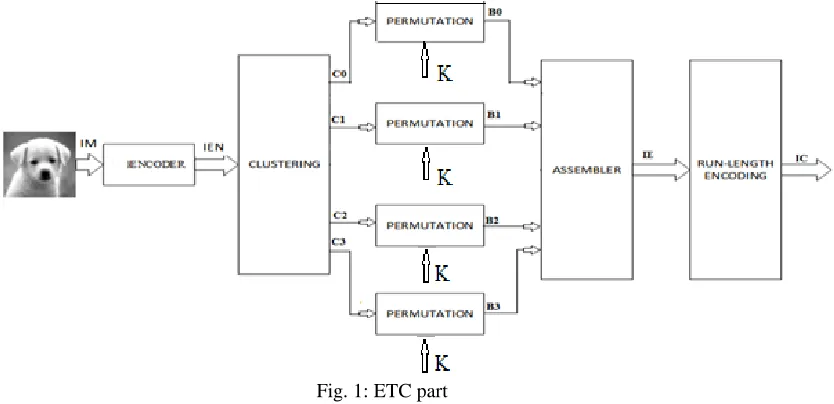
The aim of this study is the design and simulation of an image encryption then compression system for the purpose of secure image transmission. This includes the design of an image encryption then compression (ETC) part and an image decompression then decryption (DTD) part
.
Fig. 1: ETC part
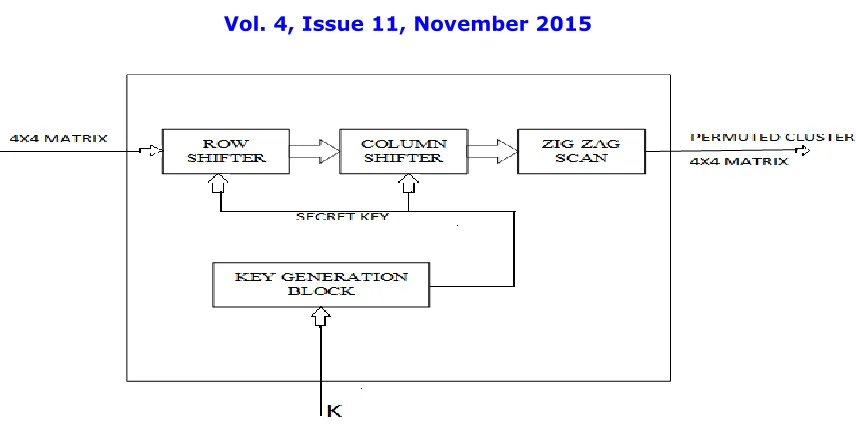
Fig .2: Permutation block
Then each of these 4x4 clusters is given to the permutation block(fig.2) with a key K. Inside the permutation block the key is converted into a secret key by a key generation block. Input 4x4 clusters is row shifted and column shifted using the same secret key. This shifted output is again scanned using a zig- zag scanner for increasing the encryption efficiency. The permuted clusters B0, B1, B2, B3 are given to an assembler block for combining four 4x4 matrix into an encrypted 8x8 image IE.
Fig. 3: Key Generation Block
Encryption is performed by encoding, clustering, shifting and scanning and also the key used for encryption is a secret key and is generated by the diagram shown in fig.3.so the encryption can be performed efficiently.
ISSN (Print) : 2320-3765 ISSN (Online): 2278-8875
I
nternational
J
ournal of
A
dvanced
R
esearch in
E
lectrical,
E
lectronics and
I
nstrumentation
E
ngineering
(An ISO 3297: 2007 Certified Organization) Vol. 4, Issue 11, November 2015
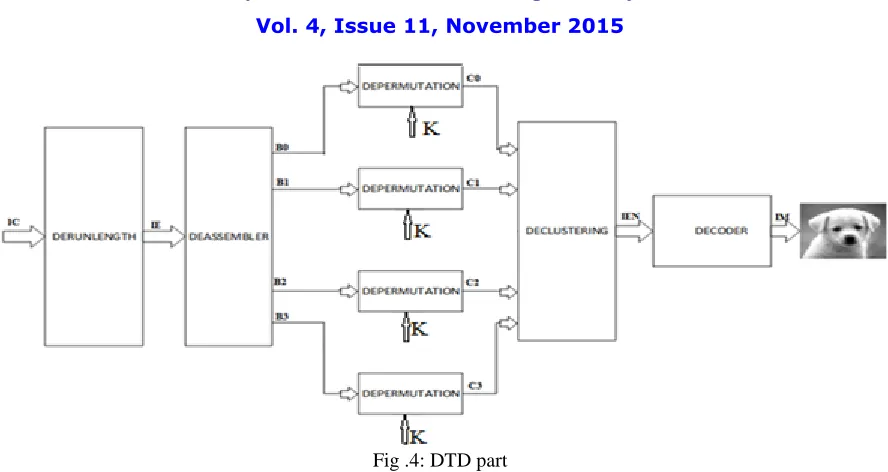
Fig .4: DTD part
At the receiver decompression then decryption part(fig.4) will recreate the original image from the encrypted and compressed image. Decryption is the reverse process of encryption and decompression is the reverse process of compression. Received encrypted and compressed image IC is first passed through the de-run-length block to perform decompression operation to get the decrypted image IE. This IE is then given to a de-assembler block , here the 8x8 encrypted image IE is divided into four clusters of 4x4 matrixes B0, B1, B2, B3. Each cluster is then given to a de-permutation block with the key K. Inside the de-de-permutation block reverse de-permutation takes place i.e. , column shift is done before the row shift using the secret key ,and then the output is scanned in a zigzag manner.C0,C1,C2,C3 will be the output from each block. These four 4x4 clusters are combined to form an 8x8 IEN inside the next de-clustering block.IEN is then passed to a decoder block to get the original image IM.
Fig. 5: Decoder block
Inside the decoder block (fig.5) the original image is reconstructed by modified matrix multiplication. The recreated IEN is multiplied with a H matrix to get the image IM. Here multiplication is done by a Vedic multiplier and addition by exoring.IM is the transmitted image and it can be recreated with original quality by this system.
V. SIMULATION RESULT
Fig .6: Simulation of ETC part
Compressed pixel values are the output from ETC part and the result is shown in fig .6. The run length output contains the runs and lengths. Run is the pixel value and length is the no of times the value repeating. This IC is the input of DTD part where original image is reconstructed from the encrypted and compressed image.
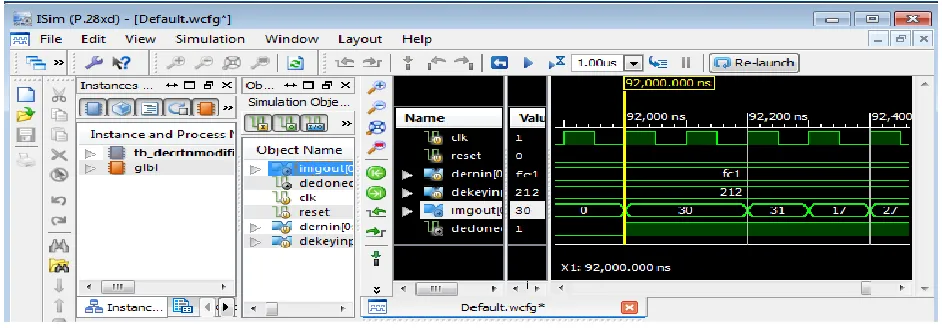
Fig .7: Simulation of DTD part
The simulation result of DTD part is shown in figure 7.Input to the DTD part is the output from the ETC part and the 8 bit key .DTD part first performs the decompression operation using the de- runlength algorithm. This decompressed output is then decrypted to recreate the original pixel values.
V.CONCLUSION
ISSN (Print) : 2320-3765 ISSN (Online): 2278-8875
I
nternational
J
ournal of
A
dvanced
R
esearch in
E
lectrical,
E
lectronics and
I
nstrumentation
E
ngineering
(An ISO 3297: 2007 Certified Organization) Vol. 4, Issue 11, November 2015
values and is based on a permutation operation. Highly efficient compression of the encrypted data has then been realized by a RLE The image decompression then decryption (DTD) part will recreate the original image from encrypted and compressed image with original quality
.
This work offers that reasonably high level of security, requires less time for computation, reduced device size and can be used in applications such as medical imaging ,military applications, legal documentation etc.REFERENCES
[1] X. Wu and N. Memon, “Context-based adaptive lossless image codec” ,IEEE Trans. Commun., vol. 45, no.4,pp. 437–444, Apr. 1997. [2] M. Johnson, P. Ishwar, V.M. Prabhakaran, D. Schonberg, and K. Ramchandran, “On compressing encrypted data”, IEEE Trans.
Signal Process., vol. 52, no. 10, pp. 2992–3006, Oct.2004.
[3] D. Schonberg, S. C. Draper, C. Yeo, and K. Ramchandran, “Towards compression of encrypted images and video sequences”, IEEE Trans.Inf. Forensics Security, vol. 3, no. 4, pp. 749–762, Dec. 2008.
[4] Jiantao Zhou, Xianming Liu, Oscar C. Au and Yuan Yan Tang, “Designing an Efficient Image Encryption-Then-Compression System via Prediction Error Clustering and Random Permutation”, IEEE Transactions on information forensics and security, vol. 9, no.1, january 2014. [5] R. Lazzeretti and M.Barni, “Lossless compression of encrypted grey level and color images”, in Proc. 16th Eur. Signal Process.Conf., pp. 1–
525,Aug. 2008 .
[6] J. Zhou, X. Liu, and O. C. Au, “On the design of an efficient encryption- then-compression system”, in Proc. ICASSP, pp. 2872–2876, 2013. [7] R. Lazzeretti and M. Barni, “Lossless compression of encrypted grey- level and color images”, in Proc. 16th Eur. Signal Process. Conf, pp. 1–5,
Aug.2008.