IMPLEMENTATION OF DEVOLUTION AS A SYSTEM OF GOVERNANCE IN KENYA: A CASE OF KAJIADO COUNTY
SINKEET JOHN SOLONKA
A RESEARCH PROJECT SUBMITTED TO THE SCHOOL OF HUMANITIES AND SOCIAL SCIENCES IN PARTIAL FULFILMENT OF THE REQUIREMENTS FOR
THE AWARD OF THE DEGREE OF MASTER OF PUBLIC POLICY AND ADMINISTRATION OF KENY ATTA UNIVERSITY
DECLARATION
This proposal is my original work and has not been presented for a degree in any other university
Signature
Name: John Sinkeet Solonka C153/CTY IPT/21 00112012
Supervisors:
This proposal has been submitted for the review with our approval as University supervisors.
Signature
Prof. David Minja
Department of Public Policy and Administration
Signature
_c_~-""L.
__
*~~_
Date-l-.---T--'\'--\
-=-\2Jb_-'-S_---_
Dr. Martm AtelaABSTRACT
ACKNOWLEDGEMENT
DEDICATION
TABLE OF CONTENTS
DECLARATION .I
ABSTRACT .11
ACKNOWLEDGEMENT 111
ABBREVlA TIONS AND ACRONYMS VIII
LIST OF TABLES .IX
LIST OF FIGURES X
DEFINITION OF TERMS XI
1.0 INTRODUCTION
1.1 Background of the study 1
1.1.2 Overview of devolution in Kenya 3
1.2 Statement of the problem : .4
1.3 Objectives of the study 6
1.4 Research questions 6
1.5 Assumptions 7
1.6 ~ignificance of the Study 7
1.7 Scope and limitation of the study 7
2.0 LITERATURE REVIEW AND THEORETICAL/CONCEPTUAL FRAMEWORK
2.1 introduction 9
2.2 Decentralization theory 9
2.2.1 Devolved governance .11
2.2.2 Challenge of human reso~rces capacity in the implementation of devolution 12
2.2.4 Challenge of strategic management of devolved resources 16
2.2.5 The challenge of accountability in the implementation of devolution .18
2.3 Conceptual framework 23
2.4 Summary and research gap 25
3.0 RESEARCH METHODOLOGY
3.1 Introduction 28
3.2 Site of the study 28
3.3 Target population 28
3.4 Sample size and sampling techniques 29
3.5 Research instruments 29
3.6 Validity and reliability ofthe research instrument 29
3.6.1 Validity of the research instrument 29
3.6.2 Reliability of the research instrument .30
3.7 Data collection procedure 30
3.8 Data analysis and procedure .30
3.9 Data management and ethical considerations 31
I'
4.0 DATA ANALYSIS AND INTERPRETATION OF RESULTS 32
4.1 Introduction 32
4.2 Presentation of findings 32
4.2.1 Response rate 32
4.2.2 Performance indicators of devolved system of governance 33
4.2.3 Human resource capacity : 34
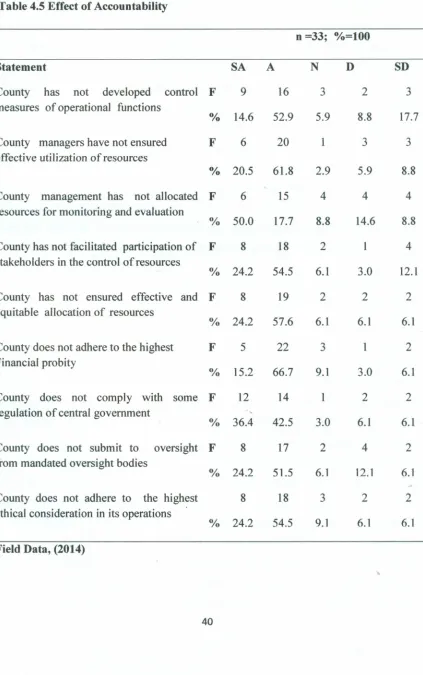
4.2.5 Accountability 38
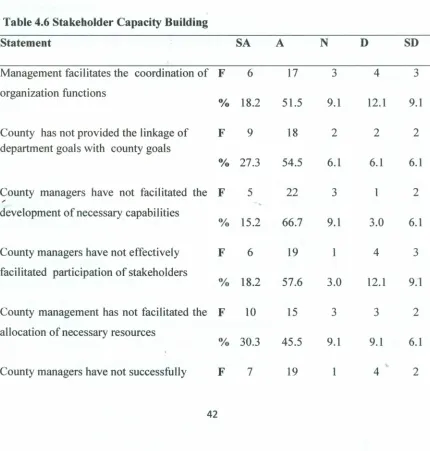
4.2.6 Stakeholder capacity building .42
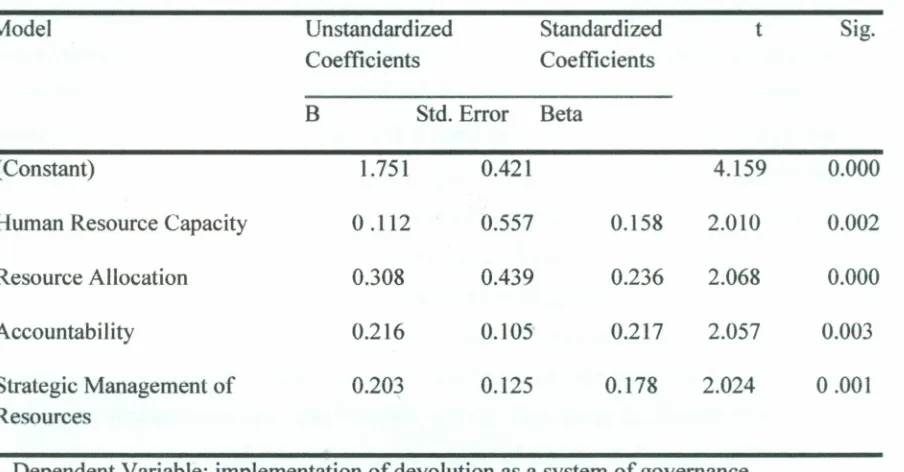
4.2.7 Test of significance 44
4.3 Summary of the chapter 48
5.0 SUMMARY OF FINDINGS, CONCLUSIONS AND RECOMMENDATIONS ...49
5.1 Introduction 49
5.2 Summary of findings 49
5.3 Discussion of the study 51
5.4 Conclusion of the study 52
5.5 Recommendation for policy 54
5.6 Suggestion for further research 54
REFERENCES 56
APPENDICES 59
AI: Study area 59
CRA
GoK
ILO
MCAs
ABBREVIATIONS AND ACRONYMS
Commission on Revenue Allocation
Government of Kenya
International Labor Organization
LIST OF TABLES
Table 4.1 : Response Rate
Table 4.2 Performance Indicators
Table 4.3 Human Resource Capacity
Table 4.4 Effect of Resource Allocation
Table 4.5 Effect of Accountability
Table 4.6 Stakeholder Capacity Building
Table 4.7 ANOVA
Table 4.8. Model Summary
Figure 2.1 Figure 2.4
LIST OF FIGURES
Theoretical Framework
Decentralization
Devolution
Government
DEFINITION OF OPERATIONAL TERMS
A process through which powers; functions, responsibilities and resources
are transferred from central to local Governments and/or to other
decentralized entities (Kauzya, 2005).
Devolution is defined as transfer or allocation of authority from a central
government to regional governments or particular interests (East Africa
Centre for Law and Justice, 2011).
Refers to the set of political systems and institutions that make up the
organization of a specific government. States are served by a continuous
CHAPTER ONE: INTRODUCTION TO THE STUDY
1.1 Background to the Study
Devolution involves the transfer of functions, resources and power to sub-national levels.
These levels, for example local Government assumes full responsibility and accountability for the specified functions (Omari, Kaburi & Sewe. 2012). Devolved
governance contributes positively to the processes of citizen participation and
management which is effective, responsive and accountable to the stakeholders. This is because devolved governance policies enable citizens to take part in the decisions that affect their livelihoods, allows experimentation and innovation and has better response to
citizen preferences, and county government control enhances policy making (Winchester
& Storey, 2008). Among the more prominent arguments for devolved system of
governance is the issue of efficiency: devolved governance is more than ever regarded as a means of achieving greater efficiency in a globalized environment (O'Brien, Pike &
Tomaney, 2003). The greater the degree of autonomy, the stronger the scope for enhanced efficiency in public spending leads to efficient public service delivery (Winchester & Storey, 2008).
According to Osburne and Gables (1992) equalization of resources and efficiency through devolution' argument has been at the heart of most devolution proponents discourses. In fact Ronald Reagan resorted to it in his 'new federalism' initiative as a way to justify transfers of powers to the states (Staeheli, Janet & Collin, 1997). This
I' ,
argument can be justified by various devolved systems; for instance Los Angeles County
comprises of 88 cities within the state of California. This county has succeeded through federalism and has had various benefits which has led to development of complex rail roads in the country that helped to open up areas as nurture entrepreneurship development of the Hollywood film industry (Donahue 1997). The Northern Italian
greater economic efficiency of devolution as the main justification of a possible
devolution to the English regions (Morgan 2002).
South Africa has a devolved system of government having regional governments headed
by a premier. The national government retains supervisory and oversight roles. It is
considered the economic hub of South Africa which contributes heavily in the financial,
manufacturing, transport and telecommunication. Nigeria runs a federal system divided
into thirty regional states headed by executive governors, regional assemblies and
government. This country has had many governments and coups inspired by unequal use
of their natural resources (Linder 1990). Among the most notable successful devolution
initiatives are the United States of America, with two centuries of experience, and India,
with 60 years' experience, the Ethiopian constitution of 1994, which has a provision for
secession that only its former province of Eritrea ever exploited. Among the most notable
global devolution failures is that of the former Union of Soviet Socialist Republics where
the 1980s political liberalization (glasnost and perestroika) opened a Pandora's box of
ethnic grievances, resulting in the breakup of the union first into 13 separate countries,
some of which subsequently divided up further (O'Brien, Pike &Tomaney, 2003).
The Kenyan constitution 2010 opened a new window of change of moving from the
central governance to the devolved government. The Government thereafter committed
itself to rapid transfer of devolved functions to the counties. This position marked by an
allocation of funding to counties and phased transfer of functions. Now devolved
governments are in charge of the new local administrations to oversee functions such as
agriculture, health facilities, sanitation, transport and trade licences, as well as the
responsibility to generate revenue for the county. The national government remains in
charge of education, security, foreign policy, and national economic policy and planning
(Omari, Kaburi & Sewe, 2012).
The devolved system of governance faces a number of challenges such as : the governors
having overarching responsibilities across sectors as a consequence of transfer of
functions from the national government implying that they should rely on dedicated
functions and accompanying powers for now because of the scarcity of trained and
experienced manpower to adequately cater for the 47 counties. A rushed transition could
set up counties to fail by giving them responsibilities before they have the capacity to
carry them out as counties start from very different positions
The devolved system has pushed the need for rational resource allocation down through
the administrative chain to the point at which services are delivered. This has forced
managers at every level to focus on best way to allocate these resources to the various
functions, projects and administrative units within the counties. The allocations of
resources need to take into consideration government's objectives, to prudently manage
the risks and to become more responsive to the requirements of the recipients of their
services (Mwenda, 2010). Given the dynamic environment, competitiveness, resource
constraints and the bureaucratic process characteristic of most county governments,
leaders are constrained to manage county resources strategically by focusing to the future
at the same time linking the institution to its environment. This implies that county
managers go beyond performance of routine management tasks and consider in a
systematic way a long- term county vision, government institution, resources and the
environment over a long period (De Toni & Tonchia, 2003)
1.1.2 Overview of Devolution in Kenya
On March 4, a significant control and executive decision-making was devolved to local
administrations. The challenge then was on the ability of the devolved structure to stem
I'
the country's widening inequalities, the provision or education, health, infrastructure,
water and other crucial services, across the counties as well as to fight poverty (Omari,
Kaburi & Sewe, 2012). A report by the World Bank (2012) showed that Kenya's poverty
levels have oscillated between 44 and 46 per cent over the past six years. However, this
represents an improvement from 12 years ago when the poverty level stood at 56 per cent
before falling to 46 per cent in 2005. Experts warned it will take time for Kenyans to
understand how the new government will work, and without skillful management both at
national and county levels, the central promise of the country's new Constitution could
Kenya's devolution project is particularly ambitious as it is one of few in the world that
shifts power from the centre to entirely new local administrations set up from scratch.
Previously, the country was divided into eight provinces and over 100 districts, but
executive power was largely vested in the central government headquartered in Nairobi.
Now, 47 governors with their respective county assemblies will be in charge of the new
local administrations to oversee functions such as agriculture, health facilities, sanitation,
transport and trade licences, as well as the responsibility to generate revenue for the
county likely to be in the form of various taxes (Mwenda, 20 lOa). The national
government remains in charge of education, security, foreign policy, and national
economic policy and planning (Mwenda, 2010).
The Commission on Revenue Allocation (CRA) has drafted a formula of sharing funds
under the Equalisation Fund provided for in the Constitution to boost development in
marginalised areas. A schedule CRA released on February 29 showed less than a third of
the 47 counties will benefit from the Ksh3 billion ($35.29 million) Equalisation Fund with Turkana taking the largest share in the next three years. CRA said it considered its
own internal survey of how counties were marginalised, came up with a County
Development Index and analysed historical injustices to arrive at the 14 counties that
would draw from the fund (Omari, Kaburi &Sewe, 2012).
1.2 Statement of the Problem
The recent wave of devolutionary initiatives across the world has been in part fueled by
I' ••.
an important change in the devolutionist discourse. Whilst the traditional discourse
heavily relied on issues of national or regional identity, such as ethnicity, language,
religion, culture, or history, the 'new regionalism' is increasingly based on functional
demands (Tomaney 2002). Devolution is more than ever regarded as a means of
achieving greater efficiency in a globalized environment hence the greater the degree of
autonomy, the stronger the scope for enhanced efficiency and performance. devolution
and the decentralization is not only seen as a way to preserve and promote regional
to the growing perception that devolution brings about an 'economic dividend' (Morgan
2002).
Counties in Kenya now face a challenge in capacity building, accountability, resource
mobilization and utilization and even where the resources are available allocation has
proved to be critical (Omari, et al, 2012). Hence there have been poor resource allocation
decisions with much of the resources being wasted or remaining unutilized (Mwenda,
201Oa). Unfortunately county institutions have been slower to respond. This is due to the
financial constraints and the bureaucratic process characteristic of most of these
institutions. However, a new approach, which incorporates strategic allocation of
resources, is necessary for most of these county government institution may it be at so as
to achieve improved performance and overall service quality. Metter (2000), Soss,
Schrame, Vanitarian and
a
Brian (2001) and Winston (2002) also contend that little iscurrently known about ramification of the devolution of policy making power by an
upper level of government (authorizes) to a lower level of government (The recipient).
This problem is even worse because there is little that is known particularly with regard
to second order devolution (The transfer of power from the county government to sub
country and other lower levels Kipkorir (2009).
A number of authors have discussed devolved system of government, for instance
Rodriguez-Pose and Bwire (2003) assesses the horizontal link between devolution and
regional economic growth in six national contexts and established that contrary to the
expectations of devolutionists, the degree of devolution is in most cases irrelevant for
economic growth and, when it matters it is linked to lower rather than greater economic
efficiency. While Omari, Kaburi and Sewe (2012) focused on structural adjustment
through devolution in Kenya and found out that that in most government departments'
officers were not aware of how to approach the change that has been as a result of
devolution. Najeebullah and Kundi (2011) sought to establish the relationship between
devolution and political accountability and established that citizen's participation in
election is unequivocally greater after devolution and the transparency level of the system
is not up to the mark. Although much has been written about devolution, less has been
especially on the challenges currently facing devolved system of governance. It is
within this context that this study seeks to investigate the challenges facing the
implementation of devolution as a system of governance in Kenya.
1.3 Objectives of the Study
The main purpose of this study is to investigate challenges facing the implementation of
devolution as a system of governance in Kenya. A case of Kajiado County
1.3.1 Specific Objectives
The following specific objectives will guide the study
i) To investigate the challenge of human resources capacity on the devolved system of
Governance in Kaj iado County
ii) To investigate the challenge of resource allocation on the devolved system of
Governance in Kajiado County
iii) To explore the challenge of accountability on the devolved system of Governance in
Kajiado County
iv) To identify the challenge of strategic management of resources in the devolved
system of Governance in Kaj iado County
1.4 Research Questions
i) What are the effects of the challenge of human resources capacity on the devolved
I'
system of Governance in Kajiado County?
ii) To what extend does resource allocation challenge affect devolved system of
Governance in Kaj iado County?
iii) How does accountability challenge affect devolved system of Governance In
Kaj iado County?
iv) How does the challenge of strategic management of resources affect the devolved
1.5 Assumptions
i) The study assumes that the implementation of the devolution will continue to in
the country
ii) The study assumes that the study respondents will answer questions in the study
instrument honestly, however anonymity and confidentiality of the study
participants will be preserved and that the respondents may withdraw from the
study at any time and with no ramifications.
1.6 Significance of the Study
The findings of this study would be of benefit to Kajiado County leaders as it will be able
to indicate the challenges facing the county and facilitate them to take necessary action to
address the challenges facing the count. The study will also be of value to other counties
as they will be able to identify the challenges that are affecting the smooth
implementation of devolved governance in their respective counties and take appropriate
action aimed at ensuring the smooth implementation of devolved system of governance.
The study findings will be of importance to central government as it will furnish it with
crucial information that can lead to formulation of policies, rules, regulations and goals to
facilitate the implementation of devolved system of governance. The study will make
theoretical, practical and methodological contributions aimed at extending existing
knowledge in strategic management. Academia and business researchers may also
borrow from the findings of this research to support literary citations as well as develop
themes for further research.
1. 7 Scope and Limitation of the Study
The study was limited to investigating the challenges facing the implementation of
devolution as a system of governance in Kenya with particular reference to Kajiado
County. The geographical scope of the study will be limited to Kajiado County. The
allocation, accountability and strategic management of county resources. The research
CHAPTER TWO: LITERATURE REVIEW
2.1 Introduction
In this chapter, literature, which is related to and consistent with the objectives of the study, is reviewed. Important theoretical and practical problems are brought out; relevant
literature on the aspects pertaining to the challenges facing the implementation of devolution as a system of governance in Kenya.
2.2 Decentralization Theory
Decentralization theory will underpin the study as they are relevant and provide the
background to the study variables and aspects related to and to be addressed by the study especially the challenges affecting the devolved system of Governance in Kenya.
Devolution is understood from the broader concept of decentralization. Decentralization
Theory relies on Richard Musgrave's (1959), Wallace Oates (1972) notion on "Fiscal
federalism" which contends that the Central Government should have the basic responsibility for the macroeconomic stabilization function and income redistribution in the form of assistance to the poor. According to Musgrave, there are three economic functions that should be assigned to the Government: stabilization, distribution and allocation (1989). In public finance theory, the stabilization function is assigned to the
Central Government.
According to Oates (1991), the distribution task should be the responsibility ofthe central
or sub-central levels of Government. Furthermore, allocation function, the provision of public goods and services is best placed with local Government organs. Oates (1991) formulated the decentralization theorem which confirms the inefficiency of uniform service provision by central Government. He argues that if there are no economies of
preferences and circumstances of their constituencies, decentralized provision increases
economic welfare above that which results from the more uniform level of such services
that are likely under national provision.
From the foregoing, decentralization is regarded as a process through which powers;
functions, responsibilities and resources are transferred from central to local
Governments and/or to other decentralized entities (Kauzya, 2005). It is a mechanism for
bringing Government closer to the governed and helps to improve public administration
by empowering counties to be the planning and decision-making bodies and thereby
enhancing the capacity of Government to achieve local participation
Organizational theorists such as Rondinelli (1981) and Faltas (1982) view devolution as
decentralization and describe the decentralization model as an administrative design
which serves to achieve the goals and objectives of the organisation. Devolution is thus
conceptualized as a means to attain particular ends. Rondinelli (1981) argues that as an
administrative strategy, devolution is best viewed as the extension of the arms of central
authorities, through which the centre establishes the administrative field units at the locus
of action. However such practice only deconcentrates administrative responsibilities and
thus continues to maintain centralised decision-making power. The institution of
administrative units and officers only serves to implement at the provincial and local
(village) levels policy-decisions which are made by authorities and officers at the central
level. Rondinelli (1981) further contends that the decentralization model thus implies
,. ...
that legislative and legal powers belong to the central authorities; and that these powers
could only be delegated to provincial authorities which are mainly either autonomous or
semi-autonomous bodies. It suggests that these powers could only be exercised in line
with the policies, procedures and general guidelines as laid down by the national
authorities and their agencies.
In contrast, the social democratic model demands a real shift in power to the people in the
making of the decisions that affect their lives. The social democratic view is based on
recognition of the potential for cooperation all human beings have (Rizvi, 1993). The
people to engage in the processes of decision-making. It suggests that new structures of
participation are needed to give people the power to have a real say in the matters that
affect their lives. Devolution is thus assumed to be necessary to ensure the creation of
caring participatory communities based on democratic values, and social relationships
that are personal and reciprocal (Rizvi, 1993).
The market view of devolution is about the rights, protection and security, of individuals.
It is based on the assumption that the notion of the individual person is of paramount
importance. This model (Chubb & Moe, 1990) advocates the right of individuals to make
decisions about issues which affect their lives. It is thought that individuals know best
what they want and therefore should decide their own destiny without, or with limited
interference from, the State. Individuals are responsible tor controlling their lives and
accountable for their own actions. This is because there is so much bureaucratic red-tape
and dominance by the bureaucracy which has limited individuals' choices and
participation in decision-making
2.2.1 Devolved Governance
The shift from centralized regulation to decentralized system of Governance is a defining
event in Kenya governance system. Devolved governance compels managers to move
from a passive compliance mentality to an active management mentality. The contractual
emphasis in the devolution model pushes the need for intelligent decisions on resource
allocation down through the administrative chain to the point at which services are
I' ,
delivered (Mwenda, 2010). This forces managers at every level to focus on the
Government's objectives, to manage the risks to those and to become more responsive to
the requirements of the recipients of their services. Freedom of information legislation,
introduced prior to the reforms, was instrumental in changing attitudes to the value of
information, and in improving the volume and quality of information about government.
Decisions at all levels are now based on better information, better budgeting processes
and a longer time frame (Mulwa, & Wekhuyi, 2010).
The process of clarifying objectives and then demanding good quality information on
around resource allocation, notably during a period in which government is being
reduced in size. However, there are limits to the gains to be had through specification and
monitoring. While the devolution reforms made government more manageable, they did
not in themselves ensure that decisions affecting the longer-run interests of government
as a whole were properly balanced against the particular interests of the component parts
(World Bank 2012). The devolved management system tends to obscure the fact that
government is a single enterprise, which should be unified around commonalties of
purpose, behaviour, management standards and reputation. The trigger for a strategic
approach to managing government is the realisation that effective public governance now
requires the capacity to design and execute long-term solutions to complex problems,
often with fuzzy boundaries and both international and inter-generational consequences
(Me Cathy et al ,2010)
2.2.2 Challenge of Human Resources Capacity in the Implementation of Devolution
Devolution is hinged on the desire for locals to set their own economic, political and
social agenda and to move away from the bureaucratic processes of the Central
governments. However the success of this depends on the various key functions of
Human resource management namely training and development, performance
management, recruitment and selection, change management and human resource
planning (World Bank, 2012). Indeed training and development has a direct relationship
with effectiveness of the devolution of counties in Kenya. When the county Executive
I' ,
and Assembly are well trained and thoroughly developed they will deliver the agenda of
their respective County Governments and hence there exists this kind of relationship
(Mulwa &Wekhuyi, 2010).
However, counties have less professional cadres as compared to support staff at a ratio of
one professional to four support staff at best (O'Brien, Pike & Tomaney, 2003).
Notwithstanding, attitudinal challenges among staff, counties have un-standardized
remuneration policies, lack of training opportunities ,performance management
mechanisms among others which hinder effective human resources performance at the
of staff rationalization and redeployment so as to reduce overlap and redundancy at the county. Level is necessary in order to attain lean public services characterized by the ability to deliver in an efficient and effective manner. Counties must therefore adopt performance management systems by which standards are established and recognized,
outcomes and performance are measured and reward schemes institutionalized. They should further create conducive environment that would encourage entrepreneurship and investment through creativity and innovation in order to increase economic out-put and create more jobs within the counties (Mulwa & Wekhuyi, 2010).
Every members of the County Government requires to be subjected to a performance Management process to establish how well they are achieving their pre-set performance standards and it's through this only that the County governments can hold their employees accountable and question their preparedness in delivering on their key
performance indicators hence there is a relationship between performance management and devolution (Mwenda, 201Oa). For the County governments to have it right and deliver their agenda they need to have in place the right people at the beginning and ensure its staff are employed based on their various competencies and not any other considerations if the devolution train has to reach its destination. To effectively run the
Counties there is need to have very clear human resource policies that are also in line with the various labour legislations, ILO standards and Kenyan Constitution for the success of the devolution (Omari, Kaburi, & Sewe, 2012).
failure to perform. If the recruitment process is wrong then there becomes a big problem
in managing them daily to make them have any contribution. (Mwenda, 2010).
Hiring of County staff should be clear, transparent and meritorious and issues of
nepotism, tribalism and other considerations during the recruitment and selection process
should be avoided. A fully empowered Human Resource Department is necessary to
ensure the people management are done competently and the delinking of the political
wing of the management of the Counties from the Human Resource Department. Have in
place Clear and simple Human resource Policies and procedures to handle the issues of
Human resources and this will ensure efficiency, fairness and industrial harmony. The
policies should govern the recruitment and selection of staff, Training and development,
Remuneration, Employee relations among other human resource management issues
(Omari, Kaburi, & Sewe, 2012).
The Human resource management departments in the various counties should take a lead
in managing the change that is devolution. The county budgetary teams need to allocate a
big chunk of the budget in building the capacity of the people to carry out the affairs of
the counties rather than allocating bigger budgets to the purchasing of luxurious
limousines for the top county officials. Training and development needs to be
administered to every staff and a good allocation to this in the county budget are
necessary. Staff training must also focus on the roles of county government, relations
with the national government and the customer service in delivering services to the
county residents. (World Bank, 2012)
2.2.3 Challenge of Allocation of Resources and Implementation of Devolution
Resources include revenues, human resources, equipment, materials, and corporate
information. Resources consist of physical and virtual resources (Winchester & Storey, 2008). County government faces constraints over resources which further exacerbated by
uncertain environments in which they operate in. Hence this requires effective and
efficient allocation of the available resources. The complexity of finding an optimum
resource allocation is exponential in devolved governments. Since resource demand and
supply can be dynamic and uncertain, various strategies for resource allocation are
essential (World Bank, 2012). The request for resources is described through a set of parameters detailing the processing and needs. Provisioning satisfies the request by
mapping resources to physical ones. The physical resources are shared across multiple
requests through provisioning based on set criteria by devolved units (Staeheli, Janet &
Collin, 1997).
The process of clarifying objectives and then demanding good quality information on
their achievement illuminated what county leaders actually do and assisted decisions
around resource allocation (Staeheli, Janet & Collin, 1997). While the devolved system
of Governance made government more manageable, they did not in themselves ensure
that decisions affecting the longer-run interests of government as a whole are properly
balanced against the available resources. The devolved system tends to illuminate the fact
that government is a single enterprise, which should be unified around commonalties of
purpose, behaviour, management standards and reputation which are all determined by
efficient resource allocation (O'Brien, Pike &Tomaney, 2003).
The devolved system has pushed the need for rational resource allocation down through
the administrative chain to the point at which services are delivered. This has forced
managers at every level to focus on the Government's objectives, to prudently manage the
risks and to become more responsive to the requirements of the recipients of their
services (Mulwa & Wekhuyi, 2010). Kenya's devolution project is particularly ambitious
as it is one of few in the world that shifts power from the centre to entirely new local
administrations set up from scratch. Previously, the country was divided into eight
provinces and over 100 districts, but executive power was largely vested in the central
government. Now devolved governments are in charge of the new local administrations to oversee functions such as agriculture, health facilities, sanitation, transport and trade
licences, as well as the responsibility to generate revenue for the county. The national
government remains in charge of education, security, foreign policy, and national
Even though the devolved unit may possess reliable resources, it experiences challenges in allocating and managing resources dynamically across the most areas of the county. Devolved government units allocation of resources may lead to an under-provisioning of resources (Mulwa & Wekhuyi, 2010). To overcome the above mentioned discrepancies,
inputs needed from both allocators of resources and users for resource allocation strategies.
Devolved units may allocate and manage resources by optimizing some objective function such as minimizing cost function, cost performance function and meeting objectives (Coen & Maritan, 2010). The objective function is defined as utility resources which are selected based on measures of response time, number of targets met and profit (Poister, 2002a). Results-based approach, where it is first decided what should be done,
then cost implications and resource requirements to achieve the agreed objectives are derived (Poister, 2002b).
One of the resource allocation strategies in multi-cluster environment is policy based resource allocation. The most-fit policy allocates resources to clusters, which produces higher distribution, leading to the most number of immediate subsequent job allocations. Most-fit policy has higher time complexities but the time overheads are negligible compared to the system long time operation(Murphy & Paolo, 2007).There are some agencies that dynamically allocate resources to meet objectives by first allocating requests to high priority applications. Given the limited resources available to national,
I' ,
state, and local governments and agencies, policy- and decision-makers require a method for prioritizing the risks faced by society and selecting the most appropriate mitigation strategy. Prioritisation should also take into account the public sector's capability; in terms of both the financial and human resources at is disposal.
2.2.4 Challenge of Strategic Management of Devolved Resources
The general mood of the public has been that county managers must do more with less the situation that requires strategic thinking in order to 'reduce wastes (Bana & Shitindi,
of its corporate values, managerial capabilities, institutional responsibilities and operational decision making at all hierarchical levels and across all operational and
functional lines of authority while taking into consideration the internal and external
environmental factors (Wechsler & Berry, 2000). Referring to the US context, Berry
(2001) noted that widespread recession of the early 1990s precipitated the need to 'hold down the size of the government' thereby forcing political leaders to initiate public sector reform process that takes strategic management to its heart.
Managing strategically implies looking to the future as well as trying to link a county to
its environment (Bana & Shitindi, 2009)..As Hughes (2003) insists strategic management goes beyond routine management tasks and consider in a systematic way a long- term
county mission and vision. The use of strategic management is triggered by the desire to
control expenditure via enhanced efficiency, to set a clear mission and direction; a desire
to emulate good governance practice and fiscal discipline and the need resolve competing pressure to allocate resources (Berry 2001).
Strategic management consists of three interrelated component processes: Strategic
planning to determine institutional goals, objectives and implementation strategies,
Resources management to configure and allocate resources among competing functions
and needs and control and evaluation to ensure the implementation of the strategies are
in accordance to the set development and operational objectives (Stewart, 2004)
I' ,
The application of strategic management to devolution may increase the operational efficiency, service delivery and in the initiation and implementation of public projects rate by county governments (Winchester & Storey, 2008). On the basis of the information received through analysis of internal and external environment county
managers can making a maximum use ofthe available resources (Halachmi, 2000). By county managers involving officers and employees in strategic implementation it
becomes an important training process for them (Matheson, Scanlan &Tanner, 2004). By this there is a notable increase in efficiency of employees and they get inspiration to work
more, while county managers are able to identify the capability and weaknesses of
17
employees and resources so as to take the necessary steps to improve them, the
employees become more alert about their own performance and the county activity
(O'Brien, Pike &Tomaney, 2003) .
In devolved government, one of the greatest benefits arising from the adoption of a strategic approach to decision-making is the premium it places on identifying and
strengthening core competence. Government's essential competence lies in its ability to: make quality long-term decisions; create and distribute knowledge; implement decisions
effectively; and mediate amongst competing interests. Other benefits include: strategic co-ordination of function, better information sharing about the intentions and impact of
the county government, strategic alignment, commitment to collective interests, future capability and long-run cost effectiveness and cohesion within the county government
(De Toni &Tonchia, 2003).
In order to enhance strategic management the county governments need to focus on the
design of work practices management style; and the process for selection, socialization, and development of human capital (Bana & Shitindi, 2009). The institution structure needs to focus not only on the fit between the institutions and its environment, but also on the harmony among constituent design elements. The structure should be fluid and
flexible, creating an agile institution that is responsive to changes in the market and to
stakeholders' customers and employees. As companies gain equal access to capital and as many technologies mature and become widespread, institutions gain a competitive advantage primarily from their ability to deploy and leverage the efforts of the people in
the institution (Beryy, 2001).
2.2.5 The Challenge of Accountability in the Implementation of Devolution
Accountability is defined as holding agents to account for meeting standards and
these representatives are strongly downwardly accountable to the rest of the community
governance system of local government, focusing on four core principles: enhancing
local democracy; serving the customer better; developing efficiency; and providing
proper resources (Mwenda, 2010).
The government collectively, and individual ministers as heads of departments, hold a
pivotal position in terms of specifying the performance expected of government
departments, offices and agencies and in terms of reporting back on performance to the
respective constitutional mandate body. Within government departments, secretaries
general now have delegated responsibility for managing their departments, and they in
turn can assign specific responsibilities to managers at other levels. Heads of offices
similarly have delegated responsibilities. In return for this delegation, civil servants are
now more directly accountable for their actions. Thus while ministers must carry the ultimate political accountability for the actions of the civil and public service, secretaries
general and heads of offices now have specific accountability for the running of their
organisations. Below them, civil servants may have specified accountabilities associated
with their specific areas of responsibility
In order to enhance open and transparent governance, it is essential that there is a free
flow of information between Government and those it serves. An open culture with a free
flow of information between Government and citizen is essential if confidence is to be
maintained in the institutions of State. The county management must ensure
I' ,
implementation of fundamental business processes to provide access to timely,
comprehensive, in an agreed format, relevant and reliable financial and operational
(non-financial) information.
The accountability of public expenditure is a key plank in moving towards a more
responsive and publicly aware system of local government accountability. The visibility
of the use of public money is the primary manifestation of the decision making process
and prioritisation of local Councils, and should therefore be a priority for public release.
By releasing financial information into the public domain, Councils are arguably
likely to be a number of issues regarding data quality and depth. Translating technical
data into something which means something to local residents is also likely to be a
significant challenge, and both innovative technologies and better financial accounting
methods will begin to address some of these issues.
The visibility of political leadership and their decisions is also a key component of
political accountability. This lies at the heart of enhancing representative democracy, by
ensuring that local MCAs represent the wishes and demands placed on them by local
residents. Increased visibility, representing the concerns of local people and being seen to
make a difference are the most important factors which form the basis for increasing the
accountability of MCAs. This is something that MCAs themselves must address.
However, Councils can support MCAs through initiatives such as devolved ward
budgets, or through increased powers to committees, which many MCAs sit on.
The main concern about increased levels of public visibility of elected officials is that it
[can encourage voting and decision making behaviour based on purely populist grounds.
This populism can be fuelled by the national media and unwarranted concerns for, for
example, things like 'postcode lotteries'. There are also concerns that increased attention
on local MCAs would prevent people wanting to be MCAs, especially when the
remuneration for their work is often perceived as insufticient for the work that they do.
Public visibility at the local level could actually be seen as an opportunity to engage in a
dialogue with local residents about some of these entrenched views, and begin to question
I' ,
the current way of doing things. Ultimately this may begin to allow counties to do things
in different and more interesting ways.
There is a clear case to improve the level of accountability of local representatives over
anything from remuneration claims to their voting and attendance record. Again, there are
some questions about the level of data and bureaucracy, and there are also questions over
the applicability of a standard template between areas. The most sensible starting point is
for counties to begin to release all information relevant to the work of MCAs including
involving residents in the development of long term plans and visions can lead to greater
levels of political accountability. There are many ways in which counties can get their
residents more directly involved in the daily activities of their wards. This may involve
more traditional methods such as surveys and other more innovative methods such as
deliberative mapping, participatory appraisals, role plays, stakeholder decision analysis,
to mention just a few arguably, it is the issues which matter most to local people which
are likely to get more people interested in local affairs, and hence increase local
accountabil ity.
According to Melese et al. (2004) a key element of good governance is the requirement
for the management to achieve legal and ethical compliance. It's commonly
acknowledged that at the base of good governance is a predictable, equitable, effective,
and efficient legal system. However, the regulatory systems are uncoordinated, very
fragmented, and is spread under different legislation thus creating a lot of conflict and
overlaps in the management of the county. In addition the government regulatory
agencies are not well resourced to enforce the existing regulations; thus are lax in
enforcing laws, guidelines and standards that govern the quality of healthcare services in
the country. The sanctions for noncompliance to the existing laws, standards and
regulations are inadequate and not sufficiently deterrent to potential offenders. This
encourages contravention of the laws since the penal consequences are not stiff and there
is a high probability of evading punishment due to corruption within the enforcement
I' '
machinery (Mwenda, 2010). The sanctions for noncompliance to the existing laws,
standards and regulations are inadequate and not sufficiently deterrent to potential
offenders. This encourages contravention of the laws since the penal consequences are
not stiff and there is a high probability of evading punishment due to corruption within
the enforcement machinery.Thus, achieving complete compliance with the disclosure
mandates would be a herculean task within the counties (Omari, Kaburi & Sewe ,2012)
Effective and efficient management of public resources is an issue of concern in many
effectively. This means that public entities have to search for ways to improve on their
activities. Notable approaches include the use of performance contracts. Similarly,
activity based management practices can increase transparency and efficiency when
conducting government activities thereby assisting public entities achieve their objectives
(Baird,2007).
2.3Conceptual Framework
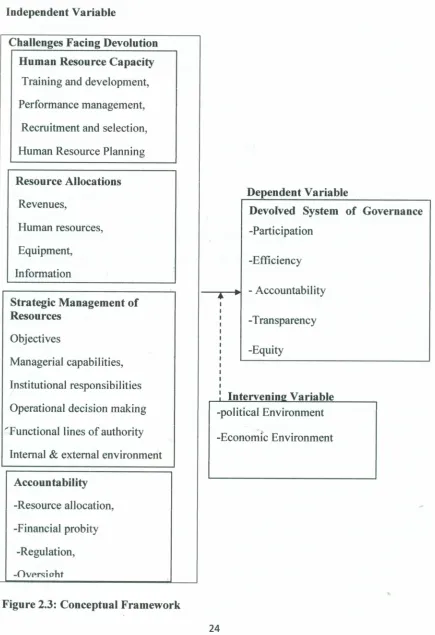
The decentralization theory and devolution model indicates the challenges affecting the
implementation of devolved system of governance. Based on the above theories the study
can be conceptualized in a framework explaining the relationship between the
independent variables (factors) which include, human resource capacity, resource
allocation, strategic management of devolved resources and accountability and how
devolved system of governance which is the dependent variables (outcomes) as shown in
Independent Variable
Challenges Facing Devolution
Human Resource Capacity
Training and development,
Performance management,
Recruitment and selection,
Human Resource Planning
Resource Allocations
Revenues,
Human resources,
Equipment,
Information
Strategic Management of Resources
Objectives
Managerial capabilities,
Institutional responsibilities
Operational decision making
"Functional lines of authority
Internal &external environment
Accountability
-Resource allocation,
-Financial probity
-Regulation,
Figure 2.3: Conceptual Framework
•
Dependent Variable
Devolved System of Governance
-Parti cipati on
-Efficiency
- Accountability
-Transparency
-Equity
Interveninz Variable -political Environment
2.4 Summary and Research Gap
The devolved system has pushed the need for intelligent decisions on resource allocation
down through the administrative chain to the point at which services are delivered. This
forced managers at every level to focus on the Government's objectives, to manage the
risks to those and to become more responsive to the requirements of the recipients of
their services. Freedom of information legislation, introduced prior to the reforms, was
instrumental in changing attitudes to the value of information, and in improving the
volume and quality of information about government. Decisions at all levels are now
based on better information, better budgeting processes and a longer time frame.
Keraro, Gakure, Katuse, Orwa and Cheluget (2014) examined the influence of
governance systems in resources development for the strategic management of the
devolved public sector in Kenya. The study adopted exploratory and descriptive research
design, which required in depth analysis on the role of governance systems in the
strategic management of counties in Kenya. The population of the study was the
forty-seven (47) counties in Kenya. Cluster and purposive sampling techniques were employed
in the study. A major result of the study was that resources endowments, both natural and
human play a significant and deterministic role of the level of economic growth
achievable by any government. Human resource capacity, in particular, has a direct and
significant impact on the strategic management of counties.
In his study Wamae (2014) examined the role of procurement function in enhancing
performance in devolved government .Therefore one'Of the key issues is to identify the
role of procurement function in enhancing performance in the newly formed county
governments the key factors namely, technology, staff competency, stakeholder influence
and government policy; that enhances this performance was presented. This study
adopted a descriptive survey design. A descriptive research design determines and reports
the way things are. The target population consisted of 800 staff working at the Machakos
county government offices. The study utilized 10% of the target population which was
selected using a stratified random sampling technique giving a sample size of 80
respondents. Regression models were used to examine the role of procurement function
jointly, the independent have a great positive influence on the performance in devolved
government.
The research study ofNajeebullah and Kundi (2011) sought to establish the relationship
between devolution and political accountability in District Dera Ismail Khan. It
examines the extent of political accountability through the gates of popular participation
in elections, level of transparency in decision making process and accessibility of general
public to public information at grass roots level. The main findings of this paper were two fold. First, citizen's participation in election especially in local body's election 2005 is
unequivocally greater after devolution; however the genuine voter choice is restricted by
the dominating elite class, especially in rural areas of the country where majority of the
people are uneducated and poor. Second, the transparency level of the system is not up to
the mark. The present devolution plan provides mechanisms of transparency by
declaring citizens' right to information thereby forcing the district government to display
public information but the present study reveals limited transparency regarding the
business of local governments.
Rodriguez-Pose and Bwire (2003) assesses the horizontal link between devolution and
regional economic growth in six national contexts and established that contrary to the
expectations of devolutionists, the degree of devolution is in most cases irrelevant for
economic growth and, when it matters it is linked to lower rather than greater economic
efficiency. While Omari, Kaburi and Sewe (2012) focused on structural adjustment
I' '
through devolution in Kenya and found out that that in most government departments'
officers were not aware of how to approach the change that has been as a result of
devolution. Although much has been written about devolution, less has been documented
on the many issues raised by the adoption of devolved system of governance especially
on the challenges currently facing devolved system of governance. Although much has
been written about devolution, less has been documented on the challenges currently
facing devolved system of governance. Hence this study seeks to investigate the
effects of applying strategic management to devolved system of Governance in Kenya
CHAPTER THREE: RESEARCH METHODOLOGY
3.1 Introduction
This section presents the different methods that the researcher will use to collect, analyze,
present and discuss the findings of the study. This includes details on the research
strategy, the different categories of respondents and how the data will be collected during
fieldwork. Also the ways through which the different data sets will be analyzed and
presented is discussed.
3.2 Site of the Study
Kajiado County is a county in the Rift Valley Province of Kenya. It has a Total
Population of 687,312; Households and covers an area of 19600 km2 (CBS, 1981). It is
roughly triangular, and is bordered by the Nairobi-Mombasa railway to the north-east, the
border with Tanzania to the south, and the western wall of the Rift Valley to the west.
The eastern boundary is formed by the Chyulu Range and western limit of Tsavo
National Park. Kajiado is divided into four ecozones: the Rift Valley, the upland Athi
Kapiti Plains, the Central Hills, and the Amboseli Plains (GoK, 2012).
Research Design
The study will use a descriptive survey approach in collecting data from the respondents.
Descriptive survey research portrays an accurate profile of persons, events, or account
of the characteristics, for example behaviour, opinions, abilities, beliefs, and knowledge
of a particular individual, situation or group (Bums and Grove 2003). The descriptive
survey method was preferred because it ensured complete description of the situation,
making sure that there is minimum bias in the collection of data (Kothari, 2008).
3.3 Target Population
Population is a group of people or objects from which the sample for statistical
measurement is going to be taken (Mugenda & Mugenda, 2003). The target population
will be drawn from the eighteen (18) department in Kajiado County and will consist
respondents as indicated by the population frame availed by Kajiado country human
resource department. The choice of the head of Departments and their deputies is hinged
on the fact that they hold the relevant information as they are directly in charge of County
operations hence have first-hand information on the challenges facing devolution
3.4 Sample size and Sampling techniques
Sampling technique is the procedure a researcher uses to gather people, places or things
to study (Orodho & Kombo, 2002). And in this case it refers to the procedure the
researcher uses to select the final sample to study.
The study will undertake census survey which will involve the use of the entire target
population of thirty six (36) respondents consisting of departmental heads and their
deputies as a sample. A census is attractive for small populations. Census eliminates
sampling error and provides data on all the individuals in the population (Kothari, 2003).
3.5 Research Instruments
The study will use questionnaires to collect primary data. Questionnaires to be used in
collecting data will consist of close ended questions. As an instrument of data collection
questionnaires are appropriate because they are easy to analyze, and are cost effective
(Streubert & Carpenter, 2003). The questionnaire will be used to capture data on
dependent variable (Devolved system of governance) and independent variables (human
resource capacity, resource allocation, accountability and strategic management of county
resources)
3.6 Validity and Reliability of the Research Instrument
3.6.1 Validity of the Research Instrument
Validity can generally be described as ''the extent to which the research findings
accurately reflect the phenomena under study (Munro, 2005). The validity of research
instruments determines the quality of data collected and hence that of the whole research
(Bartlett, Kotrlik & Higgins, 2001). The research instrument will be discussed with the
3.6.2 Reliability of the Research Instrument
Reliability is the ability of an instrument to measure something consistently and repeatedly (Munro, 2005). The research instrument will be pre-tested on seven respondents from Kajiado County who will not be included in the final sample. The questionnaires will be administered to the group and thereafter the feedback will be
obtained through debriefing them individually and comparing the results. The results of the pilot study will then be analysed using Cronbach alpha with a set lower limit of acceptability of Cronach alpha 0.6. From the responses, comments and results of the analysis, the entire questionnaire will be refined and improved to take care of the
observed shortcomings if any,
3.7 Data collection Procedure
The questionnaires will be self- administered and each respondent will receive the same
set of questions in exactly the same way. Self-administered method is preferred because
the potential anonymity of the respondent can lead to more truthful or valid responses, it
is inexpensive and allows the respondents to complete the questionnaire at a convenient time. A cover letter explaining the purpose of the study will be attached to the questionnaires.
3.8 Data Analysis and Procedure I'
Quantitative data, which will be collected using' closed ended questions in the questionnaires, will be chronologically arranged with respect to the questionnaire outline to ensure that the correct code is entered for the correct variable. Data cleaning will then be done and tabulated. The study will use descriptive statistics to analyze demographic characteristics of the respondents, while multiple linear regression analysis will be done so as to determine the relationship between independent and dependent variables with aid
Where; Y = Dependent Variable (Devolution as a System of Governance)
a = constant
bJ-4 = Regression Coefficients;
XI-4 = Independent Variable (Human Resource Capacity; X2 = Resource Allocation; X3
=Accountability;
X
,
= Strategic Management of County Resources)E= error term
For the purpose of communicative effectiveness to ultimate users, findings will be
presented using tabular representations.
3.9 Data Management and Ethical Considerations
Prior Informed consent will obtained from each respondent before the interview schedule
is dispatched. Confidentiality of information will also be assured to the respondents and
will be observed by ensuring that unauthorized persons will have no access to the data
collected. The respondents will be informed of the purpose of the study and letter of
CHAPTER FOUR
4.0 DATA ANALYSIS AND INTERPRETATION OF RESULTS
4.1 Introduction
This chapter presents the analysis of study findings on the challenges facing the
implementation of devolution as a system of governance in Kenya based on specific
objectives which included the effects of human resources capacity, resource allocation,
accountability and strategic management of resources on implementation of devolution as
a system of governance.
4.2 Presentation of the Findings
4.2.1 Response Rate
Out of the 36 issued questionnaires, 33 questionnaires representing 91.6% of the total
questionnaires distributed were returned fully completed, while 3 questionnaires were not
returned representing 8.4% of the total questions distributed to the respondents. It can be inferred that the response rate was good. According to Mugenda and Mugenda (2003) a
response rate of 70% and over is excellent for analysis and reporting on the opinion of the
entire population.
I'
Table 4.1: Response Rate
Response Frequency Percentage %
Filled in questionnaires 33 91.6
Unreturned questionnaires 3 8.4
4.2.2 Performance Indicators of Devolved System of Governance
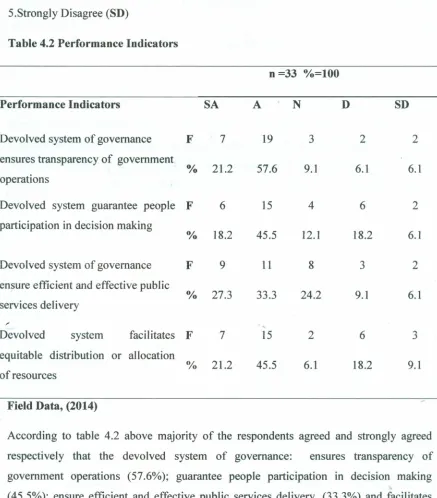
The study on table 4.2 below shows the personal opinions of the respondents regarding the following statements on the devolved system of governance based on the rating scale of 1-5, where 1- Strongly Agree (SA), 2- Agree (A), 3.NeutraJ (N), 4 Disagree (D) and 5.Strongly Disagree (SD)
Table 4.2 Performance Indicators
n~33 %=100
Performance Indicators SA A N D SD
Devolved system of governance F 7 19 3 2 2
ensures transparency of government
0/0 21.2 57.6 9.1 6.1 6.1
operations
Devolved system guarantee people F 6 15 4 6 2
participation in decision making
% 18.2 45.5 12.1 18.2 6.1
Devolved system of governance F 9 11 8 3 2
ensure efficient and effective public
0/0 27.3 33.3 24.2 9.1 6.1
services delivery
,
-Devolved system facilitates F 7 15 2 6 3
equitable distribution or allocation
% 21.2 45.5 6.1 18.2 9.1
of resources
Field Data, (2014)
According to table 4.2 above majority of the respondents agreed and strongly agreed respectively that the devolved system of governance: ensures transparency of government operations (57.6%); guarantee people participation in decision making
From the study, it can be concluded that devolved system of governance ensures
transparency of government operations; guarantee people participation in decision
making; ensure efficient and effective public services delivery and facilitates equitable distribution or allocation of resources. The findings agree with the views of Mwenda,
(2010) and Mboga (2009) that devolved system of governance pushes the need for
intelligent decisions on resource allocations down through the administrative chain to the point at which services are delivered and lead to efficient provision of effective and efficient services
4.2.3 Human Resource Capacity
Table 4.3 Human Resource Capacity
n =33; %=100
Statement SA A N D SD
County is faced by lack of Training and F 8 11 8 2 4
development opportunities for staff
0/0 24.2 33.3 24.2 6.1 12.1
County does not have effective mechanism F 8 17 2 4 2
to manage employees performance
0/0 24.2 51.5 6.1 12.1 6.1
County has a poor Recruitment and F 10 19 1 1 2
selection structures resulting
0/0 30.3 57.6 3.0 3.0 6.1
County does not undertake human F 7 18 3 2 3
resource planning
21.2 54.5 9.1 6.1 9.1
%
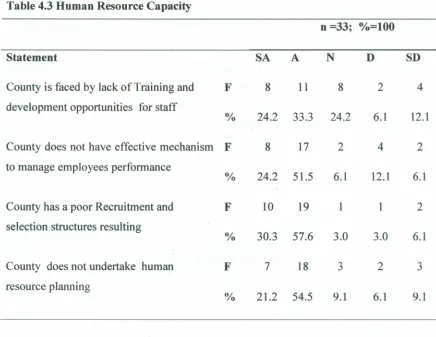
Study findings shown on table 4.3 above indicate that majority of the respondents agreed
and strongly agreed respectively that : the county is faced by lack of Training and
development opportunities for staff hence affecting governance (33.3%),; the county
I'
does not have effective mechanism to measure and manage employees
performance( 51.5%); the county has a poor recruitment and selection structures resulting
in the recruitment of unqualified staff (57.6%); the county does not undertake human
resource planning and at it ends up with skill and capacity gaps which affect the
smooth operation of county government(54.5%).
It can be deduced from the findings that the county is faced by lack of training and
development opportunities for staff which affect the implementation of devolution as a
system of governance; that the county has a poor recruitment and selection structures
resource planning ending up with skill and capacity gaps which affect the smooth
operation of county government; that the county does not have effective mechanism to
measure and manage employees' performance and this affect the implementation of
devolution as a system of governance. These findings are in line with the findings of
O'Brien, Pike,and Tomaney (2003) which established that counties have less professional
cadres as compared to support staff at a ratio of one professional to four support staff at
best, while Mwenda observes that lack of training opportunities , performance
management mechanisms among others hinder effective human resources performance
at the county levels
4.2.4 Resource Allocation
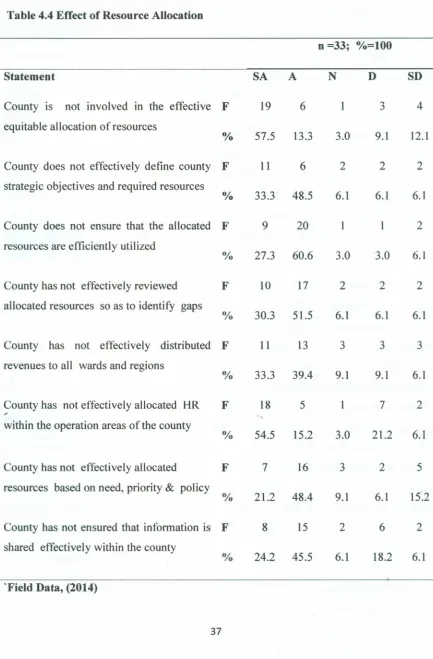
Resource allocation was the second objective of the study and consists of finance, human
resources, equipment, materials, and corporate information hence it was important to
establish whether resource allocation affects the implementation of devolved system of
governance. Thus Table 4.4 below sought to establish the effect of resource allocation
on the implementation of devolved system of governance based on the rating scale of 1-5,
where 1- Strongly Agree (SA), 2- Agree (A), 3.Neutral (N), 4 Disagree (D) and
5.Strongly Disagree (SD)
Table 4.4 Effect of Resource Allocation
n=33; %=100
Statement SA A N D SD
County is not involved in the effective F 19 6 1 3 4 equitable allocation of resources
0/0 57.5 13.3 3.0 9.1 12.1
County does not effectively define county F 11 6 2 2 2 strategic objectives and required resources
0/0 33.3 48.5 6.1 6.1 6.1
County does not ensure that the allocated F 9 20 1 1 2
resources are efficiently utilized
% 27.3 60.6 3.0 3.0 6.1 County has not effectively reviewed F 10 17 2 2 2 allocated resources so as to identify gaps
0/0 30.3 51.5 6.1 6.1 6.1
County has not effectively distributed F 11 13 3 3 3 revenues to all wards and regions
0/0 33.3 39.4 9.1 9.1 6.1
County has not effectively allocated HR F 18 5 1 7 2
I'
within the operation areas of the county
0/0 54.5 15.2 3.0 21.2 6.1
County has not effectively allocated F 7 16 3 2 5 resources based on need, priority & policy
0/0 21.2 48.4 9.1 6.1 15.2
County has not ensured that information is F 8 15 2 6 2 shared effectively within the county
0/0 24.2 45.5 6.1 18.2 6.1