ISSN (Print) : 2320 – 3765 ISSN (Online): 2278 – 8875
I
nternational
J
ournal of
A
dvanced
R
esearch in
E
lectrical,
E
lectronics and
I
nstrumentation
E
ngineering
(An ISO 3297: 2007 Certified Organization)
Website: www.ijareeie.com
Vol. 6, Issue 7, July 2017
Peak and Average Power Reduction in OFDM
System with Trellis Shaping Method
Pagidimarri Sindhu1, G. Krishnareddy2,
M.Tech. Wireless and Mobile Communication (WMC), Department of Electronics and Telematics Engineering, G.Narayanamma Institute of Technology and Science (For Women) Shaikpet, Hyderabad, Telangana State, India Associate Professor, Department of Electronics and Telematics Engineering, G.Narayanamma Institute of Technology and
Science (For Women) Shaikpet, Hyderabad, Telangana State, India
ABSTRACT: In a Wireless Communication medium, Frequencies are most important and the mode of Orthogonal Frequency Division Multiplexing [OFDM] is the major concern in this industry. The most important issue in this Orthogonal Frequency Division Multiplexing is the increasing of Peak-to-Average Power Ratio [PAPR] Signals. A new approach is required to reduce the Peak-to-Average Power Ratio Signals over the Orthogonal Frequency Division Multiplexing signals, called Trellis Shaping [TS]. Generally OFDM Signals are employed with Bit Interleaved Coded Modulation [BICM] to enhancing the reliability and performance of OFDM, which is used to attain robust operations over fading Channels. In the proposed approach, another BICM-OFDM framework is introduced, which is linked with TS for accomplishing great error/mistake performance/execution. An iterative delicate in–soft-out decoder for TS is produced at the final stage. Enhancement of the forming convolutional code as far as transmitter performance/execution is likewise talked about. The adequacy of our framework is illustrated through the investigation as far as normal shared data as well as Frame Error Rate [FER] over an added substance white Gaussian Noise/Commotion channel. Besides, the FER is assessed over a recurrence particular Rayleigh fading/blurring channel and contrasted and the hypothetical blackout likelihood. Instead of using data bits here with this approach High Data Rate Codes [HDRC] are considered to prove the performance and efficiency of OFDM. The experimental results comes about uncover that our framework can accomplish great frequency differing qualities impact over such a fading channel while getting a charge out of much lower PAPR.
KEYWORDS: Peak to Average Power Ratio [PAPR], Orthogonal Frequency Division Multiplexing [OFDM], Bit Interleaved Coded Modulation [BICM], Frame Error Rate [FER], Soft-In–Soft-Out [SISO].
I. INTRODUCTION
Orthogonal Frequency Division Multiplexing (OFDM) has been received in numerous wireless/remote interchanges measures because of its strength against frequency/recurrence particular fading/blurring channels and in addition its high unearthly effectiveness. The utilization of Cyclic Prefix (CP) wipes out the need of a convoluted equalizer at the collector to adjust for the Inter Symbol Interference (ISI) caused by the frequency/recurrence selectivity of wireless/remote channels.
ISSN (Print) : 2320 – 3765 ISSN (Online): 2278 – 8875
I
nternational
J
ournal of
A
dvanced
R
esearch in
E
lectrical,
E
lectronics and
I
nstrumentation
E
ngineering
(An ISO 3297: 2007 Certified Organization)
Website: www.ijareeie.com
Vol. 6, Issue 7, July 2017
As of late, in [2], [3], this signal move control capacity has been abused for the pinnacle control lessening of multi-bearer and OFDM frameworks. In this approach, we concentrate on the Trellis Shaping approach created in [3] for lessening the pinnacle control and the normal energy of OFDM signals. Different methods have been proposed for the PAPR lessening of OFDM motions in the writing, among which the Trellis Shaping [TS] based approach has a few notable points of interest: Unlike Clipping And Filtering (CAF) [4], [5] and companding [6], [7], it doesn't include nonlinear change, and not at all like Selected Mapping (SLM) [8], it does not require to transmit any side data. Additionally, not at all like the vast majority of different plans that make utilization of additional subcarriers [9] or, on the other hand present facilitated heavenly body bending [10]–[12], it neither devours extra transmission capacity nor expands normal control required only for top power lessening; truth be told, it can even diminish the normal power without yielding mistake performance /execution.
Fig.1 Proposed Block Diagram
As in numerous PAPR decrease conspires that include streamlining forms, one trying issue of the Trellis Shaping [TS] based approach is the computational overhead required for the pursuit of the codeword that outcomes in low PAPR at the transmitter, yet, it can be relieved by the lessened multifaceted nature approach grown likewise in [3]. Another issue is the manner by which to fuse channel coding into this Trellis Shaping [TS] system effectively, and this viewpoint is the primary concentration of this paper. Practically speaking, OFDM ought to be utilized with channel coding to enhance unwavering quality. In the event that channel coding is connected over subcarriers, OFDM can appreciate a frequency/recurrence assorted qualities impact gave by the frequency selective nature of wireless/remote channels.
With a specific end goal to abstain from giving up data transmission productivity related with channel coding, the utilization of coded regulation is fundamental, and Bit-Interleaved Coded Modulation (BICM) [13], [14] has been frequently embraced in the late benchmarks primarily because of its effortlessness of coding outline. In any case, connection of traditional Trellis Shaping [TS] with BICM may not be direct. The performance/execution of BICM depends on the measurements of the translating metric gave by the internal demodulator, and so as to accomplish limit moving toward performance/execution, the bit-wise metric as the Log Likelihood Ratio (LLR) is normally required. Shockingly, the traditional Trellis Shaping [TS] is intended to deliver hard choice yield and subsequently does not have a Shaping that gives any probability measure.
In this way, the improvement of the Trellis Shaping [TS] decoder that produces the delicate choice metric is our initial move toward acknowledgment of limit moving toward trellis formed BICM frameworks. In this system, we initially build up a novel novel Soft-In–Soft-Out (SISO) decoder that can be utilized for a general Trellis Shaping [TS] framework and after that apply it to the trellis formed BICM-OFDM with top and normal power lessening. The development of our SISO decoder is displayed in detail and its performance/execution over AWGN and frequency/recurrence specific fading/blurring channels is altogether examined in the Shaping of the OFDM framework with PAPR decrease.
ISSN (Print) : 2320 – 3765 ISSN (Online): 2278 – 8875
I
nternational
J
ournal of
A
dvanced
R
esearch in
E
lectrical,
E
lectronics and
I
nstrumentation
E
ngineering
(An ISO 3297: 2007 Certified Organization)
Website: www.ijareeie.com
Vol. 6, Issue 7, July 2017
unraveling has been produced for the pinnacle control lessening of heartbeat molded single carrier PSK signals. Despite the fact that this approach can accomplish close limit performance/execution by iterative deciphering, its augmentation to high-arrange QAM is trying because of its disentangling many-sided quality that develops exponentially with the quantity of group of stars focuses.
The utilization of an iterative SISO decoder in the BICM framework linked with Trellis Shaping [TS] in view of the approach comparative to our work has been likewise proposed freely in [16]. In any case, the framework expected in [16] is constrained to the normal control diminishment of the ordinary Trellis Shaping [TS] over an AWGN channel what's more, the nitty gritty depiction regarding trellis Shaping utilized for SISO interpreting and its related unpredictability has not been exhibited.
Major Contributions of the System
• We design a new SISO decoding algorithm for TS which can extract the soft-output from the shaping code words with lower complexity than the approach proposed in [15].
• We investigate the optimal structure of the shaping convolutional code in terms of peak and average power reduction capabilities, power amplifier efficiency, and the resulting decoding performance.
• Through computer simulations over frequency-selective Rayleigh fading channels, we demonstrate that our trellis shaped BICM-OFDM with the proposed SISO decoding can achieve a sufficient frequency diversity gain.
II. PROBLEM DESCRIPTION
(i) OFDM Signal Model
We denote an N-subcarrier baseband OFDM signal s(t) as:
s(t) = SUM[sl(t)g(t − lTs)] w.r.t ∞ (1)
where Ts is an OFDM symbol period including CP and g(t) denotes a windowing function which is assumed as an ideal rectangular window in this work. Let IN = {0, 1,...,N − 1} denote the set of the OFDM subcarrier indices. Then, the lth
complex baseband OFDM symbol sl(t) is defined as:
sl(t) = (1/√N) SUM[Al,ke (j2π(k−[N-1]/2)(t−Tg)/Tu], for 0 < t < Ts (2)
where Al,k denotes the complex modulated symbol carried by the kth subcarrier of the lth OFDM symbol and Tu is the period of an OFDM symbol without CP. The length of CP is denoted by Tg = Ts − Tu and it is used for mitigating the
effect of ISI caused by frequency-selective fading.
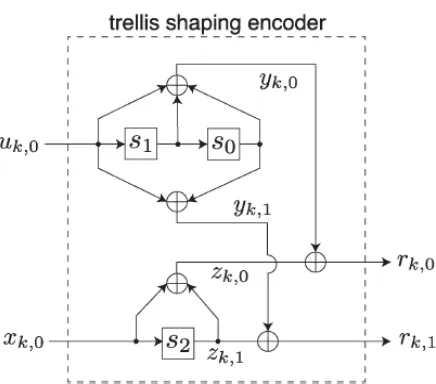
Fig.2 Transmitter for trellis shaping with M-ary QAM where B = log2 M − 1.
ISSN (Print) : 2320 – 3765 ISSN (Online): 2278 – 8875
I
nternational
J
ournal of
A
dvanced
R
esearch in
E
lectrical,
E
lectronics and
I
nstrumentation
E
ngineering
(An ISO 3297: 2007 Certified Organization)
Website: www.ijareeie.com
Vol. 6, Issue 7, July 2017
subscript representing the OFDM symbol index l for simplicity and write s(t), A, and Ak instead of sl(t), Al, and Al,k, respectively.
(ii) Serial Concatenation of TS and BICM
The block diagram of the system considered in this paper is described in Fig. 1. At the transmitter, we first encode the information bits of length Nk, d ∈{0, 1}Nk, by a binary channel code of rate Rc, and the encoded bits c ∈
{0, 1}Nc, where Nc = Nk/Rc is the length of the binary codeword, are interleaved with a bit interleave π.
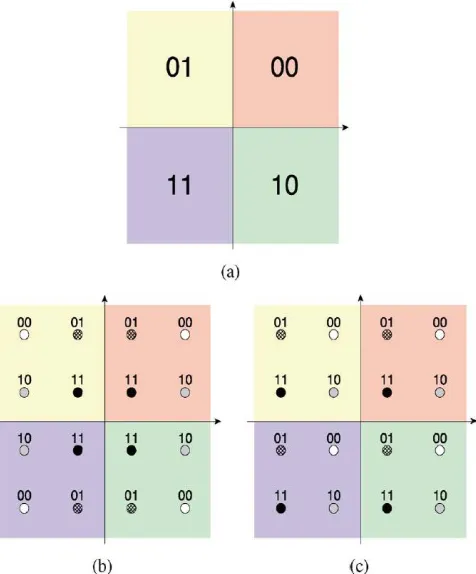
Fig. 3. Constellation mapping for the sign-bit shaping (16-QAM), (a) coded MSBs, (b) LSBs: Type-1, and (c) LSBs: Type-2
The scrambled binary codeword c is then passed to the trellis shaping system which will be described in Section II-D. In this paper, we assume that Nc is matched to one OFDM symbol for simplicity. Therefore, if no shaping is applied, for the N-subcarrier OFDM system with each subcarrier modulated by M-ary QAM, we have Nc = NB where B = log2 M denotes the number of coded bits transmitted by each QAM symbol. On the other hand, with the trellis shaping described later in Section II-D, one bit redundancy per QAM symbol is imposed for constellation shaping process and thus we have Nc = NB where B = log2 M − 1.
After trellis shaping, the modulated data symbol sequence A is transformed into the OFDM signal s(t) through the inverse fast Fourier transform (IFFT) and low-pass filtering, and then after frequency conversion and power amplification by PA, it is transmitted over a frequency-selective fading channel. At the receiver, the data symbol sequence after the fast Fourier transformation (FFT) of the received noisy OFDM signal is denoted as A=(A0, A1, A2, A3, A4,...,AN-1). Each of A corresponds to the noisy QAM symbol on the kth subcarrier and is expressed as:
ISSN (Print) : 2320 – 3765 ISSN (Online): 2278 – 8875
I
nternational
J
ournal of
A
dvanced
R
esearch in
E
lectrical,
E
lectronics and
I
nstrumentation
E
ngineering
(An ISO 3297: 2007 Certified Organization)
Website: www.ijareeie.com
Vol. 6, Issue 7, July 2017
where Wk ∈ C is the additive white Gaussian noise (AWGN) with power spectral density (PSD) N0, and Hk ∈ C is the channel coefficient which is assumed to be known at the receiver in this work. From these received data symbols, the LLR sequence L ∈ RNc is calculated and then de-interleaved by π−1. Note that the definition and calculation of the LLR are described in Section III. Finally, after the binary channel decoder, we retrieve the estimated information bits d
∈ {0, 1}Nk.
TABLE I
Classification of Operation Mode based on Mapping and metric
(iii) Channel Model and Channel SNR
As a frequency-selective channel model, we consider the commonly adopted L-path channel impulse response defined as:
h(t) = SUM[hlδ(t − lT )] w.r.t (L-1) and (l=0) (4)
where T = Tu/N corresponds to the Nyquist sampling rate, δ(t) is a delta function, and hl represents the channel
coefficient of the lth path. Assuming that the CP is longer than the maximum delay spread of the channel, Hk is related to hl by FFT and by Parseval’s theorem we have:
SUM[|Hk|2] w.r.t k∈IN = SUM[|hl|2] w.r.t (L-1) and (l=0) (5)
For a frequency-selective Rayleigh fading channel where the hl are assumed independent and identically distributed (i.i.d.) and each follows CN (0,N/L), it can be shown that each of Hk follows CN (0, 1), even though the Hk are statistically correlated in general. In this work, we define the channel signal-to-noise ratio (SNR) as the ratio of the average power of the signal component HkAk and PSD of AWGN Wk in (3) as:
SNRk = (E |HkAk|2)/N0 = E{Hk}2-E{Ak}2/N0 = E{Ak}2/N0 (6)
where E{·} denotes an expectation operation. Note that application of TS to OFDM typically causes that the variance of Ak becomes dependent on the subcarrier index k, and thus the SNR changes with k. In what follows, the SNR averaged over all the subcarriers k, i.e., SNR = 1 SNRk will be considered as our SNR measure for simplicity.
(iv) Trellis Shaping [TS] 1) Basic Principle:
A basic block diagram of the transmitter side of the TS considered in this work is described in Fig. 2. In this figure, G denotes the 1 × ns generator matrix of a rate-1/ns convolutional code Cs referred to as a shaping convolutional code. Let HT denote its parity-check matrix of size ns × (ns − 1) and (H−1)T denote its left inverse
matrix of size (ns − 1) × ns. Note that (H−1)T can be seen as a rate-(ns − 1)/ns convolutional code and referred to as an
inverse syndrome former. Therefore, by definition, these matrices should satisfy the following equations:
ISSN (Print) : 2320 – 3765 ISSN (Online): 2278 – 8875
I
nternational
J
ournal of
A
dvanced
R
esearch in
E
lectrical,
E
lectronics and
I
nstrumentation
E
ngineering
(An ISO 3297: 2007 Certified Organization)
Website: www.ijareeie.com
Vol. 6, Issue 7, July 2017
where 0n corresponds to the zero vector of size n and In is the identity matrix of size n × n. In the framework of trellis shaping matched to an N-subcarrier OFDM with M-ary QAM [3], we first partition the coded sequence c into N blocks of B = log2 M − 1 bits, i.e., c = (c0c1 ··· cN−1) where ck = (ck,B−1ck,B−2 ··· ck,0) is the kth partition of c. Each partition is then further divided into the form ck = (ukbk), where uk and bk are called the information most significant bits (MSBs) and the least significant bits (LSBs), respectively. Each set of the information MSBs consists of (ns − 1)
bits, i.e., uk = (uk,ns−2uk,ns−3 ··· uk,0) = (ck,B−1ck,B−2 ···ck,B−(ns−1)), which is input to the inverse syndrome
former and the resulting ns-bit output is denoted by zk = (zk,ns−1zk,ns−2 ··· zk,0). In this MSB-encoding process, one-bit redundancy per QAM symbol is introduced. On the other hand, the LSBs bk consist of B − (ns − 1) bits and are
expressed as bk = (bk,B−nsbk,B−ns−1 ··· bk,0) = (ck,B−nsck,B−ns−1··· ck,0).
For convenience of notation, we introduce
ILSB = {0, 1, ··· ,B − ns} IMSB = {0, 1, ··· ,ns − 2}
as the sets of the bit position indices for the LSBs bk and the MSBs uk, prior to encoding by the inverse syndrome former, respectively. To the output sequence of the inverse syndrome former z = (z0z1 ··· zN−1), a codeword y = (y0y1 ··· yN−1) from the encoder G is added and the resulting sequence r = z + y = (r0r1 ··· rN−1), where rk = zk + yk
= (rk,ns−1rk,ns−2 ··· rk,0), together with that of the LSBs b = (b0b1 ··· bN−1) is passed to the QAM mapper to form a
QAM vector A. In this paper, we call rk the coded MSBs in distinction from the information MSBs uk. In this process, even if any valid codeword y is added, the information MSBs u = (u0u1 ··· uN−1) can be retrieved provided that no bit
error is caused by a channel. Therefore, this degree of freedom will be utilized for PAPR or average power reduction of the OFDM signals through the search of a suitable codeword y. Note that the corresponding input sequence x into G can be also determined from y as illustrated in Fig. 2, and x is called the shaping bits.
2) Sign-Bit Shaping and Mapping Types:
In this system, we focus on a rate-1/2 (i.e., ns = 2) code for the shaping convolutional code G and Viterbi algorithm is used for the codeword search. This particular approach is referred to as sign-bit shaping [1], [3] since each xk consists of a single bit (i.e., sign bit) per QAM symbol. In this case, each two-bit output yk from the generator matrix G can be indirectly used for selection of the quadrant of the QAM constellation, since yk determines the coded MSBs rk, which are then mapped onto the quadrant shown in Fig. 3(a). For the LSBs, we consider the two types of mapping shown in Fig. 3(b) and (c) for the square 16-QAM example. While the mapping shown in Fig. 3(b) has the same energy for given LSBs regardless of the selected quadrant, the one shown in Fig. 3(c) has a different energy response depending on the selected quadrant. Following [3], we refer to the former mapping in Fig. 3(b) as Type-1 and the latter mapping in Fig. 3(c) as Type-2. Apparently, Type-1 mapping is not capable of reducing average power and thus only has PAPR reduction capability. To the contrary, Type-2 mapping also offers the average power reduction capability. Note that the constellation arrangements of Type-1 and Type-2 mappings can be extended to other multilevel QAM constellations in a straightforward manner.
3) Metrics for Codeword Search:
We consider the two metrics for codeword search: One is designed only for average power reduction, and the other is designed for PAPR reduction. The first metric which is used for average power reduction is defined as [1]:
μ(i)av = SUM[|Am−1|2 = μ(i−1)av + |Ai−1|2] w.r.t i and m=0 (8)
where i = 1, ··· ,N is the number of the trellis sections processed and this metric denotes the cumulative energy of the selected signal sequence from the first to the present sections. By selecting the sequence that has the lowest metric at the final section of the trellis, the statistical distribution of the constellation approaches that of complex Gaussian, and this leads to the generation of the OFDM signal with low average power without sacrificing minimum Euclidean distance property of the original QAM constellation.
The second metric is one of those developed for PAPR reduction and expressed as the following recursive form [3]:
μ(i)PAPR = μ(i−1) PAPR + i−2m=12R R(i−1)∗m δ(i−1)m + i−1m=1δ(i−1)m2 (9)
ISSN (Print) : 2320 – 3765 ISSN (Online): 2278 – 8875
I
nternational
J
ournal of
A
dvanced
R
esearch in
E
lectrical,
E
lectronics and
I
nstrumentation
E
ngineering
(An ISO 3297: 2007 Certified Organization)
Website: www.ijareeie.com
Vol. 6, Issue 7, July 2017
m denotes the aperiodic autocorrelation function of the sub-sequence formed by the first i elements of the sequence A. It can be shown that
R(i)m = R(i−1)m + δ(i−1)m (10)
where δ(i−1) mΔ=AiA∗i−m. Note that all possible entries δ(i−1) m and their squared values can be computed and
tabulated from constellation mapping beforehand for computational complexity reduction. Furthermore, the third term in (9) is constant for Type-1 mapping regardless of the selected codeword. Therefore, it can be omitted when we use Type-1 mapping [3].
4) Classification of Mapping and Metric:
Depending on the usage of TS, we can classify the pair of mapping and metric introduced in the previous subsections into the three operation modes listed in Table I. The peak mode employs Type-1 mapping with the metric for PAPR reduction, and thus this mode works only as a PAPR reduction of OFDM signals. The balanced mode is a combination of Type-2 and the metric for PAPR reduction, and this mode can thus reduce both PAPR and average power. The average mode uses the metric for average power reduction and Type-2 mapping, and this can only reduce the average power. In addition to these operation modes, one can consider the combination of Type-1 and the metric for average power reduction, but since this combination can reduce neither PAPR nor average power, it will not be pursued further in this work.
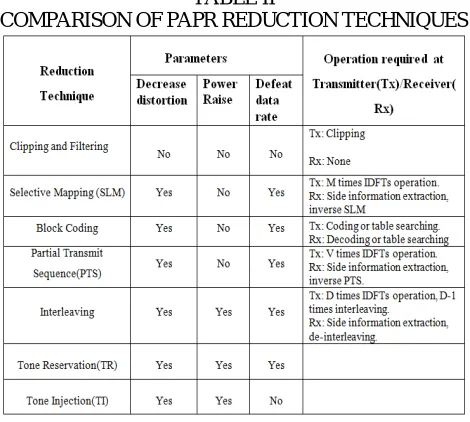
TABLE II
COMPARISON OF PAPR REDUCTION TECHNIQUES
III. SOFT-OUTPUT CALCULATION FROM TRELLIS-SHAPED SIGNALS VIA BCJR ALGORITHM
ISSN (Print) : 2320 – 3765 ISSN (Online): 2278 – 8875
I
nternational
J
ournal of
A
dvanced
R
esearch in
E
lectrical,
E
lectronics and
I
nstrumentation
E
ngineering
(An ISO 3297: 2007 Certified Organization)
Website: www.ijareeie.com
Vol. 6, Issue 7, July 2017
Fig. 4 An example of trellis shaping encoders with G = (7, 5) and (H−1) T = (3, 1).
A. LLR Calculation for LSBs
With the notations defined in Section II, the probability density function (pdf) of the kth received symbol conditioned that the transmitted jth bit is b ∈ {0, 1} is expressed as [14]
p( Ak|ck,j = b) = Xk ∈XbjP√r(Xk)πN0eAk−HkXk|2N0 ,for j ∈ ILSB and k ∈ IN, (11)
where Xb j denotes the subset of X whose jth bit is b ∈ {0, 1}, and Pr(Xk) denotes the a priori probability of the modulated symbol Xk ∈ X on the kth subcarrier. The corresponding LLRLi (0 ≤ i < Nc) is then directly expressed as
LkB+j = logp(Ak|ck,j = 0)p( Ak|ck,j = 1),for j ∈ ILSB and k ∈ IN, (12)
Where B = log2M − 1 for the trellis shaped M-aryQAM case.
B. LLR Calculation for Information MSBs
We now consider the soft-output calculation for information MSBs. To develop a SISO decoding at the receiver, we consider a trellis based on the compound matrix of G and (H−1)T , similar to the concept of combined
precoding and channel coding introduced in [20], and then apply the BCJR algorithm in order to calculate the
associated probabilities. Let νg and νh denote the numbers of bit memory elements of the convolutional codes G and (H −1) T, respectively. The constraint lengths for Gand (H −1) T are thus Kg = νg + 1and Kh = νh + 1, respectively. We
define the compound matrix (i.e., a compound trellis that can be used for BCJR-based decoding) as follows:
• The number of states of the compound trellis is Ss = SgSh, where Sg = 2νg and Sh = 2νh are those of G and (H−1)T ,
respectively.
• Each state has 2ns branches stretching to the next states, where each branch is associated with each element of rk.
IV. DESIGN CRITERIA FOR SHAPING CONVOLUTIONAL CODES
In this summary, we describe several criteria for evaluation of the peak and average power reduction capabilities as well as the dependence of the decoding performance on shaping convolutional codes.
A. Average Power Reduction Capability
ISSN (Print) : 2320 – 3765 ISSN (Online): 2278 – 8875
I
nternational
J
ournal of
A
dvanced
R
esearch in
E
lectrical,
E
lectronics and
I
nstrumentation
E
ngineering
(An ISO 3297: 2007 Certified Organization)
Website: www.ijareeie.com
Vol. 6, Issue 7, July 2017
Ψ Δ= Pav Pav,shape, (22)
where Pav is the average power of the signals before trellis shaping (i.e., this corresponds to the case where each constellation point in QAM is equiprobable) and Pav,shape is that after trellis shaping.
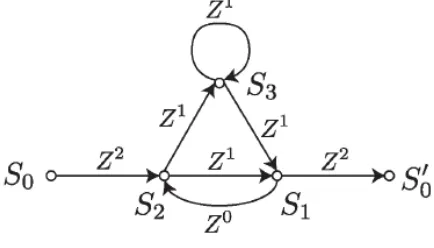
Fig. 5 An example of state transition diagram for G = (7, 5).
B. Peak Power Reduction Capability
In this work, we consider the distribution of instantaneous power for evaluating the peak power reduction capability. The instantaneous power at the time instant t is defined as
ζ(t) Δ= |s(t)|2 E |s(t)|2 . (23)
The denominator in (23) represents the average power of s(t). The complementary cumulative distribution
function (CCDF) of ζ(t) is expressed as
CCDFζ(x) = Pr (ζ(t) > x) , (24)
which represents the probability that a given realization of instantaneous power exceeds a threshold level x.
C. Power Amplification Efficiency
The effect of peak power reduction is directly related to the improvement of the power amplifier (PA) efficiency. Let rin and rout denote the input and output envelope levels, and rin,max and rout,max the corresponding input and output saturation envelope levels of a given PA, respectively. As for the nonlinearity model of PA for the PA efficiency evaluation, we employ the following solid state power amplifier (SSPA) model (i.e., Rapp model [22], [23]), whose AM-AM characteristic is expressed as
rout = rout,max rin rin,max 1 + n rin,max
2p 1 2p , (25)
D. Transfer Function
To investigate the property of the shaping convolutional codes used in TS, we consider their transfer function (TF) [26] that is defined as
T(Z) = ∞h=dminahZh, (28)
where Zh denotes the term that represents the error path with Hamming distance h from the all-zero codeword sequence and ah is the number of the error paths corresponding to Zh. Also, dmin is the minimum value of h, called minimum free distance (MFD). We use the MFD as one of our criteria to compare and analyze the performance of each shaping convolutional code.
Literature Survey
ISSN (Print) : 2320 – 3765 ISSN (Online): 2278 – 8875
I
nternational
J
ournal of
A
dvanced
R
esearch in
E
lectrical,
E
lectronics and
I
nstrumentation
E
ngineering
(An ISO 3297: 2007 Certified Organization)
Website: www.ijareeie.com
Vol. 6, Issue 7, July 2017
average power ratio and average power of the band-limited QAM-OFDM signals. Computational reduction for metric calculation is also proposed.
In the year of 2004 the author "H. Ochiai" proposed a paper titled "A novel trellis-shaping design with both peak and average power reduction for OFDM systems" in this the author described such as a new trellis shaping design is proposed for reducing the peak-to-average power ratio of the bandlimited orthogonal frequency-division multiplexing (OFDM) signals. The approach is based on recursive minimization of the autocorrelation sidelobes of an OFDM data sequence. A novel metric in conjunction with the Viterbi algorithm is devised. The performance of the trellis shaping depends on signal mapping strategy, and the two types of mapping, referred to as Type-I and Type-II, are proposed. The Type-I mapping has no capability of reducing the average power, but it can achieve a significant reduction of the peak-to-average power ratio. On the other hand, the Type-II mapping is designed to achieve both peak and average power reduction. The bit error probability of the system over an AWGN channel is evaluated based on the simulations, which confirms the effectiveness of the proposed scheme.
V. EXPERIMENTAL RESULTS
Performance Evaluation
Here, the performance of our proposed algorithm for OFDM using trellis shaping method via simulation analysis is investigated using MATLAB R2007b. Evaluation of peak and average power reduction capabilities as well as corresponding AMI and FER performance of the proposed system is described.
A. Performance at Transmitter Side:
Performance improvement at transmitter side i.e. average and peak power reduction capabilities as well as the resulting power amplifier efficiency.
Average Power Reduction Capability:
Average and power reduction capabilities of balanced and average modes where the constraint length of their shaping convolution code is described. Results are compared in table in terms of average power reduction. we have divided and classified codes into five classes defined as class A through E by first term of TF. Shaping convolutional code with larger MFD result in better average power reduction performance is shown. Further, the codes with same MFD result and the ones with lower coefficient of MFD term have turned out to achieve better performance.
Results for shaping convolutional code with larger MFD is shown in below tabular form.
ISSN (Print) : 2320 – 3765 ISSN (Online): 2278 – 8875
I
nternational
J
ournal of
A
dvanced
R
esearch in
E
lectrical,
E
lectronics and
I
nstrumentation
E
ngineering
(An ISO 3297: 2007 Certified Organization)
Website: www.ijareeie.com
Vol. 6, Issue 7, July 2017
Peak Power Reduction Capability:
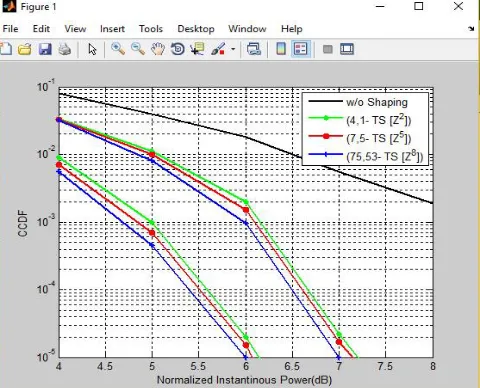
Peak power reduction capabilities of peak and balanced modes are shown in figure in the form of CCDF of normalized instantaneous power. In this figure only the results are shown for visibility but it is confirmed that the performance mostly depends on the first term of TF similar to average power reduction.
It is shown that the shaping convolutional; codes with larger MFD result in low peak power in case of peak mode. However for balanced mode, the improvement in peak power reduction capability is smaller than that obtained by peak mode due to the fact that average power reduction achieved by balanced mode in turn results in increased PAPR performance compared to that without shaping.
Power Amplifier Efficiency
The PA efficiency η corresponding to the effective IBO which achieves near linear amplification is shown in
Table IV, where we define that the linear amplification can be achieved if the effective IBO is set larger than the
threshold normalized instantaneous power ζ at CCDFζ (x) = 10−5. From the table, it is observed that as the MFD of the
shaping convolutional code increases, the power amplifier efficiency increases for both of the peak and balanced modes, and the amount of increase in the PA efficiency of the peak mode is larger than that of the balanced mode. Both of them are better than the PA efficiency of the average mode, which is around 5.6%. Since no peak power reduction is performed for the average mode, its efficiency is similar to that of the conventional OFDM without PAPR reduction.
B. Performance at the Receiver Side
In this area, we will show the performances at the receiver side, i.e., the average mutual information over an AWGN channel as well as the FER performance over both AWGN and frequency-selective Rayleigh fading channels. From the simulations, it will be observed that the receiver performance depends on both the average power reduction capability and the constraint length of the shaping convolutional code that determines the complexity of the structure of the decoding trellis. Specifically, while higher average power reduction can be achieved by increasing the trellis complexity, it also results in degradation in terms of achievable error performance, thus leading to a trade-off relationship. In what follows, the generator polynomials of (3, 2), (7, 5), and (75, 53) are chosen as our representatives and their performances are compared.
1) Average Mutual Information Over AWGN Channel:
ISSN (Print) : 2320 – 3765 ISSN (Online): 2278 – 8875
I
nternational
J
ournal of
A
dvanced
R
esearch in
E
lectrical,
E
lectronics and
I
nstrumentation
E
ngineering
(An ISO 3297: 2007 Certified Organization)
Website: www.ijareeie.com
Vol. 6, Issue 7, July 2017
compare the performances of the balanced and average modes, the best shaping convolutional code becomes different from that of the peak mode.
This is because the system with longer constraint length has better average power reduction capability but it also degrades decoding capability, and thus leading to the trade-off relationship. From this figure, we observe that (7, 5)-TS has better trade-off for the balanced and average modes. When we compare the performance of TS with that of unshaped case, the former is inferior to the latter, but it should be emphasized that the peak power distribution and power amplifier efficiency of the signal is significantly improved by the TS with the peak and balanced modes compared to the unshaped case, as we have seen in the previous subsection.
2) FER Performance of the System With the Proposed SISO Decoding: Fig. 9 shows the FER of the proposed system over an AWGN channel where we use the TS with different shaping convolutional codes. To investigate the effectiveness of our SISO decoding compared to the hard decision decoding, we also introduce the detection that does not use the proposed SISO decoding; instead, the soft-outputs for information MSBs are approximated by the average of those corresponding to LSBs
ISSN (Print) : 2320 – 3765 ISSN (Online): 2278 – 8875
I
nternational
J
ournal of
A
dvanced
R
esearch in
E
lectrical,
E
lectronics and
I
nstrumentation
E
ngineering
(An ISO 3297: 2007 Certified Organization)
Website: www.ijareeie.com
Vol. 6, Issue 7, July 2017
can achieve the best performance for the case of the peak mode similar to the result of the AMI in the previous subsection. For both the balanced and average modes, the performance of (7, 5)-TS is the best at waterfall region around FER = 10−2 because of its good average power reduction capability as well as a relatively simpler structure of
its decoding trellis. Moreover, comparing our SISO decoding system with that based on hard decision, it can be observed that the former can achieve significantly better performance. Finally, the FER performance of the proposed system with TS over the frequency-selective Rayleigh fading channel composed of L = 8 i.i.d. paths is shown in Fig. 10, together with the theoretical outage probability of (40).
When we compare the FER of the proposed system with the outage probability, it can be observed that the proposed SISO decoding can fully achieve the diversity effect, while the hard decision-based system does not. We observe that in the case of the peak mode, (3, 2)-TS performs best, which agrees with the results of AMI and the FER over an AWGN channel. Furthermore, even in the case of the balanced and average modes, (3, 2)-TS achieves almost the same performance compared to (7, 5)-TS. Since (3, 2)-TS is the simplest out of all simulated shaping convolutional codes in this work, it is conjectured that the simplicity of the decoding trellis contributes to the improvement in FER performance more than the effect of average power reduction in the case of fading channels.
VI. CONCLUSION AND FUTURE SCOPE
ISSN (Print) : 2320 – 3765 ISSN (Online): 2278 – 8875
I
nternational
J
ournal of
A
dvanced
R
esearch in
E
lectrical,
E
lectronics and
I
nstrumentation
E
ngineering
(An ISO 3297: 2007 Certified Organization)
Website: www.ijareeie.com
Vol. 6, Issue 7, July 2017
REFERENCES
[1] G. D. Forney, Jr., “Trellis shaping,” IEEE Trans. Inf. Theory, vol. 38, no. 2, pp. 281–300, Mar. 1992.
[2] W. Henkel and B. Wagner, “Another application for trellis shaping: PAR reduction for DMT (OFDM),” IEEE Trans. Commun., vol. 48, no. 9, pp. 1471–1476, Sep. 2000.
[3] H. Ochiai, “A novel trellis-shaping design with both peak and average power reduction for OFDM systems,” IEEE Trans. Commun., vol. 52, no. 11, pp. 1916–1926, Nov. 2004.
[4] X. Li and L. J. Cimini, Jr., “Effects of clipping and filtering on the performance of OFDM,” IEEE Commun. Lett., vol. 2, no. 5, pp. 131–133, May 1998.
[5] H. Ochiai and H. Imai, “Performance analysis of deliberately clipped OFDM signals,” IEEE Trans. Commun., vol. 50, no. 1, pp. 89–101, Jan. 2002.
[6] X. Wang, T. T. Tjhung, and C. S. Ng, “Reduction of peak-to-average power ratio of OFDM system using a companding technique,” IEEE Trans. Broadcast., vol. 45, no. 3, pp. 303–307, Sep. 1999.
[7] X. Huang, J. Lu, J. Zheng, K. B. Letaief, and J. Gu, “Companding transform for reduction in peak-to-average power ratio of OFDM signals,” IEEE Trans. Wireless Commun., vol. 3, no. 6, pp. 2030–2039, Nov. 2004.
[8] R. W. Bäuml, R. F. Fischer, and J. B. Huber, “Reducing the peak-toaverage power ratio of multicarrier modulation by selected mapping,” Electron. Lett., vol. 32, no. 22, pp. 2056–2057, Oct 1996.
[9] J. Tellado, “Peak to average power reduction for multicarrier modulation,” Ph.D. dissertation, Dept. Elect. Eng., Stanford Univ., Stanford, CA, USA, 1999.
[10] B. S. Krongold and D. L. Jones, “PAR reduction in OFDM viaprotect active constellation extension,” IEEE Trans. Broadcast., vol. 49, no. 3, pp. 258–268, Sep. 2003.
[11] Y. Kou, W.-S. Lu, and A. Antoniou, “A new peak-to-average powerratio reduction algorithm for OFDM systems via constellation extension,” IEEE Trans. Wireless Commun., vol. 6, no. 5, pp. 1823–1832, May 2007.
[12] S. Sezginer and H. Sari, “Metric-based symbol predistortion techniques for peak power reduction in OFDM systems,” IEEE Trans. Wireless Commun., vol. 6, no. 7, pp. 2622–2629, Jul. 2007.
[13] E. Zehavi, “8-PSK trellis codes for a Rayleigh channel,” IEEE Trans. Commun., vol. 40, no. 5, pp. 873–884, May 1992.
[14] G. Caire, G. Taricco, and E. Biglieri, “Bit-interleaved coded modulation,” IEEE Trans. Inf. Theory, vol. 44, no. 3, pp. 927–946, May 1998. [15] M. Tanahashi and H. Ochiai, “Turbo decoding of concatenated channel coding and trellis shaping for peak power controlled single-carrier systems,” IEEE Trans. Commun., vol. 58, no. 1, pp. 9–15, Jan. 2010.
[16] K. Ruttik, “Combining BICM with trellis based constellation shaping,” in Proc. ACM ICWCM, Leipzig, Germany, Jun. 2009, pp. 75–77. [17] R. Yoshizawa and H. Ochiai, “A serial concatenation of coding and trellis shaping for OFDM systems with peak power reduction,” in Proc. IEEE ISIT, Cambridge, MA, USA, Jul. 2012, pp. 1435–1439.
[18] R. Yoshizawa and H. Ochiai, “Analysis and optimization of trellis shaping concatenated with bit-interleaved coded modulation,” in Proc. IEEE 78th VTC-Fall, Las Vegas, NV, USA, Sep. 2013, pp. 1–5.
[19] L. Bahl, J. Cocke, F. Jelinek, and J. Raviv, “Optimal decoding of linear codes for minimizing symbol error rate,” IEEE Trans. Inf. Theory, vol. 20, no. 2, pp. 284–287, Mar. 1974.
[20] T. Aoki, H. Ochiai, and R. Kohno, “Combined trellis precoding and error correcting codes in multi-user MIMO-OFDM systems,” IEICE Trans. Fundam., vol. E93-A, no. 12, pp. 2663–2671, Dec. 2010.
[21] P. Robertson, E. Villebrun, and P. Hoeher, “A comparison of optimal and sub-optimal MAP decoding algorithms operating in the log domain,” in Proc. IEEE ICC, Seattle, WA, Jun. 1995, vol. 2, pp. 1009–1013.
[22] C. Rapp, “Effects of HPA-nonlinearity on a 4-DPSK/OFDM-signal for a digital sound broadcasting signal,” in Proc. 2nd ECSC, Liège, Belgium, Oct. 1991, pp. 179–184.
[23] A. J. Cann, “Improved nonlinearity model with variable knee sharpness,” IEEE Trans. Aerosp. Electron. Syst., vol. 48, no. 4, pp. 3637–3646, Oct. 2012.
[24] F. Raab, “Average efficiency of power amplifiers,” in Proc. RF Technol. Expo., Anaheim, CA, USA, Jan. 1986, pp. 474–486.
[25] H. Ochiai, “An analysis of band-limited communication systems from amplifier efficiency and distortion perspective,” IEEE Trans. Commun., vol. 61, no. 4, pp. 1460–1472, Apr. 2013.
[26] A. J. Viterbi, “Convolutional codes and their performance in communication systems,” IEEE Trans. Commun., vol. 19, no. 5, pp. 751–772, Oct. 1971.
[27] J. G. Proakis, Digital Communications, 5th ed. New York, NY, USA: McGraw-Hill, 2007.
[28] O. F. Acikel and W. E. Ryan, “Punctured turbo-codes for BPSK/QPSK channels,” IEEE Trans. Commun., vol. 47, no. 9, pp. 1315–1323, Aug. 1999.