Advance Java Study and its Approach to Java
Security
Minakshi Dhillon & Happy Sharma
Department of Information Technology, Dronacharya college of engineering, Khentawas, Farrukhnagar, Gurgaon-123506,India
Email: [email protected]; [email protected]
ABSTRACT
ADVANCE JAVA STUDY AND ITS
APPROACH TO JAVA SECURITY, this idea basically deals with the java and securing it. Java is an object-oriented programming language with a built-in application programming interface (API) that is able to handle graphics and user interface further which can be used to create applications or applets. Because of its rich set of API's, similar to Macintosh and Windows, and its platform independence, Java can also be thought of as a platform in itself. Java also has standard libraries for doing mathematics and calculation analysis. Much of the syntax of Java is same as C and C++. One major difference is that Java does not have pointer’s. However, the biggest difference is that we must write object oriented code in Java. In Java we can distinguish between applications, which are programs that perform the same functions as those written in other programming languages, and applets, which are programs that can be embedded in a Web page and accessed over the Internet. When a program is compiled, a byte code is produced that can be read and executed by any platform that can run Java. In this paper, we explore importance of java security, basic java security model and guidelines for java security.
Keywords:-
Object-Oriented; Security; Antagonism; Spoofing; multithread; java
1. INTRODUCTION
Advance Java Study and its Approach to Java SecurityMinakshi Dhillon & Happy Sharma P a g e | 1639
or “instantiated” from a class. The structure of a Java program consists of various objects exchanging messages. The keyword class defines a blueprint for objects with similar properties.
Java holds great promise as a platform for component-based software, embedded systems, and smart cards. This means Java is poised to play an important enabling role in e-commerce as these systems move from ether-ware to reality. Java components are appearing at a rapid pace and en-capsulate critical functions for transaction-based systems. Java smart cards for e-commerce will debut soon. The Java programming environment from Sun Microsystem is designed for developing programs that run on many different kinds of networked computers. Because of its multiplatform capabilities, Java shows great promise for relieving many of the headaches that developers encounter when they are forced to migrated code between different types of operating systems.
2. FEATURES OF JAVA
The features of Java this torrent computer- speak jargon has often been labelled the “Buzzword description” and was doubtless intended with tongue in
cheek, it nevertheless accurately
identifies many of the features of Java that they make it so well-suited for programming internet applications. The following Java Buzz-words are as follows:
1) Platform Independent 2) Secure
3) Portable
4) Object-Oriented 5) Robust
6) Architecture-neutral 7) Multithread
8) Interpreted
9) High performance 10) Distributed 11) Dynamic
3. PROPERTIES OF JAVA
3.1. Variable Declaration:
The types of all variables must be declared. The primitive types are byte, short, int, long (8, 16, 32, and 64 bit integer variables, respectively), float and double (32 and 64-bit floating point variables), boolean (true or false), and char. Boolean is a distinct type rather than just another way of using integers. Strings are not a primitive type, but are instances of the String class. Because they are so common, string literals may appear in quotes just as in other languages. Summary of primitive data types.
3.2. Naming Conventions
defines data (fields) and methods to manipulate the data A new set of instance variables is created each time that an object is instantiated from the class. The members of a class (variables and methods) are accessed by referrring to an object created from thr clas using the dot operator.
3.3. Comments
There are three comment styles in Java. A single line comment starts with // and can be included anywhere in the program. Multiple line comments begin with /* and end with */; these are also useful for commenting out a portion of the text on a line. Finally, text enclosed within /** ... */ serves to generate documentation using the javadoc command.
3.4. Assignments
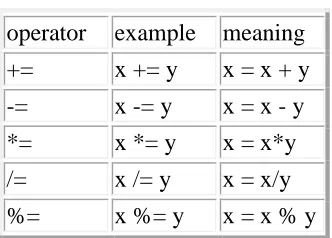
Java uses the C/C++ shortcuts summarized in Table 1.
Table 1. Assignment shortcuts.
operator example meaning
+= x += y x = x + y
-= x -= y x = x - y
*= x *= y x = x*y
/= x /= y x = x/y
%= x %= y x = x % y
The modulus operator % returns the remainder of a division.
3.5. Type casting
It Changes the type of a value from its normal type to some other type.
4. SECURING JAVA
Advance Java Study and its Approach to Java SecurityMinakshi Dhillon & Happy Sharma P a g e | 1641
A. System Modification : It is the most severe class of attacks. Applets that implement such attacks are attackapplets. B. Invasion of Privacy : If you value your privacy, this attack class may be particularly odious. They are implemented by malicious applets. Include mail forging.
C. Denial of Service : It is also serious but not severely so, these attacks can bring a machine to a standstill. Also implemented by malicious applets and may require reboot.
D. Antagonism : Merely annoying, this
attack class is the most commonly encountered. Implemented by malicious applets. May require restart of browser.
5. PARTS OF JAVA SECURITY
MODEL
A. The Verifier
The Verifier plays an essential role in Java's language-based approach to security, which is built on the foundation of type safety. As we know that, when a Java program is compiled, it compiles down to platform-independent Java byte code. In fig2, it shows that Java byte code is verified by verifier before it can run. This verification scheme is meant to ensure that the byte code, which may or may not have been created by a Java compiler, plays by the
rules. In this sense, the Verifier makes mystery code a bit less mysterious. B. The Class Loader Architecture Class loaders determine when and how classes can be added to a running Java environment. Their job is to make sure that important parts of the Java runtime
environment are not replaced by impostor code. Spoofing occurs when someone or something pretends to be something it is not. The fake Security Manager shown in the Fig.3 must be disallowed from loading into the Java environment and replacing the real Security Manager. This is known as class spoofing.
C. The Security Manager
This part of the security model restricts the ways an applet uses visible interfaces (Java API calls). The Security Manager
implements a good portion of the entire security model and is the part of the security model most often encountered (in terms of a Security Exception) by Java applet
developers. The job of the Security Manager is to keep track of who is allowed to do which dangerous operations. A standard Security Manager will disallow most operations
5.
GUIDING THE JAVA
SECURITY
A. For Java Developers
Don't Depend on Initialization
Limit Access to Your Classes, Methods, and Variables
Make Everything Final, Unless There's a Good Reason Not To
Don't Depend on Package Scope Don't Use Inner Classes
B. For Java Users
Know what Web sites you are visiting. Learn as much as you can about Java security.
Know your Java environment.
Use up-to-date browsers with the latest security updates.
Keep a lookout for security alerts. Apply drastic measures if your information is truly critical. Assess your risks
REFERENCES
1. Stephen J. Chapman, Java for Engineers and Scientists, Prentice-Hall (2000).
2. Bruce Eckel, Thinking in Java, Prentice-Hall (1998). Covers all the
syntax, plus some finer points of OOP.
3. Matthias Felleisen and Daniel Friedman, A Little Java, A Few Patterns, MIT Press (1998). Cute little tutorial that does not teach much syntax, but is designed to improve your OOP style.
4. David Flanagan, Java in a Nutshell, second edition, O'Reilly (1997). 5. David Geary, Graphic Java,
Addison-Wesley.
6. Joseph O'Neil and Herb Schildt, Teach Yourself Java, Osborne (1999). Good language reference for getting up to speed quickly.
7. Walter Savitch, Java: An introduction to Computer Science and
Programming, Prentice-Hall (1999). 8. Sun's Java Documentation or better
JavaDoc2.
9. Patrick Winston and Sundar Narasimhan, On to Java, 2nd ed., Addison-Wesley (1999).
10. Also see javaintro and Java development tutorial.
11. Peter van der Linden, Just Java and Beyond, Sun Microsystems.