ISSN (Print) : 2320 – 3765 ISSN (Online): 2278 – 8875
I
nternational
J
ournal of
A
dvanced
R
esearch in
E
lectrical,
E
lectronics and
I
nstrumentation
E
ngineering
(An ISO 3297: 2007 Certified Organization)
Vol. 4, Issue 6, June 2015
Controlling of Temperature and Humidity for
an Infant Incubator Using Microcontroller
Hitu Bansal
1, Dr. Lini Mathew
2, Ashish Gupta
3M.Tech Student (I&C), Department of Electrical Engineering, NITTTR, Chandigarh, India1
Head of the Department, Department of Electrical Engineering, NITTTR, Chandigarh, India2
Assistant Professor, Department of ECE, AKGEC, Ghaziabad, India3
ABSTRACT: The preterm infant care is one of the most important ,delegate and sensitive area in the Bio-medical field. Preterm baby requires surrounding exactly similar as in the womb to cope with the external environment. To provide the similar environment as in the womb infants have to be kept in a device known as Incubator. An infant incubator provides stable levels of temperature, relative humidity. Air temperature has to be maintained around 35ºC[1]. The relative humidity should follow set values according to the incubation day number. The purpose of this project is to design and implement a closed loop control system to regulate the temperature and humidity inside a neonatal incubator. Also it is used to monitor and control the light and oxygen level in the incubator [2]. Microcontroller and PID controller will be used for implementing the hardware. The closed loop control system is a combination of sensors and actuators that operates synchronously to provide a stable thermal environment inside the incubator [3].
KEYWORDS: Incubator, Temperature, Humidity, Microcontroller, PID Controller.
I. INTRODUCTION
Infants who born before 37 weeks of the gestation period are known as preterm or premature babies.Study shows that in every month of birth around 4 million infants die in the world. 25% of the deaths are cause due to complications of prematurity, most often heat and water [1]. Vital organs or enzymes of premature babies grow to the very lesser extent and thus requires special attention to cope with external physical condition like temperature, humidity, light etc. The infant has several disadvantages in terms of thermal regulation. An infant has a relatively large surface area, poor thermal insulation, and a small amount of mass to act as a heat sink. The new-born has little ability to conserve heat by changing posture and no ability to adjust their own clothing in a response to thermal stress. So these parameters are most important to control for saving the lives of infants. In developing countrybecause the economy is very low so the cost of medical devices should be kept low. Thus there is a need to develop a low cost incubator which provides the facilities required for the infants. This paper present a system which includes system structure, hardware circuits and software program of the incubator for premature infant. In this project we use DS18B20 as a temperature sensor and DHT11 as a humidity sensor. The goal of this study is to bring a new project which will be cost effective with improved usability.
Joshi et al
in
[1] depicted the development of a Wireless Monitoring System for Neonatal Intensive Care Unit (NICU);which is an isolated room for a premature/weak new-born baby. System provides the environmental condition similar to its mother’s belly. Lack of attention to thermoregulation continues to be a cause of unnecessary deaths in the neonatal population.
ISSN (Print) : 2320 – 3765 ISSN (Online): 2278 – 8875
I
nternational
J
ournal of
A
dvanced
R
esearch in
E
lectrical,
E
lectronics and
I
nstrumentation
E
ngineering
(An ISO 3297: 2007 Certified Organization)
Vol. 4, Issue 6, June 2015
assembly language programming. The control unit is sensitive to change of 0.1ºC. At start up, based on a unique control strategy, the incubator reaches its steady state in about 14 minutes.
Amer et al in [3] proposed a novel technique by using Artificial Neural Network (ANN) in order to simulate the premature infant incubator control system by implementing the back propagation method. Sensors are used to indicate temperature, humidity, and oxygen concentration of the incubator internal environment. Sensors output are entering to the ANN, which identify the corresponding case and decide the suitable reaction upon previous training. The proposed ANN premature incubator control system in all conditions that can occur in the premature infant incubator environment proved right decision technique. The proposed Artificial Neural Network (ANN) based to control the premature infant incubator system is tested with a set of different cases including very extreme cases. The % errors of this system are ranged between 1.6e-2 to 4.6e-2 in controlling the temperature, between 0.1 to 0.12 in controlling the humidity and are between 0.12 to 1.3 in controlling the oxygen concentration.
Bouwstra et al in [4] designed a Smart Jacket for neonatal monitoring with wearable sensor. The smart Jacket aims for providing reliable health monitoring as well as a comfortable clinical environment for neonatal care and parent-child interaction. In this paper the author explore a new solution for skin-contact challenges that textile electrodes pose. The jacket is expandable with new wearable technologies and has aesthetics that appeal to parents and medical staff. Kumar et al in [5] has done the study on designing an infant incubator for improved usability. This study helped to arrive at customer needs which were later converted into technical voice for the development of quality functional deployment (QFD), based on which final design specification (PDS) was listed. Five different concepts were generated. Final concept is selected based on Pugh’s method of concept selection. From the study the finalized concept has superior usability features compared to that in the present market
II. INCUBATOR
The first official neonatal intensive-care unit (NICU) for neonates was established in 1961 at Vanderbilt University by Professor Mildred Stahlman, Incubator is a device in which premature or unusually small babies are placed and which provides a controlled and protective environment for their care[4]. Every year, about 1 million infants in the developing world die due to heat loss and dehydration that can be prevented by an intensive care unit i.e. incubators[3]. Thus incubators provides congenial atmosphere for the infants, which helps in thermoregulation. The incubator is considered as an air conditioned room with special specification which we can be control with respect to the condition of baby in incubator. Incubators are designed to provide an optimal environment for new born babies with growth problems (premature baby) or with illness problems[4]. The incubator is an isolated area environment with no dust, bacteria, and has the ability to control temperature, humidity, and oxygen to remain them in acceptable levels. Incubator is designed to keep baby warm, to monitor many of their vital body functions like heart rate, blood pressure, oxygen saturation and to support their breathing if necessary. Regarding the temperature and humidity control, incubators should minimize heat loss from the neonate and eddies around him/her. The main physical variables affecting the incubator environment are temperature, humidity, oxygen saturation, light.
III. PARAMETERS AFFECTING THE INCUBATORS TEMPERATURE
The infants have very low thermal regulation and temperature regulation is one of the most important factors which affect the preterm[10]. It is not possible for the feeble body to cope with the thermal loss. This requires the body of the infant to be in a moist heated environment. Therefore temperature is one of the most important factors that need to be maintained with minimum variations.
HUMIDITY
Many problems like hypothermia, dehydration will occur in infants if they have less humidity. These problems can be reduced if the preterm infants are nursed at high relative humidity. Also the skin temperature increases and the distribution of surface temperature will be more if an infant is nursed at a high relative humidity[5].
ALARM
ISSN (Print) : 2320 – 3765 ISSN (Online): 2278 – 8875
I
nternational
J
ournal of
A
dvanced
R
esearch in
E
lectrical,
E
lectronics and
I
nstrumentation
E
ngineering
(An ISO 3297: 2007 Certified Organization)
Vol. 4, Issue 6, June 2015
panel registers an emergency event and sends a signal to the central monitoring station, where the appropriate authorities are notified. Alarms are activated only when the parameters attached to gets out of their specified ranges. In Neonatal Intensive Care Unit (NICU) alarms are attached with the incubators. These alarms will make a beep sound when the parameters which are to be controlled in the incubator cross its range. There are different types of alarms which are used
Temperature alarm
CO2 level alarm
Relative humidity level alarm
Power failure alarm
Battery low alarm
The block diagram of the project is shown in Fig.1. It mainly consists of the temperature sensor, humidity sensor, light sensor, carbon di-oxide sensor, PID controller and Microcontroller.
Fig1. Block Diagram of the Hardware
IV. DESIGN COMPONENTS
The components used in the project have been explained in the following sections:
SENSORS
Different types of sensors to be used for designing of the system are:
TEMPERATURE SENSOR:
We are requiring two temperature sensors for the temperature measurement are given below:
Temperature Sensor (T1) for measurement of body temperature of an infant in the range of 28 ºC-38ºC.
Temperature Sensor (T2) for measurement of temperature of water reservoir for humidity control should be
within range of 42ºC-45ºC.
TEMPERATURE SENSOR DS18B20:
The DS18B20 Digital Thermometer provides 9 to 12–bit centigrade temperature measurements and has an alarm function with non-volatile user-programmable upper and lower trigger points as shown in Fig.2. The DS18B20 communicates over a 1-Wire bus that by definition requires only one data line (and ground) for communication with a central microprocessor. It has an operating temperature range of –55°C to +125°C and is accurate to ±0.5°C over the range of –10°C to +85°C. In addition, the DS18B20 can derive power directly from the data line (“parasite power”), eliminating the need for an external power supply[6].
ISSN (Print) : 2320 – 3765 ISSN (Online): 2278 – 8875
I
nternational
J
ournal of
A
dvanced
R
esearch in
E
lectrical,
E
lectronics and
I
nstrumentation
E
ngineering
(An ISO 3297: 2007 Certified Organization)
Vol. 4, Issue 6, June 2015
TEMPERATURE SENSOR LM35
The LM35 series are precision integrated-circuit temperature sensors, whose output voltage is linearly proportional to the Fahrenheit temperature. The LM35 thus has an advantage over linear temperature sensors calibrated in degrees Kelvin, as the user is not required to subtract a large constant voltage from its output to obtain convenient Fahrenheit scaling. The LM35 does not require any external calibration or trimming to provide typical accuracies of ±1.2°F at room temperature and ±11.2°F over a full -50 to +300°F temperature range. The LM35 is rated to operate over a -50° to +300°F temperature range[4]. The circuitry is explained in Fig3. It is easy to include the LM35 series in a temperature measuring application. The outputvoltage of LM35is linearly proportional to the Fahrenheit temperature, it has a Linear +10.0 mV/°F scalefactor which means that you will get n*10.0 mV output voltage if the environment temperature is n°F.[4]
+5V
GND
GND OUTPUT LM35
Fig3. Circuit diagram for the LM35 temperature sensor
HUMIDITY SENSOR:
Humidity sensor should provide humidity level in the incubator in terms of relative humidity (%RH) in the range of 0 -100%RH. The humidity sensor chosen for the present work is DHT11.
HUMIDITY SENSORDHT11
DHT11digital temperature and humidity sensor is a composite Sensor contains a calibrated digital signal output of the temperature and humidity shown in Fig4. Application of a dedicated digital modules collection technology and the temperature and humidity sensing technology, to ensure that the product has high reliability and excellent long-term stability. The sensor includes a resistive sense of wet components and an NTC temperature measurement devices, and connected with a high-performance 8-bit microcontroller.[8]
DHT11uses a simplified single-bus communication. Single bus that only one data line, the system of data exchange, control by a single bus to complete. Device (master or slave) through an opendrain or tri-state port connected to the data line to allow the device does not send data to release the bus, while other devices use the bus; single bus usually require an external one about 5.1kΩpull-up resistor, so that when the bus is idle, its status is high. Because they are the master-slave structure, and only when the host calls the slave, the slave can answer, the host access devices must strictly follow the single-bus sequence, if the chaotic sequence, the device will not respond to the host.
HUMIDITY SENSORSHT11:
SHT11 (Fig5.) is a single chip relative humidity sensor modulecomprising a calibrated digital output. The device includes a capacitive polymersensing element for relative humidity and coupled to a 14bit ADC and a serial interface circuit on the same chip. This results in high signal quality, a fastresponse time and insensitivity to externaldisturbances (EMC). Each SHT11 is individually calibrated and calibrationcoefficients are programmed into the OTP memory. The 2-wire serial interface andinternal voltage regulation allow easy and fast system integration.[9]
MICROCONTROLLER
ISSN (Print) : 2320 – 3765 ISSN (Online): 2278 – 8875
I
nternational
J
ournal of
A
dvanced
R
esearch in
E
lectrical,
E
lectronics and
I
nstrumentation
E
ngineering
(An ISO 3297: 2007 Certified Organization)
Vol. 4, Issue 6, June 2015
PID CONTROLLER:
PID controllers will automatically control process variables such as temperature, humidity, pressure, flow rate, level or in fact, almost any physical variable that can be represented as an analog signal. The example used assumes that the variable is temperature, which is the most common, but the principles are equally applicable to all analog variables.
Fig7. PID controller circuit
III. WORKING
As we know that an incubatoris an apparatus used to maintain environmental conditions suitable for
a neonate (newborn baby). It is used in preterm or for some ill full-term babies.The mattress where the baby lies is
completely enclosed by a clear plastic canopy. In this temperature and humidity are the parameters which have to be controlled .The temperature in the incubator is increased by a heater element below the mattress. A motor driven fan near the heater draws in fresh air through a filter and blows it past the heater, warming the air. The air is directed up through slots into the area above the mattress and circulated around. A threshold value for temperature and humidity is set manually by using the potentiometer.[3]
The air temperature is monitored by temperature sensors and is adjusted by controlling the current to the heater. The user can set the incubator to control the temperature of the air. If the temperature of the incubator increased above the threshold value then the alarm will beep and the fan will be on and it remains on till the temperature decreased to the threshold value. If the temperature of the incubator decreased below the threshold value then also the alarm will beep and now the bulb will be on and it remains on till the temperature increased to the threshold value.Supplementary oxygen can be taken in by an oxygen inlet connection where it is mixed with the fresh air through the filter. The humidity can be increased by the use of water baths or by dripping water on a heated element. Light bulbs heat air in the bottom part of the incubator. The air passes over a container with evaporating water, so that its humidity increases.
The warm, humid air then flows upwards (chimney effect) into the baby compartment. The baby is cared for through
special access doors called arm ports.[6]
Typical values are:
Air Temperature: 32°C to 38°C Total gas intake: 35 L/min Relative humidity: 50-100%
The microcontroller used is Arduino mega2560.The Arduino Mega2560 can be powered via the USB connection or with an external power supply. The power source isselected automatically. External (non-USB) power can come either from an AC-to-DC adapter (wall wart) or battery.
ISSN (Print) : 2320 – 3765 ISSN (Online): 2278 – 8875
I
nternational
J
ournal of
A
dvanced
R
esearch in
E
lectrical,
E
lectronics and
I
nstrumentation
E
ngineering
(An ISO 3297: 2007 Certified Organization)
Vol. 4, Issue 6, June 2015
Fig.8 Programming in Arduino Library
In this Incubator we have used Temperature sensor DS18B20. For working with this Temperature sensor we use Arduino Library (Fig9.) by using DALLAS Temperature reads 1 wire library which is used for communicating withthe sensor similar to I2C Protocol[3].
Fig9. Arduino Library forDallasTemperature Sensor
In this Incubator we have used Humidity sensor DHT11. For working with this Humidity sensor we use DHT library & for displaying we are using LCD panel.
IV. RESULT
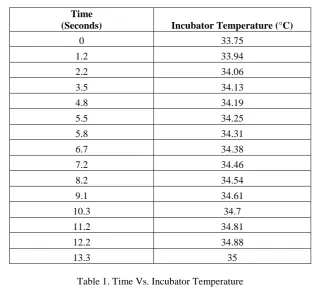
Variation of Incubator’s temperature with respect to Time:
ISSN (Print) : 2320 – 3765 ISSN (Online): 2278 – 8875
I
nternational
J
ournal of
A
dvanced
R
esearch in
E
lectrical,
E
lectronics and
I
nstrumentation
E
ngineering
(An ISO 3297: 2007 Certified Organization)
Vol. 4, Issue 6, June 2015
Time
(Seconds) Incubator Temperature (°C)
0 33.75
1.2 33.94
2.2 34.06
3.5 34.13
4.8 34.19
5.5 34.25
5.8 34.31
6.7 34.38
7.2 34.46
8.2 34.54
9.1 34.61
10.3 34.7
11.2 34.81
12.2 34.88
13.3 35
Table 1. Time Vs. Incubator Temperature
Graph 1. Time Vs. Incubator Temperature
Relative Humidity Achieved by the System:
Humidity can be increased or decreased by using water content in the Air.
Temperature of water (°C) Relative Humidity(%RH)
33.75 66.81
34.06 72.56
34.38 78.35
34.70 81.18
35.00 84.89
Table 2.Relative Humidity Vs. Water Temperature
33.5 34 34.5 35 35.5
0 2 4 6 8 10 12 14
In
cub
a
to
r
T
em
pera
ture
ISSN (Print) : 2320 – 3765 ISSN (Online): 2278 – 8875
I
nternational
J
ournal of
A
dvanced
R
esearch in
E
lectrical,
E
lectronics and
I
nstrumentation
E
ngineering
(An ISO 3297: 2007 Certified Organization)
Vol. 4, Issue 6, June 2015
Graph 2.Relative Humidity Vs. Water Temperature
V. FUTURE SCOPE
As we have used two sensors (Temperature&Humidity). But it can be improved by further using some other sensors like Light & Oxygen etc.
REFRENCES
[1] N.S. Joshi ,R.K. Kamet , P.K. Gaikwad, “Development of Wireless Monitoring System for Neonatal Intensive Care Unit”, International Journal of Advanced Computer Research, Vol.3, No.3, September, 2013.
[2] Mahmoud Salim, “Design and Implementation of a Digital Control Unit for a Oxygenaire Servo Baby Incubator”, Journal of Power Electronics, Vol. 8, No. 2, April, 2008.
[3] Ghada M.Amer, Kasid Aubidy, “Novel Technique to Control the Premature Infant Incubator System Using ANN”, 3rd International Conference on Systems, Signals & Devices, Vol.I, March,2005.
[4] Sibrecht Bouwstra, Wei Chen, Loe Feijs, “Smart Jacket Design for Neonatal Monitoring with Wearable Sensors” Proceedings of the Sixth IEEE International Workshop on Wearable and Implantable Body Sensor Networks, Washington, pp.162-167, June, 2009.
[5] Sreenath Sudhindra Kumar, Lohit H.S, “Design of an Infant Incubator for Cost Reduction and Improved Usability for Indian Health Care”, SASTECH Journal, Vol.11, No 2, September, 2012.
[6] Stephani D.P, “Neonatal Phototherapy Today’s Lights, Lamps and Devices”, Infant Journal, Vol.1, No 1, pp.14-19, January, 2005.
[7] Abdel Rahman Shabaan, Shereen M. Metwally, Moustafa M.A. Farghaly, Amr A. Sharawi, “PID and Fuzzy Logic Optimized Control for Temperature in Infant Incubators”, Proceedings of International Conference on Modelling, Identification & Control (ICMIC) Cairo, Egypt, pp.53-59, September, 2013.
[8] Vidya Dhatrak, Revati Gholap ,Supriya Patil, Nagama Bhaldar, Prof. Manisha Mhetre, “Intelligent Baby Incubator Using LabVIEW”, 2nd International Conference on Emerging Trends in Engineering & Techno-Sciences (ETETS), Vol.3, No.3, pp.50-54, April, 2014.
[9] Wei Chen, Son Tung Nguyen, Roland Coops, Sidarto Bambang Oetomo, Loe Feijs “Wireless Transmission Design for Health Monitoring at Neonatal Intensive Care Units”, Proceedings of the 2nd IEEE International Symposium on Applied Sciences in Biomedical and Communication Technologies (ISABEL), pp.1-6, November, 2009.
[10] A.J. Lyon, M E Pikaar, P Badger, N McIntosh, “Temperature Control in Very Low Birthweight Infants During First Five Days of Life”, Archives of Disease in Childhood Fetal and Neonatal Edition, Vol.76, pp.47–50, November,1996.
33.7 33.8 33.9 34 34.1 34.2 34.3
0 2 4 6
H
um
idi
ty
%RH