PIC Microcontroller Based Automatic Fish
Feeder System for Aquaculture
T.Muruganantham, Dr.M.Maheswari
Assistant Professor, Department of ECE, K.Ramakrishnan College of Engineering, Samayapuram India Professor, Department of ECE, K.Ramakrishnan College of Engineering, Samayapuram,India
ABSTRACT: This article mainly focusing in reduction of man power with reduction of human and efficient automatic feeder system design for aquaculture.The proposed design is developed and implemented by using PIC microcontroller 16F877A.The feeding system is consists of pellet storage, control unit with PIC microcontroller and the movement of the pellet system is made by DC motor is located under the feeder system.The controlling mechanism is to feed at the right cycle time.The control of motor rotation is done by the timer employed. The control unit is made with more determining speed of the motor depend on the cattle.
KEYWORDS: Embedded;Fish feeder, PIC.
I. INTRODUCTION
An advanced fish feeder is a system which is designed to spread the right amount of food in a predefined time. This system has the capability of doing this task every day in an accurate manner and hence the efficiency and productivity in aquaculture and marine culture will be increased [4,3].Generally there are two concept in which one is stationary and the other will be moving. The feeder which feed the fish in right cycle time and the amount of food which will be predefined by the user due to this over feeding of fish or non-feeding could be avoided. Today most of the fish farmers are using a manual feeding system. This will be more difficult for the farmers because they need additional labours to handle the jobs in aquaculture like maintaining, cleaning, dispensing the excess food stored in the tank and filling the feeder. It takes much time and the cost of the labour is too more. Like this there are two major problems faced by the fish farmers today. One will be an insufficient oxygen (O2) the other one is growth monitoring. Our system is designed to overcome these problems. This fish feeder is designed to dispense the right amount of pellets in a particular time and also this system is developed with the ability in repeating the task accurately and daily, so it helps to improve the productivity and efficiency in fish farming field for long time. The issue of overfeeding is also avoided in this method.
In early morning the fishes can’t breathe properly because of the decrease in the level of O2. This is due to the acidic content of water .the water becomes acidic when the hydrogen ion content in the water increases this leads to death of fishes in order to overcome this we used oxygenator and pH sensor to the system. The pH sensor will sense the pH value in the water, if the pH value is from (0-7) the oxygenator will automatically get the air from the atmosphere and supplies the O2 in the water and the another problem faced by the fish farmers are monitoring the growth of the fish.Here, this monitoring method is done by inserting two voltage leads inside the water with the particular voltage, the level of the voltage will be taken by measuring the size and depth of the pond by giving the particular voltage inside the water vibrations will be created inside during that time automatically .the fishes at the catching size will come to upper surface of the water .at the time , the size and the growth of the fishes can be monitored. By doing this we can catch thefully ground fishes by leaving the younger ones .it avoids unnecessary catching of small ones.
II. METHODOLOGY
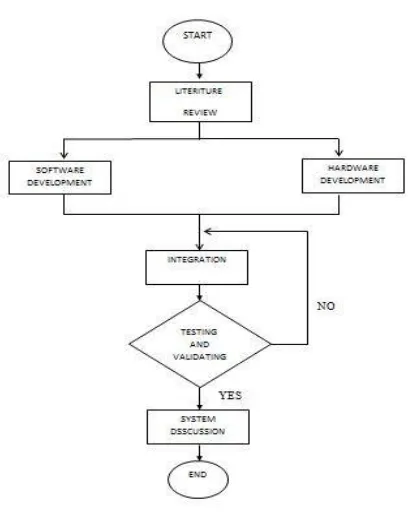
Thissystem consists of hardware and softwaredevelopments as well as the system design which helps to reduce labour cost and with great efficiency.This paper focuses the automatic PIC based feeding systemand addresses the issues and challenges facing everyday by fisher man.The efficiency of the system is also compared with the human based system and different issues were solved.The digital information is processed and initialized by the PIC microcontroller with the designer
interfacing unit.The processed data send to the output device of the feeder system to order the programming commands. The speed of the system is depends on the speed of the DC motor.If the system is started or failed the designer proceeds to test and validate it.The output voltage drop and movement of the pellet is based on the controlling actions of PIC microcontroller.
III. SYSTEM DESIGN
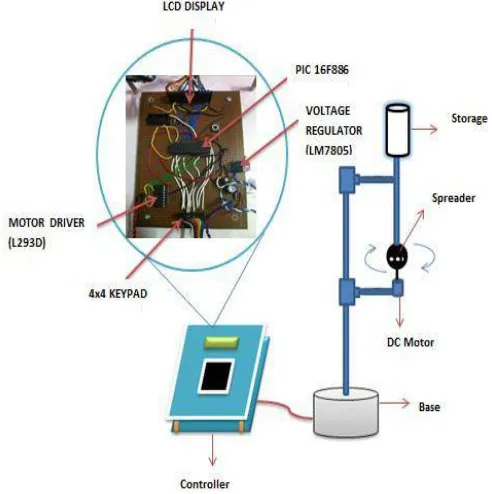
The design of this Automatic fish feeder consists of seven main parts, namely PIC microcontroller, food storage, stand, DCmotor, spreader, oxygenator, and PH sensor. The controller of this system, Apart from that, LCD display played an important role in illustrating the data entered by the user and to display the pH value before DC motor start to operate. PIC 16F887A controller was employed as main controller output of DC motor and for the oxygenator and for the voltage leads. In order to control the speed rotation of DC motor, L293D motor driver which work by PWM (Pulse Width Modulation) technique was utilized. As for the software design, programming of PIC16F887A was done with the aid of C language. The conceptual diagram as shown in Figure 2 where the major components are included.
*PIC MICROCONTROLLER *4X4 KEY PAD, DC MOTOR *2X16 LCD, L293 MOTOR DRIVER
IV. ISSUES FACED IN AQUACULTURE
Every day morning the fishes are struggling to survive due to oxygen lagging in the water, fisher man not able to see the growth of the individual fishes, maintenance of the aquaculture, feeding distribution system and labour availability. This paper mainly focuses to solve these problems and designed with great efficiency.
V. MECHANICAL SYSTEM ARRANGEMENT
The hardware setup is arranged as shown in the above diagram Figure 2.The feeder system movement system is on the water is based on the torque generated by the DC motor. The construction of the feeder system is very simple and the design is inexpensive and also reliable. The food storage system is located in the top pf the feeder system and based on the movement of the motor, the food is distributed in the water based on the availability of fishes. The area of the farm and water level is measured continuously. If the water level is low then the microcontroller will turn on the motor to flow the water in the farm area.
VI. L293DRIVER FOR MOTOR CONTROLLER
L293Dis providing the bi directional drive current upto 0.6mA and voltage range from 4.5v to 36v. It is driving load like relay and stepper motor[6,5].The L293D is utilized to control the motor rotation speed by programming the PIC microcontroller.
VII. DESIGN OF THE EXPECTED SYSTEM
This Timer 1 activates the motor as planned by the users. Timer 1 is with two modes that allowed the user to set the time. The Timer 2 is receiving the desired delay of each feeding process given by the designer. Once the parameter from input side had been completely designed by the designer, the motor will operate. early morning and indicates the motor to turn on the oxygenator motor control unit to turn on the oxygen mixing unit with water to improve the pH level and it will ensure the fishes to avoid coming on the surface of the water. The pH sensor always checking the values whether it is more than the 7 or less than the value of 7 and the system ensuring the pH level to maintain in near to seven. The speed of the motor directly proportional to the distance of the pellet, so the motor speed will result in longer distance.
VIII. THE pH SENSOR
The pH sensor used in this paper to monitor the pH value in the water. Because in the early morning period the oxygen level will be very minimum. Due to this the fishes will struggle a lot to sustain in the water.Our pH sensor available in Feeder system is measuring the pH value in the water in a frequent manner.
H.1 External Voltage Treatment
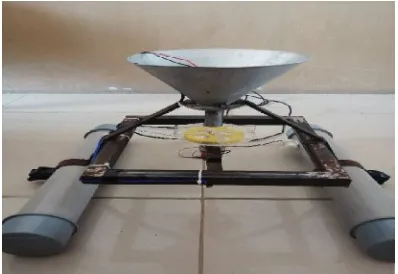
The external small amount of voltage is applied in the water surface, due to this the all fishes available will come on the top of the water. By this the fish growth can be monitored easily in every day. The Figure 3 shows the implemented design of automatic fish feeder system and the Figure 5shows the Feeder implemented system for distribution
Figure 3 The controller based implementation
Figure 5 The water level indicating system for aquaculture
IX. CONCLUSION
This work mainly focused the advanced PIC based feeder system. Now the fisher man can easily identify the issues in farming area with proper food distribution system with reduction of man power and cost. The pH level is monitored continuously and supplying the oxygen to the fish farming area. The amount of voltage is applied on the surface of the water, the fishes are coming to the top surface of the water due to this the growth of the fish is efficiently monitored. The DC motor is controlled by PWM technique the output of the pH will be monitor with the pH sensor and the insufficiency of the oxygen is avoided by the oxygenator.
REFERENCES
[1] Allen Goldblatt, Automatic feeder for marine mammals, Laboratory for marinne mammal Research University of Tel Aviv, (1992).
[2] Ding Jie, Wang kecheng, A new Type Speed Regulator for a PWM Speed Regulating System.Anshan Institute of science and technolgy, (2003). [3] Garcia1 S. Sendra1 G. Lloret J. Lloret, Monitoring and control sensor system for fish feeding in marine fish farms, IET Commun., Vol. 5, Iss.
12, pp. 1682–1690, (2011)
[4] Hidayatul Nur Binti Hasim, Mritha Ramalingam, Ferda Ernawan, Puviarasi .R, Developing fish feeder system using Raspberry Pi, Proceedings of 3rd International conference on Advances in Electrical, Electronics, Information, Communication and Bio-Informatics, (AEEICB,2017) [5] Varadi, Mechanized Feeding in Aquaculture, Inland Aquaculture Engineering, ADCP/REP/84/21, Food and Agriculture Organization (FAO), (1984).
[6] Zhijjun Liu, Lianzhi Jiang, “PWM Speed Control System of DC motor Based on AT89S51”, School of Electrical and Information Engineering
Liaoning Institute of Science and Technology, (2011).
BIOGRAPHY
T.Muruganantham, Assistant Professor of Department of ECE in K.Ramakrishnan College of
Engineering.He completed his B.E in ECE Department at J.J.College of Engineering and Technology.He completed his M.E in Power Electronics at A.C.College of Engineering and Technology.His Research Interests are CMOS Based Low Noise Amplifier for efficient Transceiver.