ISSN 2286-4822 www.euacademic.org
Impact Factor: 3.4546 (UIF) DRJI Value: 5.9 (B+)
Construction of A Homogeneous Factorization of
the Hamming Graph
H
1(n
,
q
) Using the Imprimitive
Action of
N
≤
S
q on the Arc Set of The CompleteGraph
K
qAUREA Z. ROSAL Department of Mathematics College of Science Polytechnic University of the Philippines Sta. Mesa, Manila, Philippines
Abstract:
If Γ = (V(Γ), A(Γ)) is a digraph with vertex set V(Γ) and arc set A(Γ), then a homogeneous factorization of Γ of index n is the 4 – tuple (M, G, V(Γ) , P) such that
1. P ={P1,…,Pn} is a partition of A(Γ).
2. G ≤ Aut (Γ) acting transitively on P.
3. M is the kernel of the action of G and is transitive on V(Γ).
In this paper, it will be shown that there exists a unique homogeneous factorization (M, G, V(Γ) , P) of index n where Γ = H1(n,q) = (Kq) n, using the imprimtive action of N ≤ Sq on A(Kq). This
factorization satisfies the following: 1. M = Nn
2. G = M × T, where T is an abelian subgroup of Sn acting
regularly on Ω = {1, 2, …, n}. 3. P ={P1,…,Pn}, such that
a.
1
, 1
rj ij
i
P
P
j
n
b. Pij {(( ,...,u1 uj,...,un), ( ,...,u1 vj,...,un)) | (u vj, j)Bi}
where
Complete Graph Kq
andB{ ,...,B1 Br} is a system of imprimitive
blocks.
Key words: Hamming graph, homogeneous factorization, graph product, permutation group, group action, transitive group action.
I. Introduction
If
G
(( ( ), ( ))
V
A
is a digraph with vertex set V( ) and arcset A( ) , a homogeneous factorization of of index n is a
partition
P
{
P
1,...,
P
n}
of A( ) such that there exists asubgroup GAut( ) that leaves P invariant, permutes the
elements of P transitively, and the kernel M of the action is
transitive on V( ) . The group G induces an isomorphism
between each pair of subgraphs
( ( ), )
V
P
i . The symbol(
M G V
, , ( ), )
P
is used to mean the homogeneous factorizationof Γ when it is necessary to emphasize the underlying groups. The subgraphs (( ( ),V Pi) are known as the factors of the
homogeneous factorization.
In a paper by [Guidici, et. al., 2004], methods of
constructing homogeneous factorization of digraphs were introduced. One of the methods given is that of the
homogeneous factorization of index n of a given graph
( )
n,where
is a digraph. In the construction, a primitive action ofa subgroup
N
S
q on the arc set of
is assumed. Then
orbits of
N
onA
( )
were used in defining the cells of thepartitions of
A
( )
. The above construction served as amotivation in this paper. In this paper, we take
=K
q.Complete Graph Kq
Is it possible to construct a homogeneous factorization of
(
K
q)
nof some index k using the imprimitive action of a subgroup of
n
S
?II. Theoretical Necessities
Knowledge of elementary graph theory and permutation groups shall be assumed in this paper. However, some definitions will still be given in order to better understand this study.
2.1. Graph Theoretic Necessities
A complete graph Kq is a graph with q vertices such that each
pair of distinct vertices are adjacent to each other. The nth
Cartesian product of any graph
with itself is the graph
n,whose vertex set V( n) is the Cartesian product of n copies of
( )
V . Now, two vertices ( ,...,u1 uj,...,un) and ( ,...,u1 vj,...,un)
are adjacent iff ( ,u ui j) A( ) for all u vi, j V( ). The nth
Cartesian product of Kq with itself is the graph 1( , ) ( )
n q
H n q K
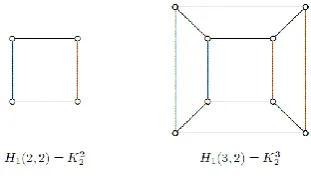
known as the Hamming graph. The cube is the Hamming
graph H1(3, 2). In general, the cubic graph Qn is the Hamming
graph H n1( , 2).
Complete Graph Kq
In this study, we shall be concerned with the homogeneous factorization of the Hamming graph H n q1( , )for q3.
Two graphs are Γ1 and Γ2 are isomorphic if there exists a
bijection
: (V 1) V(2) such that ( , )u v A( 1) iff2
( ( ), ( ))
u
v A( ). A graph automorphism or simply anautomorphism is an isomorphism of a graph with itself. The set
of all automorphisms of Γ form a group under function
Figure 2 The Hamming Graphs H1(2,2) and H1(3,2)
composition. This is known as the automorphism group of Γ and is denoted by Aut(Γ). For the complete graph Kq. Aut K( q)Sq
[Biggs, 1974].
2.2. Concepts from Permutation Group Theory
A permutation group G on a non empty set
is a subgroup of( )
Sym . The image of the action of G on
is a permutationgroup, called the permutation group induced on
by G. Also,
is known as a G-space.The kernel of the action is the set
{ | x , }
M x
. When the kernel contains only theComplete Graph Kq
Example 2.2.1. Every subgroup G of Sym( ) acts naturally on
where
g refers to the image of
under the permutationg
G
.Example 2.2.2. A natural action of
S
q onV K
(
q)
is given by( )
gg
i i
u
u
, foru
i
V K
(
q)
,g
S
qandi
g is the image of i underthe permutation g.
If is a G-space, then the orbit of
under G is the set{ | }
G x
x G
, while the stabilizer of
is the set{ | x }
G xG
.If for all
,
G , then we say that the action of G istransitive. Consequently, if
and
are in , then there existsa gG such that
g
. A transitive action that is bothtransitive and faithful is called regular.
Let be a G – space, and
, such that: { | }
x
x . If G is transitive on , then is a block of
for G if either x or x
. and{ }
are trivialblocks of respectively, for any
. Any other blocks areknown as nontrivial blocks. The action of G on is primitive if
it has no nontrivial blocks on . Otherwise, we say that the
action is imprimitive.
If is a block of , then the set
D
={g |gG} is a system ofblocks containing .
A group NAut( ) is said to be arc transitive on iff N acts
Complete Graph Kq
The following Lemma was proven in [Rosal, 2004]. This Lemma would be most useful in our construction.
Lemma 2.2.1. There exists a subgroup of Sqacting
imprimitively on the arc set A K( q) of Kq, for q3.
Example 2.2.3. For K3, let V K( 3){u1
,
u u
2,
3}
and1 2 2, 1 3
{( , ), ( )} ( )
B u u u u A K . Then B is a nontrivial block of
3 ( )
A K . Thus S3 acts imprimitively on A K( 3).
A group G is said to be arc transitive on a graph if it is
transitive on A( ) . Consequently, G is vertex transitive on ,
that is, it is transitive on V( )
III. The Construction
Let NS qq, 3 be imprimitive on A K( q). Then there exists a
nontrivial block B of A K( q). Let {Bg |gN}be a block
system. If | | r, then
r
2
and r B| |q q( 1). Thus, we maywrite { ,...,B1 Br}, where
B
i
B
m for somem
N
. We nowdefine the following:
: ( ) 1( , )
n q
K H n q
: {(( 1 ( 1 ))
| ( , ) }
,...,
,...,
),
,...,
,...,
ij j n j n
j j i
P u u
u v B
u
u
v
u
where,
1 1
((u
,...,
u
j,...,
u
n) (,
u,...,
v
j,...,
u
n))A( )
1
r
j i ij
P P
Complete Graph Kq
M :Nn
G:M T , where T Sn,
T is abelian and acting regularly on {1, 2,... }n .
We use the above sets to construct the needed homogeneous factorization. To start we introduce the following lemmas. Some proofs will be omitted.
Lemma 3.1 partitions A( ) .
Lemma 3.2. M is transitive on V( ) and fixes Pi, i 1, 2,...,n,
setwise.
Proof: Let m(m1
,...,
m
n)M , and let u(u1,..
.,un)V K( q).Then M acts on V( ) via the map 1
1
( m,..., mn)
m
n
u u u .
If ( ,...,u1 un) and ( ,...,v1 vn) are in V( ) , then i , gi N
such that gi
i i
u v . This is so since N is transitive on V( ) . Take
1 ( ,..., n)
g g g M , then 1
1 1 1
( ,..., )g ( g ,..., gn) ( ,..., )
n n n
u u u u v v .
Thus, M is transitive on V( ) . If
1 1
((u
,...,
u
j,...,
u
n) (,
u,...,
v
j,...,
u
n)) A( ), then1 1
((u
,...,
u
j,...,
u
n) (,
u,...,
v
j,...,
u
n))Pj for some j.Consequently, there exists a Bi such that (u vj, j)Bi. If,
1 ( ,..., n)
g g g is in M then, (( 1
,...,
,...,
) (,
1,...,
,...,
))g
j n j n
u
u
u
uv
u
1 1
((
,...,
,...,
)g,
(,...,
,...,
) )gj n j n
u
u
u
uv
u
1 1
1 1
(( g
,...,
gj,...,
gn) (,
g,...,
gj,...,
gn))j n j n
u
u
u
uv
u
. Since each giN,then gk (
)
k q
Complete Graph Kq
( , )gj ( gj, gj)
j j j j
u v u v (
)
gji t
B B
, for some t1,...,r. Hence,
1 1
((u
,...,
u
j,...,
u
n) (,
u,...,
v
j,...,
u
n))gPtj Pj. Therefore, M fixesj
P setwise.
□□□
Lemma 3.3. T acts
1. naturally on V( ) via the map ( ,...,1 ) ( 1f,..., f)
f
n n
u u u u .
2. on M via the map ( 1,..., ) ( 1f,..., f)
f
n n
m m m m
for all ( ,...,u1 un) V( ) and (m1,...,mn)M .
The proofs of the above Lemmas are straight-forward and will be left to the readers to do.
Lemma 3. 4. M and T are subgroups of Aut( ) .
Proof: We have already shown that both M and T permute the
elements of V( ) . It suffices to show that they preserve
adjacency.
For M, let ( , )u v A( ). Then ( , )u v
1 1
((u
,...,
u
j,...,
u
n) (,
u,...,
v
j,...,
u
n)), where ui vi whenever i j,and uj vj.
If m(m1,...mj
,
...,mn), then 11
( , )m (( m
,...,
mj,...,
mn),
j n
u v u
u
u
1
1
( m
,...,
mj,...,
mn))j n
u
v
u
.Since uj vj, then mj mj
j j
u v since mj is a bijection. Thus,
Complete Graph Kq
Let fT, then (uf
,
v
f)
( , )u v f = ((u1f,...ujf,unf), (u1f,...vjf,unf)).Since f T, then |k such that jkf.
It follows that the th
k coordinate of ( , )u v f is
(ukf,vkf)(u vj, j)A K( q). Hence ( , ) ( )
f
u v A . Therefore
, ( )
M TAut .
□□□
Lemma 3. 5. Let GM T . Then G is a group under the
binary operation
1
( , )( , )m f a b (maf , fb)
Furthermore, G is a semidirect product of M and T.
Proof: It is easy to prove that G is a group under the given
binary operation. Thus the proof for this shall be omitted. To prove that G is a semi-direct product of M and T, we have to
show T normalizes M and that M T {1}, where 1 is the
identity in G . We first define the following sets.
Let
{( ,1) | }
M m mM and T {(1, ) |f f T} where 1 is the
identity permutation.
Clearly, M and Tare subgroups of G and that MM and
TT. Also, MT{1}, where 1(1,1). Consequently,
{1} M T
Now, T acts on M by conjugation:
(1, ) 1
( ,1)m f (1, ) ( ,1)(1, )f m f (mf,1)
Consequently, T normalizes M. Since TT and MM,
then it follows that T normalizes M. Therefore, G is a
semidirect product of M and T.
Complete Graph Kq
Notice that if mM and fT, then ( ,1)(1, )m f ( , )m f and
1 f
fmm f . Obviously, G is not abelian.
Since M is normal in GM T , then GMT. For all
and
mM f T, fm f f( 1mfˆ )mfˆ , for some mˆM.
Consequently, GTM .
The following is a direct consequence of the preceding lemmas.
Lemma 3. 6. GAut( ) .
It is easy to show that G acts on V( ) through the map
( ) f
mf f m
u u , where mMand f T. Also, since m f, G, then
(um)f umf .Hence, (um)f (u f)mf .
We next show that G acts on transitively.
Lemma 3. 7. is G invariant.
Proof: Let Pj and ( , )u v
1 1
(( ,...,u uj,...,un), ( ,...,u uj,...,un))Pj. Then for some r ,
( , )u v Prj. Thus, (u vj, j)Br. Suppose gmf G, then
1
( ,..., n)
m m m M, miN for each i and fT. We now
compute for ( , )u v g.
Now, ( , )u v mPj since M fixes P setwise from Lemma 3.3.
Specifically, ( , )u v mPsj for some s .
Complete Graph Kq
1 1
1 1
(( , ) ) (( m,.., mj,.. mn), ( m,.., mj,.. mn))
m f
n n
j j
u v u u u u v u
Since f T, just as in the proof of Lemma 3.1.4, there is a
unique k such that the kth coordinate of
( , )g (( , ) )m f ( mj, mj)
j j
u v u v u v is in Bs. Thus, ( , )u v Psk Pk.
Therefore is G invariant. □□□
Finally, we are going to show that the action of G on is
transitive and the kernel of the action is actually M.
Lemma 3.8. G acts on transitively via the map f 1
g j
j
P P ,
where gmf . This action is transitive and the kernel of this
action is M.
Proof: From Lemma 3.7., it has been shown that is invariant
in G. Now, 1
1
(Pj) Pj Pj. Also, if g h, G, then gmf and
hab, for some m a, Mand f b, T. Thus,
1 1 1 ( 1 1) ( )1
( )
(( j) )g h ( f )h f b f b bf
j j j j
P P P P P .
On the other hand, ( )1
ˆ ( ˆ)
( j)gh ( j)mfab ( j)mafb ( j) ma fb fb
j
P P P P P .
Thus, (Pj)gh=((Pj) )g h. Also, let P Pj, k. Since T acts on
transitively, then there exists xTsuch that jx1 k. Taking
hmxG, for any mM , then ( x1) k
j
P P .
Hence G acts on P transitively.
Lastly, we show that M is the kernel of the action. Suppose
{ | ( j)g j}
K gG P P is the kernel. Clearly, M K. Let
gmf K, then f 1
g
j j j
Complete Graph Kq
Thus, f 1
j j. Therefore, f1 or f is in the kernel of the action
of T on . Since the action of is faithful, it follows that f 1.
Thus, gM. Therefore, K M. Consequently, K M.
□□□
IV. The Main Result
Since GAut( ) , then every elementgG is an automorphism
of. Hence, for any i j, , the subgraphs
( ( ), ) and ( ( ),V Pi V Pj) are isomorphic.
Combining all the Lemmas above, we have now proven the main result of this study.
Proposition 4.1 There exists a homogeneous factorization
(M G V, , ( ), ) of index n of the Hamming graph : H1( , )n q ,
for q3, satisfying the following:
1. { ,...,P1 Pn}
1
r
j i ij
P P
: {(( 1 ( 1 ))
| ( , ) }
,...,
,...,
),
,...,
,...,
ij j n j n
j j i
P u u
u v B
u
u
v
u
such that
1 1
((u
,...,
u
j,...,
u
n) (,
u,...,
v
j,...,
u
n))A( )
2. G:M T , where
M:Nn and T Sn,
Complete Graph Kq
We shall call the above factorization as Type 2 .
The name is temporary as further construction procedures are being developed by the author. A Type 1 factorization has been developed and introduced in an ongoing study by the author [Rosal, ongoing].
V. Conclusion
The study of homogeneous factorization of a graph or digraph is a relatively new field. The construction procedure presented in this paper is part of the author’s undergoing study on the development of construction procedures for homogeneous factorization of Hamming graphs.
REFERENCES
Biggs, Norman, (1974). Algebraic Graph Theory. Cambridge
University Press, Bentley House, 200 Euston Road, London
Cameron, Peter J., (1999). Permutation Groups. The Edinburg
Building, Cambridge, UK
Chartrand, Gary & Linda Lesniak, (1979). Graphs & Digraphs,
2nd Edition. Wadsworth & Brooklyn Cole Advanced
Books and Software, Pacific Grove, California
Cuaresma, Ma, Cristeta, (2004). Homogeneous Factorization of
Johnson’s Graphs. Ph.D. Dissertation (University of the
Philippines)
Dixon, John & Brian Mortimer, (1996). Permutation Groups.
Springer – Verlag, New York
Guidici, Michael, Cai Heng Li, Primoz Potočnik & Cheryl E.
Praeger, (2004). Homogeneous Factorizations of Graphs
and Digraphs. Submitted
Li, Cai Heng & Cheryl Praeger, (2002). On Partitioning the
Complete Graph Kq
of the American Mathematical Society, Vol. 355, Number 2, 627 – 653
Malik, D. S., John M. Mordeson & M.K. Sen, (1997).
Fundamentals of Abstract Algebra. McGraw – Hill Co.,
Inc., Singapore
Rosal, Aurea Z., (2005). On the Existence of a Subgroup of Sq
Acting Imprimitively on A(Kq) for q ≥ 3,. Poster Paper,
27th Annual Scientific Meeting, National Academy of
Science and Technology
Wielandt, Helmut, (1964). Finite Permutation Groups.