ISSN (Print) : 2320 – 3765 ISSN (Online): 2278 – 8875
I
nternational
J
ournal of
A
dvanced
R
esearch in
E
lectrical,
E
lectronics and
I
nstrumentation
E
ngineering
(A High Impact Factor, Monthly, Peer Reviewed Journal)
Website: www.ijareeie.com
Vol. 7, Issue 2, February 2018
Small Signal Stability of Power Systems with
Grid-Connected Variable Speed Wind
Generators
S. Lavanya1 , K. Senthil2
PG Scholar [PSE], Dept. of EEE, Adhiyamaan College of Engineering, Hosur, Tamilnadu, India1
Assistant Professor, Dept. of EEE, Adhiyamaan College of Engineering, Hosur, Tamilnadu, India2
ABSTRACT: Wind power has been increasingly integrated into power systems over the last few decades because of the global energy crisis and the pressure on environmental protection, and the stability of the system connected with wind power is becoming more prominent. This paper summaries the research status, achievements as well as deficiencies of the research on the impact of wind power integration on power system small-signal stability. In the end, the further research needed are discussed.
KEYWORDS: Power system stability, Stability analysis, Oscillators, Wind power generation, Power system dynamics, Damping.
I. INTRODUCTION
According to the literature in recent years, then the research of the influence of wind power on power system small-signal stability is reviewed from two aspects of modeling of wind turbine (WT) and the oscillation modes and damping characteristics of power system with wind power integration [1]. Under the above background, the research of influence of wind power grid on power system small signal stability are reviewed. At the beginning, the principle and method of power system small-signal stability analysis are outlined. At last, the control strategies to improve the system damping characteristics are introduce The influence of the access of large-scale wind power to the system on small-signal stability is an important subject which can't be ignored. On one hand, randomness is the inherent characteristic of wind power, and it is also the main factor affecting the safe and stable operation of wind power grid [2] [3] [4]. The large capacity power fluctuation caused by the randomness of wind power will lead to a series of problems, such as frequency stability, voltage stability and low frequency oscillation, which are serious threats to the safe operation of the power system [5] [6]. On the other hand, most of the large wind farms in China are hundreds or thousands of kilometers away from load center, so the large scale wind power usually needs to be given across the region, resulting in a loss of regional oscillation damping and intensifying the instability of a large power system [7].
II. RELATED WORK
2.1 Power System Small-signal Stability
Small-signal stability refers to the ability of the power system to maintain synchronism under small disturbances. Such disturbances are related to changes in the grid such as load and generation shifts. This variations occurs constantly in the grid. At the same time this changes are considered small enough for them to be linearized.
Small signal stability is largely a problem of insufficient damping of oscillations; therefore instability is normally through oscillations of increasing amplitude. Small-signal stability analysis methods mainly include the eigenvalue analysis, methods for small signal stability analysis, such as method based on the analysis of the measured signals of power system, the wide-area measurement information analysis method and normal form method based on the nonlinear theory.
ISSN (Print) : 2320 – 3765 ISSN (Online): 2278 – 8875
I
nternational
J
ournal of
A
dvanced
R
esearch in
E
lectrical,
E
lectronics and
I
nstrumentation
E
ngineering
(A High Impact Factor, Monthly, Peer Reviewed Journal)
Website: www.ijareeie.com
Vol. 7, Issue 2, February 2018
(2)
Eigenvalue analysis method is most widely used in the small-signal stability analysis, which is based on linear system theory and the lyapunov's first law.
Because eigenvalue analysis theory is highly reliable and can reveal the nature of stability of the systems with complex dynamic behavior, it is a powerful tool for analyzing system oscillation mode and damping characteristics and has been successfully applied in small signal stability evaluation and the controller’s design, configuration, site selection and parameter setting.
Figure: 1 Wind Turbine on Power System Small-signal Stability
Impact of Wind Turbine on Power System
Small-signal Stability WT system normally consists of wind turbine, generator and grid interface converters. During the development of the WT techniques, squirrel cage induction generator (SCIG), doubly fed induction generator (DFIG) and direct-drive permanent magnet synchronous generator (DDPMSG) were employed to convert wind power to electrical power, and DFIG is applied most.
2.2 Wind Turbine Modeling
Establishing proper dynamic models of WT and wind farm is the top priority to study the influence of WT on power system small-signal stability, and the accuracy of the models and parameters will be directly related to the precision of the analysis and calculation.
ISSN (Print) : 2320 – 3765 ISSN (Online): 2278 – 8875
I
nternational
J
ournal of
A
dvanced
R
esearch in
E
lectrical,
E
lectronics and
I
nstrumentation
E
ngineering
(A High Impact Factor, Monthly, Peer Reviewed Journal)
Website: www.ijareeie.com
Vol. 7, Issue 2, February 2018
Figure: 2 improves transient stability
A mathematical model for DFIG was earlier proposed by, and this documents simulated the respond of this WT model to two kinds of wind model. Established an improved type of DFIG small signal
Thus, this model can reflect the electromechanical mode for DFIG connected to the power system more accurately. set up a simplified three-order dynamic model of DFIG in the reference frame of stator’s circumrotatory magnetic field, which considered rotor field voltage and mechanical torque received by generator as controlled variables, and compared the response of simplified DFIG model’s and accurate DFIG model’s various state variables to small disturbances by using MATLAB simulation.
According to the characteristics of variable speed WT shafting of DFIG, established a dynamic model of DFIG gearbox shafting system, and constructed an eight order simultaneous differential equations based on the dynamic equations of generation. This model can be used to analyze the dynamic behavior of DFIG under various operating conditions.
Studied the wind farm equivalent modeling method based on operating data, made comparison with traditional wind farm modeling method, and the analysis shows that the equivalent modeling method based on operating data is more consistent with the physical condition. Researches on WT have achieved fruitful results, and some commercial software do quite well in WT modeling. However, because the control system of WT is quite complex and each manufacturer applies their own control strategies, among which there are some difference, it has certain difficulty to establish a more realistic model.
III. STRATEGIES FOR IMPROVING POWER SYSTEM SMALL-SIGNAL STABILITY WITH WIND POWER INTEGRATION
The strategies for improving power system small-signal stability with wind power integration can be classified into two types, which are the primary system strategy and the secondary system strategy.
ISSN (Print) : 2320 – 3765 ISSN (Online): 2278 – 8875
I
nternational
J
ournal of
A
dvanced
R
esearch in
E
lectrical,
E
lectronics and
I
nstrumentation
E
ngineering
(A High Impact Factor, Monthly, Peer Reviewed Journal)
Website: www.ijareeie.com
Vol. 7, Issue 2, February 2018
(3)
J˙ j (δ, V, ωr, Pref, Qref) = ∆Prefj∆δ˙j − dPj∆δ˙j2
+ ∆Qrefj∆V˙j2/Vj − dQj∆V˙j2
−∆Prefj∆ωrj2, j ∈ W (4)
To improve the damping of the system, the control of asynchronous WT pitch PID was proposed. The primary system strategy include the enhancement of the grid structure and the installation of energy storage devices, etc.
The secondary system strategy include the installation of PSS (PSS Power System Stabilizer) and FACTS (flexible AC installed transmission system) devices, and the use of modulation function of HVDC (high-voltage direct current) transmission system, etc.
The pitch angle of the blades is adjusted to increase (decrease) mechanical torque and improve (lower) WT power output, thus the system positive damping is increased. This method is similar to the control strategy of power system stabilizer, which can enhance the system damping and improve power system small-signal stability.
Figure: 3 Strategies for Improving Power System
Proposed the control method of amplitude and angle of rotor field magnetic flux, which can enhance system damping by additional control. Electrical variables related to system oscillation mode were regarded as the input signal and output signal was regarded as the additional control signal of active or reactive power ring, and the low frequency oscillation can be suppressed through adjusting the angle of the rotor field magnetic voltage angle.
ISSN (Print) : 2320 – 3765 ISSN (Online): 2278 – 8875
I
nternational
J
ournal of
A
dvanced
R
esearch in
E
lectrical,
E
lectronics and
I
nstrumentation
E
ngineering
(A High Impact Factor, Monthly, Peer Reviewed Journal)
Website: www.ijareeie.com
Vol. 7, Issue 2, February 2018
This type of power system stabilizer was installed inside the WT regarded the local slip signals as additional signals which are transported to the rotor converter of WT to suppress low frequency oscillation.Designed an adaptive damping controller based on variable frequency transformer, which could automatically calculate and optimize the parameters of the damping controller according to the Prony method. In general, mechanical control, active power control and reactive power control are applied to improve the damping of power system connected with wind power. However, for a result showed that it did well in suppressing the active power oscillation of the wind farm. Aiming at the problem of low frequency oscillation between regions, the damping control strategy applying wide-area measurement system (WAMS) has attracted.
In document, the DFIG wide-area damping controller was designed, where the active power reference value of the DFIG rotor-side converter and power angle difference of inter-area synchronous generator were regarded as the input signals large power system, it’s difficult to achieve an ideal effect for these reasons: a large amount of system parameters are needed in the PSS design; the structural changes of the system may have a great impact on the damping effect; the PSS of some wind turbines may exist the operating state for some reasons in the actual operation.
IV. SIMULATION RESULT
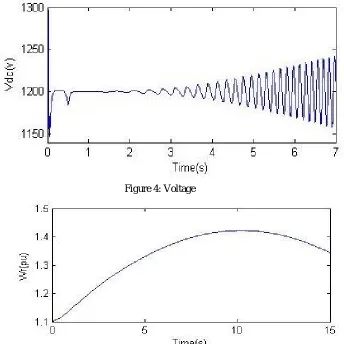
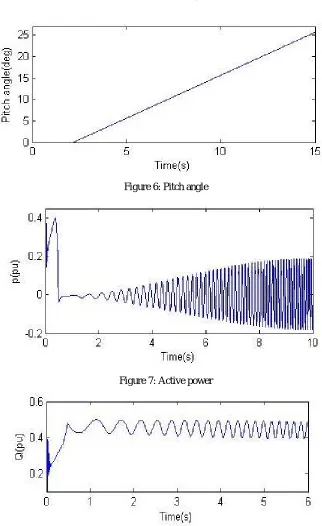
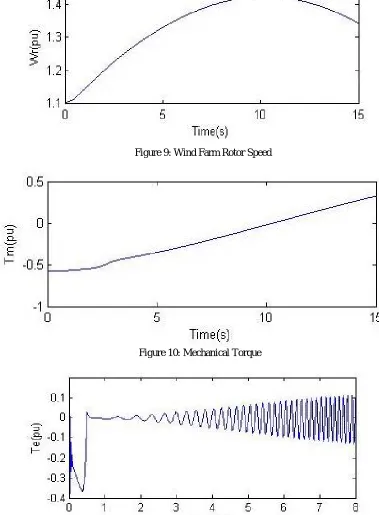
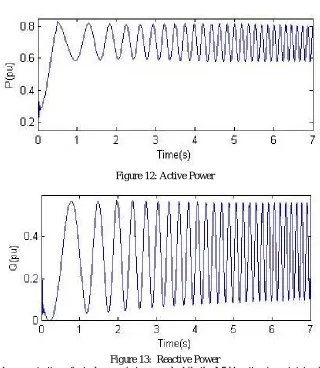
The aim of the study is to analyze the influence of increased wind power penetration on power oscillations in the system, with emphasis on the previously mentioned inter-area modes. Two cases with a varying penetration of wind power are investigated and compared to the base case with only synchronous generators.
Figure 4: Voltage
ISSN (Print) : 2320 – 3765 ISSN (Online): 2278 – 8875
I
nternational
J
ournal of
A
dvanced
R
esearch in
E
lectrical,
E
lectronics and
I
nstrumentation
E
ngineering
(A High Impact Factor, Monthly, Peer Reviewed Journal)
Website: www.ijareeie.com
Vol. 7, Issue 2, February 2018
Figure 6: Pitch angle
Figure 7: Active power
ISSN (Print) : 2320 – 3765 ISSN (Online): 2278 – 8875
I
nternational
J
ournal of
A
dvanced
R
esearch in
E
lectrical,
E
lectronics and
I
nstrumentation
E
ngineering
(A High Impact Factor, Monthly, Peer Reviewed Journal)
Website: www.ijareeie.com
Vol. 7, Issue 2, February 2018
Figure 9: Wind Farm Rotor Speed
Figure 10: Mechanical Torque
ISSN (Print) : 2320 – 3765 ISSN (Online): 2278 – 8875
I
nternational
J
ournal of
A
dvanced
R
esearch in
E
lectrical,
E
lectronics and
I
nstrumentation
E
ngineering
(A High Impact Factor, Monthly, Peer Reviewed Journal)
Website: www.ijareeie.com
Vol. 7, Issue 2, February 2018
Figure 12: Active Power
Figure 13: Reactive Power
1) Step of G2 is reduced as penetration of wind power is increased while the MVA rating is maintained
2) MVA rating of G2 is reduced as penetration of wind power is increased while the loading of G2 is maintained In all cases and for all wind power penetration levels, active power production is shifted between only G2 and the WPP and the power flow in the system is thus unchanged.
V. CONCLUSION
In this paper an Cascade Controller is primarily based WAC is projected on a Wind integrated power grid. Cascade controller has been employed to design a better optimal control for small signal stability improvement. The DFIG based wind farms design the local active and reactive power control by using cascade controller. By the using of proposed cascade controller based WAC showed as the improved system response with the simulations. The wide area control is able to damp the stability tie-lines margins, CCT increasing and fast are oscillations. For a future work thee system is design to reduce the oscillation time by incrementing the intelligent controller. This may increase the transient stability during all types of power system problem.
REFERENCES
[1] K. Belyeu. 2008: Another record year for wind energy installations. American Wind Energy Association. 1501 M Street, NW, Suite 1000, Washington, DC 20005, USA. [Online]. Available: http: //www.awea.org/pubs/factsheets.html
ISSN (Print) : 2320 – 3765 ISSN (Online): 2278 – 8875
I
nternational
J
ournal of
A
dvanced
R
esearch in
E
lectrical,
E
lectronics and
I
nstrumentation
E
ngineering
(A High Impact Factor, Monthly, Peer Reviewed Journal)
Website: www.ijareeie.com
Vol. 7, Issue 2, February 2018
[3] R. de Almeida and J. Lopes, “Participation of doubly fed induction wind generators in system frequency regulation,” Power Systems, IEEE Transactions on, vol. 22, no. 3, pp. 944–950, Aug. 2007.
[4] J. Morren, J. Pierik, and S. W. de Haan, “Inertial response of variable speed wind turbines,” Electric Power Systems Research, vol. 76, no. 11, pp. 980–987, 2006.
[5] P.-K. Keung, P. Li, H. Banakar, and B. T. Ooi, “Kinetic energy of wind turbine generators for system frequency support,” Power Systems, IEEE Transactions on, vol. 24, no. 1, pp. 279–287, Feb. 2009.
[6] V. Akhmatov, “Variable-speed wind turbines with doubly-fed induction generators part III: Model with the back-to-back converters,” Wind Engineering, vol. 27, no. 2, pp. 79–91, 2003.