Comparative Study on Energy Efficient GUI
in Smartphone Environment
S.Pandikumar
1, M.Sumathi
2Asst. Professor, Department of Computer Science, Subbalakshmi Lakshmipathy College of Science, Madurai. India1
Associate Professor, Department of Computer Science, Sri Meenakshi Govt College for women, Madurai, India 2
ABSTRACT: Mobile computing and Smartphones are becoming essential to every ones day to day life. Handheld devices are not only a just gadget today, but it plays vital roles in all quarters. Smart handheld devices are manufactured by several components. In those components, mobile batteries are the most essential one; because smart device life is directly depend on battery life. In recent years, growth of handheld device and its configurations are incomparable, but at the same time, the growth of their battery is not adequate to the configuration. This situation leads the researchers to focus on energy efficient computing environment to bridge those gap. Obviously, the major energy consumption units of Smartphones are Display, CPU, Wireless Networks etc. Display unit consumes significant energy among other internal components. This paper studies and highlights various methodologies, techniques and architectures of existing researches regarding energy efficient GUI design.
KEYWORDS: Energy Efficient GUI, Energy aware Smartphone Development, LCD, OLED, AMOLED, Frame Buffer
I. INTRODUCTION
Graphical User Interface is the very important factor for the user, who admires the handheld devices. Even sometimes the GUI unit plays a vital role in energy consumption and it claims upto 30% of energy cost of total power consumption [17, 18] in the mobile devices. From the viewpoint of energy cost evaluation, a GUI can be broken down into two conceptual components, namely, display and user interactions. In Smartphone display, already there are number of technologies in practices like LCD, LED, OLED, AMOLED, plasma etc. among these LCD and LED technologies are widely used in mobile phones.
The display unit is composed with the following key components: display panel, frame buffer memory, display controller, and backlight inverter and lamp. A number of techniques have been proposed to minimize the energy consumption at the component level like
brightness control of the backlight frame buffer compression
dynamic control of color depth and refresh cycle dark window optimization
Much of the early research on low-power display techniques was intended primarily for LCD displays [1, 2, 3]. However, the design of low-power techniques dealing with OLED displays has attracted more attention recently. A widespread measurement of OLED power modeling is clearly explored to understand the characteristics of OLED power consumption. It has facilitated the empirical design of various low-power display techniques, such as partial display disabling/dimming [13], color remapping [14], and OLED dynamic voltage scaling [11].
II. BACKLIGHT CONTROL AND REGULATION
M. Pedram, et al.[1] propose a concurrent brightness and contrast scaling (CBCS) scheme to achieve a 3.7X backlight power saving with 10% of contrast distortion. They formulate and optimally solve the CBCS optimization problem with the objective of minimizing the fidelity and power metrics.
In Gatti et al. [2], a technique called backlight auto-regulation was devised which regulates the backlight based on ambient lighting levels. This technique employs an on-board environment luminance sensor to determine the appropriate backlight needs based on an ambient light condition. The authors adjusted the input voltage of the backlight driver to modify the luminance. Power saving ratio becomes more significant, reaching up to 74% as the environment becomes darker and the backlight luminance becomes lower.
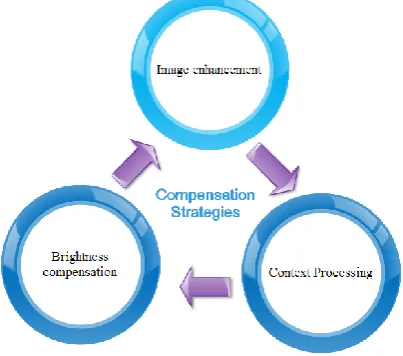
The principle of DLS (Dynamic Backlight Luminance Scaling) is to save power by backlight dimming while restoring the brightness of the image by appropriate image compensation. This scheme is generally known as Dynamic Backlight Luminance Scaling. In Chang et al. [3], a dynamic backlight luminance scaling scheme is proposed. Based on different scenarios, three compensation strategies are discussed (fig 1),
Fig 1. Image Compensation Strategies
It keeps the perceived contrast of the image as close as possible to the original while achieving 20-80% power reduction from the backlight system for still images.
III. OLED DISPLAY POWER CONSERVATION
The power consumption of an OLED display depends on the Lightness and Colour (Hue) value of the pixels displayed. Energy consumption of an OLED display can be computed as sum of energy consumption of each pixel. Unlike LCD displays whose power consumption is dominated by the external lighting, an OLED display is self-emissive and its power consumption is highly dependent on the image content (pixel value). In specific the energy consumption of a pixel is simply sum of energy used to illuminate R (Red), G (Green) and B (blue) organic materials which forms the pixel [5]. While OLED displays consume nearly zero power when presenting a black image, they could consume maximum power when presenting a white image [7].
Chuang et al. [6] propose two colour mapping approaches that is Discrete Optimization of Energy Aware Colors and Continuous Optimization of Color. Through these approach, swap current colours with an ISO-lightness colour set within a certain restrictions, so that the overall lightness of the final display is still the same with the original output. In the discrete optimization approach, in which, from a set of M iso-lightness and distinguishable colours, a subset of N colours (N ≤ M) is chosen so that the sum of the energies associated with the chosen colours is the minimum of any subset of N colours. To select the set of M adequate input colours the authors propose to adopt named (categorical) colours because they are sufficiently distinct and they exhibit proven perceptual benefits. The second approach optimizes over a continuous ISO-lightness color space by minimizing a cost function that takes into account the energy of the colors and the distances between them.
Dong et al. [7] describe two approaches of reducing power consumption of OLED based displays on mobile phones through structured colour transformation of standard background and foreground Graphical User Interface (GUI) objects, or unstructured transformation of individual pixel colours of arbitrary GUI elements. In unstructured transformation, a power efficient colour for background is identified first, then colours which have high contrast with the selected background colour are be used as window borders and foreground colours. In unstructured transformation, Dong et al. do an exhaustive search in the colour space to replace each colour in the GUI with a power efficient colour. To ensure readability, the approach ensures the colour difference between every two colours in the transformed GUI is no less than their counterparts in the original.
Betts-LaCroix [13] proposed a method that enables power savings in an OLED display by dimming selected areas of the OLED display pixel by pixel. The selected areas may include, for example, particular displayed objects such as an active Window, particular colors, etc. Dimming selected areas of the OLED display results in overall power savings. Mion Dong et al [14] introduced transforming GUI colors for power saving mechanism. The power saving color transformation can be structurally applied to GUI themes and background/foreground colors. The methodology gathers statistical information of pixel numbers of each color. It identifies a new color for each original color so that the color-transformed GUI has reduced power consumption and the difference between new colors remains in certain level of that between their originals. Dong provide three color mapping mechanism such as Problem Formulation, Rank-based Mapping, Mono-color Mapping. The experimental result proves that color transformation saves as much as 75% of the power with user acceptance.
Fig 2 Output of CURA
IV. HISTOGRAM APPROACH
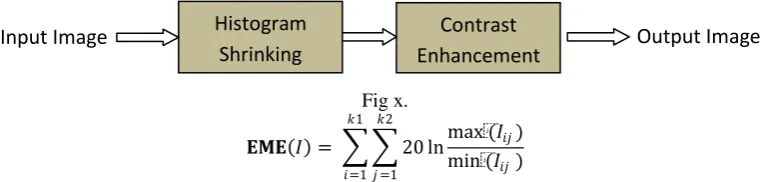
Yan-Tsung Peng et al [19] proposed a method of shrinking of histogram to reduce power. Formulate a new objective function which is subject to the constant entropy. By minimizing the distance between two near non-empty bins of image histogram, the power reduction and entropy preservation are simultaneously achieved (fig x). The balance between contrast enhancement and power-saving is a significant problem in modern display devices.
Fig x.
𝐄𝐌𝐄 𝐼 = 20 lnmax(𝐼𝑖𝑗)
min(𝐼𝑖𝑗 ) 𝑘2
𝑗 =1 𝑘1
𝑖=1
Compared to the PCCE algorithm [2], the HS method is automatically applied to different images without adjusting parameter, indicating that it has high potential for real-time Full-HD displays. This paper has proposed the HS algorithm for emissive panels of display devices. We have formulated an objective function subject to constant entropy, which prevents distortion of image histogram after power reduction (equ 1). Specifically, the HS algorithm involves one subtraction operator for computing image. Hence, it is very appropriate for real-time applications of modern Full-HD displays
V. AMOLED POWER REDUCTION STRATEGIES
Active Matrix Light Emitting diode is a display technology basically used in the touch screens of mobile phones, at the same time it is also used in computers, netbooks, tablet pc. Today most of the modern Smartphones are having AMOLED screen, it provide an optimized realization of video due to their vivid color, high contrast, wide-view angle, and fast motion-picture response time. OLED describes a specific type of thin-film display technology in which organic compounds form the electroluminescent material, and active matrix refers to the technology behind the addressing of pixels. Since it is an advancement of OLED technology, AMOLED features a great deal of the same characteristics as its predecessor.
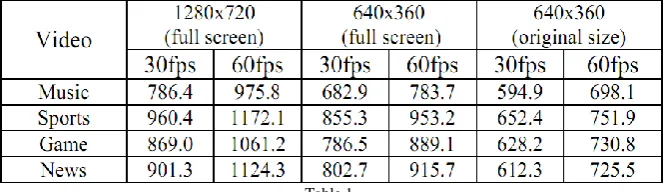
Xiang Chen et al [8] evaluate the power status of AMOLED (Active-Matrix Organic Light Emitting Diode) display unit with series of Samsung Smartphones. It discusses the power modeling of different generations of AMOLED screens and conduct detailed power investigations of popular multimedia applications. The result (Table 1) of this analysis reveals frequent generations of AMOLED does not improve notable power efficiency that was expected. The
Histogram
Shrinking
Contrast
Enhancement
dynamic color tuning techniques act better power efficiency than chromatic colors. Video encoding process consumes small unit of power from total power required for actual view of video.
Table 1
Chen experimental result reveals the sport video at 60fps and 30 fps consumes more power than the other category videos during this time AMOLED screen occupy 29% and 32% respectively. Such high power consumption comes from bright color tone and complex texture. The power consumption of an AMOLED screen is highly based on the content [8].
Pi-Cheng Hsiu et al [10] focus on minimizing the energy consumption incurred by the backlight for multimedia streaming applications on mobile devices, without adversely impacting the user’s visual perception. The authors proposed a dynamic programming algorithm for reduce backlight level. The algorithm achieved energy savings of 18-31% when browsing videos on YouTube, while users were not conscious of the dynamic backlight scaling technique.
Qiyam Tung et al [15] presented a context aware energy saving method for video on mobile device. This method tested with educational video and reduces energy usage upto 59.2% of the display unit and reduces 27% of the total energy used by the device. The author uses backprojection algorithm to replacing colors from less important regions of a lecture video and altering background color to improve energy efficiency. It uses slide-to-frame matching and slide semantic extraction to provide fine-grained understanding of content that can be exploited to enhance viewing and save energy.
Kyungtae Han et al [16] proposed a hybrid frame buffer architecture that exploits the display contents' read-dominant property to improve the energy efficiency of display subsystems. Specifically, this research employ two memory types: DRAM and Phase-Change Memory (PCM), in the display frame buffer to exploit their different read/write energy characteristics. It also present an analysis of the energy efficiency of the hybrid frame buffer based on our display content and energy consumption models. The evaluation results show that the proposed hybrid frame buffer reduces frame buffer energy consumption by up to 43%, compared to the conventional DRAM-only frame buffer.
VI. CONCLUSION
This paper reviews and highlights the milestone researches in energy aware mobile phone display and GUI design. This study surveys the energy saving methods of display, such as display backlight control, OLED, AMOLED power reduction strategies and histogram based techniques. Among the strategies of OLED power reduction, Mion Dong et al achieved high energy savings result of 75 % using the transformation of energy aware color set and various color mapping methods. AMOLED displays are more energy efficient than the other displays, Xiang Chen et al reveals that sports videos occupies more power than other videos in AMOLED displays. Pi-Cheng Hsiu et al achieved maximum of 31% of energy saving by using dynamic programming algorithm to reduce backlight level.
REFERENCES
[1] W.-C. Cheng, Y. Hou and M. Pedram, “Power Minimization in a Backlit TFT-LCD Display by Concurrent Brightness and Contrast Scaling,” IEEE Trans. on Consumer Electronics, Vol. 50, No. 1, Feb.2004, pp. 25-32.
[3] N. Chang, I. Choi and H. Shim, “DLS: Dynamic Backlight Luminance Scaling of Liquid Crystal Display,” IEEE Trans. on VLSI Systems, Vol.3, No. 8, August 2004, pp. 837-846
[4] R. Cornea, A. Nicolau and N. Dutt, “Software Annotations for Power Optimization on Mobile Devices,” Proc. DATE, 2006, pp. 684-689. [5] M. Dong, Y.-S. K. Choi, and L. Zhong, “Power modeling of graphical user interfaces on OLED displays," in Proceedings of the 46th Annual
Design Automation Conference, New York, USA: ACM, 2009, pp. 652-657
[6] J. Chuang, D. Weiskopf, and T. Moller, “Energy aware color set," in Computer Graphics Forum (Eurographics), 2009.
[7] M. Dong, Y.-S. K. Choi, and L. Zhong, “Power-saving color transformation of mobile graphical user interfaces on OLED-based displays," in Proceedings of the 14th ACM/IEEE international symposium on Low power electronics and design, ser. ISLPED '09. New York, NY, USA: ACM, 2009, pp. 339-342
[8] Xiang Chen et al., “How is Energy Consumed in Smartphone Display Applications?”, ACM HotMobile'13, pp.26-27, 2013.
[9] M. Dong and L. Zhong. Chameleon: A Color-Adaptive Web Browser for Mobile OLED Displays. In Proc. of ACM MobiSys, pp 85–98, 2011.
[10] P.-C. Hsiu, C.-H. Lin, and C.-K. Hsieh. Dynamic Backlight Scaling Optimization for Mobile Streaming Applications. In Proc. of IEEE/ACM ISLPED, pages 309–314, 2011.
[11] D. Shin, Y. Kim, N. Chang, and M. Pedram. Dynamic Voltage Scaling of OLED Displays. In Proc. of IEEE/ACM DAC, pages 53–58, 2011. [12] Chun-Han Lin, Chih-Kai Kang, and Pi-Cheng Hsiu, “Catch Your Attention: Quality-retaining Power Saving on Mobile OLED Displays”
June 01-05, 2014.
[13] J. Betts-LaCroix. Selective Dimming of Oled Displays. US Patent 0149223 A1, 2010
[14] M.Dong,Y.-S.K.Choi, andL.Zhong. “Power-Saving Color Transformation of Mobile Graphical User Interfaces on OLED-based Displays”. In Proc. of IEEE/ACM ISLPED, pp. 339–342, 2009
[15] Qiyam Tung et al, “MobiSLIC: Content-aware Energy Saving for Educational Videos on Mobile Devices” Technical Document, University of Arizona, 2014.
[16] Kyungtae Han et al, “A hybrid display frame buffer architecture for energy efficient display subsystems”, IEEE International Symposium on Low Power Electronics and Design (ISLPED), Beijing, pp. 347 – 353, 2013.
[17] M. Dong and L. Zhong. “Power Modeling and Optimization for OLED Displays”. IEEE Trans. on Mobile Computing, 1587–1599, 2012. [18] A. Bhowmik and R. Brennan. “System-Level Display Power Reduction Technologies for Portable Computing and Communications
Devices”. In IEEE Portable, May 2007