Available Online atwww.ijcsmc.com
International Journal of Computer Science and Mobile Computing
A Monthly Journal of Computer Science and Information Technology
ISSN 2320–088X
IJCSMC, Vol. 4, Issue. 6, June 2015, pg.1035 – 1039
RESEARCH ARTICLE
A Study on MAC Level Architecture
Exploration for Delay Tolerant Network
Savita
Student, M.Tech (ECE), South Point Institute of Technology & Management E.mail: [email protected]
Amit Kumar
HOD, ECE Dept, South Point Institute of Technology & Management E.mail: [email protected]
Abstract— Delay Tolerant Network is one of the critical network type which provides the controlled communication in real time scenarios. In this work, the architectural constraints of the network are explored. The architecture specification is here defined along with the MAC exploration. The protocol specific adaptation is provided in this work which includes the physical layer adaptation to the network. The communication constraints and the key feature exploration under architectural level is defined in this paper. The paper has explored the MAC protocol configuration and the responsibilities to optimize the communication. The paper has presented the exploration of various communication level resolvements provided under MAC analysis.
Keywords: MAC, Contention Control, Delay Tolerant Network, Spectrum Sensing.
I. INTRODUCTION
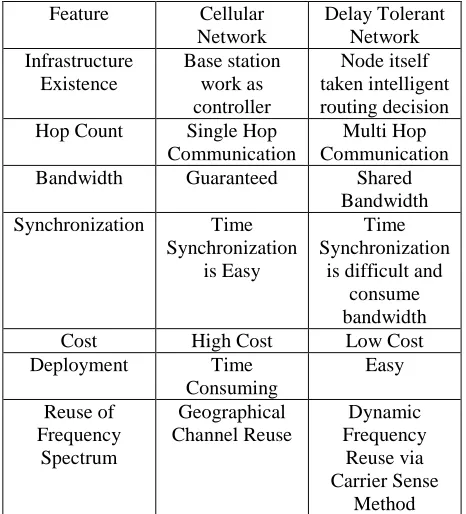
Table 1 : Feature Difference between Cellular and Delay Tolerant Network
Feature Cellular Network Delay Tolerant Network Infrastructure Existence Base station work as controller Node itself taken intelligent routing decision Hop Count Single Hop
Communication
Multi Hop Communication Bandwidth Guaranteed Shared
Bandwidth Synchronization Time
Synchronization is Easy
Time Synchronization
is difficult and consume bandwidth
Cost High Cost Low Cost
Deployment Time
Consuming Easy Reuse of Frequency Spectrum Geographical Channel Reuse Dynamic Frequency Reuse via Carrier Sense Method
A) MAC In Delay Tolerant Network
As the Delay Tolerant Network is defined to provide the sharing on broadcast channel. The bandwidth available for communication is limited so that the shared communication is required to perform in controlled form. This protocol is responsible for providing the shared medium access over the network along with issue relative derivation such as mobility observation, bandwidth analysis and resolving the expose terminal problem. MAC protocol is responsible to provide the answers to these all problems and challenges. Some of the common issues associated with MAC protocol are discussed in this section
B) MAC Protocol Issues
MAC protocol is adaptive to the channel sharing and provided the low level signal based communication over the network. The issues resolved by this protocol are listed here under
a) Bandwidth Efficiency
MAC protocol must be design to provide the effective utilization of available bandwidth. Different MAC forms are defined to provide the ratio adaptive bandwidth estimation based on actual communication analysis. This protocol is responsible to obtain the control overhead involved to provide the minimum bandwidth adaptive communication using MAC protocol.
b) Service Quality Support
This protocol is defined to provide the QoS support to resolve the complexities in data sessions. This protocol provided the improved communication under critical traffic sessions. MAC protocol is responsible for resource reservation and provides the consideration to the complexities of Delay Tolerant Network.
c) Synchronization
d) Mobility Tracking
As the nodes changes the location frequently, to perform the cooperative communication it is the responsibility of MAC protocol to track these nodes significantly. The MAC protocol does not affect the mobility but is required to track the position to provide the cooperative communication. Some MAC protocols are also defined based on the predictive positional estimation.
e) Error Prone Shared Communication
As the communication is performed through shared medium, some communication fault or conflicts or collisions can occur. The carrier sense adaptive communication is provided by MAC protocol. MAC protocol must grant channel access in such way that can reduce the collisions.
In this paper, an exploration to the MAC protocol for Delay Tolerant Network is explored. The paper has discussed different type of MAC along with evolution characteristics is explored. In this section, the basic characteristics of Delay Tolerant Network and MAC protocol is defined. The section also identified the issues required to resolve by MAC protocol for Delay Tolerant Network. In section II, the work defined by earlier researchers on different MAC protocols is discussed. In section III, the MAC protocol types are discussed along with categorization. In section IV, the conclusion of this work is defined and explored.
II. RELATED WORK
Lot of work is provided by earlier researchers on optimization of Delay Tolerant Network applied on different layers of network. Some of such work is discussed in this section. Nermin Makhlouf[1] has provided a work on MAC protocol optimization using cooperative link analysis without forming the central control. Author observed the associated communication issues along with Collision Detection on multiple nodes. Author observed the directional analysis on nodes so that mobility at node level will be identified and the predictive location based communication is formed to optimize the communication. Shivani Rao[2] has presented a comparative analysis on different MAC protocol based on cooperative communication and provided the analysis on dynamic behaviour of nodes. Author defined the comparison for CSMA and MACA technologies in terms of packet communication and delay parameters. Author observed that CSMA provided the more effective results as compared to MACA. Hongqiang Zhai[3] provided a study on associated challenges and relative solution for MAC protocol observation. Author provided the functionality specification based work to analyze the various challenges for different communicating features such as mobility, power and vulnerability analysis. Author provided the study on the associated design issues and provided the criticality observation based communication in the network. Patheja[4] also provided a work on improved MAC protocol with integration of exponential algorithm for bandwidth optimization. Author provided the analysis on the rapid growth of communication system with service level observation and sub layer derivation so that the wireless channel adaptive communication will be formed. Author provided the collision analysis and provided the secure communication under resolution analysis so that the successful transmission will be formed in the network. Author observed the real time problem in the network and provided the wait time adaptive communication in the network. Author provided the performance derivation based communication under different associated parameters. Author provided the algorithmic formation using back-off algorithm so that the observation to the network under different constraints is done. Author also provided the parameters specific analysis so that the observation to the communication vector is obtained from the work. Author provided the parameter specific communication in network and provided the improved communication over the network.
Jagruti Sahoo[6] has provided a partition adaptive message dissemination for MAC optimization. Author provided the service range based road safe communication to identify the emergency messages. Author control the density, accident adaptive communication in network.
and region specific analysis to reduce the communication latency. Aarja Kaur[13] has provided the investigation on QoS aware routing by MAC optimization. Author reduced the communication delay to optimize the network communication.
III. MAC CLASSIFICATION
There are different types of MAC protocols available. These protocols are different in terms of protocol initiation stage, time synchronization and the reservation methods. The protocol is here defined in three main categories given here under
A) Contention Based Protocols
The main feature or the requirement of MAC protocol is to improve the channel access policy under contention. The node communication control is here defined under resource reservation so that the shared channel access can be optimized. As the communication performed, the neighbor node analysis is performed. These Contention based protocols can be divided in two sub stages called single channel sender initiated and multi channel sender initiated. In case of sender initiated single channel protocol, the node gains the contention to use the complete bandwidth. But in case of multiple channels, the bandwidth is divided into sub channels and provided the simultaneous access to multiple nodes. Each node gets a separate sub channel with bandwidth specification on separate channel.
B) Contention Based Protocol with Reservation Mechanism
The real time traffic analysis is defined to achieve the periodic access over the communication channel. The communication traffic observation with reserve bandwidth analysis is achieved to provide the active traffic and communication support. The protocols in this category divided in two sub categories called Synchronous Protocol and Asynchronous Protocols. Synchronous protocol are adaptive time shared mechanism and provides the time synchronization. Asynchronous protocol does not requires such global synchronization among the communicating nodes.
C) Contention Based Protocol with Scheduling Mechanism
These protocols provide the packet scheduling at the nodes and provides channel access optimization. The node level scheduling is here achieved so that the bandwidth starvation can be avoided. The scheduling scheme is here defined to optimize the battery characteristics and provide the scheduling over the channel in optimized form.
IV. CONCLUSION
In this paper, an exploration to the MAC protocol is provided for Delay Tolerant Network. The paper has discussed the various issues associated with Delay Tolerant Network. The paper also explored the structural components of MAC protocol. Later on the categorization of MAC protocol is discussed.
REFERENCES
[1] Nermin Makhlouf," Mac Protocols in Mobile Ad Hoc Networks".
[2] Shivani Rao," A Comparative Analysis of MAC Protocols in MANET", International Journal of Emerging Technology and Advanced Engineering 2013, ISSN 2250-2459.
[3] Hongqiang Zhai," Medium access control in mobile ad hoc networks: challenges
and solutions", WIRELESS COMMUNICATIONS AND MOBILE COMPUTING 2006.
[4] Dr. P.S. Patheja," An Adaptive MAC 802.11 Protocol for MANET Using Exponential Algorithm", (IJCSIT) International Journal of Computer Science and Information Technologies 2013.
[5] HAMID MENOUAR," A SURVEY AND QUALITATIVE ANALYSIS OF MAC PROTOCOLS FOR VEHICULAR AD HOC NETWORKS", 1536-1284/06© 2006 IEEE. [6] Cristina Rico Garcia," A Reliable MAC Protocol for Broadcast MANETs".
[7] Gentian Jakllari," A SYNC-LESS TIME-DIVIDED MAC PROTOCOL FOR MOBILE AD-HOC NETWORKS". [8] Weihong Hu," LA-MAC: A Load AdaptiveMAC Protocol for MANETs".
[9] Sofiane Hamrioui," Improving Transport Protocol Performance in MANET by exploiting the Backoff Algorithm of MAC Protocol", IJNCCA 2011 (ISSN: 2220-9085).
[10] Madan Mohan Nagar," Design of Energy Efficient MAC Protocol with Increased Throughput in MANET’s", International Journal of Engineering and Innovative Technology (IJEIT) 2012, ISSN: 2277-3754.
[12] Teerawat Issariyakul," Medium access control protocols for wireless mobile ad hoc networks: issues and approaches", WIRELESS COMMUNICATIONS AND MOBILE COMPUTING 2003.
[13] Alaa Muqattash," CDMA-Based MAC Protocol for Wireless Ad Hoc Networks", MobiHoc’03 ACM 1-58113-684-6/03/0006.