Scholarship@Western
Scholarship@Western
Electronic Thesis and Dissertation Repository
8-3-2016 12:00 AM
Essays on Human Capital Complementarities
Essays on Human Capital Complementarities
Hiroaki Mori
The University of Western Ontario
Supervisor Audra J. Bowlus
The University of Western Ontario Graduate Program in Economics
A thesis submitted in partial fulfillment of the requirements for the degree in Doctor of Philosophy
© Hiroaki Mori 2016
Follow this and additional works at: https://ir.lib.uwo.ca/etd
Part of the Health Economics Commons, and the Labor Economics Commons
Recommended Citation Recommended Citation
Mori, Hiroaki, "Essays on Human Capital Complementarities" (2016). Electronic Thesis and Dissertation Repository. 3898.
https://ir.lib.uwo.ca/etd/3898
This Dissertation/Thesis is brought to you for free and open access by Scholarship@Western. It has been accepted for inclusion in Electronic Thesis and Dissertation Repository by an authorized administrator of
The thesis consists of three chapters that study the interplay between skills and
health in shaping labour market outcomes. I focus on two distinct but related issues:
i) the wage losses among older workers due to work-limiting health conditions, and ii)
the long lasting effects of childhood health conditions on human capital formation.
Chapter two studies how health conditions among older workers affect their wages
depending on the characteristics of their occupations. The U.S. Social Security Act
defines disability as the inability due to health conditions to perform physically or
men-tally demanding tasks. To examine the potentially task-specific nature of work-limiting
health conditions, I estimate a wage equation that allows health conditions to have
het-erogeneous wage returns depending on what kinds of tasks the workers conduct within
their occupations. The estimation results, based on a panel dataset of older workers in
the U.S., indicate that the magnitude of health-induced wage losses differs substantially
across occupations depending on their task characteristics, contrary to the commonly
used assumption that health is uniformly valued across occupations. I also show that
about 60% of the health-related wage gaps can be explained by the correlations
be-tween health and skills. This chapter further demonstrates that work-limiting health
conditions are correlated with the time-varying components of multiple skills. This
suggests that econometric models with single-dimensional, time-invariant unobserved
heterogeneity may not be fully successful in isolating the influences of the correlations
between health and skills.
The third chapter investigates the link between childhood health conditions and skill
formation. While existing evidence suggests that certain childhood health conditions
affect schooling outcomes, little is known as to whether and how such influences persist
skills/tasks approach, this chapter provides a set of new evidence regarding how
child-hood health conditions affect skills used in the labour market. To obtain objective
measures of childhood health conditions, I exploit medical examinations conducted in
the 1958 British National Child Development Study (NCDS). The results point to the
importance of childhood health conditions in determining what kinds of occupations
individuals pursue in the labour market. In particular, I find that those who had mental
health conditions before age 16 tend to select into less cognitive skill demanding jobs
while those who had physical health conditions sort into less manual skill demanding
jobs. The observed variation in job selections are found as important predictors of the
health-related earnings gaps.
An important question is whether poor health during childhood influences later
out-comes by restricting skill formation, or by mainly affecting future health. To further
ex-amine the sources of the earnings gaps associated with childhood health conditions, the
fourth chapter develops and estimates a lifecycle model where childhood health
condi-tions can affect formation of skills and health over the life course. The estimated model
is used to quantify the relative importance of the multiple channels through which
child-hood health conditions may affect labour earnings. The results indicate that the most
important channel accounting for mental health-related earnings gaps is the skill
chan-nel. About 60-65% of the earnings gaps can be explained by the effects of childhood
health conditions on skill formation. The effects of childhood health status on health
formation are also found to play important roles.
keywords: health, skills, task-based approach, dynamic factor analysis
First and foremost, I would like to express my deepest gratitude to my dissertation
committee members. I am especially indebted to my advisor, Audra Bowlus, for her
thoughtful guidance ever since the earliest steps of my dissertation. I simply would not
have completed this thesis without her patience and wisdom. I thank Chris Robinson
and Todd Stinebrickner for their invaluable feedback and encouragement. It was a
pleasure and an honour working with Chris for our joint project through which I learned
so much. His permission to use his multidimesional skills/tasks measures is gratefully
acknowledged.
I extend special thanks to many other faculty members who contributed greatly to
this work, including Tim Conley, Jim Davies, Lance Lochner, Nirav Mehta, Salvador
Navarro, and David Rivers. Comments received from the participants in the Applied
Economics workshop and Labour Lunch meetings have been very helpful. I am obliged
to Salvador for generously sharing his computational resources. I thank my colleagues
at Hitotsubashi University, especially Taiji Furusawa, for providing me a study leave
that helped me complete this dissertation. I am grateful to Hidehiko Ichimura and
´
Aureo de Paula for offering a kind help at early stages of my graduate studies. I would
also like to thank Daiji Kawaguchi, Hisahiro Naito, and Shintaro Yamaguchi who have
been my mentors and role models. I am also thankful to my thesis examiners including
Philip DeCicca and Sisira Sarma.
The support staffat Western have been critical to my completion of the program. I
thank Yvonne Adams, Sandra Augustine, Karin Feulgen, Jennifer Hope, Leslie Kostal,
Debra Merrifield, Maureen O’Connell, and Sharon Phillips for their great support for
my teaching and research at Western.
dous source of inspiration and joy. I extent my gratitude to Youjin Choi, Peter and
Zinaida Foltin, Selina Gonzalez, Hyeongsuk Jin, Bohan Li, Brandon Malloy, George
Orlov, Youngmin Park, Wenya Wang, Jin Zhou and many other friends who have come
and gone over the years.
To my family back in Japan, I owe a heartfelt thanks for their unconditional support
at every single step throughout my life. I dedicate this dissertation to my parents.
Abstract i
Acknowledgements iii
List of Tables ix
List of Figures xi
List of Appendices xii
1 Introduction 1
Bibliography . . . 6
2 Specificity of Health Capital 8 2.1 Introduction . . . 8
2.2 The Skill-Health Nexus . . . 12
2.2.1 Data Sources . . . 12
National Longitudinal Study of Older Men . . . 12
Dictionary of Occupational Titles . . . 14
2.2.2 Measuring Multidimensional Skills . . . 16
2.2.3 Health Measures . . . 18
Characterizing Work-limiting Health Conditions . . . 19
2.2.4 Descriptive Evidence of the Skill-Health Nexus . . . 21
2.3 Estimating a Task-based Wage Equation . . . 24
2.3.1 A Task-based Wage Equation . . . 24
2.3.2 Dealing with Self Selection and Simultaneity . . . 26
2.4 Estimation Results . . . 28
2.4.1 Task Specificity of Health-related Wage Gaps . . . 28
2.4.2 Decomposing the Health-related Wage Gap . . . 31
Contributions of Skills/Tasks and Health . . . 31
Disentangling the Skill-Health Nexus . . . 32
2.5 Conclusion . . . 34
Bibliography . . . 36
3 The Long Reach of Childhood Health on Skills 39 3.1 Introduction . . . 39
3.2 Data Sources . . . 43
3.2.1 National Child Development Study . . . 44
3.2.2 UK Skills Survey . . . 44
3.3 Linking Childhood Health with Skill Characteristics . . . 46
3.3.1 Measuring Childhood Health Conditions . . . 46
3.3.2 General Work Experience . . . 48
3.3.3 Task-specific Work Experiences . . . 48
3.3.4 Educational Outcomes . . . 51
3.4 Understanding the Health-related Earnings Gaps . . . 52
3.4.2 Decomposition of Earnings Gaps Associated with Childhood
Health Conditions . . . 53
3.5 Conclusion . . . 55
Bibliography . . . 56
4 Childhood Health and Lifecycle Human Capital Formation 60 4.1 Introduction . . . 60
4.2 Model and Estimation Strategy . . . 66
4.2.1 Model Setup . . . 66
4.2.2 Model Solution and Estimation . . . 73
4.2.3 Identification . . . 76
4.3 Estimation Results . . . 78
4.3.1 Parameter Estimates . . . 78
4.3.2 Model Fit . . . 86
4.4 Counterfactual Experiments . . . 91
4.4.1 Quantifying the Sources of the Earnings Gaps Associated with Childhood Health Conditions . . . 91
4.4.2 The Effects of Targeted Schooling Subsidy on Schooling Out-comes and Earnings . . . 94
4.5 Conclusion . . . 95
Bibliography . . . 97
5 Conclusion 101
A Chapter 2 Appendix 104
A.2 Parameter Estimates . . . 105
A.2.1 Wage Equation . . . 105
A.2.2 Skill Formation Technology . . . 105
B Chapter 3 Appendix 107
B.1 Task Characteristics in the UK Skills Survey . . . 107
C Chapter 4 Appendix 109
C.1 Health Measures . . . 109
C.1.1 Childhood Health Measures . . . 109
C.1.2 Adult Health Measures . . . 111
Curriculum Vitae 115
2.1 Classification of DOT Characteristics . . . 15
2.2 Correlation among Task Indices: CPS 1971 . . . 16
2.3 Classification of Daily Activities and Specific Health Conditions . . . . 20
2.4 Characteristics of Work-limiting Health Conditions . . . 20
2.5 Correlation between Health Reports and Observed Skills Characteristics 23 2.6 Wage Equation Parameters: Returns to Work-limiting Health Conditions 29 2.7 The Partial Effect of Work-limiting Health on Wages at Each 1-digit Occupation . . . 30
2.8 Decomposition of Health-related Wage Gap . . . 33
2.9 Further Decomposition of the Skill Components . . . 33
3.1 Distribution of Task Measures . . . 45
3.2 Fractions Ever Diagnosed with Mental or Physical Health Conditions by Age 16 . . . 47
3.3 Schooling Probabilities by Childhood Health Conditions . . . 51
3.4 Gaps in Math Test Scores by Childhood Health Conditions . . . 51
3.5 Gaps in Annual Earnings by Childhood Health Conditions . . . 53
3.6 Decomposing the Health-related Earnings Gaps . . . 55
4.1 Parameter Estimates: Post-schooling Skill Formation . . . 79
4.3 Parameter Estimates: Post-schooling Health Formation . . . 81
4.4 Parameter Estimates: Health at Labour Market Entry . . . 82
4.5 Parameter Estimates: Earnings Process . . . 83
4.6 Parameter Estimates: Work Preferences . . . 85
4.7 Parameter Estimates: Schooling Preferences . . . 86
4.8 Model Fit Regarding Average Annual Labour Earnings . . . 89
4.9 Fractions Selecting High School or University: Data vs. Model . . . 90
4.10 Quantifying Channels Through Which Childhood Health Affects Earnings 92 4.11 Decomposion of the Skill Formation Channels . . . 93
4.12 Effects of a Targeted Education Subsidy on Schooling Outcomes . . . . 94
4.13 Effects of a Targeted Education Subsidy on the Present Value (PV) of Lifetime Earnings at Age 16 . . . 95
A.1 Testing Correlated Random Effects . . . 104
A.2 Parameter Estimates: Wage Equation . . . 105
A.3 Parameter Estimates: Skill Formation Technology . . . 106
B.1 Task Characteristics in the UK Skills Survey . . . 108
C.1 Prevalence of Childhood Health Conditions . . . 110
C.2 Malaise Inventory Items . . . 112
C.3 Adult Health Indicators . . . 113
C.4 Parameter Estimates: Health Reports . . . 114
2.1 Age Profiles of Work-limiting Health Conditions and Labour Force
Par-ticipation Rates by Cohort . . . 19
3.1 Full-time Employment Rates by Childhood Health Conditions. . . 49
3.2 Task levels by Childhood Health Conditions . . . 50
4.1 Task Profiles by Childhood Health Conditions: Model vs. Data. . . 88
4.2 Full-time Employment Rates by Childhood Health Conditions: Model vs. Data. . . 89
A Chapter 2 Appendix . . . 104
B Chapter 3 Appendix . . . 107
C Chapter 4 Appendix . . . 109
Chapter 1
Introduction
My dissertation studies the interplay between health and skills in shaping labour market
outcomes. In chapter two, I examine the wage losses among older workers due to
work-limiting health conditions. In chapter three, I document descriptive evidence regarding
the long lasting effects of childhood health conditions on skill formation. Chapter four
develops and estimates a lifecycle model where childhood health conditions can affect
labour earnings both through skill formation and health formation. Each of these
chap-ters aims to facilitate our understanding regarding how the two kinds of human capitals,
health and skills, interact and evolve over the life course.
Workers face a substantial lifetime risk of developing a work-limiting health
condi-tion: the U.S. Social Security Administration estimates that a 20-year-old U.S. worker
has a three in ten chance of becoming disabled before reaching full retirement age.1
It is not surprising, therefore, that there is a large body of literature that investigates
work-limiting health conditions and the roles that they play in shaping labour market
1U.S. Social Security Administration, “Disability Benefits,” SSA Publication No. 05-10029, July
outcomes. Understanding how such health conditions affect earnings is a central task
for designing social insurance programs including the Social Security Disability
Insur-ance (SSDI) and the Medicare.2
The second chapter studies wage returns to having a work-limiting health
condi-tions. I focus in particular on estimating how the wage returns vary depending on the
characteristics of workers’ occupations. Wolfe (1984) argues that appropriate measures
of disability for labour market analysis relates to the inability to carry out a specific
task. This argument corresponds to the fact that the U.S. Social Security Act defines
disability as the inability due to health conditions to perform physically or mentally
demanding tasks. In practice, the U.S. Social Security Administration determines
eligi-bility of disaeligi-bility insurance applicants by assessing how their health conditions affect
their productivity in conducting various tasks. While the task-specific nature of
work-limiting health conditions has been acknowledged in the literature, it has not been its
main focus. Indeed, the existing literature estimates the effect of health on earnings
as-suming that health is uniformly valued across occupations, regardless of differences in
the tasks workers conduct within the occupations. The main objective of this chapter is
to address this gap by investigating the potentially task-specific nature of work-limiting
health conditions.
I take advantage of insights from task-based approaches that allow me to observe
what kinds of tasks workers conduct within their occupations. Following the previous
research, especially Poletaev and Robinson (2008) and Bowlus et al. (2016), task
mea-sures are obtained from the Dictionary of Occupation Titles (DOT) and assigned to the
2French and Jones (2011) study the Medicare program and Low and Pistaferri (2015) examine the
sample of male workers in the National Longitudinal Survey of Older Men (NLSM).
Motivated by the task selection model of Heckman and Sedlacek (1985, 1990), I then
estimate a wage equation that allows health conditions to have heterogeneous wage
re-turns depending on the task content of the occupations. Following Yamaguchi (2014),
a multidimensional learning-by-doing skill formation technology is estimated together
with the wage equation.
The estimates indicate that the magnitude of health-induced wage losses differs
sub-stantially across occupations depending on their task characteristics. The results do not
support the assumption commonly used in the previous literature that health is
uni-formly valued across occupations. Further, I find that about 60% of the health-related
wage gap can be explained by the correlations between health and skills. Existing
empirical literature on wage returns to work-limiting health conditions commonly use
fixed-effect approaches that model unobserved heterogeneity as a single-dimensional
factor. I show that the existence of work-limiting health conditions is correlated with
time-varying components of multiple skills. This suggests that the fixed-effect
ap-proaches may not fully isolate the influences of the skill-health nexus. While task-based
approaches have been mainly applied to study wage dynamics among young workers,
this chapter demonstrates that such approaches are also useful to investigate the
task-specific nature of health-induced wage losses among older workers.
In chapter three, I investigate the relationship between childhood health conditions
and skill formation. A growing body of literature emphasizes the importance of health
conditions during childhood for shaping skills and earnings over the life course.3
Exist-ing evidence suggests that certain childhood health conditions negatively affect
ing outcomes. Little is, however, known as to whether and how such influences persist
into skills used in the labour market beyond academic outcomes. While academic
out-comes may be useful to measure certain types of skills developed during schooling
periods, it is not clear whether the gaps in such skills can fully account for the long
reach of childhood health conditions on labour earnings.
The objective of the third chapter is to complement the previous research on
child-hood health by providing a set of new evidence regarding the link between childchild-hood
health conditions and various skills used in the labour market. To this end, this chapter
also adopts a task-based approach that allows me to observe how skills of
individu-als are used in conducting various tasks within their occupations. Task measures are
obtained based on workers’ self-ratings of skills/tasks in the UK Skills Survey. The
measures are then assigned to the individuals in the 1958 National Child Development
Study (NCDS) and their age profiles are examined between individuals with childhood
health conditions and those without. Following the previous research, I distinguish
mental and physical health conditions during childhood and investigate how these two
types of health conditions, observed before labour market entry, affect the age profiles
of the multidimensional, task-based skill portfolios.
The results point to the importance of childhood health conditions in determining
what kinds of occupations individuals pursue in the labour market. In particular, I find
that those who had mental conditions before age 16 tend to select into less cognitive
skill demanding occupations. In contrast, those who had physical conditions are more
likely to sort into less manual skill demanding occupations. The evidence supports
the view that childhood health conditions affect occupational choice and, therefore,
occupations. In chapter three, I further show that the observed variation in occupation
choices is a significant predictor of the earnings gaps associated with childhood health
conditions.
An important question that cannot be addressed with the descriptive analysis is the
extent to which the earnings gaps are generated by the effect of childhood health
con-ditions on skill formation. It is not clear whether poor health during childhood
influ-ences later outcomes mainly by restricting skill formation, or by affecting future health.
Quantifying the roles of the “skill channel” and the “health channel” is, however,
em-pirically challenging. Choices on schooling, labour supply, and tasks may be driven
not only by the underlying skills but also by other unobserved factors such as psychic
costs or tastes for those choices. Health conditions may affect not only what individuals
can do but also what they prefer to do. To estimate the effect of childhood health on
skill formation from the observed choices, it is necessary to distinguish the influence of
childhood health on skills and tastes. An explicit model of schooling and labour market
choices is useful for this particular purpose.
In chapter four, I formulate and estimate a lifecycle model where childhood health
conditions affect the dynamics of both skills and health over the life course. My
frame-work embeds a multidimensional technology of skill formation and health formation
into a dynamic model of schooling, labour supply and occupation choices. The model
is estimated based on the NCDS data that provides results of medical examinations
dur-ing the childhood. The estimated model is used to quantify the relative importance of
alternative channels through which childhood health conditions affect labour earnings.
Many salient features of the data are closely reproduced by the model, including
parameter estimates indicate that childhood health conditions affect formation of skills
and health as well as preferences for schooling and labour market choices. The results
indicate that the effect of childhood health on skill formation plays the greatest role in
accounting for the observed earnings losses among individuals who had childhood
men-tal health conditions. About two-thirds of the earnings losses associated with childhood
mental health conditions can be explained by the skill channel. The skill channel is also
the main factor behind the earnings losses at younger ages among those with childhood
physical health conditions. Further, I find that differences in tastes and health formation
also play significant roles for both types of health conditions, especially at older ages.
Overall, these results suggest that skills and health during childhood are complementary
in producing future skills and labour market outcomes over the life course.
Bibliography
Almond, Douglas and Janet Currie (2011) “Human Capital Development before Age
Five,”Handbook of Labor Economics, Vol. 4, pp. 1315–1486.
Bowlus, Audra J, Hiroaki Mori, and Chris Robinson (2016) “Ageing and the Skill
Port-folio: Evidence from Job Based Skill Measures,”The Journal of the Economics of
Ageing, Vol. 7, pp. 89–103.
French, Eric and John Bailey Jones (2011) “The Effects of Health Insurance and
Self-Insurance on Retirement Behavior,”Econometrica, Vol. 79, pp. 693–732.
Market Wage Functions: an Empirical Model of Self-selection in the Labor Market,”
Journal of Political Economy, pp. 1077–1125.
(1990) “Self-selection and the Distribution of Hourly Wages,”Journal of
La-bor Economics, pp. 329–363.
Low, Hamish and Luigi Pistaferri (2015) “Disability Insurance and the Dynamics of
the Incentive Insurance Trade-Off,” The American Economic Review, Vol. 105, pp.
2986–3029.
Poletaev, Maxim and Chris Robinson (2008) “Human Capital Specificity: Evidence
from the Dictionary of Occupational Titles and Displaced Worker Surveys,
1984-2000,”Journal of Labor Economics, Vol. 26, pp. 387–420.
Wolfe, Barbara L (1984) “Measuring Disability and Health,” Journal of Health
Eco-nomics, Vol. 3, pp. 187–193.
Yamaguchi, Shintaro (2014) “Changes in Returns to Task-specific Skills and Gender
Chapter 2
Specificity of Health Capital
2.1
Introduction
Understanding how health affects workers’ earnings is essential for designing social
insurance programs against work-limiting health conditions.1 The U.S. Social Security
Act defines “disability” as the inability due to health conditions to perform physically
or mentally demanding tasks.2 In practice, the U.S. Social Security Administration
assesses eligibility of disability insurance applicants by evaluating how the applicants’
health conditions limit their productivity in conducting various tasks given their health
conditions and their skill portfolio. The task-specific nature of work-limiting health
conditions has been acknowledged in the literature at least since Wolfe (1984).3
A large body of literature, however, estimates the effect of health conditions on
1See, e.g., French (2005), French and Jones (2011), and Low and Pistaferri (2015). They all estimate
the effect of health on wages as a part of their structural models.
2In this chapter I use interchangeably the term “disability” and “work-limiting health conditions”. 3According to Wolfe (1984), “disability is not simply an impairment - persistent abnormality of
earnings by modelling health explicitly or implicitly as a form of general human
cap-ital, following the health capital model of Grossman (1972). The existing empirical
models routinely assume that workers’ health is uniformly valued across occupations
and workers.4 The potentially task-specific nature of health-induced wage losses has
not been a major focus of the previous research. Moreover, the existing empirical
mod-els typically abstract from important interplay between health and skills in determining
labour market outcomes.5
The objective of this chapter is to investigate how health conditions affect wages
depending on workers’ skills and the characteristics of tasks they perform in the labour
market. To this end, I apply a multidimensional task-based approach that
character-izes various occupations as a bundle of tasks performed within the occupations.6 With
this approach, I observe what kinds of tasks individuals conduct in the labour market
through their occupation choices. While task-based approaches have been mainly used
so far to study wage dynamics among young workers, this chapter argues that this
ap-proach is also well-suited to investigate the task-specific nature of health-related wage
losses among older workers.
This chapter makes three main contributions. First, I investigate the nexus between
health conditions and skills. Skills are defined to be task-specific, following the
re-cent literature of multidimensional skills, and I estimate task-specific skills based on
task-specific occupational experience. Following Poletaev and Robinson (2008) and
Bowlus et al. (2016), the task measures are obtained from the Dictionary of Occupation
4See, e.g., J¨ackle and Himmler (2010) for an empirical model of wage determination with workers’
characteristics. Currie and Madrian (1999) provide a survey of the literature.
5See Heckman (2012) for further discussions of a framework in which skills and health jointly affect
socio-economic outcomes.
6See Sanders and Taber (2012) for a recent survey of the literature on task-based approaches and
Titles (DOT) that provides analyst ratings of tasks conducted by workers in various
oc-cupations in the U.S. The task measures are then assigned to the sample of workers in
the National Longitudinal Survey of Older Men (NLSM). While most of the previous
research regards skill heterogeneity as a nuisance parameter, I explicitly model a
multi-dimensional technology of skill formation and show how various health conditions are
correlated with skills.
The second main contribution of this chapter is to examine how health conditions
affect wages depending on the nature of tasks that workers conduct in the labour market.
Motivated by the model of Heckman and Sedlacek (1985, 1990), I estimate a task-based
wage equation in which returns to workers’ attributes are allowed to be task-specific.
In estimating the parameters of the wage equation, selection biases may arise if
indi-viduals sort into the labour force and specific occupations based on their unobserved
skill endowments. To the extent that the unobserved skills are correlated with observed
health indicators, due to genetic reasons and health investments, the estimates from a
wage regression on the health status may also suffer from a simultaneity bias. To deal
with the endogeneity issues, this chapter adopts a correlated random effect approach
(Wooldridge, 2010), following Yamaguchi (2012), and characterizes workers’
unob-served skill heterogeneity with career histories available from the NLSM.
Finally, based on the estimates of the task-based wage equation, this chapter
con-ducts a wage decomposition to isolate the contributions of skills and health in
gen-erating the observed wage gap between individuals with different health conditions.
To estimate the causal effect of health on wages, previous research has commonly
used fixed effect approaches that model unobserved heterogeneity of individuals as a
explic-itly models and estimates workers’ multidimensional time-varying skills from observed
choices and characteristics. This approach allows me to quantify the extent to which the
observed wage gaps between two individuals with different health conditions is driven
by their skill heterogeneity. This analysis features the interplay between
multidimen-sional skills and health in determining wages.
The outline of the chapter and a preview of the results are as follows. Section 2.2
explains the data sources and presents descriptive evidence regarding the nexus between
observed health conditions and skills. Skills are measured based on a
learning-by-doing skill formation technology, combining educational outcomes, work experiences,
and other observed characteristics. Measures of time-varying skills are shown to be
correlated significantly with emergence of work-limiting health conditions among older
individuals. This evidence suggests that conventional “fixed effect” approaches may not
fully remove the correlations between skills and health conditions.
Section 2.3 develops a model of wage determination that allows task-specific returns
to skills and health. By explicitly modelling how skills evolve and how skills and health
affect wages, the framework allows me to disentangle the link between skills, health,
and wages. This section also discusses approaches to deal with potential endogeneity
issues in estimating the wage equation.
Section 2.4 first presents estimates of the task-specific returns to work-limiting
health conditions. There is a sizeable difference between occupations in terms of their
task characteristics. I show that health-induced wage losses are task-specific. Indeed,
the results indicate that the magnitude of health-induced wage losses is not uniform
across occupations. An explicit model of skill formation is used not only to isolate the
wage gap between two health groups is driven by the differences in their skills. The
average wage among individuals with work-limiting health conditions is about 25%
less than that among individuals without such conditions. The wage decomposition
analysis indicates that about 60% of this wage gap is attributable to differences in their
skills. Importantly, I show that work-limiting health conditions are correlated with
time-varying components of the multidimensional skills. This result suggests that
con-ventional fixed effect approaches may not fully remove the influences of the skill-health
nexus. Finally, Section 2.5 provides some discussion and conclusions.
2.2
The Skill-Health Nexus
2.2.1
Data Sources
I combine two datasets to conduct the descriptive analysis presented in this section.
The National Longitudinal Survey of Older Men (NLSM), part of the NLS Original
Cohort project, provides data on health conditions, lifespan, completed education, and
labour market outcomes including detailed census occupations codes. The data on
oc-cupational task contents come from the 1977 edition of the Dictionary of Ococ-cupational
Titles (DOT) compiled by the U.S. Department of Labor.
National Longitudinal Study of Older Men
The NLSM includes 5,020 men born in the years 1906-21 who are 45-59 in 1966. The
original sample was designed to represent the civilian noninstitutionalized population
of the United States at the time of the initial survey. The respondents were surveyed
five until 1983. In 1990, a final interview was conducted with either living respondents,
or widows/other family members of deceased respondents. To study the nexus between
health, skills, and wages, I draw a sample from the 1966-1983 surveys, because there
is a relatively long gap between the 1983 survey and the 1990 survey and all the
re-spondents reach the early eligibility age for the Social Security retirement benefits (age
62) by 1983. I calculate lifespan of each respondent based on the mortality
informa-tion obtained in 2008 from the Nainforma-tional Death Index database and the Social Security
database.
The entire sample was used to construct all relevant variables including health,
ed-ucation, and labour market outcomes. Sampling weights calculated at the initial survey
are used. The NLSM uses the 3-digit 1960 census occupational classification system
to record workers’ occupations throughout the sampling period so there is no break
in occupation coding unlike other panel surveys that are commonly used in the
litera-ture.7 At the initial survey in 1966, all the respondents are asked to provide information
regarding the occupation title and the job tenure of their post-schooling first job, the
longest job, the previous job, and the current job. I use this career information to
con-struct occupation histories up to the initial survey year. Hourly wages are calculated by
dividing weekly labour income by weekly hours of work, and are deflated by the 1980
PCE Index.
7For instance, the Panel Study of Income Dynamics used initially a one-digit occupation code, and
Dictionary of Occupational Titles
The DOT provides on-site analyst ratings of 12,741 jobs with respect to about 50
char-acteristics of five main types. The first type has charchar-acteristics that measure levels of
interactions with “people”, “data” and “things”. The other four types measure (1)
gen-eral educational development, broadly indicating the level of education required for the
job, (2) aptitudes for various tasks, (3) temperaments for aspects of the job, and (4)
physical requirements for the job.
Subsets of the DOT characteristics are chosen as the relevant characteristics for
three predefined basic tasks. Task indices are constructed as the first principle
com-ponent in a factor analysis using these subsets. The subsets are chosen to allow some
comparability with the previous literature, especially Poletaev and Robinson (2008).
The three pre-specified tasks are given the following shorthand labels: (1) “cognitive”,
(2) “motor”, and (3) “manual”. The subsets of DOT characteristics for each of these
tasks are given in Table 2.1.
The data set for the factor analysis is the 1971 Current Population Survey (CPS)
dual coded file that includes both 1960 census occupation codes and employment weights
for DOT jobs. The analysis constructs each task indexτk as a linear combination of the
estimated scoring coefficients and standardized values of the relevant Jk DOT
charac-teristics scores for each taskk:
τk = Jk X
j=1
βjcj, k= 1,2,3, (2.1)
whereβj is the scoring coefficient for the standardized value of the j-th DOT
Table 2.1: Classification of DOT Characteristics
(1)Cognitive (2)Motor (3)Manual
(a) DOT code ratings
data, people things
(b) General educational development
reading, math, literacy
(c) Aptitude
intelligence, verbal spacial eye-hand-food coordination
form perception motor coordination
finger/manual dexterity
color discrimination
(d) Temperaments
direction-control-planning tolerances
dealing with people
(e) Physical requirements
strength
physical demand 2, 3, 5
vector from this factor analysis, and the means and standard deviations of the DOT
characteristics for the individuals in the sample, the three task indices can be computed
for any individuals in any data set with three digit occupation codes for which mean
DOT characteristic values for each three digit census occupation code can be
com-puted. Following Bowlus et al. (2016), I compute the three DOT task indices for each
of the 3-digit 1960 census occupations.
The constructed task indices are not required to be orthogonal as in a standard
fac-tor analysis. The computed tasks are, in fact, correlated. The correlation matrix for the
population used in the factor analysis is given in Table 2.2. There is a sizeable
nega-tive correlation between “cogninega-tive tasks” and “manual tasks”. Note that while “motor
be-tween “cognitive tasks” and “motor tasks”.
Table 2.2: Correlation among Task Indices: CPS 1971
(2) Motor (3) Manual
(1) Cognitive 0.157 -0.361
(2) Motor 0.218
2.2.2
Measuring Multidimensional Skills
The past literature on heterogeneous human capital has made a distinction between
tasks and skills, though often they have been treated interchangeably. Heckman and
Sedlacek (1985, 1990) introduced the concept of a task-based production function
through which labour output could be produced by workers conducting tasks with their
endowed task-specific skills. A recent discussion of the distinction in the context of the
DOT based measures used in this chapter is provided in Yamaguchi (2012). The basic
concept is that workers, at any point in time, have a vector of skills that can grow or
deteriorate over the lifecycle and are transferable across occupations. The occupations
produce output through occupation specific bundling of tasks associated with these
skills. Skills are measured based on the history of tasks chosen in the past, motivated
by a learning-by-doing skill formation process.
As in Yamaguchi (2014), I assume that skills are accumulated through a
learning-by-doing technology as in Equation (2.2), and that the endowment of thek-th skill (k =
heterogeneity ˜θki as in Equation (2.3):
lnskit+1−lnskit = dit
˜
βk
1+β˜
k
2eit+β˜k3τkit
(2.2)
lnskit0 = z 0 iβ˜
k
0+θ˜
k
i, (2.3)
wheresk
itis thek-th skill of the individualiat periodt,ditis an indicator of labour force
participation,eitis general labour market experience, andτkitis thek-th task
characteris-tic. The observed individual characteristicsziinclude years of completed education and
cohort membership. Note that the skills stay constant over two periods if the individual
does not work. The skill formation technology features diminishing returns to work
experience if ˜βk1 > 0 and ˜βk2 < 0.
It is straightforward to show that, under the skill formation technology, skills in each
period consist of observable components and unobservable permanent heterogeneity as
in Equation (2.4) after rescaling the parameters:
lnskit =z 0 iβ
k
0+β
k
1eit+β k
2e 2
it+β k
3x
k it+θ
k
i, k =1,2,3, (2.4)
where xk
it =
Pt−1
j=t0di jτ k
i j are referred to as task-specific work experience measures.
Throughout this chapter I measure multidimensional task-specific skills based on
Equa-tion (2.4). Note that skills depend on the history of past tasks, but not directly on the
2.2.3
Health Measures
Work-limiting Health Conditions
The NLSM offers two distinct kinds of health measures. The first kind of health
mea-sure is obtained through asking whether individuals have any health condition that limit
the kind or the amount of work they can perform.8 The second kind of health measure
is provided by a self-rating of one’s health status compared with others of the same age
on a discrete ordinal scale. Specifically, the respondents of the NLSM are asked the
fol-lowing question “Would you rate your health compared with other men of about your
age as excellent, good, fair, or poor?”9 I focus mainly on the measures of work-limiting
health conditions in this chapter because they are likely more relevant to labour
mar-ket outcomes and the responses are easily comparable between individuals of different
ages.
The left panel of Figure 2.1 presents the age profiles of work-limiting health
con-ditions. At age 45, around 17% of individuals report work-limiting health concon-ditions.
This fraction increases to around 24%-25% by age 55 and rises sharply afterwards to
around 50%-55% by age 65. The age profiles are similar across cohorts with the earlier
cohort somewhat less likely to report health conditions than the later cohort especially
around age 60. The higher prevalence of work-limiting health conditions among the
later cohort corresponds with lower labour force participation rates as shown in the
8The NLSM respondents are asked whether their health conditions prevent them from working if they
are not employed during the survey week. If they are employed they are asked whether they have health conditions that limit either the kind of work or the amount of work they can do. These questions are asked first in 1966 and later in 1969, 1973, 1975, 1978, 1980, and 1983. In 1971, 1976, and 1981, the respondents are asked the following question regardless of their employment status: “Do you have any health problem or condition that limits in any way the amount or kind of work you can do?”
9The NLSM asks the same question to the respondents in 1969, 1978, 1980, 1981, 1983, and 1990
right panel. 0 .2 .4 .6 .8 1 F ra ct io n w it h w o rk-l imi ti n g h e a lth co n d it io n s
45 50 55 60 65 70 75 Age
Born in 1906-13
Born in 1914-21 0
.2 .4 .6 .8 1 L a b o r fo rce p a rt ici p a tio n ra te
45 50 55 60 65 70 75
Age Born in 1906-13 Born in 1914-21
Figure 2.1: Age Profiles of Work-limiting Health Conditions and Labour Force Partic-ipation Rates by Cohort
Characterizing Work-limiting Health Conditions
The NLSM data provide additional information regarding the characteristics of the
re-spondents’ health conditions. In particular, the respondents report whether their health
conditions limit various daily activities as well as the types of their health conditions. I
categorize the daily activities into four broad groups: (1) physical, (2) social, (3)
sen-sory, and (4) other. The health conditions are classified into three groups: (1) somatic,
(2) mental, and (3) other. The specific daily activities and the health conditions in each
category are given in Table 2.3.
Table 2.4 presents the fractions of individuals reporting each type of daily activity
limitations and specific health conditions. I also tabulate the fractions of individuals
reporting fair/poor health status compared to others in the age. In addition, this table
also shows the length of remaining lifespans for each group defined by age and health
Table 2.3: Classification of Daily Activities and Specific Health Conditions
A. Daily activities
(1) Physical walking, using stairs/inclines, standing for long time, stooping,
kneeling, crouching, lifting, reaching, handling/fingering
(2) Social dealing with people
(3) Sensory seeing, hearing
(4) Other any other activity
B. Specific conditions
(1) Somatic pain, weakness, lack of strength, aches, swelling. sick feeling,
fainting spell, dizziness, troubled breathing, tiring easily
(2) Mental nervousness, tension, anxiety, depression
(3) Other any other condition
Table 2.4: Characteristics of Work-limiting Health Conditions
Overall Work-limiting health?
Yes No
Ages 46-55 56-65 46-55 56-65 46-55 56-65
Daily activity limitations
(1) Physical 0.21 0.42 0.75 0.82 0.05 0.16
(2) Social 0.03 0.04 0.09 0.08 0.01 0.01
(3) Sensory 0.07 0.18 0.25 0.34 0.02 0.08
(4) Other 0.02 0.02 0.06 0.04 0.01 0.01
Specific health conditions
(1) Somatic 0.16 0.32 0.59 0.71 0.03 0.06
(2) Mental 0.09 0.13 0.32 0.30 0.01 0.02
(3) Other 0.01 0.01 0.05 0.03 0.00 0.01
Fair/Poor health status 0.22 0.30 0.57 0.61 0.11 0.11
As individuals get older, the prevalence of physical or sensory activity limitations
increases while the prevalence of social activity limitations declines slightly. Most of
the reported work-limiting health conditions are somatic and limit physical activities,
both at earlier and later ages. While about 34-35% of work-limiting health conditions
are mental, less than 10% of the work-limiting health conditions affect social activities.
It is clear that work-limiting health conditions are typically characterized as limitations
on physical or sensory activities. Individuals who do not report work-limiting heath
conditions typically have no daily activity limitations and no specific health conditions.
Even among individuals without work-limiting health conditions, the most common
health conditions are somatic and involve limitations in physical activities, if any.
While the proportion of individuals reporting relatively fair/poor health status
in-creases with age, this trend is likely driven in part by the fact that more individuals
report work-limiting health conditions at later ages. Indeed, the age pattern is
substan-tially masked once work-limiting health conditions are controlled for. Note that the
existence of work-limiting heath conditions is correlated with a shorter lifespan:
in-dividuals with work-limiting health conditions live about 4.3-4.5 years less than those
without. The gaps in lifespan are statistically significant at the 1% level.
2.2.4
Descriptive Evidence of the Skill-Health Nexus
Estimating the causal effect of health on wages requires isolating health from other
kinds of heterogeneity that correlates with wages such as skills and job characteristics.
Most previous research has handled the skill-health nexus by modeling unobserved
het-erogeneity using a fixed effect approach. This approach may be justified if skills
occupations are typically managed by using occupation dummies or task characteristics
of the occupations.10
Table 2.5 presents how changes in health reports are correlated with work
experi-ence, employment status, and the task content of occupations. To measure changes in
health reports, I select individuals who did not report any work-limiting health
con-ditions in the initial survey. Then, I estimate how observed characteristics are
corre-lated with health reports after 5 years, 10 years, and 15 years. To measure changes in
observed skill characteristics, work experience measures are calculated based on
addi-tional experience in labour force and tasks since the initial survey. Task-specific work
experience measures are normalized to have a unit standard deviation. All estimates
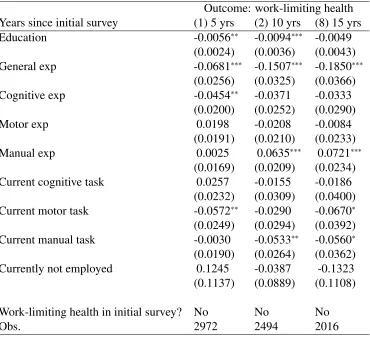
in Table 2.5 show an average partial effect based on a probit model. Individuals with
longer general work experience are less likely to report work-limiting health conditions.
This may be driven partly by the negative effect of work-limiting health conditions on
labour force participation. While individuals may over-report their work-limiting health
conditions when out of the labour force, I do not find evidence that current labour force
status is systematically correlated with current health reports conditional on past work
experiences and past health reports.11
Individuals with more extensive experience in complex cognitive tasks are less
likely to report work-limiting health conditions: a standard deviation higher
experi-10Haveman et al. (1994) include job characteristics based on DOT task measures in their wage
equa-tion, similar to this chapter. They, however, do not control the correlations between health conditions and task-specific work experience.
11Individuals may systematically change their subjective health reports depending on their labour force
Table 2.5: Correlation between Health Reports and Observed Skills Characteristics
Outcome: work-limiting health
Years since initial survey (1) 5 yrs (2) 10 yrs (8) 15 yrs
Education -0.0056∗∗ -0.0094∗∗∗ -0.0049
(0.0024) (0.0036) (0.0043)
General exp -0.0681∗∗∗ -0.1507∗∗∗ -0.1850∗∗∗
(0.0256) (0.0325) (0.0366)
Cognitive exp -0.0454∗∗ -0.0371 -0.0333
(0.0200) (0.0252) (0.0290)
Motor exp 0.0198 -0.0208 -0.0084
(0.0191) (0.0210) (0.0233)
Manual exp 0.0025 0.0635∗∗∗ 0.0721∗∗∗
(0.0169) (0.0209) (0.0234)
Current cognitive task 0.0257 -0.0155 -0.0186
(0.0232) (0.0309) (0.0400)
Current motor task -0.0572∗∗ -0.0290 -0.0670∗
(0.0249) (0.0294) (0.0392)
Current manual task -0.0030 -0.0533∗∗ -0.0560∗
(0.0190) (0.0264) (0.0362)
Currently not employed 0.1245 -0.0387 -0.1323
(0.1137) (0.0889) (0.1108)
Work-limiting health in initial survey? No No No
Obs. 2972 2494 2016
Note: All estimates show an average partial effect based on a probit model. Standard errors in paren-theses are clustered at the individual level. Ages are controlled in all specifications. The work-limiting
health indicator takes the value 1 if individuals report work-limiting health conditions and 0 otherwise.
Work experiences measure additional experiences since the initial survey in 1966. Task-specific work experiences are normalized to have a unit standard deviation. Task indices take the value 0 if individuals
are not employed.∗∗∗:p<0.01,∗∗:p<0.05,∗:p<0.10.
ence in cognitive tasks leads to about 4.5 percentage points lower reporting of
work-limiting health conditions five years after the initial survey. In contrast, individuals
with more extenive experience in manual tasks are more likely to report work-limiting
6.4-7.2 percentage points higher reporting of work-limiting health conditions ten years
after the initial survey.12 This is not surprising given the fact that most of the reported
work-limiting health conditions involve a somatic condition and limitations in
physi-cal activities. Note that the “complexity” of the current occupation in terms of manual
tasks is negatively correlated with health reports after controlling for past work
expe-rience. This may be because those who stay in a manual-task complex occupation are
relatively healthier than others.
Table 2.5 shows that changes in health reports are correlated with general and
task-specific work experience even after controlling for current employment status and
oc-cupational characteristics. In particular, the emergence of work-limiting health
condi-tions is associated with slower accumulation of work experience and more intensive
exposure to manual tasks. This suggests that modelling individual heterogeneity as a
single-dimensional time-invariant parameter may not completely remove the
correla-tion between skills and health reports.
2.3
Estimating a Task-based Wage Equation
2.3.1
A Task-based Wage Equation
The descriptive evidence presented in the last section indicates that workers’ health
conditions are correlated both with their work experiences and task choices in the labour
market. This section develops a framework to disentangle the link between health,
skills, tasks, and wages.
12Fletcher et al. (2011) show that cumulative exposure to physically demanding or hazardous
In estimating an occupational choice model, researchers often aggregate
occupa-tions arbitrarily into a small number of broad classes, such as blue collar and white
collar, to reduce computational burdens. Task-based approaches instead characterize
occupations as a set of tasks. This approach facilitates comparisons across occupations
by their task contents. The task-based wage equation provides a clear interpretation
as to how workers’ attributes are rewarded depending on the nature of the tasks they
conduct in the labour market. Consider a static economy in which labour is the only
factor of production. Assume that workers, at any point in time, are endowed with a
vector of attributes that consist of skills and health: θ = (s,h) where s = (s1,· · · ,sK)
is aK-dimensional vector of task-specific skills andhdenotes an observed indicator of
health. Occupations are characterized by specific bundling of tasksτ. Wages are paid
in accordance with the value of the marginal product of labour:
w= P(τ)Q(τ,s,h). (2.5)
Here,P(τ) denotes the price of the labour output that depends on the task characteristics
τof the occupation. The labour output Qis produced by a match between the taskτ
and the worker with productive attributesθ. Imposing a Cobb-Douglas functional form
on the output function results in the following specification of the log-wage equation:
ln ˜wit =γ0(τit)+γ1(τit)hit+ K
X
k=1
h
γk
2
τk it
lnskit
i
+ηit, (2.6)
parameters are defined as follows:
γj(τit) = γj,0+γj,1τ1it+γj,2τ2it+γj,3τ3it, j∈ {0,1} (2.7) γk
2
τk it
= γk
2,0+γ
k
2,1τ
k
it, k∈ {1,2,3}. (2.8)
The returns to task-specific skills skit can vary depending on the characteristics of
the corresponding tasksτkit. As in a Roy model, workers’ attributes have heterogeneous
returns across different tasks. Workers therefore may sort into different tasks depending
on their attributes. The task-based wage equation generalizes the previously estimated
Mincerian health-wage equations by modeling the health-related wage losses to be
po-tentially task-specific.
2.3.2
Dealing with Self Selection and Simultaneity
This chapter estimates the wage equation (2.6) with skills measured based on the
equa-tion (2.4). The parameter estimates may suffer from selection biases if individuals
select into labour force and tasks/occupations according to their unobserved skills. We
would not be able to estimate the returns to the workers’ observed attributes if those
attributes are corrlated with the unobserved skills and if the unobserved skills affect
wages. Further, the health capital model of Grossman (1972) suggests that high earners
invest more on health as the marginal benefits of health investment rises with earnings.
Therefore, observed health status may also depend on the unobserved initial skills,
thereby causing a simultaneity bias.13
13Lee (1982) and Haveman et al. (1994) use a simultaneous equation model to deal with the reverse
Yamaguchi (2014) argues that neither conventional first differencing nor
demean-ing do not necessarily alleviate those issues as the permanent unobserved skills are
interacted with the time-varying observables in the wage equation (2.6). To handle the
correlations between observed characteristics and the unobserved skill heterogeneity,
this chapter also adopts a correlated random effects approach (Wooldridge, 2010) and
models the permanent unobserved skills θk
i as a function of observed labour market
histories and lifespans:
θk i =β
k
4τ¯
k i +β
k
5d¯i+uki, k∈ {1,2,3}. (2.9)
To the extent that the observed career/life histories reflect unobserved skills
hetero-geneity, we can effectively “control” the influences of such heterogeneity by
incorporat-ing the observed histories into the wage equation (2.6). Individuals with a longer career
or those conducting complex tasks in the labour market are likely to be high-skilled.
Following Yamaguchi (2014), I include average task levels ¯τi and labour force
partici-pation ¯di over the lifecycle. Inclusion of these factors likely captures unobserved skills
that generate non-random selections into labour force and particular tasks/occupations
in the labour market. Appendix A.1 tests the null hypothesis that the additionally
in-cluded variables are uncorrelated with unobserved skills. The null hypothesis is soundly
rejected, indicating that these variables are useful in controlling for unobserved skills
of the individuals.
I assume that the residual unobserved skills (uki) are uncorrelated with the wage
measurement error and satisfy the following conditional mean independence restriction:
Euki|hit,zi,dit,eit,xit, τit,τ¯i,d¯i
This condition ensures that the health indicator (hit) and the task choices (τit) are
condi-tionally uncorrelated with unobserved skills, eliminating the endogeneity issues due to
self-selection and simultaneity. The parameters in the skills equation (2.4) and the wage
equation (2.6) can be jointly estimated by exploiting the moment restriction provided
in Equation (2.10).
2.4
Estimation Results
This section presents the main empirical results of this chapter. The first subsection
investigates and demonstrates the task-specific nature of health-related wage gaps. The
following subsection proposes and implements a wage decomposition analysis to
iso-late the contributions of skills and health in generating the observed wage gaps
associ-ated with the indicator of work-limiting health conditions.
2.4.1
Task Specificity of Health-related Wage Gaps
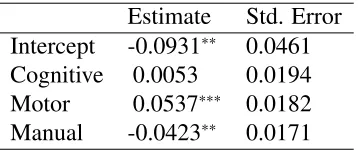
Table 2.6 reports the estimates for the parameterγ1in Equation (2.6) that characterizes
the effect of work-limiting health conditions on log-wages. Following the descriptive
analysis in the previous section, I distinguish three types of pre-defined tasks: (1)
cog-nitive tasks, (2) motor tasks, and (3) manual tasks. Note that the task-based wage
equation allows the wage effect of health conditions to vary with the three tasks.
The estimates support the views of Wolfe (1984) that the labour market
conse-quences of work-limiting health conditions are task-specific. In particular, the
Table 2.6: Wage Equation Parameters: Returns to Work-limiting Health Conditions
Estimate Std. Error
Intercept -0.0931∗∗ 0.0461
Cognitive 0.0053 0.0194
Motor 0.0537∗∗∗ 0.0182
Manual -0.0423∗∗ 0.0171
Note: This table shows the estimates for the parameterβ1in Equation (2.6). Standard errors are clustered at the individual level. The sample consists of 3,804 men. The total number of observations is 15,145.
∗∗∗:p<0.01,∗∗:p<0.05,∗:p<0.10.
in occupations that command higher manual tasks.14 This is not surprising given the
fact that most work-limiting health conditions involve a limitation in physical activities.
Interestingly, the estimates indicate also that the negative wage-effect of work-limiting
health conditions is smaller in occupations that command higher motor tasks. While
motor tasks and manual tasks are positively correlated, these results suggest the
impor-tance of distinguishing these two types of “physical” tasks. While previous research
has commonly assumed that the wage returns to health conditions are uniform across
workers in different occupations, the estimates presented in Table 2.6 do not support
this assumption.
Researchers often rely on fixed-effect approaches to deal with correlations between
health and other unobserved factors that may affect both health and wages. Such
ap-proaches may not work well with wage models in which health conditions are interacted
with period-by-period choices. The estimates in Table 2.6 suggest the importance of
modelling interactions between health and tasks in wage equations.
The estimates suggest that the wage effect of work-limiting health conditions differ
across occupations as occupations are heterogeneous in bundling the tasks. Table 2.7
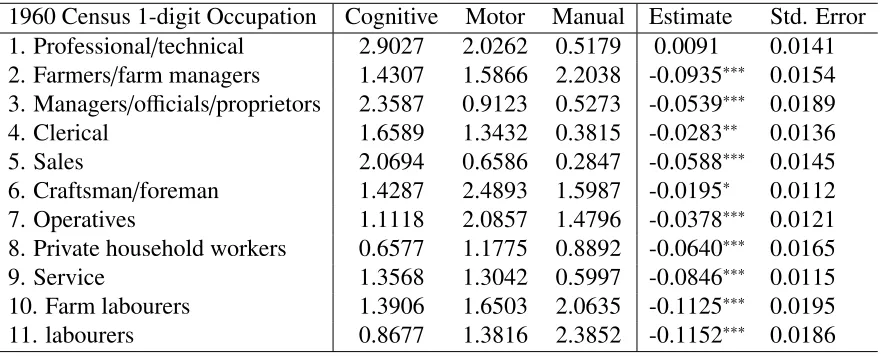
reports the average task characteristics of each 1-digit census 1960 occupation along
with estimated wage effect of having a work-limiting health condition. Note that the
estimates are based only on the parameter estimates in Table 2.6 and the task
character-istics of each occupation so that they do not reflect the differences in workers’ skills in
each occupation.
Table 2.7: The Partial Effect of Work-limiting Health on Wages at Each 1-digit
Occu-pation
1960 Census 1-digit Occupation Cognitive Motor Manual Estimate Std. Error
1. Professional/technical 2.9027 2.0262 0.5179 0.0091 0.0141
2. Farmers/farm managers 1.4307 1.5866 2.2038 -0.0935∗∗∗ 0.0154
3. Managers/officials/proprietors 2.3587 0.9123 0.5273 -0.0539∗∗∗ 0.0189
4. Clerical 1.6589 1.3432 0.3815 -0.0283∗∗ 0.0136
5. Sales 2.0694 0.6586 0.2847 -0.0588∗∗∗ 0.0145
6. Craftsman/foreman 1.4287 2.4893 1.5987 -0.0195∗ 0.0112
7. Operatives 1.1118 2.0857 1.4796 -0.0378∗∗∗ 0.0121
8. Private household workers 0.6577 1.1775 0.8892 -0.0640∗∗∗ 0.0165
9. Service 1.3568 1.3042 0.5997 -0.0846∗∗∗ 0.0115
10. Farm labourers 1.3906 1.6503 2.0635 -0.1125∗∗∗ 0.0195
11. labourers 0.8677 1.3816 2.3852 -0.1152∗∗∗ 0.0186
Note: Standard errors are clustered at the individual level.∗∗∗:p<0.01,∗∗:p<0.05,∗: p<0.10.
The estimated wage effects of work-limiting health conditions are the largest among
occupations that command relatively high manual tasks and low motor tasks such as
farmers and labourers: the wage losses are around 9%-12%. The wage losses are
sub-stantially smaller in occupations that command relatively high motor tasks and low
manual tasks. In particular, the estimated health-related wage loss is not statistically
different from zero at the professional and technical occupations.
The results shown in Table 2.7 highlight the heterogeneity in health-related wage
losses. While some of the previous research acknowledged the correlations between
health and occupation choices, such correlations were often ignored or modelled as
nuisance parameters.15 Allowing rich interactions between occupation dummies and
health indicators can be computationally demanding. Further, it is not clear how we
can interpret the heterogeneity in health-related wage losses across occupations
with-out knowing the characteristics of those occupations. The task-based wage equation
provides a clear interpretation as to how health affects wages depending on the task
contents of the occupations.
2.4.2
Decomposing the Health-related Wage Gap
Contributions of Skills/Tasks and Health
The estimates presented in the last section demonstrate significant correlations between
the observed skill measures and the indicator of work-limiting health conditions. This
suggests that a wage gap between individuals with work-limiting health conditions and
those without may be in part due to the differences in their skills. Unlike fixed-effect
approaches, the task-based wage equation explicitly takes into account the correlations
between health and skills. This enables me to “partial out” the influences of the
skill-health nexus in generating the wage gap between individuals with work-limiting skill-health
conditions and those without. In this section I estimate the contributions of skills and
tasks in generating the health-related wage gap given the the estimates from the
task-based wage equation and the skill formation equation.16
Table 2.8 decomposes the health-related wage gap into five components: the first
component arises due to the differences in task choices, the next three components
re-flect differences in task-specific skills, and the last component shows the partial effect
of a work-limiting health condition. Note that both the wage structure and the skill
for-mation technology are common for all the individuals. Individuals with work-limiting
health conditions earn about 25% lower hourly wages than those without such
condi-tions. The partial effect of a work-limiting health condition is found to be substantially
smaller than their overall wage gap: the wage gap due to a work-limiting health
condi-tion is found to be about 7.9% after controlling for the skill gaps and task choices. The
differences in cognitive skills explain about 44% (≈ 0.1110/0.2502) of the wage gap
and the the differences in terms of manual skills/tasks explain additionally about 18%
(≈ 0.0451/0.2502) of the wage gap. The wage decomposition demonstrates that about
60% of the overall health-related wage gap is attributable to the differences in the skill
portfolios. These results point to the importance of the interplay between health and
skills to account for health-related wage gaps. The differences in the observed
char-acteristics, including the skill measures, work-limiting health conditions, and the task
choices, can account for about 81% of the observed wage gap.
Disentangling the Skill-Health Nexus
The estimates presented in Table 2.8 indicates that the health-related wage gap is largely
driven by the correlation between work-limiting health conditions and two types of
skills: the cognitive skills and the manual skills. Table 2.9 further decomposes skills
at each period of time into the following three components: the first component shows
the effect of education on the skill, the second component is the effect of general and
Table 2.8: Decomposition of Health-related Wage Gap
Estimate Std. Error
Tasks 0.0225 0.0167
Cognitive skills -0.1110∗∗∗ 0.0320
Motor skills 0.0104 0.0112
Manual skills -0.0451∗∗∗ 0.0201
Health -0.0786∗∗ 0.0378
Unobs. -0.0482∗∗∗ 0.0104
Overall -0.2502∗∗ 0.0991
Note: The wage structure and the skill formation technology are common for all the individuals. Standard errors are clustered at the individual level.∗∗∗: p<0.01,∗∗: p<0.05,∗: p<0.10.
factors defined in Equation (2.9). Again,both the wage structure and the skill formation
technology are assumed to be common for all the individuals.
Table 2.9: Further Decomposition of the Skill Components
Estimate Std. Error
Cognitive skills:
Intercept -0.0034∗∗∗ 0.0014
Education -0.0836∗∗∗ 0.0232
Experience -0.0363∗∗∗ 0.0191
Other factors 0.0123 0.0112
Overall -0.1110∗∗∗ 0.0320
Manual skills:
Intercept -0.0240∗∗∗ 0.0091
Education -0.0028 0.0128
Experience 0.0454∗∗ 0.0211
Other factors -0.0637∗∗∗ 0.0253
Overall -0.0451∗∗∗ 0.0201
Note: The wage structure and the skill formation technology are common for all the individuals. Standard