i
CHALLENGES FACING TRANSITION OF LEARNERS
WITH INTELLECTUAL DISABILITY FROM SPECIAL
SCHOOLS TO WORK IN NAKURU COUNTY, KENYA
BY
HANNAH N. MAINA
E55/CE/22941/2010
A Research Thesis Submitted in partial fulfillment for
the Degree of Master of Education (Special Needs
Education) in the School of Education, Kenyatta
University
ii Declaration
I confirm that this research thesis is my original work and has not been
presented in any other university/institution. The thesis has been
complimented by referenced works duly acknowledged. Where text, data
graphics, pictures or tables have been borrowed from other works- including
the internet, the sources are specifically accredited through referencing in
accordance with anti-plagiarism regulations.
Signature: _______________________________Date:_______________
Maina Hannah Njeri
E55/CE/22941/2010
We confirm that the work presented in this thesis was carried out by the
candidate under our supervision as University supervisors
Signature: _______________________________Date:________________
Dr. Jessina Muthee,
Lecturer, Department of Special Needs Education
Kenyatta University
Signature: _______________________________Date:________________
Dr. Catherine G. Murungi,
Senior lecturer, Department of Early Childhood studies
iii Dedication
This work is dedicated to my children Naomi and Brian who have been a great
iv Acknowledgement
I would like to thank those who have supported me; my supervisors Dr. Jessina
Muthee and Dr. Catherine G. Murungi, my family and friends who have made
v
Table of Contents
Declaration ... ii
Dedication ... iii
Acknowledgement ... iiv
Table of Contents ... v
List of Figures ... iix
List of Tables ... x
Abbreviations ... xi
Abstract ... xii
CHAPTER ONE: INTRODUCTION TO THE STUDY ... 1
1.0 Introduction ... 1
1.1 Background to the Study ... 1
1.2 Statement of the Problem ... 4
1.2.1 Purpose of the Study ... 5
1.3 Specific Research Objectives ... 5
1.4 Research Question ... 6
1.5 Significance of the Study ... 6
1.6 Delimitations and Limitations ... 7
1.6.1 Delimitations ... 7
1.6.2 Limitations ... 7
1.7 Assumptions ... 7
1.8 Theoretical and Conceptual Framework ... 8
1.8.1 Theoretical Framework ... 8
vi
1.9 Definition of Operational Terms ... 11
CHAPTER TWO: REVIEW OF RELATED LITERATURE ... 12
2.0 Introduction ... 12
2.1 Introduction to Intellectual Disability ... 12
2.1.1 Prevalence ... 13
2.1.2 Causes ... 14
2.1.3 Categories of Intellectual Disability ... 14
2.2 Transition of Adolescents and Young Adults with Disability ... 15
2.2.1 Post School Experiences for Learners with Intellectual Disability ... 19
2.3 Transition Goals and Plans for Learners with Intellectual Disability ... 20
2.4 Individual Graduation Preparedness of the Learners with Intellectual Disability ... 21
2.5 Engagement of the Graduates with Intellectual Disability by the Service Providers after School ... 22
2.6 Summary ... 23
CHAPTER THREE: RESEARCH DESIGN AND METHODOLOGY ... 25
3.1 Introduction ... 25
3.2.1 Research Design ... 25
3.2.2 Research Locale ... 25
3.3 Population ... 26
3.4 Sampling Techniques and Sample Sizes ... 26
3.4.1 Sample Size ... 26
3.4.2 Sampling Technique ... 28
vii
3.5.1 Instrumentation ... 29
3.5.2 Validity ... 29
3.5.3 Reliability ... 30
3.6 Data Collection Techniques ... 30
3.6.1 Piloting Study ... 30
3.6.2 Actual Data Collection ... 31
3.6.3 Logistical and Ethical Considerations ... 32
3.7 Data Analysis ... 33
CHAPTER FOUR: FINDINGS, INTERPRETATION AND DISCUSSIONS ... 34
4.1 Introduction ... 34
4.2 General and Demographic Information ... 35
4.2.1.1General Information ... 35
4.2.1.2 Return Rate ... 35
4.2.1.3 School Population and Learners Above 18 Years of Age ... 35
4.2.1.4 Admissions ... 36
4.2.1.5 Demographic Data ... 37
4.2.1.6 Gender of Respondents ... 38
4.2.2.1Academic Qualification ... 38
4.2.2.2 Area of Specialisation ... 39
4.2.2.3 Teaching Experience ... 40
4.3 Findings by Objectives ... 41
viii
4.3.2 Preparedness of the Learners for Transition ... 44
4.3.3 Graduation among the Learners with Intellectual Disability ... 48
4.3.4 Service Providers and Systems Engaging Learners with Intellectual Disability after their Training ... 49
CHAPTER FIVE: SUMMARY, CONCLUSIONS AND RECOMMENDATIONS ... 52
5.1 Introduction ... 52
5.2 Summary ... 52
5.3 Conclusions ... 54
5.4 Recommendations ... 55
5.5 Recommendation for Further Research ... 56
References ... 57
APPENDIX I: QUESTIONNAIRE FOR HEAD TEACHERS ... 61
APPENDIX II: QUESTIONNAIRE FOR TEACHERS ... 67
APPENDIX III: INTERVIEW GUIDE FOR PARENTS ... 71
APPENDIX IV: TIME SCHEDULE ... 75
APPENDIX V: RESEARCH BUDGET ... 77
APPENDIX VI: MAP OF NAKURU COUNTY ... 78
ix
List of Figures
Figure 1.1 Transition of learners with intellectual disability from school to
work ... 10
Figure 3.1 Sampling frame ... 27
x List of Tables
Table 4.1 School enrolment as at February 2015 ... 35
Table 4.2 Source of information of existence of the special school ... 36
Table 4.3 Duration of the children in the special school ... 37
Table 4.4 Gender of respondents ... 38
Table 4.5 Academic qualification of respondents ... 38
Table 4.6 Area of specialisation of respondents ... 39
Table 4.7 General teaching experience of the teachers ... 40
Table 4.8 Teaching experience in the special schools ... 40
Table 4.9 Duration the curriculum has been used ... 42
Table 4.10 Presence of transition plans in the curriculum... 43
Table 4.11 Curriculum addressing individual learner’s needs ... 43
Table 4.12 Learners Aacquisition of skills of independent living ... 46
xi Abbreviations
AAMR American Association on Mental Retardation
BCPSS Baltimore City Public School System
BTC Baltimore Transition Connection
FPE Free Primary Education
ID Intellectual Disability
IDEA Individuals with Disability Education Act
IEP Individualized Education Programme
IER International Encyclopedia of Rehabilitation
ITP Individualized Transition plan
KNSPWD Kenya National Survey for Persons with Disability
MDGs Millennium Development Goals
MR Mentally Retarded
NCSET National Center on Secondary Education and Transition
NIMH National Institute for the Mentally Handicapped
SNE Special Needs Education
xii Abstract
1
CHAPTER ONE
INTRODUCTION TO THE STUDY
1.0 Introduction
Aim of the study was to investigate what hinders the learners with
intellectual disability from transiting from school to work. This chapter
presents background to the study, statement of the problem, purpose of the
study, research objectives, research questions of the study, significance of
the study, delimitations and limitations of the study, assumptions to the
study, theoretical and conceptual framework of the study and definitions of
operational terms.
1.1 Background to the Study
Globally, for many young adults with intellectual disability, becoming a
productive, sufficient and independent adult frequently remains an elusive
goal. According to Hardman (as cited in Gargiulo, 2009), the graduates of
special education programs do not yet participate fully in the economic and
social mainstream of their communities (Gargiulo, 2009).
According to Thressiakutty& Rao, 2001, majority of children with
intellectual disability continue to be in special schools irrespective of their
age, ability and the duration of schooling. As a result they rarely leave
school to join the community as a productive member of the society; where
as the ultimate aim of special education is employability and independent
2
often times, uninformed people believe that persons with intellectual
disability are not capable of obtaining and holding a job. This is not true,
even though employment rate for adults with intellectual disability are
minimal especially for young ladies with intellectual disability.
Secondly, according to Blacher, (2001), most research findings are derived
from two ends of the continuum-childhood and old age. There is a wide gap
in research between childhood and adulthood for persons with intellectual
disability. Blacher further proposes that researchers ‘‘fill the gap’’ in the
literature by examining the critical transition period for persons with
intellectual disability from late adolescence to young adulthood between the
ages 18-26 years where formal education ends and changes in where the
individual lives, what he/she does and the socialization. Study of transitional
experiences will help to fill this gap, providing information that can be
utilized by policy makers and employers, especially to facilitate planning for
the future of these young adults with intellectual disability.
Thirdly, in the AAMR, 2002 definition of intellectual disability there are
five assumptions essential in using this definition. The third assumptions
states that within an individual, limitations often co-exist with strengths, the
fourth states that an important purpose of describing limitations is to develop
a profile of needed supports while the fifth states that with appropriate
personalized supports over a sustained period, the life functioning of the
3
these children must be comprehensive and functional, equipping them to the
maximum extent possible with the experience they need to live and work in
their respective communities both now and in future (Gargiulo, 2009).
Fourth, the Kenya National Survey for persons with Disability (KNSPWD)
preliminary report, 2008, had the intention of providing the basis for
improving planning for persons with disability in terms of education,
training, infrastructure, rehabilitation, assistive devices and environmental
factors. In this way persons with disability were to be assisted and enabled to
participate effectively and with dignity as full members of society.
According to Kiarie, 2005, issues affecting other areas of special education
services in Kenya also affect services for students with intellectual disability.
According to Musima, 2014 in his study into Factors Influencing Transition
Rate of Learners with Intellectual Disability from Vocational Training to
Employment in Nairobi County Kenya, transition from school to
employment for learners with intellectual disability remains a challenge in
Kenya.
In efforts to seek a solution to the transition problem, some countries like
India, the Special Needs Educators have come up with a transition guide to
assist the students with intellectual disability to smoothly transit from school
to work (Thressiakutty& Rao, 2001). Baltimore city in Maryland, United
States has a model that supports the learners with intellectual disability to
transit to the world of work by integrating their training with attachment to
4
It is out of the challenges faced by learners with intellectual disability in
transiting from school to work in Nakuru County and Blacher’s call to
research of the critical transition period that the researcher intends to
investigate whether with appropriate planning and coordinated training,
individuals with intellectual disability can secure and maintain meaningful
and gainful employment.
1.2 Statement of the Problem
Besides employment difficulties for the intellectually challenged persons,
independent living is an objective not yet attained Kraus, seltzer, Gordan &
Friedman, as cited in Gargiulo, 2009.According to Kiarie, 2005,in her
research on Educational Services for Students with intellectual disability in
Kenya, development of a transition-based service provision model is vital
especially for students with severe intellectual disability. Students with
disabilities need to be taught with content that considers where and how they
are going to live and work as adults. Learners with intellectual disability
who have undergone education in special schools should utilize the skills
that are impacted to them and lead a more decent life which is not the case.
This aspect is lacking in the education of students with intellectual
disabilities in Kenya.
In Nakuru County Kenya learners with intellectual disability remain in the
5
these special schools that include the prevocational and vocational level that
is meant to empower the learners with intellectual disability with skills to
use at work after their lives in school.
In this view the researcher seeks to investigate what hinders the learners
with intellectual disability from transiting to work after their stipulated
training period in the special schools is over.
1.2.1 Purpose of the Study
In this study, the researcher seeks to investigate why the learners with
intellectual disability rarely leave the special school after their education
which includes the vocational training. Further, the researcher will find out
what hinders the employers from employing the persons with intellectual
disability despite the vocational training.
1.3 Specific Research Objectives
The objectives of this study are to:
1. Find out transitions plans in curriculum for the learners with intellectual
disability
2. Investigate preparedness of the learners with intellectual disability for
transition
3. Find out what determines graduation readiness for the learners with
6
4. Investigate the engagement of the learners with intellectual disability
by the employers after their training
1.4 Research Question
This study seeks to answer the following questions:
1. Which are the transition plans in curriculum for the learners with
intellectual disability in special schools?
2. How prepared are the learners with intellectual disability for transition
according to the curriculum used?
3. What factors determines graduation readiness among the learners with
intellectual disability?
4. How well do the employers engage learners with intellectual disability
after their training?
1.5 Significance of the Study
It is hoped that the findings of the study will be useful to the government in
realizing the need to reassess the curriculum and services offered in special
school for the learners with intellectual disability for better and
well-coordinated transition service provision. The study may be useful to improve
understanding of the needs of the learners with intellectual disability to the
parents and teachers hence a chance to reflect on comprehensive transition
plans and suitable adaption. The study may also help to develop a positive
7
learn skills for independent living. It may also add knowledge to the existing
literature on training of the learners with intellectual disability.
1.6 Delimitations and Limitations
1.6.1 Delimitations
The study was carried out in special schools for the learners with intellectual
disability in Nakuru County. The study included only children with no other
handicapping condition undergoing the current curriculum in institutions for
the learners with intellectual disability. The study was carried out in fully
established special schools for the learners with intellectual disability with
all the levels up to the vocational level. The study was carried out in public
special schools that receive the FPE funds from the government that are
intended to support the schools for more efficiency.
1.6.2 Limitations
The researcher was not able to get information from the learners with
intellectual disability because of their nature of disability. Schools and
institutions of the learners with intellectual disability are few and scattered
within the country.
1.7 Assumptions
The researcher assumed that the schools have adequate teaching and
learning resources, adequate professionally qualified staff, there exists a
8
hand in hand with the relevant government and non-governmental bodies to
facilitate educational services for the learners with intellectual disability
1.8 Theoretical and Conceptual Framework
1.8.1 Theoretical Framework
The researcher will use the Piaget’s theory of cognitive development. It is a
comprehensive theory about the nature and development of human
intelligence. It deals with the nature of knowledge itself and how humans
come gradually to acquire, construct, and use it (Weisz & Yeates, 1981),
According to Weisz & Yeates(1981),persons with ID and those without pass
through cognitive developmental stages in an identical order. These stages are
usually defined as those described by Piaget in 1970. Persons with intellectual
disability are said to traverse these stages more slowly and attain a lower upper
limit than those without. But when the two groups are equated for level of
cognitive development they are not expected to differ in the cognitive
processes by which they reason.
In this study the theory will be adopted to show that with appropriate and
well-coordinated school programme and instruction involving all stakeholders and
multiple quality options of employment and meaningful training, learners with
intellectual disability can learn from the school experiences that mainly
9
The most critical aspect is success through a comprehensive Individualized
Education Programme (IEP) with Individualized Transition Programme (ITP)
for the learners with intellectual disability.
According to Gargiulo, (2009), transition is associated with gaining access
to employment and becoming appropriately involved in the community.
Examining the status of the teaching and learning activities, human and
material resources for the learners with intellectual disability in special
schools of Nakuru County will enable the researcher to reflect on their lived
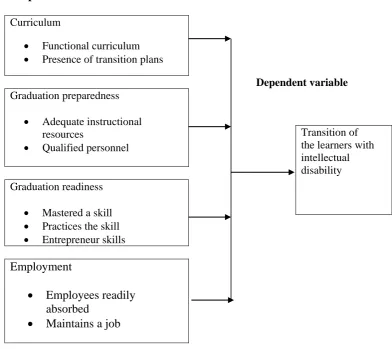
10 1.8.2 Conceptual Framework
Independent variables Independent variables
Curriculum
Functional curriculum Presence of transition plans
Dependent variable Graduation preparedness
Adequate instructional resources
Qualified personnel
Graduation readiness
Mastered a skill Practices the skill Entrepreneur skills
Employment
Employees readily
absorbed
Maintains a job
Source: Researcher’s own conceptualization (2014)
Figure 1.1 Transition of learners with intellectual disability from school to
work
11 1.9 Definition of Operational Terms
Adolescent – A person developing from being a child to an adult
Adult- A person who has attained the age of 18 and is expected to be working
and responsible.
Curriculum – The teaching and learning guidelines lay down by the MOEST
Education- The skills that learners with intellectual disability get from
attending a special school
Intellectual disability -The recent term referring to mental retardation
Mental retardation – Disability hindering the affected children from
learning basic academics in schools but can learn other skills leading to
independence in their future adult life.
Learner with intellectual disability- This is learner cannot cope with basic
academics in schools but can learn other skills leading to independence in
their future adult life.
Special school - An institution where the trainable mentally retarded
children go for their education and vocational training
Transition - The movement of a learner from the education stage to
working stage of life
Vocational skills for ID: Non academic skills that an ID person has gained
12
CHAPTER TWO
REVIEW OF RELATEDLITERATURE
2.0Introduction
This chapter covers introduction to intellectual disability, transition of
adolescents and young adults, post school experiences, transition goals and
plans, individual preparedness of the graduates and absorption of the
graduates after school by the employers.
2.1Introduction to Intellectual Disability
In the past, several terms have been used to refer to this category of disability.
The terms included idiot, moron, feeble minded and the mentally retarded. In
each case, the original term was neutral in meaning. As the term entered public
use, it become pejorative. When the conditions carry a social stigma, the
diagnostic labels themselves become stigmatizing. The original term loses its
intended neutral meaning. This prompts search for a new better term. The most
recent version of the Diagnostic and Statistical Manual of Mental Disorders
(DSM-5, APA, 2013) adopted the term intellectual disability replacing the
older term mental retardation ( Reynolds, Zupanick&Dombeck, 2013).
Intellectual disability is a disability characterized by significant limitations in
both intellectual functioning and inadaptive behavior, which covers many
13
18(Schalock, Borthwick-Duffy, Bradley, Buntinx, Coulter, Craig,Yeager,
2010).
The American Association on Mental Retardation (AAMR), (2002) define
intellectual disability as a disability characterized by significant limitations
both in intellectual functioning and in adaptive behaviour as expressed in
conceptual, social, and practical adaptive skills. This disability originates
before age 18. Accompanying this description were five assumptions
considered essential when applying this definition: First limitations in present
functioning must be considered within the context of community environments
typical of the individual age’s peer and culture. Second, valid assessment
considers cultural and linguistic diversity as well as differences in
communication, sensory motor and behavioral factors. Third, within an
individual, limitations often coexist with strengths. Fourth, an important
purpose of describing limitations is to develop a profile of needed supports.
Lastly, with appropriate personalized supports over a sustained period, the life
functioning of the persons with mental retardation will improve (Gargiulo,
2009).
2.1.1 Prevalence
For many years, the Federal government of USA estimated the prevalence of
intellectual disability in the general population to be three percent.
Researchers have questioned the accuracy of three percent prevalence figure.
Most of them propose a prevalence figure close to one percent of the general
14
Persons with Disability (KNSPWD) preliminary report, 2008, the prevalence
of persons with intellectual disability in Kenya is 0.3 percent of general
population.
2.1.2 Causes
The AAMR, 2002 describes three main possible cause of intellectual
disability based on the time of onset. It may be before birth, during birth or
after birth. The causes for the specific intellectual disability are difficult to
determine. Some causes before birth may include chromosomal
abnormalities, metabolic and nutritional disorders, maternal infections,
environmental contributions and unknown influences. During birth,
gestational disorders and neonatal complication may lead to intellectual
disability. At post natal stage the possible cause are infections and
intoxications and environmental factors. (Gargiulo, 2009).
2.1.3 Categories of Intellectual Disability
The individuals with an intellectual disability are classified into categories
according to the cause of disability, severity of the condition and educational
expectations. Deficits in intellectual functioning and impairment in adaptive
behaviour results to the individual being classified into one of the four levels
of mental retardation, mild, moderate, severe or profound, with mild
representing the highest level of performance for persons thought to have
15
In the field of Special Needs Education, teachers classify learners with
intellectual disability into two groups; educable mentally retarded (EMR)
and the trainable mentally retarded (TMR). The educable can progress
academically to a late elementary level. The trainable are incapable of
academic learning but can be trained in the non-academic areas.
The Kenya Ministry of Education, in its guidelines on students with disabilities
(1995), characterized the children with intellectual disability as follows:
develop more slowly than other children, learn more slowly than people of the
same age, have low attention abilities, lack motivation, have poor memory,
have problems with language and other social skills, experience low academic
achievement, have personality and behavioural problems, experience low
academic achievement, are withdrawn and experience difficulties in making
friends, lack self-help skills, lack work adjustment skills, may be aggressive,
may have physical defects and associated disabling problems such as autism,
epilepsy, and cerebral palsy (Kiarie,2005).
2.2Transition of Adolescents and Young Adults with Disability
PL108-446 Individuals with Disability Education Act (IDEA) stipulates that
each student with disability is to receive transition services, which are
defined as coordinated set of activities for a student with disability. To
ensure that the mandate for transition services is met, IDEA 2004 requires
that each student, beginning no later than age 16(and annually thereafter),
have an Individualized Transition Plan (ITP) incorporated in their IEP
16
needs and courses of study that are intended to enhance the student’s post
school success. The goal of the ITP is to link the curricular content to the
demands of living and working in the community as an independent adult.
To meet this, the instruction strategies must be functional according to the
requirements of the community settings i.e. the natural settings where these
skills are to be exhibited (Halpern, 1992 as cited in Gargiulo, 2009).
Preparing the young people for lives as independent adults has been a long
term goal for the education system. This objective typically includes the
skills necessary for securing employment, pursuing post primary and
secondary educational opportunities, participating in the community, living
independently, and engaging in social / recreational activities (Gargiulo,
2009).Full participation in adult life is a goal that is unattainable for a large
number of persons with disabilities if proper plans are not made.
In terms of adult outcomes, transition education is built on three basic
propositions. First, upon leaving school young adults with disabilities should
be engaged in some form of employment or meaningful daytime activity
occupying an amount of time equivalent to a full working day. Second, the
young adults with disabilities will live in a community setting and
participate in community activities in a manner similar to persons of the
same age that do not have disabilities. Third, it is expected that these young
17
In terms of transition-focused education, the educational process should
concentrate on the acquisition of the skills that will assist in achieving this
quality of life. In the situational analysis the SNE policy framework, 2009
acknowledges existence of gaps in provision of SNE services. This gap is
evident in the special schools for the learners with intellectual disability in
Nakuru County. The 5th guiding principle of the Kenyan National SNE
policy framework, in coming up with the policy document was the provision
of barrier free transition of learners with SNs and disabilities through the
various educational levels in accordance with their abilities (MOE, SNE
policy framework, 2009).Special education services in some countries have
come up with model of addressing transition for students with intellectual
disability. An example is the model implemented by Baltimore City Public
School System (BCPSS) in some of its local colleges. The Baltimore
transition connection (BTC) program has been supporting students toward
positive transition experiences and outcomes. The first step in creating
transition services for students with intellectual disabilities in college and
community settings is to create an interdisciplinary committee representing
each of the major players or organizations involved, including the local
school system, students and their families, college or university personnel,
local and state rehabilitation personnel, state developmental disabilities
personnel, adult service providers, employers, and representatives from local
18
The Baltimore system has been a success with the students exiting the
programme having been connected to adult service agency of their choice.
The most significant results are that 77% of the BTC students have paid
employment during participation in the program, and 71% had volunteer
positions. Every student who has participated in the BTC programme has at
least one volunteer position within the community, while many have both
paid and volunteer position at the same time.
Transition planning ranks one of the top priorities of SNE and vocational
rehabilitation programmes across India. They have come up with a transition
guide“NIMH Transition model” that shows four stages of vocational training
and employment for persons with Intellectual disability. The transition
model suits well the Indian context. It has several diverse models that
accommodate the several unique needs of the learners with intellectual
disability. Several researches on transition model have been done and model
proposed. There is the ‘National vocational transition model for persons with
mental retardation’ that is guides the transition of the students with
intellectual disability from school to work. Stage one is the foundation of
systematic school instruction, the second stage involves planning for the
transition, third is the placement of the students into employment and final
stage is the ongoing support services (Thressiakutty& Rao, 2001). The
transition modelis an existing gap in the Kenyan special schools for learners
19
2.2.1 Post School Experiences for Learners with Intellectual Disability
When entitlement to education ends, the young people and their families are
faced with many options and decisions about the future. The most common
choices for the future are pursuing vocational training or further academic
education, getting a job, and living independently. What happens after the
students leaves school depends on the skills learners with intellectual
disability have acquired by undergoing planned and coordinated services to
ensure they join the post school programme successfully.
According to Thressiakutty& Rao, (2001), special schools increase with
little concern for transition planning and post school programmes. This trend
has to be reversed in order to achieve empowerment of the persons with
intellectual disability according to their functional ability. If proper
transition plan is implemented for every student, older students would easily
exit the institution giving chance for new admissions thus rendering the
instruction they go through more meaningful in addressing the future needs
of the learners with intellectual disability. The learners with intellectual
disability on graduation should be in a position perform tasks and jobs that
they have learnt in their vocational classes. The ability to perform these tasks
should be the determinant for graduation readiness and transition.
Unfortunately graduation of a learner with intellectual disability is not given
20
2.3 Transition Goals and Plans for Learners with Intellectual Disability
To improve transition results for young people with disabilities, individual
transition team members and community must work creatively. If transition
team members cultivate relationships with these resources and combine
successful teamwork methods with the services available in their
community, they will be able to create dynamic individual transition plans.
Both the Carl D. Perkins Vocational Education Act of 1984 (Public Law
98-524) and the IDEA (Public Law 101-476) give emphasis to career
assessment and vocational outcomes for students with disabilities. The
passage ofPL94-142 incorporated the IEP into routine practice. Later
changes added the requirement plans for the transition services to be part of
the IEP for all students no later than age 16 (Polloway,Patton & Serna,
2001).
The family provides the most day-to-day support for their child from birth to
adult life, so the family knows best which services their young person needs
to make the transition from school to adult life. Take an active role in the
transition process. The Individualized Vocational Transition Planning
(IVTP) should be developed as a shared responsibility of special educators,
other school personnel, adult service providers from the community, family
member and perhaps most importantly the student. It is a comprehensive and
collaborative activity focusing on adult outcomes that are responsive to the
goals and vision for adult hood (Gargiulo, 2009). In the special school the
21
2.4 Individual Graduation Preparedness of the Learners with Intellectual
Disability
Educational programmes for students with intellectual disability reflect a
relationship of various focal points including functional academic skills,
vocational training, community living and self help skills along with a
growing emphasis on exposure to the general education curriculum.
Instructional programming for the learners with intellectual disability must
be forward looking and address the student’s current needs and future goals;
it must be based on realistic assessment of adult outcomes and be sensitive
to diploma requirements and graduation goals (Gargiulo, 2009).
With appropriate and coordinated training, individuals with intellectual
disability are capable of securing and maintaining gainful and meaningful
employment. Persons with intellectual disability make good employees. For
those who are not successful on the job, it is frequently not due to their skill
level or job performance but to a lack of interpersonal and social behaviour
appropriate to the work place. Professional must do timely planning of
transition experiences for adolescents with intellectual disability if they are
to reach their full potential as adults (Gargiulo, 2009).
The BCPSS BTC began in September 1999 at the Baltimore City
Community College campus, serving 10 students with intellectual and other
22
On average, students remained in this program for two and half years. From
September 1999 through December 2003, 70 students applied for services in
the BTC program. As of June 2004, 37 students have exited BTC and the
school system, with 95% of those students connected to the adult service
agency of their choice upon exit (Grigal et al, 2006)
2.5Engagement of the Graduates with Intellectual Disability by the Service
Providers after School
Successful adjustment to life in one’s community requires more than skills
in self determination and advocacy; it is also predicted on acceptance and
support from the general public. There should be an adaptation of
people-first perspective while dealing about the persons with disability. This
changes the attitude and belief about the dignity and potential for the
graduates with intellectual disability (Gargiulo, 2009). This will be the first
initiative in absorbing them in the labour market.
A research was done that reported on a project to employ teenagers and
young adults with intellectual disability in fast food establishments. They
were placed in a hotel and most were able to handle the necessary task, and
the turnover rate was only 40%compared to the 175%rate for regular
employees and 300% - 400% for the rate of high school and college
students. From this research it showed that the employer profited from hiring
adults with intellectual disability, and the retarded employees experienced
23
key elements to success in the programme appeared to be the degree to
which the job is structured by the employer so that the workers with
intellectual disability understand what is expected of them (Gallagher,
1989).
A study done by Katz and Yekutiel, 1975(as cited in Katz 1994) on the
Vocational status of the graduates of two sheltered workshop in Israel, Gil
Tushia and Achikam shows that employers feel that the persons with
intellectual disability on inception to the job is that 90% of them had a
liability due to their inability to grasp the basic requirements of the job
followed by lack of discipline and poor social skills. This is more a function
of their intellectual disability than their training. The fact that some
employer thought this to be a problem for some this is was indication that of
the placement options for retarded workers could be improved. The workers
with intellectual disability as compared to other workers needed a longer
time to adjust to a new task, more initial help and supervision, more
repetition and concrete examples to perform the job properly. With time they
grasp the job and adequately fulfill the job requirements. The employers are
happy thereafter and are willing to employ more workers with intellectual
disability.
2.6 Summary
For some individuals with intellectual disability, successful adjustment to
well-24
coordinated planning involving all stakeholders for them to have a
constructive life after school.
The literature reviewed show that graduates with intellectual disability can
perform at work after proper induction to the job by integrating the training
and the work. Most special schools have minimal concern on graduation on
the learners with intellectual disability thus end up staying for several years
in the schools.
Literature also shows that the education system should be planned in
consideration to what they would like to be in future and specified period of
25
CHAPTER THREE
RESEARCH DESIGN AND METHODOLOGY
3.1 Introduction
This chapter covers the research design and locale, population, sampling
techniques and sample size, research instruments, data collection techniques,
data analysis, logistical and ethical considerations.
3.2.1 Research Design
The researcher used the descriptive survey design adopting an exploratory
approach which answers the question ‘why’ (Babbie, 2001) to investigate
what hinders transition of the persons with intellectual disability from school
to work. The descriptive survey research design was intended to produce
good quantitative information through the use of questionnaires that were
ideal in collecting information about the people’s attitude and opinions about
the current situation in the special schools for learners with ID (Kombo&
Tromp, 2006).
3.2.2 Research Locale
The study was carried out in Nakuru County, one of the 47 counties of
Kenya. Nakuru County is located about 165 km to the north west of Nairobi.
Nakuru borders seven counties; Laikipia to the north east, Kericho to the
west, Narok to the south west, Kajiado to the south, Baringo to the north,
Nyandarua to the east and Bomet to the west. (Kenya information guide,
26
Two special schools for the learners with intellectual disability in Nakuru
County were studied; the Nakuru Hills Special and Pangani special.
According to the assessment reports from the Education Assessment and
Resource Centres learners with ID tops the list. The researcher conducted
the study in the two schools because the respondents in the schools had the
characteristics necessary for the study and they were having all levels of
education for the learners with intellectual disability up to the vocational
training.
3.3 Population
The population of study was two hundred and twenty eight consisting of two
head teachers, thirty teachers and one hundred and ninety six parents of the
two special schools for the learners with intellectual disability in Nakuru
County.
3.4 Sampling Techniques and Sample Sizes
3.4.1 Sample Size
Sampling was done in two stages. The first stage was to purposively sample
special schools for the children with intellectual disability from Nakuru
County i.e. Pangani special and Nakuru Hills special. The second stage was
sampling the respondents in each school i.e. the parents, teachers and head
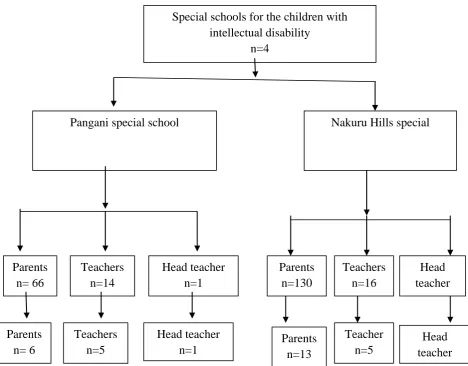
27 Figure 3.1 Sampling frame
Gay as cited in Mugenda, (2003), suggests that for descriptive studies, 10%
of the accessible population is enough for a sample. The researcher sampled
the respondents by considering the total number of respondent in each
group. The two and only head teachers,10 out of the 30 teachers i.e. 5
teachers from each school, and 20 parents from the two schoolsi.e. 7 from
Pangani special school and 13 from Nakuru Hills special constituted the
sample.
Special schools for the children with intellectual disability
n=4
Pangani special school Nakuru Hills special
28
Population Sample
Head teachers 2 2
Teachers 30 10
Parents 196 20
Total 228 32
Figure 3.2 Sample sizes of the respondents
3.4.2 Sampling Technique
The schools were purposively sampled in the county. This kind of sampling
enabled the researcher to use only respondents that had the required
information as per the objectives of the study. The two schools selected had
the characteristics required by the study for example, they are public special
schools for the learners with intellectual disability; they have prevocational
and vocational classes, amongst others. The head teachers were purposively
sampled since they were key persons in school administration. For the
teachers, simple random sampling was used. Folded papers with ‘yes’ and
‘no’ written on them were used for the sampling. Five papers in each school
had ‘Yes’ and the rest ‘No’. Those with ‘yes’ constituted the sample of a
total of ten teachers from the two schools.
The parents were randomly sampled by use of folded papers where seven
29
written ‘Yes’ and the rest ‘No’. Those with yes constituted the sample of a
total of 20 parents from the two schools.
3.5 Construction of Research Instruments
In the study which was a social science research, the instruments used were
questionnaires (Mugenda & Mugenda, 1999).
3.5.1Instrumentation
Questionnaires were the main tools for collecting data from the respondents.
Different questionnaires were used for the head teachers and teachers. The
head teacher’s questionnaire had more administrative questions while the
teachers had learners and classroom teaching and learning experiences. The
written questionnaires were appropriate for the head teacher and teachers
since they were able to read and write while oral questionnaires were
appropriate for the parents who may have not been able to read and write.
All the respondents were reachable and willing to cooperate (Orodho,
2010).The questionnaires consisted of question to be answered to address the
research questions. They also included demographic information of the
respondents. The questionnaire had different questions each addressing a
research objective.
3.5.2 Validity
Validity of the research instruments was done with supervision from the 2
30
questionnaires and interview guide who provided feedback to the researcher.
Their recommendations were incorporated in the final research instruments
(Orodho, 2010)
3.5.3 Reliability
Reliability of the instruments was established through test- retest technique
to reduce the chance error of different test. (Mugenda & Mugenda, 2003),
(Kombo& Tromp, 2006). The instruments were administered to a similar
group to the study group, recorded then the same was done two weeks later
then computed the test retest reliability using the Statistical Package for
Social Sciences(SPSS). A correlation coefficient of 0.8 was considered high
enough to judge the instruments as reliable for the study (Orodho, 2010)
3.6 Data Collection Techniques
3.6.1 Piloting Study
The research instruments were constructed; they were piloted at Njoro
special school for the intellectual disability. The respondents that were used
for the piloting were similar to those of the actual study but did not take part
in the actual study. The questionnaires used in piloting were identical to
those that were used during the actual data collection. Piloting was
conducted for about 1% of the sample size for each category of respondents
except the head teachers (Orodho, 2010). 1 head teacher, 2 teachers and 2
31
Piloting helped the researcher to validate the research instruments by making
correction where there was need and identify ambiguous or unclear items
and changed appropriately. For example in some questions the researcher
had given only ‘yes’ or ‘no’ options but some respondents wanted the ‘not
sure’ response option include. In identifying the class or level of the
learners, some parents did not know the class level of their children. The
researcher had to include the ‘not sure’ option. The researcher also realized
the parents responses depended with the child’s ability, age, gender and
duration the child had been in school. This prompted the researcher to
include an observation guide to help observe the learner’s characteristics that
were likely to influence the parent’s responses. In addition the pilot study
familiarized the researcher with administration of the research instruments
and data analysis by analyzing the questions to see if the methods of data
analysis were appropriate.
3.6.2 Actual Data Collection
Data was collected in three days. Day one the researcher visited Pangani
special school and administered the questionnaire for the teachers and head
teacher. Day two the researcher meet the parents of Pangani special and
administered the parents oral questionnaires later in the day, the researcher
visited Nakuru hills special and administered the teachers and head teachers
questionnaires and finally administered the parents questionnaires on the third
32 3.6.3 Logistical and Ethical Considerations
The researcher began by visiting the graduate school of Kenyatta University
where the researcher was referred to the Ethics Review Committee of
Kenyatta University. After approval by the Ethics Committee, the researcher
then visited the National Commission for Science, Technology and
Innovation (NACOSTI) seeking the research clearance permit. After
receiving the research clearance permit and authorization from NACOSTI,
the researcher reported to the County Commissioner and the County
Director of Education, Nakuru County before embarking on the study for
further authorization at County level. The researcher then drew a work plan;
pretested the instruments through piloting and made the necessary revision
and adjustments.
The researcher visited the sampled schools to discuss the research intention
with the school head teachers, met the teachers and parents on different
sessions and explained the study intentions and the sampling techniques
applied. The researcher assured the respondents of the confidentiality of the
information they will give and that was to be used only for the current study.
The researcher requested the sampled respondents to fill the consent form
before completing the questionnaires or taking part in the interview. The
researcher administered the research tools and collected all the tools before
33
collection. Ethical issues related to research were upheld to the best of the
researcher’s knowledge as explained above.
3.7 Data Analysis
Data collected was quantitative in nature. The questionnaires were collected;
the responses organized. The data was analyzed using descriptive statistics
by percentages. The findings were discussed, concluded and
34
CHAPTER FOUR
FINDINGS, INTERPRETATION AND DISCUSSIONS
4.1 Introduction
This chapter presents, analyses, and discusses the data. The study was aimed
at investigating what hinders the learners with intellectual disability from
transiting to the work after their education in special schools. Further, the
researcher intended to find out what hinders the learners with intellectual
disability from getting employment after school which would lead to
independence and self-sustaining lives. This study sought to answer question
in the following areas:
1. Transition plans in curriculum for the learners with intellectual
disability
2. Preparedness of the learners with intellectual disability for
transition
3. Graduation among the learners with intellectual disability
4. Service providers and systems engaging learners with intellectual
disability after their training
Data was collected using questionnaires for all the respondents from the
35 4.2 General and Demographic Information
4.2.1.1General Information
The general information is discussed under the following sub headings: return
rate, school enrolment and factors considered during schools admission,
parental reasons for enrolling their children in special schools
4.2.1.2 Return Rate
The researcher had a good return rate of 96%. This mainly because the
instruments were administered and collected on the same day before the
researcher left the school of study. The researcher did not experience any major
problem, only that the parents really wanted to know what the sampled ones
were being asked in the hope of there was some assistance.
4.2.1.3 School Population and Learners Above18 Years of Age
Nakuru hills special was started in 1978 while Pangani Special was started in
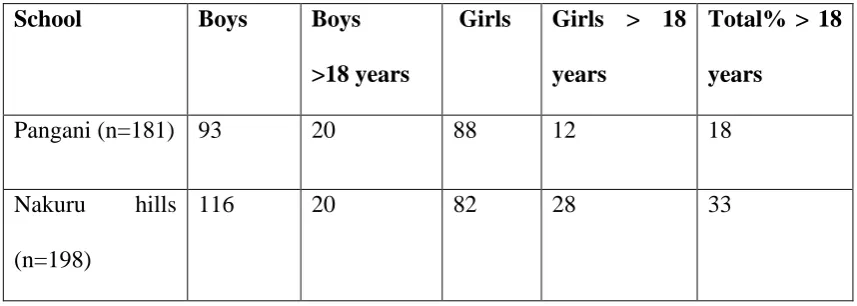
2011. The two schools had a total of 379 pupils, 209 boys and 170 girls.
Table 4.1 School enrolment as at February 2015
School Boys Boys
>18 years
Girls Girls > 18
years
Total% > 18
years
Pangani (n=181) 93 20 88 12 18
Nakuru hills
(n=198)
36 4.2.1.4 Admissions
During admission of new students to the school the main factors considered in
order of priority include: type of disability, age, severity of disability
(functional skills) and health status as assessed and identified by the Education
Assessment and resources centres (EARC) which was mandatory for all the
learners before being enrolled in these special schools.
About half of the parents were informed of special schools from the schools
where their children started schooling when the teachers realize that these
children could not cope with the regular academic work. The other half is from
friends, churches, and others sources (Table 4.2).
Table 4.2Source of information of existence of the special school
Source of information Frequency Percent
Friends 6 32
Previous School 9 47
Church 2 11
Others 2 10
Total 19 100
On learning of the existence of special schools, majority of the parents take
their children to the special school for security, rehabilitation and therapy while
37
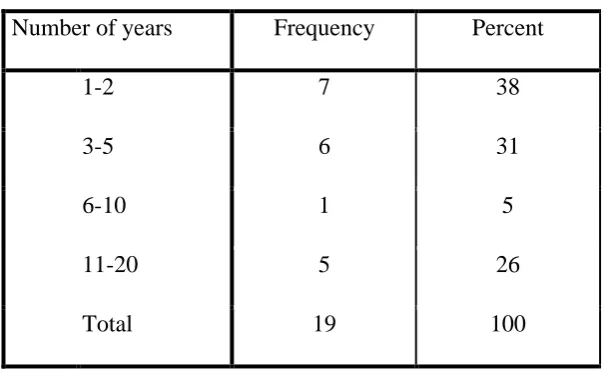
During this study, the researcher found out that majority of the parents reported
that their children had been learning in these special schools for less than five
years, while a quarter had their children in these special schools for over 20
years (Table 4.3).
Table 4.3Duration of the children in the special school
Number of years Frequency Percent
1-2 7 38
3-5 6 31
6-10 1 5
11-20 5 26
Total 19 100
4.2.1.5 Demographic Data
Demographic data is discussed under the following sub titles: Gender of
respondents, academic qualification, area of specialization and teaching
38 4.2.1.6 Gender of Respondents
Table 4.4 Gender of respondents
Respondent Teachers Parents Percentage (%)
Male 4 6 32
Female 8 13 68
Majority of the respondents were female while few are male as shown in Table
4.4.
4.2.2.1 Academic Qualification
Table 4.5 Academic qualification of respondents
Highest qualification Teachers Parents Percentage (%)
Masters Degree 3 0 25
Bachelors Degree 3 0 25
Diploma 6 0 50
Diploma 0 1 5
Certificate Level 0 1 5
Secondary Level 0 5 26
Primary Level 0 12 64
Findings show that all the teachers in the two schools are trained in Special
Needs Education where a quarter of the respondents were master’s degree
39
holders as shown in Table 4.5 above. Most of the parents were of primary
school level, a quarter were of secondary school level while few have gone
beyond secondary school (Table 4.5).
4.2.2.2Area of Specialization
Table 4.6 Area of specialization of respondents
No of teachers Percentage (%)
Intellectual disability 4 33
Learning disability 2 17
Hearing impairment 1 8
Inclusive education 3 25
Others 2 17
Findings show that only a third of the SNE teachers were trained in the area of
intellectual disability while the majority were trained in other areas like
learning disability, hearing impairment, inclusive education and autism (Table
4.6)
A learner with intellectual disability requires teachers specially trained in the
area of intellectual disability to understand the learner's special needs and
ability so as to teach and train him accordingly. Musima (2014) found out that
despite being qualified, there was need for specialized training for handling
40 4.2.2.3 Teaching Experience
Table 4.7 General teaching experience of the teachers
Number of years Number of teachers Percentage (%)
11-20 years 5 50
21years and above 5 50
The teachers were asked to indicate for how long they had been teaching. The
results are shown in Table 4.7above. Half of the teachers have been teaching
for a period of 11-20 years while the other half have been teaching for over
21years.
Table 4.8 Teaching experience in the special schools
Number of years Number of
teachers
Percentage (%)
3-5 years 3 30
6-10years 2 20
11-20 years 4 40
Over 21years 1 10
The teachers were further asked for how long they had taught in the special
school for the learners with intellectual disability. Table 4.8 shows about a
third of the teachers have been teaching in a special school for the intellectually
41
slightly less than half have taught for 11-20 years and few for over 21years.
The two head teachers have been in the schools for the learners with
intellectual disability for over 21 years.
Teachers experience in teaching learners with intellectual disability would
improve performance of learners. However, long teaching duration without
refresher training and exposure to the changing trends in education of learners
with intellectual disability could result ineffectiveness in imparting skills
(Orao, 2010).
4.3 Findings by Objectives
4.3.1 Transition plans in Curriculum for the Learners with Intellectual
Disability
The first task of the study was to study presence of transition plans in the
curriculum guiding the teaching and learning activities aimed at preparing
the learners for their future life after school. The head teachers and teachers
were asked whether there existed a curriculum guiding their teaching and
learning activities where all of the head teachers and the teachers agreed that
there is a curriculum. For how long they had used the curriculum the results
42
Table 4.9Duration the curriculum has been used
Number of years Frequency Percent
1-2 years 7 58
3-5 years 1 8
Over 5 years 4 34
Total 12 100
Majority of the teachers including the head teachers agreed they had used
the curriculum for less than three years while a third had used it for over five
years. According to Kiarie, (2003), the curriculum in units and special
schools in Kenya does not seem to be consistent. Muuya, (2002) as quoted in
Kiarie, (2003), found out that the need for the learners with intellectual
disability to acquire skills in self- reliance amongst others, are largely
dependent on the goals and orientation of the funding religious, private or
other organizations. This showed that there was a difference on the number
of years the curriculum had been used showing there was no consistence on
the use of the curriculum. Majority of the teachers reported that they had
used the curriculum for about two years showing it may have been too short
the period to show its impact during the time of study.
On whether the curriculum has plans specifically preparing the learners for
43
Table 4.10 Presence of transition plans in the curriculum
Frequency Percent
No 3 25
Yes 9 75
Total 12 100
Three quarters of the teachers including head teachers reported that the
curriculum has transition plans preparing the learners for future while a quarter
said it does not have.
To what extent the curriculum addressed the individual needs of the learners
with intellectual disability in readiness for their future life after school, results
are indicated in Table 4.11
Table 4.11Curriculum addressing individual learner’s needs
Frequency Percent
Fully 1 10
To a great extent 4 40
Partially 5 50
44
Half of the teachers agreed that the curriculum partially addressed individual
needs of the learners with intellectual disability for their future life after
school while slightly less than half said it addresses individual needs to a
great extent and few of the teachers said that it fully addresses the individual
needs of the learners with intellectual disability. Kiarie, 2003, argues that the
curriculum should not only focus on the skills the learners with intellectual
disability need to use frequently in school, at home and in the community,
but teaching the functional skills in the natural contexts in which they are
performed is necessary.
PL108-446(IDEA) stipulates that each student with disability is to receive
transition services, which are defined as coordinated set of activities for a
student with disability which in this study should be the teaching and learning
activities stipulated in the curriculum. The goal of the Individualized
Transition Plan (ITP) is to link the curricular content to the demands of living
and working in the community as an independent adult. Table 4.11 shows that
a quarter of the teachers said the curriculum has no transition plans, which
indicates that they do not have any deliberate teaching and learning activities
to prepare the children for transition.
4.3.2 Preparedness of the Learners for Transition
The researcher sought to find the preparedness of the learners with
intellectual disability for transition. On what determines the readiness of an
45
the key determinants of graduation to the next level / grade are the skills
gained and to a small extent the age of the learner. This shows that skills
acquisition develops gradually with the stay in the school.
On whether the learners could learn skills that can be of economical help to
them after school and whether they were offered in their vocational training.
The respondents indicated that the learners could learn such skills and the skills
were offered in their vocational training. Findings from the head teachers and
teachers show that despite the learners being offered theses skills in the
vocational training, the teaching and learning resources are inadequate for the
appropriate training. With adequate resources, the learners can acquire the
necessary skills. Musima, (2014), found out there are inadequate facilities and
resources for teaching and learning in the vocational training institutions for
learners with intellectual disabilities in Nairobi County. In addition to this the
severity of disability determines the level of independence where the mild the
disability the more independent the learner becomes.
The researcher sought to find out if the parents knew the level /class of their
children. Most of the parents did not know and those who knew did not clearly
understand what goes on at that level. This show the parents are not fully
involved in transition preparedness of their children. The parents were asked
whether learners with intellectual disability are able to acquire skills for
independent living by the time they leave the special school. The results are
46
Table 4.12 Learners Acquisition of skills of independent living
Frequency Percent
No 2 10
Yes 14 74
Not sure 3 16
Total 19 100
Nearly three quarters of the parents said their children were able to acquire
skills of independent living, a few said they were not able while the others
were not sure.
The parents were further asked what plans they had for their children after
leaving school. The results are indicated in Table 4.13.
Table 4.13Parental plans for the child after leaving school
Frequency Percent
None 7 37
Not yet 5 26
Business 4 21
Employment 3 16
Total 19 100
Slightly over a third of the parents had no plans for their children after leaving