THESES SIS/LIBRARY TELEPHONE: +61 2 6125 4631
R.G. MENZIES LIBRARY BUILDING NO:2 FACSIMILE: +61 2 6125 4063
THE AUSTRALIAN NATIONAL UNIVERSITY EMAIL: [email protected]
CANBERRA ACT 0200 AUSTRALIA
USE OF THESES
This copy is supplied for purposes
of private study and research only.
Passages from the thesis may not be
copied or closely paraphrased without the
The Dynamics of Change in Decentralisation:
Implications for Local Government-Business
Relations
A Case Study of Decentralisation in Sidoarjo, East Java,
Indonesia
Agus Pramusinto
A thesis submitted for the degree of Doctor of Philosophy at
The Australian National University
STATEMENT OF ORIGINALITY
I certify that this thesis is my original work except where due reference is made in the text.
A!tusinto
ACKNOWLEDGEMENTS
I would like to thank many people and organisations who have made this
research possible. First, I am very indebted to the Australian Agency for
International Development (AusAID) that has been very generous with
financial support of this study and all travel and living expenses in Canberra,
Australia. Second, I would like also to express my gratitude to Prof. Sofian
Effendi, Prof. Agus Dwiyanto, Prof. Warsito Utomo and my other colleagues in
the Department of Public Administration of Gadjah Mada University for
encouraging me to undertake this study.
There have been many people in Sidoatjo who also deserve special
appreciation. I am very grateful to Mr Win Hendrarso, the head of Sidoatjo
district, who was very generous with his time to do interviews. For the local
agency heads, the local parliament members and the public servant staff
members in Sidoatjo, I would like to thank them for information provided. They were very helpful in providing me with data. I also thank the business
people with whom I explored various topics that might place them at risk.
The key person to whom I would like to express my sincere gratitude is Dr .
Peter Larmour, my main supervisor, who has not only always inspired me to
develop analysis and interpretations, but also encouraged me during my study.
Prof. James J. Fox from the Research School of Pacific and Asian Studies and
Prof. Michael Hess who has moved to the University of Tasmania have been
great advisers during the writing process of this thesis. Prof. Raymond
Apthorpe, Dr Margot Lyon, and Prof. Ron Duncan have given me encouraging
comments for this thesis. My thanks also go to Dr Sue Holzknecht who
patiently and carefully read the entire draft and gave useful suggestions. People
of Australia (ASAA) Conference and at the Indonesian Regional Science
Association (IRSA) Conference have also given me invaluable suggestions.
In the Asia Pacific School of Economics and Government (APSEG), a number of
people have spent time and given unselfish support for me. Special thanks go
to Ms Billie Headon who has helped me over problems in dealing with various
matters. Alison Cumming-Thom has been tireless in correcting my English.
Maurette McLeod is always sincere in helping me with many things. Thanks
also go to Annie Bartlett who has shown great concern about my study and
family.
My Indonesian friends have established a good atmosphere during our lives in
Canberra. Mas Wahdi Yudhi and family, Pak Marpuddin and family, Tony
Prasetiantono and family, Siwi Nugraheni and Agung, Kacung Marijan & Adek
and family, Joko Prayitno and family, Ira Armstrong and Gabriel Lele, have
made my family enjoy living in Canberra.
Finally, my personal debt goes to my family. For my wife, Menik, her patience
and understanding have made this thesis possible. My lovely daughter Sheila
khshana and son Rifqi A vicena are the endless inspiration and support for this
thesis. My mum who always lets me leave her alone in my kampong with her
sickness has encouraged me to take this opportunity. Without her support, I
would never have had the courage to start this study.
ABSTRACT
This study is about the impact of decentralisation on the business sector in the
district of Sidoarjo, East Java, Indonesia. It presents three themes in exploring changes related to business people during the early implementation of the
policy: (1) services and local regulations related to the business sector and the
business people's responses; (2) corruption at the local level and its effect on
business people; and (3) emerging patterns of local government-business
relations.
In theory, decentralisation can bring the government closer to the people. It will make better information available on the people's preferences for services
provided by the government. It will also enhance accountability and reduce corruption in the government since people can more easily control local
governments' actions than those of the central government's. Devolving
power to the local government will change the relationship structure between
government and business. However, in practice, the study found that
decentralisation does not necessarily lead to positive impacts on the business
sector.
Ethnographic approaches were applied to gather and analyse data during the ·
fieldwork. They included documentation investigation, surveys and in-depth
interviews. Fieldwork in Sidoarjo was conducted from November 2001 to July
2002. Current issues related to the Sidoarjo government have been explored
through Indonesian newspapers up to January 2005.
The research found that, in terms of services provided by the local government,
the results are mixed. The local government has espoused two contradictory
policies. Business-related services have been restructured to encourage the
existing business people and to invite new investors. Local taxes and levies
have also been reformed to increase local government revenue, but they have at
can enjoy the facilitation of services, but others do not. Most medium-large
businesses suffer a lot from the new local regulations associated with the
increases in local taxes and levies, whereas small businesses have not been
affected.
Business people see corruption as a common phenomenon and regard it as
having mushroomed during the early implementation of decentralisation.
Actors involved are not only people in the bureaucracy but also those in the
local assembly, in NGOs, and journalists. However, corruption is not always
seen as a bad thing. The perception of business people towards corruption
depends on whether it directly affects their business activities or not.
Regarding the local government-business relations patterns, evidence in this
study shows that they do not form a simple picture. It depends on what type of business is involved.
For local contractors, their relations with the local government have changed.
They are not subordinates of the local government any more and they can
influ~nce the local government policy openly and collectively through their
business representation. Medium-large businesses hold a different model of
relations with the local government. They are represented formally in the
determination of the minimum standard of wages. Interestingly, the way the.
business people respond to the decisions is not collectively through their
business representation. Rather, they use individual connections and covert
relations with local government officials. In contrast, small businesses are not
greatly affected by the policy of decentralisation. The local government has
paid little attention to them, and they also do not rely on the local government.
In short, whether the decentralisation policy exists or not, their business
activities go on as usual.
In general, decentralisation has had different impacts on local government
regulations related to business activities. However, positive changes in
levies. Corruption has not decreased, but tends to involve more actors at the
local level. From the business people's perspective, both changes in local
regulations and policies as well as in the extent of corruption have been
perceived differently according to the different types of business.
Decentralisation has also brought about new emerging models of relations
between local government and the business sector.
The findings of this research are important for the existing debates on
decentralisation. Although decentralisation is believed to improve development
at the local level, this is not necessary true in relation to business activities.
Devolving power to local governments has produced distortive policies that
make it difficult for business people to run their business. The problems of
decentralisation come from an unbalanced structure, that is providing local
governments with more employees but lacking financial capacity. Local power
CONTENTS
Title Page ... i
Declaration ... ii
Statement of Originality ... iii
Abstract ... v
Table of Contents ... viii
List of Tables ... xiv
List of Figures ... xvi
List of Map ... xvi
Glossary of Acronyms and Abbreviations ... xvii
CHAPTER 0 NE ... ... ... ... ... ... ... ... ... .. ... ... 1
INTRO'DUCTION •.•..•...•...•....••..•.••..•...••••.•.•.•.••.•.••.•••.••..•.•.•••..•... 1
1.1. BACKGROUND OF THE STUDY ... 1
1.2. OBJECTIVES OF THE STUDY ... 2
1.3. JUSTIFICATION FOR THE STUDY ... 4
1.3.1. Why is Decentralisation Important? ... .4
1.3.2. Why The Business Sector? ... 7
1.4. DECENTRALISATION: WHY IS IT IMPORTANT IN INDONESIA? ... 13
1.4.1. Various Issues of Power Relations ... 14
1.4.2. Changes After the Fall of Soeharto (1998) ... 15
1.4.3. Problems in the Implementation ... 21
1.4.4. Debates on Proposals of Revisions ... 24
1.4.5. Summary ... 27
1.5. ORGANISATION OF THE THESIS ••••••••••••••••••••••••••••••••••••••••••••••••••••.•.•••.••••.•••••.•..•... 28
CHAPTER TW 0 ... ... ... ... ... .... .. .... .... ... . .. . . . .. 30
DECENTRALISATION, LOCAL GOVERNMENT AND THE BUSINESS SECTOR: AN ANALYTICAL FRAMEWORK ...•...•...•.•....••••••...•...•... 30
2.1. INTRODUCTION ... 30
2.2. TYPOLOGY OF DECENTRALISATION ... 31
2.3. DECENTRALISATION AND CENTRAL-LOCAL GOVERNMENT RELATIONS ... 34
2.3.1. The Autonomous Model ... 35
2.4. DECENTRALISATION AND IMPACTS ON THE BUSINESS SECTOR ... 39
2.4.1. Functions and Policies ... 39
2.4.2. Sources of Revenues ... 40
2.4.3. The Economic Significance of Decentralisation ... .42
2.4.3.1. Allocative Efficiency and Cost Recovery ... .42
2.4.3.2. Accountability and Corruption Reduction ... 45
2.5. DECENTRALISATION, LOCAL GOVERNMENT AND THE BUSINESS SECTOR: EMPIRICAL EVIDENCE ... 50
2.5.1. Central Control ... 50
2.5.2. Responsiveness in Service Delivery and Cost Recovery ... 51
2.5.3. Accountability and Corruption ... 52
2.6. MODELS OF GOVERNMENT-BUSINESS RELATIONS ... 52
2.6.1. Pro-Market Versus Pro-State Models ... 53
2.6.1.1. Pro-Market Arguments ... '. ... 53
2.6.1.2. Pro-State Arguments ... 55
2.6.2. Approaches To Government-Business Relations In Indonesia ... 57
2.7. CONCLUSIONS ... 62
CHAPTER THREE ... 65
RESEARCH METHODOLOGY ...•...•...•...•...•... 65
3.1. INTRODUCTION ... 65
3.2. THE RESEARCH PROBLEM ... 66
3.3. RESEARCH FRAMEWORK ... 69
3.4. RESEARCH QUESTIONS ... 70
3.5. RESEARCH METHODOLOGY ... 71
3.5.1. Why a Case Study? ... 71
3.5.2. Why Sidoatjo? ... 73
3.5.3. Methods of Collecting Data: Ethnographic Approaches ... 77
3.5.3.1. Documentation Research ... 78
3.5.3.2. Survey of Business People ... 79
3.5.3.3. In-Depth Interviews ... 80
3.6. LIMIT A TIO NS AND CONSTRAINTS OF THE RESEARCH ... 81
CHAPTER FOUR ... 84
DECENTRALISATION AND REGIONAL GOVERNMENTS IN INDONESIA ... 84
4.1. INTRODUCTION ... 84
4.2. DECENTRALISATION IN THE PRE-COLONIAL ERA AND AFTER ... 85
4.2.1. Indonesia in the Pre-Colonial Era ... 85
4.2.2. The Arrival of the Europeans ... 87
4.3. DECENTRALISATION IN THE POST INDEPENDENCE ERA ... 98
4.~.1. Law No. 1/1945: The First Indonesian Law Concerning Decentralisation98 4.3.2. Law No. 22/1948 and Law No. 44/1950 on the State of East Indonesia (Negara Indonesia Timur): Decentralisation during Regional Rebellion103 4.3.3. Law No 1/1957: Decentralisation under Liberal Democracy ... 106
4.3.4. Law No. 18/1965: Decentralisation under Guided Democracy ... 109
4.3.5. Law No. 5of1974: Half-Hearted Implementation ... 111
4.3.6. Law No. 22 and Law of 1999: Radical Changes in the Era of Reformasi121 4.3.6.1. Early Stages of Decentralisation Implementation ... 124
4.3.6.2. First Proposal of Revisions of Law No. 22/1999: Pulling up the Power ... 131
4.3.6.3. Second Proposal of Revision of Law No. 22/1999: Introducing Direct Election of Head and Deputy Head of the Regions ... 133
4.3.6.4. The Final Amendment of Law No. 22/1999: Law No. 32/2004 ... 137
4.4. CONCLUSIONS ... 140
CHAPTER FIVE ... 143
DECENTRALISATION AND LOCAL GOVERNMENT IN SIDOARJO •.•.••... 143
5.1. INTRODUCTION ... 143
5.2. SIDOARJO UNDER DECENTRALISATION PILOT PROJECT IN 1995 ... 144
5.2.l. Restructuring Local Agencies ... 150
5.2.2. Restructuring Sources of Local Income ... 159
5.2.2.1. Sources of Local Government Income Before Pilot Project ... 159
5.2.2.2. Reform of Local Taxes and Levies During Pilot Project ... 165
5.3. SIDOARJO UNDER LAW No. 22 AND25OF1999···;·167
5.3.1. The Economic Burden of Decentralisation on Local Government ... 169
5.3.2. Efforts of Local Government to Increase Local Income ... 177
5.3.2.1. Increasing the Rate of Existing Taxes andLevies ... 178
5.3.2.2. Intensifying Tax & Levy Collection ... 179
5.3.2.3. "Recycling" Old Levies Banned by Central Government ... 179
5.3.2.4. Renegotiating Tax Sharing with Central and Provincial Governments ... 180
5.3.2.5. Renegotiating Profit Sharing with other Districts ... 182
5.3.2.6. Renegotiating Profit Sharing with the Private Sector ... 183
5.3.2.7. Developing Local Government-Owned Enterprises ... 183
5.3.2.8. Issuing Municipal Bonds ... 185
5.4. CONCLUSIONS ... 185
CHAPTER SIX ... 188
DECENTRALISATION, LOCAL REGULATIONS AND THEIR IMPACT ON THE BUSINESS SECTOR: ENCOURAGING OR DISCOURAGING To BUSINESS PEOPLE? ... 188
6.2. BUSINESS REGULATIONS: FROM THE CENTRAL GOVERNMENT To LOCAL
GOVERNMENT ... ··· ... 191
6.3. FRAGMENTED AGENCIES RELATED TO THE BUSINESS SECTOR ... 194
6.3.1. Dinas Perindustrian dan Perdagangan (Local Agency for Industry and Trade) ... 196
6.3.2. Dinas Koperasi Dan Usaha Kecil dan Menengah (Local Agency for Cooperatives and Small and Medium Businesses) ... 200
6.3.3. Dinas Tenaga Kerja (Local Agency for Manpower) ... 203
6.3.4. Dinas Pendapatan (Local Agency for Revenue) ... 205
6.3.5. Badan Perencanaan Pembangunan Kabupaten (Board of Local Planning at District Level) ... 206
6.4. THE POLICY REGIME RELATED To THE BUSINESS SECTOR lN SIDOARJO ... 209
6.4.1. Regulatory Regime Attracting the Business Sector ... 209
6.4.1.1. District Head Decree No. 16 of 2001 on Dinas Perijinan dan Penanaman Modal (Local Agency for Permits and Capital Investment) ... 209
6.4.1.2. Promoting Growth-Pole Triangle Development and Tax Relief .... 215
6.4.2. The Regulatory Regime Inhibiting the Business Sector: Exploiting Taxes and 'Levi.es ... 218
6.5. RESPONSES OF THE BUSINESS PEOPLE To THE Loc:AL REGULATIONS ... 222
6.5.1. Ol.anges of Local Taxes and Levies ... 232
6.5.1.1. 'Levy on Business Activity Permits ...•... 232
6.5.1.2. Levy on Generator Sets and Fire Extinguishers ... 235
6.5.1.3. 'Levy on Abattoirs ... 236
6.5.1.4. 'Levy on Disturbance Law Permits ... 237
6.5.1.5. Levy on Inspection on and Testing of Meat or Fish Product Quality239 6.5.1.6. Taxes on Special Parking Area ... 24Q 6.6. CONCLUSIONS ... 241
CHAPTER SEVEN···-··· 245
DECENTRALISATION, CORRUPTION AND PRESSURE ON THE BUSINESS SECTOR: FROM THE ExECUTIVE, LEGISLATIVE BODY AND BEYOND ···-···245
7.1. lNTRODUCTION ... 245
7.2. THE STRENGTiiENED ROLE OF LocAL GOVERNMENT AND 0PPORTUNmES FOR CORRUPTION: As EMPLOYER, TAX AND LEVY COLLECTOR, AND AS SERVICE PROVIDER ... 246
7.2.1. Local Budget and Number of Projects lncrease ...•... 247
7.2.2. The Holder of Power in Business Licensing ... 250
7.3. BUSINESS PEOPLE'S PERCEPTIONS OF THE ExTENT OF CORRUPTION ... 252
7.3.1. Corruption in the Local Government ... 257
7.3.2.1. Money Politics in the Election of District Head and Local Parliament
Head ... 268
7.3.2.2. Money Politics in the Yearly District Head Accountability Report and Local Regulation.Legalisation ... 272
7.3.2.3. Extortive Corruption by Local Parliament ... 281
7.3.3. Corruption Beyond the Local Polity ... 284
7.4. CONCLUSIONS ... 288
CHAPTER EIGHT ... 291
DEVOLVING POWER FROM THE CENTRAL TO LOCAL GOVERNMENT AND THE BUSINESS SECTOR: AN EMERGING NEW LOCAL GOVERNMENT-BUSINESS RELATIONSHIP? ...•...•.•...•.•...•... 291
8.1. INTRODUCTION ... 291
8.2. CURRENT PICTURES OF LOCAL GOVERNMENT-BUSINESS RELATIONS IN 5IDOARJ0293 8.2.1. Local Government-Related Contractors: The Case of Gapensi. ... 293
8.2.1.1. Characteristics of the Business ... 293
8.2.1.2. Relationship with the Local Government: Collective Actions and Mutual Symbiosis ... 295
8.2.2. Medium-Big Businesses: The Case of Apindo ... 308
8.2.2.1. Characteristics of the Business ... 308
8.2.2.2. Relationship with the Local Government: Individual and Covert Relations ... 309
8.2.3. Small Businesses: The Case of Intako Cooperative Tanggulangin ... 321
· 8.2.3.1. Characteristics of the Business ... 321
8.2.3.2. Relationship with the Local Government: Independent and Beyond the Government's Target ... 323
8.3. CONCLUSIONS ... 331
CHAPTER NINE···-··· 334
CONCLUSIONS AND IMPLICATIONS ...•...•....•...•... 334
9.1. INTRODUCTION ... z;;,, ... 334
9.2. SUMMARY AND CONCLUSIONS ... 335
9.2.1. Decentralisation and Central-Local Government Relations ... 335
9.2.2. Decentralisation and Business-Related Services and Regulations under Decentralised Local Government Regime ... 338
9.2.3. Decentralisation and Corruption at the Local Level.. ... 341
9.2.4. Decentralisation and Emerging Patterns of Local Government-Business Relations ... 343
9.3. LOCAL GOVERNMENT, DECENTRALISATION AND THE BUSINESS SECTOR: LOOKING BEYOND SIDOARJO ... 347
9.4.1. Policy Implications: Towards Better Local Govemment ... .355
9.4.2. Research Implications: More Studies Beyond Sidoarjo ... .357
9.4.3. Future Directions: Reorienting Development Administration ... 359
REFERENCES ... .360
APPENDICES: APPENDIX!: QUESTIONNAIRE ... .384
APPENDIX 2: NAMES OF RESPONDENTS AND INFORMANTS ... 392
APPENDIX 3: NAMES OF KABUPATEN (DISTRICT) AND KOTA (CITY) IN EAST JAVA ... 394
List of Tables
Tables: Page_
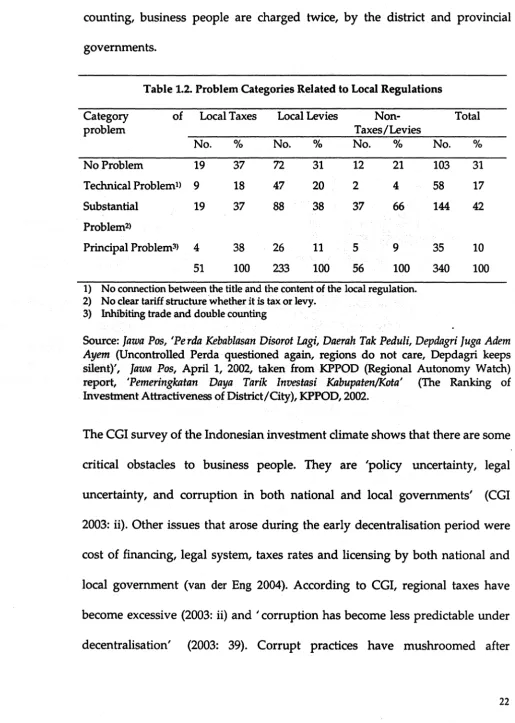
Table 1.1. Changes in the Distribution of Natural Resource 20 Revenue since Decentralisation
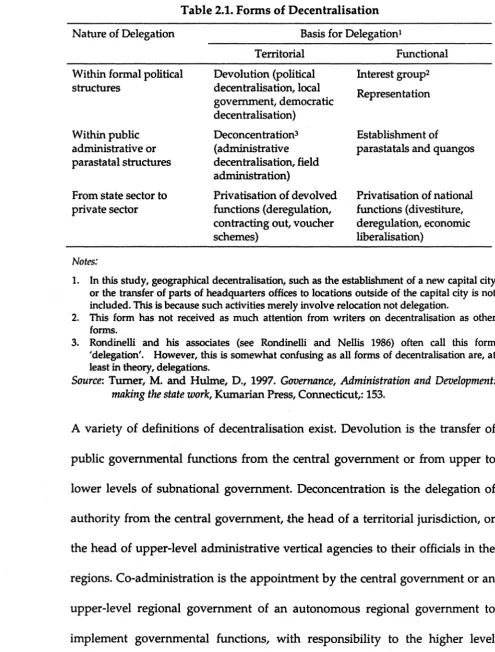
Table 1.2. Problem Categories related to Local Regulations 22 Table 2.1. Forms of Decentralisation 33 Table4.1. Comparison between Law No 5/1974 and the First 120
and Second Draft Revision of Law No 22/1999
Table 5.1. Selected Local Government Pilot Projects 145 Table 5.2. Deconcentrated Functions from the Department of 151
Home Affairs to Sidoarjo Local Government
Table 5.3. Deconcentrated Functions from the East Java 152 Provincial Government to Sidoarjo Local Government
Table5.4. Deconcentrated Functions from the Central 153 Government Ministries to Sidoarjo Local Government
Table 5.5. Decentralised Functions from the Central and East 154 Java Provincial Government to Sidoarjo Local
Government
Table 5.6. Co-Administrative (Medebewind) Functions in 155 Sidoarjo Local Government
Table 5.7. Comparison of Personnel Before and After Pilot 156 Project and Number of Transfers from the Central and
Provincial Government in Sidoarjo Local Government
Table5.8. Proposal of Local Agencies Number Prepared by the 158 Technical Team in Sidoarjo
Table 6.1. Types of Permits Under Dinas Perijinan dan 212 Penanaman Modal
Table 6.2. Cumulative Agreement of Domestic and Foreign 218 Investment from 1967 in Sidoarjo (1990-2002}
Table6.3. Types of Local Taxes and Levies Related to the 221 Business Sector
Table 6.4. Impact of Local Autonomy on Business Permit 222 Facilitation Based on Company Size
Table6.5. Impact of Local Autonomy on Investment Promotion 225 Based on Company Size
Table6.6. Impact of Local Autonomy on Tender Process 227 Facilitation Based on Company Size
Table 6.8. Impact of Local Autonomy on Fair Competition 229 Promotion Based on Company Size
Table 6.9. Impact of Local Autonomy on Fair Competition 230 Promotion Based on Contractor and Non-Contractor
Table 6.10. Impact of Local Autonomy on Distribution Cost 230 Reduction Based on Company Size
Table 6.11. Impact of Local Autonomy on Taxes and Levies 231 Reduction Based on Company Size
Table 7.1. Sidoarjo Government Budget Allocation for 249 Construction Projects in 2002
Table 7.2. Perception of Business People of the Impact of 253 Decentralisation on Corruption Reduction
Table 7.3. Perception of Business People of the Impact of 254 Decentralisation on Corruption Reduction based on
the size of company
Table 7.4. Perception of Business People of the Impact of 258 Decentralisation on the Amount of Illegal Money Paid
to Local Government Before and After
Decentralisation based on the Size of Company
Table 7.5. Perception of Business People on Local Government's 259 Efforts to Cope with Corruption Since Decentralisation
Table 7.6. Receivers of Illegal Payment 265 Table 7.7. Perception of Business People on Money Politics in the 269
District Head Election
Table 7.8. Perception of Business People on Money Politics in the 269 District Assembly Head Election
Table 7.9. Perception of Business People on Money Politics in the 274 Yearly District Head Accountability Report
Table 7.10. Perception of Business People on Money Politics in the 274 Ratification of Local Regulations
Table 7.11. Budget Standard Based on Government Regulation 278 No. 110/2000 and the 2002 Real Local Budget of
Sidoarjo
Table 8.1. The Relationship of Government-Related Contractors 307 with Stakeholders
Table 8.2. The Relationship of Medium-Big Companies with 320 Stakeholders
Table 8.3. The Relationship of Small Companies with 330 Stakeholders
List of Figures
Figures:
Figure 1.1. Comparison of Total Public Sector Outlays by Local, State and Federal Governments in Indonesia (1994), Australia (1993) and the USA (1992)
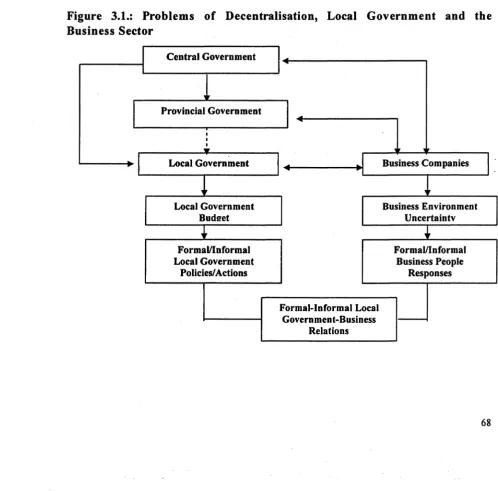
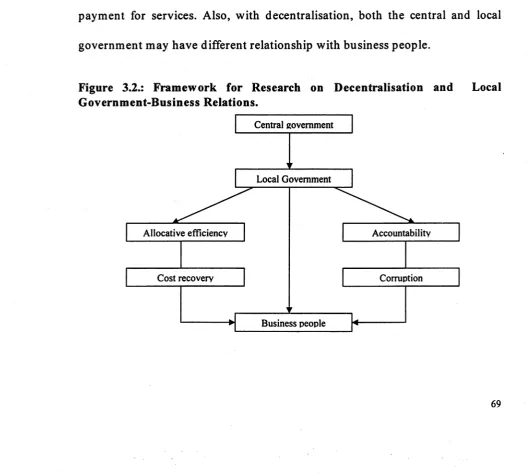
Figure 3.1. Problems of Decentralisation, Local Government and the Business Sector
Figure 3.2. Framework for Research on Decentralisation and Local Government- Business Relations
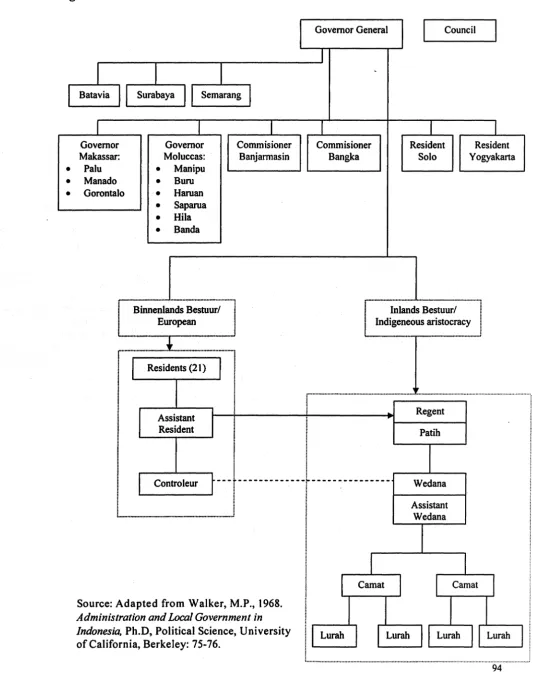
Figure 4.1. The Structure of Administration in Netherlands India after 1830
Figure 4.2. The Structure of Government During the Japanese Colonial Government
Figure 4.3. The Structure of Government in the New Order Era (Under Law No 5/1974)
Figure 4.4. The Structure of Government in the Reformasi Era (Under Law No 22/1999)
Figure 5.1. Composition of Total Public Sector Outlays in District, Province and National Governments in Indonesia (1994,1996,2002)
Figure 5.2. Sidoatjo Government Budget and Local Original Income(1992-2002)
Figure 5.3. Comparison between Routine and Development Expenditure of Sidoatjo Local Government Figure 5.4. Percentage of Original District Income and
Development Expenses Compared to Total Budget Figure 5.5. Comparison between Taxes and Levies taken by East
Java Province and Sidoatjo District Government (1994-2002)
Figure 5.6. Comparison between Original Revenue (PAD) and Decentralisation Fund (DAU) in Sidoatjo (1992-2002)
List of Map
Map:
Map3.1. Map of Sidoatjo, East Java, Indonesia
Glossary of Acronyms and Abbreviations
ABRI ADEKSI AD KASI APBD APEKSI APINOO APKASI APPSI Asekda Bandeng Bappeda Bappekab BKPM BPK BPKP BPM BPNBu pa ti
OAK
Dana Perimbangan
DAU Din as Dirjen
Angkatan Bersenjata Republik Indonesia (Indonesian Armed Forced)
Asosiasi Dewan Kota Seluruh Indonesia (Indonesian City Parliament Association)
Asosiasi Dewan Kabupaten Seluruh Indonesia (Indonesian District Parliament Association)
Anggaran Pendapatan dan Belanja Daerah (Regional or Local Government Revenue and Expenditure Budget) Asosiasi Pemerintah Kota Seluruh Indonesia (Indonesian City Government Association)
Asosiasi Pengusaha Indonesia (Indonesian Employers Association)
Asosiasi Pemerintah Kabupaten Seluruh Indonesia (Indonesian District Government Association) Asosiasi Pemerintah Propinsi Seluruh Indonesia (Indonesian Provincial Government Association) Asisten Sekretaris Daerah {Assistant Regional Secretary) Milk fish, popular fish produced in Sidoarjo
Badan Perencanaan Pembangunan Daerah (Regional or Local Planning Agency)
Badan Perencanaan Pembangunan Kabupaten (District Planning Agency)
Badan Kordinasi Penanaman Modal (Coordinating Board of Capital Investment)
Badan Pemeriksa Keuangan (Agency for Financial Audit) Badan Pengawasan Keuangan dan Pembangunan (Agency for Financial and Development Monitoring)
Badan Penanaman Modal (Capital Investment Board) Badan Pertanahan Nasional (National Agency for Land Affairs)
Head of the District Government
Dana Alokasi Khusus (Special Allocation Fund) Decentralisation Fund
Dana Alokasi Umum (General Allocation Fund) Regional or Local Services
Direktur
f
enderal (Director General)Disnaker Dispenda DPD DPOD DPPM DPR DPRD GAPEN SI GBHN Golkar Golongan GPO GTZSfDM Gubernur Haji IFSC In pres INTAKO Kabupaten KADIN KADINDA Kandep
Dinas Tenaga Kerja (Regional or Local Agency for Manpower)
Dinas Pendapatan Daerah (Regional or Local Agency for Revenue)
Dewan Pemerintahan Daerah (Board of Regional Government)
Dewan Pertimbangan Otonomi Daerah (Regional Autonomy Board)
Dinas Perijinan dan Penanaman Modal (Local Agency for Permits and Capital investment)
Dewan Perwakilan Rakyat (People' s Representative or National House of Representative, National Assembly)
Dewan Perwakilan Rakyat Daerah (Regional or Local Assembly; Provincial, District or City Assembly)
Gabungan Pengusaha Konstruksi Nasional (National Building Contractor Association)
Garis-Garis Besar Haluan Negara (State Guidelines)
Golongan Karya (Funtional Groups)
Grade
Gelo~a Putra Delta, Football club belonged to Sidoatjo government
Deutsche Gesellschaft fur Technische Zusammenarbeit
(German Technical Cooperation) Support for Decentralisation Measures
Head of the Provincial Government
Pilgrimage for Muslim to Mecca
Indonesian Footwear Service Centre, a Sidoarjo-based training centre of footwear in cooperation between the Government of Indonesia and Italy.
Instruksi Presiden (Presidential Instruction)
Industri Tas dan Koper (Bags and Luggage Industry) District
Kamar Dagang dan Industri (Chambers of Commerce and Industry)
Kamar Dagang dan lndustri Daerah (Regional Chambers of Commerce and Industry)
Kantor Kanwil Karesidenan Kawedanan Kecamatan Kecurangan Kepala Dinas Kepmen Keppres KKN KNIP Korpri KPPOD KPPT Lebaran Lelang Bandeng LPJ MaulidNabi Mendagri MPR Muscab New Order NKRI NU Otonomi Khusus PAD Office
Kantor Wilayah (Representative Office of the Central Government at provincial level)
Sub-Regional Government Coordinating districts Sub-Local Government Coordinating sub-districts Sub-district
Fraud
Head of District or Provincial Agency
Keputusan Menteri (Ministerial Decree) Keputusan Presiden (Presidential Decree)
Korupsi Kolusi Nepotisme (Corruption, Collusion, Nepotism)
Komite Nasional Indonesia Pusat (Central Indonesian National Committee)
Korps Pegawai Republik Indonesia (Indonesian Public Servants Corps)
Komite Pemantau Pelaksanaan Otonomi Daerah
(Local/Regional Autonomy Watch)
Kantor Perijinan dan Pelayanan Terpadu (Integrated Office of Permits and Services)
Indonesian Muslim Tradition of celebration after fasting month
Milk Fish Auction, Yearly Event in Sidoatjo to Collect Donation Money
Laporan Pertanggungjawaban (Yearly Accountability Report)
The birthday celebration of prophet Muhammad
Menteri Dalam Negeri (Minister of Home Affairs)
Majelis Permusyawaratan Rakyat (People's Co nsultative Assembly)
Musyawarah Cabang (Regional Meeting)
The Soeharto era, 1965-1998
Negara Kesatuan Republik Indonesia (Unitary State of the Republic of Indonesia)
Nadlatul Ulama, Indonesia's largest traditionalist Islamic Organisation
Special Autonomy
Pendapatan Asli Daerah (Regional/Local Revenue)
Pajak Daerah PAN Pancasila PDAM PDI PDIP Pejabat Pemda Penguasa Tunggal PERC Perda PKB PKI Politik Uang pp PPh PPN PPP Pribumi Propinsi Proyek Percontohan RAPBD Reformasi REI Retribusi Daerah
soo
Regional or Local Tax
Partai Amanat Nasional (National Mandate Party)
Five Principle, the State Ideology
Perusahaan Daerah Air Minum (Local Govemment-Owned Water Company)
Partai Demokrasi Indonesia (Indonesian Democratic Party)
Partai Demokrasi Indonesia Perjuangan (Indonesian Democratic Party Struggle)
People who hold a position in governmental institutions
Pemerintah Daerah (Regional/Local Government) The Sole Power Holder
Political Economic Risk Consultancy
Peraturan Daerah (Regional/Local Regulation)
Partai Kebangkitan Bangsa (National Awakening Party) Partai Komunis Indonesia (Indonesian Communist Party)
Money politics
Peraturan Pemerintah (Government Regulation)
. Pajak Penghasilan (Income tax)
Pajak Pertambahan Nilai (Value Added Tax)
Partai Persatuan Pembangunan (United Development Party)
Indigenous
Province Pilot Project
Rancangan Anggaran Pendapatan dan Belanja Daerah (Proposal of Regional or Local Government Revenue and Expenditure Budget)
Reform
Real Estate Indonesia (The Indonesian Real Estate Association)
Regional or Local Charge/levy
Siborian
SMERU
Suap
TI
TNI
UangSaku
Udang
UMK UMP UMR UPT Urusan
uu
UUD
Wakil Bupati Walikota
Sidoarjo, /abon, Krian (Growth Pole Area of Sidoarjo)
Social Monitoring Early Rescue Unit, A Jakarta-Based Research Institute
Bribery
Transparency International
Tentara Nasional Indonesia (Indonesian Armed Forces)
Pocket Money
Shrimp
Upah Minimum Kabupaten (District Minimum Wage)
Upah Minimum Propinsi (Provincial Minimum Wage)
Upah Minimum Regional (Regional Minimum Wage)
Unit Pelayanan Terpadu (Integrated Service Unit)
Affairs, functions
Undang-Undang (Law)
Undang-Undang Dasar (Constitution) Vice Head of the District Government Head of the City Government
Chapter One
INTRODUCTION
1.1. Background of the Study
Indonesia is legally a unitary state. At the moment, the country of more than
210 million people and 17,000 islands stretching over 5,000 kilometres from
west to east encompasses 32 provinces and more than 416 districts and cities1•
They contain a wide array of resources, languages, religions, customs and
ethnic variations. Despite such differences, they have been united under the
Unitary State of the Republic of Indonesia (Negara Kesat.uan Republik Indonesia,
NKRI). It is not an easy thing to manage such differences under one unitary
state. Therefore, decentralisation in Indonesia is still an unfinished topic of
debate amo:ngst political elites.
A number of principles have been brought to play in defining the term
'decentralisation/ autonomy'. For example, under various laws, there were
different principles used such as 'real autonomy' (otonomy nyata), 'as wide as
possible autonomy' (otonomi seluas-luasnya), 'real and responsible autonomy'
1 The official report of Direktorat Pengembangan Daerah dan Perbatasan, Direktorat Jenderal PUMDA.
(otonomi nyata dan bertanggungjawab), and 'autonomy in the framework of the
NKRI' (Otonomi dalam bingkai NKRI) reflecting different responses to
separatists' demand s.
At the formal level, decentralisation has been concerned only with the
tug-of-war between the central and regional governments2. The implications of
decentralisation on the society -particularly business people-- have received
little attention from policy makers and researchers.
1.2.
Objectives of the Study
The objective of this study is to understand the impacts of decentralisation3 on
the Indonesian business sector4. Specifically, this research is aimed at
investigating what the local government does when power is devolved from
the centre; how the business sector perceives and responds to the subsequent
changes in policies and regulations; and what local government-business
relationss are like before and after decentralisation.
The argument of this thesis is that decentralisation of power brings about both
blessings and burdens for local governments and for business people. On the
one hand, with the new power in the hands of local government, room for
manoeuvre for local government to develop local regulations and policies is
2 Regional government as used in this thesis covers provincial and district/city/regency government. Local government refers to district/city/regency government.
3 I will use the term 'decentralisation' interchangeably with 'increasing local autonomy'.
4 The term 'business' in this research includes small businesses (trade), medium and big businesses (manufacture) and contractors (service). I do not include the informal sector such as street traders.
5 Local government-business relations refers to the degree of interdependency between the two actors and
to the way they interact with each other.
greater vis-a-vis the central government. On the other hand, limitations of
economic resources faced by local government can influence local government
policy, particularly taxes and levies, which may in turn hamper the business
sector. A combination of the two conditions will determine how local
government plays its role in shaping regulations and policies, in providing
public services and in controlling and encouraging the business sector. In this
regard, corruption is an important issue that will be addressed as one of the
concerns in this thesis. Further, actions of local government officials and
responses from business people, formal or informal, will affect the pattern of
local government-business relations.
The above arguments are important as the success of decentralisation depends
not only on how the central government deliyers its power to local government
but also on how local government manages the power with other stakeholders.
Policies and regulations adopted by local government officials to develop the
local economy are not always compatible with the wishes of the business ·
people. Local taxes and levies are instruments for financing development
programs and public services. However, they may also become a burden on
business activities. Decentralisation may lead to better accountability that can
reduce the degree of corruption. However, decentralisation may also be
vulnerable to capture by local elites, making the corruption worse (Bardhan
2002). In terms of local government-business relations, it is interesting to
Much has been written about government (at the national level)-business (large
companies) relations with large differences of definition, terminology and
emphasis such as a predatory state model (Haggard 1989), a patrimonial state
model (Crouch 1979) or patron-client relationship (Muhaimin 1990), a
corporatist model (King 1982) and a pluralist model (Macintyre 1988). My
concern in this thesis is government at the local level and business with various
sizes and types. There is very little written on local government-business
relations. This thesis will contribute to the existing literature on
government-business relations. Also, this thesis can make a useful contribution to the debate
on decentralisation in Indonesia.
1.3. Justification for the Study
1.3.1.
Why
is
Decentralisation Important?
Decentralisation is in fact not a new phenomenon in the development
discourse. Cohen et al. analyse the discussions held in the nineteenth century
about the centralised state. There were two different views. The first was that
an over-centralised state is characterised by 'apoplexy at the centre and
paralysis at the extremities'. The other was that 'the centralised state is the
best instrument to destroy unfair and unproductive caste and privilege and
smash the hold of local elites in the countryside' (Cohen et al. 1981: 3 ).
In the last few years, despite some advantages of centralisation, many scholars
have recognised the importance of decentralisation such as greater participation
by implementers and the community in decision making, decision making that
reflects local needs, and more responsive local government (Cheema and
Rondinelli 1983; Slater 1989; Slater 1997; Smith 1985; Turner 1999).
Decentralisation is one of the most commonly used mechanisms for
transforming society and is part of a broader process of political and economic
reform in most countries (World Bank 1997). The need for decentralisation may
be universal regardless of the size of the population and of the total area of a
country. A small country like Jamaica may be said not to need decentralisation
(Prud'homme 1995: 203). That is in contrast to the case of South Pacific states
that are demanding decentralisation regardless of the smallness of the states
(Larmour 1999: 149-164).
There are some conditions that lead decentralisation to occur. The first is
political changes. They 'have given voice to local demands and the need to
bring the economic and political systems closer to local communities' (Litvack
et al. 1998: 4). In this respect, the function of decentralisation is to strengthen·
accountability and political skills (Smith 1985: 4) and to promote liberty,
equality and welfare (Hill 1974; Maas 1959). The second is that decentralisation
of power is also believed to be an instrument for the preservation of a national
political system. Some governments use decentralisation to cope with political
instability that is often brought about by minority groups or secessionist
movements (Smith 1985: 3). Third, under the influence of globalisation,
the structure of government. These lead to the creation of supranational bodies
to administer the growing economic integration among nations on the one
hand, and decentralisation of power may ensure the efficiency of the increasing
number of public services on the other. Fourth, the failure of centralised
systems has promoted regional and local governments to play their role in the
political and economic process (Litvack et al. 1998: 4).
Although criticisms of decentralisation have been many, in practice,
decentralisation is often taken for granted. A certain amount of euphoria about
adopting decentralisation has occurred in developing countries. International
donor agencies such as the World Bank and IMF also support such programs
by offering technical expertise in preparing and implementing programs
related to decentralisation. Many public services in developing countries have
been reformed by applying the concept of decentralisation.
However, evidence shows that decentralisation always brings problems in
itself. Crook and Manor have reminded us that 'decentralisation cannot work
independently or even against contradictory forces coming from the social and
political factors within which they are embedded' (1998: 302). Eaton (2001)
shows evidence of political obstacles from national politicians who often
renege o~ their earlier support for decentralisation. Prud'hom me (1995) has
also warned of some dangers of decentralisation; it can adversely affect the
distribution or equity or make macroeconomic polices more difficult to
Given the controversial and sometimes contradictory evidence in the
international literature and the current trend of decentralisation practices, it is
therefore still intriguing to investigate decentralisation as a subject of study.
1.3.2. Why
the Business Sector?
Why should this study focus on the impact of decentralisation on the business
sector? There are two main reasons for that: first, practically, business is one of
the main actors in development processes; second, there is a shortage of both
theoretical and empirical studies on the subject. The former reason deals with
the contribution of this study to improving policies relevant to business
activities. The latter reason is concerned with enriching the existing literature
that has ignored the potential impact of decentralisation on the business sector
such as the simplification of licensing procedures, increases in taxation and the
degree of corruption.
The first reason can be referred to the debate on the role of market to counter
the governments' failure. The neo-liberal approach offers prescriptions for
solving economic problems by deregulation and reducing the economic role of
the state to that of a 'night-watchman' (Chang and Rowthom 1995: 16-17).
The World Bank (1987) also recommended a market-led model of development
in its statement in the World Development Report 1987.
In most developing countries, the government is still the central agent of
providing a budget for developmental activities. The budget deficit has forced
some governments to reduce their role and to surrender their functions to the
private sector. Second, many governments have failed to provide better public
services. Instead of delivering services more efficiently, most governments tend
to create a monopoly. Poor services and a high cost economy are common in the
government services. Third, corruption is prevalent in most government public
services. The trust of the public in government bodies is diminishing rapidly.
The second reason relates to studies on decentralisation that have been
conducted by the World Bank, IMF, other international donor agencies as well
as academics. There are several categories of this kind of research which are
described in more detail below.
The first type of research relates to reasons of why a country introduces
decentralisation policies and of why it fails to adopt them. The second is
concerned with the issue of central-local government relations and of how they
share power. The third deals with output of decentralisation program such as
fiscal decentralisation and corruption reduction. The fourth focuses on impacts
of decentralisation on government programs · such as poverty eradication,
health service delivery, and education.
Almost all such studies have followed more 'state-centred'6 than
'society-centred' approaches. The evaluation of decentralisation is only based on
6 I use the term 'state-centred' as the emphasis on the interactions within the state such as between
executive and legislative officials or between central and local apparatus, and on the perceptions of state officials.
internal mechanisms of governmental bodies such as central-local power
sharing. In terms of impacts of decentralisation, attention is also directed
toward changes within governmental institutions such as the allocation of
financial resources to certain programs, the transfer of authority in decision
making, and capacity building of local governments. In fact, it is also important
to think of decentralisation from the 'society-centred' perspective, particularly
business people.
For the first 'state-centred' category, Eaton's (2001) research comparing
Argentina and the Philippines is an attempt to understand the struggles among
political actors at the national and subnational levels over decentralisation. The
political decision made at the national level does not ensure that
decentralisation will work as has been expected. In the case of Argentina, the
President reversed the decentralisation due to the potential challenges from
fiscally-independent provincial governors. In the Philippines, legislators also
cancelled decentralisation because their status was threatened (Eaton 2001). ·
This is clearly a view from the 'state-centred' approach.
Similar 'state centred' approaches in the second category (central-local
government relations) are provided by Amal (1992), Magenda (1989),
Sucharithanarugse (1979) who have discussed the role of the central
government of the New Order Government in controlling the regions. Amal
(1992) described how the central government used the armed forces,
governments. Magenda (1989) analysed the weakened position of the
aristocracy vis-a-vis th e national government.
Some studies can be seen as focusing on the third category (output of
decentralisation). Bird and Vaillancourt (1999) investigate fiscal decentralisation
in developing countries, including the case of Indonesia. Ahmad and Mansoor
(2002), discuss the impacts of decentralisation on fiscal capacities of regional
governments in Indonesia. They argue that oil and gas revenue sharing as well
as a general allocation fund will significantly increase the central
government's deficit. They also emphasise that regions without oil, gas or
forest resources will find it difficult to finance their decentralised expenditure
responsibilities7.
Carbonara (1999), Fisman and Gatti (2002) and Fjeldstad (2003) are other
examples of the third category of 'state-centred' approaches relating
decentralisation and corruption. By using the case of the USA states, Fisman
and Gatti present evidence that larger federal transfer relates to higher rates of
conviction for abuse of public office. Again, these studies only deal with the
internal government. Corruption that is felt by business people and has impacts
on business activities has not been explored in the existing literature.
There are many studies related to the fourth category (impacts of
decentralisation). Some have used the 'state-centred' approaches, some others
have applied the 'sod ety-centred' approaches. Gilson et al.' s (1994) research
can be placed in the fourth category, 'st ate-centred' approaches, since it
discusses the impact of decentralisation on the health sector in Tanzania.
Limited authority posed by managers in managing resources caused
inefficiency and poor quality of health care. 'Resource constraint, conflicts
between the demands for central ·control and local discretion, limited
institutional capacity, and political and cultural influences over the
implementation of decentralisation' (Gilson et al. 1994: 451) are the main
obstacles preventing more effective management.
Some studies conducted by the World Bank can be included in the fourth
category, but are 'society-centred'. They relate to impacts of decentralisation
on school management in El Salvador (World Bank 1994; World Bank 1997) and
on health care for the poor in Peru (World Bank 1997; World Bank 1999). Other·
studies also relate decentralisation to education, health care, roads in six
countries of Latin America: Argentina, Mexico, Bolivia, Brazil, Chile and
Colombia (Burki et al. 1999).
However, little research has focused on the impacts of decentralisation on the
business sector. If they exist at all, studies have been only partial. Some research
investigates decentralisation and public service delivery of governments'
decentralisation on the degree of corruption (Brojonegoro 2004; Gurgur and
Shah 2000; Khouw 2004).
Several studies on decentralisation and the business environment have been
conducted in some provinces in Indonesia (SMERU 2001a; SMERU 2001b;
SMERU 2001c; SMERU 2001d). The studies focused on changes in local
regulations in the early period of decentralisation that may affect the business
environment. In three Kabupaten (district) in North Sumatra, local governments
have tended to increase the number of new taxes and levies that have a
potentially distorting impact on the business sector. Many business people have
been complaining about the policy (SMERU 2001d). Similar trends have also
been occurring in North Sulawesi and Gorontalo (SMERU 2001c).
Those studies have been very useful in presenting views of the impact of
decentralisation on the business sector. The authors interviewed business
people to explore changes at the local level. Another study, by KPPOD8 to
create district ratings also paid attention to local regulations influencing the
business environment (K.PPOD 2002b). Unfortunately, there are two issues that
have not yet been thoroughly explored. The first is corruption, often said to be
the main problem faced by business people. Second, the previous studies have
not investigated government-business relations. This second is the main
concern of my research, but I also inquired about corruption.
This thesis attempts to fill this gap by examining the implications of
decentralisation that are perceived from the business people's perspective.
Practically, this is an important issue because unless business people feel
comfortable with the decentralisation and local government policy, their role in
development will not be optimal. Analytically, the research uses a
'society-centred' framework i nstead of following the current 'state 'society-centred' trend.
1.4. Decentralisation:
Why
is it Important in Indonesia?
Constitutionally, decentralisation is mandatory for Indonesia as it is stated in
Article 18 of the 1945 Constitution9• After an amendment to the constitution,
this was also emphasised in the same Article of the second amendment to the
1945 Constitutionto. Historically, decentralisation from the pre-colonial era to
the so-called reformasi11 era shows various form, model and coverage of power
devolved12. In practice, decentralisation policy in Indonesia has been modified
several times (Gerritsen and Situmorang 1999).
9 Article 18 of the Constitution, 1945 refers to the territorial decentralisation of gcwernment stating 'the division of the area of Indonesia into large and small regional territories together with the structure of their administration shall be prescribed by statute, with regard for and in observance of the principle of deliberation in the governmental system of the State, and the traditional rights in the regional territories which have a special character'.
10 The first amendment of the 1945 Constitution came to an end on October 19, 1999, whereas the second, third and fourth amendments were on August 18, 2000, on November 9, 2001, and on August 10, 2002 respectively. The second amendment of the 1945 Constitution, Article 18 (1): 'The Unitary State of the Republic of Indonesia shall be divided into provinces and those provinces shall be sub-divided into regencies and cities, which each province, regency, and city possess a regional government, as regulated by laws; (5) The regional governments shall carry out the widest possible autonomy, except in governmental affairs that by the laws shall be determined as being the affairs of the Central Government.
11 Reformasi refers to the period of struggle since the resignation of[ former] President Suharto on May 21, 1998.
12 The structure of regional and local government varies from time to time. In the period of the new
1.4.1. Various Issues of Power Relations
Various issues of decentralisation have arisen from time to time (a detailed
discussion of these issues is presented in Chapter four). In the pre-colonial
period, power relations in Indonesia were characterised by horizontal
competition among kingdoms to gain and hold influence over other kingdoms.
The colonial period was dominated by tensions between Holland and the
Netherlands India in managing the colony. In the early independence period,
the main concern was the conflicts between Java and the outer islands. During
the Soeharto government, the main problems of decentralisation were related to
the relationship between the central and regional/local governments.
Centralisation has been the dominant theme practiced in Indonesia.
Since independence, a number of laws related to decentralisation have been
passed (Gie 1993; 1994)13: Law No. 1/194514, Law No. 22/194815, Law No.
1/195716, Law No. 18/196517, Law No. 5/19741s, and Law No. 22/199919
together with Law No. 25 of 199920.
province to kabupaten (district) or kota (city). During the second occupation of the Dutch Government in 1945-1949, several regions were federated states, and this federation model was put forward as an alternative to the unitary model during the reformasi era.
13 A detailed discussion of the laws related to decentralisation and local government is in Chapter three. 14 On National Regional Committees (Komisi Nasional Daerah).
15 Basic Law on Regional Government (Undang-Undang Pokok tentang Pemerintahan Daerah).
16 On the Essentials of Regional Government (Pokok-Pokok Pemerintahan Daerah).
17 The principle for this law was 'the granting of the widest possible regional autonomy' (pemberian
otonomi seluas-luasnya).
18 This law changed the previous principle of autonomy to a 'concrete and responsible autonomy' for the regions (otonomi yang nyata dan bertanggungjawab).
19 Concerning 'Local Government' (Pemerintahan Daerah).
20 Concerning 'The Fiscal Balance between the Central Government and the Regions' (Perimbangan
1.4.2. Changes After the Fall of Soeharto (1998)
Laws No. 22 and 25 of 1999 were issued in 1999 replacing Law No. 5/1974. The
new laws were released when the financial crisis had just begun, and was
followed by economic and political crises. Rupiah depreciation, foreign debt,
and bankruptcies then followed the economic crisis.21 Subsequently, there were
some pressures for political reform after President Soeharto was toppled in
1998. Demand for more power by local elites varied from arguments in favour
of federalism to calls for independence. The crisis of legitimacy reached a very
low point where the central government had insufficient resources to buy
political loyalty from local elites. Dissatisfaction of local elites with the Jakarta
elites has in fact been a persistent theme, due to the limited access to power at
the local level. Political power has been dominated by people from Java,
especially since the early Soeharto era. The transfer of resources from rich areas
outside Java has taken place for a very long time. Aceh, Riau and West Papua
are resource-rich regions but their people are poor. Important positions and
decisions were also determined from Java. District heads (bupati) and provincial
heads (governor) were appointed from Jakarta, especially from the armed
forces (Samego et al. 1998: 106-107; Suryadinata 2002: 164-165)22.
21 The social and political context when Law No. 5of1974 was issued is very different from that of the more recent Laws No. 22 and 25of1999. During the 1970s, the central government, supported by a huge amount of income from the oil boom, was very strong and maintained very tight control over political, economic and social development in Indonesia.
Regional autonomy was offered in 1999 by President Habibie to avoid
centrifugal forces in some provinces23, Most local elites seemed to be convinced
that power devolved through local autonomy is similar to a federalist model;
through local autonomy, they feel substantially independent since they can run
their own affairs. However, some regions are still struggling for special
autonomy24 or independence2s.
With the implementation of Law No 22/1999 on January 1, 2001, some changes
occurred. In terms of authority, the new law reduced significantly the role and
size of the central government. Except for five areas (security and defence,
foreign affairs, religion, fiscal and monetary policies, and judicial affairs) which
were retained by the national government, all responsibilities have been
transferred to the provincial and local governments. The central government
can only control local governments in areas of national interest. In terms of
structure, 'the greater autonomy of local government has broken down the
hierarchical relationship between the districts and the provinces' (Brojonegoro·
2004: 127). District and provincial governments are now equal. District/ city
heads are now accountable to the local assembly (DPRD), and not to the
23 These included East Timor, Aceh, West Papua, Riau and East Kalimantan at that time.
24 Two regions have eventually been granted special autonomy by the central government: Law No. 18 of 2001 on Special Autonomy for the Nangro Aceh Darroessalaam Province (August 9, 2001) and Law No. 21 of 2001 on Special Autonomy for the Papua Province. For Aceh, the Central Government allowed
Mahkamah Syariah to be established as part of the adoption of Islamic syariah. For West Papua, the Central Government agreed with the existence of Maje/is Rakyat Papua (Papuan People's Assembly) consisting of informal leaders, religious leaders and women. They are positioned in the regional and local government structure and have the right to assess the local regulations and candidates for governor and district heads.
25 Under President Habibie, the Central Government conducted a referendum in East Timor on August
governor. DPRD is also stronger than the executive because regional heads are
elected by DPRD.
In terms of financial sharing, the conditions prior to the current decentralisation
were very centralised. It is very interesting to compare Indonesian local
governments which have such a huge range of functions with Australian local
governments that have a limited range of functions (but state governments are
relatively powerful). According to McNeill (1997),in 1993-1994, Australian local
authority outlays comprised 5 per cent of total public sector outlays, the states
accounted for 53 per cent, and the Commonwealth contributed the remaining
42 per cent. In the United States, the share of local government in the direct
expenditures of all three levels of government was 26 per cent, the state
governments accounted for 20 per cent and the federal. government for 54 per
cent. These comparisons show the difference of the national/ federal
government domination over the state/provincial and local governments.
Indonesia was very centralised compared to its counterparts. The total outlays.
of the state governments in Australia was higher than that of total local
governments and the federal government. The total outlay of the USA public
sector has shown that the total outlays of the local governments were higher
than those of the state government, however, the federal government outlays
were still higher than those of the local government (see Figure 1.1).
However, Law 25/1999 has changed the sharing of revenue derived from the
subsidies (500) and Presidential Instruction (lnpres) grants have been included
in general purpose grants administered through a General Allocation Fund
(DAU), the total of which is set at 25 per cent of central government domestic
revenue (Brojonegoro 2004: 127). With the new decentralisation, the revenue
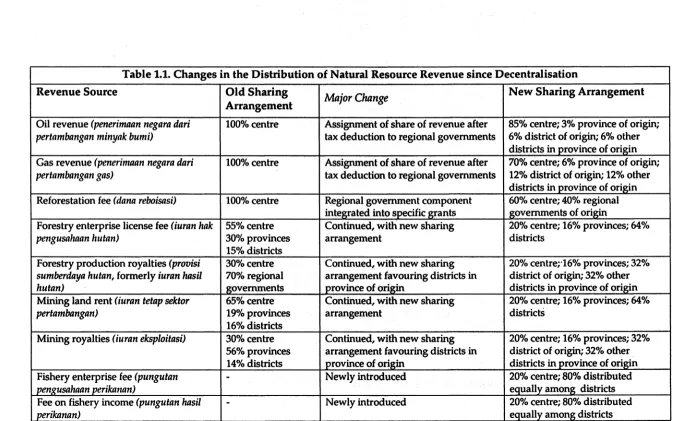
sharing arrangement for oil, gas, mining and reforestation fees between the
central and local government has changed (see Table 1.1). For example, the old
arrangement for sharing of oil revenue was 100 per cent for the central
government. The new arrangement for oil revenue is 85 per cent for the central
government and 3 per cent for the province of origin, 6 per cent for the district
of origin, 6 per cent for other districts in the province of origin (Brojonegoro
2004: 128). Significant changes. have also occurred in the revenue-sharing
arrangement for gas. Consequently, the central government budget in 2002
decreased to 64 per cent whereas the total district government budget increased
to 27 per cent.26
Figure 1.1. Comparison of Tota~ Public Sector Outlays by Local, State and Federal Governments in Indonesia
(1994), Australia (1993) and the USA (1992)
90-.--~~~~~~~~~~~~~~~~~~~~~~~-,
80 70
60
! 50
~
,::. 40
30 ... . 20 ... . 10
0
Indonesia Australia Country
US of America
I CILG
l •sG
I
CIFGSource: McNeill, J., 1997. 'Local Government in the Australian Federal System' in B. Dollery and N. Marshall (eds), Australian Local Government Reform and Renewal,
Table 1.1. Changes in the Distribution of Natural Resource Revenue since Decentralisation
Revenue Source Old Sharing
Major Change New Sharing Arrangement
Arrangement
Oil revenue (penerimaan negara dari 100% centre Assignment of share of revenue after 85% centre; 3% province of origin;
pertambangan minyak bumi) tax deduction to regional governments 6% district of origin; 6% other
districts in province of origin
Gas revenue (penerimaan negara dari 100%centre Assignment of share of revenue after 70% centre; 6% province of origin;
pertambangan gas) tax deduction to regional governments 12% district of origin; 12% other
districts in province of origin
Reforestation fee (dana reboisasi) 100% centre Regional government component 60% centre; 40% regional
integrated into specific grants governments of origin
Forestry enterprise license fee ( iuran hak 55% centre Continued, with new sharing 20% centre; 16% provinces; 64%
pengusahaan hutan) 30% provinces arrangement districts
15% districts
Forestry production royalties (provisi 30%centre Continued, with new sharing 20% centre;·16% provinces; 32%
sumberdaya hutan, formerly iuran hasil 70% regional arrangement favouring districts in district of origin; 32% other
hutan) governments province of origin districts in province of origin
Mining land rent ( iuran tetap sektor 65%centre Continued, with new sharing 20% centre; 16% provinces; 64%
pertambangan) 19% provinces arrangement district$
16% districts
Mining royalties ( iuran eksploitasi) 30%centre Continued, with new sharing 20% centre; 16% provinces; 32%
56% provinces arrangement favouring districts in district of origin; 32% other
14% districts province of origin districts in province of oriein
Fishery enterprise fee (pungutan
-
Newly introduced 20% centre; 80% distributedpenKusahaan perikanan) equally among districts
Fee on fishery income (pungutan hasil
-
Newly introduced 20% centre; 80% distributedperikanan) equally among districts
[image:42.843.86.775.43.464.2]