ISSN(Online): 2320-9801
ISSN (Print): 2320-9798
I
nternational
J
ournal of
I
nnovative
R
esearch in
C
omputer
and
C
ommunication
E
ngineering
(A High Impact Factor, Monthly, Peer Reviewed Journal) Website: www.ijircce.com
Vol. 5, Issue 10, October 2017
Energy Hole Evolution for Continuous Data
Gathering in WSN
Prof.Kantilal Shamlal Chandre
Master of Technology, Department of Computer Science and Engineering, Matsyodari College of Engineering and
Technology, Jalna, Dr.B.A.M.University, Aurngabad, India
ABSTRACT: Continuously Data acquisition in wireless sensor network is critical, because of network lifetime where battery powered sensor nodes timely update the environment and forward collected data to sensor node. Proposed system represents an analytic model to modulate the entire network lifetime from network initialization until it is completely disabled, and determine the boundary of energy hole in a data-gathering WSN. Specifically, Proposed work estimate the traffic load, energy consumption, and lifetime of sensor nodes during the sensing network lifetime. Furthermore, we design the temporary sensor node and spatial evolution of energy hole and apply our analytical results to WSN routing in order to balance the energy consumption and improve the network lifetime. Extensive simulation results are given to show the validity of the proposed analytic model in estimating the network lifetime and energy hole evolution process.
KEYWORDS: Energy efficiency, energy hole, network lifetime, routing, wireless sensor network (WSN).
I. INTRODUCTION
Wireless sensor networks, event driven clustering approach used for analysing the network lifetime is presented when events occur randomly over the network field. This system model the packet transmission rate of the sensors, using the theory of coverage processes and Voronoi tessellation. Then, the probability of achieving a given lifetime by individual sensors is found. This probability is then used to study the cluster lifetime. It finds an accurate approximation for the probability of achieving a desired lifetime by a cluster. The proposed study contains the effect of packet generation model, random deployment of sensors, dynamic cluster head assignment, data compression, and energy consumption model at the sensors. In proposed system we modulate problem of energy hole evolution for effective data acquisition We design sensor network by appropriate sensor deployment, Such sensor networks are implemented to collect multiple data points from each selected location over a period of weeks or months. Battery capacity gained by sensor nodes is limited in computation capability, memory space, communication bandwidth, and, above all, energy supply. A sensor network cannot carry out its task after the nodes’ energy is finished. So to improve the operational lifetime of a sensor network is critical. A wireless sensor network consists of a set of sensing devices which work to collect data from a sensor deployed area. The limited energy available at the sensors makes the network lifetime one of the most critical issues in the design of WSNs. A information sensing in WSN consists of a large number of battery powered sensor nodes that sense the allocated bandwidth limitation and periodically send the sensing results to the sink.The nodes near to the sink need to transfer the data packets from other nodes; they exhaust their energy quickly, leading to an energy hole around the sink. So that complete wireless sensor network fail to transmit data packet.
II. RELATED WORK
In wireless sensor networks, sensor nodes near to the sink node consume more energy than others because they are
forced to relaying packet traffic towards for the sink and result in premature death of network resources. Energy hole is
ISSN(Online): 2320-9801
ISSN (Print): 2320-9798
I
nternational
J
ournal of
I
nnovative
R
esearch in
C
omputer
and
C
ommunication
E
ngineering
(A High Impact Factor, Monthly, Peer Reviewed Journal) Website: www.ijircce.com
Vol. 5, Issue 10, October 2017
In existing WSN sensor nodes transmit the data packet via hop to hop communication. In that case all sensor nodes nearest node need to spatially aware to take path towards transmission.
In[1], author defines the building area network for high-traffic advanced metering infrastructure in smart grid applications.Using multi-interface ZigBee , high-traffic communication in these building area networks (BANs), a multi-interface management framework defined. This system provides the design engineer with seven recommendations for a generic MIZBAN design.Smart grid communication technology supports advanced metering infrastructure.The smart metering, AMI(advanced metering infrastructure) also facilitates utilities to perform demand response, and thus energy demand is reduced . Therefore various AMI pilot projects have been created around the world, e.g. in Australia, Japan, the United States, and Europe, and most of these are designed for individual homes.This system has benefits The RTT measurement is only carried by sender and so no extra network traffic has been generated. RTT provides the Updated transmission condition of the entire path because the path cost cannot be updated frequently because it can only be updated by performing route discovery, which may degrade the network performance.This system includes Channel selection algorithm and Interface selection algorithm.
In [2],author describes a ZigBee In-Patient Monitoring system embedded with a new ZigBee mobility management solution. This system enables ZigBee device mobility in a fixed ZigBee network. This system provides valuation which shows that the new algorithm offers a good efficiency, resulting in a low management cost. The system can save lives by supporting a panic button and can be used as a location discover service. A case study emphasis on the Princes of Wales Hospital in Hong Kong is enlisted and findings are given. This investigation reveals that the developed mobile solutions offer promising value-added services for many potential ZigBee applications.
In [3],Author proposed the wireless sensor networks,the nodes have limited power supply and sometimes network lifetime expected as per the need. So the energy consumption and network lifetime are the key factors to achieve in WSN. This paper proposes an overlay, energy optimized, sensor network to extend the functional lifetime of an energy-intensive sensor network application. The overlay network consists of additional nodes that exposes recent advances in energy harvesting and wake-up radio technologies, coupled with an application specific, complementary and ultra-low power sensor. The experimental results and simulations prove that this study can ensure survivability of energy-inefficient sensor networks. This paper exploits these techniques to take advantage of the benefits of each and to extend the lifetime of the network while maintaining similar (or improved) security.
.
In [4],author defines WSN cluster based scheme used to reduce the energy consumption in WSN applications.Sometimes network lifetime is affected by unbalanced energy consumption in WSN due to many to one traffic pattern. In this system propose a Non-Uniform Node Distribution (NUND) scheme to improve the energy efficiency and network lifetime in cluster-based WSNs. Specifically, It first propose an analytic model to analyze the energy consumption and the network lifetime of the cluster-based WSNs. Based on the analysis results this system describes a node distribution algorithm to maximize the network lifetime alongwith a fixed number of sensor nodes in cluster-based WSNs.
ISSN(Online): 2320-9801
ISSN (Print): 2320-9798
I
nternational
J
ournal of
I
nnovative
R
esearch in
C
omputer
and
C
ommunication
E
ngineering
(A High Impact Factor, Monthly, Peer Reviewed Journal) Website: www.ijircce.com
Vol. 5, Issue 10, October 2017
In [6],The author describes the network lifetime depends upon the design of network.InWSN,the most efficient way to maximize the lifetime of a wireless sensor network (WSN) is to provide energy to sensors they release their energy at the same time. The lifetime of a WSN as well as an optimal initial energy allocation are determined by a network design.The main contribution of thepaper is to show that the lifetime of a WSN can be maximized by an optimal network design. We represent the network lifetime as a function of the number m of annuli and show that m has significant impact on network lifetime. The goal of this system is to increase lifetime of Wireless Sensor Network also including redundant sensor,nonuniform sensor distribution,aggregation and forwarding nodes for data transmission using routing algorithm.
In [7], author proposed system that represents the area near the sink nodes.The network lifetime is limited by heavy-traffic. This work attempts to improve the energy efficiency of the sink node to overall improvement of the network lifetime by considering a duty cycled WSN. studies carried out to evaluate the upper bounds of the network lifetime by considering (i) duty cycle, (ii) network coding and (iii) combinations of duty cycle and network coding. Energy efficiency of the bottleneck zone increases because more volume of data will be transmitted to the Sink with the same number of transmissions. This improves the overall lifetime of the network. Performance metrics such as packet delivery ratio and packet latency have also been investigated. The theoretical study and simulation results have been provided to show the efficacy of the proposed approach.
In [8],author defines wireless sensor networks variety of mission-critical applications, are comprised of sensor nodes with limited battery power. Improvement of energy efficiency and estimation of network lifetime are important issues in these energy constrained networks. This system present a probabilistic model for estimating the network lifetime of a sensor network. The traffic generation model is build up for unbalanced surfaces while combining the Elfessensing model and event generation model.A discrete radio model is considered in this system for better energy efficiency. Two different scenarios, such as, singlehop and multi-hop networks are analyzed with the proposed model. The likelihood of achieving the desired network lifetime with the proposed model is evaluated. Essential simulations are done taking the topology from real-sensor network testbeds. We also estimate the packet loss rates and the results also confirm the accuracy and energy efficiency of the proposed model.
In [9], author explains due to extended networks the problem of data gathering and sampling becomes critical in WSN. Increasing network size poses significant data collection challenges, for what concerns sampling and transmission coordination as well as network lifetime. To resolve these problems, in-network compression techniques without centralized coordination are becoming important solutions to extend lifetime. This system consider a scenario in which a large WSN, based on ZigBee protocol, is used for monitoring (e.g., building, industry, etc.). It propose a new algorithm for in-network compression aiming at longer network lifetime. This approach is fully distributed: each node autonomously takes a decision about the compression with respect to network size using datasets collected by a real-life deployment. An improved version of the algorithm is also introduced to take into account the energy spent in compression.
III. PROPOSED SYSTEM MECHANISM
ISSN(Online): 2320-9801
ISSN (Print): 2320-9798
I
nternational
J
ournal of
I
nnovative
R
esearch in
C
omputer
and
C
ommunication
E
ngineering
(A High Impact Factor, Monthly, Peer Reviewed Journal) Website: www.ijircce.com
Vol. 5, Issue 10, October 2017 Advantages of Proposed System:
1. Extend the lifetime analysis into energy harvesting WSNs. 2. Improve network security by node authentication.
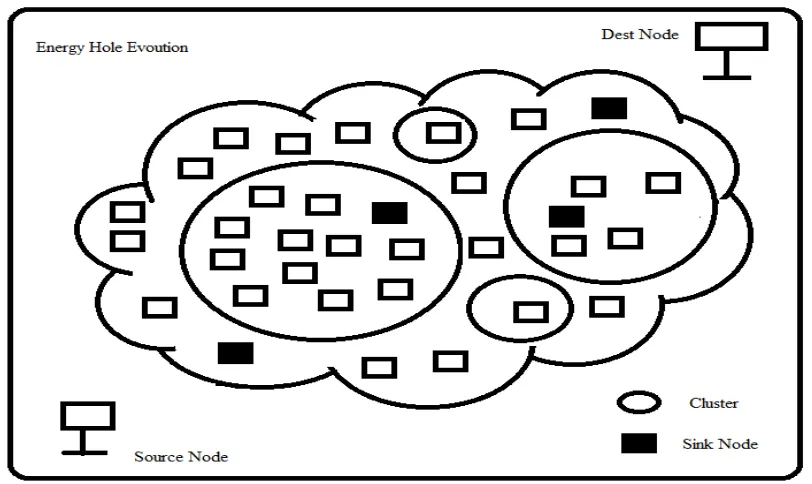
Fig. 1. Proposed System Architecture
IV. MATHEMATICAL MODEL
Let us consider S as a system for Energy hole evolution for data analysis in WSN. Assume that node j is in the small region of Ax with the width of ε. Denote x as the distance between Ax and the sink, and θ as the angle formed by Ax and the sink. If each node generates one data packet per round, the average data amount sent by j in a round at S0 is,
( )
=
( + 1) + ( )
( + 2) + ( + 1)r ,
Where,
=∟(R-x)/r⏌and =∟(R- )/r⏌
Since node j is in the small region of , its traffic load can be calculated as the average traffic load in Ax according to our analytic model. Therefore, we first calculate the average traffic load in . εis the width of Ax and θ denotes the angle formed by Ax and the sink; thus, we can obtain the number of nodes in Ax As these nodes receive and forward the data from theupstream regions, the number of sensor nodes in the upstreamregions ,
=
ISSN(Online): 2320-9801
ISSN (Print): 2320-9798
I
nternational
J
ournal of
I
nnovative
R
esearch in
C
omputer
and
C
ommunication
E
ngineering
(A High Impact Factor, Monthly, Peer Reviewed Journal) Website: www.ijircce.com
Vol. 5, Issue 10, October 2017
Where,
=∟(R-x)/r⏌and =∟(R- )/r⏌
Since each node only generates a data packet per round, the number of data packets equals to the number of the involved nodes. Thus, the number of data packets sent by Ax is,
= + +…………+
We have the average traffic load of Ax as .Since the traffic load of the node j approximately equals theaverage
traffic load of the sensor nodes in Ax, the traffic load of the node j at should be ( )= . With some
simplecalculation, we have ( ). S= {……
INPUT:
Identify the inputs
F= {f1, f2, f3 ...,fn| ‘F’ as set of functions to execute commands.}I= {i1, i2, i3…|’I’ sets of inputs to the function set}
O= {o1, o2, o3….|’O’ Set of outputs from the function sets}
S = {I, F, O} .
I = {Number of sensor node, sink node, nearest nodes, data packet size, transmission rate} O = {Reduced energy hole evolution for data acquisition.}
F = {Functions implemented to get the output}
V. METHODOLOGY USED
Network life time determination Algorithm
Input: Network radius R, transmission radius r, node density of the network ρ, and other parameters.
Output: For each stage iand each node j, return the nodal traffic load Pj(i) energy consumption, ej(i) as well as the energy
transfer function fand lifetime vector l.
1: Determine the traffic load and energy consumption of each node at stage S0, i.e.
[ P1(0), P2(0), …..,Pj(0),….,Pn(0) ] and [e1(0), e2(0), …., ej(0), …, en(0)], according to Theorems 1 and 2;
2: i= 1;
3: While the sink can receive data in a data period do
4: According to Corollary 1, calculate the lifetime l(i-1) at stage Si-1, and the ith batch of dead nodes region [ui, ui + ε];
5: Determine the traffic load and energy consumption of the sensor nodes at stage Si, i.e.,
[P1(i), P2(i), …, Pj(i), …, Pn(i)] and [e1(i), e2(i), …., ej(i), …, en(i)], according to Theorems 3 and 4;
6: i= i+ 1; 7: end while
8: return the traffic load and energy consumption Pj(i) and ej(i) (for each iand j), and the network stage duration vector
l(i)(for each i).
Determination of energy time and boundary of energy hole Algorithm
Input: Network radius R, transmission radius r, node density of the network ρ, and other parameters.
Output: For each stage iand each node j, return the nodal traffic load Pj(i) energy consumption, ej(i) as well as the energy
transfer function fand lifetime vector l.
1: Determine the traffic load and energy consumption of each node at stage S0, i.e.
[ P1(0), P2(0), …..,Pj(0),….,Pn(0) ] and [e1(0), e2(0), …., ej(0), …, en(0)], according to Theorems 1 and 2;
ISSN(Online): 2320-9801
ISSN (Print): 2320-9798
I
nternational
J
ournal of
I
nnovative
R
esearch in
C
omputer
and
C
ommunication
E
ngineering
(A High Impact Factor, Monthly, Peer Reviewed Journal) Website: www.ijircce.com
Vol. 5, Issue 10, October 2017
3: While the sink can receive data in a data period do
4: According to Corollary 1, calculate the lifetime l(i-1) at stage Si-1, and the ith batch of dead nodes region [ui, ui + ε];
5: Determine the traffic load and energy consumption of the sensor nodes at stage Si, i.e.,
[P1(i), P2(i), …, Pj(i), …, Pn(i)] and [e1(i), e2(i), …., ej(i), …, en(i)], according to Theorems 3 and 4;
6: i= i+ 1; 7: end while
8: return the traffic load and energy consumption Pj(i) and ej(i) (for each iand j), and the network stage duration vector
l(i)(for each i).
VI. EXPERIMENTAL RESULT
In this section, we explorethe temporal and spatial evolution of energy hole based on our analytical result. The traffic load and energy consumption of the sensor nodes and the networklifetime can be determined, where the endcondition is that the sink can’t receive any data in a data period, which consists of two cases. One is all nodes die due to energy exhaustion. The other is some nodes still have remaining energy, but the sink is isolatedfrom the outer nodes after the formation of the energy hole. Accordingly, even if the network still has remaining energy, the network becomes useless and is also considered as disabled. We can easily judge the algorithm is terminated in which case by checking if there are sensor nodes with remaining energy in the network. If it is the second case, the formation of energy hole should be analyzed temporally and spatially. According to our analytic model, at least one sensor node will die after each network stage. Since the location of the dead nodes can be determined by Algorithm 1, we can check if the dead sensor nodes form a continuous dead ring with the width d and d ≥ r after every network stage. The network might be partitioned by the continuous dead ring, which is preciselythe energy hole of the network. Demonstrateshow to decide the emerging time and boundary of the energy hole.
Fig02 .Transmission radius r (m) 0
1 2 3 4 5 6
60 80 100 120 140 160
FNDT in a
2 % nodes die in a
ANDT in a
FNDT in b
ISSN(Online): 2320-9801
ISSN (Print): 2320-9798
I
nternational
J
ournal of
I
nnovative
R
esearch in
C
omputer
and
C
ommunication
E
ngineering
(A High Impact Factor, Monthly, Peer Reviewed Journal) Website: www.ijircce.com
Vol. 5, Issue 10, October 2017 VII. CONCLUSION
Proposed system represents architecture to overcome the network traffic load, reduce energy consumption, and lifetime of sensor nodes in a data collection. In this system, we have evaluated the network lifetime under failed nodes, and analyzed the emerging time and location of energy hole, as well as its evolution process. In addition to this, two network characteristics have been found based on our analytic results, which can be leveraged to guide the WSN design and optimization. Our simulation results demonstrate that the proposed analytic model can estimate the network lifetime and energy hole evolution process within an error rate smaller than 5%. Finally, we have applied our analytic results to WSN routing. Proposed routing scheme is leads to results of efficiently balance the energy consumption and increase the network lifetime.
REFERENCES
[1] Y. Tung et al., “The generic design of a high-traffic advanced metering infrastructure using zigbee,” IEEE Trans. Ind. Informat., vol. 10, no. 1, pp. 836–844, Feb. 2014.
[2] C. Tung et al., “A mobility enabled inpatient monitoring system using a zigbee medical sensor network,” Sensors, vol. 14, no. 2, pp. 2397–2416, 2014.
[3] C. Caione, D. Brunelli, and L. Benini, “Distributed compressive sampling for lifetime optimization in dense wireless sensor networks,” IEEE Trans.Ind. Informat., vol. 8, no. 1, pp. 30–40, Feb. 2012.
[4] M. Magno, D. Boyle, D. Brunelli, E. Popovici, and L. Benini, “Ensuring survivability of resource intensive sensor networks through ultra-low power overlays,” IEEE Trans. Ind. Informat., vol. 10, no. 2, pp. 946–956, May 2014.
[5] R. Rout and K. Ghosh, “Enhancement of lifetime using duty cycle and network coding in wireless sensor networks,” IEEE Trans. WirelessCommun., vol. 12, no. 2, pp. 656–667, Feb. 2013.
[6] L. Zhang, S. Chen, Y. Jian, Y. Fang, and Z. Mo, “Maximizing lifetime vector in wireless sensor networks,” IEEE/ACM Trans. Netw., vol. 21, no. 4, pp. 1187–1200, Aug. 2013.
[7] R. Kacimi, R. Dhaou, and A. Beylot, “Load balancing techniques for lifetime maximizing in wireless sensor networks,” Ad Hoc Netw., vol. 11, no. 8, pp. 2172–2186, 2013.
[8] J. Ren, Y. Zhang, and X. Lin, “NUND: Non-uniform node distribution in cluster-based wireless sensor networks,” KSII Trans. Internet Inf. Syst., vol. 8, no. 7, pp. 2302–2324, 2014.