Recommending Learning Path of Student
using Machine Learning
Priti B. Jadhav1, Dr. R. B. Ingle2
Student, Dept. of Computer Engineering, University of Pune, PICT Pune, India1
Professor, Dept. of Computer Engineering, University of Pune, PICT Pune, India2
ABSTRACT: There are many emerging fields, technologies in the Engineering field. Many times students do not understand, what is the field they are good? What is the area they can improve? This workdone introduces the adaptive questionnaire, which changes the question based on student's previous answer. It helps student to find depth of knowledge they have in that subject. Hence it helps to understand the nature of the student for what course they are suitable or they can find their correct career path. Adaptive algorithm is used to built the questionnaire. It make sure to fetch the questions based on student's previous response to check depth of student knowledge in particular subject. In this system, Machine Learning algorithm performs the task of recommending courses which can help them in their career, for analyzing their learning path.
KEYWORDS: Adaptive Algorithm, Machine Learning, Fuzzy Classifier
I.INTRODUCTION
Machine Learning is the emerging field. It has the tons of uses in the different fields of research. Many of its techniques shows the tremendous effect on the e-commerce, medical diagnosis [15], education, social media, image processing. Fuzzy classifier has become extremely popular in designing controllers for industrial plants [15], it used by the different areas of research and the education and many more, as in references [13], [14], [15].
There are different classification algorithms. Need to choose the best suitable for the problem addressed in the education system. The idea is to use the proper machine learning algorithm for the classification of the student in the proper class of field. Along with this gives brief idea about how to find the learning path of student based on their previous data, their interest in particular subject on the scale of one to ten as well as adaptive questionnaire. It has different steps:
First need to collect the student history, its interest, courses done. Second The history includes B.tech marks as well. Collected through their profile. Third step lead to analyze all the data which we have previously and currently available. Step fourth by analyzing the history data need to track on current data we can identify the student learning path and in what area he/she is good. What courses we can suggest by observing this data. There are different section in this paper and conclusion followed by publication detail.
II.RELATEDWORK
In [1] Zhaoli Wang et al. the resume scanning and then checking in the fields of programming skills and company’s requirements we have to match and after matching those we can say the particular candidate is eligible for so and so company by matching it with company profile. The algorithms used in this paper genetic algorithm is used to meet the needs. The algorithm is used for training the data set and it build three kind of resume databases: positive feedback resume database (PosF), negative feedback resume database (NegF), non deterministic resume database (NonF). But the problem here is the student can lie in the resume.
algorithm and CRT(classification and regression algorithm) algorithm for generating rules. The CRT tree got the 76\%accuracy in [2].
There is the adaptive question formation discussed in [3] SilviaSabine Graf et al. in the paper Learning Management System is build in which the automatic, dynamic, and global student modelling is done adaptive
mechanism aims at being easy to use for teachers by being generic and adaptable for teachers, allowing them
to adjust the mechanism to their course structure and preferences. The adaptive modelling is made based on student learning style in [4]. Vaibhav M. Kale et al. in this we can see the question paper generation is for coverage the total syllabus as well as topics are covered. The algorithm presented in this paper attempts to solve the problem of dividing unit wise questions, marks allocated to that and the format of paper by dividing the task of generation of question in [5].
Mohamed Amine Chatti et al. implemented 16 different tag-based collaborative filtering recommendation algorithms, memory based as well as model based, and compare them in terms of accuracy and user satisfaction. The results of the conducted offline and user evaluations reveal that the quality of user experience does not correlate with high-recommendation accuracy. In this paper for recommendation they have used collaborative filtering, content based recommendation and hybrid recommendation. The main technique is the collaborative filtering recommendation. Memory based CF algorithm is used for rating prediction and recommendation in [6].
III.PROPOSEDALGORITHM
A. Proposed Algorithms:
There are two algorithms used in this system for the purpose of the taking online test and then for the second part which is recommendation or suggestion based on the performance.
Adaptive Algorithm
Fuzzy Classifier
B. Description of the Proposed Algorithm:
Aim of the proposed algorithm is to maximize the accuracy of recommending the course based on the student's performance. Other algorithm is for the fetching appropriate question from the questionnaire.
Step 1: Perform the Online Test:
Firstly we collected the questions from the different websites. It has the 14 subjects of engineering field. The questions are divided in to three levels and stored in the database. The Adaptive Algorithm has the randomized function. Function pick question adaptively based on the previous answer. If the answer is correct question will be picked from the high level else from low level set randomly.
Step 2: Fuzzy logic:
Fuzzy Classifier is used for the recommendation. Fuzzy Classifer work on the rules. Rules are created by the different Rule generation algorithm by providing dataset in the form of csv file. Fuzzy control system is made up of these rules. There are 14 subject treating them as a feature. There are different classes like Machine Learning, Application Development, Android Development near about 10 classes. Each feature has three qualities like low, medium, high. These is decided in the Control System.
The following function i=1...c where c is class. M is for membership function j and k stands for the subject and x1 and x2, x3 are features. Which will support the class x in that case to get picked.
X is the class label then the membership values having the membership values ( )∈ [0,1] where l =1,2...c, where c is number of classes. Let i→l denote rule i is in favor of class l the
( ) = → Step 3: Recommendation of Area:
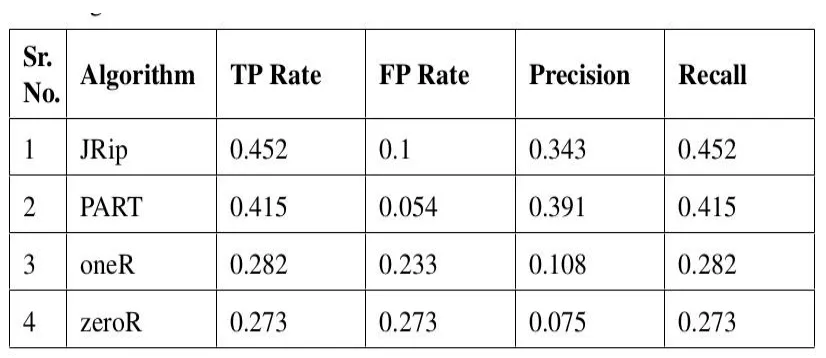
This work is done by the fuzzy classifier the above formula will tell the class which have maximum favor with the help of rules states by the different algorithms. The algorithms we used for the rule generation are JRip, PART, oneR. For the rule generation used the WEKA tool. The results for the different algorithms correctness is given in the table in the result section. This rules are then used in the fuzzy classifier control system for the recommendation.
IV. PSEUDO CODE
Adaptive Algorithm:
Step 1:Initialize NumberofQuestion=0; Step 2:Initialize SubjectID = 0 Step 3: If QuestionLevel equal to 0
levels = Easy\\
Else if QuestionLevel equal Easy If Marks >0 level = Medium Elsel evel = Easy
Else if QuestionLevel = Medium if Marks > 0 level = Hard else level = Easy
Else if QuestionLevel = Hard if Marks < 0level = Hard else level = Medium increase SubjectID
Step 4: Repeat Step 3 until NumberofQuestions=100 and SubjectID=14 .
V.RESULTSANDDISCUSSION
The algorithms we compared with Fuzzy Rule Based Classifier are Naive Bayes, Decision Tree which includes J48, CART tree. For the Statistics check the Table. 1. The algorithm we used for the Rule generation JRip which gives maximum Recall and hence the accuracy. Other algorithm such as PART, oneR, zeroR gives the different accuracy as shown in the Table. 2 . The algorithm we choose to generate rule is having the maximum recall of all. As shown in the following tables the fuzzy classifier gives 89% accuracy over the other algorithms. The rules generated by the algorithms are shown in Table. 3.
Table 2. Comparison of the Algorithm used for Rule Generation
Table 3. Rules generated
VI. CONCLUSIONANDFUTUREWORK
guessing answers in online test. This work considers the limited courses and only restricted to the Computer Engineering branch. Which only useful to the Computer Engineering field student about their path. In future this system can be used to develop for the different branches in broader way. Adaptive algorithm of this work can extend and improve such a way that it can itself suggest the course to the student.
REFERENCES
1. AZhaoli Wang, Xinhuai Tang, DelaiChen, “A Resume Recommendation Model for Online Recruitment,” 11th International Conference on Semantics, Knowledge and Grids, pp. 256 - 259, 2015.
2. Lakshmi Sreenivasa Reddy. D, M. Rao Batchanaboyina, D. V. V. S. Phanikumar, “Learning Styles Vs Suitable Courses,” IEEE International Conference in MOOC, Innovation and Technology in Education (MITE),, pp. 152 – 157, 2013.
3. Silvia Quarteroni and Suresh Manandhar, “User Modelling for AdaptiveQuestion Answering and Information Retrieval,” American Association for Artificial Intelligence , 2006, pp. 776-781.
4. Sabine Graf and Kinshuk, “Advanced Adaptivity in Learning Management Systems by Considering Learning Styles,” IEEE/WIC/ACM International Joint Conference on Web Intelligence and Intelligent Agent Technologies Technology Workshop, VOL. 3, pp. 482-486, 2009. 5. Vaibhav M. Kale, Arvind W. Kiwelekar, “An Algorithm for Question Paper Template Generation in Question Paper Generation System,” Technological Advances in Electrical, Electronics and Computer Engineering (TAEECE), International Conference, pp. 256 – 261, 2013.
6. Mohamed Amine Chatti, SimonaDakova, Hendrik Ths, and UlrikSchroeder, “Tag-Based Collaborative Filtering Recommendation in Personal
Learning Environments,”IEEE trans., VOL. 6, NO. 4, pp. 337 – 349, 2013.
7. Dr. A. Padmapriya, “Prediction of Higher Education Admissibility using Classification Algorithms,” https://www.researchgate.net 2012, pp. 330-336, 2012.
8. Xin Chen, MihaelaVorvoreanu, Krishna Madhavan, “Mining Social Media Data for Understanding Student’s Learning Experiences,” IEEE trans., VOL. 7, NO. 3, pp. 246 – 259, 2014.
9. Mugdha Sharma, Ankit Goyal, “An Application of Data Mining to Improve Personnel Performance Evaluation in Higher Education Sector In India,” Computer Engineering and Applications (ICACEA), 2015 International Conference on Advances IEEE, pp. 559-564, 2015.
10. S. S. Ajeesh, M. S. Indu, Elizabeth Sherly, “Performance analysis of classification algorithms applied to Caltech101 image database,” Issues and Challenges in Intelligent Computing Techniques (ICICT), 2014 International Conference, IEEE, pp. 693 – 696, 2014.
11. Norlida Buniyamin, Usamah bin Mat, Pauziah Mohd Arshad, “Educational Data Mining for Prediction and Classification of Engineering Students Achievement,” Engineering Education (ICEED), IEEE 7th International Conference, pp. 49 – 53, 2015
12. Mamdani E. H., “Application of fuzzy logic to approximate reasoning using linguistic synthesis,”IEEE Trans. Computers 26(12), VOL. C-26, NO. 12, pp. 1182-1191, 1977.
13. H. Ishibuchi, T. Nakashima, T. Murata, “Performance evaluation of fuzzy classifier systems for multidimensional pattern classification problems”, IEEE trans. on systems, man, and cybernetics-part B;cybernetics, VOL. 29, NO. 5, pp. 601 – 618, 1999.
14. A. R. Varkonyi-Koczy, B. Tusor, J. T. Toth, “Active problem workspace reduction with a fast fuzzy classifier for real time applications,” in Systems, Man, and Cybernetics (SMC), IEEE International Conference, IEEE,, pp. 4423 – 4428, 2016.
15. Ilan Chamovitz, Marcos da Fonseca Elia, Carlos Alberto Nunes Cosenza, “Fuzzy assessment model for operative groups in virtual educational forums,” in Science and Information Conference (SAI), IEEE, pp. 395 – 405, 2015.
16. Manh Tuan Tran, Hai Minh Nguyen, Van Tao Nguyen, Thi Ngan Tran, Huu Nguyen, “Medical diagnosis from dental X-ray images: A novel approach using Clustering combined with Fuzzy Rule-based systems,” in Fuzzy Information Processing Society (NAFIPS), Annual Conference of the North American, IEEE, pp. 1 – 6, 2016.
BIOGRAPHY