Quality of Service on Mobile Adhoc Network
to Increase the Efficiency of Client
Priya Gupta, Alka Setiya
M.Tech Student, Department of Computer Science and Engineering, Faculty of Engineering and Technology, MRIU
at Faridabad, Haryana, India
M.Tech Student, Department of Computer Science and Engineering, Faculty of Engineering and Technology, MRIU
at Faridabad, Haryana, India
ABSTRACT: Qos is interpreted as an android application which run on any android system it involves running of a server on mobile systems in which camera gets started in horizontal orientation there is no status bar every time when a client gets connected to server it displays a message on the server displaying which client has been connected. Server has files on it like .docx,.ppt ,.pdf,.jpeg,.gif etc. Which client can access easily. Client is a self-defined web browser which contains features like status bar address bar, tool bar, drop down list, progress bar, cookies, and history. When the browser runs and the user type a url with the port 1111 a page gets displayed which prompts for username and password and after the authentication is completed it get transferred to the second page.Several page consists of several options. User can click on those files and are available to users within seconds even if it is of large size. The merit of this application is that we are using a tethered network which is fast , secure and has a high coverage area operating on 2.4 ghz frequency band. Also if the server gets down due to any avoidable reason like low battery it send a request to another device in a tethered network which will now act as a master and client is connected to it.
KEYWORDS: Adhoc network Ipaddress , piconet ,port no., QoS , scatternet , tethering routes.
I. INTRODUCTION
Tethering is an emergent technology which is short in range, consumes less power along with a facility of wireless communications. It provides the functionality of the logic link control layer together with the physical layer of the OSI model. We can operate tethering in 2.4 GHz frequency band. The tethering uses the slotted protocol with a frequency hopping spectrum method in the 2.4 GHZ ISM band which is free of cost. A strict master slave scheme is followed in for the communication of tethering devices.In this a particular piconet can have a maximum of seven devices. Two or more piconets can be combined to form a scatternet. Figure 1 shows the formation of piconet and scatternet.
Fig.1: Piconet and Scatternet
modes in the tethering architecture will be PARK, HOLD, SNIFF. In the PARK mode it is not possible to have the duty cycle less than 1 percent. The QoS enhancements should have no significant increase in the power consumption.
Fig.2: QOS Framework Fig.3: Flow diagram of methodology
The QoS Framework is described in Figure2. The main aim of the Resource Requester(RR) and the Resource Manager(RM) is to make a reservation within the air interface bandwidth for QoS flow in the piconet or the scatternet.The flow of traffic between two devices is a uni- directional flow with the quality as same of service requirements.The function of the RR is to make requests for the flow to the RM. The function of the RM is to manage the resources of the piconets and either it accepts or rejects the resource request from RR. The reservation of resources is down at the start of the data transmission and the reservation gets cancelled when the flow of data is over.The RR is responsible for receiving all the traffic and the different requirements of the QoS flow from the higher layers.For Example the traffic specification contained in the RSVP message could be passed to the RR. Based on the requirements the RR generates request for RM. When the request gets accepted the RR entity can provide different parameters to the local resource allocation (RA) entity.
II. LITERATURE SURVEY
routing problem is to determine optimal tree spanning the source and all the destinations.in recent years both the shortest path routing and multicast routing have been well addressed using intelligent optimization techniques. With the advancement in wireless communication more and more mobile wireless network appear e.g., Mobile ad-hoc Network(MANETs).The significant features in MANETs is the topology dynamics that is the network topology changes over time due to energy preservation or node mobility. Therefore both routing problem turn out to be dynamic optimization problem in MANETs. It is essential for designed solution is to quickly adapt to environmental (i.e. the network topology changes) changes and produce high quality solution after each change as soon as possible. In [4] authors have discussed several routing protocols been proposed for mobile ad hoc networks and prominent among them are DSR, AODV and TORA. Their research paper provides an overview of these protocols by presentingtheir advantages and disadvantages of the proactive, reactive and hybrid protocols and then makes theircomparative analysis of their advantages and disadvantages. In [5] authors have proposed method WBTQ (Weightage Based Trusted QoS Protocol) thatfocuses on both the issues in parallel, it is providing secure environment by evaluating each node’s trustworthiness in the network instead of using high computational encryption algorithms without losing its performance. The WBTQ is the extension of OLSR protocol where node trust values and QoS metrics are propagated in the network through the HELLO packets. This protocol provides a flexible and feasible approach to the user in choosing a better route by giving weightage to Quality and Trust values. In [6] authors have proposed a stable and energy-efficient routing technique. In the proposed method, quality of service (QoS) monitoring agents collect and calculate the link reliability metrics such as link expiration time (LET), probabilistic link reliable time (PLRT), link packet error rate (LPER) and link received signal strength (LRSS). In addition, residual battery power (RBP) is implemented to maintain the energy efficiency in the network. Finally, route selection probability (RSP) is calculated based on these estimated parameters using fuzzy logic. Simulation results show that the proposed routing technique improves the packet delivery ratio and reduces the energy consumption.
III. METHODOLOGY
We have used Route Discovery Protocol (RDP) in which route discovery packet is flooded over the tethered network to find the destination i.e. connected client. When first RDP is received RRP (Route reply packet) is send back to the source ensuring the successful connection. After the process a tethering link is created to connect the different devices. When the RRP arrives at the source device, the scatternet route is ready to transmit data from the source to the destination. If no device is found it will search for the other device using crank back routing mechanism. In this mechanism the RRP packet will crank back to the previous node and in return send a Route Discovery with Role Protocol (RDRP) packet to the neighbor nodes to find a path that intersects with source i.e. master. Figure 3 describes the flow of work. It consists of the following modules. Module 1 describes the server is being created which is coded in android and an apk is generated which runs on an android device. When it runs a camera gets started on background. Module 2 describes the web browser is being created. It is used as a client. It consists of address bar, status bar, navigation bar etc.In Module 3, Integration of server and client in which client can access the files kept on server with ease. Files can be of .docx, .ppt,.pdf, .jpeg,.gif. In Module 4,Load balancing is done i.e. if server gets down due to any reason the request gets transfer to other device connected in a tethered network with den becomes a master(server) and client is unaffected and client gets an illusion that he is working on the same server.
IV. SIMULATION RESULTS
To evaluate the performance of the proposed Quality of Service on Mobile Adhoc Network to Increase the efficiency of Client, we develop a simulation model using below mentioned algorithm herewith conducted simulation study with desired results.
Algorithm Incorporated:
The following notations are used in this solution Di: end-to-end delay for secured route Ri
Bi: the route of bits per second through Ri
tg: guard time for a bridge switching among ther-net
Nin: the number of nodes on route Ri
Nib: the number of bridges on route Ri
L: is the length of the packet size (2745bits) em: the number of masters on the endpoints of Ri
We can calculate the end-to-end delay and the bandwidth by using Eq. (1) and Eq. (2).
2ts(Ni
n– 1) + Ni
b(tg + tp) ,
for
1-slot
D
i =4t
s(N
in– 1) + N
ib(t
g+ t
p) ,for
3-slots
6t
s(N
in– 1) + N
ib(t
g+ t
p)for
5-slots
Eq.(1)
L
2ts(Ni
n– 1) + Ni
b(tg + tp) ,
for
1-slot
3L
B
i=
4t
s(N
in– 1) + N
ib(t
g+ t
p) , for
3-slots
5L
6ts(Ni
n– 1) + Ni
b(tg + tp) , for
5-slots
Eq.(2)
We make the following assumptions for this simulation study. (i) We assume that the number of nodes on the route is odd in order to simplify the study. In other words, the source and the destination devices are either two masters or two
slaves and the number of nodes on the route that we would like to evaluate is from 5 to 39. Thus, the value of
e
min ourstudy is either 0 or 2, and we can figure out the number of bridges on
Ri
according to Eq. (3).Ni
b= 1 (Ni
n– 3 + em)
Eq. (3)
2
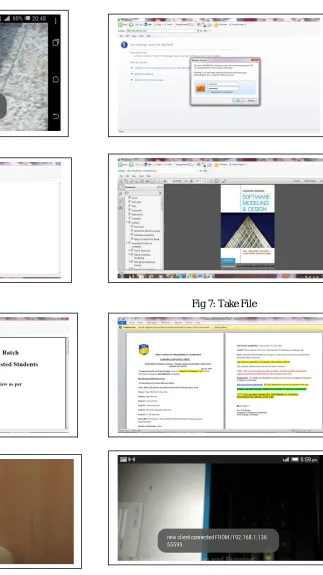
Fig 4: Server is connected. Fig 5: Enter username and password
Fig 6: Second page of client Fig 7: Take File
Fig 8: Take picture two Fig 9: Take picture three
V. CONCLUSION
We were able to transfer files over the Wi-Fi tethered network. We have also checked the coverage of the Wi- Fi network which is more than that of Bluetooth. The advantages of using the Wi-Fi network are:-
1.1 High speed as compared to that of Bluetooth. The speed of Bluetooth is upto 25mbps while that of Wi Fi is
250 mbps.
1.2 Range of Wi Fi is more than that of Bluetooth which is 100m and Bluetooth has a range of 25m.
1.3 In Bluetooth the maximum no. of devices connected can be 7 while in case of Wi-Fi the maximum no. of devices that can be connected depends upon the router which can have 1 to several devices at a time.
1.4 Wi Fi is more secure than that of Bluetooth Wi Fi has multiple standards for security.
1.5 Wi Fi is more used in connecting computers with different devices such as routers or any other device.
1.6 It also ensures flexibility in transmitting data from sever to client.
REFERENCES
1. Priyanka Goyal,VintiParmar and Rahul Rishi, “MANET: Vulnerabilities, Challenges, Attacks,Application‖”, IJCEM International Journal of Computational Engineering & Management, Vol. 11,January 2011.
2. Nastooh Taheri Javan, Bahram Hakhamaneshi, Reza Kiaeifar, Mehdi Dehghan “ZD-AOMDV: ANew Routing Algorithm for Mobile Ad-Hoc Networks” Eight IEEE/ACIS International Conferenceon Computer and Information Science, pp 852-857, 2009.
3. Mr. Nareshkumar R. Mustaryand Dr. Phanikumar. S, “Computational Intelligence Based EfficientRouting in MANET: A Review”, International Journal for Research in Engineering Application & Management (IJREAM), ISSN : 2494-9150 Vol-02, Issue 04, July 2016. 4. ]M. Palaniammal, and M. Lalli “Comparative study of routingprotocols for MANETs”International Journal of Computer Scienceand Mobile
Applications, Vol.2 Issue. 2, pg. 118-127,February- 2014.
5. NageswararaoSirisalaand C.ShobaBindu, “Weightage Based Trusted QoS Protocol inMobile Adhoc Networks”, IEEE Global Conference on Wireless Computing and Networking (GCWCN), 2014.