University of Windsor University of Windsor
Scholarship at UWindsor
Scholarship at UWindsor
Electronic Theses and Dissertations Theses, Dissertations, and Major Papers
2010
3D Object Reconstruction using Multi-View Calibrated Images
3D Object Reconstruction using Multi-View Calibrated Images
Mohammad R. Raeesi N. University of Windsor
Follow this and additional works at: https://scholar.uwindsor.ca/etd
Recommended Citation Recommended Citation
Raeesi N., Mohammad R., "3D Object Reconstruction using Multi-View Calibrated Images" (2010). Electronic Theses and Dissertations. 8044.
https://scholar.uwindsor.ca/etd/8044
3D Object Reconstruction using
Multi-View Calibrated Images
b y
M o h a m m a d R. Raeesi N.
A Thesis
Submitted to the Faculty of Graduate Studies
through Electrical and Computer Engineering
in Partial Fulfillment of the Requirements for
the Degree of Master of Applied Science at the
University of Windsor
Windsor, Ontario, Canada
2010
1 * 1
Library and Archives Canada Published Heritage Branch Bibliothgque et Archives Canada Direction du
Patrimoine de I'gdition
395 Wellington Street Ottawa ON K1A 0N4 Canada
395, rue Wellington Ottawa ON K1A 0N4 Canada
Your file Votre reference
ISBN: 978-0-494-62747-1
Our file Notre reference
ISBN: 978-0-494-62747-1
NOTICE: AVIS:
The author has granted a
non-exclusive license allowing Library and Archives Canada to reproduce, publish, archive, preserve, conserve, communicate to the public by
telecommunication or on the Internet, loan, distribute and sell theses
worldwide, for commercial or non-commercial purposes, in microform, paper, electronic and/or any other formats.
L'auteur a accorde une licence non exclusive permettant a la Bibliotheque et Archives Canada de reproduce, publier, archiver, sauvegarder, conserver, transmettre au public par telecommunication ou par Nnternet, preter, distribuer et vendre des theses partout dans le monde, a des fins commerciales ou autres, sur support microforme, papier, electronique et/ou autres formats.
The author retains copyright ownership and moral rights in this thesis. Neither the thesis nor substantial extracts from it may be printed or otherwise reproduced without the author's permission.
L'auteur conserve la propriete du droit d'auteur et des droits moraux qui protege cette these. Ni la these ni des extraits substantiels de celle-ci ne doivent etre imprimes ou autrement
reproduits sans son autorisation.
In compliance with the Canadian Privacy Act some supporting forms may have been removed from this thesis.
While these forms may be included in the document page count, their removal does not represent any loss of content from the thesis.
Conformement a la loi canadienne sur la protection de la vie privee, quelques formulaires secondaires ont ete enleves de cette these.
Bien que ces formulaires aient inclus dans la pagination, il n'y aura aucun contenu manquant.
M
Author's Declaration of Previous Publication
This thesis includes one original paper that has been previously submitted for
publication in peer reviewed conference, as follows:
Thesis Chapter Full Citation Publication Status
Chapter 4 Mohammad R. Raeesi N., Q. M. Jonathan Wu, "A Complete Visual Hull Model Using Bounding Edges", Pacific Rim Conference on Multimedia 2010.
Submitted
I certify that I have obtained a written permission from the copyright owner(s) to
include the above published material(s) in my thesis. I certify that the above material
describes work completed during my registration as graduate student at the University of
Windsor.
I declare that, to the best of my knowledge, my thesis does not infringe upon
anyone's copyright nor violate any proprietary rights and that any ideas, techniques,
quotations, or any other material from the work of other people included in my thesis,
published or otherwise, are fully acknowledged in accordance with the standard
referencing practices. Furthermore, to the extent that I have included copyrighted
material that surpasses the bounds of fair dealing within the meaning of the Canada
Copyright Act, I certify that I have obtained a written permission from the copyright
owner(s) to include such material(s) in my thesis.
I declare that this is a true copy of my thesis, including any final revisions, as
approved by my thesis committee and the Graduate Studies office, and that this thesis has
Abstract
In this study, two models are proposed, one is a visual hull model and another one
is a 3D object reconstruction model. The proposed visual hull model, which is based on
bounding edge representation, obtains high time performance which makes it to be one of
the best methods. The main contribution of the proposed visual hull model is to provide
bounding surfaces over the bounding edges, which results a complete triangular surface
mesh. Moreover, the proposed visual hull model can be computed over the camera
networks distributedly. The second model is a depth map based 3D object reconstruction
model which results a watertight triangular surface mesh. The proposed model produces
the result with acceptable accuracy as well as high completeness, only using stereo
matching and triangulation. The contribution of this model is to playing with the 3D
Dedication
This thesis is dedicated to my beloved parents, who have raised me to be the
person I am today. You have been with me every step of the way, through good times
and bad. Thank you for all the unconditional love, guidance, and support that you have
always given me, helping me to succeed and instilling in me the confidence that I am
Acknowledgements
I would like to thank all people who have helped and inspired me during my
graduate study.
I especially want to thank Dr. Jonathan Wu, my supervisor, for his support and
guidance throughout this entire thesis process and for believing in my abilities. Dr.
Shervin Erfani and Dr. Nader Zamani deserve special thanks as my thesis committee
members. Thank you for your support and guidance.
I am indebted to all of my roommates during past two years for their friendship,
care and support. I would like to thank Abbas Ghaei, Amir Hassannejadasl, Ali
Aryanpour, and especially Esmaeal Navaei. Good luck to each of you in your future
endeavors.
My deepest gratitude goes to my family for their unflagging love and support
throughout my life; this dissertation is simply impossible without them. I am indebted to
my parents, for their care and love. I cannot ask for more from them, as they are simply
perfect. I have no suitable word that can fully describe their everlasting love to me. I
remember their constant support when I encountered difficulties. I feel proud of my
family, for their support and care in my whole life.
Last but not least, thanks to God for my life through all tests in the past two years.
You have made my life more bountiful. May your name be exalted, honored, and
Table of Contents
Author's Declaration of Previous Publication iii
Abstract iv
Dedication v
Acknowledgements vi
List of Figures x
List of Tables xiii
1. Introduction 1
2. Fundamental Concepts 5
2.1. Distributed Vision Network 5
2.2. Distributed Computing 6
2.3. Silhouettes 6
2.4. Visual Hull 9
2.4.1. Voxel Based Visual Hulls 12
2.4.2. Polyhedral Visual Hulls 14
2.4.3. Image-Based Visual Hulls 17
2.4.4. Bounding Edge Visual Hull 18
2.5. Visual Hull across Time 20
2.6. Comparison 23
2.7. Stereo Vision 25
3. Implementation Platform 28
3.1. Implementation Methodology 28
3.3. Silhouette Images Computation 34
4. Proposed Visual Hull Model 38
4.1. The Algorithm 38
4.1.1. Modified Bounding Edge Model 40
4.1.2. Bounding Surfaces 45
4.1.3. Merging Bounding Surfaces 45
4.1.4. Re-Meshing 46
4.2. Experiments 47
4.2.1. Results 47
4.2.2. Comparison and Evaluation 51
4.3. Conclusion 53
5. The Proposed 3D Object Reconstruction Model 54
5.1. Existing Models 54
5.1.1. 3D Volumetric Approaches 57
5.1.2. Surface Evolution Techniques 57
5.1.3. Feature Extraction and Expansion Algorithms 58
5.1.4. Depth Map based Methods 59
5.2. Surface Reconstruction Methods 60
5.3. The Proposed Algorithm 62
5.3.1. Producing Depth Maps 62
5.3.2. Merging 3D Points 67
5.4. Experiments 69
5.4.1. Results 69
5.4.2. Comparison and Evaluation 72
7. References 80
Appendix A: Implementation using Java 88
Appendix B: Comparison of the 2nd Proposed Model 94
List of Figures
Figure 1-1. Sample views of DinoSparseRing dataset [2] 2
Figure 1-2. 3D convex hull for DinoSparseRing dataset 2
Figure 1-3. Visual hull model of DinoSparseRing dataset 3
Figure 1-4. Surface points for DinoSparseRing dataset 4
Figure 2-1. Sample view (a) of Dinosaur dataset and its silhouette image (b) [7] 7
Figure 2-2. The polyhedron representation of a plastic horse produced by Baumgart [6]. 7
Figure 2-3. Sample application of chromakeying 8
Figure 2-4. Intersection of silhouette cones 9
Figure 2-5. Two different images with the same silhouette set 10
Figure 2-6. The division of Laurentini of the object surfaces [12] 11
Figure 2-7. Reconstructed visual hull based on different number of views [13] 11
Figure 2-8. A simple octree structure to model the 3D object [16] 13
Figure 2-9. The synthetic objects and their octree models produced by R. Szeliski [16]. 13
Figure 2-10. Two rims intersecting at a frontier point [19] 15
Figure 2-11. The silhouette image and the corresponding edge-bin structure [20] 16
Figure 2-12. The results of the proposed algorithm in [13] on a torus in different number
of views with the processing time 16
Figure 2-13. A sample slice of the image based visual hull [21] 17
Figure 2-14. The rays and their corresponding projected rays [22] 18
Figure 2-15. A bounding edge through the first camera [23] 18
Figure 2-16. A sample view of a 3D object and corresponding bounding edge model from
two views [11] 19
Figure 2-17. A sample view of a 3D object and the corresponding colored surface points
from two different views [11] 21
Figure 2-18. Forward and backward moving of the colored surface points have been
Figure 2-19. Combining silhouette images from different time instances, by moving the
center of the cameras backward [11] 23
Figure 2-20. Sample image pairs for stereo vision [24] 27
Figure 2-21. The ideal depth map for sample pairs [24] 27
Figure 3-1. A sample view ofMeshLab application 29
Figure 3-2. Images of Dinosaur dataset 31
Figure 3-3. Images of Predator dataset 32
Figure 3-4. DinoSparseRing dataset images 33
Figure 3-5. Resulted silhouette images for Dinosaur dataset 35
Figure 3-6. Resulted silhouette images for Predator dataset 36
Figure 3-7. Resulted silhouette images for DinoSparseRing dataset; sample images (1st
row), results of providers suggestion (2nd row), manually refined results (3rd row) 37
Figure 4-1. (a) The bounding edge model for the 1st view of Dinosaur dataset and (b)
corresponding contour map 42
Figure 4-2. The silhouette of the 1st view of Dinosaur dataset (left) and the inconsistent
pixels which are the difference between the input silhouette and the consistent one (right).
44
Figure 4-3. Intersection of the occupancy intervals form different viewpoints 46
Figure 4-4. Bounding surfaces resulted for the first 8 views of Dinosaur dataset 48
Figure 4-5. Bounding surfaces resulted for the first 8 views of Predator dataset 48
Figure 4-6. Bounding surfaces resulted for the first 8 views of DinSparseRing dataset.. 49
Figure 4-7. Final triangular meshes for Dinosaur datasets 49
Figure 4-8. Final triangular meshes for Predator datasets 50
Figure 4-9. Final triangular meshes for DinoSparseRing dataset 50
Figure 5-1. Ground truth for DinoSparseRing dataset [2] 56
Figure 5-2. Dinosaur sample image pair 63
Figure 5-3. Rectified Dinosaur image pair 63
Figure 5-4. Rectified silhouette image pairs 64
Figure 5-5. Left-to-right (left image) and right-to-left (right image) depth maps produced
Figure 5-6. Left-to-right depth map (left image) and resulted depth map after LRC check
(right image) for the sample image pairs of Dinosaur dataset 66
Figure 5-7. Reconstructed 3D points for the first view of Dinosaur dataset 66
Figure 5-8. Refined 3D points for the first view of Dinosaur dataset 68
Figure 5-9. Resulted 3D surface points for Dinosaur dataset 70
Figure 5-10. Resulted 3D surface points for DinoSparseRing dataset 70
Figure 5-11. The inconsistent image of DinoSparseRing dataset 71
Figure 5-12. Final 3D triangular mesh for DinoSparseRing dataset 71
Figure 5-13. Final 3D triangular mesh for DinoSparseRing dataset from different views.
72
Figure B - l . Accuracy comparison among all the state-of-the-art methods 94
Figure B-2. Completeness comparison among all the state-of-the-art methods 95
Figure B-3. Accuracy comparison among the depth map based methods 95
Figure B-4. Completeness comparison among the depth map based methods 96
Figure B-5. Accuracy comparison among the methods which are not published yet 96
Figure B-6. Completeness comparison among the methods which are not published yet.
List of Tables
Table 2-1. The comparison of different visual hull models 24
Table 4-1. Numbers of inconsistent points for the first 8 views of the Dinosaur dataset. 43
Table 4-2. Number of vertices in the all surfaces versus the merged surfaces before
re-meshing 51
Table 4-3. Execution time of the final visual hull model produced by different models in
second 51
Table 4-4. Execution time sequentially versus distributedly in second 53
Table 5-1. Evaluation results of both proposed models on Middlebury benchmark for
DinoSparseRing dataset. The accuracy is in millimeter and completeness is percentage. 73
Table 5-2. Comparison of accuracy of the state-of-the-art models. The accuracy threshold
is 90% 74
Table 5-3. Comparison of completeness of the state-of-the-art models. The completeness
threshold is 1.25mm 75
Table 5-4. Comparison of accuracy of the state-of-the-art depth map based models. The
accuracy threshold is 80% 76
Table 5-5. Comparison of completeness of the state-of-the-art depth map based models.
The completeness threshold is 1.5mm 77
Table A - l . Class files implemented in Java with number of physical and logical lines of
1. Introduction
There are many applications such as obstacle avoidance in robotics, 3D modeling
in inverse engineering, assisted living, security and surveillance which need to localize,
recognize, reconstruct and track the 3D objects. There are many approaches for these
applications, such as marker-based tracking which attaches some markers to the
interesting objects. Some of the existing approaches are not applicable in many
environments; for example, it is not possible to use the marker-based approaches for
surveillance applications in public places. The best, applicable approach is vision
network, because it is relatively cheaper, and it can be configured easily [1].
The area of these applications is quite wide, including Electrical Engineering,
Computer Science, Mechanical Engineering, Medicine, and Security. The goal of all of
these applications is to reconstruct the 3D object, but each of them needs the geometric
information of the 3D object in different level of details. In obstacle avoidance
applications in robotics, for example, moving robot gets the information from the
environment using its sensors, and based on the received information it chooses a path to
reach the destination without hitting the existing obstacles. Since the robot only needs the
location and the course information of the shape of the 3D objects just to move along the
objects, there is no need to recover the exact shape of the 3D object. Controversially, in
3D modeling for inverse engineering, the shape of the object and all geometrical
information of it should be reconstructed as accurate as possible. Considering the
processing time, the reconstruction should be real time for moving robots, while there is
no limitation for 3D modeling applications.
In vision networks, there are different algorithms which will result in different 3D
reconstructed shape of the object, from a coarse model to the most precise one. The
applications in this field recover the 3D shape of the objects based on the captured
images from different views of the object. Most of them use the silhouette images to do
information from each image, computing a model of the objects in the scene, representing
the objects and making decision about the situation of the objects in the scene.
The inputs used for vision network applications are multi-view calibrated images.
Camera calibration is a part of vision network applications which is out of the scope of
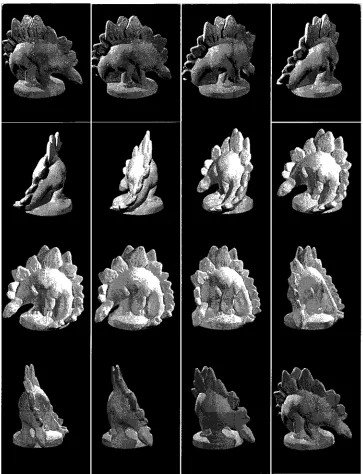
this study. Figure 1-1 shows sample images from DinoSparseRing dataset [2].
c
Figure 1-1. Sample views of DinoSparseRing dataset [2].
The coarsest model in camera networks is 3D convex hull. The 3D convex hull of
a set of 3D points is the smallest subset of the space such that for any two points u and v,
the segment joining them is completely in the subset. Consider DinoSparseRing dataset,
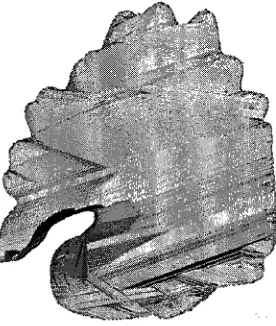
for example, the resulted 3D convex hull has been shown in Figure 1-2.
Figure 1-2.3D convex hull for DinoSparseRing dataset.
A better 3D model for the reconstructed object is visual hull model which is
described in the next section as a fundamental concept in 3D reconstruction field. As an
overall view, visual hull is the best approximation of the object based on the binary
images of the object without any color information. Figure 1-3 shows the resulted visual
model for the DinoSparseRing dataset. As it can be seen clearly, the visual hull model is
more precise than the convex hull. In other words, visual hull is much more similar to the
3D object than the convex hull model.
Figure 1-3. Visual hull model of DinoSparseRing dataset.
The 3D reconstructed object is the name of the best model for representing an
interesting 3D object, which shows all the concavities of the 3D objects. This model
represents all geometric information of the object as accurate as possible. To produce 3D
reconstructed object, all the information captured by the cameras will be used including
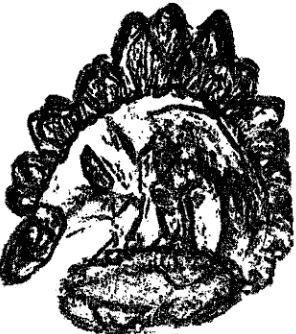
color information. A sample view of the best reconstructed surface points of
DinoSparseRing dataset has been shown in Figure 1-4.
The 3D reconstructed object model is the most similar model to the 3D object. As
providing more detailed information needs more processing, the execution time of the 3D
reconstructed object is much higher than the visual hull and convex hull models.
Figure 1-4. Surface points for DinoSparseRing dataset
In this thesis, I propose two new algorithms, one is a visual hull model and the
other one is a 3D reconstructed object model. The proposed visual hull model produces a
complete triangular mesh based on the bounding edge model, which is the fastest visual
hull model in the existing approaches. The time performance of the proposed model is
better than the most existing approaches which provide the same type of results. For the
second model, I used depth maps to reconstruct the 3D surface points of the object. To
have the reliable depth map, I did a survey in stereo vision to select the best way to do so.
Before describing the proposed models, fundamental concepts are reviewed in
section 2. Implementation platform including programming methodology and datasets are
mentioned in section 3. Section 4 describes the proposed visual hull model and the
obtained results and evaluation. The 3D reconstructed object model is described in
section 5, followed by the conclusions in section 6. The last part, Appendix A, describes
the implemented codes in Java programming language.
I used Matlab and Java programming languages to implement the codes of the
proposed algorithms. Because Matlab is much faster than Java for matrix manipulation, I
used Matlab for image processing tasks, such as window matching. For the 3D
computation, Java is used which is faster than Matlab in this case. The Matlab version
used is 7.0.0.19920(R14), and the Java version is 1.6.0_12.
2. Fundamental Concepts
W. N. Martin and J. K. Aggarwal [3] first described the volumetric description
from multiple views. Later, other researches defined the fundamental concepts of the 3D
model approximation, such as silhouette and visual hull. These concepts are used in all of
the corresponding algorithms.
To provide the multi-view calibrated images, as the input for 3D object
reconstruction, there are two approaches. The first one is to use a turntable to rotate the
object and a camera to capture images. The second approach is to configure a camera
network on the environment under study. If a processing unit is available for the camera
nodes in the network, the computation of the algorithms can be distributed over the
network. Otherwise, there is a server which processes the captured images from different
cameras.
2.1. Distributed Vision Network
The most significant concept to be defined is the Distributed Vision Network. In
this study, the definition of the Distributed Vision Networks is the same as the definition
of A. Mavrinac [4]. Distributed Vision Networks are networks of dispersed camera
nodes. Each node has (i) a camera module for image acquisition, (ii) a processor to
process the raw image locally, and (iii) a communication module to send and receive
information. This type of network can either use a central device to perform collective
processing of the data or perform the processing collaboratively by the nodes. The
cameras are calibrated over the network. Camera calibration, also called camera
resectioning, is the process of finding the true parameters of the cameras that produced a
given photograph or video. Camera parameters include the focal length, point of view,
global position, global direction, and global rotation. Camera calibration may be done
The field of distributed vision networks is a new and growing field, which is still
in the beginning stages of research. This field is a combination of several fields including
computer vision, image processing, distributed computing, embedded systems, data
networks and communications. This combination adds new opportunities from the union
of the fields and new limitations imposed by their intersections [4].
It this study, I consider distributed computing as well as centralized one. The
performance of the proposed visual hull model is evaluated on the both types of
networks. For the 3D reconstructed object model, all the computations are done
sequentially on a centralized server. In this case, a set of camera stations send their
captured images to the server and server reconstructs the 3D shape of the objects based
on the received images and camera parameters.
2.2. Distributed Computing
Using the distributed computing network environment is beneficial for the Vision
Networks in some ways. Distributed computing makes the networks to be scalable. It
avoids transmitting the raw images, which have so huge amount of data. In addition, it
can preserve the privacy of the network users in some applications such as assisted living.
Also, it enhances the flexibility on the type of feature and level of exchanging data. So
we will have the fusion across the three dimensions; 3D space (different camera views),
time (collecting the data over time) and feature levels (selecting and fusing different
feature subsets) [5]. As mentioned before, I consider distributed computing only for the
evaluation of the proposed visual hull model. In this case, the first step of the algorithm is
computed over the camera nodes in parallel, while the next step which is the merging step
is done on a centralized server.
2.3. Silhouettes
All of the existing algorithms use the silhouette concept to get the information
foreground or background. The scene background pixels are most often colored as white,
while the foreground pixels are colored as black. These foreground pixels are related to
the interesting objects in the scene. Baumgart [6] first considered silhouettes to
approximate a polyhedron representation of the objects. He called his work as inverse
computer vision, because computer vision generates synthetic images from the real
world, while 3D object reconstruction uses the captured images to reconstruct the real
object with all the geometric information. A sample silhouette image with its
corresponding image has been shown in Figure 2-1.
Baumgart [6] used three captured images from a plastic horse on a turntable to
draw the silhouette images. Then by using the silhouette cone intersection, he produced a
polyhedron model of the object. He mentioned that silhouette cone intersection looks like
carving a statue by cutting away everything not related to the object. Figure 2-2 shows
the 3D reconstructed object using Baumgart techniques. His result polyhedron looks like
a statue of a horse which is not completed yet. It seems to be cut by knife.
(a) (b)
Figure 2-1. Sample view (a) of Dinosaur dataset and its silhouette image (b) [7].
There are two common ways to produce the silhouette from the captured images
which include chromakeying and background subtraction. However, in some recent
work, the silhouettes are computed manually using Adobe Photoshop, just to
segmentation of the foreground and background pixels.
The first approach, chromakeying, also called bluescreen matting. In this
approach the background is a single uniform color which does not appear in the
foreground objects. So by checking the color and compare it with the background color, it
is possible to compute the silhouette of the object. This method can not be used in many
applications, because of its limitation on the background color, but it is applicable in
cinematic special effect and television weather forecasts [8]. A sample application of
bluescreen matting has been shown in Figure 2-3. The selected color for the background
is green, while there is no green pixel for the foreground object. So only by a comparison
of the color of the pixels, it is possible to detect the background pixels and change their
value to provide a special effect.
Figure 2-3. Sample application of chromakeying.
Another common way is background subtraction. In this method, first the
statistical model of the background is produced by capture many images from the
background. So it is possible to detect the foreground objects by comparing the new
new image is greater than the corresponding threshold, that pixel will be considered as a
foreground pixel [9].
For some datasets, the dataset providers provide the contour information of the
silhouettes as well as the image data. The contour information is a set of pixels which are
not connected. The connected version of these pixels represents the silhouette contour. I
implement a function to produce the best connected version of these pixels. Then based
on the resulted silhouette contours, the silhouette image is produced. Other datasets
suggest the best way to produce the silhouette information. These methods will be
described later.
Silhouette images are very efficient for vision networks in case of
communication, because their size is much smaller than the size of the raw images. For
example, a 2000x1500 color image is approximately 400KB, while a silhouette image
with the same resolution (without any compression) is less than 8KB.
2.4. Visual Hull
The constructed objects of the silhouettes is called visual hull. Visual hull concept
was first defined by A. Laurentini [10]. Visual hull is the intersection of the silhouette
cones, which are the cones started from the camera positions and goes through the
silhouette contours. Figure 2-4 shows the silhouette cones from different viewpoints with
different colors. The intersection of all the silhouette cones is called visual hull model of
the object.
A
Based on the silhouettes information, visual hull is the best approximation of the
interesting object. Because visual hull is constructed from the silhouette images, it is also
called Shape from Silhouette (SFS). Visual hull is the maximal one of the objects which
has the same set of silhouettes as the given one. In other word, it is possible for many
objects to have the same set of silhouettes; visual hull represents the maximal object. So,
it is not possible to identify the objects only based on the silhouette, especially for the
non-convex objects. Figure 2-5 shows two different objects which have the same set of
silhouettes. So based on the silhouette information, there is no way to recognize any of
them.
The visual hull applications and the resulted models are very sensitive to
silhouette noise and camera calibration errors.
G. Cheung et al. [11] defined a consistency concept for the set of silhouette
images. The set of silhouette images is consistent, if there is at least one non-empty
volume that exactly explains all the silhouette images. Because there are many objects
that have the same set of silhouettes, G. Cheung defined the visual hull as the largest
possible volume which exactly explains the silhouette images.
A. Laurentini [12] divided the surfaces of a volume into two categories,
silhouette-active surface and silhouette-inactive surface. The former is what can be
reconstructed by the silhouette cone intersection, while the latter one is what can have
any shape without affecting the silhouettes of the object. The following figure shows an
example of this division. Figure 2-6(a) and (b) shows the two categories of surfaces. The
images. So the resulted visual hull in the best situation is what has been shown in Figure
2-6(c), while the real object is one has been shown in Figure 2-6(d).
• -p. • I silhouette-active surface
• silhouette-inactive surface
(») 0 ) («) (<)
Figure 2-6. The division of Laurentini of the object surfaces [12].
The accuracy of the visual hull mainly depends on the number of silhouette
images and their corresponding camera positions. The visual hull will be tighter if the
number of silhouette images is increased. The greater the number of the views, the more
precise the approximated visual hull. Figure 2-7 shows different reconstructed visual
hulls based on different number of views. It also shows the execution time of
reconstruction for each set. The execution time is increased by increasing number of
views more rapidly.
i ti:
4 views 119 ma
1 \
' • ' ' J/
12 vfcnra I tit at* 16 views / 217 na 42 view« / 1.44 s I view* J7ins
Figure 2-7. Reconstructed visual hull based on different number of views [13].
Based on the survey I did in this field, there are four main categories of visual hull
models. In existing approaches for modeling the visual hull, two categories are popular,
voxel based approaches and surface based (polyhedron) ones. Other categories are
image-based visual hull and bounding edge visual hull. Main existing models are described in
2.4.1. Voxel Based Visual Hulls
The first category is modeling the objects by a collection of elementary 3D cells.
These cells are called voxels (volumetric pixels), which are first introduced by W. N.
Martin and J. K. Aggarwal [3]. Voxels are classified into two categories, the inside and
the outside one. If voxels are positioned completely outside the visual hull, in other word,
if they have not any intersection at least with one silhouette, they will be classified as
outside voxels. Otherwise, if they intersected partially or completely with all the
silhouette images, they will be classified as inside voxels. Because voxel based model
uses the discrete volumetric representation, it generates some quantization and aliasing
artifacts on the resulting model.
The voxel based approaches improved by introducing octrees. Octrees have been
first introduced by C. L. Jackins and S. L. Tanimoto as an efficient geometric
representation [14]. Then octrees have been used for modeling the objects from three
orthographic projections by C. H. Chien and J. K. Aggarwal [15].
Octrees are tree-structured representations which are used to model the volumetric
data. The octree is constructed by recursively dividing each cube to eight sub-cubes to
cover the interesting volume as accurate as possible. There are three possible locations
for the cubes including inside the volume, outside the volume and on the boundary. If a
cube is completely inside the volume, it will be labeled as inside and its color will be
black. If it is completely outside the volume, it will be labeled as outside and it will be
colored as white. Otherwise, it will be labeled as boundary and be colored as gray. Based
on the application, the gray cubes will be recursively divided to reach the desired
accuracy for modeling the object. Figure 2-8 shows the structure of a sample octree
model [16].
Figure 2-8 represents an octree model by 6 cubes of two consecutive levels. Each
C MM, 2 4 ^Jtk
10 «0 6i
Figure 2-8. A simple octree structure to model the 3D object [16].
R. Szeliski used the octree representation to model the objects. To have an
efficient algorithm, he first produced a coarse model of the objects and then by dividing
the gray cubes, he refined the model. By using this approach, the number of the trimmed
cubes was decreased. To check the location of the cube, it is necessary to project the cube
to each image plane to check whether it is inside the silhouette or not. The simplest way
is to project the corners of the cube to the image plane and then check the situation of the
projected hexagon against the silhouette. This method is accurate, but it is very time
consuming. R. Szeliski proposed to convert the cube to a bounding square instead of
project its corners. The resulted reconstructed visual hulls of his model have been shown
in Figure 2-9 [16].
Figure 2-9. The synthetic objects and their octree models produced by R. Szeliski [16].
The octree model performs voxel model. With the same storage space, the
time needed to construct a voxel model is greater than what the octree model needs,
because it evaluates more geometric cells. For representing the reconstructed 3D shape of
the object, octree model is also faster, since the number of its geometric cells is less than
voxel model.
K. Kutulakos and S. Seitz [17] proposed a voxel based algorithm to model the
visual hull. They called it space carving. Space carving algorithm starts on the initial
volume and recursively checks the surface voxels to decide whether to carve them or not.
It continues checking until no voxels is carved in an iteration.
If the silhouette images are noise free, the smaller voxel size results the better
approximation of the visual hull. Otherwise, if the silhouette images are noisy, smaller
voxel size causes more errors in classification. So, the best size of the voxels is highly
dependent to the error of silhouette images [18].
2.4.2. Polyhedral Visual Hulls
The second category of the popular visual hull modeling is surface based one. In
this category, a polyhedron model of the object is produced by intersecting the silhouette
cones. The surfaces of the polyhedron are the visual cone patches, the edges of it are the
intersection curve between two silhouette cone, and the vertices are the points where
more than two silhouette cones intersect. To generalize the polyhedron, it is assumed that
the contour of the object has been oriented counterclockwise, so the object is always at
the left of the contour.
S. Lazebnik et al. [19] proposed two representations for the visual hull of a 3D
object, the rim mesh and the visual hull one. Rim is the surface points of the object where
a ray through the viewing point intersects the object. The projection of the rim to the
corresponding image plane is the silhouette contour. The intersection of two rims could
be isolated points which are called frontier points. The rim concept has been shown in the
following image. They defined the rim mesh by its vertices (the frontier points), edges
the edges). Figure 2-10 shows two rims from two different points of view which intersect
at a frontier point.
Besides, S. Lazebnik et al. [19] described the difference between the rim mesh
and the visual hull one. Because the rim mesh depends only on the ordering of the
frontier points, it is topologically more stable. While the visual hull meshes recover the
geometry information in a more reliable manner.
* » / ;?
_ . ; frontierpoiat
intersection curve
J. '' i ;
S • ' ' V
/
/ ; 4. > X
„" apparent contours '* r>. J
Figure 2-10. Two rims intersecting at a frontier point [19].
C. Buehler et al. [20] proposed the real time representation of the polyhedral
visual hulls. Their representation is view independent, so it does not need to be
reproduced for a set of silhouette images. It is suited to be computed by the graphics
hardware. They assumed each silhouette is a 2D polygon. For each edge of the polygon,
they compute the face of the silhouette cone. By using the intersection of the face and
other silhouette images, the face of the polyhedron is determined which itself is a
polygon. To intersect the face of the silhouette cone by the other silhouette images, the
edges of the face of the silhouette cone have been projected to the silhouette images. To
accelerate this process, preprocess has been done for each silhouette images. In the
preprocessing step, each silhouette has been divided to the bins. Based on these bins, a
table of the edges-bins is computed. Figure 2-11 shows the divided silhouette image and
the corresponding edge-bins table. The algorithm uses this table to respond as quickly as
possible to the intersection problem. This edge-bin structure can be used for the visibility
Figure 2-11 shows an example of an edge-bin structure. The silhouette image is
divided into seven bins. The cells of the edge-bin table contain the intersecting edges
which are sorted ascendingly, based on the distance to the epipole increasingly.
bill i //Mtt5X^ hmi / t x X
Em I 2 S 4 5 6 1
Edges 0 1*4 €2- 9
Figure 2-11. The silhouette image and the corresponding edge-bin structure [20].
J. S. Franco and E. Boyer [13] proposed a fast algorithm to represent the best
polyhedral visual hull. They first computed a coarse approximation of the visual hull by
retrieving the viewing edges. Then, they generated the surfaces of the mesh. Finally, they
identified the faces of the polyhedron. They applied their algorithm on a torus for
different number of views. The greater the number of the views, the more precise the
approximated visual hull. Their results have been shown in Figure 2-12. The time needed
to compute each result has been shown as well, which is increased faster than the number
of views.
4 views /19 m* 8 views 175 mi 12 views 1125 us 16 views /217 ms 41 views / 1.44s
2.4.3. Image-Based Visual Hulls
On of the compact representations of the visual hull is image-based visual hull. C.
Buehler et al. [21] defined the image-based representation as a two dimensional, sampled
representation. For example, a color image is a 2D color samples, or a disparity map in
stereo vision is a 2D disparity samples.
The image-based visual hull is a two dimensional, occupancy intervals samples.
The visual hull is represented by the rays from view points through the image plane.
Instead of storing either foreground or background, the samples are the intervals of the
rays which are inside the visual hull. In other word, the intervals of the ray which
intersect all the other silhouette images are stored in the samples. So for each pixel, the
list of its corresponding intervals is stored. If a pixel is a background pixel, its list will be
empty. Figure 2-13 shows a slice of the image-based visual hull [21].
Figure 2-13. A sample slice of the image based visual hull [21].
The image-based representation has many advantages in comparison to other
models. Its storage requirements and computational complexity are very low, which is
much less than the aforementioned algorithms. It has a simple and fast computation. The
rendering is too simple as well. Because it has two discrete dimensions and one
continuous dimension, it has a higher resolution than the resolution of the voxel based
representation.
W. Matusik et al. [22] proposed an image-based approach to represent the visual
hull. Based on the Calculatus Eliminatus principle, they said that the visual hull
approximation is carving away the regions of space where the object is not. Calculatus
and it must be in the place we haven't looked. Their algorithm contains three steps. It first
projects the rays from a desire viewing point to the silhouette images. Then, in the second
step, by intersecting the projected rays and the silhouettes, it computes the interesting
intervals. Finally, the intervals are returned to the 3D space. The intersected parts of these
intervals from all the silhouettes will be saved for each pixel. A plot of the projected rays
is shown as follows. Figure 2-14 shows the rays from the point of view of an image
through the interesting pixels and their corresponding projected lines on the plane of
another image. All the projected lines intersect at the epipole, the projected point of the
corresponding point of view.
2.4.4. Bounding Edge Visual Hull
The next visual hull representation is bounding edges. This representation has
been first introduced by G. Cheung [18, 23, 11, 1]. He defined the bounding edge
representation as the parts of the rays from the viewing point through the contour of the
corresponding silhouette image which intersect all the other silhouette images.
Target Image
Figure 2-14. The rays and their corresponding projected rays [22].
Figure 2-15 shows a bounding edge of first camera for a sample pixel which is
located on the 3D ray from the camera position through the pixel, and is intersected with
other three silhouettes. The starting point SV and finishing point F F will be saved for the
pixel as the endpoints of a bounding edge. To have a better performance, instead of
saving the 3D position of each endpoint, its distance to the camera position will be saved
[23].
Bounding edges are very similar to the based representation. Like
image-based model, it calculates the intervals of the rays from the view point through the
silhouette pixels. However, in contrast to image-based representation, it considers only
the silhouette contour pixels instead of all the silhouette pixels. Image based
representation is view dependent, since it produces the interval samples for only one
view, but bounding edge model produces the edges for all viewpoints. An example of
bounding edge representation has been shown in Figure 2-16 [11].
Figure 2-16. A sample view of a 3D object and corresponding bounding edge model from two views
[Hi-Bounding edges lie exactly on the surface of the visual hull. They intersect the
real object at least at one point. The drawback of this representation is that it is
incomplete. A visual hull is complete, if it has all the geometrical information of its
shape. If visual hull has any holes on its surface, it will be considered as incomplete
model. Since the small amount of accurate data is better than the large amount of the
approximated data, in many applications, an exact visual hull is preferred than the
It is not necessary for the bounding edges to be continuous. They can consist of
many parts. It exactly depends on the shape of the silhouette images. If all the silhouette
images are convex, the bounding edges will be continuous. The important usage of the
bounding edge representation is refinement of the visual hull across time. G. Cheung et
al. [11] proposed an algorithm to increase the number of silhouettes by capturing more
images of the interesting objects over the time.
2.5. Visual Hull across Time
As mentioned before, the visual hull accuracy depends mainly on the number of
silhouette images. To increase the precision of the visual hull, the number of silhouette
images should be increased. There are two ways to increase the silhouettes number. The
first one is to increase the number of cameras to produce more silhouette images which
has the financial cost and the limitation for the camera positions. The second approach is
using the same cameras across time. G. Cheung et al. [11] proposed an algorithm to
increase the number of silhouette by capturing more images of the interesting objects
over the time. If there are K cameras in the environment, and J frames of each camera are
used, the effective number of silhouette images will be JK instead of K. To apply this
approach, first it is necessary to calculate the motion of the interesting object between the
time instances. Then silhouette images in different time instances can be combined based
on the computed motion over the time. The task of estimating the motion of the object is
called visual hull alignment, and the task of combining the silhouette images is called
visual hull refinement.
G. Cheung et al. [23, and 11] considered two fundamental properties of the visual
hull. The first one, called 1st FPVH (First Fundamental Property of Visual Hull), is that
the 3D object which produces the silhouette images lies completely inside the visual hull.
This property can be used for many applications such as obstacle avoidance in robotic
navigation. The second one, called 2nd FPVH, is that each bounding edge touches the real
construction of the colored surface points (CSP) possible. To construct the colored
surface points, they combined the 2nd FPVH with the stereo vision concept.
Colored surface points have been first introduced by G. Cheung [18]. CSPs are
the 3D points on the bounding edge which touch the object. The information needed to
find the position of the CSPs through the bounding edge comes from the color
consistency check algorithm. It finds the best point on the bounding edge, the color of
which is consistent in all other color images for which the point is visible. The visibility
is another important issue to refine the visual hull across time. Because at least one point
exists on the bounding edge to touch the object, there is no need to define any threshold.
An error measurement algorithm is applied to find the best point. This error is the
variance of the color of the point from different visible point of view. In noise free
environment, the color variance of a 3D point in all the points of view should be zero.
But in real environment, it is necessary to find the best point with least color variance.
Figure 2-17 represents the visual hull by its colored surface points. These CSPs are on the
surface of the visual hull. In contrast to all other representation, CSPs are colored 3D
points.
Figure 2-17. A sample view of a 3D object and the corresponding colored surface points from two different views [11].
To estimate the motion of the object, G. Cheung et al. [11] used the 3D CSPs. The
algorithm starts with an initial motion, followed by the refinement step. To decrease the
complexity of the algorithm, CSPs are moved forward from the first time instance to the
next one based on the initial motion, and then projected to the images in the second time
instance which is followed by the 3D consistency check. This approach is done in inverse
the silhouettes of first time instance. Figure 2-18 shows the forward and backward
movement of the 3D CSPs through the time instances.
To refining the motion, G. Cheung et al. [11] used two error measurements
including photometric error and geometric one in both directions, forward and backward.
The forward photometric error is the color difference between the CSPs in the first time
instance and the projected moved points in the second time instance. If the moved points
project in the background section of the corresponding silhouette, the photometric error
will be considered as zero. Because the images may be noisy and there are some errors in
camera calibration in practical cases, they considered valid. For these cases, geometric
error is defined, which is the distance of the projected moved CSPs to the silhouettes.
This error is zero, when the points project inside the silhouette [11].
: Till
Colored SmisMie Touching taint*
{"3D limtgti*")
I n l t i n l m o t i o n e s i i m m o ( R . 1)
t, ^ t,
Error between ihu projected color* on .
2D images at t. «»<! M ; KT W,1 - HT T
lienor becwtxti tfc projected cotors on 2t> image* sit vt and p ,
Figure 2-18. Forward and backward moving of the colored surface points have been shown as well as the corresponding errors [11].
After finding the best approximation of the motion, it's time to combine the
silhouette images, called visual hull refinement. To do so, first a reference time instance
should be set. The first time instance is the best candidate for the reference. The
silhouette images from other time instances are effective silhouette images in reference
time instance, whose points of view are moved, based on the corresponding refined
lime i, 'time t. i i ,. . • C
( R \ - RTt )
R (C"- I )
RT( C I t
< Rr, - R * t )
Figure 2-19. Combining silhouette images from different time instances, by moving the center of the cameras backward [11].
G. Cheung et al. [11] applied the proposed algorithm on the rigid objects as well
as the articulated objects. The articulated objects are the objects that have many parts
which can move in different directions. The best example of an articulated object is
human body. The joint estimation is separated from the motion estimation to decrease the
complexity of the algorithm. The shape and the motion of all the object parts are
computed individually, and then the position of the joints are localized.
2.6. Comparison
The four different representations of visual hull have been described. The entities
of the representations are different. The voxel-based one represents the visual hull by the
cube cells, while the polyhedral representation models it by the faces, edges and vertices
of the polyhedron. The image-based visual hull consists of a two dimensional interval
samples, and the bounding edge model represents the visual hull by the bounding edges
from different viewpoint.
The comparison of the visual hull models has been shown in Table 2-1. Two
factors of the comparison should be defined here which are completeness and exactness.
As it mentioned before, a visual hull is complete, if it has all the geometrical information
of its shape. If visual hull has any holes on its surfaces, it will be considered as
incomplete model [18]. Exactness is a term which refers to the quantization and
discretization issues. If a visual hull model uses any type of quantization, it will be
Considering exactness, it should be mentioned that only the voxel-based
representation is not exact because it uses discretization for classification of the voxels.
Because surface-based and voxel-based models produce all the geometric information of
the resulted 3D shape, they are complete, while the others are not.
However, it is not possible to select the one representation as the best model
because each model has its own strengths and weaknesses. Deciding about the best model
only depends on the intended application.
Table 2-1. The comparison of different visual hull models.
Model Voxel-Based Surface-Based
(Polyhedral) Image-Based Bounding Edge
Geometric
Entity Cube Cells
Polyhedron Faces, Edges and
Vertices
Two Dimensional interval samples
Bounding Edges
Number of
Dimension 3D 2D ID ID
Exactness Inexact Exact Exact Exact
Completeness Complete Complete Incomplete Incomplete
Computational
Complexity Low High Low Moderate
Storage
2.7. Stereo Vision
To reconstruct a 3D shape of the object, the second suggested model is proposed
based on Depth Maps. Depth map is a map which contains the depth information for each
pixel. Depth value is the amount of shifting between the positions of the corresponding
pixels between two images from different views. The shifting amount is called disparity,
and the depth map is also called disparity map. Depth maps can be shown as grayscale
images, in which the nearer objects to the camera look lighter. The top performers of the
existing methods in 3D object reconstruction are depth map based methods, which
usually have two steps, producing depth maps and merging them.
The main step of depth map based methods is to produce the reliable depth maps,
which influences the quality of the final reconstructed object. To produce the depth maps,
two images of the scene from different viewpoints are used. Because of using a pair of
images, it is called stereo vision or stereopsis. Stereo vision gets two rectified images
from different viewpoints, and calculates the disparity for each pixel. Disparity value is
the shifted amount between the two views for each pixel. In other words, disparity value
is the difference between the position of each pixel in one view and its best match in
another view. Because to provide the depth maps, the disparity value is calculated for all
pixels of the image, it is called dense stereo matching.
In stereo matching, the view for which the depth information is calculated is
called reference view, and another view is called the target view. To find the best match
for each pixel of the reference view, first a neighborhood window is considered, which is
usually a square window. Then a measurement is applied to find the best match pixel
from the target view. There are two types of measurement including the error
measurement and correlation measurement.
1. Error Measurement: It measures the errors between the reference pixel and
the target one over the neighboring window. Finally, the target pixel
of Absolute Differences (SAD) and Sum of Square Differences (SSD) are
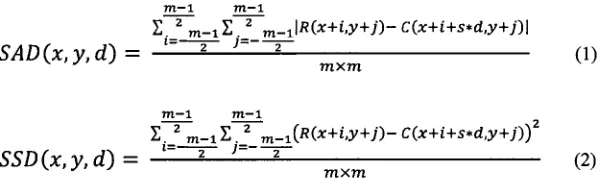
the error measurement functions which have been shown as follows.
771-1 771—1 2 V 2
m-1£ .=_m-ilR{x+i,y+n- C(x+i+s*d,y+j)\
SAD(x,y,d) = ——-———1 (1)
v J J mxm
m-l 77t-l
,.\2
£._2 m-iE,_2 m-i(R(x+i,y+;)- C(x+i+s*d,y+j))
SSD (x, y, d ) = " 2 2 — (2)
where the neighboring window i s m x m square window, and R(x,y) and
C(x,y) mean the pixel value of the reference image and target image for
row x and column y, correspondingly.
2. Correlation Measurement: It measures the correlation between two
windows, and selects the pixel with the highest correlation value as the
best match. Normalized Cross Correlation (NCC) is a correlation equation
which has been shown as follows.
m-l rn—l
Z.J2 TO-jS .1 m-1( « Q + t , y + - ? ) - « )x(C(.x+i+s*d,y+n- C)
NCC (x, y,d)= , 2 J" 2 — — — — (3)
v ' J m-l m-l m-l m-l v '
2 zm - i Z 2 m-i(R(x+i'y+j)-R)2xZ 2 TO-2 m_1(c(*+i+s*d,y+;)- c)2
i=—J- ;=—J- ' = - — ——
where R and C are the average of the pixel values over the neighboring
window of the pixels of the reference image and target image,
correspondingly.
Sample image pairs of Middlebury stereo vision datasets [24] have been shown in
Figure 2-20. As it can be seen clearly, the objects which are nearer to the cameras have
Figure 2-20. Sample image pairs for stereo vision [24].
The ideal depth map for the sample image pairs which have been shown in Figure
2-20 has been shown in Figure 2-21. Because the disparity values for the nearer objects
are higher, they look lighter in depth map.
Figure 2-21. The ideal depth map for sample pairs [24].
The depth map based models have been reviewed in depth because the proposed model is
a depth map based model. The proposed model uses the surface reconstruction methods
3. Implementation Platform
In this thesis, two models to reconstruct the 3D object have been proposed. The
proposed algorithms are implemented using Java programming language and Matlab.
Matlab is used because it is very fast for matrix manipulation which is very important in
computer vision; images are considered as matrices. However, Matlab is very slow for
other computations such as ray projection. In these computations, the algorithms are
implemented in Java.
To test and evaluate the proposed models, the algorithms are applied on existing
datasets, which are popular in this field. The selected datasets will be described in the
following subsections. For one of the datasets, Adobe Photoshop is used to produce the
high quality silhouette images as a semi-automatic process, like what S. Lazebnik et al.
[25] did.
3.1. Implementation Methodology
As it mentioned before, matrix manipulations is implemented in Matlab, which
include the silhouette production, image rectification, and stereo matching process. The
codes for mentioned computation are implemented as the Matlab functions. For each
dataset, a final script is implemented which performs all the steps for all the images
sequentially. However the number of implemented functions in Matlab is great, all the
implemented functions in Matlab have small number of Lines of Code (LOC).
Source line of code (LOC) is a software metric which is used to measure the size
of an implemented application, by counting the number of lines in the source code of the
implementation. There are two types of this measure, physical and logical. Physical line
of code which is referred by LOC counts the number of line in the text file of the source
code. It counts the comment lines and also blank lines as lines of code, which is not
LLOC, counts the number of statements in the code. Logical measure is more appropriate
for size estimation of the application.
However, all the other computations of the proposed methods are implemented in
Java using Object Oriented Programming (OOP). I defined 31 different classes which are
described in Appendix A. Just to show the estimation of the implemented codes, it should
be mentioned that the number of logical lines of code (LLOC) for all the java codes is
4252 lines, and the number of physical lines of code (LOC) is 6380. For detailed
information of the implemented classes, please refer to Appendix A.
Another important issue here is that there is no graphical user interface
implemented in Java, and codes are just implemented to calculate the final results and
save it as a file with PLY format. Finally, MeshLab software [26] is used to show the
final result. MeshLab is an advanced mesh processing application for automatic and user
assisted editing, painting, converting, cleaning, remeshing, coloring, filtering, measuring,
scanning, and rendering of large unstructured 3D triangular meshes.
Implementation of MeshLab is started as a university project with small group of
core developers at Visual Computing Lab of the Italian National Research Council
Institute. Now, there are many plug-in developers for MeshLab around the world. Figure
3-1 shows a sample view of MeshLab application showing the final result of the proposed
visual hull model on Dinosaur dataset.
PLY file format is developed at Stanford University [27]. PLY file format has two
different types, binary and ASCII. An ASCII PLY file is a text file which first determines
the number of vertices and surfaces of a mesh, following by the information of all
vertices and surfaces. Vertices are defined by their x, y, and z parameters and their color
if applicable. Surfaces are determined by the lists of their vertices which are defined by
their indices in vertices section.
3.2. Datasets
To show the performance of the proposed models, complex 3D datasets have been
selected. These datasets are the 3D Photography datasets [7] and Middlebury datasets [2].
3D Photography datasets are produced using three fixed cameras (Canon EOS ID Mark
II) and a motorized turn table in Beckman Institute and Department of Computer Science
at University of Illinois at Urbana-Champaign. Each dataset of 3D Photography
collection has 24 images from 24 points of view, which are calibrated using Intel's
OpenCV package [28]. The calibration information is provided in the format of the
Camera Calibration Toolbox for Matlab [29]. Moreover, the contour information of the
interesting object has been provided as unconnected 2D pixels.
Middlebury datasets are provided by support of Middlebury College, Microsoft
Research, and the National Science Foundation. They used the Stanford Spherical Gantry
to capture images, which enables moving a camera on a sphere to specified latitude and
longitude angles. The cameras are calibrated by capturing the images of a planar grid
from different points of view.
From 3D Photography datasets, Dinosaur dataset and Predator dataset are
selected, each of which has 24 images from different viewpoint. The intrinsic parameters
and the image size are the same for the first 8 views. They are the same for next 8 ones as
well as the last 8 ones. These intrinsic parameters include the focal length, principal
point, skew coefficient and distortion coefficients. It is easy to provide the matrix of the
intrinsic parameters to map the camera coordinate system to the pixel coordinates of the
can be used to map a world point in homogeneous coordinate to the corresponding
camera coordinate. The images for Dinosaur dataset have been shown in Figure 3-2.
m
/
t vpe»
i
t
f ' s
Figure 3-2. Images of Dinosaur dataset.
The Predator dataset specification is similar to Dinosaur dataset. The images for
Figure 3-3. Images of Predator dataset.
From Middlebury datasets, the DinoSparseRing dataset is selected which has 16
images from different viewpoint. The intrinsic parameters and image size is the same for
Figure 3-4. DinoSparseRing dataset images.
The contour information is provided for each image of 3D Photography dataset in
a text file in the following structure. The file starts with "Contour" name, followed by the
number of contours. It contains the number of pixels and the pixel information for each
contour. In all of the datasets, it is considered that there is only one contour. As it can be
information of this object should not be a connected part. However, they consider the
contour of the object as a part without any hole.
A sample file is as follows.
1. CONTOUR
2.
3. 1
4.
5. 951
6 .
7. 1276.27 871.568 8. 1280.03 871.535
9. 1283.78 871.377
As it is clear, the pixels coordinate information is not discrete, it is in float format.
Prior to computing a connected version of the image contour, the numbers should be
discretized.
3.3. Silhouette Images Computation
This section is divided into two parts. The first one is for the 3D Photography
datasets, and the second one is for the DinoSparseRing dataset.
For 3D Photography datasets, the contour information is provided. I use this
information to compute the silhouettes. I first convert the pixel information of the contour
to the discrete values. Using these discrete values, I produce a binary image which is
black in the mentioned pixels, while other pixels are white. I connect each pixel to the
consecutive pixel by finding the best discrete connection throw four neighboring pixels.
This algorithm works based on the slope of the connecting line between the current pixel
and the consecutive one. In each iteration, it selects the best of its four neighbors. The
best neighbor is one for which the slope of the connecting line throw the current pixel is
close to the slope of the line connecting the current pixel and the consecutive one.
After producing the closed silhouette contour, the silhouette image can be
considered as foreground pixels. To do so, I implement another algorithm which
classifies pixels based on the class of its neighbors. If one of the eight neighboring pixels
of a pixel is classified as foreground, the pixel will be classified as foreground too. This is
the same for the background pixels. If all the neighboring pixels are not classified yet or
they are the contour pixels, the pixel will be classified based on the class of the pixels in
the other side of the contour pixels, inversely.
These two mentioned algorithm is implemented in Matlab as a parser function
which gets the text file as an input and produces the silhouette images. Resulted
silhouette images for Dinosaur dataset have been shown in Figure 3-5, and Figure 3-6
shows the produced silhouette images for Predator dataset.
T, H
Figure 3-5. Resulted silhouette images for Dinosaur dataset.
As it can be seen clearly, silhouette images do not have any holes, because there
is no information provided for the exiting holes. To apply the proposed models, the same
![Figure 1-1. Sample views of DinoSparseRing dataset [2].](https://thumb-us.123doks.com/thumbv2/123dok_us/1455118.1178297/16.612.254.388.468.622/figure-sample-views-of-dinosparsering-dataset.webp)
![Figure 2-14. The rays and their corresponding projected rays [22].](https://thumb-us.123doks.com/thumbv2/123dok_us/1455118.1178297/32.612.232.413.547.677/figure-rays-corresponding-projected-rays.webp)