Multiple Object Tracking, Learning and
Detection Using P-N Learning Template
Matching
Archana Vilas Kshirsagar1, Kanchan Doke2
M.E. Student, Dept. of Computer Engineering, Bharati Vidyapeeth College of Engineering, Mumbai University,
Assistant Professor, Dept. of I.T., B.N. Bandodkar College of Science, Mumbai University, Thane, Maharashtra, India1
Assistant Professor, Dept. of I.T., Bharati Vidyapeeth College of Engineering, Mumbai University, Navi Mumbai,
Maharashtra, India2
ABSTRACT: Tracking, learning and detection in real time is important domain now days in the field of crime
detection and surveillance. Many systems are exist which provides the motive to achieve tracking of object and detection. The proposed system provides Tracking, Learning and Detection not only for single object but for multiple objects in real time. This system also helps us to reduce clutter, motion effect and problem occurs due to change of the object position. Proposed system works with P-N learning technology using template matching for object tracking, learning and detection, where object to be tracked is separated as a P-type images from background, and background act as a N-type images. Array is maintained for P-type and N-type images which works as a reference for template matching.
KEYWORDS: P-type learning, N-type learning, Template matching, multiple object tracking, background subtraction,
Region of interest (ROI), object detection, R-type images
I. INTRODUCTION
Real time multiple objects tracking in dynamic background video frame has been widely used in various domains such as weapon detection, on field war, traffic monitoring where background of selected object may change in frequent manner. The correct, clear and unambiguous detection of an object is mandatory in such systems. Fig.1. shows the example of multiple object tracking.
The system decision making my be affected due to the rotation and the movement of an object, change in background, clutter effect, joint nature of an object, change in shape which can lead system to very unstable result and occluded tracking of an object.
To overcome above problem system need to access and learns the various features of the objects with subsequent frames fetched from live video. The proposed system provides results betterment by introducing template matching with P-N learning algorithm. Where template is divided between positive images i.e. the selected object that need to be track and background images known as a negative type of images. The template matching happens based on the upper and lower threshold value which decides whether the current template does match with previous one or it is a new feature of an object.
II. LITERATURESURVEY
Tracking learning and detection framework has initiated by kalal [3]. This technique is effective for the situation where tracking happens for restricted scenarios, such as pedestrians, by using back ground subtraction. [3], [4], [9]
Camshift framework provides better tracking accuracies, when object is under slow or constant motion, but get confused due to background illumination and distraction. This framework uses object classification method using object location. [3], [4]. This improved framework works on five different parameters to recognize targeted object like, 2-D central location, width, height and orientation of selected object.
The technique of template matching performs well which is independent from shape and size of an object, where current video frame considered as template to find selected object by comparing current frame with previous frames. [1], [5], [6]. Background subtraction technique used for motion segmentation. It works on pixel by pixel subtraction between the video frames. The result of subtraction is compared with threshold value to know the accuracy of the tracking. This helps to avoid background illusion with more enhancements in tracking, learning and detection.[1], [7].
In multi object tracking the algorithm which works on multi feature tracking works on different objects features such as colour, texture and motion information [9]. Tracker get easily failed due to change in background and object distortion. The enhanced version of this technique provides filtering on all the object in the frame, but this contains huge set of calculations which makes system hard to operate in real time environment.
The other system based on motion information extraction which provides better result by getting motion information using optical flow and difference method [10]. This system works well for the objects which are under slow motion such as person tracking, but constant change in background makes system confused.
3D information tracking is enhanced version over 2D tracking which get information of object over spatial background by applying particle filter. This system performs accurately even in the case of occlusion, but system is not applicable for the dynamic background object tracking [11].
The technique based on data association algorithm in multi object tracking environment provides better result in combination with multi feature fusion [12]. The algorithms like joint probabilistic data association algorithm (JPDA), multiple hypothesis filter (MHF) meant to perform well even in dynamic background. Problem with this technique the calculation use for object detection is complex, as number of object get increase the calculations increase in exponential manner. This drawback makes system work hard in real time multi object tracking environment.
III. PROPOSEDSYSTEM
This paper provides concept of tracking, learning and detection of multiple object in real time. Here system accepts the user input from camera interface, where consecutive frames from camera forms the video. Each frame is considered for object detection using selected object, region of interest (ROI), template matching using P-N learning algorithm. Each object which needs to be track is considered as an individual object and processing of template matching done on every object independently.
To enhanced system accuracy the video frame gets divided into two types of images. Positive images which are actual objects which need to be track and negative images are the background images in the frame. System contain multi-dimensional array for multiple object known as P-array for positives types of images, N-array for negative types of images and R-array which hold rejected images.
claim that object is found within frame and matched object is added into the P-type of array. If pixel intensity is < 0.85 then object is not in the current ROI which result into the expansion of ROI with 20 pixels from all the site of selected object area and process repeats itself for every frame which keep on updating P-array, N-array, R-array and ROI.
The following algorithm helps to determine workflow of proposed system.
A. Proposed algorithm for overall system. 1. start
2. Take the video into the system using camera interface. 3. Select the desired object using rectangular selection. 4. Save selected region as a template.
5. Get next frame from camera
6. Incoming frame is detected for grid area.
7. Selection act as a positive type images. P-type images 8. Background act as a negative type of images, N-type images 9. Crop all N-type images and store into N-type array.
10. Crop all P-type images and store into P-type array. 11. Apply template matching algorithm on ROI. 12. Search for brightest intensity pixel.
13. If pixel intensity >= Upper Threshold Then
9.1. Object found in current frame; add it into the P-array.
Else if pixel intensity is between Lower Threshold and Upper Threshold Then
9.1. Compare template with N-type images i.e. background If match found
9.1.1. Add into R-type array i.e. rejected image array. Else
9.1.1. Object found in current frame; add it into the P-array. Else
9.1. NO match found; increase ROI. 13. Go to step 5.
The appearance of target can be change due to position change or motion change. The nature of proposed system to learn target features using P-N learning and template matching make most of the difference for the betterment in Tracking, learning and detection technologies. The separation of targeted image and its background images which compared themselves with current frame and threshold value. This helps is reduction in detection of error and illumination conditions which leads system toward more successful tracking, learning and detection.
IV. SIMULATIONRESULT
The proposed system works for object tracking, learning and detection. Following simulation result provides better view of system.
Fig. 2. GUI of Multiple Tracking, Learning and Detection
Clear All button clears the current selection and stops the process.
The picture box mark as a 1 provides camera interface to user. This is the box using which user can select the multiple objects appears into the live frame. Once we select the objects, one need to click on start process which starts the tracking of selected object. Picture box marked as 2 shows the processing messages. Picture box 3 shows the objects which being tracked by the system. Picture box 4 shows that on which array index, template is matching by showing index value of an array.
Text boxes known as an M-Trigger, L-Trigger, R-Trigger shows us the threshold value respectively. The icon X shows how many objects user has selected for tracking. The text boxes Object 1, Object 2, Object 3, Object 4, Object 5 provides us the matching threshold for each and every object to whom system want to track.
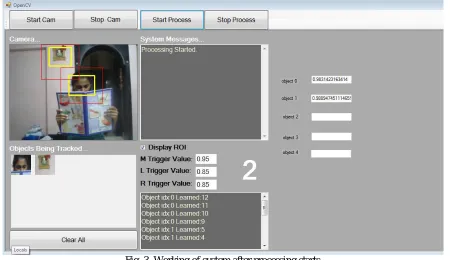
Fig.3. Shows how system works and looks after clicking on Start Process button. The camera picture box, from where user can select the objects. Following figure shows the selection of 2 objects which get selected with yellow rectangle which also shows ROI with red rectangle provides area where chances of object appearance are highest. GUI shows user how many objects user has selected. The selected objects are visible in the object being tracked picture box. Index box shows user what is the current index of array and from what index position images object is getting learned. If objects are not found within the ROI then it’s get increased with 20 pixels from all the sites.
Fig. 3. Working of system after processing starts
V. CONCLUSIONANDFUTURESCOPE
The proposed system provides better methodology than existing system the algorithm of template matching works with P-N learning technology which keep on comparing current template with existing templates by applying threshold value which helps system to perform better and generate more accurate results. The concept of ROI minimizes the searching area which helps in increasing system efficiency. The initiated system implemented in Open CV library in C#.net. The approach of tracking multiple objects in real time makes system more effective. Thought system provides multiple TLD, as number of objects increases the performance of system getting slow, this problem can be improved in future development.
VI. AKNOWLEDGEMENT
I sincerely express my deep sense of gratitude to my guide and PG Co-coordinator Prof. Kanchan Doke for her valuable guidance, continuous encouragement and support whenever required.
I would like to give sincere thanks to our Honourable Principal DR. M. Z. Shaik and Head of Department of Computer Engineering Dr. D.R. Ingle, for valuable guidance and encouragement lead to the success of this paper.
REFERENCES
[1] Bhushan Nemade, Dr.Vinayak ashok Bhardi, “Adaptive Automatic Tracking, Learning and Detection of Real Time object in the Video Stream”, IEEE 5th International Conference- Confluence The Next Generation Information Technology Summit (Confluence), Vol. 9, pp.569 – 575, 2014
[2] Zdenek Kalal, Krystian Mikolajczyk, and Jiri Matas , “Tracking-Learning-Detection”, IEEE TRANSACTIONS ON PATTERN ANALYSIS AND MACHINE INTELLIGENCE, Vol. 34, Issue 7, pp.1409 – 1422, 2012
[3] xinchen, xiang Li, Hefeng Wu, taishengQiu, “Real time Object Tracking via CamShift-Based Robust Framework”, 2012 IEEE International Conference on Information Science and Technology, Vol. 3, pp.527 – 530, 2012
[4] Swantje Johnson, Ashley Tews, “Real time Object Tracking and classification Using a static Camera”, Proceedings of IEEE ICRA, Vol. 5, pp.1-6, 2009
[6] Sanjay Kumar Sahani, G.adhikari and BK Das, “A Fast template matching algorithm for Arial object”, ICIIP International Conference On Image Information Processing, Vol. 11, pp.1-6, 2011
[7] s, In proc. Of Image and Vision computing, pp.1-6, 2000
[8] Lixia Xue, Zuocheng Wang and Yanxiang Chen ”Multi-target Tracking Algorithm Based on TLD under Dynamic Background”, International Journal of Hybrid Information Technology, vol.8, Issue 7, pp. 267-276, July 2015
[9] Pernkopf F. ”Tracking of multiple targets using online learning for reference model adaptation”, IEEE Trans on SMC-B, Issue 12, pp. 1465-1475, December 2008
[10] Chang FL, Ma L, Qiao YZ, “Human oriented multi-target tracking algorithm in video sequence”, CKNI, 2007, pp. 418-422
[11] Yao Jian, Odobez JM, “Multi-camera 3D person tracking with particle filter in a surveillance environment”, EUSIPCO, pp. 25-29, August 2008
[12] Betke M, Hirsh DE, Bagchi A., “Tracking large variable numbers of objects in clutter”, 2007 IEEE Conference on Computer Vision and Pattern Recognition, Issue 6, pp. 1-7, June 2007
BIOGRAPHY
Archana Vilas Kshirsagar is Student of M.E. Computer Engineering, Bharati Vidyapeeth College of Engineering,
Mumbai University, Navi Mumbai, Maharashtra, India. She is an Assistant Professor in the Department of I.T., B.N.Bandodkar College of science, Mumbai University, Thane, Maharashtra, India. Her area of interest is Cloud computing and Image Processing.
Kanchan Doke is a Professor in the Department of computer science, Bharati Vidyapeeth College of Engineering,