University of Windsor University of Windsor
Scholarship at UWindsor
Scholarship at UWindsor
Electronic Theses and Dissertations Theses, Dissertations, and Major Papers
2011
Inference of Non-Overlapping Camera Network Topology using
Inference of Non-Overlapping Camera Network Topology using
Statistical Approaches
Statistical Approaches
Abedalrhman Alkhateeb
University of Windsor
Follow this and additional works at: https://scholar.uwindsor.ca/etd
Recommended Citation Recommended Citation
Alkhateeb, Abedalrhman, "Inference of Non-Overlapping Camera Network Topology using Statistical Approaches" (2011). Electronic Theses and Dissertations. 312.
https://scholar.uwindsor.ca/etd/312
This online database contains the full-text of PhD dissertations and Masters’ theses of University of Windsor students from 1954 forward. These documents are made available for personal study and research purposes only, in accordance with the Canadian Copyright Act and the Creative Commons license—CC BY-NC-ND (Attribution, Non-Commercial, No Derivative Works). Under this license, works must always be attributed to the copyright holder (original author), cannot be used for any commercial purposes, and may not be altered. Any other use would require the permission of the copyright holder. Students may inquire about withdrawing their dissertation and/or thesis from this database. For additional inquiries, please contact the repository administrator via email
Inference of Non-Overlapping Camera Network Topology
using Statistical Approaches
by
Abedalrhman Alkhateeb
A Thesis
Submitted to the Faculty of Graduate Studies through Computer Science
in Partial Fulfillment of the Requirements for the Degree of Master of Science at the
University of Windsor
Windsor, Ontario, Canada
2011
© 2011 Abedalrhman Alkhateeb
Inference of Non-Overlapping Camera Network Topology
using Statistical Approaches
by
Abedalrhman Alkhateeb
APPROVED BY:
_________________________________ Dr. Faouzi Ghrib
Department of Civil and Environmental Engineering
______________________________________________ Dr. Imran Ahmad
School of Computer Science
______________________________________________ Dr. Boubaker Boufama, Advisor
School of Computer Science
______________________________________________ Dr. Ziad Kobti, Chair of Defense
DECLARATION OF ORIGINALITY
I hereby certify that I am the sole author of this thesis and that no part of this thesis has
been published or submitted for publication.
I certify that, to the best of my knowledge, my thesis does not infringe upon anyone’s
copyright nor violate any proprietary rights and that any ideas, techniques, quotations, or
any other material from the work of other people included in my thesis, published or
otherwise, are fully acknowledged in accordance with the standard referencing practices.
Furthermore, to the extent that I have included copyrighted material that surpasses the
bounds of fair dealing within the meaning of the Canada Copyright Act, I certify that I
have obtained a written permission from the copyright owner(s) to include such
material(s) in my thesis and have included copies of such copyright clearances to my
appendix.
I declare that this is a true copy of my thesis, including any final revisions, as approved
by my thesis committee and the Graduate Studies office, and that this thesis has not been
submitted for a higher degree to any other University or Institution.
iv ABSTRACT
This work proposes an unsupervised learning model to infer the topological
information of a camera network automatically. This algorithm works on non-overlapped
and overlapped cameras field of views (FOVs). The constructed model detects the
entry/exit zones of the moving objects across the cameras FOVs using the
Data-Spectroscopic method.
The probabilistic relationships between each pair of entry/exit zones are learnt to
cover the topological information among the different camera FOVs. Increase the
certainty of the probabilistic relationships using Computer-Generating to create more
Monte Carlo observations of entry/exit points. Our method requires no assumptions, such
as input parameters of the system, no processors for each camera and no communication
among the cameras. The purpose is to figure out the relationship between each pair of
linked cameras using the statistical approaches which help to track the moving objects
and predict the future location of them depending on their present location.
The Output is shown as a Markov chain model that represents the visible and
DEDICATION
ACKNOWLEDGEMENTS
All praise and glory to Almighty Allah (God) who gave me courage and patience
to carry out this work. Peace and blessing of Allah be upon my teacher Muhammad
(Peace Be upon Him)
For my parents the one who have struggled in their life to make my life easier,
thanks for the emotional and financial support you. May Allah reward you later on.
For my brother (Mohammad), the one I grow-up with, and share all childhood
memories with, thanks for all kind of support you gave me.
For my beloved wife (Crystalena), the one who stood up behind me in good and
bad, I really appreciate everything.
Especial thanks to Dr. B. Boufama my supervisor; I appreciate your
encouragement, advices and support. Finally thanks for the university of Windsor staff
Table of Contents
DECLARATION OF ORIGINALITY ... iii
ABSTRACT... iv
DEDICATION...v
ACKNOWLEDGEMENTS... vi
LIST OF TABLES... ix
LIST OF FIGURES...x
I. INTRODUCTION 1 1.1 COMPUTER VISION ... 1
1.2 HISTORY OF COMPUTER VISION ... 2
1.3 CAMERA NETWORK TOPOLOGY ... 3
1.4 APPLICATIONS OF LEARNING THE CAMERA NETWORK TOPOLOGY 4 1.5 MOTIVATION ... 5
1.6 OVERVIEW... 6
II. BACKGROUND OF CAMERA NETWORK TOPOLOGY 7 2.1 BASIC CAMERA (PINHOLE MODEL) ... 7
2.2 CAMERA FIELD OF VIEW (FOV)... 8
2.3 OBSERVATIONS DETECTION... 9
2.4 LEARNING ENTRY/EXIT ZONES... 10
2.5 BLOB CONSTRUCTION: ... 14
2.6 NOISE REDUCTION... 14
2.7 MARKOV CHAIN MONTE CARLO ... 16
III. RELATED WORK 19
IV. DESIGN AND METHODOLOGY 24
4.1 OBSERVATION DETECTION ... 25
4.2 LEARNING ENTRY/EXIT ZONES... 27
4.3 COMPUTER-GENERATING OBSERVATIONS AND OPTIMIZATION USING MONTE CARLO ... 29
4.4 DETECTING THE LINKS BETWEEN EACH PAIR OF ENTRY/EXIT ZONES ... 30
4.5 CALCULATING THE TRANSITION TIME FOR THE LINKED ENTRY/EXIT ZONES ... 32
4.6 THE OUTPUT ... 34
4.7 CONCLUSION ... 35
V. EXPERIMENTAL RESULTS 36 5.1 FOUR NETWORKED CAMERA ... 36
5.2 FIVE NETWORKED CAMERA ... 42
VI. CONCLUSIONS AND RECOMMENDATIONS 46 6.1 CONCLUSION ... 46
6.2 FUTURE WORK ... 47
REFERENCES...48
LIST OF TABLES
TABLE 2.1:SUMMARY OF OBSERVATIONS DETECTION APPROACH IS USED BY THE
RESEARCHERS. ... 10
TABLE 3.1:APPROACHES ARE USED FOR CAMERA NETWORK LOCALIZATION... 22
TABLE 4.1:SAMPLE OF DETECTED OBSERVATIONS... 25
TABLE 4.2:MONTE CARLO SIMULATION FOR GENERATING OBSERVATION... 30
TABLE 4.3:ALGORITHM FOR DETECTING THE LINKED ENTRY/EXIT ZONES... 31
TABLE 4.4:LEARNING THE RELATIONSHIP BETWEEN PAIR OF NETWORKED CAMERAS... 33
TABLE5.1:CLASSIFIED OBSERVATIONS FOR CAMERA 1 ... 38
TABLE 5.2:THE ADJACENCY MATRIX OF TRANSITION TIME... 41
TABLE 5.3:DETECTING THE OVERLAPPED CAMERAS FOVS IN THE CAMERA NETWORK... 41
LIST OF FIGURES
FIGURE 1.1: A)OVERLAPPED CAMERAS FOV B)NON-OVERLAPPED CAMERAS FOVS.. 3
FIGURE 2.1:CAMERA PINHOLE MODEL... 7
FIGURE 2.2:CAMERA INTRINSIC PARAMETERS... 8
FIGURE 2.3:CAMERA FIELD OF VIEW... 8
FIGURE 2.4: A)SPATIAL REPRESENTATION OF PATHS B):GRAPH REPRESENTATION OF PATHS... 11
FIGURE 2.5:SOURCES AND SINKS... 12
FIGURE 2.6:MOVING OBJECT IN CAMERA FOV ... 14
FIGURE 2.7: A)AN IMAGE OF SCENE HAS A VARIANT LIGHTENING... 15
B)THE IMAGE AFTER BACKGROUND SUBTRACTION, THE VARIATION OF LIGHT NOISE APPEARS AS A WHITE PIXEL... 15
FIGURE 2.8:MARKOV CHAIN MODEL... 17
FIGURE 3.1:SIMPLICIAL REPRESENTATION OF THE CAMERAS FOVS RELATIONS... 21
FIGURE 4.1THE PROPOSED MODEL FOR INFERENCE THE CAMERA NETWORK TOPOLOGY... 24
FIGURE 4.2: A)THE MOVING PERSON B)THE GRID OF THE 24 X 30 BOXES... 26
FIGURE 4.3:DETECTED OBSERVATIONS ENTRY/EXIT POINTS... 27
FIGURE 4.4: A)DASPEC CLUSTERS B)GENERAL K-MEANS CLUSTERS... 28
FIGURE 4.5: A)OVERLAPPED 2 CAMERAS FOV B)NON-OVERLAPPED 2 CAMERAS FOVS ... 33
FIGURE 4.6:MARKOV MODEL FOR NETWORKED CAMERA TOPOLOGY... 35
FIGURE 5.2:EXPERIMENT 1 CAMERA FOVS... 37
FIGURE 5.3:ALL CAMERAS OBSERVATIONS ARE CLUSTERED INTO MAIN ENTRY/EXIT ZONES ... 39
FIGURE 5.4:HISTOGRAM OF THE TRANSIT TIME OF THE OBSERVATIONS... 40
FIGURE 5.5:THE CAMERA NETWORK TOPOLOGY... 42
FIGURE 5.6:EXPERIMENT 2 SETUP... 43
FIGURE 5.7:EXPERIMENT 2 CAMERAS FOVS ... 44
CHAPTER I
INTRODUCTION
This chapter gives an overview of the general field of computer vision and the
topic of the thesis as well. A brief overview of computer vision and the historical
development of the field are discussed in the first two sections. Then camera network
topology is explained. After that, the main application of learning camera network
topology is described in general followed by the motivation of this work. Finally, the
chapter ends outlining the layout of the rest of this thesis.
1.1 Computer Vision
Computer vision is a mixed field of Artificial intelligence (AI); Image processing,
Computer graphic, Physics and Geometry fields. It is the computer science techniques
that are used to extract, recognize, classify and learn the information of computer images
in the real, 3D world.
Because the field is multidisciplinary, computer vision is a vast field and has
exchanged many visibility techniques with the related fields [Durand00]. Computer
vision is considered as a subfield of AI; many of the basic techniques were developed in
the AI laboratories. Computer vision and image processing have a significant overlap in
the basic techniques which have been developed in them. However, image processing
focuses more in image enhancement, image to image transformation and noise removal;
whereas computer vision focuses in 3D construction from one or several images.
Computer vision is the opposite of computer graphics since computer graphics generates
electromagnetic radiation using the image sensor [Ali06]. Computer vision is considered
as a subfield of the artificial intelligence - machine vision part, while machine vision
mainly focuses on the manufactory applications to control the robots. Computer vision
focuses more about the theoretical methods for these functions.
1.2 History of Computer Vision
During 1960’s digital image processing by computers started attracting
researchers. In 1965 the first computer vision system was built at MIT Lincolin
laboratory by L.G Robert [Kropatsch08]. A perspective view of a geometric model was
constructed on the computer; it was the first attempt to automatically recognize a 3D
object. Limitations of computer resources in those days motivated scientists to build
perceiving computers to handle the complex computer vision system [Kropatsch08]. The
needed resources where made available after a decade of work in the new computer
vision field. These new computers could process complicated mathematical applications
which were needed in order to further research in computer vision.
By the late 1970’s computer vision was considered as a discipline field [Ali06]. In
the early 1980’s [Delp82] stated that computer vision research in industrial robots was an
important field for the robotics industry. In 1987, the first international conference in
computer vision, ICCV, was held in London, UK [IEEE-ICCV]. Since the late 1980’s
research in human vision has increased; researchers started studying the human vision
functionality in which a discipline field is called neurobiology. This branch focuses on
1.3 Camera Network Topology
Camera network is an interdisciplinary area encompassing computer vision,
sensor networks, image, as well as signal processing [Zou09]. The network topology is
the layout pattern of interconnections of the various elements (links, nodes, etc.) of a
computer network [Learn-NT]. In video surveillance the camera network topology is the
layout pattern of the linked cameras; a pair of linked cameras has a path in which objects
can move through, or between them. The path can be a seen (i.e. corridor) or unseen path
(i.e. tunnel or hidden wall). Each camera in the network has a field of view (FOV), which
is the (angular or linear or area) extent of the observable world that is seen at any given
moment [Murray99]. If a pair of cameras fully or partially shares a field of view it means
they are overlapped, if not, it means they are non-overlapped cameras. Camera networks
differ depending on their cameras' FOVs. Some camera networks have only
non-overlapped FOVs cameras, some have only non-overlapped FOVs and the others have mixed
overlapped and non-overlapped FOVs cameras.
Figure 1.1: a) Overlapped cameras FOV b) Non-overlapped cameras FOVs
The network camera can be connected by wired or wireless communication. Due
development of wireless multimedia sensor networks, WMSNs, has advanced at great
speed [Akyildiz07]. Occasionally the networked cameras cannot be connected due to the
unavailability of the wireless or wired communication.
1.4 Applications of Learning the Camera Network Topology
1- People Tracking and Behaviour Interpretation
Topological information of the camera network can be used to anticipate the
future location of the target [Makris04]. The networked cameras collaborate to observe
the future location of the target [Funiak06]. Mapping the nodes in a camera network can
be an input parameter for different object tracking methods [Zou09], same as an agent’s
behaviour interpreting [Soro07].
2- Measuring Traffic Flow
Camera network localization can be used to analyze traffic flow and observe the
current transition time on a road. Camera network topology is used as a required
parameter of the smart traffic flow applications [Niu06].
3- Occlusion Handling in Video Surveillance
In video surveillance the object may hide behind another object, or in the blind
regions due to non-overlapped field of views. Learning about the spatial information of
the camera network can overcome the loss of the appearance information of the object
4- Event Detection
Much research has been focused on event detection, and activity analysis. The
applications of event detection range from simple motion detector [Nelson91] to
detecting aggressive behaviour (i.e. robbery at bank)[Zambanini09]. Spatial information
of the camera network can be useful for all kind of detection [Zou09].
5- Intelligent Environments
Intelligent environments are strongly influencing recent research in the computer
vision field. One of the most well-known applications is the smart home, which was
created to serve senior citizens and people with disabilities. Smart homes, combined the
fields of face recognition, object tracking and voice recognition to assist the target users
of these homes. Camera network localization is an essential requirement for this
application [Trivedi07].
1.5 Motivation
In the past twenty years the computer vision community has made great strides in
the automatic solutions to such problems as camera localization and visual tracking.
Camera based networks have been employed for critical real-time systems, such as
security monitoring and video surveillance. Researchers in this field focus on the smart
systems of automatic computer vision unsupervised learning methods. These can be set
These kinds of smart applications require the topological information of the
network’s cameras to determine the linked or the relative distance among them. Although
wireless communication has become available everywhere the communication among the
camera nodes in the network is still constrained by the bandwidth, data rate and energy.
Another important constraint is the limitation of the camera node processor as some
camera networks have basic video cameras, sensor, or low-level processing nodes.
Therefore, we do not make any assumption on the inputs from the camera network.
Our model input is simply a set of videos from one camera network. It does not
make any difference for us whether the cameras’ FOVs are overlapped or not, wired or
wireless, and whether or not they are connected. The output of our model is a graph
representing the relative location of each camera with respect to the other cameras in that
same network.
1.6 Overview
This thesis addresses the problem of learning the camera network topology that
has overlapped or non-overlapped camera field of views using the statistical information
of the moving objects through the cameras scenes. The thesis contains six chapters with
Chapter two explaining the background of the camera network topology and the
approaches that have been used to recover the topological information of the networked
cameras. Chapter three gives a brief overview of previous works in this area, while
Chapter four explains the approach we have used to recover the topology. The
experimental results are shown and analyzed in Chapter five. Finally, the conclusion and
CHAPTER II
BACKGROUND OF CAMERA NETWORK TOPOLOGY
This chapter gives the background of the camera network components and the
method used for creating these components. First, the basic units of the camera networks
are explained. Then the general methods for learning the camera network topology
processes are elaborated upon. Finally, the Markov chain Monte Carlo process is
discussed in general.
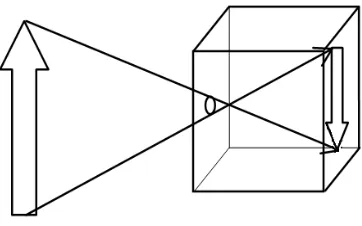
2.1 Basic Camera (Pinhole Model)
The pinhole camera is the most basic camera which consists essentially of a
light-proof, darkened box with a small hole in one side and no lens. When the photographer
takes a photo the light comes from the scene through the small hole, thus making the
scene appear upside down, and on the opposite side of the cameras hole. Alhassen (Ibn
Al-Haytham), a great authority on optics in the Middle-Ages who lived around 1000AD,
invented the first pinhole camera. The intrinsic parameters for this model includes the
focal length (ƒ), the principal point (p) and the skew coefficients, which is the angle
between x and y axis on the principle plane [Kamath07].
Figure 2.2: Camera Intrinsic Parameters
2.2 Camera Field of View (FOV)
The field of view, FOV, is the angular extent of the observable world that is seen
at any given moment. Different animals have different types of FOV, and humans have
an almost 180-degree forward-facing horizontal FOV. Camera FOV is the area of the
inspection captured on the camera’s imager. The size of the field of view and the size of
the camera’s imager directly affect the image resolution [Murray99].
2.3 Observations Detection
Observation detection is necessary for learning the camera network topology
without using wireless/wired connected camera nodes. Some models use the object
tracking approach to recover for camera network localization
[Meingast07][Lee00][Nam07][Marinakis05]. While others use the objects entry/exit
statistical information for camera network localizing [Tieu05][ Wang10][Makris04].
Most object tracking models use the spatio-temporal features for relating the object
trajectories.
Nam et al.[Nam07] proposed an original model for object tracking that establish
the object correspondence across the network’s cameras. A merged-spilt, MS, approach is
used for object occlusion which uses the grid-based approach for extracting the
appropriate spatio-temporal features. Chilgunde et al.[Chilgunde04] use the shape as a
feature-based object tracking for multi-camera network localization. They solved the
occlusion problem using the Kalman filter prediction. A colour histogram is used for
object tracking in the camera network localization model [Qurashi05]. The proposed
method used the HSV colour histogram to save many pictures for each pedestrian
crossing the road with different angles and sizes.
The bounding box feature-based tracking system is used to estimate the camera
network topology [Cralot09]. A bounding box made up of the lower left corner and the
upper right corner of the object’s blob. Wang et al. [Wang10] employ a correspondence
free model to classify the objects behaviours through studying the trajectories’ patterns in
each camera FOV. Boyd et al. [Boyed99] used the camera network topology for
statistically tracking the objects in the cameras’ FOVs by correlating the number of trips
statistical tracking approach, which is especially convenient for long term traffic patterns.
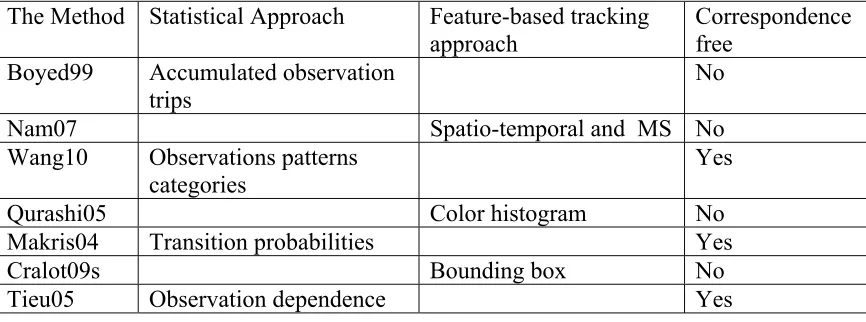
In Table 2.1, Observation detection models and approaches that were used by different
researchers are presented.
Table 2.1: Summary of observations detection approach is used by the researchers.
The Method Statistical Approach Feature-based tracking approach
Correspondence free
Boyed99 Accumulated observation trips
No
Nam07 Spatio-temporal and MS No
Wang10 Observations patterns
categories Yes
Qurashi05 Color histogram No
Makris04 Transition probabilities Yes
Cralot09s Bounding box No
Tieu05 Observation dependence Yes
From Table 2.1, one may notice that whenever the method is using a
feature-based object tracker the correspondence between object trajectories is required. On the
other hand, for statistical approaches there is no need for correspondence.
2.4 Learning Entry/Exit Zones
Learning entry/exit zones is very important for object tracking, object occlusion
and camera network localization systems. In [Makris02] an activity model is constructed
to identify the routes in an image. The proposed model is based on the recorded trajectory
observations by classifying them using a spatial feature, calculated using a simple
distance function. If an observation matches a learned route the function updates the
learned route with the new route weight information. Otherwise, the function creates a
The spatial model works on overlapped FOVs camera systems or a single camera
where pedestrians can be continuously tracked. However, it is inappropriate for
non-overlapped camera FOVs systems where tracked objects can be hidden in blind regions.
The clustering process is restricted by the object speed as the system cannot
recognize the object’s motion type. In other words, the system cannot distinguish
between a running, a walking or a lingering person in the scene. The system constructs
paths from the learned routes by grouping the connected routes and creating a junction
when the routes diverge in the cameras’ FOVs. The method reduces the number of
junctions by setting a threshold distance between each pair of routes before grouping or
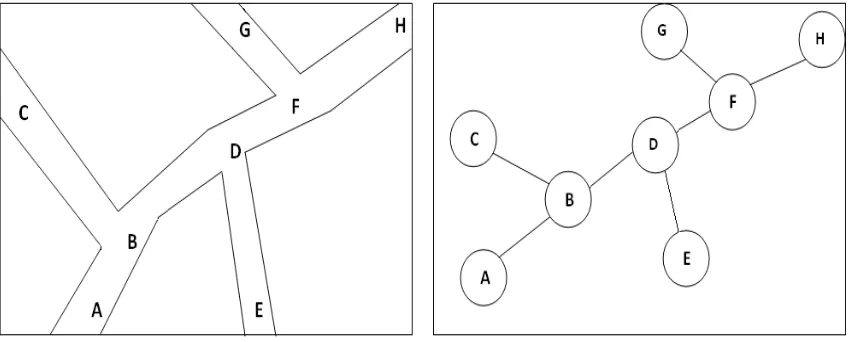
creating a junction decision. Figure2.4 shows the spatial and graph representation of a
path; the alphabetical characters (A, B etc...) represent the junctions.
Figure 2.4: a) Spatial representation of paths b): Graph representation of paths
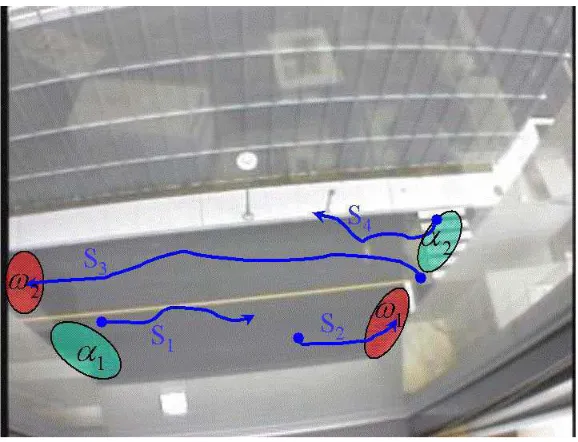
A method of fixing broken tracking sequences is introduced by stitching the
unlinked track scenes because of the “blind” areas while estimating source and sink
locations where objects appear in a camera FOV, and sink to locations where objects
disappear from a camera FOV (see Figure2.5). The standard Hungarian algorithm is used
for stitching the primary tracking correspondences resulting from the first model running
failure. The proposed method uses a two-state Hidden Markov Model, HMM. The first
state represents source events and the second represents the sinks events.
Experiments have been done for 400-1100 objects that were moving in different
scenes. Although the model effectively determines the entry/exit zones it has the
drawback that when objects cross a low-frequency used entry/exit zone, for example, a
fire exist, they will be considered as `lost` then as `found` objects in the scene.
Figure 2.5: Sources and sinks
Figure 2.5: Shows four tracking sequences with two sources and two sinks places.
S1 and S2 belong to the same object where these sequences need to be stitched together,
The data spectroscopy method, DaSpec, is able to handle unbalanced groups of
data and recover clusters of different shapes. The method focuses on clustering
information contained in eigenvectors of (n x n) affinity matrix based on radial kernel
function. Given data x1, x2, …,xn ∈ ℜ the affinity matrix is (Kn)ij = K(xi,xj)/n. The
eigenvector is the normalized version of the affinity matrix by obtaining the top of
eigenvector K. Spectral clustering method consists of reducing the dimensionality of the
affinity matrix and investigating the block structure of the normalized vector. The
connection between data clusters and the top eigenvector is that each eigenvector
corresponds to one mixing component. Thus Shi et al.[SHI09] take a threshold of the top
eigenvector. The distribution (P) of data is related to the eigenvectors and the
eigen-values and eigen-functions of the distribution dependent convolution operator:
(2.1)
Estimating the number of cluster G by identifying all eigenvectors vj that have no
sign changes up to precisionε, in other words, A vector e = (e1,…,en) has no sign
changes to ε if either ei > -ε or ei < ε). Tthen the algorithm represents these
eigenvectors and corresponding eigen-values by: the eigenvectors and
its top
v
v
v
G02 0 1
0, ,...
λ
λ
λ
G0 1
0, ,..., 2
0 respectively. Finally, the cluster label is assigned to each data
point:[SHI09]
2.5 Blob Construction:
Determining the contour or box (blob) around the moving object in the camera
FOV is very important for many computer vision applications such as object tracking,
object recognition and histogram analysis. Blob descriptors can also be used for peak
detection with application in segmentation. When the object is determined by a contour it
is called a snake [Ksantini09]. However, it is called a blob when it is a rectangular box of
pixels around the moving object. Active objects are the moving objects in the scene.
Figure 2.6: Moving object in camera FOV
2.6 Noise Reduction
Noise reduction is the process of removing noise from an image. The noise should
be removed from the image so it cannot affect the results. All recording devices, either
digital or analogue, add noise due to the errors in the image acquisition process
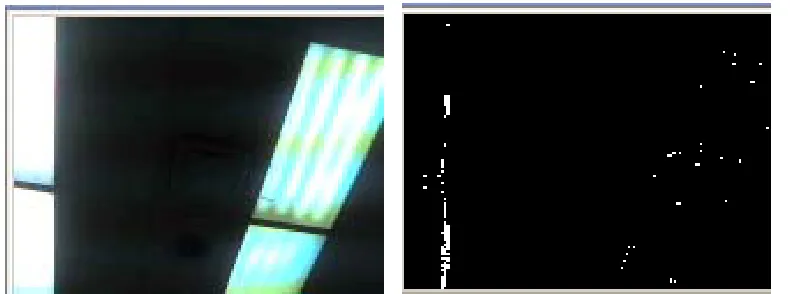
noise may be generated because of the small variation in the scene lightening, (see
Figure2.6) or variation of quantization of the scene colour.
In computer vision noise reduction is an essential tool used for all kinds of
applications. It is in fact crucial to remove the noise before starting the main processing
of the image. The density of the noise pixels is different than the original pixels in the
background and many filters have been used for noise removal. For example, the
Gaussian filter, salt and pepper, Median and the Wiener filter [Panda09]. The Wiener
filter was proposed by Norbert Wiener in 1949, and mainly it filters the noise n (t)
corrupting a signal s (t) the filter g (t) filters the image with noise and the result has the
following equation:
(2.3)
The erroe is computed as:
(2.4)
Where: α is the delay of the Wiener filter
Figure 2.7: a) An image of scene has a
Variant lightening
b) The image after background
subtraction, the variation of light
2.7 Markov Chain Monte Carlo
Real use of Markov chains started during World War II [Zhu05]. Monte Carlo
method is a computational algorithm for sampling that depends on repeatedly random
sampling to find the result [Katan09]. Since it includes repeated complex calculations it is
a computer-based method. Generally, the Monte Carlo method is used for physical
simulations, mathematical problems and computer applications for different purposes
such as optimization, integration/computing and learning. A few examples of these are
finding the best ten moves for a chess game, generating random users for a
telecommunication company with different, random states and generating a random
challenger in video games.
In the late 1990’s researchers started using MCMC for very complex genetic
inference and other biological applications [Zhu05]. The basis of the Monte Carlo
approach is to sample the large system into small, random configurations. In other words,
a large, unsolvable problem can be divided into small, solvable problems. A stochastic
process has the Markov property if the conditional probability distribution of the future
states of the process depends only upon the present state.
Markov model is a stochastic model that employs the Markov property for its own
states [Katan09]. If the state of an object in the model is fully observed then the model is
a Markov Chain model [Makris04], but if it is partially observed that means that the
model is a Hidden Markov Chain Model [Staufer03]. MCMC has been used in computer
visions applications like object tracking [Osawa07, Khan05], camera network
localization [Staufer03, Makris04] and 3D reconstruction [Dellaert00]. A simple example
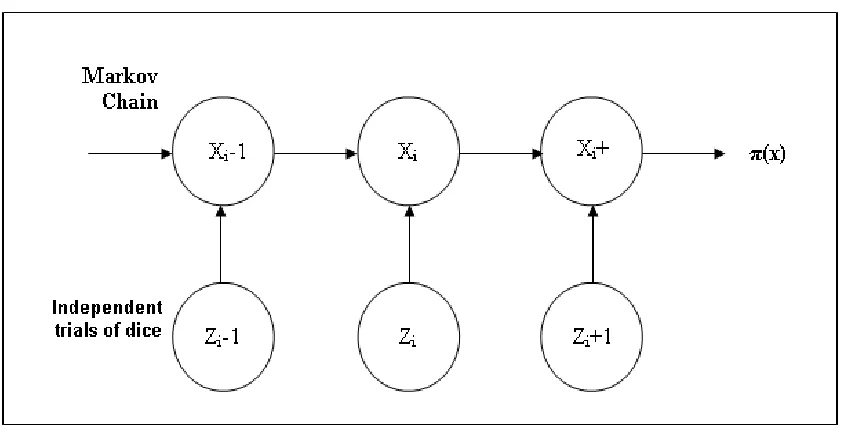
of MCMC sampling is that if we had a model with different states X = {x1, x2, ...xn}; each
Figure2.8. MCMC generates fair samples from a probability in Ω using random numbers
(i.e. dice) drawn from uniform probability in a certain range. A Markov chain is designed
to have π(x) being its stationary (or invariant) probability [Zho05], where each state xi+1
depend upon state xi.
Figure 2.8: Markov chain model
2.8 Gaussian Mixture Model
A statistical mature method is used for data clustering in an unsupervised learning
model. Assume that entry/exit zones are already known, and consider these zones as K
classes. Each class can have observations with normal distribution and variance σ2.
Using the Gaussian method the observation is classified to the class that maximizes the
posterior probability for it [Makris04]. The observation (x) will be classified into the
learnt entry/exit zones y = {i = 1: n} where n is the number of entry/exit zones as
(2.5)
(2.6)
Where pi is the prior probability of each entry/exit zone. and are the
covariance and average for each ith entry/exit zone.
Observation (x) is classified to the ith entry/exit are where x P(y =iǀx) is the
CHAPTER III
RELATED WORK
Activity models based on trajectory observation for overlap FOVs camera
network are proposed in [Meingast07, Lee00]) where the spatio-temporal feature is used
to match trajectories of objects that are moving through the cameras FOVs. In
[Funiak06], an algorithm called SLAT, Simultaneous Location and Tracking, requiring
only minimal overlap of the cameras FOVs has been proposed. The model determines the
location of the observations using the object Gaussian densities. Many proposed
algorithms use the image correspondence for tracking the objects in the Camera network
FOVs. The method, correspondence camera network calibration, has overlapping FOVs
which requires image formation, epippolar geometry and projective transformation that
are between each pair of overlapped cameras FOVs [Meingast07].
[Mantzel04] introduced a distributed localization algorithm using the Kalman
filter framework on the extended epipolar geometry. However, the Kalman filter has
difficulties distinguishing between objects when the number of objects in the camera
FOVs is too numerous [Boyd99].
SLAM, Simultaneous Localization and Mapping, is proposed for localizing and
mapping the camera network nodes based on the movement of a robot which takes
pictures by its sensors to use for land-marking. The true locations of the landmarks are
then estimated by an Extended Kalman Filter (EKF) [Rekleitis06]. The method represents
the positions and orientations of cameras in 3D.
Many researchers in this field have focused on non-overlapping camera networks.
topological information of the camera network. They employ the entry/exit models to
correlate objects’ transition time between the related camera FOVs. [Makris04] used a
node to represent each entry/exit zone in the resulted graph, while [Kim09] used a node
to represent each pair of entry/exit zones in the graph model. The constructed model
works on multi-camera tracking and does not rely on correspondence between
trajectories. Makris et al. stated that correlation is inappropriate for multi-model
distribution. In other words, these models are not appropriate for high traffic places
where the moving objects have a substantial variation in speed.
Some researchers have worked on the supervised learning approaches. These
models require assumptions about the environment of the camera network [Marinakis05,
Lobaton09, Rahimi04]. Marinakis and Dudek proposed a Markov Chain Monte Carlo
(MCMC) model to recover the camera network topology. A Monte Carlo Expectation
Maximization is used to maximize the likelihood of the observation which minimizes the
functional usage of the Markov chain sampling. The model used environmental
assumptions as input parameters.
Rahimi et al. proposed a model that requires assumptions about the object
transiting manner. The camera position is estimated by encoding a prior learning of the
locations and velocity of targets in the Markov model. Then they calibrate this prior
learning with the camera calculations to produce posterior probability of the observations
trajectory. Even though the model works for a large number of cameras, around ten
down-facing cameras in the experiments, the result was not fully accurate since they tried
to a 3D-representation of the output model. In addition, the weakness of this approach is
Lobaton et al. used an algebraic approach simplicial representation, called the
CN-complex, which can be constructed from discrete local observations. They utilize this
representation to recover topological information of the camera network. Each camera
performs a local computation to extract the discrete observation and convert it into a
symbolic representation to reduce the cost of data communications. Then it analyzes this
symbolic representation to build a model of the environment. This approach overcomes
the restrictive input assumptions. Figure3.1 shows the simplicial representation of the
CN-Complex vectors of the overlap cameras FOVs Areas: {[1], [2], [3], [4], [5], [1 2], [2
3], [2 4], [2 5], [3 5], [4 5] and [2 4 5]}. The major drawback of this work is that each
camera has to have a processor.
Detmold et al. proposed a scalable system for automatic and online estimation of
activity topology. The model used multi-processing video streams collectively instead of
a camera unit basis processing. They used the Exclusion method that simply indicates if a
camera’s FOV is occupied, and that another camera’s FOV is unoccupied
simultaneously. Thus, the two cameras cannot be observing the same space. One major
drawback of this model is the slow processing and lack of memory usage due to the huge
number of camera nodes in the network.
Table 3.1: Approaches are used for camera network localization
Overlap Non overlap Communication Algebriac Input Unsupervised Supervised Applied Method
Meingast07 √ Feature-based
Makris04 √ √ MCMC
Lee00 √ Feature-based
Funiak06 √ SLAT
Mantzel04
Lobaton09 √ √ √ CN-Complex
Bulusu00 √ GPS
Marinakis5 √ √ √ MCMC
Mardini10 √ RSSI
Savarese02 √ √ Estimationv node
position
Rahimi04 √ √ √
Kim09 √ √ MCMC
Rekleitis06 √ √ √ SLAM
Wen10 Cloud Computing
Table 3.1: summarizes the research models in camera network localizing field in
computer vision and computer network laboratories. Some of the methods supervised the
agents transitions in scene, some others rely on an overlap camera network, while some
others have non-overlapped camera network with unsupervised learning. The rest of the
approaches used a communicated camera network and one used an algebraic approach.
Much work has been done in computer network laboratories using ultra-sound,
radio waves and GPS technology. These models utilize the communication methods
among the camera network nodes to localize the cameras positions. [Bulusu00] solves the
problem of finding locations of camera network nodes by using the triangulation (GPS)
called Received Signal Strength Indicator (RSSI) that exists in the physical layer of the
network to locate the position of a sensor in a camera network.
[Savarese02] proposes a two-phase method that depends on the connectivity of
the initial position to estimate the new network sensors’ location. All network models can
be implemented on the vision based sensor network to localize their positions, but in this
case a wireless connection is needed for the network’s nodes. Wen et al. proposed
[Wen10] a Cloud computing based algorithmic framework to for Multi-Camera Topology
Inference. The comprehensive approach uses thousands of cameras for online smart city
CHAPTER IV
DESIGN AND METHODOLOGY
We propose a Dynamic approach for recovering the topological information of a
camera network using the statistical information of the moving objects through the
networked camera FOVs. The input of our method is a set of videos of the cameras
FOVs. First, the model records the statistical information of each observation then it
learns the entry/exit zones. The model generates more observations based on the detected
observations. The generated observations are classified into learned entry/exit zones.
After that, the model detects the related cameras and calculates the transition time
between each pair of related cameras. The output of our model is a Markov model for the
networked cameras.
4.1 Observation Detection
Inference camera network topology starts reading the video that is supplied from
the networked cameras FOV. Each video is divided into frames; the frame is the image of
the scene at any particular time. Then the frames will be sent to a special buffer to be the
input for the filtering process. The buffer saves the frame as an RGB matrix, then the
filter reads the frames from the buffer and applies the Weiner filter to filter the frames of
unwanted noise. The noises have four levels which are red, green, blue and alpha level.
The default is the alpha noise level to reduce the white noise that mainly comes from the
variant lights in the corridors.
The rapid movement in-between frames get detected and the entrance of an object
is identified by comparing the rapidly changed pixels in the new series of frames to the
previous state of the settled down frames. The exit of an object is detected by noticing the
rapid change in movement to the settled down frames. We construct the blob box around
the moving object by defining the upper left corner and the lower right corner of the
moving pixels in the frame. The centroid point of the object is defined as the center of the
blob box.
Table 4.1: Sample of detected observations
Entry/Exit Row #
Entry/Exit column #
Event time
Camera #
7 20 15 c1
29 8 49 c2
7 20 66 c1
28 9 103 c1
6 19 119 c1
7 20 168 c1
6 17 217 c2
29 10 245 c1
In our system we detect the entrance and exit of each observant object (O), as a
result, whenever an object enters or exits we assign an ID to the object. Then we register
the entry/exit point (the object’s blob centriod point) in 2D (X-axis and Y-axis), as well
as the entry/exit time. Our observation detector works for live camera videos.
The problem we are facing here is the unexpected small movement in the
recording environment, such as trees’ leaves moving in the window. We overcome this
problem by using the concept of sensitivity of movement which is predefined before
detecting the motion [Lee09]. That means we threshold the speed and the quantity of
movement that will be considered as a movement. A real time organizer is provided to
register each entry/exit instant time. The time organizer makes sure that all cameras start
recordings at the same time in the network.
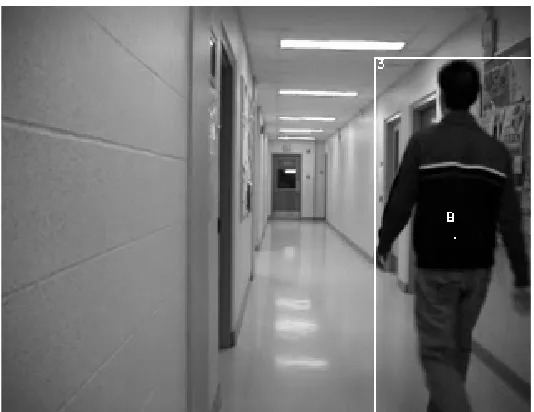
Figure 4.2: a) The moving person b) The grid of the 24 x 30 boxes
Figure 4.5 Illustrates how the moving pixels of the objects are represented in the
grid of the camera FOV. It shows the boxes that have moving objects pixels with values
4.2 Learning Entry/Exit Zones
The output entry/exit points of each camera FOV from the observation detection
phase are clustered into general classes. Then they are classified to infer the entry/exit
zones of each camera’s FOV. The method used for clustering is the Data Spectroscopy
method or DaSpec [SHI09]. We have compared this method with the general K-means
method and it has shown better results. In particular, the K-means failed to cluster two
groups of entry/exit points in their general means when they are close together. The best
example for cameras with close entry/exit zones would be when a camera FOV is looking
down a corridor that has many doors. The corridor seems to be getting narrower when the
door is further away from the camera. So the door appears small in the camera FOV and
will appear very close to the next door. Therefore, the entry/exit points detected for both
doors will be close to each other.
Figure 4.3: Detected observations entry/exit points
We have simulated a camera network with five camera FOVs and thirteen
differing, random speeds through these camera FOVs among these specified entry/exit
zones. The result from the DaSpec method was very accurate; however, this was not the
case for the K-means method. The features used for clustering are a horizontal row
number and a vertical column number of the grid’s box.
Figure 4.4: a) DaSpec Clusters b) General K-Means Clusters
Figure 4.7 Show the results of the simulation of three thousand moving agents
through five different cameras FOVs. Figure4.4 shows how the DaSpec method
succeeded to cluster the entry/exit points into thirteen groups of data which represent the
simulated entry/exit zones in the simulated network. Whereas Figure4.5 shows how the
general K-Means method could not cluster the entry/exit zones because it clusters close
groups of data that have a similar vertical or horizontal box’s numbers into same data
4.3 Computer-Generating Observations and Optimization using Monte Carlo
In this phase our model generates a number of random variables to be the input of
the Monte Carlo simulation. The Monte Carlo algorithm generates the observations to
increase the certainty of detecting the relationship between the entry/exit zones. Noise
that corrupts the Gaussian mixture model can be isolated by generating observations with
uniform distribution [Cho09]. The uniform distribution random number generator is
convenient for time accuracy purposes [WaterlooCh3].
The observations are generated based on the detected observations that have
known entry/exit zones. Let be the learned entry/exit zones from Section 3.2 where
and is the number of entry/exit zones in each camera. Let Oji be the
observations where K is the number of observations for each . The
following equation to calculate ( ) the number of iterations needed for the Monte Carlo
simulation:
(4.1)
Where:
sss
(4.2)
Table 4.2: Monte Carlo Simulation for generating observation
Monte Carlo Simulation Algorithm
Output( ) = MC(Input~,Z , ^
O , , )
// the new generated observations data set ^
O
// Z the number of the generated observations
^
O arbitrary
arbitrary
Repeat i = 1 .. N loop
Repeat j = 1 .. Z loop
Generate a new random displacement based on and
^
Oj +
^
O
end loop
end loop
MC simulation algorithm generates more observations for our model; based on
the variance for each pair of entry/exit zones to in crease the certiniaty of the relation
between them. The model consists the learnt entry/exit zones as the model states.
4.4 Detecting the Links Between each pair of Entry/Exit Zones
When using the fuzzy cognitive map to determine the relationship between each
pair of entry/exit zones to find if they are linked or not is related to the researcher’s
observations the variance of time difference can be used to determine how distances
change between observations of the cameras entry/exit zones. If the amount of the
difference (d) changes in small amount 0≤ Var(d) ≤1 that means the pair of the
entry/exit zones are linked. OtherwiseVar(d) ≥1 indicates that they are not linked.
Table 4.3: Algorithm for detecting the Linked Entry/Exit zones
Linked Entry/Exit Zones Detector Algorithm
Output(List) = LinkDetector(Input~, EE List,P)
// EE list is a List of each entry/exit Zone, each EEx contains it is Own Observations
// List is the list of the linked EE among cameras' FOV
//P is the probability matrix of the entry/exit zones
j i≠ loop Repeat for each pair of EE (EEi,EEj) where
if 0 < P(i,j) <= 0 then
) ( ), ( (
tance EEi O EEj O
sSis mahanoboli d ←
if 0≤Var(d) ≤1 then
//EEi and EEj are linked
List →addNode( EEi, EEj)
end if
Otherwise
//EEi and EEj are not linked
end if
The Mahalanobis distance between each pair of ( , ) where have the
observations Oi = {O1, O2...Ok} and have the observations = {O1, O2…Ok}
i
EE EEj EEi
j
EE Oj
∑
=
−
−
−
K
m im jm
T jm
im
O
S
O
O
O
11
(
)
)
(
(4.3)Where S is the Covariance matrix:
(
,
)
j iO
O
Cov
S
=
(4.4)4.5 Calculating the Transition Time for the Linked Entry/Exit Zones
For each pair of linked entry/exit zones the histogram of Mahanobolis distances
(d) between their observations is calculated. Then the most popular histogram is
considered as the transition time between them. The most popular histogram of the
different distances can be found applying the peak finder function. The transition time
between each pair of entry/exit zones is used to determine if the cameras are overlapped
or not. First of all, it is simple to determine if two cameras have no linked entry/exit
zones, hence, they do not have overlapped FOVs. However, if they have linked entry/exit
zones between them they can be overlapped, or not overlapped with an unseen path
between them.
Let us assume that camera c1 have entry/exit zones A, B and they are linked.
Camera c2 has entry/exit zone C. Then the relationship between c1 and c2 can be
Table 4.4: Learning the relationship between pair of networked cameras
Learning relation between pair of cameras
Output (Relation) = determineRelation(Input~,c1,c2,EEListc1,c2)
//EEListc1,c2 is the entry/exit list between c1, c2
if EEListc1,c2 has no pair of linked entry/exit between c1 and c2 then
Relation is non-overlapped
Otherwise
if EEListc1,c2 has Linked entry/exit zones (A,B,C) where (A,B) c1, C c2 then
if absolute (transition_time (A, B) – ( transition_time(A,C) +
transition_time(C, B))) <= Threshold then
Relation is overlapped
Otherwise
Relation is related_unseen_path
End determineRelation
Figure 4.8 explains how the transition times between a pair of cameras entry/exit
zones determine the relationship between them. In a) t1=t2 + t3 that means the object can
cross an entry/exit zone of another camera FOV while it is going through a path in the
first camera. In contrast, b) the passing object moves from A to B in the same camera and
does not cross any other camera’s entry/exit zones.
4.6 The Output
A Markov Chain model is constructed from related cameras. Since we have a
countable number of cameras the future location of the object, in terms of what camera it
is in, depends on the current location of the object (what camera is seeing the object
currently). The undirected graph that represents the camera network is weighted by the
transition time between the cameras. This is the transition time between the related
entry/exit zones of each pair of networked cameras. So the vertices V = {v1, v2..vn}
represent the cameras with the edges and E = {e1, e2,…em} represent the paths between
the cameras. Where (n) and (m) are the number of networked cameras and the number of
edges between them, respectively. The overlapped cameras are linked by a black edge
while, the related non-overlapped camera are linked by a grey edge. The grey edge
represents the unseen path between two related cameras. The non-related cameras have
Figure 4.6: Markov model for networked camera topology
4.7 Conclusion
In this chapter the statistical approach of learning the camera network topology is
explained. First we described how the input videos are taken from the networked cameras
that are divided and saved in a buffer. Then we explained how a Weiner filter is used to
reduce the white noise coming from light variation in the input video. Followed by how
we located the centroid point of the object’s blob as an entry/exit point, as well as the
time of each entry/exit. We also determined that the Monte Carlo method is used to
generate more observations to increase the certainty of the learning entry/exit zones. For
classifying new entry/exit points we use a Gaussian mixture model for the purpose of
classifying the entry/exit point to the entry/exit zones which maximize the likelihood of
the zone. Links among cameras’ FOVs entry/exit zones are then detected from this prior
knowledge. We find the transition time by calculating between each pair of linked
entry/exit zones and the adjacency matrix of the linked entry/exit zones of the networked
cameras is analyzed to construct the output model of the relationships between each pair
CHAPTER V
EXPERIMENTAL RESULTS
We have implemented the camera network topology inference system in Borland
C++ and Matlab 7.2. We have also used VisionLab [VisionLab] tool to implement the
observation detection. We have evaluated our application with two different networked
camera locations using real videos.
5.1 Four Networked Camera
We setup a four-camera network on one floor which has crossed corridors with
different entry/exit zones. Figure 5.1 shows the camera network setup. The camera
network has some overlapped camera FOVs and some cameras that have non-overlapped
camera FOVs. For example, camera 1 and camera 2 are overlapped while camera 1 and
camera 3 are not.
Figure 5.1 shows how we locate the cameras in the environment. The pair of
camera FOVs, camera1 and camera 2, are overlapped, camera3 and camera4 are also
overlapped.
a) Camera 1 FOV b) Camera 2 FOV
c) Camera 3 FOV d) Camera 4 FOV
Figure 5.2: Experiment 1 camera FOVs
Figure 5.2 shows the networked cameras FOVs. The cameras are used are of
different manufacture, camera1 and camera 2 are Sony 10.1 mega pixel, while the other
The object detector reads the video and analyzes the entry/exit location as well as
the time of the moving objects. The output of this step is a text file with all observations.
Then we cluster the entry/exit points for each camera to find the number of classes to
infer the entry/exit zones for these cameras. The scale used for the entry/exit points is (30
x 24), which means we divided the screen into thirty rows and twenty-four columns to
simplify the computation and increase the speed of processing. We have used the Data
Spectroscopy function for this task. The top eigenvector of X-row and Y-row for each
observation are not classified until the last unsigned eigenvector value does not change.
Table5.1: Classified observations for camera 1
X-row Y-column
Class or (Entry/Exit) zone number
X-row sign eigen vector picked Y-row sign eigen vector picked 0 11 0 11 0 11 0 11 1 11 0 11 0 1 11 12 13 16 14 7 13 7 12 17 13 18 13 16 17 13 2 1 2 1 2 1 2 1 2 1 2 1 2 2 1 0.0004 0.3047 0.0117 0.2955 0.0042 0.3047 0.0042 0.2955 0.0147 0.3047 0.0095 0.3047 0.0117 0.0147 0.3047 0.0129 0.0093 0.4029 0.0070 0.0697 0.0093 0.0697 0.0106 0.4090 0.0093 0.4001 0.0093 0.0106 0.4090 0.0093
Table 5.1: shows the classified observations of camera 1. The observations were
When all camera FOVs observations are clustered and classified into the detected
entry/exit zones the Monte Carlo method generates new observations in order to
accurately detect the relationship between each pair of entry/exit zones.
a) camera 1 observations b) camera 2 observations
c) camera 3 observations d) camera 4 observations
Figure 5.3: All cameras observations are clustered into main entry/exit zones
We generated eighty-nine observations from eleven observations for each pair of
entry/exit zone 1 in camera 1 to entry/exit zone 2 in the same camera; the standard
deviation = 0.5828 and the number of iterations N = 348. After generating the new
observations the transit time was found by the peak finder to equal 7.8102, for the time
histogram, see Figure 5.4.
Figure 5.4: Histogram of the transit time of the observations
Figure 5.4: represents the histogram of the transit time of the observations that
were generated by Monte Carlo method based on the observations detected between
entry/exit zone 1 and entry/exit zone 2 in camera 1. The most popular histogram equals
7.8102.
After finding the transition times by the Monte Carlo method between each pair
of the learned entry/exit zones then an adjacency matrix is constructed based on the
related entry/exit zones and transition time. If the variance of the Mahalanobis distances
is lower than one then they are related. Since the objects are moving in a consistent way
around the cameras all the entry/exit zones are related in this experiment. Therefore, the
variance of the Mahalanobis distance between pairs of entry/exit zones is smaller than
one for all pairs of entry/exit zones. The transition time is computed by finding the most
popular histogram of the different distances between the pairs of entry/exit zones.
Table 5.2: The adjacency matrix of transition time
E/E# 1 2 3 4 5 6 7 8
1 0 7.8102 12.35 0.95 19.95 17.1 25.65 21.85
2 7.8102 0 2.3 8.25 29.45 9.1 0 0
3 12.35 2.3 0 10.5 1.65 26.6 0 0
4 0.95 8.25 10.5 0 11.55 16.15 14.85 20.9
5 19.95 29.45 1.65 11.55 0 5.1 3.9 0.991
6 17.1 26.6 26.6 16.15 5.1 0 0.55 3.95
7 25.65 0 0 14.85 3.9 0.55 0 4.9167
8 21.85 0 0 20.9 0.991 3.95 4.9167 0
Table 5.2: The adjacency matrix is constructed depending on the relation between
each pair of entry/exit zones among the networked cameras. The networked cameras have
eight entry/exit zones among them.
The relationship linking cameras are determined by the transition times between
the entry/exit zones among cameras. We used a threshold of T =0.200 seconds for
detecting the cameras overlapping See 5.4.
Table 5.3: Detecting the overlapped cameras FOVs in the camera network
Cam1 Cam2 Cam1 EE#A Cam1 EE#B Cam2 EE#C Transition time C-A Transition time C-B Transition time A-B
2 1 3 4 2 2.3 8.25 10.5
3 4 5 6 8 0.991 3.95 5.1
Table 5.3: shows the results of the detected pairs of overlapped camera FOVs. For
example, camera 2 is overlapped with camera 1, camera 1 has entry/exit zone 2 and
camera 2 has related entry/exit zones 3 and 4. The summation of the transition time from
entry/exit zone 2 to entry/exit zone 3 and the transition time from entry/exit zone 2 to
entry/exit zone 4 is approximately equal to the transition time from entry/exit zone 3 to
entry/exit zone 4.
The Markov model shows the overlapped camera FOVs is shown in Figure 5.6
Figure 5.5: The camera network topology
5.2 Five Networked Camera
We set five networked cameras on the same floor of a building which has crossed
corridors with different entry/exit zones. Figure 5.6 shows the camera network setup. The
camera network has some overlapped cameras FOVs and some cameras have
cameras while camera 3 is overlapped with camera 4, camera 5 and non-overlapped with
camera1 and camera 2.
Figure 5.6: Experiment 2 setup
Figure 5.6 shows how we locate the cameras in the environment. The pair of
camera FOVs, camera1 and camera 2, are overlapped, camera3 and camera4 are also
a) Camera1 FOV b) Camera 2 FOV
c) Camera 3 FOV d) Camera 4 FOV
e) Camera 5 FOV
Table5.4: Overlapped Camera FOVs in experiment 2
Cam1 Cam2 Cam1 EE#A Cam1 EE#B Cam2 EE#C Transition time C-A Transition time C-B Transition time A-B
1 2 1 2 3 9.9 2.85 13
2 1 3 4 1 10.2 3 13
2 1 3 4 2 2.85 10.5 13
2 5 3 4 10 11.75 1.05 13
2 5 3 4 11 9.75 3.05 13
3 4 6 7 9 1.6 3.3 4.45
5 1 10 11 1 2 0.35 2
5 3 12 13 6 3.55 1.15 4.7
5 4 12 13 9 3.7 7.55 10.65
Table 5.4 shows the result of detecting the overlapped cameras FOVs. For
Experiment 2 the threshold is used for this example is T = 0.450; when we used 0.250 we
missed one link between camera 4 and camera 5.
The Markov model shows the overlapped camera FOVs is shown in Figure 5.8
CHAPTER VI
CONCLUSIONS AND RECOMMENDATIONS
6.1 Conclusion
In this thesis we have proposed a MCMC model to recover the topological
information of a camera network depending on the statistical information of the moving
objects in the cameras’ FOVs. The networked cameras’ FOVs can be overlapped or
non-overlapped, and communication between the network nodes is not necessary. The
unsupervised learning model requires no assumption on the input parameter to construct
the topology of the camera network. Many applications in the smart video surveillance
field can benefit from this work.
We have analyzed the videos from the networked cameras to determine the
needed information to infer the camera network topology. We have used an observation
detector to detect the entry/exit points and time by detecting the centroid points of the
objects’ blobs. The model learnt the entry/exit zones of each camera FOV using the Data
Spectroscopy algorithm. Then we generate more observations using the Monte Carlo
method and we classify the new observations into learned entry/exit zones.
The proposed model uses a Fuzzy cognitive decision to determine the relations
between the cameras entry/exit zones. The variance of the Mahalanobis distances
between the closest pairs of observations time of the entry/exit zones is used to decide
whether the entry/exit zones are related or not. The results of the entry/exit zones are
saved in an adjacency matrix. The next step is to find the overlapped cameras FOVs
chain graph of the related cameras. The relative location of each camera to the others is
shown in a graph representation.
6.2 Future Work
Although the object detector has been already implemented for this work we are
aiming at implementing a real life system of this problem. In this case, big network
hardware is needed to be set for a real life application, such as processors for each node
as well as a wireless communication among of them.
A variant of traffic types experiment needs to be tested for this approach, such as
a high speed traffic road and a building with multi-floor setting camera network or, a
senior citizen care centre experiment. The smart care centre application can benefit from
this work. For low traffic experiments, the application needs to run for a longer time and
it might need supervised agents to be moving in the cameras’ FOVs. For example, a fire
exit door in a building might not be used in the experiment time, but in reality, it is used
in emergencies. In this case, a supervised agent or a person can be guided in using these
doors
The threshold of the camera overlap detector needs to be overcome or at least it
can be minimized further. For this purpose, choosing the observation process can be
enhanced by adding a criterion to select the convenient observation for a specific kind of
REFERENCES
[Akyildiz07] Akyildiz, I.; Melodia, T.; and Chowdhury, K.; “A survey on wireless
multimedia sensor networks”, The International Journal of Computer
and Telecommunications Networking, 51(4), p.921-960, March 2007
[Ali06] Ali, M. A.; "Feature-Based Tracking of Multiple People for Intelligent
Video Surveillance", Master's Thesis, School of Computer Science,
University of Windsor, 2006
[Andrieu03] Andrieu, C.; Freitas, N. D.; Doucet, A.; Jordan, M. I.; “An
Introduction to MCMC for Machine Learning, Machine Learning”,
Volume 50, pp 5–43, February 2003
[Boyd99] Boyd, J. E.; Meloche, J.; and Vardi, Y.;"Statistical tracking in video
traffic surveillance", The Proceedings of the Seventh IEEE
International Conference on Computer Vision, Volume.1, pp.163-168,
September 1999
[Chavel78] Chavel, P.; and Lowenthal, S.; "Noise and coherence in optical image
processing. II. Noise fluctuations", Optical Society of America,
Volume 68, pp. 721–732,August 1978
[Chilgunde04] Chilgunde, A.; Kumar, P.; Ranganath, S.; WeiMin, H.;
”Multi-Camera Target Tracking in Blind Regions of ”Multi-Cameras with
Non-overlapping Fields of View”, The Proceedings of The British Machine
Vision Conference BMVC, September 2004
[Cho09] Cho, E.; Downes, I.; Wicke, M.; Kusy, B.; Guibas, L. J.;” Recovering
Conference on Embedded Networked Sensor Systems, 387-388,
Novermber 2009
[Clarot09] Clarot, P.; Ermis, E.; Jodoin, P.; Saligrama, V.; "Unsupervised camera
network structure estimation based on activity", Third ACM/IEEE
International Conference on Distributed Smart Cameras, pp.1-8,
August 2009
[Dellaert00] Dellaert, F.; Seitz, S.; Thorpe, C.; Thrun, S.;"Structure from motion
without correspondence", Proceedings. IEEE Conference on
Computer Vision and Pattern Recognition, Volume 2, pp.557-564,
June 2000
[Delp82] Delp, E.; Mudge, T; Siegel, L.; Siegel, H. J.;"Parallel Processing for
Computer Vision", Proceedings of the SPIE Conference on Robot
Vision, Volume 336, pp. 161-167, May 1982
[Durand00] Durand, F.; “A multidisciplinary survey of visibility”, in: ACM
SIGGRAPH course notes, Visibility, Problems, Techniques, and
Applications, July 2000
[Funiak06] Funiak, S.; Guestrin, C.; Paskin, M.; Sukthankar, R.; "Distributed
localization of networked cameras", The Fifth International
Conference on Information Processing in Sensor Networks, pp. 34-42,
2006.
[IEEE-CV] http://ieeexplore.ieee.org/xpl/conhome.jsp?punumber=1000149,
November 12th, 2010
and multiple target tracking usingmobilerobots”, Master’s Thesis,
Rensselaer Polytechnic Institute, December 2007
[Kandasamy07] Kandasamy, W.; Smarandache, F.; and Ilanthenral, K.; “Elementary
Fuzzy Matrix Theory and Fuzzy Models for Social Scientists”,
Technical Report, 2007
[Katan09] Kattan, M. W.; Cowen, M. E.; "Encyclopedia of medical decision
making", SAGE. Publications ,Inc. , Volume 2, Decision Trees, pp.
345-346, 2009
[Khan05] Khan, Z.; Balch, T.; and Dellaert, F.; "MCMC-based particle filtering
for tracking a variable number of interacting targets", IEEE
Transactions on Pattern Analysis and Machine Intelligence, 27(11),
pp.1805-1819, November 2005
[Kim09] Kim; H.; Romberg, J.; and Wolf, W.;"Multi-camera tracking on a
graph using Markov chain Monte Carlo", ICDSC 2009. Third
ACM/IEEE International Conference on Distributed Smart Cameras,
pp.1-8, September 2009
[Ksantini09] Ksantini, R.; Shariat, F.; and Boufama, B.; "An Efficient and Fast
Active Contour Model for Salient Object Detection", 2009 Canadian
Conference on Computer and Robot Vision CRV, pp.124-131, May
2009
[Learn-NT]
http://learn-networking.com/network-design/a-guide-to-network-topology, December 17th, 2010