A Cognitive study of Nonlinguistic Factors Affecting the use of Prepositions by Vietnamese
Native Speakers
Phuc Tran Huu1, Thang Nguyen Tat2,Nghi Tran Tin3*
1University of Foreign Language Studies – The University of Da Nang, Vietnam 2Faculty of Foreign Languages, Da Lat University, Vietnam
3Ho Chi Minh City University of Food Industry, Ho Chi Minh city, Vietnam Corresponding Author: Nghi Tran Tin, E-mail: [email protected]
ABSTRACT
This article investigates factors that influence the use of English expressions made by Vietnamese native students at Ho Chi Minh City University of Food Industry (HUFI). The research is conducted to analyze the factors that validly affect the usage of prepositions by EFL learners based on a variety of personal data and background of the participants. It is hypothesized that the application of prepositions is affected by some of geographical and social factors rather than linguistics matters. With the help of the software SPSS, the research took a thorough exploration into certain hindered elements in Vietnamese that may affect the language acquisition through negative interference to EFL learners. The data came from the survey of 141 EFL students at HUFI. A number of factors that appear to influence the use of English prepositions made by EFL learners. The findings discovered that location, favourite colours and negative transfers influenced the use of prepositions rather than the other factors, e.g. gender, reading habits, leisure activities, outdoor activities. The result of the study contributes to the understanding of the hindering factors to the SLA in teaching English prepositions under the light of Cognitive Linguistics. Practical suggestions for EFL pedagogy and research are also included in this paper.
Key words: English Prepositions, Negative Transfer, Cognitive Linguistics, EFL
INTRODUCTION
Prepositions play a very important role in languages. Prep
-ositions are crucial in forming utterances because most of language users rely on them to form sentence structures and meanings. In fact, prepositions connect various parts of a sentence. Some location (where something is in relation to something else, e.g. in, on, atop, under, next to, etc.) or space (how things are related in space, e.g. in, on, to, with, over, under, onto, into, besides, etc.). Others tell us physical con
-nections or possession between nouns or pronouns and an
-other word, such as of, with, by. Some refer to relationships
in time: while, during, after, until (till), before, and since and many other aspects. That is why English is considered as the most often use in English.
Prepositions are extremely polysemous and complex in defining their variegated senses in contexts with a lot of difficulties in semantics and syntax fields. Even though English prepositions belong to the closed class, they have archaic words, dialectal forms and combing formulas that are very easy to form a new one like structure of the “prep
-osition – adjective – prep-osition” to make a multiple word preposition like “as opposed to”. English prepositions do not have a fixed number since different sources report dif
-Published by Australian International Academic Centre PTY.LTD.
Copyright (c) the author(s). This is an open access article under CC BY license (https://creativecommons.org/licenses/by/4.0/)
http://dx.doi.org/10.7575/aiac.ijalel.v.8n.1p.147
ferent figures. There are over 90 English single-word prep
-ositions (Lindstromberg, 2010). Besides, there are also 40 two-word prepositions and 24 three-word prepositions, 37 archaic or dialect prepositions and 10 postpositions which bear the different form with the existing list. With a high frequency and richly polysemous usage, prepositions cause a lot of challenges for English as a Foreign Language (EFL) learners in Vietnam. These challenges are partly described and interpreted in recent linguistic researches for learners’ competence (Hoang & Boers, 2018) and self-efficiency (Thi, Phan, & Locke, 2015) but these researches papers do not state clearly the factors that may influence on their process of acquisition of the language, especially those for preposi
-tions.
Besides, the number of English prepositions is much larger than that in Vietnamese. The Vietnamese prepositional system focuses on location and time (Tri C. Tran; Minh-Tam Tran, 2007). The Vietnamese locative prepositions are “bor
-rowed” or “extracted” from the other kinds of Vietnamese parts of speech. Vietnamese locative prepositions are consid
-ered as the coherence device words, for example “trên’ (on, above, over), ‘trong’ (in, inside), ‘chung quanh’ (around), ‘bên phải’ (on/to the right of), ‘cạnh’ (next to/beside) and so ARTICLE INFO
Article history
Received: October 06, 2018 Accepted: December 19, 2018 Published: January 31, 2019 Volume: 8 Issue: 1
Advance access: December 2018
on. They are the same as those of Vietnamese prepositions of time, for example ‘vào” (in, on, at), ‘trong”/‘suốt’ (during/ for),’trước’ (before), ‘sau’ (after), ‘kể từ khi’ (since) and ‘cho tới khi’ (until), etc. It is clear that Vietnamese language does not have an equivalent system like that of English preposi
-tions, and Vietnamese grammarians try to explain the notion of prepositions as means of conveying the grammar mean
-ings. It means that Vietnamese prepositions are ‘the words to create the relations and according to this, Vietnamese prep
-ositions are named as linking words of place, time, reason, purpose, etc.’ (translated from Vietnamse grammar (Kim, Kỷ, & Khiêm, 1940, p. 132). That is the reason why Vietnamese EFL learners focus too much on nouns, verbs and adjectives because they generally assume that these kinds of words are crucial. They spend most of their time learning nouns, verbs and adjectives to actively master English vocabulary; conse
-quently, they put the other parts of speech aside, especially prepositions. Moreover, they assume that prepositions and adverb particles are easy words, and they just tend to foster ‘the translation’ from the ‘equivalent words’ in their mother tongue into English. Based on those above reasons, this re
-search is conducted to investigate which factors intervene the results of using English prepositions by EFL learners.
This research paper focuses on the extended use of prep
-ositions as motivated polysemy networks of Vietnamese people based on the CL. The research tries to answer the question: “Which factors negatively intervene the way the EFL learners’ using English prepositions from the perspec
-tive of CL?”. Based on this research question, the study fo
-cuses on the factors affecting the use of English prepositions made by EFL learners based on the information collected from the survey. To achieve this purpose, we set up the three sub-theme questions (1) Is there any relationship between gender and the use English prepositions?; (2) Do Vietnamese negative transfers result in the choice of simple English prep
-ositions uses by Vietnamese native speakers?; and (3) Which group of factors influences the use of English prepositions: social factor group or geographical one?
The research is not going to describe the linguistic signs that account for the results of the language used, but we pay our attention to the cognitive, experiential, and social con
-texts, which go far beyond the linguistic system itself. They are gender, age, location, leisure time, favourite colours, sports and many others. The research is setting a very new idea in defining which factors may influence language learn
-ing through the use of English prepositions by Vietnamese native speakers.
LITERATURE REVIEW
Cognitive Studies on English Prepositions Usages in Vietnamese Context
Studies on the prepositions in Vietnamese language are hard
-ly found because the term of “Vietnamese preposition” does not exist in the Vietnamese language system. The studies of ‘Vietnamese prepositions’ only found in studies on space, time, manner, and movements under the term of “connecting words” or something similar. One of very early studies on
this matter is the article titled “Trong phòng khách và ngoài phòng khách: vài điều thảo luận từ quan điểm của ngôn ngữ học Tri nhận” (Translated into English, “Some notes from the views of cognitive linguistics on the use of the preposition when referring to the living room in Vietnamese”) (Thắng, 2007). The research explores a particular case of Vietnamese preposition from the view cognitive perspectives, i.e. Viet
-namese linguistic expressions of “trong” (English word “in”) and “outside” the living-room. The research presents plausi
-ble findings that there are five Vietnamese expressions for the single sentence “Mom is in the living room” in English or “Mama est dans le salon” in French.
[1] Mẹ (đang) ở trong phòng khách. [2] Mẹ (đang) ở dưới phòng khách. [3] Mẹ (đang) ở trên phòng khách. [4] Mẹ (đang) ở ngoài phòng khách. [5] Mẹ (đang) ở phòng khách.
(Thắng, 2007) Vietnamese language does not have prepositions as a type of speech, but it does have many ways of expressing the spa
-tial relations due to ‘different perspectives on orientation, ex
-perience, physical or cultural directionality’ (Thắng, 2007). Although the research succeeds in interpreting the complex of ground “phòng khách” for stranding of native Vietnamese speakers, the lexical change of the guest (“khách”) is not fully involved in the category of ROOM under the view of CL. That lexical change leads to the different understanding propositional schemas. In the latter section of this research, major propositional schemas of aspect and tense will be ana
-lyzed to know the location, motion or actions.
Prepositions usually play a significant function in the sentence as markers to join the words, phrases together to make a sentence. One imperial study to apply Cognitive Perspective to teaching English prepositions for Vietnamese students is “Vietnamese Students Learning the Semantics of English Prepositions” (Hung, 2017). In this study, the author uses vivid pictures to teach English prepositions to exam
-ine how different senses of prepositions are analyzed. Thirty eight (38) selected students join the experiment and they are split into two groups: one with the new cognitive linguis
-tic approach and the other with traditional instructions. The participants give their opinions of new pedagogical instruc
-tions and traditional one on ten proposi-tions, namely above, among, at, behind, beside, between, in, in front of, on and under. The findings illustrate that the group that is treated with CL-based instructions outperform the traditional group in the fastest, although they win a comparable mean score in the pretest. Most participants have positive reactions to the new treatment of CL. The findings suggest that cognitive treatment could be practiced to assist students in bettering their understanding and retaining the metaphorical meanings of the prepositions. The thought of using CL in teaching, es
-pecially for teaching a very specific type of language is be
-coming much of interested in Vietnam, although it is rather later than the other nations in the world. As a matter of fact, his research is done in the controlled groups and the students have a long time to work with the researcher, and the meth
the research has pointed out the better performance of stu
-dents when they learn with CL approach, it does not reveal the hinders of cross-linguistic influence or negative transfers that students may have during their studying.
The Cognitive Studies of Prepositional Senses
Recently, cognitive linguists have paid much attention to the semantic nature of English prepositions, because ‘they are notoriously hard to learn and frequently subject to negative transfer’ (Bratož, 2014, p. 325). The meanings of preposi
-tions and adverb particles vary according to the ways they appear such as in time, space, manner, or even abstract and are often unpredictable and arbitrary. Cognitive studies on prepositional senses vary from English language learning and teaching to linguistic research. An experimental inves
-tigation into learning Semantics of English to, from and at has been conducted since 2003 which represent a promis
-ing target for the application of CL to instruct L2 learn-ing (Mueller, 2011; Andrea Tyler, 2003; Andrea Tyler, Muel
-ler, & Ho, 2011). Since then, CL has been applied to many meanings associated with English prepositions in a very sys
-tematic way. Their research is reported basing on a quasi-ex
-perimental study which examines the efficacy of applying a CL perspective to L2 learning such as the cognitive use of prepositions of English spatial preposition (Brenda, 2014), prepositional error detection (Akhtar & Rizwan, 2017). Re
-searches on spatial preposition are the starting point of the CL framework for grammaticalization. Heine and Steele (1994) develop ‘propositional schemas’ to represent pro
-cesses and events and are divided into three basic schemas:
location, motion, and action.
Lu (2013) adopts a cognitive pragmatic and a Conceptual Blending approach to examine the preposition “in”. The cri
-terion for sense establishment for preposition “in” is based on Grice’s Modified Occam’s Razor (Bontly, 2005) and his work can be considered an inferential product of the pro
-to-scene. The sense of preposition “in” is divided into two senses: physical containment and means, and the pragmat
-ic model of the meanings can itself position as cognitive models. The study of prepositions also contributes how the context oriented model of polysemy senses integrates into Conceptual Blending Theory (Fauconnier, 1985, 2001; Fau
-connier & Turner, 2003) by depicting the correspondenc
-es between its contextualization and elements of emergent structures. However, the research does not cover the other factors that may influence on the mastery of English prepo
-sitions of survey participants in the research such as gender, location, religion, cultures, etc. The other studies on preposi
-tional polysemy are related to the preposition “over” which has been studied by many researchers (Bergen & Chang, 2000; Brenda, 2014; Nevalainen, 2000; Quirk, Greenbaum, Leech, & Svartvik, n.d.; A Tyler, 2003; Wright & Hope, 2005; Yoon, 2001). From their points of view, the meanings of “over” are derived by means of reconceptualization and given pragmatic contexts. The differences of senses are the results of conceptualizing the relationship between Trajector (TR) and Landmark (LM). Although at least seven distinct senses of the preposition “over” can be drawn from these
researches such as proto-scene, trajectory, examining, re
-flexive, covering, covering-multiplex, covering - multiplex and path, the finding is only examined the only one English preposition ‘over’. The group of the prepositional schemas
of “above/over/beyond/atop” needs clarifying more deeply. In the next section of this study, all of the factors affecting to the mastery of English prepositions under the light of CL are taken into accounts for analyzing.
Negative Transfers on Prepositions
Zhu (2009) describes the prepositions’ frequencies and roles through his analysis of argument realization of preposition structures as follows:
Considering the total number of annotated sentences in Frame Net (62812/139 439), it means that in every two to three annotated sentences, there is one sentence with prepositional phrases marked as frame elements (2.21:1). It is interesting to note that argument real-izations in the form of prepositional structures are so marked in Frame Net that in many sentences, the major-ity of the annotated semantic arguments are realized by prepositional phrases (p.383).
Chong (2007) investigates the prepositional errors of time, place and direction made by junior Chinese students. His experiment focuses on the difficulties in using English prepositions made by junior Chinese students and he points out that “many of the Chinese ESL learners have difficulty in employing English prepositions when they write in the target language. Consequently, they are not able to employ them in a correct manner or without ambiguity so as to satisfy the rules ascribed to their use’(Chong, 2007, p. 4). Chong succeeds in explaining the sources of errors mainly based on Contrastive Analysis Hypotheses, Error Analysis Hypotheses and Interlanguage Hypotheses. This research mainly bases on the ‘surface’ of the language through their work to interpret the sources of errors. That does not reveal to the readers why most of the Chinese students have certain ‘must-have’ types of errors of using English prepositions, but other students do not.
Zarei, Darakeh, & Daneshkhah (2016) also address the difficulties of EFL learners in using English prepositions through ‘nonlinear systematic and meaningful teaching/ learning procedures’. Their findings support the use of im -age-schemas on learning English prepositions and enhanc
-ing learner autonomy, in which ‘the experimental group participants who received instruction through focusing on the networks of relations and their experience of the world outperformed the control group’ (Zarei et al., 2016, p. 130). This research presents a clear-cut of prepositional polysemy which is experimented based on the basic conceptual struc
-tures such as ‘image schemas, prototypes, and radical net
-works in a step-by-step dynamical approach’(Evans & Tyler, 2005).
word order processing (Erdocia & Laka, 2018), language skills (Akhtar & Rizwan, 2017; Li, 2014), teaching gram
-mar (Sudhakaran, 2015), but not for minor lexical group of words such as prepositions and particles. One analysis of prepositions which is mainly on idiomatic phrases, prepo
-sitional phrases and zero prepositions for detecting errors in the writing of graduate ESL learners of Pakistan is found with a wellknown work. This work investigates the nature of errors in the writing skill problems of graduate learners. The research asks students from four colleges and one university to finish the writing project and then detect writing errors in the fields of prepositional phrases, idiomatic phrase and zero prepositional phrase from Pakistan learners. The outcomes indicate the incorrect usage of prepositions frequently ‘with, in, by’ and unnecessary insertion of prepositions because the learners tend to place a proposition as the same designs of Pakistan language.
METHODOLOGY Population and Sample
With the focus on defining the factors influencing English prepositional usage at Ho Chi Minh City University of Food Industry (HUFI), we set up a survey of 141 students who are from the different areas in Vietnam. The survey was con
-ducted to collect the personal background of the participants, such as age, gender, location, religion, color favourites, time management, time consumption, and qualifications. The sur
-vey involved 141 randomly selected students from different HUFI’s 14 faculties and one institute. The data were collected through 70 multiple-choice item questionnaire and 5 writing tasks of describing pictures, in which students were asked to fill in the blanks with the most appropriate prepositions.
Research Design
To present the analysis of the input data from the undergrad
-uates, descriptive methods were used. The results were ex
-pected to test the hypothesis of which factor had the most influence on the results of using English prepositions. The research based on descriptive methods, with the application of independent T-test, Anova test, and Linear Regression test to explain which factor had its own values in comparison with the participants’ scores.
Research Instruments
There were two different tests in the questionnaire (See Appen
-dix) which were used as instruments to collect data from the EFL undergraduates at HUFI. The first test included 70 multi
-ple choice questions. The deletion of English prepositions was used to assess their overall semantic accuracy and capability
to fill in the blanks appropriately in this test. In the first test, the correct answers were coded with digit ‘0” and incorrect an
-swers with digit “1” in order to analyze the frequency of correct and incorrect of the reach of questions. We changed the coding signals with four different specific prepositions in each of the questions in the first test to analyze the source of difficulties when they used English prepositions. The coding was marked from 0 to 3, based on the proximity to the correct answer which was coded 0. The second test was designed to asked participants to describe the place or spatial relation of an item with the other things in the picture. There were five pictures in the total.
RESULTS AND DISCUSSIONS
The Relationship between Gender and the use of English Prepositions
The study set up a hypothesis that gender, age, location, fa
-vourites and leisure activities certainly affected the results of using prepositions. Based on the first multiple choice test in the questionnaire, the data were collected and analyzed sta
-tistically in comparison with the score they got through the test as shown in Table 1. The scores were in the rank from 15 to 700, according to their performance in the test.
Overall, the results presented above show that the scores of the participants were falling at the mean of 260.28. The Standard Deviation of 137.485 revealed that the difference among participants’ results was extremely high. There was a perceived difficulty of the participants in the survey found in the large amount of the questions, but not for certain “dif
-ficult questions” only. Furthermore, it could seem appropri
-ate to st-ate that the correlation significant varied from.001 to.216 for the questions 35 and 70 in Table 2:
A high Standard Deviation around the mean identified from the analysis showed the ‘negative results’ of the sur
-vey. It meant that participants might have a wide spread-out in choosing the correct answers. Many of them have answers that were not expected to be close to the proximity with the correct answers.
Taking the survey, participants filled out the blanks with appropriate prepositions in 70 multiple choice questions and wrote sentence to describe an object in pictures. The analysis variables for investigating the relationship between gender and the use of prepositions were their total scores and respondent Table 1. Descriptive statistics of the participants’ scores
N Minimum Maximum Mean Standard deviation
Total score 141 15 700 260.28 137.485
Valid N (listwise) 141
Table 2. Paired samples correlations Q.35 and Q.70 N Correlation Sig. Pair 1 Total score &
Question 35 141 −0.275 0.001
Pair 2 Total score &
gender. The data were tested with Chi-Square test. The result from the survey testified the hypothesis that genders played no role in determining the nature sources of using English prepo
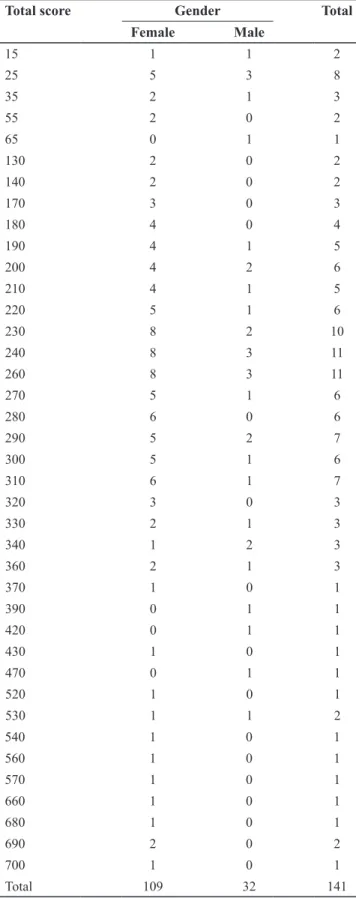
-sitions. Table 2 illustrated the performance of 109 female and 32 male undergraduates to prepositional uses in the survey.
Table 3 shows that p value is 0.887, which is greater than 0.005. This means that there is not any statistically signifi
-cant difference between genders and total scores. It was con
-cluded that no evidence was found to the relation between gender and the performance of using prepositions. Table 4 illustrates the tabulation between gender and scores in the Chi-square test.
However, one of the noticeable points that 5 questions numbered 8, 10, 12, 20, and 55 in the first test showed that there existed the differences between male and female per
-formance in using prepositions. The results showed that it was statistically significant regarding the relationship be
-tween gender and the use of prepositions, with p <. 0005 (see Table 5). This indicates that somehow there was a dif
-ference in between female and male performances, but not clear enough. These questions were closely related to phrasal verbs with the complex correlations with each other.
Geographical Factor Vs. Social Factors
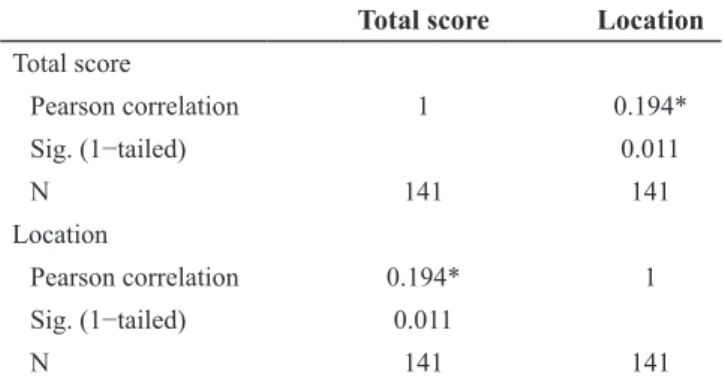
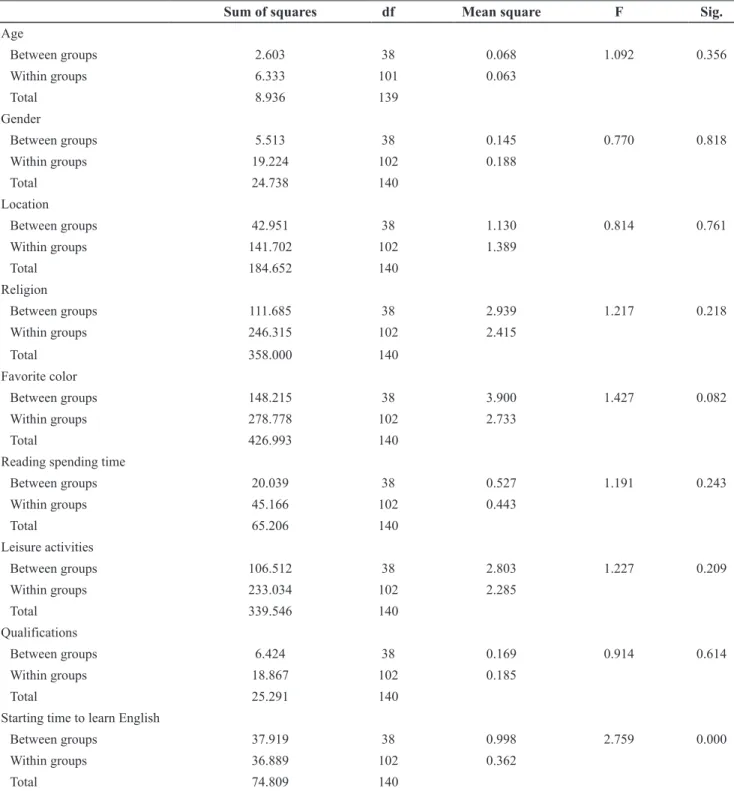
To test which factor most affects the choices of using proper English prepositions, we used the Anova (See Table 7) and T-test (See Table 6) with an independent sample. The results revealed that location, where the students come from, had two significant factors influencing the answers of the par
-ticipants: location and favourite colours with the same sig. at 0.011. That was a surprising result because we expected the reading time, habits, leisure activities could affect the results, but they did not have any strong correlations from our statistic data analysis.
The other factors like gender, age, religions, qualification (compared with the different group ratio), habits including reading times, playing games, sports, etc.) did not exceed the p-valuein the correlation test: Age (0.397), Religion (0.59), Reading spending time (0.09), Leisure activities (0.388), Qualifications (0.181), and Starting time to learn English (0.88). Among them, only reading habit could have an in
-fluence on using English preposition of participants with the p-value at 0.88.
The geographical factors and favourite colours were shown as strong factors that might have such a significant number on the test. It showed that participants may have ‘some capacity of using preposition’ from the place they come and the colours their love might reveal their ability in using them.
From these statistical facts, it is high time that teaching English prepositions by rote learning and some of exceptions
Table 3. Group statistics with the gender factor
Gender N Mean Standard deviation Standard error mean Sig.
Total score Female 109 265.05 139.999 13.409 0.887
Male 32 244.06 129.343 22.865
Table 4. Total score *Gender crosstabulation
Total score Gender Total
Female Male
15 1 1 2
25 5 3 8
35 2 1 3
55 2 0 2
65 0 1 1
130 2 0 2
140 2 0 2
170 3 0 3
180 4 0 4
190 4 1 5
200 4 2 6
210 4 1 5
220 5 1 6
230 8 2 10
240 8 3 11
260 8 3 11
270 5 1 6
280 6 0 6
290 5 2 7
300 5 1 6
310 6 1 7
320 3 0 3
330 2 1 3
340 1 2 3
360 2 1 3
370 1 0 1
390 0 1 1
420 0 1 1
430 1 0 1
470 0 1 1
520 1 0 1
530 1 1 2
540 1 0 1
560 1 0 1
570 1 0 1
660 1 0 1
680 1 0 1
690 2 0 2
700 1 0 1
should be considered because this kind of teaching leads to non-stable improvements for such factors like location and colours. For leaners’ locations and attitudes to colours, we use the domains, the notions of image schemas and the con
-ceptual metaphor theory in the field of Cognitive Linguistics perspective to locate them and their ‘outside world’, forming their spatial, time and purpose relations. By that way, they can predict the use of prepositions in certain cases that are constrained by model of Trajectors and Landmarks for some common preposition such as in, on at, over, above, under, etc.
Simple English prepositions as the Results of Vietnamese Negative Transfers
When asked to describe the five pictures (See Section IV. Ap
-pendix), participants wrote the answers for the given ques
-tions below the picture. These pictures were focused to check the locative prepositions. Undergraduate participants could only use 26 locative prepositions (approximate to 57.7% of the total 45 English locative prepositions). The highest fre
-quency was the preposition “on” with 334 times and appears only one a time is the following prepositions: against, along, among, below, close to, into, outside, and through.
That participants used the prepositions “on” up to 334 times and “in” with 247 times in their descriptions, nearly twice the number of participants itself. These Figures 1 illustrated the problems of defining their own embodiment out of the things Table 5. Independent samples test for Questions numbered 8, 10, 12, 20 and 55
Levene’s test for equality of variances
T−test for equality of means
F Sig. t df Sig. (2−tailed) Mean
difference Standard error difference
95% confidence interval of the
difference Lower Upper Q.8
Equal variances assumed 9.268 0.003 1.444 139 0.151 0.1193 0.0826 −0.0440 0.2825
Equal variances not assumed 2.672 108.000 0.009 0.1193 0.0446 0.0308 0.2077
Q.10
Equal variances assumed 10.496 0.001 1.165 139 0.246 0.2294 0.1969 −0.1599 0.6186
Equal variances not assumed 1.372 67.815 0.175 0.2294 0.1671 −0.1042 0.5629
Q.12
Equal variances assumed 11.448 0.001 3.077 139 0.003 0.5499 0.1787 0.1966 0.9032
Equal variances not assumed 4.154 94.088 0.000 0.5499 0.1324 0.2871 0.8127
Q.20
Equal variances assumed 5.656 0.019 −0.966 139 0.336 −0.2308 0.2390 −0.7034 0.2418
Equal variances not assumed −1.038 56.859 0.304 −0.2308 0.2223 −0.6760 0.2144
Q.55
Equal variances assumed 4.056 0.046 2.574 139 0.011 0.5020 0.1950 0.1164 0.8876
Equal variances not assumed 2.443 47.072 0.018 0.5020 0.2055 0.0886 0.9154
Table 6. The Correlations of the location and scores Total score Location Total score
Pearson correlation 1 0.194*
Sig. (1−tailed) 0.011
N 141 141
Location
Pearson correlation 0.194* 1
Sig. (1−tailed) 0.011
N 141 141
*Correlation is significant at the 0.05 level (1−tailed).
need describing. They focus too much on the ‘surface’ and the ‘containment’. They had no ideas with geometric factors that might require them to use along, besides, next to, behind, beyond, etc. That was a real debate issue in linguistics.
There is debate in the literature about whether preposi-tions like at, in and on, and over and under are defined entirely in terms of non-geometric factors, or whether their meaning involves a combination of geometric and functional elements.
(Zwarts & Gärdenfors, 2016, p.112). The participants considered the thing needed describing was already “on/in the picture”. They did not concern about
the spaces in which it was related to the other items in the picture. Therefore, they described the position of the fan in the picture 5 like these:
[1a] The fan is on the roof.
[2a] It’s under the ceiling and on the girl. [3a] [It’s] in the ceiling.
[4a] [The] fan [is] below [the] roof.
These four sentences were extracted from the Section IV of the Questionnaire with the errors in using English prepositions due to the negative transfers from their mother tongue as in [1-4b]:
[1b] Quạt trên mái nhà. Table 7. ANOVA test for the correlation between total scores and other factors
Sum of squares df Mean square F Sig.
Age
Between groups 2.603 38 0.068 1.092 0.356
Within groups 6.333 101 0.063
Total 8.936 139
Gender
Between groups 5.513 38 0.145 0.770 0.818
Within groups 19.224 102 0.188
Total 24.738 140
Location
Between groups 42.951 38 1.130 0.814 0.761
Within groups 141.702 102 1.389
Total 184.652 140
Religion
Between groups 111.685 38 2.939 1.217 0.218
Within groups 246.315 102 2.415
Total 358.000 140
Favorite color
Between groups 148.215 38 3.900 1.427 0.082
Within groups 278.778 102 2.733
Total 426.993 140
Reading spending time
Between groups 20.039 38 0.527 1.191 0.243
Within groups 45.166 102 0.443
Total 65.206 140
Leisure activities
Between groups 106.512 38 2.803 1.227 0.209
Within groups 233.034 102 2.285
Total 339.546 140
Qualifications
Between groups 6.424 38 0.169 0.914 0.614
Within groups 18.867 102 0.185
Total 25.291 140
Starting time to learn English
Between groups 37.919 38 0.998 2.759 0.000
Within groups 36.889 102 0.362
[2b] Cái quạt ở dưới trần nhà và trên [đầu] ô gái. [3b] [Nó] trong trần nhà.
[4b] [Cái] quạt [ở] dưới [mái] nhà.
Sentences [1-4a] produced by students were negative
-ly transferred from [1-4b] their Vietnamese semantics and structures when they were asked to write. The causes for these were different from two cultures in recognizing their embodiments. Vietnamese people normally define them
-selves as a reference point to examine the things in the world. They examined things without their proximity or geometri
-cal positions. The prepositions “on” with the basic spatial meaning of “contacting” or “supporting” was lost during the process of transferring from the word “trên” in their mind to the words “in” the form of the questionnaire. The prepo
-sition “on the girl” in [2a] was referred to the notion of the preposition “above” in the participant’s mind because both of these prepositions were equivalent “trên” in Vietnamese language. Simply “trên” could not be clear for the two situa
-tions with spatial meanings of “contact” or “support”. If we said “on the girl” as in [2a], the fan would have ‘contacted’ or ‘touched’ on the girl’s head or any part of her body, and if we said “the fan is on the roof”, there would be no fan that was being up-side-down hung on the ceiling, but there was one standing on the roof. Langacker (2008: 235) mention that phenomenon after a long observation. Langacker inter
-pret that prepositions implying visibility of positive meaning like up, over, above, in front of tend to be used more often than the prepositions under, beneath, underneath, below, and behind that lack of visibility. The evidence from the research survey also supported his conclusions.
The negative transfer also occurred on participants who were unable to recognize exactly about the geometrical spa
-tial meaning of the preposition “in” and “below’. The word “trong” as in [3b] did not cause serious error in using “[The fan is] trong trần nhà” because Vietnamese people referred “trần nhà” (ceiling) as the whole space as a house. In this case, they considered “their trajector” (the fan) as their posi
-tion in their house, but not the fan. By the way, the landmark was not the ceiling, but a house itself in their mind. Once again, the notion of the basic spatial meaning of the “below” was lost in the [4a] because ‘BELOW is not used to refer to physical séances in which the Subject (Trajector) and Land-mark are touching (Lindstromberg, 2010)’. With the lack of the Vietnamese equivalent terms in compared with English prepositions, Vietnamese learners tend to use very simple prepositions to express the complex dimensional LM as the results of Vietnamese negative transfers.
CONCLUSION
The main objective of this research paper was to investi
-gate the nonlinguistic factors which may intervene the uses of English prepositions made by Vietnamese native speak
-ers. The three sub-theme questions were also identified with the statistical data from the survey of 141 students at HUFI. The preliminary finding of the survey analysis was that gen
-der did not affect the uses of English prepositions, while the geographical factor and their attitude to colours somewhat strongly influenced their choice by the extended use of poly
-semy networks of English prepositions. The results also pro
-vided the evidences of Vietnamese negative transfers in using English prepositions. Results from this research motivated us to give two remarkable conclusions for EFL teachers: (i) Prepositions that belong to the closed class of words in
English are unchangeable in forms, pronounced soft
-ly, and unstressed, but they cause more problems for non-native speakers or learners of English than any other parts of speech. They appear to be not important in some ways; For example, they aren’t even given capital letters in book titles. Native speakers are likely to choose the correct ones intuitively since they are native born with the language and have been using them and familiar with them for their whole lives, so prepositions are the big challenges for foreign learners. The nonlinguistic factors must be involved in teaching or interpreting the use of prepositions because the use of prepositions is quite arbitrary. One may have many metaphor schema
images based on the context they appear;
(ii) Vietnamese culture is also quite different from the Brit
-ish culture. One experiences the language use of his/ her own language system interacting with the cultures and social relations. That causes difficulties in searching one-to-one mappings between the prepositions in Viet
-namese and English. Negative transfers come up as a very natural process of learning and teaching, especially prepositions and particles.
Although this research paper only explores factors af
-fecting the usage of prepositions based on the Cognitive Linguistic, the authors hope to explore the effectiveness of language teaching by a CL-approach. In future studies, the authors will design and set up a pilot study for applying this perspective to real teaching to evaluate its effectiveness not only for prepositions but the other parts of speech as well.
REFERENCES
Akhtar, S., & Rizwan, M. (2017). An Analysis of Preposi
-tion (Idiomatic Phrases, Preposi-tional Phrases and Zero Prepositions) Detection Errors in the Writing of Gradu
-ate ESL Learners of Pakistan, 32(2008), 24–42.
Bergen, B. K., & Chang, N. C. (2000). Spatial Schematicity
of Prepositions in Neural Grammar. The Fifth Interna-tional Conference on Conceptual Structure, Discourse and Language, 1–7. https://doi.org/DOI 10.1016/j.en
-cep.2011.10.002
Bontly, T. D. (2005). Modified Occam’s Razor: Parsimony, Pragmatics, and the Acquisition of Word Meaning. Mind and Language, 20(3), 288–312. https://doi.org/10.1111/ j.0268-1064.2005.00286.x
Bratož, S. (2014). Teaching English locative prepositions: a cognitive perspective. Linguistica, 54(1), 325. https:// doi.org/10.4312/linguistica.54.1.325-337
Brenda, M. (2014). The Cognitive Perspective on the Poly
-semy of the English Spatial Preposition Over.
Chong, K. F. (2007). An Analysis of the prepositional er
-rors of time,place and direction among chinese sec
Erdocia, K., & Laka, I. (2018). Negative Transfer Effects on L2 Word Order Processing. Frontiers in Psychology, 9,
337. https://doi.org/10.3389/fpsyg.2018.00337
Evans, V., & Tyler, A. (2005). Applying Cognitive Lin
-guistics to pedagogical grammar: the English prepo
-sitions of verticality. Revista Brasileira de Linguistica Aplicada, 5(2), 11–42. https://doi.org/10.1590/S1984-63982005000200002
Fauconnier, G. (1985). Mental spaces: Aspects of meaning construction in natural language.
Fauconnier, G. (2001). Conceptual Blending. Internation-al Encyclopedia of the SociInternation-al & BehaviorInternation-al Sciences,
19(2003), 2495–2498. https://doi.org/10.1016/B0-08-043076-7/00363-6
Fauconnier, G., & Turner, M. (2003). Conceptual blending, form and meaning. Recherches En Communication. https://doi.org/10.1007/11915034_11
Hoang, H., & Boers, F. (2018). Gauging the association of EFL learners’ writing proficiency and their use of metaphorical language. System, 74, 1–8. https://doi. org/10.1016/J.SYSTEM.2018.02.004
Hung, B. P. (2017). Vietnamese Students’ Learning the Se
-mantics of English Prepositions. GEMA Online® Jour-nal of Language Studies, 17(4), 146–158. https://doi. org/10.17576/gema-2017-1704-10
Kim, T. T., Kỷ, B., & Khiêm, P. trọng. (1940). Vietnamese grammar (First). Ha Noi: Le Thang Publishing.
Langacker, R. W. (2008). Cognitive grammar : a basic intro-duction. Oxford University Press.
Li, H. (2014). Cognitive Skills in Learning to Read in Chi-nese and English: A transfer of learning Perspective. Washington.
Lindstromberg, S. (2010). English Prepositions Explained. Amsterdam: John Benjamins Publishing Company. https://doi.org/10.1075/z.157
Lu, W. (2013). Contextualization and Blending : a Cognitive Linguistics Approach To the Semantics of in.
Mueller, C. M. (2011). English learners’ knowledge of prepositions: Collocational knowledge or knowledge based on meaning? System, 39(4), 480–490. https://doi. org/10.1016/j.system.2011.10.012
Nevalainen, T. (2000). Early modern English lexis and seman
-tics. In R. Lass (Ed.), The Cambridge History of the En-glish Language: Volume 3: 1476–1776 (Vol. 3, pp. 332– 458). Cambridge: Cambridge University Press. https:// doi.org/DOI: 10.1017/CHOL9780521264761.006 Quirk, R., Greenbaum, S., Leech, G., & Svartvik, J. (n.d.).
A brief overview of locative prepositions and their role of marker.
Steele, S., & Heine, B. (1994). Auxiliaries: Cognitive Forces and Grammaticalization. Language, 70(4), 818. https:// doi.org/10.2307/416332
Sudhakaran, B. (2015). Acquisition of English Language Prepositions in the Absence of Formal Grammar Teach
-ing. English Linguistics Research, 4(4), 88–99. https:// doi.org/10.5430/elr.v4n4p88
Thắng, N. T. (2007). Trong phòng khách và ngoài phòng khách : vài điều thảo luận từ quan điểm của ngôn ngữ học tri nhận. VNU Journal of Science of Foreign Stud-ies, 23, 136–140.
Thi, N., Phan, T., & Locke, T. (2015). Sources of self-effi
-cacy of Vietnamese EFL teachers: A qualitative study. Teaching and Teacher Education, 52, 73–82. https://doi. org/10.1016/j.tate.2015.09.006
Thi Minh Tran, G., & Lưu, K. Q. (2014). A Study of Some Linguistic Features of the Transferred Negation of Cog
-nitive Non-Factive Verbs in English. International Jour-nal of Language and Linguistics, 2(3), 140. https://doi. org/10.11648/j.ijll.20140203.12
Tri C. Tran; Minh-Tam Tran. (2007). Chao Ban!: An Intro-duction to Vietnamese. University Press of America. Tyler, A. (2003). Reconsidering prepositional polysemy net
-works: the case of over* Andrea Tyler and Vyvyan Ev
-ans. Polysemy: Flexible Patterns of Meaning in Mind and Language, 142(1994), 95.
Tyler, A., Mueller, C., & Ho, V. (2011). Applying cognitive linguistics to learning the semantics of English to, for and at: An experimental investigation. Vigo Internation-al JournInternation-al of Applied Linguistics, 8(1), 181–205. https:// doi.org/10.1128/JCM.41.7.2987-2991.2003
Wright, L., & Hope, J. (2005). Stylistics: A Practical Course
-book. https://doi.org/10.1111/jar.12118
Yoon, S. Y. (2001). The Polysemy Networks of over, (1988). Zarei, G. R., Darakeh, M., & Daneshkhah, N. (2016). Ef
-fect of Using Image-Schemas on Learning L2 Prepo
-sitions and Enhancing Learner Autonomy : A Dynam
-ic System Theory and Cognitive Linguist-ics-Inspired Approach. Journal of Research in Applied Linguistics,
7(1), 118–137.
Zhu, Q. (2009). A corpus-based analysis of argument reali
-zation by preposition structures. Natural Language En-gineering, 15(3), 379–414. https://doi.org/http://dx.doi. org/10.1017/S1351324908005044
Zwarts, J., & Gärdenfors, P. (2016). Locative and Direction
APPENDIX
Survey Question for investigating English prepositions
uses
I. PERSONAL INFORMATION
1. Full name:……… 2. Your age:
a. 1-18 b. 18-23 c. 23-35 d. 35-50 e. >50
3. Your gender: a. female b. male c.-4. Your hometown: Select from the list 5. Your religion:
6. Your favourite colours:
a. red b. yellow c. white d. green e. blue f. orange g. black h. purple i. pink j. brown k. grey
7. How long do you spend reading books?
a. hardly b. seldom c. 1-2 hours d. 3-4 hours e. > 4 hours
8. How do you spend your free time?
a. playing games, surfing Facebook, Zalo, reading news, etc. on mobile
b. spending time reading books
c. spending time with family and local community d. playing sports and outdoor activities
e. others
9. Your background education
a. Secondary School qualification b. High school qualification c. Vocational qualification d. College qualification e. High education qualification 10. When did you start to learn English?
a. Since primary school b. Since secondary school c. Since high school
d. Since college or university e. others
II - PREPOSITIONS: PLACE, TIME AND MOVEMENT
Choose the correct answer for each of the questions. 1. We met a lot of people _______our holiday?
A. on B. in C. during D. at 2. He went _______ sea alone.
A. in B. to C. into D. on
3. Speed is _______ essence in a project of this type. A. on B. for C. about D. of
4. He is addicted _______ smoking. A. to B. with C. on D. for
5. He sat _______ the shade of a tree. A. under B. with C. in D. for
6. When will you hand _______ your assignment? A. in B. back C. down D. into
7. There is a bridge _______ the river. A. over B. on C. down D. up 8. Please make yourself _______ home.
A. at B. with C. in D. on
9. The brave youth immediately jumped _______ the riv
-er to save the downing child. A. in B. into C. inside D. to
10. Keep your dog _______ the flower beds. It may dam
-age the flowers.
A. out B. from C. beside D. off
11. _______ the moment she felt disappointed for no stockings hung over from the fire place.
A. just B. for C. at D. since
12. King Shivaji fought _______ every kind of aggres
-sion.
A. against B. to C. with D. at
13. Don’t depend _______ others; you must stand on your feet.
A. at B. on C. to D. for
14. Our life promises a lot _______ pleasure and we must learn to enjoy it.
A. with B. for C. of D. at
15. He travelled all _______ the world when was eighty years old. `
A. in B. with C. of D. over
16. Amy did not disclose the fact __________ her hus
-band.
A. to B. before C. from D. on
17. The child did not approve _______ the father’s plan. A. to B. by C. of D. with
18. The tribes live _______ customs different from the English had ever seen.
A. on B. by C. off D. with 19. The strike has been called _______.
A. of B. at C. off D. by 20. We warned her _______ the danger.
A. from B. about C. against D. of 21. We laughed _______ the affair.
A. over B. about C. for D. on 22. Put a blanket _______ the baby.
A. over B. about C. at D. on 23. Stay _______ your limits.
A. within B. in C. at D. on
25. I can cope _______ any problems A. up with B. with C. up D. from
26. Discrimination _______ any form should be avoided. A. of B. by C. from D. in
27. She scoffed _______ the idea of revolution. A. for B. at C. about D. on
28. It is our duty to get _______ the truth. A. to B. over C. into D. at
29. This work of art is worthy _______ praise. A. of B. for C. off D. to
30. For a child, a blow _______ self-esteem is a terrible thing.
A. of B. with C. to D. on
31. You must apologise _______ him for this. A. with B. to C. of D. for
32. She seems cursed _______ bead luck. A. by B. with C. for D. on
33. The criminal was totally taken _______ when the po
-lice recognised him.
A. aback B. up C. for D. away
34. As she became tired, errors began to creep _______ her work.
A. with B. into C. off D. up
35. Small pox has been eradicated _______ India. A. in B. from C. within D. out of 36. Poets compared this world _______ a stage.
A. with B. to C. by D. on 37. My cousin will arrive _______ Sunday.
A. in B. at C. on D. the 38. The boys went inside _______ room
A. of the B. the C. to the D. of 39. He goes ____ disco techs every night.
A. to B. across C. down D. towards 40. You must walk ____ the bridge.
A. into B. across C. down D. along
41. That woman going ____ the supermarket is my mother. A. onto B. across C. off D. into
42. Sally is talking ____ Michael. A. to B. off C. through D. up
43. Anna has returned ________ her home town. A. to B. into C. onto D. towards 44. The plane landed _______ the runway.
A. to B. into C. in D. on
45. There is something wonderful _______ him. A. of B. about C. for D. in side
III - PREPOSITIONS: PHRASAL VERBS AND OTHERS
46. We were completely taken _______ by the estate agent who turned out to be a crook.
A. for B. on C. off D. in
47. Dr. Sheldon concluded his speech _______ explain
-ing the importance of the charity. A. by B. with C. at D. in
48. A large number of people have fallen victim _______ dengue fever.
A. to B. of C. from D. with 49. I smiled _______ him in all his virtues.
A. above B. below C. on D. at
50. A wise man profits _______ the mistakes of others. A. through B. from C. with D. by
51. A minister has taken _______ after the election. A. to B. over C. off D. down
52. Everyone in this world is accountable to God _______ his actions.
A. of B. for C. to D. over
53. That week the dollar dropped _______ its lowest levels. A. to B. at C. into D. by
54. The students should be reconciled _______ the way things are changing.
A. with B. to C. for D. at 55. Walk ____ the street and turn left.
A. onto B. across C. around D. down
56. Don’t put _______ until tomorrow what you can do today.
A. up B. of C. on D. off 57. He is known _______ others
A. by B. among C. for D. to
58. He was brought _______ by his aunt as his mother died when he was just a lad.
A. up B. of C. off D. with
59. I complimented him _______ his success. A. about B. for C. on D. at 60. How did the things come _______?
A. at B. into C. about D. down
61. I prevailed _______ him to contest the election. A. on B. off C. over D. of
62. The Principal called _______ an explanation from the clerks.
A. on B. out C. for D. in
64. He shows great ability _______ Mathematics. A. at B. for C. in D. about
65. The headmaster congratulated him _______ getting the merit scholarship.
A. for B. about C. with D. on
66. The aim of education is to bring _______ the best in students.
A. on B. in C. about D. out 67. You should not confide _______ stranger.
A. in B. to C. with D. by
68. The firm has been dealing _______ luxury goods for more than two decades.
A. in B. with C. out D. on
69. Our teacher cleared _______ points before the exams. A. off B. away C. up D. out
70. After several minutes we located the key ________ the door.
A. off B. away C. for D. out
IV - PICTURE DESCRIPTION
Look at the Picture and Answer the Questions: 71. Where is the small house?
72. Where is the fan?
73. Where is the bike?
74. Write a sentence to describe the picture.