EHEROS: Energy Aware Load Balancing in
Green Cloud using Heterogeneous Data
Centers
Jaspreet Kaur1, Amritpal Kaur2
M.Tech Student, Dept. of CSE, Sri Guru Granth Sahib World University, Punjab, India1
Assistant Professor, Dept. of CSE, Sri Guru Granth Sahib World University, Punjab, India2
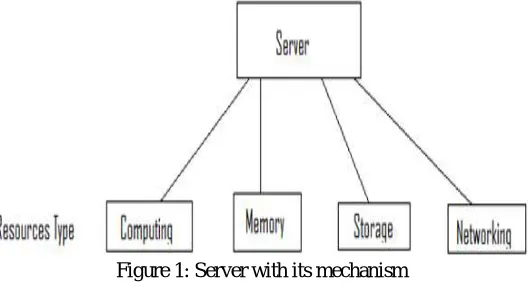
ABSTRACT: Now a days, data center’s energy consumption accounts for a significantly large piece of operational expenditure that are used as backend computing communications for cloud computing. Heterogeneous architecture have developed into more popular and large spread in the modern years with growing recognition of general idea processing on graphics processing units , low power systems on a chip. The design and execution of cloud computing data centers must adjust to these changes although targeting intention of improving system performance, energy efficiency and consistency. This paper presents load balancing algorithm for energy efficient resource allocation in heterogeneous system. EHEROS takes into explanation the heterogeneity of a system through decision making procedure. Servers have resources of many types (computing, memory, storage and networking) and these resources need to be optimized efficiently in heterogeneous environment.
KEYWORDS: Cloud Computing, Data Center, Energy Efficient, Load Balancing, Green Cloud Simulator.
I. INTRODUCTION
Cloud Computing is incoming our lives and considerably change the mode people parse in order. Cloud provides platforms to work which enabling a big range of terminal, devices owned by individual. Green cloud simulator is a
packet point of cloud computing which focus on communication and energy capability of cloud [
1
]. Cloud services aretypically implemented in one or additional multiple data centers where a huge number of servers are provisioned. Cloud computing has risen as a new computing example to carry unparallel elasticity and to contact shared and scalable
computing resources [
2
]. Heterogeneity is a increasing in fashion for distributed systems, including cloud computing.The increasing developed capabilities collecting with the need for high performance and high computational mass
result in increasing and specialization of hardware. [
3
]Data center are more suitable and fashionable for the provisioning of computing resources. Data center are mainly essential of the information and communication skill division organizations. Huge data center with thousands of servers have been deployed by popular ICT organizations like IBM, Microsoft, Amazon to afford cloud computing services
[
4
]. Energy consumption is a grave problem for data center. In order to reduce energy efficiency, whether in a systemor over company of systems, users and data center operators want to know the bond between resource usage and
system level power use [
5
].The energy efficiency working at data center can be classified into virtualization. Virtualization is the mainly adopted energy efficient method in data center environments. It aims to combine data center workload on an amount of physical
servers using virtual machine exists migration in order to classify and offer energy efficiency [
6
].II. ENERGY EFFICIENCY AND LOAD BALANCING IN DATA CENTER
The test of Load balancing in data center is critical and reviews a selection of the most important and agent works. [
7
]
greatest option of optimization for some applications and workflows, but it has large overheads in terms of time and
bandwidth supplies, especially in case of big system reconfiguration. [
8
]A basic strategy to treat with heterogeneous setting is to only select the main energy efficient server. It contributes to
this advancement by presenting a focused scheduler to excel in heterogeneous settings. [
9
] Simply an element of theenergy consumed by the data center gets delivered to computing servers openly. A key part of the energy is utilized to preserve interconnection links and network tools operations.
The efficient utilization of virtualized servers and computing resources requires thoughtful expenditure in energy
consumption and throughput, mainly on high-demanding High Performance Computing [HPC] platforms. [
10
]S.Saha, J.Deogun et al. [
11
] Presented energy model at server and at the network part in data center .In this paper, atthe server site temperature and voltage energy are distributed. They proposed green routing scheme for minimization of total combined energy consumption at both server and network site.
D.Kliazovich, S.U.Khan etal. [
12
] Describes energy efficiency and job scheduling which focus on job distributionbetween servers based on computational demands, but in which communication demands are ignored.
To conclude, we proposed new technique named EHEROS which combines the top features of HEROS and contributes with a new heterogeneity that creates aware decision. It tolerates any usual network topology as it operates on the rack stage. Still, the network load is objective amongst various racks. To maximize ease energy consumption, server
selection job promotes DNS and DVFS. HEROS allocates responsibilities to the server with maximum attain. [
13
]III. EHEROS- ENHANCED HETEROGENEOUS ENERGY EFFICIENT RESOURCE ALLOCATION OPTIMIZING SCHEDULER
In previous HEROS algorithm, it comprises complete experimentation with non regular task size and task generation patterns and simulations of additional complex virtualized work. HEROS might be improved by extension of the position of optimized objectives, integration of extra data sources and substitute of information by scheduler in a particular data center. HEROS could allow success of scalable and dynamic workflow portion in cloud system.
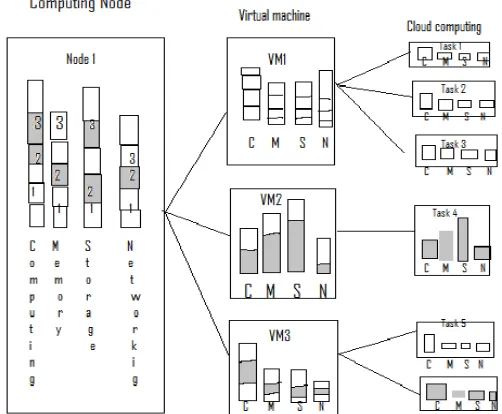
Figure 2: Resource allocation lying on a join with heterogeneous resources
A . Binary search algorithm
Binary search algorithm is well identified as half interval search is a search algorithm that finds the location of a target value, whether only or part of a proof within a sorted array. Among slight extra gap , binary search runs in at worst logarithm time creation O[log n] where n is the number of elements in an array and log is the binary logarithm.
Binary search simply works on sorted arrays . Binary search begins by comparing the center element of the array with the goal value. If the goal value matches the center element its location in the array is returned. If the goal value is less or more than the center element the search continues the minor or high half of the array correspondingly with a new center element , eliminating the other half from kindness .[14]
B. Three tier architecture
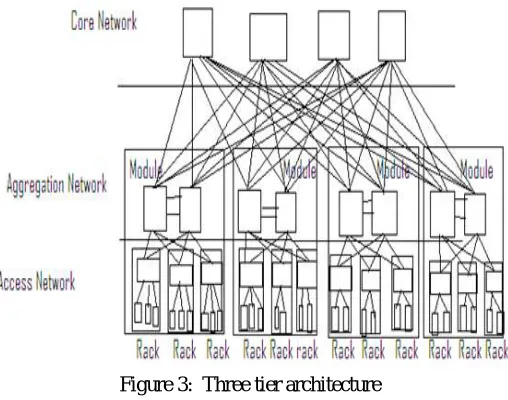
Figure 3: Three tier architecture
IV. EXPERIMENTS
A. Green cloud simulator
Green cloud is a fine identified simulation tool which offers fine-grained simulation of new cloud computing environments focusing on data center communications and energy efficiency[16]. Green cloud is based on ns-2 simulation platform[17]. It appears as exhaustive modeling of the energy consumed next to the element of the data center, such as computing server , switches , and network links . It also locates tools in the form of energy efficient metrics[18]. Green cloud wires have conventional three tier data center architecture as well as new data center architectures such as D Cell, B Cube, D Pillar. The three tier architecture used in this study consists of the topmost core tier, the aggregation tier that is responsible for routing and the access tier to hold the group of computing servers set into racks. The Green cloud simulator was complete with functionalities compulsory to model heterogeneous servers to allow the performance of the proposed scheduler[19].
B. Results of simulations
Table I. Three tier configurations
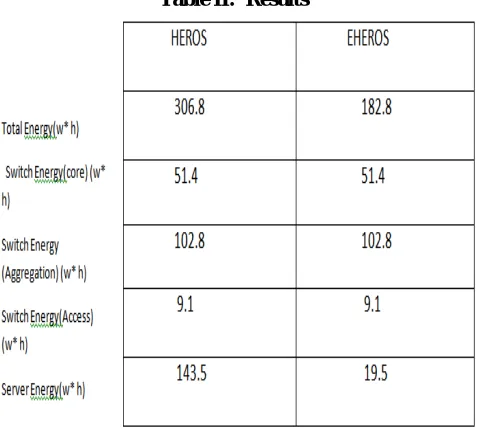
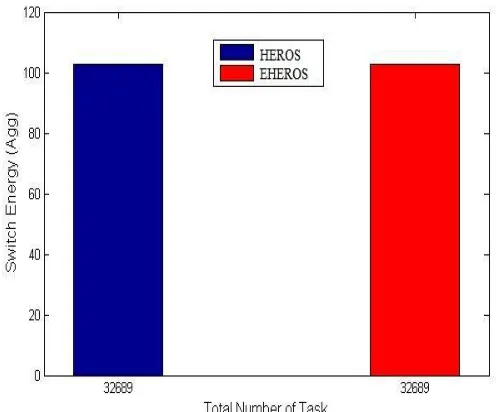
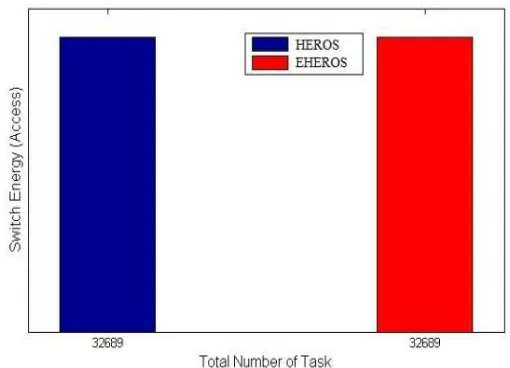
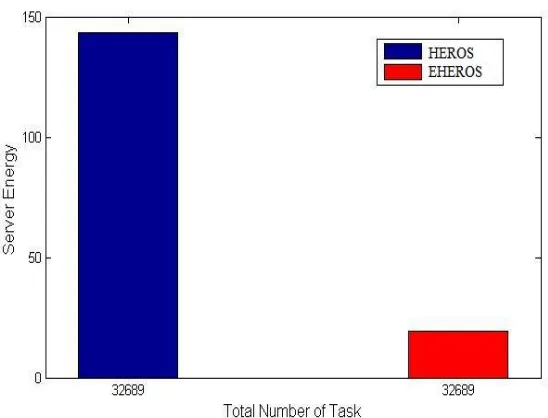
The mean value allocation as value indicators is described in Table I while having the equivalent relative values. Each relative value is computed as the ratio of charge for a scheduler .The key aim for judgment of schedulers are server energy consumption and mean response time, both of these objectives should be minimized. Additionally, it is advantageous if the response time is low.
Table II: Results
Figure 3: Calculating the Total energy of EHEROS algorithm
Figure 5.Calculating the core switch energy of EHEROS algorithm
Figure 6: Calculating the Access switch energy of EHEROS algorithm
Figure 7: Calculating the Server energy of EHEROS algorithm
V. CONCLUSION AND FUTURE SCOPE
The novel EHEROS scheduler is an expansion of the state-of-art network and energy aware schedulers. EHEROS is particularly intended to operate in heterogeneous systems. It is based on the aggregation of utilization and network links. EHEROS is implemented in the green cloud simulator, proving its affectivity in connection with position scheduling approaches in heterogeneous systems somewhere it saves up to 72% of server’s energy .The result of EHEROS, affectively simplifies explanation of heterogeneous servers. It also normalizes capacities and power functions of servers, creative the scheduler extensible and adaptive to novel settings.
[8]D.Li, J.Wu, Z.Liu, and F.Zhang, "Joint power optimization through vm placement and flow scheduling in data center," in IEEE International Performance Computing and Communications Conference, pp. 1-8, 2014.
[9]N.Liu, Z.Dong, and R.Rojs-Cessa, "Task scheduling and server provisioning for energy efficient cloud computing data centers," in IEEE International Conference on Distributed Computing Systems Workshops, pp. 226-231,2013.
[10]M.Guzek, S.Varrette, V.Plugaru, J.E.Pecero, and P.Bouvry, "A holistic model of the performance and the energy efficiency of hypervisors in a high-performance computing enviornment," Concurrency and Computation:Practice and Experience, vol. 26, no. 15, pp. 2569-2590, 2014.
[11]S.Saha, J.Deogun, and L.Xu, "Energy models driven green routing for data centers ," in IEEE Global Communications Conference, pp. 2529-2534, 2012.
[12]D.Kliazovich, S.T.Arzo, F.Granelli, P.Bouvry, and S.U.Khan, "e-STAB:Energy-efficient scheduling for cloud computing applications with traffic load balancing ," in IEEE International Conference on Green Computing and Communications, pp. 7-13, 2013.
[13]Mateusz Guzek, Dzmitry Kliazovich, and Pascal Bouvry, "HEROS:Energy-Efficient Load Balancing for Heterogeneous Data Centers," in IEEE International Conference on Cloud Computing, pp. 742-749, 2015.
[14]"https://en.wikipedia.org/wiki/Binary_search_algorithm,". [15]"Cisco:Cisco data center infrastructure 2.5 design guide," , 2007.
[16]D.Kliazovich, P.Bouvry, U.Khan, and Samee, "Greencloud:A packet-level simulator of energy-aware cloud computing data center," The Journal of Supercomputing, vol. 62, pp. 1263-1283, 2012.
[17]S.McCanne and S.Floyd, "The network simulator-ns2.".
[18]C.Fiandrino, D.Kliazovich, P.Bouvry, and A.Zomaya, "Performance and energy efficiency metrics for communicationsystemsof cloud computing data centers," in IEEE Transactions on cloud computing, 2015, pp. 1-1.
[19]M.Guzek, S.Varrette, V.Plugaru, J.E.Pecero, and P.Bouvry, "A holistic model of the performance and energy efficient of hypervisors in a high performance computing enviornment," Concurrency and Computation, vol. 26, no. 15, pp. 2569-2590, 2014.
[20] "http://whatis.techtarget.com/definition/dynamic-voltage-and-frequency-scaling-DVFS".
BIOGRAPHY
Jaspreet Kaur is currently pursuing M.tech degree in Computer Science and Engineering at Sri Guru Granth Sahib World University, Punjab, India. Her areas of interest in research are cloud computing and networking.