S-boxes
Sebastian Kutzner1, Phuong Ha Nguyen2, Axel Poschmann2 and Huaxiong Wang2.
1
Laboratory of Physical Analysis & Cryptographic Engineering (PACE) Temasek Laboratories @ NTU.
2
Division of Mathematical Sciences, School of Physical and Mathematical Sciences
Nanyang Technological University, Singapore
Abstract. One of the most promising lightweight hardware counter-measures against SCA attacks is the so-called Threshold Implementation (TI) [12] countermeasure. In this work we resolve many of the remaining open issues towards it’s applicability. In particular, our contribution is three-fold: first we define which optimal (from a cryptographic point of view) S-boxes can be implemented with a 3-share TI. Second, we intro-duce two methodologies to efficiently implement these S-boxes. Third, as an example, we successfully apply these methodologies to PRESENT and are able to decrease the area requirements of its protected S-box by 57%.
1
Introduction
Side Channel Attacks (SCA) [6] were introduced in 1997 by Kocheret al.and ex-ploit the fact that while a device is processing data, information about this data is leaked through different channels, e.g., power consumption, electromagnetic emanation and so forth. DPA [7] is a well known technique analyzing many mea-surements. It exploits the correlation between intermediate results, which partly depend on a secret, and the power consumption.
Several countermeasures (far too many to address all of them) have been proposed during the last years, for example, to increase the SNR ratio [10], to balance the leakage of different values [9] or to break the link between the pro-cessed data and the secret, i.e., masking [10]. Due to the presence of glitches masked implementation might still be vulnerable to DPA [10]. A recent counter-measure against DPA was introduced in 2006 by Nikovaet.al.[11] and is called
Threshold Implementation (TI). It is based on secret sharing (or multi-party computation) techniques and is provable secure against first order DPA even in the presence of glitches. Furthermore, it can be implemented very efficiently in hardware [13].
more shares are required and the larger is the implementation. Since a degree of two is the minimal degree of a non-linear function, the optimal number of shares is three. Therefore, to apply a 3-share Threshold Implementation to a larger degree function, this function must be represented as a composition of quadratic functions [13].
In this work we focus on 3-share Threshold Implementations of optimal 4-bit S-boxes. These S-boxes were defined in [8] and fulfill certain cryptographic prop-erties which make them secure against cryptanalytic attacks. First we answer the question which of these optimal S-boxes can be protected using only 3-shares1. Second, we introduce two methodologies to efficiently implement these S-boxes in a 3-share TI scenario. We successfully apply these methodologies to the PRESENT S-box resulting in the smallest protected implementation known so far. Last, we investigate the security of our new design by practical mea-surements. During those investigations we develop a new attack model and, to the best of our knowledge, for the first time use the sum of square t-differences (SOST) [4] as a new distinguisher.
The remainder of this work is organized as follows. First we proof an open conjecture and recall important definitions in Section 2. Subsequently in Sec-tion 3, we introduce two new methodologies that allow to significantly reduce the area requirements of all TI S-boxes using the PRESENT S-box as an exam-ple. Section 4 describes the optimized hardware implementation of TI-PRESENT and its experimental analysis is performed in Section 5. Finally, Section 6 con-cludes the paper.
2
Decomposability of 4-bit S-boxes
The 3-share Threshold countermeasure can only be applied to permutations with a maximum degree of two [11,12]. Therefore, the decomposability of cubic 4-bit S-boxes into a composition of several quadratic vectorial boolean functions plays an important role when implementing the 3-share Threshold countermeasure. For example, in [13] the authors decompose the cubic PRESENT S-box into two quadratic vectorial boolean functionF(·) andG(·) in order to apply the 3-share Threshold countermeasure.
In this section we prove the Nikova’s conjecture presented at the poster ses-sion of CHES 2010. There the authors conjecture that any decomposable 4-bit S-box/permutation must belong to A16, i.e., the alternating group of the 4-bit symmetric groupS16. A 4-bit S-box/permutation is considered as decomposable if and only if it can be written as a composition of several quadratic vectorial boolean functions. We recall some properties of a permutation inS16.
Lemma 1. A16 is a subgroup ofS16, i.e., ifp1(·)andp2(·)are permutations in
A16, then the resulting permutation of their composition p3(·) =p1(p2(·)) must be in A16 as well.
Lemma 2. All linear and quadratic permutations inS16 are in A16.
Proof. In [13], the authors state that there are around 226 quadratic
permuta-tions. Since the number of linear and quadratic permutations is not big, we can check the parity of all these permutations. If a permutation has a parity of +1, it belongs toA16.
All parities of the considered permutations are +1. Hence, all these permu-tations belong to A16.
Theorem 1. If a permutationp(·)can be written as a composition of quadratic permutations, then p(·) is inA16.
Proof. The theorem is directly derived from the lemma 1 and lemma 2.
Corollary 1. Theorem 1 implies that if a cubic permutation does not belong to
A16, it can not be written as a composition of several quadratic permutations.
Note 1. The composition of a quadratic permutation and a linear permutation is again a quadratic permutation. Hence, a quadratic permutation is able to be decomposed in a composition of linear and quadratic permutations. This fact will be used for our improvement of the hardware implementation of the PRESENT S-box in the next sections.
Optimal and Decomposable 4-bit S-boxes An S-box is considered as opti-mal if it fulfills the following requirements [8]:
Definition 1. LetS:F42→F24be an S-box. IfS fulfills the following conditions we call S an optimal S-box:
1. S is a bijection, 2. Lin(S)= 8, 3. Diff(S) = 4,
where Lin(S) and Diff(S) denote the linearity and differentiality of S-box S. The reader is referred to [8] for more detail on definitions of Lin(S) and Diff(S).
Definition 2. Two S-boxesS(x), S0(x)are linearly equivalent iff there exist two
4×4-bit invertible matrices A, B and two 4-bit vector c, dsuch that
S0(x) =A(S(Bx⊕c)⊕d),∀x∈ {0, . . . ,15}
Optimal S-boxes attract our attention due to their importance in designing cryptographic ciphers. An arbitrary optimal S-box always belongs to a certain class. In [8], the authors define 16 classes of linearly equivalent S-boxes in S16. Each class can be represented by using one its S-box which is called representa-tive of class.
Based on Note 1, if the representative of a considered class is decomposable, then all S-boxes in this class are decomposable as well, i.e., they belong toA16. Checking the parity of the permutation of all class representatives reveals that exactly 8 classes (50%) are decomposable (see Table 1).
Table 1. Decomposability of S-box classes. Decomposable 0 1 2 4 5 7 8 13 Not decomposable 3 6 9 10 11 12 14 15
3
One S-box for all
In this section, we introduce a new methodology to improve the hardware imple-mentation costs of the Threshold countermeasure. To illustrate our contribution we chose PRESENT as an example. Figure 1 shows how to apply the Threshold countermeasure to a 4-bit S-box: first it is decomposed into two stages G and F (horizontal), then each stage is shared (vertical). Figure 1 also shows that in [13] the authors implemented F and G using six different 8×4 vectorial Boolean functions f1, f2, . . . ,g3. In the following we will show how to implement the same functionality with onlyone 8×4 vectorial Boolean function, this way significantly reducing the area/memory requirements of the S-box.
4 g3
g2
g1 y3
y2
y1
f1
f2
f3 4
4
4
4
4 4
4
4
S2
S3 S1
G F
4 4 4
S
4 4
Fig. 1.Decomposition of an S-box [13]
3.1 The Horizontal Level
In order to apply the 3-share Threshold countermeasure to a cubic S-box S(·), in the first step the S-box is decomposed into a composition of two quadratic permutations F(·) andG(·) (see Figure 1).
Lemma 3. Assume a vectorial boolean function S(·) =G(G(·)), where G(·)is a vectorial boolean function. Then the hardware implementation of S(·) can be reduced by reusing the implementation ofG(·).
The main problem of Lemma 3 is how to find aG(x) such thatG(G(x)) lies in the desired class, e.g., class 1 for the PRESENT S-box. We discovered that the only classes reachable by the construction G(G(x)) are 0, 1, 2 and 8. For class 1 we found the following quadraticG(x) such thatS0(·) =G(G(·)).
x 0 1 2 3 4 5 6 7 8 9 A B C D E F G(x) 0 4 1 5 2 F B 6 8 C 9 D E 3 7 A G(G(x)) 0 2 4 F 1 A D B 8 E C 3 7 5 6 9 The ANF ofG(x, y, z, w) = (g3, g2, g1, g0) is as follows:
g3=x+yz+yw g2=w+xy g1=y g0=z+yw
Using Definition 2 we know that the S-box of PRESENT S(·) is linearly equivalent to the foundS0(·) =G(G(·)), i.e
S(x) =A(S0(Bx⊕c)⊕d) =A(G(G(Bx⊕c))⊕d),∀x∈ {0, . . . ,15}. It can be constructed with the following 4×4-bit matrices A, B and 4-bit constantsc,d:
A=
1 0 1 0 0 1 0 0 1 0 0 0 1 0 1 1
, B=
1 1 0 0 0 1 1 0 0 0 1 0 0 1 0 1
, (1)
canddare (0001)2= 1 and (0101)2= 5, respectively.
3.2 The Vertical Level
In the second step G(·) has to be divided into three 8×4 vectorial Boolean functionsG1(·),G2(·) andG3(·). In practice, all these vectorial boolean functions are implemented separately. We can reduce the implementation costs by using the following lemma:
Lemma 4. The hardware templates of the vectorial boolean functions of G(·)
are the same except for the indices of the inputs and the existence of constants.
G1(x2, y2, z2, w2, x3, y3, z3, w3) = (g13, g12, g11, g10)
g13=x2+y2z2+y2z3+y3z2+y2w2+y2w3+y3w2 g12=w2+x2y2+x2y3+x3y2
g11=y2
g10=z2+y2w2+y2w3+y3w2 G2(x1, y1, z1, w1, x3, y3, z3, w3) = (g23, g22, g21, g20)
g23=x3+y3z3+y1z3+y3z1+y3w3+y1w3+y3w1 g22=w3+x3y3+x1y3+x3y1
g21=y3
g20=z3+y3w3+y1w3+y3w1 G3(x1, y1, z1, w1, x2, y2, z2, w2) = (g33, g32, g31, g30)
g33=x1+y1z1+y1z2+y2z1+y1w1+y1w2+y2w1 g32=w1+x1y1+x1y2+x2y1
g31=y1
g30=z1+y1w1+y1w2+y2w1
Therefore, we only need to implementG1(·) and then reuse it forG2(·) and G3(·) by arranging the inputs appropriately.
Note that this technique can be applied not only for this special case but also in general whenever a function is shared. For example, let’s take a look at the implementation presented in [13], stating the following ANFs forG1,G2and G3:
G1(x2, y2, z2, w2, x3, y3, z3, w3) = (g13, g12, g11, g10) g13=y2+z2+w2
g12= 1 +y2+z2
g11= 1 +x2+z2+y2w2+y2w3+y3w2+z2w2+z2w3+z3w2
g10= 1 +w2+x2y2+x2y3+x3y2+x2z2+x2z3+x3z2+y2z2+y2z3+y3z2 G2(x1, y1, z1, w1, x3, y3, z3, w3) = (g23, g22, g21, g20)
g23=y3+z3+w3 g22=y3+z3
g21=x3+z3+y3w3+y1w3+y3w1+z3w3+z1w3+z3w1
g20=w3+x3y3+x1y3+x3y1+x3z3+x1z3+x3z1+y3z3+y1z3+y3z1 G3(x1, y1, z1, w1, x2, y2, z2, w2) = (g33, g32, g31, g30)
g33=y1+z1+w1 g32=y1+z1
g31=x1+z1+y1w1+y1w2+y2w1+z1w1+z1w2+z2w1
As one can see, our trick can also be applied to this implementation by han-dling the constants separately asgi0, gi1, gi2, gi3 comprise of similar monomials with different indices. Alternatively, it is possible to use correction terms, i.e., add the constant 1 tog22, g21, g20andg32, g31, g30such that the template of the terms match again.
4
Hardware Implementation
In the last sections we have described how to optimize the decomposition of cubic 4×4 S-boxes using the PRESENT S-box as an example. In this section we will describe an exemplary hardware implementation of PRESENT protected with the TI countermeasure with a shared data path and an unshared Keysched-ule that is similar to profile 2 described in [13]. First we introduce the design flow used before we detail the hardware architectures and finally summarize the implementation results.
4.1 Design flow
For the hardware implementation inVHDL, we used the Boolean minimization tool BOOM II[1,2] to obtain the four ANFs of G. For functional simulation we usedMentor Graphics ModelSimXE 6.4bandSynopsys DesignCompiler version
E-2010.12-SP2 was used to synthesize the designs to theVirtual Silicon (VST) standard cell libraryUMCL18G212T3, which is based on theUMC L180 0.18µm 1P6M logic process and has a typical voltage of 1.8 Volt [14]. We usedSynopsys Power Compiler version E-2010.12-SP2 to estimate the power consumption of our ASIC implementations. For synthesis and for power estimation we advised the compiler to keep the hierarchy and use a clock frequency of 100 KHz. Note that the wire-load model used, though it is the smallest available for this library, still simulates the typical wire-load of a circuit with a size of around 10,000 GE. We provide the power figures for information only and would like to highlight that it is not possible to compare them across different technologies.
4.2 Architecture and Design
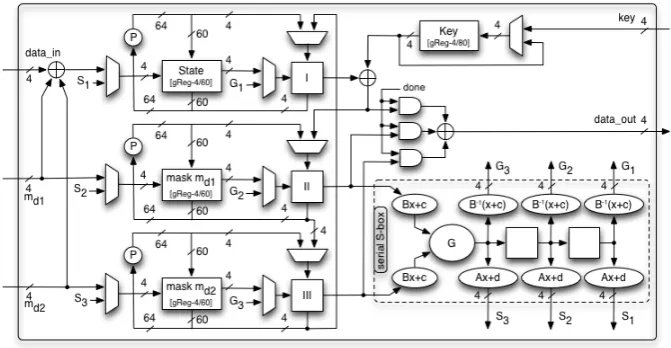
the 4-bit wide register and is transformed by the P-layer of PRESENT. TheKey
module stores the key state and performs the PRESENT keyschedule.
TheS-boxmodule comprises of onlyone 8×4 vectorial Boolean function G (47 GE) that is used for all three shares and for both staged instead ofsix as used in [13]. Recall, that we implement the PRESENT S-box S(x) as S(x) = A(G(G(Bx⊕c))⊕d). Therefore, the inputs toGare transformed byBx+c(two times 7 GE) and its output is temporarily stored for two clock cycles in two consecutive 4-bit flip-flops (48 GE) until all three shares have been computed. Since, for the second stage, we do not need to process the input toGbyBx+c, we transform all three shares by B−1(x+c) (21 GE)2 and store them in
I, II
andIII. After the second stage is completed, the three shares are transformed byAx+d(18 GE) and stored in the shift registersState,md1 andmd2, which are shifting horizontally, and the new 4-bit nibbles are ready to be processed.
Fig. 2.Architecture of a serialized TI-PRESENT-80 using our new optimization techniques.
TheFSMmodule comprises of one initial state, six states for the S-box, one state for the permutation layer that is used instead of the sixth S-box state at the end of each round, a finished state that sets the done signal to high, and a done state. The output is gated by an AND-gate that only lets data pass to the final output XOR after 31 rounds have been processed.
It takes in total 6∗16 = 96 clock cycles for one round, hence the output is ready after 2976 clock cycles. During the 16 clock cycles required to output the 2 Compared to using two MUXes (19 GE), this approach has the advantage of a
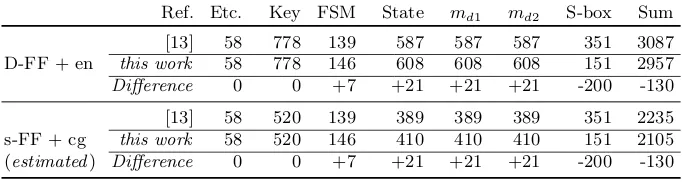
Table 2. Breakdown comparison of the post-synthesis implementation results of a serialized PRESENT-80 are shown in the upper half using D-flip-flops with enable (D-FF + en). The lower half shows estimated figures using scan-flip-flops and clock gating (s-FF + cg). All figures are Gate Equivalents (GE)
Ref. Etc. Key FSM State md1 md2 S-box Sum
D-FF + en
[13] 58 778 139 587 587 587 351 3087
this work 58 778 146 608 608 608 151 2957
Difference 0 0 +7 +21 +21 +21 -200 -130
s-FF + cg
[13] 58 520 139 389 389 389 351 2235
this work 58 520 146 410 410 410 151 2105 (estimated) Difference 0 0 +7 +21 +21 +21 -200 -130
result nibble-wise, the next message and key can be loaded, which takes 20 clock cycles. Thus in total our architecture requires 2996 clock cycles to process one message, compared to 578 clock cycles reported in [13].
4.3 Performance figures
Our main goal is to investigate the savings that one can achieve using our new optimization technique, hence we compare our core to profile 2 as published in [13]. However, there the authors use a combination of clock-gating and scan-flip-flops, which results in storing costs of 6 GE per bit (plus a negligible overhead for clock gating logic). For ASIC prototyping it is sometimes not desirable to use clock gating, thus we decided to use D-flip-flops with enable signal, which results in storage costs of 9 GE per bit.
In order to have a fairer comparison between our results and [13], we also report post-synthesis figures for a modified variant of their source code where we replaced the clock gating and scan-flip-flops with D-flip-flops with enable (9 GE). The upper half of Table 2 shows these post-synthesis results. We have also estimated the area requirements of our implementation using 6 GE scan-flip-flops in combination with clock gating. This is shown in the lower half of Table 2.
Please note that the area of 387 GE for theS-box module in [13] comprises of both the shared S-box (359 GE) for the data path and the unshared S-box (28 GE) for the keyschedule. Thanks to a more optimized ANF [5] the unshared PRESENT S-box we used only takes 22 GE, and since the unshared S-box is only used in theKeySchedule module we account it’s area share there. We have also taken into account that our post-synthesis results of theS-box,FSMand the top level glue logic (etc.) are smaller than the ones reported in [13] and estimated the figures accordingly.
by 21 GE each. TheS-box module is 57% smaller than the one reported in [13] yielding area savings of 200 GE. using our new approach in total it is possible to save 130 GE.
5
Experimental Results
In order to evaluate the security of our new approach, we analyzed power con-sumption traces obtained from SASEBO G-II. In the next subsection the mea-surement setup is introduced and subsequently the results of different DPA ex-periments are shown and compared to the results of [13]. In addition, we utilize additional techniques to investigate possible first order leakage. In the end we revisit the idea of Wagner et al. [15] which describes an attack targeting counter-measures where the masks and the masked state are processed simultaneously as it is usually the case for Threshold implementations.
5.1 Measurement Setup
The SASEBO G-II hosts two FPGAs, i.e., one control FPGA (Xilinx XC3S400A-4FTG256, Spartan-3A series) and one cryptographic FPGA (Xilinx XC5VLX50-1FFG324, Virtex-5 series) which is decoupled from the rest of the board to minimize electronic noise from surrounding components. It is supplied with a voltage of 1V by an external stabilized power supply as well as with a 3MHz clock (24 MHz on-board clock oscillator utilizing a clock divider of 8). The power consumption is measured over a 1Ωresistor inserted in the VDD line by using a differential probe. All power traces are collected with a LeCroy WR610Zi-s-32 at a sampling rate of 1GS/s.
5.2 Side-channel Resistance
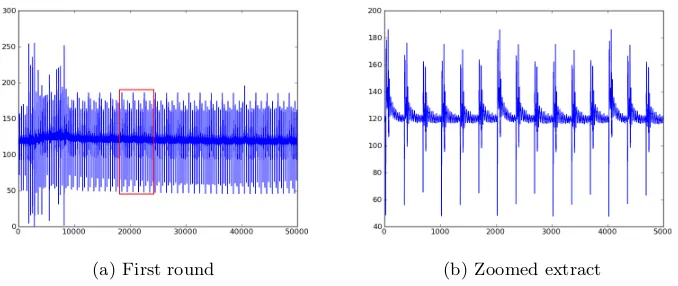
Figure 3 shows an exemplary power trace of the first round of an encryption run as well as a zoomed extract. The high peaks in the power consumption at the left of Figure 3(a) are caused by the loading of the plaintext and key to the cryptographic FPGA. The encryption starts at sample 8500 - for our analyses we omit these first 8500 samples. In Figure 3(b) one can clearly identify the peaks in the power consumption for every single clock cycle (300 samples between the peaks equals 3 MHz).
(a) First round (b) Zoomed extract
Fig. 3.Exemplary power trace
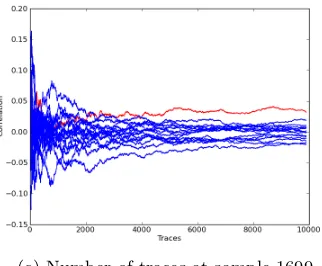
(3 shares * 4-bit S-box output) are updated simultaneously. Figure 4 shows the correlation results using the old model introduced in [13] and our new model. Using the old model one can nicely determine the 15 peaks representing the 15 updates of the state, i.e., the 15 shift operations, but the correlation coefficient is approximately five times lower than the one attacking the intermediate values between two S-box stages. The correct key guess becomes distinguishable after approximately 4,000 measurements.
Next, we measured 5,000,000 traces. As in [13] we considered three different attack models for the DPA attack: HW of the S-box input, HW of the S-box output and the HD between two subsequent states. In addition we also con-sidered our new model attacking the intermediate value between S-box stages. All attacks were performed nibble-wise, i.e., 16 key guesses had to be analyzed. Figure 5 shows the results of the DPA attack for the four models. As can be seen - and as expected - none of the attack models reveals the correct key nibble.
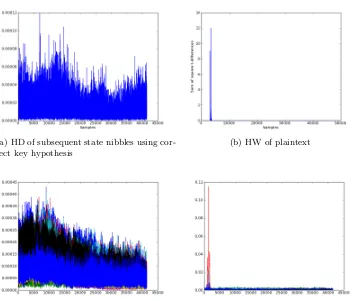
As mentioned in the introduction we want to extend our DPA analysis by utilizing additional measures to detect first-order leakage. We try to utilize the sum of square t-differences (SOST) introduced in [4]. Originally it was used to find points which contain the most information according to the chosen model in a template attack profiling phase. Here, we use it to see if there are any points containing any information (with a known key). The main advantage of SOST is, comparable to MIA [3], that it does not require a linear dependency between the attack model and the power consumption contrary to, e.g., the Pearson correlation coefficient.
(a) HD of subsequent state nibbles (b) HD of intermediate S-box outputs
(c) Number of traces at sample 1699
(a) HW of the S-box output (b) HD of subsequent state nibbles
(c) HW of S-box input (d) HD of intermediate S-box outputs
the results but as can be seen, there are no clear peaks indicating the correct key guess. To show that the idea indeed works and to highlight the strength of SOST as distinguisher we attacked the intermediate state with known masks using 200,000 measurements as in Figure 4. Figure 6(d) shows the result of this attack and as can be seen, the correct key hypothesis can be clearly identified and the relative difference between the highest and the second highest peak is much bigger than using the Pearson correlation coefficient. Hence, we think that in future work it is worth to evaluate the strength of SOST in more detail.
(a) HD of subsequent state nibbles using cor-rect key hypothesis
(b) HW of plaintext
(c) DPA attack using SOST as distinguisher, correct hypothesis in red
(d) DPA attack using SOST as distinguisher, correct hypothesis in red, known masks
Fig. 6.Results using the sum of square t-differences
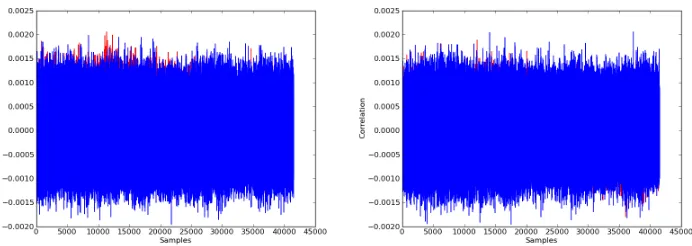
implementations should be susceptible to this attack. Therefore, we took the previously measured 5,000,000 traces and performed the Zero-offset attack. Fig-ure 7 shows the results of this attack using the before mentioned Hamming distance model. As we can see in 7 there are some red correlation peaks repre-senting the correct key hypothesis rise above the rest. But repeating the attack for the second and third key nibble showed that the correct hypothesis cannot be distinguished. We repeated the attack using different models, i.e., targeting the intermediate state and using the Hamming weight, but none of the attacks worked. Simulations finally showed that the Zero-offset attack, i.e., squaring the power consumption, does not work with Threshold implementations. Future work will be done in this direction to find more suitable preprocessing functions.
(a) HD of subsequent state nibbles, key byte 1
(b) HD of subsequent state nibbles, key byte 2
Fig. 7.DPA results of the Zero-offset attack
6
Conclusion
In this paper we have proven that all optimal S-boxes which can be protected by the 3-share Threshold countermeasure belong toA16. Furthermore, we intro-duced two methodologies to efficiently implement these S-boxes in a TI scenario. Applying these methodologies to the PRESENT S-box we were able to reduce its area requirement by 57% (130 GE), resulting in the smallest implementation of a protected PRESENT so far (2105 GE). Finally, we have proven the security of our new design by practical experiments.
References
1. P. Fiˇser and J. Hlaviˇcka. BOOM - A Heuristic Boolean Minimizer.Computers and Informatics, 22(1):19–51, 2003.
2. P. Fiˇser and J. Hlaviˇcka. Two-Level Boolean Minimizer BOOM-II. InProceedings of 6th Int. Workshop on Boolean Problems – IWSBP’04, pages 221–228, 2004. 3. Benedikt Gierlichs, Lejla Batina, Pim Tuyls, and Bart Preneel. Mutual Information
Analysis. InCHES 2008, volume 5154 ofLNCS, pages 426–442. Springer, 2008. 4. Benedikt Gierlichs, Kerstin Lemke-Rust, and Christof Paar. Templates vs.
stochas-tic methods. InProceedings of the 8th international conference on Cryptographic Hardware and Embedded Systems, CHES’06, pages 15–29, Berlin, Heidelberg, 2006. Springer-Verlag.
5. Jian Guo, Thomas Peyrin, Axel Poschmann, and Matthew J. B. Robshaw. The led block cipher. InCHES, pages 326–341, 2011.
6. Paul C. Kocher. Timing attacks on implementations of diffie-hellman, rsa, dss, and other systems. pages 104–113. Springer-Verlag, 1996.
7. Paul C. Kocher, Joshua Jaffe, and Benjamin Jun. Differential power analysis. In
Proceedings of the 19th Annual International Cryptology Conference on Advances in Cryptology, CRYPTO ’99, pages 388–397, London, UK, UK, 1999. Springer-Verlag.
8. G. Leander and A. Poschmann. On the classification of 4 bit s-boxes. InProceedings of the 1st international workshop on Arithmetic of Finite Fields, WAIFI ’07, pages 159–176, Berlin, Heidelberg, 2007. Springer-Verlag.
9. Stefan Mangard. Masked dual-rail pre-charge logic: Dpa-resistance without routing constraints. InSystems CHES 2005, 7th International Workshop, pages 172–186. Springer, 2005.
10. Stefan Mangard, Elisabeth Oswald, and Thomas Popp. Power Analysis Attacks: Revealing the Secrets of Smart Cards (Advances in Information Security). Springer-Verlag New York, Inc., Secaucus, NJ, USA, 2007.
11. Svetla Nikova, Christian Rechberger, and Vincent Rijmen. Threshold implemen-tations against side-channel attacks and glitches. In Peng Ning, Sihan Qing, and Ninghui Li, editors, ICICS, volume 4307 of Lecture Notes in Computer Science, pages 529–545. Springer, 2006.
12. Svetla Nikova, Vincent Rijmen, and Martin Schl¨affer. Secure hardware implemen-tation of nonlinear functions in the presence of glitches. Journal of Cryptology, October 2010.
13. Axel Poschmann, Amir Moradi, Khoongming Khoo, Chu-Wee Lim, Huaxiong Wang, and San Ling. Side-channel resistant crypto for less than 2,300 ge. J. Cryptol., 24(2):322–345, April 2011.
14. Virtual Silicon Inc. 0.18 µm VIP Standard Cell Library Tape Out Ready, Part Number: UMCL18G212T3, Process: UMC Logic 0.18µm Generic II Technology: 0.18µm, July 2004.
![Fig. 1. Decomposition of an S-box [13]](https://thumb-us.123doks.com/thumbv2/123dok_us/7886609.1308569/4.595.136.477.354.442/fig-decomposition-of-an-s-box.webp)