On Reverse-Engineering S-Boxes with Hidden Design
Criteria or Structure
Alex Biryukov and Léo Perrin
[email protected], [email protected] University of Luxembourg, SnT
Abstract. S-Boxes are the key components of many cryptographic primitives and designing them to improve resilience to attacks such as linear or dierential crypt-analysis is well understood. In this paper, we investigate techniques that can be used to reverse-engineer S-box design and illustrate those by studying the S-BoxF of the Skipjack block cipher whose design process so far remained secret. We rst show that the linear properties ofF are far from random and propose a design criteria, along with an algorithm which generates S-Boxes very similar to that of Skipjack. Then we consider more general S-box decomposition problems and propose new methods for decomposing S-Boxes built from arithmetic operations or as a Feistel Network of up to 5 rounds. Finally, we develop an S-box generating algorithm which can x a large number of DDT entries to the values chosen by the designer. We demonstrate this algorithm by embedding images into the visual representation of S-box's DDT.
Keywords: S-box design criteria, Skipjack, linearity, functional decomposition prob-lem, ecient implementation
1 Introduction
Non-linearity in cryptographic primitives is usually provided by so-called S-Boxes, functions which map a few inputs bits to a few output bits and which are often specied as look-up tables. These have been a topic of intensive research since their properties are crucial for resilience of a cipher against dierential [1,2,3] and linear [4,5] attacks. Further, the structure or the method used to build the S-Box can provide other benets.
Indeed, the structure of an S-Box can be leveraged for instance to improve the imple-mentation of a primitive using it. The hash function Whirlpool [6] and the block ciphers Khazad [7], Fantomas, Robin [8] and Zorro [9] among others use 8×8 bits S-Boxes built from smaller 4×4 ones, since storing several 4×4 permutations as tables of 16 4-bits nibbles is more memory ecient than storing one8×8permutation as a table of 256 bytes. Except for implementation advantage, knowledge of the internal structure helps to produce more ecient masked implementations against side-channel attacks, a notable example here being the AES [10] with its algebraic S-box based on a power function.
In some cases the design process of an S-Box might be kept secret for the purpose of im-plementing white-box cryptography, as described e.g. in [11]. In this paper, Biryukov et al. describe a memory-hard white-box encryption scheme based on a Substitution-Permutation Network where the S-Boxes are very large and are built using a so-called ASASA or ASASASA structure where A denotes an ane layer and S a non-linear S-Box layer. Preventing an adversary from decomposing these S-Boxes into their A and S layers is at the core of the security claims for this scheme.
launch a 51% attack taking control of the mining process. Memory hard S-Boxes with hid-den structure can oer a distinct advantage in such setting since ecient implementation of the proof-of-work function may be kept secret by the owners of the currency.
Examples of algorithms for which the components are known but the rationale behind their choice is not (at least at the time of release), are the block ciphers designed by or with the help of the US National Security Agency (NSA), namely the DES [12], Skipjack [13], SIMON and SPECK [14] (the last two do not use S-Boxes though). Although the design criteria for the S-Boxes of DES were later released [15] they were kept secret for 20 years in order to hide the existence of dierential cryptanalysis, a technique only known by IBM and NSA at the time. Skipjack also uses an S-Box, denoted F, which is a permutation of
{0,1}8. However, nothing was known so far about how this S-Box was chosen.
Our Contribution Dierent methods can be used to recover the hidden structure of an S-Box. We propose that a cryptanalyst follows the strategy given below to try and decompose an unknown S-Box S:
1. Draw the "Pollock" visual representation of the LAT and DDT ofS (see Section4.
2. Check whether the linear and dierential properties ofS are compatible with a random
function/permutation (see Section2). 3. Compute the signatureσ(S)ofS.
4. Ifσ(S)is even, you may:
(a) Try an attack on SASAS [16],
(b) Try to distinguish S from a Feistel Network with XOR, using the distinguishers
in [17],
(c) If one of the Feistel Network distinguishers worked, run DecomposeFeistel(S, R,⊕) for an appropriateR (see Section3.2).
5. Regardless ofσ(S), run DecomposeFeistel(S, R,)forR∈[2,5](see Section 3.2). 6. Regardless ofσ(S), run BreakArithmetic(S)(see Section 3.1).
We study in Section 2 the seemingly average linear properties of F. After a careful
investigation and despite the fact that these properties are not impressive, we show that the probability for a random permutation of{0,1}8to have linear properties at least as good as those of F is negligible. This implies three things. First, F was not chosen uniformly at
random. Second,F is very unlikely to have been picked among random candidates according
to some criteria. Third, the method used to build it improved the linear properties. We also provide a candidate algorithm which can be used to generate S-Boxes with very similar dierential and linear properties.
In Section3 we consider a general problem of decomposition of an S-box with hidden structure and describe two algorithms which can be used to decompose S-Boxes based on: a) multiple iterations of simple arithmetic operations (for ex. like those found in a typical microprocessor) and b) Feistel Networks with up to ve independent rounds. The rst algorithm is an optimised tree-search and the second one involves a SAT-solver.
Finally, we show in Section4 how visual representations of the dierence distribution table (DDT) or the linear approximation table (LAT) of an S-Box can help a cryptographer to spot non-randomness at a glance. As a bonus, we present an algorithm which generates non-bijective S-Boxes such that large set of entries in their DDT are set according to the designer's choices. We illustrate it by embedding images in the visual representation of the S-Box's DDT.
2 Partially Reverse-Engineering the S-Box of Skipjack
2.1 Overview of the S-Box of Skipjack and Useful Denitions
an impossible dierential attack leveraging its particular round structure. Further analysis trying to discover the design criteria of Skipjack is given in [19,20].
Skipjack's specication contains and 8x8 bit bijective S-box which is called F-Table and which is given as a lookup table (we list it in the AppendixA). In order to study it we need to introduce the following concepts.
Denition 1 (Permutations Set). We denote S2n the set of all the permutations of {0,1}n.
Denition 2 (Dierence Distribution Table). Lets:{0,1}n→ {0,1}n be a function. Its dierence distribution table (DDT) is a2n×2n matrix where the number at line iand column j is
di,j= #{x∈ {0,1}n |s(x⊕i)⊕s(x) =j}.
The maximum coecient in this table (minus the rst line and column) is the dierential uniformity of swhich we denote∆(s):∆(s) = maxi>0,j>0(di,j).
Dierential cryptanalysis relies on nding dierential transitions with high probabilities, i.e. pairs(a, b)such thats(x⊕a)⊕s(x) =b has many solutions which is equivalent toda,b being high. Therefore, cryptographers usually attempt to use S-Boxesswith as low a value
of∆(s))as possible. A function dierentially 2-uniform, the best possible, is called Almost Perfect Nonlinear (APN). The existence of APN permutations of GF(2n)for evenn was only proved recently by Browning1 et al. [21] in the case n= 6, while the case n= 8 and
beyond still remains an open problem. Hence, the dierential uniformity of the S-Boxes of the AES [10] and of most modern S-Box based ciphers is equal to 4.
The distribution of the coecients in the DDT of Skipjack is summarized in Table1
along with the theoretical distribution identied in [22] for a random permutation ofGF(28). As we can see it is dierentially 12-uniform, the same as you would expect from a random permutation, which is surprising since minimizing the dierential uniformity is usually one of the corner stones of provable resilience against dierential attacks.
Table 1: Distribution of the coecients in the DDT ofF.
Coecient Number Proportion (%) inF Poisson(1/2) (%)
0 39104 60.14 60.65
2 20559 31.62 30.33
4 4855 7.467 7.582
6 686 1.055 1.264
8 69 0.106 0.158
10 5 0.008 0.016
12 2 0.003 0.002
We briey mention the linear properties ofF before studying them thoroughly in
Sec-tion2.2. In particular, we dene the Linear Approximations Table of an S-Box.
Denition 3 (Linear Approximations Table). Lets:{0,1}n→ {0,1}n be a function. Its linear approximations table (LAT) is a 2n×2n matrix where the number at linei and column j is
ci,j = #{x∈ {0,1}n | x·i=s(x)·j} −2n−1= 1 2
X
x∈{0,1}m
(−1)i·x⊕j·s(x)
1 The fact that Browning works at the NSA shows that this agency values theoretical
with "·" denoting the scalar product. The maximum absolute value of theci,jis the linearity ofs,Λ(s), whereΛ(s) = maxi>0,j>0(|ci,j|).
The quantity ci,j has dierent names in the literature. It is called bias or Imbalance of the Boolean function x 7→ i·x⊕j ·s(x) in, for example, [22]. In papers from the Boolean functions community, it is more often dened in terms of Walsh Spectrum, the Walsh Spectrum of a Boolean function being the multiset {ci,j/2}i≥0,j≥0. The maximum coecient in the LAT ofF isΛ(F) = 28and it occurs in absolute value 3 times.
For the sake of completeness, we also give the sizes of the cycles in which F can be
decomposed: 2, 10, 45, 68, 131.
2.2 The Linear Properties are Too Good to be True
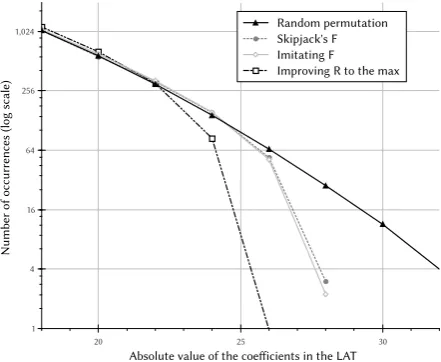
Figure 1 contains the distribution of the value of the coecients of the LAT (minus the rst line and column) along with the theoretical proportions for a random permutation of
GF(28)described below.
N
u
m
b
er
o
f
o
cc
u
rr
en
ce
s
(l
o
g
s
ca
le
)
1 4 16 64 256 1,024
Absolute value of the coefficients in the LAT
20 25 30
Random permutation Skipjack's F Imitating F Improving R to the max
Fig. 1: Coecients of the LAT of F, random permutations and some outputs of Improve-R(s).
The probability distribution for the coecientsci,jin the LAT of a permutation ofS2n is described in [23]:
P[ci,j= 2z] = 2n−1 2n−2+z
2
2n 2n−1
.
Using Section 3.4 of [22], we derived thatΛ(s)has a mean over all permutationss∈S28
of approximately 34.8which is notably larger than forF sinceΛ(F) = 28.
Given the probability distribution of the coecients of the LAT, it is easy to compute the probability thatΛ(f)≤28assuming that f is a permutation chosen uniformly at random
and that the coecients' values correspond to independent sample of the same distribution. Note that there are only(28−1)2 such trials because the rst line and column are ignored here.
P[Λ(f)≤28] = 14
X
j=−14
P[ci,j= 2j])
(28−1)2
This probability is low but it would be feasible to generate a set of about226 random permutations from S28 and compute the LAT for each of them. In such a set, the best
S-Box s should verify Λ(s) = 28. However, we must also take into account that in order to resist linear cryptanalysis it is not only best to have a low maximum value, it is also better to have a low number of occurrences of it. In this regard, F and its only three
occurrences of 28 could almost be considered as having a maximum value of 26 for which
P[Λ(f) = 26] = 2−66.4.
More rigorously, we compute the probability to have at mostqcoecients equal to 28 in
the LAT of a permutation picked uniformly at random fromS28. If we letp(2i) =P[ci,j= 2i], then this probability is equal toP28,q where
P28,q= q
X
j=0
h(28−1)2 j
p(28) +p(−28)j
13
X
k=−13
p(2k)
(28−1)2−j i
.
Unsurprisingly, we nd that this probability is equal to2−66.4forq= 0, i.e. the proba-bility to have Λ(s)≤26. It also converges to2−25.6 =P[Λ(s)≤28]whenq increases. For q= 3, the case of Skipjack'sF, we nd:
P28,3= 2−54.4.
The probability for a random permutation to have linear properties comparable to those of Skipjack'sF is thus at most2−54.4. Hence, we claim:
F was not chosen uniformly at random inS28,
the designers of Skipjack did not generate many random permutation to then pick the best according to some criteria as they would need to have generated at least about255 S-Boxes,
the method used to buildF improved its linear properties.
2.3 A Possible Design Criteria
We tried to create an algorithm capable of generating S-Boxes with linear and dierential properties similar to those ofF. It turns out that such an algorithm is easy to write. First,
we introduce a quantity we denoteR(f)and dene as follows:
R(f) =X `≥0
N`·2`,
where N` counts coecients with absolute value ` in the LAT of f: N` = #{ci,j ∈ (LAT off),|ci,j|=`}.
Algorithm1starts from a random permutationsofS28 and returns a new permutation s0 such thatR(s0)< R(s)and such thats0 is identical tos except for two entriesxandy
which are swapped:s0(x) =s(y)ands0(y) =s(x). It works by identifying one of the highest coecient in the LAT, removing it through swapping two entries and checking whetherR(s) was actually improved. This algorithm can be used in two dierent ways: either we keep iterating it until it reaches a point at which no swap can improveR(s)or we stop as soon as R(s)is below an arbitrary threshold.
We implemented both variants. For the second one, we stop whenR(s)<1010because
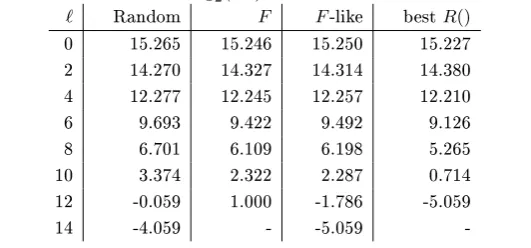
R(F) ≈109.92. We denote N` the average number of coecient with absolute value ` in the LAT or the DDT of the S-Boxes obtained. For the LAT,log2(N`)is given in Table 2 and in Figure 1; for the DDT it is in Table 3. Random corresponds to the average over 200 S-Boxes picked uniformly at random in S28; F to the distribution for the S-Box of
Algorithm 1 Improve-R(s) c:=LAT ofs
Finda, bsuch that|ca,b|=Λ(s)
L:=empty list
for allx∈ {0,1}8 do
if a·x=b·f(x)then
AppendxtoL end if
end for
for all(x, y)∈L2, x6=ydo
s0=s; s0(x) =s(y) ; s0(y) =s(x)
if R(s0)< R(s)then
returns0 end if end for return Fail
Table 2: Distribution oflog2(N`)in the LAT of dierent S-Boxes.
` Random F F-like bestR()
20 9.164 9.147 9.230 9.311
22 8.220 8.308 8.336 8.247
24 7.173 7.267 7.280 6.400
26 6.041 5.755 5.688 0.000
28 4.826 1.585 1.157
-30 3.506 - -
-32 2.146 - -
-34 0.664 - -
-whenR(s)<1010; best to the average over 100 S-Boxes obtained using Improve-R()and stopping only when it fails.
Using Improve-R()with an appropriate threshold allows us to create S-Boxes with both linear and dierential properties very close toF. However, in order to achieve this, we need
to choose a threshold value computed from F and which does not correspond to anything
specic. In fact, to the best of our knowledge, the quantityR(s)does not have any particular importance unlike for instance the linearityΛ(s). Still, replacingR(s)by the linearityΛ(s) or a pair(Λ(s),#{(i, j), ci,j=Λ(s)})yields S-Boxes which are very dierent fromF. Such S-Boxes indeed have a value ofNΛ(s)−2much higher than in the random case, which is not the case forF.
While our denition ofR(s)may seem arbitrary, it is the only one we could nd that leads to linear properties similar to those of F. For instance it may have been tempting
to base R(s) on the square of ` which is used when computing the correlation potential
of a linear trail, a quantity useful when looking for linear attacks. We would thus dene
R(s) = P
`≥0N``2. However this quantity is worthless as an optimization criteria since it is constant: Parseval's equality on the Walsh spectrum of a Boolean function imposes that the sum of the(ci,j)2 over each column is equal to22n−2.
Table 3: Distribution oflog2(N`)in the DDT of dierent S-Boxes.
` Random F F-like bestR()
0 15.265 15.246 15.250 15.227 2 14.270 14.327 14.314 14.380 4 12.277 12.245 12.257 12.210
6 9.693 9.422 9.492 9.126
8 6.701 6.109 6.198 5.265
10 3.374 2.322 2.287 0.714
12 -0.059 1.000 -1.786 -5.059
14 -4.059 - -5.059
-2.4 Public Information About the Design of Skipjack
The only information indirectly published by the NSA on Skipjack corresponds to an In-terim Report [24] written by external cryptographers and it contains no information on the specics of the design. The most relevant parts of this report as far as the S-Box is concerned are the following ones.
SKIPJACK was designed to be evaluatable [...]. In summary, SKIPJACK is based on some of NSA's best technology. Considerable care went into its design and evaluation in accordance with the care given to algorithms that protect classied data.
Furthermore, after the leakage of an alleged version of Skipjack to usenet2, Schneier replied
with a detailed analysis of the cipher [26] which contained in particular the following quote indicating that the S-box was changed in August 1992.
The only other thing I found [through documents released under FOIA] was a SECRET memo. [...] The date is 25 August 1992. [...] [P]aragraph 1 reads:
1. (U) The enclosed Informal Technical Report revises the F-table in SKIPJACK 3. No other aspect of the algorithm is changed.
Note also that the rst linear cryptanalysis of DES [4] had not been published yet in August 1992 when the F-Table was changed. Gilbert et al. suggested at CRYPTO'90 [27] to use linear equation to help with key guessing in dierential attack to attack FEAL. This block cipher was later attacked at CRYPTO'91 [28] and EUROCRYPT'92 [29] using directly some linear equations involving plaintext, ciphertext and key bits. We can but speculate about a connection between these papers and the change of S-Box of Skipjack.
3 Algorithm Decomposing Particular Structures
A powerful tool able to discard quickly some possible structures for an S-Box is its signature, as shown in Lemma 1.
Denition 4 (Permutation Signature). A permutation s of {0,1}n has an odd signa-ture if and only if it can be decomposed into an odd number of transpositions, a transposition being a function permuting two elements of {0,1}n. Otherwise, its signature is even.
The signature off◦g is even if and only iff andg have the same signature.
2 An anonymous member of sci.crypt posted what they claimed to be Skipjack at a time when
Lemma 1. The following b×bpermutations always have an even signature:
Feistel Networks using XOR to combine the output of the Feistel function with the other branch,
Substitution-Permutation Networks for which the diusion layer is linear inGF(2)b or can be decomposed into a sequence of permutations ignoring a fraction of the internal state.
Proof. Let b be the block size of the block ciphers considered. The proof for the case of
Feistel Networks with XOR can be found in [30].
Let us look at substitution permutation networks. An S-Box layer consists in the par-allel application of several invertible S-Boxes operating on nbits, with ndividingb. This
operation can be seen as the successive application of the S-Box on each nbit block, one
after another. Such an operation ignores 2b−n bits, meaning that its cycle decomposition consists in 2b−n replicas of the same set of cycles. Since 2b−n is even, the application of each S-Box is even; which in turn implies that the successive application of the S-Box on each block is even. More generally, any permutation which can be decomposed into a se-quence of sub-permutations ignoring a fraction of the internal state is even. The fact that permutations linear in GF(2)b are even is showed in the proof of Lemma 2 in [31]. ut
The restriction put on the diusion layer of SPN's is usually not important, e.g. the diusion layer of the AES ts the requirement. However, for small block sizes, it must be taken into account.
So far, we have proved that F has been built in contrast to being picked out of a set
of random S-Boxes according to some criteria. The signature of F is odd so Lemma 1
implies that F cannot be a Feistel Network with XOR. The generic attack on the SASAS
structure [16] fails onF, meaning that it is not a simple SPN either. Finally,F is not ane
equivalent to a monomial of GF(2n)like for instance the S-Box of the AES. Indeed, such functions have the same coecients in the lines of their DDT, only the order is dierent. This observation lead to the denition of the dierential spectrum by Blondeau et al. [32]. It also implies that, for a monomial, the number of coecients equal todin its DDT must
divide 2n−1. As it is not the case forF, we can also rule out this structure.
However, this is not sucient to conclude that F does not have a particular
struc-ture. It could be based on simple operations such as rotations, addition modulo 2n and multiplication available in a typical microprocessor (thus oering the designer a benet of memory-ecient implementation) or on a Feistel Network which uses modular addition to combine the output of the Feistel function with the other branch. We study these two possi-bilities in this section by rst describing an algorithm capable of decomposing S-Boxes built from multiple simple arithmetic operations and then by presenting a new attack recovering all Feistel functions of a small Feistel Network of up to 5-rounds regardless of whether XOR or modular addition is used.
The purpose of the algorithms we present in this section can be linked to the more general Functional Decomposition Problem (FDP) tackled notably over two rounds in [33]. In this paper, Faugère et. al. introduce a general algorithm capable of decomposing h= (h1, ..., hu)into f1(g1, ..., gn), ..., fu(g1, ..., gn)
where thehi's,fi's andgi's are polynomials of n variables. The time complexity of this algorithm (see Theorem 3 of [33]) is lower
bounded by O n3·(dfdg−1)whered
f (respectively dg) is the maximum algebraic degree of the fi's (respectively thegi's). Note that this lower bound on the time complexity is not tight. In fact, the ration/uof the number of input variables over the number of coordinates
3.1 Iterated Simple Arithmetic Permutation
A plausible assumptions for an ecient yet compact S-box design is that the S-box is constructed using a formula containing basic instructions available in the microprocessor. Indeed, a simple code:
for (i = 0; i < 3; i++) {
y = a * (ROTL8((b * y) ^ c, d)) ^ e; }
generates an S-box which may have a dierential uniformity better than Skipjack'sF's for
a proper choice of constantsa, b, c, dand e.
We introduce BreakArithmetic(s), an optimized tree-search capable of recovering the simple operations used to create such an S-Box constructed as an arbitrary sequence of basic processor instructions. It is based on the following observation. Suppose that s =
φr◦...◦φ1, where the φi's are one of the following algebraic operations: constant XOR, constant addition modulo 2n, multiplication by a constant modulo2n and bit rotation by a constant. Thens◦φ−11 = φr◦...◦φ1
◦φ−11 =φr◦...◦φ2, meaning that s◦φ−11 is less complex, closer from the identity than s itself. The aim of this algorithm is to peel of
theφi's one after another by performing a tree-search among all possible simple operations which selects operations to consider rst based on how closer they get us to the identity.
In order for this to work, we need to capture the concept of distance to the identity using an actual metric which can be implemented eciently. We chose to base this metric on the DDT since it is less expensive to compute than the LAT3. We dene the following metric:
M(s) =P
`≥2N`(`−2)2. Our tree-search privileges candidatesφ1 such thatM(s◦φ−11 )is closer fromM(Id), where Id is the identity function.
Our implementation of this algorithm is for example capable of recovering the decom-position ofs:x7→ψ ψ ψ(x)with
ψ:x7→0xa7· (3·x⊕0x53)>>>4
⊕0x8b. However,
our algorithm could not nd any such decomposition for Skipjack's F despite running for
96 hours on a CUDA computer with more than 1000 cores for fast computation of the DDT.
3.2 Decomposing Feistel Structures
Another possible structure for F which is compatible with its having an odd signature is
a Feistel Network where the XOR is replaced by a modular addition. In this section, we describe an algorithm which uses a SAT-solver to recover the Feistel functions of small Feistel Networks which use either XOR or modular addition. We describe below the key idea of this attack, namely the encoding of the truth table of each Feistel function using Boolean variables and then how we can use this encoding to actually decompose a small Feistel Network.
Methods to distinguish Feistel Networks from random permutations have been actively investigated, notably in the work by Luby and Racko [34] as well as by Patarin [35,36]. Here, we present a method which goes beyond distinguishing: it actually recovers all the Feistel functions for up to 5-rounds of Feistel Networks with low branch width.
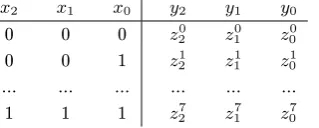
Encoding of the Feistel Function Let f :{0,1}n → {0,1}n be an unknown function. We associate to each of its output bitsion each possible inputxa unique variablezix. The
truth-table of f is thus as shown in Table4forn= 3. We encode the fact that a vector of Boolean variablesyi, i∈[0, n−1]is the output off given input variablesxi, i∈[0, n−1]
3 One can also notice that linear operations do not alter the DDT prole of the permutation and
using the truth-table off by building a CNF4involving{xi}i<n,{yi}i<nand{zix}i<n, x<2n which is true if and only if(yn−1, ..., y0) =f(xn−1, ..., x0).
x2 x1 x0 y2 y1 y0
0 0 0 z02 z01 z00
0 0 1 z1
2 z11 z01
... ... ... ... ... ... 1 1 1 z72 z71 z07
Table 4: The variables used to encode an unknown function f : {0,1}3 → {0,1}3, where (y2, y1, y0) =f(x2, x1, x0).
We denote biti(b)thei-th of the binary expansion of any integerb <2n in little-endian notation so that b =P
i<nbiti(n)2n−i. We also denote a1 the variablea itself and a0 its negation. The procedure used to build this CNF is based on the following implication: if {xi}i<ncorresponds to the binary expansion of an integerx <2nand{yi}i<nto the binary expansion of the integer y =f(x), thenyi⊕zix = 0for all i < n. Using the notations we just introduced, this idea can be written as n implications, the conjunction of which for j < nmust hold:
^
i<n
xbiti(x) i
=⇒ yj⊕zxj = 0
.
Each of these can be turned into a CNF made of two clauses using that(a =⇒ b)≡ (a0∨b1), that(a⊕b= 0)≡ (a1∨b0)∧(a0∨b1)and basic linear algebra as follows:
_
i<n
x1−biti(x) i
∨ yj1∨z0j∧ _ i<n
x1−biti(x) i
∨ yj0∨zj1.
If we concatenate the CNF generated in this way for all values ofx <2n, we obtain a CNF which we denote CNF f,{xi},{yi}
with2n2nclauses involvingn2n+ 2nvariables.
It holds if and only if the assignment of the variables {xi}i<n and {yi}i<n is such that (yn−1, ..., y0) =f(xn−1, ..., x0).
Generating the Full CNF and Solving Using CNF f,{xi},{yi}
, a SAT-solver and the full codebook of a S-Box S :{0,1}2n → {0,1}2n, we can recover the Feistel functions used to generateS if it was indeed generated using a Feistel network or prove that it was
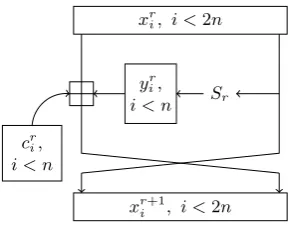
not constructed in this fashion using DecomposeFeistel(S, R,operation)(see Algorithm2). To describe it, we introduce variables{xr
i}i<2n,{yri}i<n and, if the combining function is a modular addition instead of a XOR,{cr
i}i<n forr < RwhereR is the number of rounds we consider were used. These are summarized in Figure2.
The general idea consists in building the CNF representation of the fact thatS(p) =c
for each input/output pair (p, c) separately, concatenate these CNF's and then have a SAT-solver solve the CNF obtained in this fashion. To each Feistel functions is associated a unique set of n2n variables as described in the previous section. These are used when encoding that half of the internal state at roundr+ 1of the Feistel Network goes through the corresponding Feistel function. The only diculty left is the combination of the left branch with the output of the Feistel function. In the case where a XOR is used, we can simply encode that xri+1 =yir⊕xri+n separately for each bit i. However, in the case of a 4 A formula in Conjunctive Normal Form is the conjunction of multiple clauses, each of them
xri, i <2n
xr+1
i , i <2n
Sr
yir,
i < n
cr i,
i < n
Fig. 2: The variables used to encode roundrof a Feistel Network operating on blocks of2n
bits.
modular addition, we need to introduce a new set of variables for each evaluation of the addition corresponding to the carry bits:{cr
i}i<n. The addition is then encoded into a CNF using the CNF encoding of the following equations:
xri+1=cri ⊕xri+n⊕yir, cr
i+1= cri ∧xri+n
∨ yr i ∧xri+n
∨ cr i ∧yir
.
Algorithm 2 DecomposeFeistel(S, R,operation) C:=empty CNF
for allp∈[0,2n−1]do
for allr∈[0, R−1]do
{xp,ri+n+1}i<n={xp,ri }i<n
C:=Concatenation of CNF Sr,{xp,ri }i<n,{yp,ri }
and C if operation is⊕then
Append CNF repr. of{xp,r+1
i }i<n={yp,ri }i<n⊕ {xp,ri+n}i<ntoC
else
Append CNF repr. of{xp,ri +1}i<n={yp,ri }i<n{xp,ri+n}i<ntoC
end if end for
for alli∈[0, n−1]do
Append clause only made of literal(xp,i0)biti(p)toC Append clause only made of literal(xp,Ri )biti(S(p))toC end for
end for
Run SAT-solver onC if C is satisable then
Extract truth-table of allSr's from the variable assignment
return Feistel Network withRrounds else
return Not a Feistel Network withRrounds end if
Sa. In this case, DecomposeFeistel(S, R,operation)also takes the assumed sequence of the S-Boxes as an additional input.
Another improvement comes from the observation that constants can be XOR-ed (or added/subtracted) in the input of Feistel functions in the rst R−2 rounds provided they are cancelled by XOR-ing (or adding/substracting) in the later rounds without changing the output of the function. Using this, we can arbitrarily decide that the rst Feistel functions all map, say, 0 to 0. This simplication of the CNF helps the SAT-solver a lot and is actually necessary to attack 5 independent rounds.
We implemented Algorithm 2 and used the SAT-solver Minisat [37] to solve the CNF formula generated. The time taken to decompose S-Boxes actually made of small Feistel Networks is smaller than the time taken to discard an S-Box which is not based on such a structure. Decomposing8×8 S-Boxes built using 4-rounds Feistel Networks, regardless of whether⊕oris used, takes less than a second on a regular desktop PC5 and discarding S-Boxes built in other ways requires about 5 seconds. Decomposing 5-rounds requires a bit less than a minute but discarding this structure takes longer, for instance 3 minutes to prove thatF is not a 5-rounds ⊕-Feistel and 23 minutes to show that is it not a 5-rounds -Feistel. It is also possible to attack larger instances provided enough RAM is available. A 4-rounds Feistel Network corresponding to a14×14S-Box can be broken in about 2 hours using up to about 38 Go of RAM6.
The CNF formulas equivalent toF being a Feistel Network with 3,4 or 5 rounds, using
either⊕orare all unsatisable, meaning thatF is not a Feistel Network with at most 5
rounds.
For the sake of completeness, we mention the existence of another time ecient attack on 5-round Feistel Networks by Gaëtan Leurent based on a boomerang-like property [38]. Indeed one of the open problems is how far cryptanalytic techniques can go in analysis of ciphers with small block, where the full code-book is available to the attacker.
4 From an S-Box to a Picture and Back Again
In order to distinguish an S-Box from a random one we propose a new method which we call Pollock's Pattern Recognition7. It is based on turning the DDT and the LAT of the
S-Box into a picture and then use the natural pattern nding power of the human eye to identify not-random properties. We also describe a method to perform (partially) the inverse operation: Seurat's Steganography8. It creates an S-Box such that an image is embeded in
the picture representation of its DDT.
4.1 Pollock's Pattern Recognition
As is clear from Section 2, the distribution of the coecients in the LAT of an S-Box provides a powerful tool to distinguish a random-looking S-Box from a permutation chosen uniformly at random from the set of all permutations. We suggest here another method for looking at these coecients which can also be applied to the DDT. The idea is to look at the whole table at once, be it a DDT or LAT, and then rely on the pattern matching capabilities of the pair human eye/human brain to possibly discard that the S-Box was
5 The PC used for the experiments has a Intel(R) Core(TM) i7-3770 CPU (3.40GHz) for a cpu
and 8 Go of RAM.
6 This experiment was performed on a single core of a dedicated server with 500 Go of RAM. 7 The pictures obtained in this fashion have a strong abstract feel to them, hence a name refering
to the painter Jackson Pollock for this algorithm.
8 As will be explained later, this algorithm works by drawing the image to embed point after point
chosen uniformly at random. In order to look at the whole table, we associate to the values of the coecients dierent colors. Exactly which color scale to use is a question which can only be answered by trying dierent ones. As an illustration of the power of this method, we provide pictures allowing us to discard the randomness of 4 S-Boxes using merely a quick glance in AppendixB.
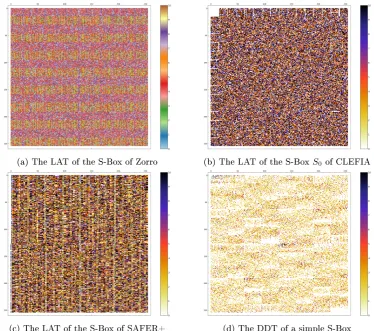
Zorro The S-Box of this cipher [9] is based on a 4-rounds Feistel Network with a complex diusion layer. As a consequence, the algorithm presented in Section 3.2 fails on it. The picture representation of its LAT, given in Figure 4a, contains stripes. These correspond to coecients equal to 6 (orange) and 2 (green). These never appear for half of the input masks according to a repeating pattern. Such a behaviour is not expected from a random permutation. The color scheme was chosen so as to highlight this property. We note that the congruence modulo2k for somekof the coecients of the LAT is related to the algebraic degree ofi·x⊕j·S(x)as explained for example in [39] (Proposition 6.1).
CLEFIA This block cipher [40] uses two distinct S-Boxes. The one denoted S0 has a particular structure based on smaller 4x4 S-Boxes. The LAT of this S-Box is given in Figure 4b: note the dents on the top and left side of the picture as well as the low number of colors compared to Figure4c which also depicts a LAT and uses the same color-scale. This low number of colors is a consequence of the fact that no coecient in the LAT is congruent to 2 modulo 4 which in turn is related to this S-Box having an algebraic degree equal to 6 on all of its coordinates. Neither this nor the dents are expected from a random permutation.
SAFER+ This block cipher [41] uses an S-Box based on exponentiation in Z/256Z. Its LAT is given in Figure 4c; note in particular the vertical lines whih appear in this representation.
Arithmetic The DDT can also be used in the same fashion. For example, we can look at the DDT of an S-Box generated using a simple algebraic expression similar to those discussed in Section3.1, namelys:x7→ψ ψ(x)with
ψ:x7→3· (3·x⊕0x53)>>>
4
⊕0x8b. The representation of its DDT is in Figure 4d. Note the white rectangles
corresponding to subsets of impossible dierentials and the loose similarity between the top left and bottom right quadrants on one hand and the top right and bottom left quadrants on the other hand. None of these characteristics are expected from the DDT of a random permutation. Note that with 3 iterations ofφ this S-box becomes
reasonably good.
We however were not able to spot any particular pattern in the Pollock representation of neither the DDT nor the LAT of Skipjack'sF. Such representations are given respectively in
Figures3aand3bin AppendixB. We used the function matrix_plot from the SAGE [42] software package to draw the Pollock representations.
4.2 Seurat's Steganography
In this section, we present an algorithm allowing the creation of a non-bijective S-Box such that the picture representation of its DDT contains a particular image. Since we draw this image dot after dot like in pointillism and since it hides said image, we call the method we present below Seurat's Steganography. The pictures we embed are black and white, the white parts corresponding to places where dierentials are impossible and black parts to places where the dierentials have non-zero probability.
White Equations Wa,b:∀x∈ {0,1}m, S(x+a) +S(x)6=b. Black Equations Ba,b:∃x∈ {0,1}m, S(x+a) +S(x) =b.
The inputs considered in this Section are:
B The complete list of the black equations.
Tw A table of booleans of sizeu×v(the dimensions of the image) whereTw[a, b]is false if and only if the pixel at(a, b)cannot be white.
S A partially unspecied S-Box such that all equations Bj forj < i hold and such that none of theWj has a solution for anyj.
i The index of the equation inB for which we need to nd a solution.
We rst need a sub-routine checking if adding an entryS(x) =y to a partially assigned
S-Box, i.e. an S-Box for which some of the outputs are unspecied, leads to at least one of the white equations not holding anymore. It is described in Algorithm 3.
Algorithm 3 checkW(S, x, y, Tw).
for alla∈ {0,1}m, if S(x+a)is specied, do
if Tw[a, S(x+a) +S(x)]is false then return false
end for return true
We now describe Seurat's Steganoraphy, namely Algorithm 4, which uses two lists of equations to iteratively build an S-Box such that a particular picture appears in its DDT. It works by rst making a listLof all the ways entries could be added to the S-Box in order
to satisfy the black equationBi. If none are found, the function fails. The function is nally called recursively on the candidates found to look for a solution for the next equation. If no solution are found for the next equation, the function fails.
Some optimizations are possible. First of all, it is not necessary to write this algorithm using recursion. It is also not necessary to let L be as large as possible. In fact |L| ≤2 is sucient, although|L|= 1does not work unless the picture is very simple. It is also possible to allow some noise by tweaking CheckW(S, x, y, Tw) to return true with low probability for pairs(x, y)even if they blacken a white pixel.
Two outputs of this algorithm are presented in AppendixC: the S-Boxes are given along with the Pollock representation of their DDT which clearly show the pictures we chose to embed in them. The dierential and linear properties of the S-Box described in Table6are close from what would be expected from a random function (dierential uniformity of 14, linearity of 39), meaning that it could be used in a context were a 8×8 random function would be sucient.
Counting Possible S-Boxes Let S be a random function from {0,1}m to {0,1}n. Then Wa,b holds if and only if da,b = 0, which happens with probability P[da,b = 0] = exp −2m−n−1because the coecients in the DDT of a random function follow
approx-imately a Poisson distribution with parameter 1/2 (see [22]). Hence, if we have b black
equations, w white ones and if we consider that their having solutions are independent
events, then the probability that an S-Box has the correct image at the center of its DDT isPsuccess= exp(−2m−n−1)w× 1−exp(−2m−n−1)b. In the case wherem=n, we use
that log2(exp(−1/2))≈ −1.35and thatlog2(1−exp(−1/2))≈ −0.72to approximate this probability by
Algorithm 4 Seurat(S, B, Tw, i). δin:=input dierence inBi
δout:=output dierence inBi
L:=empty list of S-Boxes
if Biis already satised byS then
AppendS toLand returnL end if
for allx∈ {0,1}m do
if S(x)is not dened butS(x+δin)is dened then
y=S(x+δin) +δout if CheckW(S, x, y, Tw)then
S0=S ; S0(x) =y AppendS0toL end if
else if S(x+δin)is not dened either then
for ally∈ {0,1}n do
if CheckW(S, x, y, Tw)and CheckW(S, x+δin, y+δout, Tw)then
S0=S; S0(x) =y; S0(x+δin) =y+δout
AppendS0 toL end if
end for end if end for
If Lis still empty then return Fail for allS0∈Ldo
If Seurat(S0, B, Tw, i+ 1)does not fail then returnS0
end for return Fail
As there are2n2n possiblen×nS-Boxes, we expect to have very roughly the following amount of solutions:
NSolutions= 2n2n−(0.72·w+1.35·b).
Therefore, we need0.72·w+ 1.35·b < n2n in order to have a non-empty set of S-Box with the image we want inside their DDT. Black pixels are about twice as expensive as white ones according to this model. However, in practice, it is only possible to build a S-Box such that its DDT contains a black square of size22×22or a white one of size62×62 without any noise, meaning that black pixels are, from our algorithm's point of view, about 8 times more expensive. Stirling's equation gives an approximate number of 2(n−1.44)·2n permutations of {0,1}n, so we need that 0.72·w+ 1.35·b < (n−1.44)2n in order for permutations with the correct black/white pixels to exist with non negligible probability. However, our algorithm will require signicant changes in order to search for permutations. Since our algorithm does not require the pixels to be organised inside a square, we can also use it to force white or black pixels to appear anywhere in the DDT of an S-Box. This could be used to place a sort of trapdoor by for instance ensuring that a truncated dierential compatible with the general structure of a cipher is present. Another possible use could be to sign a S-Box: Alice would agree with Bob to generate a S-Box for him and tell him before hand where some black/white pixels will be. Bob can then check that those are placed as agreed.
5 Conclusion
the white-box or crypto-currency setting. Hiding the S-box's structure can be also a way to hide superior cryptanalysis techniques or trapdoors.
In this paper we have introduced several approaches and algorithms to decompose an S-Box with unknown structure and we illustrated them by studying the S-Box of the NSA's block cipher Skipjack. This allowed us to rule out some possible structure, and to prove that its linear properties are too unlikely to have happened at random. We also provided an algorithm capable of generating very similar S-Boxes.
An open problem related to this work is the study of block ciphers with small block sizes: how far can cryptanalysis go given a whole codebook? How many rounds of small-block Feistel Network or SPN is it feasible to break?
6 Acknowledgement
We thank the CRYPTO reviewers for their helpful comments. We also thank Anne Canteaut for pointing out the connection between algebraic degree and congruence of the coecient of the LAT modulo2k. The work of Léo Perrin is supported by the CORE ACRYPT project (ID C12-15-4009992) funded by the Fonds National de la Recherche (Luxembourg).
References
1. Biham, E., Shamir, A.: Dierential cryptanalysis of DES-like cryptosystems. Journal of CRYP-TOLOGY 4(1) (1991) 372
2. Nyberg, K.: Dierentially uniform mappings for cryptography. In: Advances in cryptology Eurocrypt'93, Springer (1994) 5564
3. Blondeau, C., Nyberg, K.: Perfect nonlinear functions and cryptography. Finite Fields and Their Applications 32(0) (2015) 120 147 Special Issue : Second Decade of FFA.
4. Matsui, M.: Linear cryptanalysis method for des cipher. In: Advances in Cryptology EU-ROCRYPT'93, Springer (1994) 386397
5. Nyberg, K.: Linear approximation of block ciphers. In De Santis, A., ed.: Advances in Cryptol-ogy EUROCRYPT'94. Volume 950 of Lecture Notes in Computer Science. Springer Berlin Heidelberg (1995) 439444
6. Barreto, P., Rijmen, V.: The whirlpool hashing function. In: First open NESSIE Workshop, Leuven, Belgium. Volume 13. (2000) 14
7. Barreto, P., Rijmen, V.: The khazad legacy-level block cipher. Primitive submitted to NESSIE 97 (2000)
8. Grosso, V., Leurent, G., Standaert, F.X., Varc, K.: Ls-designs: Bitslice encryption for ecient masked software implementations. In: Fast Software Encryption. (2014)
9. Gérard, B., Grosso, V., Naya-Plasencia, M., Standaert, F.X.: Block ciphers that are easier to mask: how far can we go? In: Cryptographic Hardware and Embedded Systems-CHES 2013. Springer (2013) 383399
10. Daemen, J., Rijmen, V.: The design of Rijndael: AES-the advanced encryption standard. Springer (2002)
11. Biryukov, A., Bouillaguet, C., Khovratovich, D.: Cryptographic schemes based on the ASASA structure: Black-box, white-box, and public-key (extended abstract). In Sarkar, P., Iwata, T., eds.: Advances in Cryptology - ASIACRYPT 2014 - 20th International Conference on the Theory and Application of Cryptology and Information Security, Kaoshiung, Taiwan, R.O.C., December 7-11, 2014. Proceedings, Part I. Volume 8873 of Lecture Notes in Computer Science., Springer (2014) 6384
12. U.S. DEPARTMENT OF COMMERCE/National Institute of Standards and Technology: Data encryption standard. Federal Information Processing Standards Publication (1999)
13. National Security Agency, N.S.A.: SKIPJACK and KEA Algorithm Specications (1998) 14. Beaulieu, R., Shors, D., Smith, J., Treatman-Clark, S., Weeks, B., Wingers, L.: The simon and
15. Coppersmith, D.: The Data Encryption Standard (DES) and its strength against attacks. IBM journal of research and development 38(3) (1994) 243250
16. Biryukov, A., Shamir, A.: Structural cryptanalysis of SASAS. In Ptzmann, B., ed.: Advances in Cryptology EUROCRYPT 2001. Volume 2045 of Lecture Notes in Computer Science. Springer Berlin Heidelberg (2001) 395405
17. Patarin, J.: Luby-Racko: 7 rounds are enough for2n(1−)security. In: Advances in Cryptology
CRYPTO'03. Springer (2003) 513529
18. Biham, E., Biryukov, A., Shamir, A.: Cryptanalysis of skipjack reduced to 31 rounds using impossible dierentials. Journal of Cryptology 18(4) (2005) 291311
19. Knudsen, L.R., Robshaw, M.J., Wagner, D.: Truncated dierentials and skipjack. In: Advances in CryptologyCRYPTO'99, Springer (1999) 165180
20. Knudsen, L., Wagner, D.: On the structure of skipjack. Discrete Applied Mathematics 111(1) (2001) 103116
21. Browning, K., Dillon, J., McQuistan, M., Wolfe, A.: An apn permutation in dimension six. Finite Fields: theory and applications 518 (2010) 3342
22. Daemen, J., Rijmen, V.: Probability distributions of correlation and dierentials in block ciphers. Journal of Mathematical Cryptology JMC 1(3) (2007) 221242
23. O'Connor, L.: Properties of linear approximation tables. In Preneel, B., ed.: Fast Software Encryption. Volume 1008 of Lecture Notes in Computer Science. Springer Berlin Heidelberg (1995) 131136
24. Brickell, E.F., Denning, D.E., Kent, S.T., Maher, D.P., Tuchman, W.: Skipjack review: Interim report (1993)
25. Anonymous: This looks like it might be interesting. sci.crypt (usenet), https://groups. google.com/forum/#!msg/sci.crypt/vLtuBDoqPfc/jm6MshFbomgJ(August 1995)
26. Schneier, B.: the S-1 Algorithm. mail to the cypherpunk mailing list, http://cypherpunks. venona.com/date/1995/09/msg00315.html, (1995)
27. Gilbert, H., Chassé, G.: A statistical attack of the feal-8 cryptosystem. In Menezes, A., Vanstone, S., eds.: Advances in CryptologyCRYPT0'90. Volume 537 of Lecture Notes in Computer Science. Springer Berlin Heidelberg (1991) 2233
28. Tardy-Corfdir, A., Gilbert, H.: A known plaintext attack of feal-4 and feal-6. In Feigenbaum, J., ed.: Advances in Cryptology CRYPTO'91. Volume 576 of Lecture Notes in Computer Science. Springer Berlin Heidelberg (1992) 172182
29. Matsui, M., Yamagishi, A.: A new method for known plaintext attack of feal cipher. In: Advances in Cryptology Eurocrypt'92, Springer (1993) 8191
30. Patarin, J.: Generic attacks on feistel schemes. In: Advances in CryptologyASIACRYPT 2001. Springer (2001) 222238
31. Wernsdorf, R.: The round functions of rijndael generate the alternating group. In: Fast Software Encryption, Springer (2002) 143148
32. Blondeau, C., Canteaut, A., Charpin, P.: Dierential properties of power functions. Interna-tional Journal of Information and Coding Theory 1(2) (2010) 149170
33. Jean-Charles, F., Perret, L.: An ecient algorithm for decomposing multivariate polynomials and its applications to cryptography. Journal of Symbolic Computation 44(12) (2009) 1676 1689
34. Luby, M., Racko, C.: How to construct pseudorandom permutations from pseudorandom functions. SIAM Journal on Computing 17(2) (1988) 373386
35. Patarin, J.: New Results on Pseudorandom Permutation Generators Based on the Des Scheme. In Feigenbaum, J., ed.: Advances in Cryptology CRYPTO'91. Volume 576 of Lecture Notes in Computer Science. Springer Berlin Heidelberg (1992) 301312
36. Patarin, J.: Security of random feistel schemes with 5 or more rounds. In: Advances in CryptologyCRYPTO 2004, Springer (2004) 106122
37. Een, N., Sörensson, N.: Minisat: A sat solver with conict-clause minimization. Sat 5 (2005) 38. Biryukov, A., Leurent, G., Perrin, L.: ESC 2015 S-box Reverse-Engineering Challenge. In:
Early Symmetric Crypto, ESC 2015. (2015) 104107
39. Canteaut, A.: Analyse et Conception de Chirements à Clef Secrète. Habilitation à diriger des recherches, Institut National de Recherche en Informatique et Automatique, Rocquencourt (September 2006)
41. Massey, J.L.: Safer k-64: A byte-oriented block-ciphering algorithm. In: Fast Software Encryp-tion, Springer (1994) 117
42. Stein, W., et al.: Sage Mathematics Software (Version 5.10). The Sage Development Team. (2013) http://www.sagemath.org.
A The S-Box of Skipjack
Table 5: Skipjack's S-Box,F, in hexadecimal notation. For example,F(7a) =d6. .0 .1 .2 .3 .4 .5 .6 .7 .8 .9 .a .b .c .d .e .f
0. a3 d7 09 83 f8 48 f6 f4 b3 21 15 78 99 b1 af f9 1. e7 2d 4d 8a ce 4c ca 2e 52 95 d9 1e 4e 38 44 28 2. 0a df 02 a0 17 f1 60 68 12 b7 7a c3 e9 fa 3d 53 3. 96 84 6b ba f2 63 9a 19 7c ae e5 f5 f7 16 6a a2 4. 39 b6 7b 0f c1 93 81 1b ee b4 1a ea d0 91 2f b8 5. 55 b9 da 85 3f 41 bf e0 5a 58 80 5f 66 0b d8 90 6. 35 d5 c0 a7 33 06 65 69 45 00 94 56 6d 98 9b 76 7. 97 fc b2 c2 b0 fe db 20 e1 eb d6 e4 dd 47 4a 1d 8. 42 ed 9e 6e 49 3c cd 43 27 d2 07 d4 de c7 67 18 9. 89 cb 30 1f 8d c6 8f aa c8 74 dc c9 5d 5c 31 a4 a. 70 88 61 2c 9f 0d 2b 87 50 82 54 64 26 7d 03 40 b. 34 4b 1c 73 d1 c4 fd 3b cc fb 7f ab e6 3e 5b a5 c. ad 04 23 9c 14 51 22 f0 29 79 71 7e 8c 0e e2 d. 0c ef bc 72 75 6f 37 a1 ec d3 8e 62 8b 86 10 e8 e. 08 77 11 be 92 4f 24 c5 32 36 9d cf f3 a6 bb ac f. 5e 6c a9 13 57 25 b5 e3 bd a8 3a 01 05 59 2a 46
B Picture Representation of the DDT and LAT of Some S-Boxes
(a) The LAT of Skipjack'sF (b) The DDT of Skipjack'sF
Fig. 3: The Pollock representations of the LAT and DDT of Skipjack'sF. For both, 0 is in
(a) The LAT of the S-Box of Zorro (b) The LAT of the S-BoxS0 of CLEFIA
(c) The LAT of the S-Box of SAFER+ (d) The DDT of a simple S-Box
Fig. 4: The Pollock representation of the LAT or DDT of dierent S-Boxes. The scales all go from 0 to 10 (anything above 10 is treated as equal to 10).
(a) The DDT of the S-Box in Table6 (b) The DDT of the S-Box in Table7
C S-Boxes Built from Pictures
The S-Box described in Tables6and7were built using the method described in Section4.2. Note that these are not bijections. The picture representations of their DDT are given in Figures5aand5b.
Table 6: An output of the algorithm described in Section4.2. .0 .1 .2 .3 .4 .5 .6 .7 .8 .9 .a .b .c .d .e .f 0. 7a b3 b9 b6 53 b1 26 6e b9 43 86 ec 94 4b 9e 43 1. 5d 83 d5 57 16 4c 44 d5 5d 81 7f 79 b3 8d e6 f8 2. 0d 59 b3 8d 04 4c 8d ec d9 7f 7a 7e 9a 92 61 3. 05 fc e3 1a ed 12 1e 52 1a e5 30 34 ef e5 97 e5 4. 9e 69 29 d6 29 cd b8 3a d2 c4 1b d1 1c 17 c3 3b 5. 44 ba bd 19 57 0c 5a 5f bb 55 b7 4a 5e 3f a6 fe 6. 7f c8 7e 65 be 1e b3 bf 8b 85 83 83 87 12 b2 26 7. a6 b4 bc ef 9e 9d 6c 9e 90 5e 68 25 30 97 9f 71 8. bf 64 65 9a 77 18 da 60 05 97 58 b2 88 d5 25 a1 9. 58 00 db 85 ca 9f 8d 42 db bc b2 b6 e7 85 44 78 a. ac be 5b 21 45 e9 40 4d 73 5f af 93 4b bd 45 42 b. 55 37 e2 c8 c8 20 d1 ee 7e 36 c5 28 32 37 2f d4 c. 86 21 79 70 08 b6 91 89 e3 e5 10 e5 c6 cf 02 ca d. cc b9 e1 9a 8c 8c f3 70 ec 13 0f 00 17 7e 57 5c e. 09 27 27 85 a0 87 3f 53 74 e3 b1 bd de b1 8d 61 f. 4b 84 9c f3 72 04 7e 9c 25 3e 98 9e 43 8d b2 9d
Table 7: An output of the algorithm described in Section4.2. .0 .1 .2 .3 .4 .5 .6 .7 .8 .9 .a .b .c .d .e .f