ISSN 2286-4822
www.euacademic.org DRJI Value: 5.9 (B+)
Effect of Hypothyroidism on renal function tests in
Indian patients in 2012
WALED MOHAMED ALSALMI LAILA HAMED FARAJ SHAGLOUF ABDU ALHAMEED .A. ALI AZZWALI SAPNA SMITH LAL
Faculty of Medical Technology, Sabratha University Surman, Libya
Abstract:
Background: Thyroid dysfunction causes significant changes in kidney function, both hypothyroidism and hyperthyroidism affect renal blood flow, GFR, tubular function, electrolytes homeostasis, electrolyte pump functions, and kidney structure
Objective: The aim of this study was to investigate the effect of thyroid dysfunction (hypothyroidism) on biochemical markers of kidney in hypothyroid patients. TSH was used as a marker of the thyroid status.
Methods: Thyroid function tests (T3, T4 and TSH levels) were assayed in 70 subjects. Based on TSH levels, subjects were classified as euthyroid (n=47), hypothyroidism (n=23). BUN, serum CTN, UA, serum Na, serum K and serum Cl were studied in patients with hypothyroidism and euthyroid subjects.
Results: BUN, serum CTN, UA and K levels were significantly increased in hypothyroid patients as compared to euthyroid subjects, whereas serum Na and Cl levels were significantly decreased in hypothyroid patients as compared to controls.
Key words:hypothyroidism, renal function tests, Indian patients
INTRODUCTION:
Thyroid hormones (TH) are necessary for growth and development of the kidney and for the maintenance of water and electrolyte homeostasis. On the other hand, kidney is involved in the metabolism and elimination of TH (1). Thyroid hormones may directly affect the kidney, and altered kidney function may also contribute to Thyroid disorders. Thyroid dysfunction causes significant changes in kidney function, both hypothyroidism and hyperthyroidism affect renal blood flow, GFR, tubular function, electrolytes homeostasis, electrolyte pump functions, and kidney structure (2–6).
Hypothyroidism has been associated with increased serum creatinine (Scr), decreased GFR (7-9), reduction of renal plasma flow (RPF), disruption of the capacity to excrete free water and hyponatremia (10).
MATERIALS AND METHODS:
This study include 70 participant between the age 16-82 of both sex (male & female), collected from Asian institute of medical science at Faridabad region, They were divided into two groups, group 1 (n= 23 subjects) for the patients having hypothyroidism (T3, T4 & TSH) and group 2 ( n= 47 subjects) for control.
Biochemical analysis:
a-Thyroid Function Tests:
• FT3: The method used is CMIA method. • FT4: The method used is CMIA method. • TSH: The method used is CIMA method.
These tests were done by fully automatic analyzer (ARCHITECT I 1000 SR).
b- Renal Function Tests:
• BUN: The method used is (Enzymatic-Urease Kinetic). • Creatinine serum: The method used is (Jaffe's Reaction). • Uric acid: The method used is (Enzymatic-Uricase).
These tests were done by fully automatic analyzer (UNICEL DXC 600).
c- Electrolytes:
• Na+: The method used is (Indirect Ion-Selective Electrode). • K+: The method used is (Indirect Ion-Selective Electrode). • Cl: The method used is (Indirect Ion-Selective Electrode). These tests were done by fully automatic analyzer (UNICEL DXC 600).
Statistical analysis:
The data was analyzed by graph pad software. Student t-test was used for the calculation. P ≤ 0.05 was considered statically significant.
RESULTS
observed in TSH, T3 and T4 levels of euthyroid subjects and hypothyroid patients. On evaluation, it was observed that 8.7% of the patients were mild hypothyroid (T4˂ 0.35 mIU/ ml) and another 97.1% were subclinical hypothyroid. This study shows that there is significant increase in blood urea nitrogen, serum creatinine and uric acid levels as well as decrease in serum sodium in hypothyroid patients as compared to euthyroid subjects.
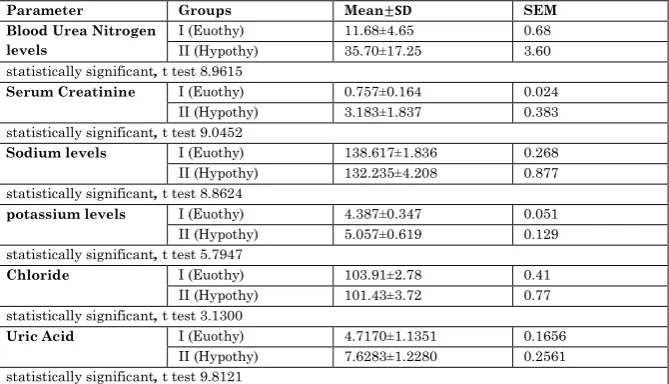
The various data which have been obtained during the study subjected to statistical analysis in order to find out the mean, standard deviation, standard error of the mean (SEM), P value and t test of each group of study. All the results obtained are shown in table 1 and whether there is statistical significant or not between the two groups for each parameter were indicated.
In the present study it was found that there is significant difference in the BUN level between the two groups. There is significant increase in the BUN level in group II compared to the group I. Also there is an extremely significant difference in the serum creatinine levels between the two groups. There is significant increase in the serum creatinine level in group II compared to the group I.
In the present study it was found that there is significant difference in the serum sodium levels between the two groups (group I & group II). There is significant decrease in the serum sodium level in group II compared to the group I. Potassium levels were also show significant difference between the two groups (group I & group II), it was increased in group II compared to the group I. Serum chloride levels were decreased in group II compared to the group I.
Table 1: The mean, standard deviation and SEM of renal parameters in normal and hypothyroidism patients.
Parameter Groups Mean SEM
Blood Urea Nitrogen levels
I (Euothy) 11.68±4.65 0.68
II (Hypothy) 35.70±17.25 3.60
statistically significant, t test 8.9615
Serum Creatinine I (Euothy) 0.757±0.164 0.024
II (Hypothy) 3.183±1.837 0.383
statistically significant, t test 9.0452
Sodium levels I (Euothy) 138.617±1.836 0.268
II (Hypothy) 132.235±4.208 0.877
statistically significant, t test 8.8624
potassium levels I (Euothy) 4.387±0.347 0.051
II (Hypothy) 5.057±0.619 0.129
statistically significant, t test 5.7947
Chloride I (Euothy) 103.91±2.78 0.41
II (Hypothy) 101.43±3.72 0.77
statistically significant, t test 3.1300
Uric Acid I (Euothy) 4.7170±1.1351 0.1656
II (Hypothy) 7.6283±1.2280 0.2561
statistically significant, t test 9.8121
DISCUSSION
The main finding of this study was that serum creatinine, blood urea nitrogen, uric acid and potassium were higher, while serum sodium was lower in hypothyroid status when compared to the euthyroid status or normal controls.
Electrolytes, thyroid hormones have significant effects
on renal handling of salt and water on the active tubular transport of electrolytes (11).
Serum creatinine, serum creatinine levels in our study
that tubular creatinine secretion is diminished in hypothyroidism, thereby increasing the serum creatinine concentration (15).
Uric acid, the uric acid level in serum was significantly elevated in hypothyroid cases when compared to controls (p value less than 0.0001). Previous study noticed elevated serum uric acid levels in hypothyroidism similarly to our finding (16). The increase in uric acid levels in hypothyroid state may result from either increased production due to myopathy or due to decrease renal clearance of uric acid (17). Hyperuricemia associated with hypothyroidism has been shown to be due to decreased renal clearance of uric acid in earlier studies (18, 19).
BUN, during the hypothyroidism clinical condition, the protein catabolism is more frequently occur, so that more production of BUN is there in hypothyroid patients.
CONCLUSIONS
It is concluded from the present study that thyroid dysfunction specially hypothyroidism raise the risk of renal dysfunction by changing in the kidney biomarkers as serum uric acid, serum creatinine, and some electrolytes such as serum sodium and potassium. Knowledge of the association between thyroid dysfunction and renal impairment is important for the clinician.
REFERENCES:
2. Kaptein EM, Quion-Verde H & Massry SG. Hemodynamic effects of thyroid hormone. Contributions to Nephrology 1984 41 151–159.
3. den Hollander JG, Wulkan RW, Mantel MJ & Berghout A. Correlation between severity of thyroid dysfunction and renal function. Clinical Endocrinology 2005 62 423– 427.
4. Villabona C, Sahun M, Roca M, Mora J, Go´mez N, Go´mez JM, Puchal R & Soler J. Blood volumes and renal function in overt and subclinical primary hypothyroidism. American Journal of the Medical Sciences 1999 318 277–280.
5. Kinsella J & Sacktor B. Thyroid hormones increase NaC-HC exchange activity in renal brush border membranes. PNAS 198582 3606–3610.
6. Davis RG, Madsen KM, Fregly MJ & Tisher CC. Kidney structure in hypothyroidism. American Journal of Physiology 1983 113;41–49.
7. Kreisman SH, Hennessey JV. Consistent reversible elevations of serum creatinine levels in severe hypothyroidism. Arch Intern Med. 1999;159(1):79-82. 8. Mooraki A, Broumand B, Neekdoost F, Amirmokri P,
Bastani B. Reversible acute renal failure associated with hypothyroidism: report of four cases with a brief review of literature. Nephrology (Carlton). 2003;8(2):57-60. 9. Karanikas G, Schütz M, Szabo M, et al. Isotopic renal
function studies in severe hypothyroidism and after thyroid hormone replacement therapy. Am J Nephrol. 2004;24(1):41-45.
11. Azuma KK, Balkovetz DF, Magyar CE, Lescale-Matys L, Zhang Y, Chambrey R, Warnock DG, McDonough AA . Renal Na+/H+ exchanger isoforms and their regulation by thyroid hormone. Am J Physiol. 1996; 270:C585–92. 12. Kreisman SH, Hennessey JV. Consistent reversible
elevations of serum creatinine levels in severe hypothyroidism. Arch Intern Med. 1999;159:79–82. 13. Verhelst J, Berwaerts J, Marescau B, Abs R, Neels H,
Mahler C, et al. Serum creatine, creatinine, and other guanidino compounds in patients with thyroid dysfunction. Metabolism. 1997;46:1063–7.
14. Lafayette RA, Costa ME, King AJ. Increased serum creatinine in the absence of renal failure in profound hypothyroidism. Am J Med. 1994; 96:298–299.
15. Feyza Darendeliler et al. Effect Of Hypo-and Euthyroid Status On Serum Cystatin C Levels. J Clin Res Ped Endo. 2010;2(4):155-158.
16. Dumitriu L , Bartoc R , Ursu H , Purice M , Ionescu V. Significance of high levels of Serum malonyldialdehyde (MDA) and Ceruloplasmin (CP) in hyperthyroidism and hypothyroidism. Endocrinologie. 1988 Jan-Mar; 26(1):35-8.
17. Facchini F , Chen I , Hollenbeck C and Reaven GM. Relationship between resistance to insulin mediated glucose uptake , urinary uric acid clearance and plasma uric acid concentration . JAMA. 1991; 266:3008-3011.
18. Giordano N, Santacroce C , Mattii G , Geraci S, Amendola A , Gennari C . Hyperuricemia and gout in thyroid endocrine disorders . Clin Exp Rheumatol . 2001; 19 (6):661-5.