An Innovative Idea for Management of
Libraries Using A RFID Based Library
Assistant Robot
Lidia J Chungath1, Deepthi U2, Aswani C R3, Ganesh S4, Arjun K5
Assistant Professor, Dept. of EEE, IES College of Engineering, Chitillapilly, Thrissur, Kerala, India1 U G Scholar, Dept. of EEE, IES College of Engineering, Chitillapilly, Thrissur, Kerala, India2 U G Scholar, Dept. of EEE, IES College of Engineering, Chitillapilly, Thrissur, Kerala, India3 U G Scholar, Dept. of EEE, IES College of Engineering, Chitillapilly, Thrissur, Kerala, India4 U G Scholar, Dept. of EEE, IES College of Engineering, Chitillapilly, Thrissur, Kerala, India5
ABSTRACT:This paper demonstrates the application of Robots in library management systems.A robot is designed that follows a predefined line to keep track the library book shelf arrangements. The number of the book that has to be taken is given as input to the robot. Robot gets the data of book by comparing the saved RFID number with the books in the shelves. If the particular book which is to be found out by the robot matched with the saved book detail, then the robotic will send a notification to the shelf unit. The corresponding shelf tray will move forward and the book in the tray will deposit the book in the basket of robot. The robot will return the book to the collection centre. Thus the customer can deliver the book from the collection centre. This helps and simplifies the job of monitoring the arrangement of books and also reduces the manual routine work done by the library staff.
KEYWORDS:RFID, library management, shelf unit, shelf tray
I.INTRODUCTION
II. LITERATURE SURVEY
In older days libraries required more manual power to manage, In particular, a library easily contains hundreds of thousands of books that are frequently borrowed and returned back to the shelves. Typically we need a librarian to pick the books and hand it over to the person to whom the books are being issued. This might be an easy task in case the library floor area is small. Also, to search for the books by humans takes a lot of time as many a times the books gets overlooked by the human eye.i.e. Running of library manually is a difficult task. It is time consuming &laborious.We can overcome these drawbacks through our proposed paper. In this method we are going to maintain an autonomous service robotic assistant whose functionality includes the assistance of individuals within a library environment. The evolution of robotics started in the twenty first century. The 'robot' term was firstly coined in early 1920 by a Czechoslovakian dramatist, Karel Capek in his play entitles "Rossum's universal robots". Robota is the original term of robot that widely used since it has been introduced to the public. Robota is a czech word which means 'slave laborer'. On 1942 science fiction author Isaac Asimov used the term 'robotics' in his short story "Runaround". Robotics means study of robot. Three Laws of robotics have been introduced in "Runaround". It describes the three basic rules that robot should follow to operate without harming or cause injury. The laws are:
a) A robot is not allowed to harm a human or cause injury to a human being whatever be the condition.
b) A robot must always follow the direction or order given to it by the human being as muchas it does not contrast or conflict to first law.
c) A robot must protect its own existence as long as it does not make conflict to first and second law.
A) AuRoSS: an Autonomous Robotic Shelf Scanning System Renjun Li, Zhiyong Huang, Ernest urniawan, Chin KeongHo 2015 IEEE/RSJ International Conference on Intelligent Robots and Systems (IROS) Congress Centre Hamburg Sept 28 - Oct 2, 2015. Hamburg, Germany.
This paper elaborates on the key enabling robotic technology for the fully autonomous system, namely, a navigation system with surface tracking capability. A Radio Frequency Identification (RFID) reader is carried by the
navigation system to identify the RFID tags embedded in each book. Based on the tag information, a tracking report that highlights missing and misplaced books is generated for the end users. To ensure successful identification, the
surface tracking requires high accuracy, for which we propose a filtered Hough transform and a macro-mini manipulator structure. Tests of the AuRoSS system in a library show high accuracy in the scanning performance.
Inventory tracking is a tedious but important process for inventory management. In particular, a library easily contains hundreds of thousands of books that are frequently borrowed and returned back to the shelves. To facilitate users to easily locate a particular book, books are placed in dedicated areas and sorted in a running sequence based on their socalled call numbers. Library staffs have to ensure that the books are placed in order, which is an extremely labour intensive and time consuming process. Library staffs first need to perform shelf reading, i.e., manually search for books that are misplaced in the wrong book sequence, then pick up the book and insert it in the correct location. Radio Frequency Identification (RFID) technology has been introduced to ease shelf reading, such as by using hand held
RFID readers nevertheless the task is still time consuming and the user still cannot easily interpret the RFID results to see if the books are sequenced properly. Smart shelf, on the other hand, uses many RFID antennas that are placed at many strategic locations so as to scan the RFID tags. The high infrastructure cost and implementation complexity remains a barrier for this technology to be widely adopted
B) A Research on Autonomous Position Method for Mobile Robot Manipulator based on Fusion Feature Mingfang Du, Junzheng Wang, Lipeng Wang and Haiqing Cao Jianjun Fang, Zongyu Gao, JiLv and Shide Zhang College of Automation College of Automation Beijing Institute of Technology Beijing Union University Haidian, Beijing City, China Chaoyang, Beijing City, China 2013 IEEE/RSJ Mechatronics and Automation Aug 47,Takamatsu, Japan.
architecture is used when designing the manipulator position system. The experiment result has proved this method can help the manipulator realize the accurate position and rapid catching.
In this system, the robot is a kind of mobile robot with wheels whose main part is an Automatic Guided Vehicle (AGV). A manipulator with a camera and a RFID reader at its front part is installed on the AGV. The road in the library is divided into some areas according to the types of books and every area has its road signs. The wireless image acquisition module on the AGV can acquire the road signs’ picture and send them to the remote PC through wireless internet. The program in the remote PC will process the pictures and calculate the AGV’s control parameters which are send to the robot controller’s speed-governing system to realize the PWM speed-governing control of the direct-current dynamo
III.SCOPE OF THE PAPER
. This paper aims to build and design the Library Assistant Robot which has the capability to look for a specific book in a shelf, asked by any user, and when it is found, to deliver it as soon as possible to the user. Tracking of items on shelves is an important but time-consuming task in inventory control. In particular, books in public libraries are frequently borrowed and returned, even misplaced, and proves a challenge to be tracked on a daily basis. This Library assistant robot is an autonomous service robotic assistant whose functionality includes the assistance of individuals within a library environment.
IV.PROPOSED METHODOLOGY
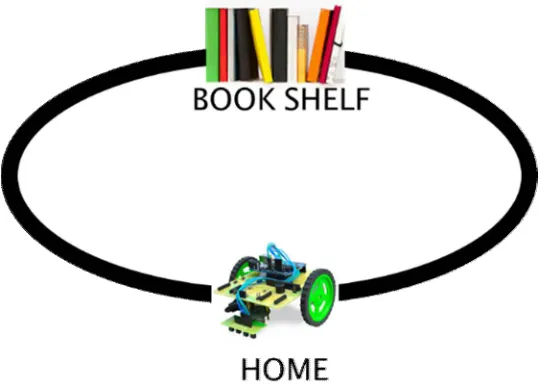
The hardware is implemented as a robot unit and shelf unit independently. Firstly enter the name of book which we want to issue using keypad. The robot end sends a data to the shelf end using data modem. Line follower robot follows the track and reaches the shelf end. The IR sensor matches with the shelf unit. The RF reader scans for the RF tag and matches with the corresponding book. If both the robot and the shelf end get synchronised the arm in the shelf end pushes the book into the basket. Thus the robot unit follows the path back to home.
A. SYSTEM BLOCK DIAGRAM
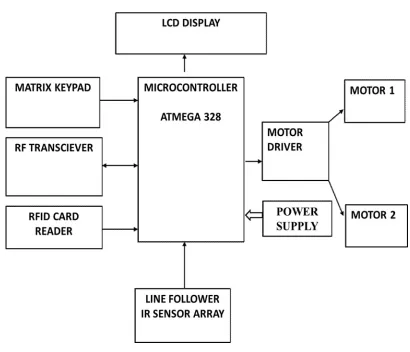
ROBOT END :
Fig. 2. ROBOT END BLOCK DIAGRAM
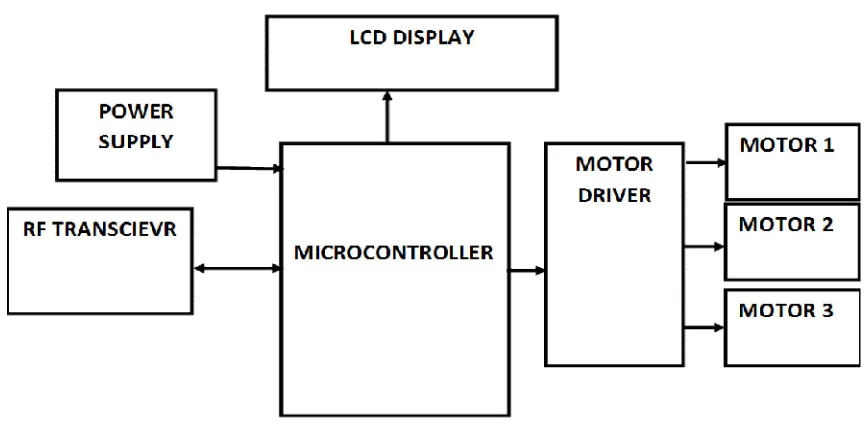
Fig. 3. SHELF END BLOCK DIAGRAM
The shelf end consist of three motors driven using a motor drive which is used to push the book from the shelf to the basket in the robot, all the control is done by the ATmega328 microcontroller which inter links with the other microcontroller using RF transceiver.
B. SYSTEM IMPLEMENTATION
a. CIRCUIT DIAGRAM
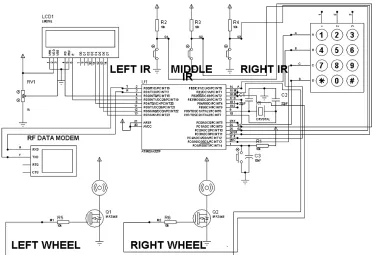
We are using ATmega328 microcontroller in our project. A 16 MHz crystal is used to provide clock for the ATmega328 microcontroller and 22pF capacitors are used to stabilize the operation of crystal. The 10µF capacitor and
10KΩ resistor is used to provide Power on Reset (POR) to the device. When the power is switched ON, voltage across
capacitor will be zero so the device resets (since reset is active low), then the capacitor charges to VCC and the reset will be disabled. 30th pin (AVCC) of ATmega328 should be connected to VCC.
Here, we are using three analog IR sensors. All the three sensors will be placed in the front side of the robot and all will be pointing downward. IR TX and IR RX are to be soldered on small general purpose Grid PCB. From this module, 3 wires of sufficiently long length (say 1 ft.) are taken and connect them to VCC, preset and to ground. By adjusting preset, we can adjust sensitivity of the sensor. The VCC is connected to 5V supply
the ground. This puts LCD in highest contrast and read mode. We just need to control ENABLE and RS pins to send characters and data accordingly. The connections which are done for LCD are given below:
PIN1 or VSS to ground
PIN2 or VDD or VCC to +5v power
PIN3 or VEE to ground (gives maximum contrast best for a beginner) PIN4 or RS (Register Selection) to PIN4 of ATmega328
PIN5 or RW (Read/Write) to ground (puts LCD in read mode eases the communication for user) PIN6 or E (Enable) to PIN5 of ATmega328
PIN11 or D4 to PIN06 of ATmega328 PIN12 or D5 to PIN11 of ATmega328 PIN13 or D6 to PIN12 of ATmega328 PIN14 or D7 to PIN13 of ATmega328
We are using EM-18 RFID Reader in the project. EM-18 is a 125 KHz RFID Reader module and comes with both Serial and Weigand interfaces. In serial interface, the EM-18 RFID Reader provides a 12 byte data when it reads any RFID tag.
In our project we are making use of DC motors. The Motor Supply is given to the Vs pin of L293D and motor is connected to the first pair of drivers, which is enabled by connecting EN1 to logic HIGH. Vss pin is used to provide logic input to L293D. Control signals is given by using ATmega32 microcontroller which operates at 5V, hence Vss is connected to 5V
We are using a 12 keys keypad in our project. Keypad is nothing but multiplexed keys. Buttons are connected in a multiplexed form for reducing the pin usage of control system. The rows R0 to R3 are connected to Input lines of Microcontroller (Ro-pin14, R1-pin27, R2-28, and R3-17). The column C0 to C2 are also connected to MCUs i/o line (C0-18, C1-19, C223).
b. THE LIBRARY ASSISTANT ROBOT SYSTEM
Fig.5. Complete system Fig.6. Robot end
V.SIMULATION RESULT AND DISCUSSION
The simulation is performed in PROTEUS. The Proteus Design Suite is an Electronic Design Automation (EDA) tool including schematic capture, simulation and PCB Layout modules. It is developed in Yorkshire, England by Lab centre Electronics Ltd with offices in North America and several overseas sales channels. The software runs on the Windows operating system. The Proteus Design Suite is a Windows application for schematic capture, simulation, and PCB layout design.
A. SIMULATION SETUP
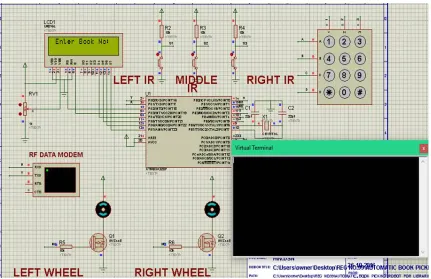
Initially we are at the home position (000-blue, blue, blue).The required book’s number is given as the input to the keypad (Say 101). The Name of the particular book will get displayed on the LCD. If the book number is wrong “INVALID BOOK NUMBER” will be printed. Next status printed will be “SEARCHING.” of the book. At once the book gets matched with the book in the shelf, the robot starts slowly from its home position. When a sensor is on black line it reads 1 and when it is on the bright surface it reads 0 and sensor module gives the value into the controller to generate control signal as per the program. When both right and left sensors are on bright surface (read 0) the wheels gain speed. When left sensors moves in black region then left motor stops while right motor continue to move so that left turn takes place and robot returns on black line. When right sensor comes in black region then right motor stops while left motor continue to move so that right turn takes place and robot returns on black line. By correcting the path robot moves to the destination i.e. the shelf end.
Fig. 7. Matlab simulation for robot end.
VI.CONCLUSIONS
The implementation of the robot end section in PROTEUS was successful. The desired results were verified in the simulation. The I R sensors navigated the Robot end from its home position to the book shelf end and back to home after the collection of required book. In this paper the proposed system give the result of find the book. It reduces the manual work. With the proposed architecture, if constructed with at most accuracy, the robot will find the book. If such a system developed, it will act as a basic platform for the generation of more such devices for the library management.
REFERENCES
[1] [1] JackritSuthakom, “A Robotic Library System for an Off-Site Shelving Facility”, Proceedings of the 2002 IEEE International Conference on Robotics 8 Automation Washington. DC May 2002.
[2] R.-C. Hua and T.-G. Ma, “A printed dipole antenna for ultra high frequency (UHF) radio frequency identification (RFID) handheld reader,” Antennas and Propagation, IEEE Transactions on, vol. 55, no. 12, pp. 3742–3745, 2007.
[3] P.-Y. Lau, K.-O. Yung, and E. K.-N. Yung, “A low-cost printed CP patch antenna for RFID smart bookshelf in library,” Industrial Electronics, IEEE Transactions on, vol. 57, no. 5, pp. 1583–1589, 2010.
[4] J. Lang and L. Han, “Design of library smart bookshelf based on RFID,” Applied Mechanics and Materials, vol. 519, pp. 1366–1372, 2014. [5] .Kazuki Watanabe, Tomoyuki Takahashi, “LiNS: A Library Navigation System Using Sensors and Smartphones” International Conference on
Broadband, Wireless Computing, Communication and Applications. Fukuoka 4-6 Nov. 2010 pp. 346 - 350
[6] Tetsuo Tomizawa, Akihisa Ohya, Shin’ichiYuta “Book Browsing System using an Autonomous Mobile Robot Tele operated via the Internet” IEEEIRSJ Intl. Conference on Intelligent Robots and Systems EPFL, Lausanne, Switzerland October 2002.pp. 1284 - 1289
[7] Mohamad Bdiwi, JozefSuchý “Library Automation Using Different Structures of Vision-Force Robot Control and Automatic Decision System” IEEE/RSJ International Conference on Intelligent Robots and Systems October 7-12, 2012. Vilamoura, Algarve, Portugal pp. [8] Kho Hao Yuan, Ang Chip Hong, Marcel Ang, GoiSiPeng,”UnManned
[9] Library: An Intelligent Robotic Books Retrieval & Return Sytem Utilizing RFID Tags”, 2002 IEEE SMC TA2Rl
[10] D. J. Lee, “Matching Book-Spine Images for Library Shelf-Reading Process Automation”, 4th IEEE Conference on Automation Science and Engineering Key Bridge Marriott, Washington DC, USA August 23-26,
[11] 2008
[13] ZHANG Lixun, SHEN Jinhua, LU Dunmin, YANG Yong, A PWM Speed Controller of DC Motor Using AVR Microcontroller [J], Machinery & Electronics, 2004,(4)
[14] SUN Jun, JIANG Xiyi, Hanjie, CAO Feilong, Walking Control System [15] Design of Library Robot[J],China Electric Power Education, 2009, (15)