doi:10.1136/bmj.326.7391.684
2003;326;684-
BMJ
Katja Taxis and Nick Barber
intravenous drug errors
Ethnographic study of incidence and severity of
http://bmj.com/cgi/content/full/326/7391/684
Updated information and services can be found at:
These include:
References
http://bmj.com/cgi/content/full/326/7391/684#otherarticles
10 online articles that cite this article can be accessed at:
http://bmj.com/cgi/content/full/326/7391/684#BIBL
This article cites 19 articles, 10 of which can be accessed free at:
Rapid responses
http://bmj.com/cgi/eletter-submit/326/7391/684
You can respond to this article at:
http://bmj.com/cgi/content/full/326/7391/684#responses
free at:
9 rapid responses have been posted to this article, which you can access for
service
Email alerting
box at the top right corner of the article
Receive free email alerts when new articles cite this article - sign up in the
Topic collections
(629 articles)
Regulation
(2604 articles)
Other Public Health
Articles on similar topics can be found in the following collections
Notes
http://www.bmjjournals.com/cgi/reprintform
To order reprints of this article go to:
Papers
Ethnographic study of incidence and severity of
intravenous drug errors
Katja Taxis, Nick Barber
Abstract
ObjectivesTo determine the incidence and clinical importance of errors in the preparation and administration of intravenous drugs and the stages of the process in which errors occur.
DesignProspective ethnographic study using disguised observation.
ParticipantsNurses who prepared and administered intravenous drugs.
Setting10 wards in a teaching and non-teaching hospital in the United Kingdom.
Main outcome measuresNumber, type, and clinical importance of errors.
Results249 errors were identified. At least one error occurred in 212 out of 430 intravenous drug doses (49%, 95% confidence interval 45% to 54%). Three doses (1%) had potentially severe errors, 126 (29%) potentially moderate errors, and 83 (19%) potentially minor errors. Most errors occurred when giving bolus doses or making up drugs that required multiple step preparation.
ConclusionsThe rate of intravenous drug errors was high. Although most errors would cause only short term adverse effects, a few could have been serious. A combination of reducing the amount of preparation on the ward, training, and technology to administer slow bolus doses would probably have the greatest effect on error rates.
Introduction
Intravenous therapy is a complex healthcare technol-ogy. In the United Kingdom, as in most other European countries, nurses generally prepare and administer intravenous drugs prescribed by doctors. Administration of intravenous therapy is associated with considerable risk—for example, patients have died when cytotoxic drugs have been given intrathecally instead of intravenously.1 The UK Department of Health has made this particular type of error one of its prime targets in increasing patient safety.2 Similar initiatives have been proposed in the United States.3
Little prospective research has been done into the incidence, causes, and severity of intravenous drug errors. Single site studies carried out on one or two wards have reported errors in preparing and adminis-tering intravenous drugs of 13%-84%,4–7but the studies used different definitions and did not assess the
sever-ity of errors. Epidemiological studies using retrospec-tive record review have shown that adverse drug events are common but have not provided detailed analysis of the type of errors.8–11 We therefore conducted an ethnographic prospective study using defined meas-ures to determine the incidence of errors in preparing and administering intravenous drugs, to identify the stages in the process in which errors occur, and to evaluate their clinical importance.
Participants and methods
We used a purposive sampling strategy to select study hospitals and study wards, with the aim of exploring the preparation and administration of intravenous drugs in a range of settings. We selected a university teaching hospital and a non-teaching general hospital of similar size (about 20 wards and 400 beds). We did a pilot study to determine the frequency of use of intra-venous drugs on each ward and then selected a total of 10 wards with high, medium, and low usage.
Both hospitals operated a typical British ward pharmacy service. Doctors recorded prescriptions on formatted inpatient drug charts, and nurses used the charts to determine the doses due and record the administration of drugs. Ward pharmacists ordered drugs that were not stored on the ward and reviewed the appropriateness of prescribed drugs every weekday. Nurses usually prepared and administered intravenous drugs on the wards, but cytotoxic drugs were prepared centrally by the pharmacy department. Nurses had to attend a one day training course before they were allowed to give intravenous drugs. A guide to preparation and administration of intravenous drugs was available on each ward.
Identification of errors
We defined an intravenous drug error as a deviation in preparation or administration of a drug from a doctor’s prescription, the hospital’s intravenous policy, or the manufacturer’s instructions. The clinical appro-priateness of the prescription was not assessed. All errors had to have the potential to adversely affect the patient, so deviations from hospital procedures, such as not checking name bands or not labelling infusions, were not considered as errors if the correct drug was given to the patient. Deviations from prescribed administration time were not considered errors. We excluded errors if they were corrected by a member of
Department of Practice and Policy, School of Pharmacy, University of London, London WC1 1AX Katja Taxis assistant professor in pharmacy Nick Barber professor of the practice of pharmacy Correspondence to: K Taxis,
Pharmazeutische Biologie, Pharmazeutisches Institut, Universität Tübingen, Auf der Morgenstelle 8, 72076 Tübingen, Germany katja.taxis@ uni-tuebingen.de
staff or the patient before administration. Errors were related to particular actions; multiple errors could occur in each case of preparation and administration.
We chose a prospective ethnographic research method to collect data. A trained and experienced observer (KT) accompanied nurses during intravenous drug rounds. She recorded the preparation and administration of each drug on a standard form. Infor-mation came from observation and talking informally to staff. The researcher intervened in a discreet and non-judgmental manner when she became aware of a potentially serious error; these incidents were still included as an error. Ward staff were told that we were investigating common problems of preparing and administering intravenous drugs; this disguised obser-vation method has been shown to be valid.12 The researcher avoided the word error to prevent the study from appearing threatening to staff. Each nurse gave permission for observation.
Data were collected on 6-10 consecutive days on each ward between June 1999 and December 1999. To be representative, the study included weekends and all times of drug rounds on each ward. The researcher attended two to three drug rounds out of the four that took place each day.
Importance of errors
We used a validated scale to assess the clinical import-ance of intravenous drug errors.13 Briefly, four experienced healthcare professionals (one doctor, one nurse, and two pharmacists) scored the potential clini-cal importance of each drug error on a visual analogue scale between zero (labelled as no harm) and 10 (death). The mean score was calculated for each drug error. Mean scores below 3 suggested a minor outcome, scores of 3-7 a moderate outcome, and scores above 7 a severe outcome.
Analysis of data
The data on the incidence of intravenous drug errors is expressed in two ways: errors per dose and errors per process stage (boxes 1 and 2). KT classified the errors and NB checked them. We calculated proportions and 95% confidence intervals using standard methods.14
Results
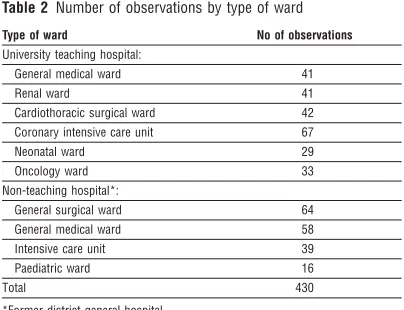
A total of 113 nurses and one doctor were observed over 76 days (table 1). Table 2 shows the number of
observations on each ward. All the nurses agreed to participate. On three occasions ward managers asked the researcher not to observe a particular drug round as the general workload on the ward was high. Altogether 1042 doses of intravenous drugs, represent-ing 35 different drugs, were prescribed for 106 patients during the study. Our observations were representative for the study period: 41% (430) of all intravenous drug doses prescribed were observed; administrations of 91% (32) of the prescribed drugs was observed at least once; and 92% (98) of patients who were prescribed regular intravenous drugs were observed at least once. The researcher intervened in 12 cases to prevent an error reaching the patient.
One or more errors occurred in the preparation and administration of 212 out of 430 intravenous drug doses (error rate 49%, 95% confidence interval 45% to
Box 1: Classification of intravenous drug errors according to stage of occurrence (categories are mutually exclusive)
Preparation stage
Identification of prescription Preparation process:
Ready for administration
One step preparation, eg measuring a drug solution Multiple step preparations, eg measuring and diluting a drug solution, reconstitution of a drug
Administration stage Identification of the patient Administration process:
Bolus dose injection, usually 3 to 5 min Intermittent infusion
Continuous infusion
Box 2: Classification of type of intravenous drug errors (categories are mutually exclusive)
Preparation errors Preparation of wrong drug
Preparation of an unauthorised drug Errors in solvent/diluent (use of wrong solvent/diluent or wrong volume) Preparation of wrong dose Omission of prescribed drug Other
Administration errors Administration to wrong patient
Fast administration of bolus dose through a peripheral line
Fast administration of bolus dose through a central line
Incompatibility errors Other
Table 1 Position of staff included in the study
Staff grade No of observations
Staff nurse 280
Ward manager/sister 73
Bank/agency nurse 62
Student nurse 11
Doctor 4
Total 430
Table 2 Number of observations by type of ward
Type of ward No of observations University teaching hospital:
General medical ward 41
Renal ward 41
Cardiothoracic surgical ward 42 Coronary intensive care unit 67
Neonatal ward 29
Oncology ward 33
Non-teaching hospital*:
General surgical ward 64
General medical ward 58
Intensive care unit 39
Paediatric ward 16
Total 430
54%). A total of 249 errors were identified. Preparation errors occurred in 32 intravenous doses (7%), adminis-tration errors in 155 doses (36%), and both types of error in 25 doses (6%). Errors were potentially severe in three doses (1%), potentially moderate in 126 (29%), and potentially minor in 83 (19%). Box 3 describes the three severe errors and typical examples of moderate and minor errors.
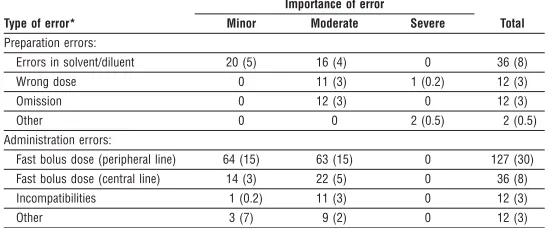
The figure shows the incidence of errors at each stage of drug preparation and administration. Most preparation errors were associated with multiple step preparations—for example, drugs that required recon-stitution with a solvent and addition of a diluent. Typi-cal errors were preparing the wrong dose or selecting the wrong solvent. All three severe errors occurred at this stage. A few errors occurred in identifying prescriptions—for example, not seeing a drug order. Most errors occurred when giving bolus doses, with errors in 172/235 (73%) doses. In most of these cases (163, 95%) the dose was given faster than recom-mended, which is usually three to five minutes; more than half of these errors (85, 52%) were considered to be of potential moderate severity. Table 3 gives a more detailed analysis of the type and severity of the errors.
Discussion
We found a high incidence of errors in the preparation and administration of intravenous drugs. Although most were unlikely to cause lasting harm, some were serious. The sample was taken from two types of hospi-tal and included a range of patients, nurses, drugs, drug administration times, ward specialties, and frequency of drug administration on the ward. We have used explicit methods, definitions, and tools that we hope others can use elsewhere for research and audit.
Although the proportion of serious errors is small, the number of patients and intravenous doses in a hos-pital means that errors may be more common than expected. A point prevalence study we carried out in the university teaching hospital (400 beds) showed that about 112 (28%) of inpatients received intravenous drugs, resulting in more than 300 doses a day. Although we cannot extrapolate with any precision, our data suggest that at least one patient will experience a potentially serious intravenous drug error every day in a hospital of that size. Hence, intra-venous drug errors are a potential source of serious harm for patients and risk reduction strategies should be developed accordingly.
Reducing the risks
Our analysis shows that the two weak stages in the system are drugs that require multiple step prepara-tion and administraprepara-tion of doses as a bolus. Several strategies could be used to reduce multiple step preparation errors. Centralised preparation of intra-venous drugs by the pharmacy department was suggested in the 1970s in the United Kingdom but was rarely adopted.15Centralised preparation of intra-venous drugs is common in the United States16but not in Europe, apart from in specialised areas such as oncology.17 The evidence for centralised services is currently weak, and it is unclear whether they are cost effective or improve the quality of the service.18–21An alternative strategy would be to purchase ready
prepared intravenous drugs from pharmaceutical companies.
The effect of the above changes would have to be assessed carefully. New types of errors could be
Box 3: Examples of intravenous drug errors
Potentially severe errors
• The whole content of a vial containing 125 000 international units of heparin was prepared as a continuous infusion, resulting in a five times overdose (severity score 8.4; general medical ward, teaching hospital). Comment: Haemorrhage is one of the serious, potentially life threatening complication of an overdose of heparin.
• A nurse injected 750 mg vancomycin into an infusion bag of 0.9% sodium chloride (already connected to the patient’s cannula) without mixing the solution. The patient is likely to have initially received a concentrated solution of vancomycin as a bolus (severity score 7.3; renal ward, teaching hospital).Comment: Rapid infusions of vancomycin carry the risk of reactions such as severe hypotension (including shock and cardiac arrest) and flushing of the upper body.
• A patient’s continuous infusion of adrenaline (epinephrine) was interrupted for about 10 minutes as the new infusion had not been prepared in advance (severity score 7.5; intensive care unit, non-teaching hospital).Comment: This patient’s blood pressure decreased to about 50/30 mm Hg. A bolus dose of adrenaline and midazolam was given to stabilise him until the adrenaline infusion was restarted.
Potentially moderate errors
• A nurse measured 0.2 mg metoclopramide using a 1 ml syringe and then drew up 0.9% sodium chloride into the same syringe. This was administered as a bolus dose. Using this preparation technique, the metoclopramide contained in the dead space of the syringe (hub and needle) was also administered to the patient, resulting in a two to three times overdose (severity score 7.0; neonatal ward, teaching hospital).Comment: Side effects include extrapyramidal effects, which are more likely in children. There are also reports of cardiac conduction abnormalities.
• A patient’s lunchtime dose of 750 mg cefuroxime was omitted because of his transfer to another ward at lunchtime (severity score 4.1; cardiothoracic surgical ward, teaching hospital).Comment: Successful anti-infective therapy depends on achieving effective levels.
• Administration of 80 mg furosemide (frusemide) over 45 seconds through a peripheral vein (severity score 6.1; general surgical ward, non-teaching hospital).Comment: The recommended duration of administration was 20 min (4 mg/min). Tinnitus and deafness are among the side effects reported after rapid administration.
Potentially minor errors
• Preparation of 1.2 g co-amoxiclav using 10 ml instead of 20 ml water for injection (severity score 2.3; general surgical ward, non-teaching hospital). Comment: The drug may not dissolve completely when insufficient solvent is used. Concentrated solutions may also increase the risk of
thrombophlebitis.
• Administration of 500 mg amoxycillin/10 ml of water by injection over 2.5 minutes rather than through a peripheral vein over 3-5 minutes (severity score 2.9; general medical ward, teaching hospital).Comment: More rapid administration may damage the blood vessels but is unlikely in this case.
Identification of prescription
12/430 (3%)
Ready for administration
0/53
One step preparation
0/32
Multiple step preparation 50/345 (14%)
Identification of patient
0/430
Bolus dose injection 172/235 (73%)
Intermittent infusion 15/163 (9%)
Continuous infusion
0/32
introduced, such as transmission errors from the ward to the preparation department.22Furthermore, nurses who are no longer used to preparing intravenous drugs may make serious errors if they have to prepare drugs in an emergency.
Technical solutions could reduce the frequent errors from rapid bolus injections—for example, a pump that prevents fast administration of bolus doses. Staff training could improve awareness of drugs that have a high risk of adverse effects when given too fast. A warning could also be put on the drugs by the pharmacy.
Validity of study
The effect of the observer on the observed is often dis-cussed as a possible limitation of ethnographic observation methods.23 The error rate may be even higher in the absence of the researcher. However, a previous observation based study using a similar method showed that the drug error rate is unlikely to be affected by the observer, even if the observer occasionally intervenes.12Modification of behaviour is minimal once the researcher is an accepted member of the group and part of the social context.24 The researcher seemed to have been accepted in our study, and some initial activities by nurses, such as wearing gloves to make up the doses, were soon abandoned. Using an observation based approach allowed us to explore drugs errors that would not have been documented and therefore missed by studies relying on review of hospital records.8 9 11
Conclusions
Our study shows that errors in the preparation and administration of intravenous drugs remain a concern in the United Kingdom, 25 years after the problem was first highlighted. Steps to ensure the correct adminis-tration of bolus doses and to reduce mistakes in making up drugs that require multiple step prepara-tion will have the greatest effect on error rates.
We thank the staff of the two participating hospitals.
Contributors: KT and NB designed the study and wrote the paper. KT collected the data and was responsible for data analy-sis. KT and NB are guarantors.
Funding: School of Pharmacy, University of London. The guar-antors accept full responsibility for the conduct of the study, had access to the data, and controlled the decision to publish. Competing interests: None declared.
Ethical approval: The ethics committees of the participating hospitals approved the study.
1 Dyer C. Doctors cleared of manslaughter.BMJ1999;318:148. 2 Department of Health.Building a safer NHS for patients.London:
Station-ery Office, 2001.
3 Institute of Medicine Committee on the Quality of Health Care in America.To err is human.Washington: National Academy Press, 2000. 4 Thur MP, Miller WA, Latiolais CJ. Medication errors in a nurse-controlled
parenteral admixture program.Am J Hosp Pharm1972;29:298-304. 5 Hartley GM, Dhillon S. An observational study of the prescribing and
administration of intravenous drugs in a general hospital.Int J Pharm Pract1998;6:38-45.
6 O’Hare MCB, Gallagher T, Shields MD. Errors in the administration of intravenous drugs.BMJ1995;310:1536-7.
7 Clark CM, Bailie GR, Whitaker AM, Goldberg LA. Parenteral drug delivery—value for money?Pharm J1986;236:453-5.
8 Brennan TA, Leape LL, Laird N, Herbert L, Localio AR, Lawthers AG, et al. Incidence of adverse events and negligence in hospitalized patients.
N Engl J Med1991;324:370-6.
9 Leape LL, Brennan TA, Laird N, Lawthers AG, Localio AR, Barnes BA, et al. The nature of adverse events in hospitalized patients.N Engl J Med
1991;324:377-84.
10 Wilson RM, Runciman WB, Gibberd RW, Harrison BT, Newby L, Hamil-ton JD. The quality in Australia health care study. Med J Aust
1995;163:458-71.
11 Vincent C, Neale G, Woloshynowych M. Adverse events in British hospi-tals: preliminary retrospective record review.BMJ2001;322:517-9. 12 Dean B, Barber N. Validity and reliability of observational methods for
studying medication administration errors. Am J Health Syst Pharm
2001;58:54-9.
13 Dean BS, Barber ND. A validated, reliable method of scoring the severity of medication errors.Am J Health Syst Pharm1999;56:57-62. 14 Gardner MJ, Altman DG.Statistics with confidence. London: BMJ
Publica-tions, 1989.
15 Department of Health and Social Security.Report of the working party on the addition of drugs to intravenous infusion fluids (Breckenridge report). London: DHSS, 1976.
16 Brzozowski DF, Hale KM, Segal R, Mirtallo JM. Pharmacists’opinion about and compliance with recommendations for intravenous admixture practices.Am J Health Syst Pharm1987;44:2077-84.
17 Delaney T. EAHP survey of hospital-based pharmaceutical services in Europe, 1995.Eur Hosp Pharm1996;2:92-105.
18 Armour DJ, Cairns CJ, Costello I, Riley SJ, Davies EG. The economics of a pharmacy-based central intravenous additive service for pediatric patients.PharmacoEconomics1997;10:386-94.
19 Chan R, Ryan M, Moriarty S, Feely J, Sabra K. The impact of a centralized reconstitution of intravenous additives service on administration times of intravenous antibiotics.Eur J Hosp Pharm1993;3:93-5.
20 Cousins DH, Lee M, Stanaway M, Neary C. Implementation and evalua-tion of a centralised IV additive service for antibiotic injecevalua-tions.Pharm J
1989;242:HS14-6.
21 Wilson M. An evaluation of the cost effectiveness of a centralised intravenous admixture service.Proc Guild1990;27:3-11.
22 Allan Flynn E, Pearson RE, Barker KN. Observational study of accuracy in compounding iv admixtures at five hospitals.Am J Health Syst Pharm
1997;54:904-12.
23 Mays N, Pope C. Observational methods in health care settings.BMJ
1995;311:182-4.
24 Weick KE. Systematic observational methods. In: Lindzey G, Arouson E, eds.The handbook of social psychology. Reading: Addison-Wesley, 1968:357-421.
(Accepted 30 January 2003)
Table 3Type and clinical importance of errors in preparation and administration of intravenous drugs. Values are numbers (percentages) of errors in 430 observations
Type of error*
Importance of error
Total Minor Moderate Severe
Preparation errors:
Errors in solvent/diluent 20 (5) 16 (4) 0 36 (8)
Wrong dose 0 11 (3) 1 (0.2) 12 (3)
Omission 0 12 (3) 0 12 (3)
Other 0 0 2 (0.5) 2 (0.5)
Administration errors:
Fast bolus dose (peripheral line) 64 (15) 63 (15) 0 127 (30) Fast bolus dose (central line) 14 (3) 22 (5) 0 36 (8) Incompatibilities 1 (0.2) 11 (3) 0 12 (3)
Other 3 (7) 9 (2) 0 12 (3)
*No errors were observed in the categories of preparing the wrong drug, using an unauthorised drug, or administration to the wrong patient.
What is already known on this topic
Errors in preparing and administering intravenous drugs can cause considerable harm to patients
Reduction of drug errors is a government health target in the United Kingdom and the United States
What this study adds
Errors occurred in about half of the intravenous drug doses observed
Errors were potentially harmful in about a third of cases
The most common errors were giving bolus doses too quickly and mistakes in preparing drugs that required multiple steps