Application of Artificial Intelligence Techniques for
Dissolved Gas Analysis of Transformers -A Review
*Manoj Kumar Jha,PP**Nisha Barle, ***Ruchi Trivedi
*Department of Applied Mathematics, Rungta Engg. College, Raipur, India (30TU[email protected]U30T)
**Ph.D. Scholar, Department of Mathematics, Dr. C.V. Raman University, Bilaspur, India ***Ph.D. Scholar, Department of Mathematics, Dr. C.V. Raman University, Bilaspur, India
Abstract: Chemical processes are systems that include complicated network of material, energy and process flow. As time passes, the performance of chemical process gradually degrades due to the deterioration of process equipments and components. The early detection and diagnosis of faults in chemical processes is very important both from the viewpoint of plant safety as well as reduced manufacturing costs. The conventional way used in fault detection and diagnosis is through the use of models of the process, which is not easy to be achieved in many cases. In recent years, an artificial intelligence technique such as neural network has been successfully used for pattern recognition and as such it can be suitable for use in fault diagnosis of processes [1]. The application of neural network methods in process fault detection and diagnosis is demonstrated in this work in two case studies using simulated chemical plant systems. Both systems were successfully diagnosed of the faults introduced in them. The neural networks were able to generalise to successfully diagnosed fault combinations it was not explicitly trained upon. Thus, neural network can be fully applied in industries as it has shown several advantages over the conventional way in fault diagnosis.
1. DGA Methods
The detection of certain level of gases generated in oil filled transformer in service is frequently the first available indication of malfunctioning that may lead to ultimate failure of a transformer, if not corrected. Arcing, corona discharge, low energy sparking, overheating of insulation due to severe overloading, failure of forced cooling systems are some of the possible mechanism for gas generation. The gases generated in oil filled transformers that can be used for qualitative determination of fault type, based on which gas is typical or predominant at various temperatures. These gases are hydrogen (HR2R), methane
(CHR4R), ethylene (CR2RHR4R), ethane (CR2RHR6R), acetylene (CR2RHR2R), carbon monoxide (CO), and carbon dioxide
(COR2R).
2. Artificial Intelligence Techniques Applied to DGA
Data of the dissolved gas in oil can be incorporated into expert systems to facilitate decision making. There also exists certain amount of uncertainty in the data concerning dissolved gas analysis due to generation, sampling, and chromatography analysis. There is thus variation in interpreting the variation of the gases by the utilities. Due to the diverse gas content of the insulating oil of transformers many AI techniques have been presented. The AI techniques studied and used by the researches for application to DGA are Expert Systems , Fuzzy Inference Systems (FIS) and various type of Artificial Neural Networks
(ANN), Genetic Algorithm (GA)and even Novel Cerebellar Model Articulation Controller based method for off line and on line monitoring and Discrete Wavelet Transforms for on line monitoring.
3. Expert Systems
The expert system is decision support systems that have been applied for fault diagnosis and maintenance to advance the DGA information and incorporate it to build diagnostic rules. The effectiveness of the knowledge expert systems depends on the precision and knowledge base, which is usually very complicated and must be constricted carefully. Such an expert system can neither acquire knowledge from new data samples through self-learning process and nor can it adjust its diagnostic rules automatically. C. F. Lin et al. developed an expert system to diagnose transformer faults using DGA and also suggested proper maintenance. Data of 251 samples from transformers of Taiwan Power Company were used; three cases are discussed in details for the last five to six tests carried out. For the first two samples the diagnostic results agreed with the actual fault type causes and appropriate maintenance was suggested. For the third case the transformer unit after more than seventeen years of operation suffered an arc tracing fault. After repairing and degassing the transformer oil a gas fingerprint of this transformer was developed.
4.Fuzzy inference system
K. Tomsovic et al. proposed a fuzzy information approach to integrate different transformer diagnostic methods. Five gases were considered and detailed analysis of four transformers had been carried out. A fault tree was proposed and there was a framework for performing diagnosis using fuzzy information system. The fuzzy relations were combined with the fault tree to provide best analysis possible. The fact that an older or a heavily loaded transformer will have high concentration of gases that have built up over a time was taken into account. The proposed framework could provide a good foundation for providing diagnosis on variety of power system equipment. Yann-Chang Huang et al. used Evolutionary Fuzzy Logic to develop a diagnostic system. The DGA method considered were Rogers Ratio, Doernenburgs’ & IEC method. All the seven gases were considered. N.A Muhamad et al. made a comparative study & analysis using fuzzy logic for six DGA methods namely Key Gas, Rogers Ratio, Doernenburg’s, Logarithmic Nonograph, Duval Triangle, and IEC Method. 69 samples were used and a MATLAB program was developed to automate the evaluation of the methods. Some basic coding and construction of simulink block diagram was carried out. It was found that the accuracy gets reduced with fuzzy logic this was because the no of predictions when using fuzzy system is increased and this increases the possibility of incorrect prediction.
5.Artificial Neural Network
Diego Roberto Moaris et al. proposed an ANN approach for Transformer Fault Diagnosis. Forty sample sets from different transformers are used for training and testing of major fault type diagnosis. A two step Back Propagation Algorithm ANN approach was used. One ANN was used to classify the major fault type and the second ANN focused on determining in case cellulose is involved. The two step approach made ANN easier to train and more accurate in detecting faults. For diagnosis of oil-insulated power apparatus using neural network simulation O. Vanegas et al. used real data from 26 samples. NN Back propagation technique algorithm was used. In the NN the input features (or variables) selected were the ratios while in the second SOPN the input features (or variables) selected were the gases HR2R, CHR2R, CR2RHR6R,
CR2RHR4R, and CR2RHR2R. Two ANN- were built as well using the same sample data by error back propagation
training algorithm. J. L. Guardado et al. made a comparative study of Neural Network Efficiency in Power Transformer Diagnosis using DGA.
A feed forward neural network was trained to diagnose reasons for failure of distribution transformers. The training algorithm used was back propagation assuming initially a sigmoid transfer function for networks processing unit. After the network was trained the units’ transfer function was changed to hard limiters with thresholds equal to the biased obtained for the sigmoid during training. Six individual ANN were used for six important factors that were; age of the transformer, the weather conditions, damaged bushings, damaged bodies, oil leakage, and winding faults. The six ANN’s are combined to one ANN to give recommendations complete diagnosis for working transformers to avoid possible failures. The developed ANN could give complete diagnosis of working transformer and be used as a decision support facilities to the companies for planning and maintenance schedule.
6. Artificial Neural Network & Fuzzy Logic
Transformer oil diagnosis using fuzzy logic and NN was proposed by James J. Dekagram using 150 real and synthetic examples. Fuzzy was applied to Key gas analysis, Rogers’ ratio method, and monographs. Feed forward neural network were used. It was concluded that fuzzy logic can be used to automate standard methods of transformer oil DGA. In some cases NN could be used in combination with fuzzy logic to implement more complex diagnostic methods while maintaining a straightforward relation between the enhanced method and the original one. The main obstacle to developing a real diagnostic rule is the lack of sufficient high quality examples with which to train and validate a network. Jingen Wang et al. applied fuzzy classification by Evolutionary Neural Network. The method models the membership functions of all fuzzy sets by utilizing a three layer feed forward network, trains a group of neural networks by combining the modified evolutionary strategy with Levenberg-Marquardt optimization method in order to accelerate convergence and avoid falling into local minima.
M. A. Izzularab et al. developed an on line method for diagnosis of incipient faults and cellulose degradation using neuro-fuzzy. Records of six gases were considered and for the cellulose degradation the ratio of COR2R/CO was used. A combination of neural networks and fuzzy sets was proposed to enhance the
diagnostic system. Multilayered perceptron with sigmoidal activation function and error back propagation algorithm for training was used for 160 data samples of Egyptian Electricity Network. 75% for the data was used for training and remaining 25 % for testing. Three cases were considered and discussed in detail. Total combustible gases (TGC) was used to decide the normal and abnormal condition in a transformer. A comparison of the proposed technique and reported methods were carried out. The test results reveled that the proposed system had the highest reported classification capability. Adriana Rosa et al made an attempt on knowledge discovery in NN with application to transformer failure diagnosis. A new methodology for mapping a neural network into a rule based fuzzy inference system. The maping makes explicit the knowledge implicitly captured by the neural network during the learning stage, by transforming it into a set of rules. 292 training and 139 testing patterns were used. The control of convergence of ANN has been taken into account not only the mean square error (MES) but also the success in classification. The classification of transformer faults has been done as onto three type only namely thermal faults, discharges and partial discharges. This is applied to transformer fault diagnosis using DGA. Good results were achieved and knowledge discovery was made possible.
7.Genetic Algorithm Approach
Yann-Chang Huang used a new data mining approach to dissolved gas analysis of oil-insulated power apparatus using 820 actual gas records of Taipower Company from 172, 68 kV transformers. The Genetic Algorithm (GA) and ANN (back-propagation) has been compared with Genetic Algorithm Tunes Wavelet Networks (GAWN) for data mining of dissolved gas analysis records and incipient fault detection of oil insulated power transformers. The GAWN’s have been tested using four diagnosis criteria, and compared with ANN and conventional methods. The GAWN’s have remarkable diagnosis accuracy and require far less learning time than ANN’s for different diagnosis criteria. Wavelet network for power transformers diagnosis using DGA was proposed by Weigen Chen et al.. 700 samples were used; 400 training samples and 300 testing samples. Wavelet Networks (WN’s) are an efficient model of nonlinear signal processing developed in recent years. The training and testing samples are processed by fuzzy logic technology comparison and analysis of network training process and simulation results of five WN’s. The proposed approach had many important advantages over traditional methods of analysis and interpretation of DGA data. The novel approach does not depend upon any actual fault cases for its modeling, hence it is easy and cost effective to implement. It provides more consistent and convincing diagnosis as the revealed structure actually originates from the real measured DGA records. The feed forward wavelet network used is divided into two types based on different activation functions of the wavelet nodes applied in fault diagnosis of power transformer. A GA base on real-encoded method of optimization in WN, was put forward (WNfiGA) which is used to optimize the structure and parameters of the training process. The training process, diagnostic results and reasons for the difference in diagnosis are compared and analyzed. The Gauss activation function used achieve higher diagnostic accuracy because it can capture, the non-linear relationship among dissolved gas contents and corresponding fault information. The WN-GA had higher fault reorganization as compared the two other WN.
8.Discrete Wavelet Transform Method
Karen L. Butler-Purry et al. for identifying transformer incipient events for maintaining distribution system reliability have used Discrete Wavelet Transform (DWT). The approach has been applied to investigate the characteristics of incipient events in single phase transformer. MATLAB program was used to calculate the DWT of the signals. The Daubechies Db-4 type wavelet was used as a mother wavelet. On line incipient fault detection technique for distribution transformer was based on signal analysis. The method used discrete wavelet transform to identify incipient faults in single phase distribution transformers. The simulation method is based on Finite Element Methods (FEM) and ANSOFTs’ Maxwell software was used for the circuit analysis. The simulation method takes into account the aging phase and the arcing phase. An experimental setup was made and the simulation methodology was tested. Time-domain results and frequency-Time-domain results were compared for single phase transformer. The data obtained from tests and computer simulations were used to observe the variation. The results show the potential of using DWT-based method for fault prediction, maintenance and maintaining reliability of transformer.
9. Proposed Sequential Hybrid System
Each of the soft computing methods has been inspired by biological computational processes and natures problem solving strategies. Each of these techniques, in their own right has provided efficient solutions to fault identification in transformers using DGA. Attempts on wide range of problems belonging to different domains have been made to synergize the three techniques - Fuzzy Logic, Neural Networks and Genetic Algorithm. The objective of synergy or hybridization is to overcome the weakness of one technology during its application, with the strengths of the other by appropriately integrating them. The hybridization of technologies has its pitfalls and should be done with care. The hybrid systems are classified as Sequential hybrid, Auxiliary hybrid and embedded hybrid.
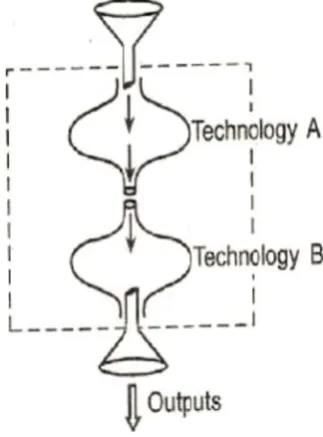
Fig. 5.1 shows a sequential hybrid system. When the output of one technology becomes another’s input and they are used in pipeline fashion the system is said to be sequential hybrid. Since an integrated combination of the technologies is not present it is one of the weakest forms of hybridization. The Neuro-fuzzy hybrid system is one of the most researched form and has resulted in stupendous quantity of publication and research results. These systems have demonstrated the potential to extend the capabilities of the system beyond either of these technologies when applied individually. There are two ways of looking at this hybridization. One is to endow NN’s with fuzzy capabilities, thereby increasing the networks expressiveness and flexibility to adapt to uncertain environment, the other one is to apply neuronal learning capabilities to fuzzy system to make the fuzzy system more adaptive to changing environments. This approach is also known in literature as NN driven fuzzy reasoning.
Fig. 5.1 shows a sequential hybrid system.
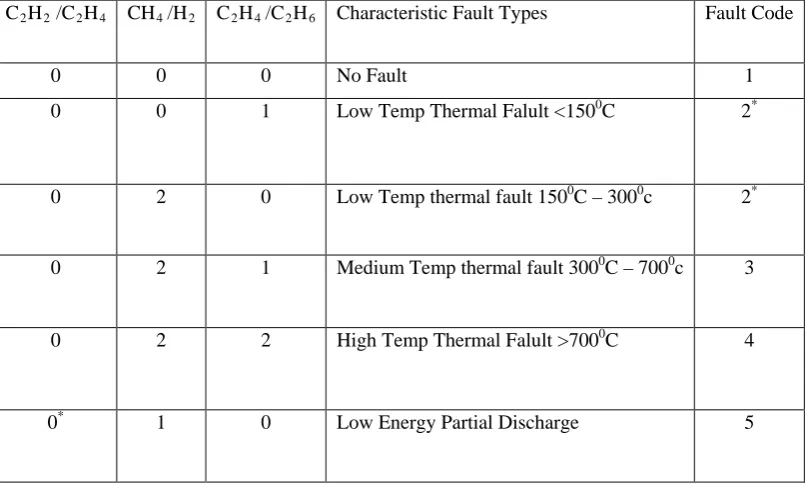
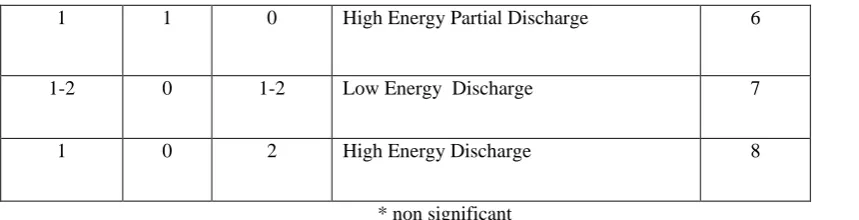
The IEC/IEEE ratio codes used in the recent research work are given in Table 5.1 the codes used for
interpretation are tabulated in Table 5.2.
Table 5.1 IEC/IEEE Ratio Codes Ratio of Characteristic Gases Range Code of range ratio
CR2RHR2 R/CR2RHR4
< 0.1
0.1 – 1.0
1.0 – 3.0
> 3.0
0
1
1
2
CHR4 R/HR2
< 0.1 0.1– 1.0 1.0– 3.0 > 3.0 1 0 2 2
CR2RHR4 R/CR2RHR6
< 0.1
0.1– 1.0
1.0 – 3.0
> 3.0
0
0
1
2
Table 5.2 IEC/IEEE codes for the interpretation of DGA Method
CR2RHR2R /CR2RHR4 CHR4 R/HR2 CR2RHR4 R/CR2RHR6 Characteristic Fault Types Fault Code
0 0 0 No Fault 1
0 0 1 Low Temp Thermal Falult <150P
0
P
C 2P
*
0 2 0 Low Temp thermal fault 150P
0
P
C – 300P
0
P
c 2P
*
0 2 1 Medium Temp thermal fault 300P
0
P
C – 700P
0
P
c 3
0 2 2 High Temp Thermal Falult >700P
0
P
C 4
0P
*
1 0 Low Energy Partial Discharge 5
1 1 0 High Energy Partial Discharge 6
1-2 0 1-2 Low Energy Discharge 7
1 0 2 High Energy Discharge 8
* non significant
It is established that the main difficulty for developing a good diagnostic rule is the lack of sufficient high quality examples with which to train and validate a network. So, as to overcome this in the proposed work real data from research publications and test records from utilities has been taken. Of the total samples randomly 60% are taken as training data, 20% as validation data, and the remaining 20 % as testing data.
The NN were trained and validated and the rules are extracted from the trained neural network. Since the NN have no explaining ability its difficult to interpret the results hence the extracted rules from the trained NN would be used for defining the membership functions of the FIS which can explicitly display the knowledge by the AI techniques The human understanding would be greatly improved and the engineers and technicians would gain confidence in fault diagnosis of transformers. The proposed system is shown in Fig. 5.2. The results of the work will be published in a separate paper.
INPUT: DATA FROM DGA
IEC/IEEE CODES FOR INTERPRETATION OF GDA METHOD
INPUT TO ANN (TECHNOLOGY: A)
EXTRACTING RULES FROM ANN
INPUT TO FIS (TECHNOLOGY: B)
OUTPUT
Fig. 5.2 Schema of proposed Diagnostic system
Conclusion
After study of the AI methods applied for the fault detection in transformers based on DGA methods, it has been found that these can be used to evaluate the condition of the transformer provided sufficient amount of reliable DGA data is available. Each of AI techniques and combination of two of these, in their own right has provided efficient solutions to incipient fault identification. The synergy of ANN and FIS can be a good solution for reliable results for predicting faults because one should not rely on a single technique when dealing with real –life applications. The SVM classifiers offer very considerable results and has demonstrated its efficiency for power transformers fault diagnosis.
Reference
1. Fan, J.Y., Nikolaou, M. & White, R. E. (1993). An approach to fault diagnosis of chemical
processes via neural networks. AIChE Journal, 39, 82-88.
2. Himmelblau, D. M. (1978). Fault Detection and Diagnosis in Chemical and Petrochemical
Processes, Amsterdam: Elsevier.
3. Watanabe, K., Matsuura, L., Abe M. & Kubota M. (1989). Incipient Fault Diagnosis of Chemical Processes via Artificial Neural Networks. AIChE Journal, 35, 1803-1812.
4. Watanabe, K., & Himmelblau, D. M. (1984). Incipient Fault Diagnosis in Nonlinear Chemical Processes with Multiple Causes of Faults. Chemical Enineering. Science, 39, 491-508.
5. Hoskins, J. C., & Himmelblau, D. M. (1988). Artificial Neural Network Models of Knowledge
Representation in Process Engineering Computers and Chemical Engineering, 12, 881-890. 6. Pao,Y. (1989). Adaptive Pattern Recognition and Neural Network. New York: Addison-Wesley. 7. Hussain, M.A & Kershenbaum, L.S. (2000). Implementation of inverse model- based control
strategy using neural networks on a partially simulated exothermic reactor. Transactions of
Chemical Engineers (Part A), 78, 299-311.
---