Strength in Numbers: Threshold ECDSA
to Protect Keys in the Cloud
Marc Green and Thomas Eisenbarth
Worcester Polytechnic Institute, Worcester, MA, USA
{marcgreen,teisenbarth}@wpi.edu
Abstract. Side-channel attacks utilize information leakage in the imple-mentation of an otherwise secure cryptographic algorithm to extract se-cret information. For example, adversaries can extract the sese-cret key used in a cryptographic algorithm by observing cache-timing data. Threshold cryptography enables the division of private keys into shares, distributed among several nodes; the knowledge of a subset of shares does not leak in-formation about the private key, thereby defending against memory dis-closure and side-channel attacks. This work shows that applying thresh-old cryptography to ECDSA—the elliptic curve variant of DSA—yields a fully distributive signature protocol that does not feature a single point of failure. Our security analysis shows that Threshold ECDSA protects against a wide range of side-channel attacks, including cache attacks, and counteracts memory disclosure attacks. We further provide the first per-formance analysis of Threshold ECDSA, and provide a proof of concept of the protocol in practice.
Keywords: Threshold Cryptography, Elliptic Curve Cryptography, ECDSA, SSL/TLS, Side-channel Attacks, Cloud Computing
1
Introduction
across cores and across VM boundaries; Benger et al. recovered ECDSA private keys using Flush+Reload [2]. Recently, Liu et al. and Irazoqui et al. have both developed new cross-VM attacks using the Prime+Probe method that do not rely on memory deduplication [25, 16], making cache attacks a realistic concern for today’s public clouds.
Existing defenses against cache attacks fall under two categories: architec-tural countermeasures and algorithmic countermeasures. The former prevent the exploitability of side-channels on the architectural level. They can be im-plemented at the hardware [35, 23, 10], the hypervisor, or the OS level [21, 39]. Architectural countermeasures generally come at a performance overhead. Since the overhead usually applies to all applications, not only security critical ones, they are often viewed as too expensive. Algorithmic countermeasures, on the other hand, usually armor the implementation or algorithm of the used cryp-tosystems. Protection methods include: (i) The use of isochronal algorithms, thus preventing data dependent timing differences from arising [27]; (ii) The use of software diversification to randomize control flow and thus hide leaked in-formation [8]; (iii) The use of threshold cryptography to prevent sensitive data from appearing in memory at all (e.g., [30]). Unlike architectural countermea-sures, only the security-critical code is protected in algorithmic countermeasures. Hence, performance penalties are restricted to security-critical code and do not affect other applications.
Our Contribution:In this paper, we proposeNephele, a cloud-based system resilient to cross-VM side-channel attacks on ECDSA through the use of thresh-old cryptography. Our approach is completely transparent to the end user and can work as a drop-in replacement for existing ECDSA implementations. Our fundamental technique comes from the application of threshold cryptography: the ECDSA private key is split into multiple shares and distributed to multiple VMs. To sign a message, each VM will use its private key share to compute a
performance, and budget constraints. Our benchmarks show thatNephele in-curs a reasonable performance overhead over unprotected ECDSA. In summary,
Nephele:
– presents the firstfully distributedthreshold implementation of ECDSA. This is achieved by providing fully distributed key generation and signature gen-eration algorithms. Based on the protocol proposed in [15], we show several tweaks that further enhance performance.
– allows for fully distributed key re-sharing, effectively limiting the number of observations and hence the amount of information that a side-channel adversary can aggregate per key share.
– significantly raises the bar for any attacker by requiring the compromise of at leastt+ 1 machines to recover any sensitive information.
Results are backed up by a detailed security and performance analysis ofNephele, as well as a proof-of-concept implementation1.
The rest of the paper is organized as follows. We give relevant background information in Section 2. Threshold ECDSA and our modifications are described in Section 3, and we analyze their security in Section 4. We deploy a proof-of-concept of Nephele to a realistic cloud-based setting and analyze its perfor-mance in Section 5. We discuss Nephele with respect to related and future work in Section 6. Finally, we conclude in Section 7.
2
Background
2.1 Threshold Cryptography
Threshold cryptography, an application of secure multiparty computation [13], splits sensitive data into multiple shares and distributes them among a set of
n participants. To compute cryptographic operations, a subset of participants use their shares to compute partial results, which are then combined to produce the final result. A threshold t ≤ n is defined such that t or less shares cannot
be used to compute the final result, but t+ 1 or more shares can be. We refer to these as (t, n)-threshold secret sharings. When applied to a digital signature scheme, the signer’s private key is shared so that partial signatures are computed by the participants. The partial signatures are combined to produce the full signature, identical to one that could be computed with the unshared private key. The mathematical techniques used in these operations are designed such that the unshared private key never appears during computation. Thus, while side-channels could still be used to attack a threshold signature scheme, the adversary
cannot recover the sensitive data unless t+ 1 shares are recovered. Note that the use of threshold cryptography thus protects againstallside-channel attacks, not only cache-timing attacks.
Gennaro, et al., apply threshold cryptography to DSS in [12]. We use their protocol as a basis for Nephele. In [30], Pattuk, et al. use existing threshold
1
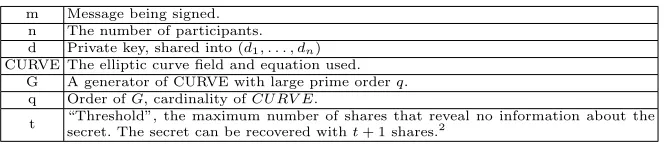
Table 1.Notation and Definitions
m Message being signed. n The number of participants. d Private key, shared into (d1, . . . , dn)
CURVE The elliptic curve field and equation used. G A generator of CURVE with large prime orderq.
q Order ofG, cardinality ofCU RV E.
t “Threshold”, the maximum number of shares that reveal no information about the secret. The secret can be recovered witht+ 1 shares.2
cryptographic algorithms to create a cloud-based system resilient to key leak-age. To defend against cross-VM side-channel attacks, their system distributes key shares among a set of cooperating VMs. We adopt their system model in developing our own proof-of-concept system forNephele.
2.2 ECDSA
ECDSA, standardized by NIST in 2003 [28], is a variant of DSA that uses ellip-tic curve cryptography. It is supported in TLS as part of the key exchange and client authentication algorithms [4]. ECDSA is also supported in OpenSSL, first introduced in version 0.9.8. The main benefit of using elliptic curve cryptography is that the keys and generated signatures are significantly smaller in size. For ex-ample, for 128 bits of security, ECDSA requires a 256 bit key, whereas DSA and RSA require 3248 bits [9]. This additional security of ECDSA comes from the in-tractability of the Elliptic Curve Discrete Logarithm Problem (ECDLP). Unlike the Integer Factorization Problem and the ordinary Discrete Logarithm Prob-lem (DLP), there is no subexponential-time algorithm known for the ECDLP, substantially increasing its strength-per-key-bit [19]. Another benefit is that the performance of ECDSA signature generation scales well with key sizes. While ECDSA and RSA have comparable signing performance for small keys (less than 409 and 7680 bits, respectively), ECDSA becomes significantly faster with larger keys [18].
3
Threshold ECDSA (TECDSA)
A robust threshold ECDSA has been proposed by Ibrahim et al. in [15]. That protocol is, in principle, the elliptic curve version of the threshold DSS intro-duced by Gennaro et al. [12]. Note that, forNephele, we have slightly modified key generation and signature generation by dropping robustness, making key generation explicitly distributed, and improving efficiency by reordering some of the steps of the algorithms. We further introduce a key re-sharing algorithm used to refresh the secret key shares as an additional defense mechanism. ECDSA’s signature verification algorithm processes no secret information and is not dis-cussed further. The parameters of the protocol are introduced in Table 1 and are used throughout the rest of this paper.
2
Algorithm 1TECDSA Key Generation
Domain Parameters:CU RV E, cardinalityq, generatorG
Input: None
Output: Public key:Q, private key shares:di
1: Generate private key sharesdi←Z∗qwithJRSS .JRSS requiresnbroadcasts.
2: Broadcastfi=G×di
3: Q= Exp-Interpolate(f1, . . . , fn) .[=G×d] ; See below for Exp-Interpolate()’s definition.
4: return(di, Q)
Algorithm 2Re-sharing private keyd
Input: ParticipantPi’s share of private key,di Output:Pi’s new private key share,d0i
1: Generate zero sharezi←Z∗q withJZSS .JZSS requiresnbroadcasts.
2: d0i=di+zi
3: returnd0i
Key Generation We have modified the ECDSA key generation algorithm to make our signature schemefully distributed. The private key is collectively cho-sen at random by all participants using JRSS. The threshold key generation algorithm is given in Algorithm 1. Each step of the algorithm is to be executed by every participant and ought to be carried out synchronously due to its in-teractive nature. Note that, while Ibrahim et al. [15] did not realize they could simply make the key generation fully distributed, their joint randomverified se-cret sharing scheme (EC-JRVSS, c.f. Appendix A) can be used to make this key generationrobust.
Signature Generation While threshold signature generation is well explained in [15], we give a slightly modified version in Algorithm 3 in Appendix B. Our version is closer to the protocol found in [12] (titled DSS-Thresh-Sig-1) and shows slightly more efficient performance that the version by Ibrahim et al.
Re-sharing the Private Key The fully distributed key re-sharing is achieved by having the participants execute one round of JZSS, and adding the resulting zero-share to the participant’s private key share (see Algorithm 2). As long as one participant is honest during JZSS and introduces randomness, the resulting zero-shares will be random. The use of JZSS allows us to additively mask the private key share without changing the actual private key. Note that key re-sharing is an excellent measure to prevent aggregation of potential key leakage. Like the other distributed algorithms, each step of this algorithm is to be executed by every participant and ought to be carried out synchronously due to its interactive nature.
4
Security Analysis
that arise when cryptography is used by an implementation in practice. These attacks are usually not considered in the security discussion of the cryptosystem itself. Specifically, our system protects against memory disclosure attacks as long as at mosttparties are affected. It also protects against implementation attacks such as side-channel attacks.
4.1 Scenario
We assume protocol participants are to be instantiated as independent VMs and there are enough VMs to support the desired threshold. Specifically,n≥2t+ 1. The participants have pair-wise private channels they can use to communicate with one another. These are used whenever the protocol needs to execute an instance of SSS, JRSS, or JZSS. Also, the private key is created in a shared fashion by invoking the key generation algorithm described in Section 3. The key is to be re-shared according to Section 3. Under these assumptions, we define oursecurity goalsas follows:
1. The system should withstand side-channel attacks of a passive, potentially co-located adversary.
2. The system should be able to tolerate memory disclosure attacks on up to t participants. These memory disclosure attacks can be viewed as an attacker managing to break into a VM and read the entire memory content, including all keys. Similarly, it describes a system that has been successfully compromised by means of a side-channel attack.
3. The system should remain operational when up to tparticipants have been compromised by an adversary. In addition, the remaining honest majority should be able to identify misbehaving nodes that try to compromise the protocol operation.
Based on the scenario and the security goals, we now define the adversary. The adversary’s primary goal is to learn the secret key d. A secondary goal is to disrupt service, e.g., by dropping network messages or sending bogus partial signatures. We define three types of adversaries:
An eavesdropping side-channel adversary is able to observe all traffic sent over the network. In addition, the adversary can observe a subset of physical machines participating in TECDSA. This will allow the adversary to col-lect partial information on secrets processed by the monitored participants through side-channels. This passive adversary is only trying to steal keys and will not actively corrupt messages.
A persistent adversary is one who compromises one of the participating VMs in order to witness at least one execution of the protocol. This includes eavesdropping on secure channels and gaining root privileges on the VM. Like the eavesdropping side-channel adversary, the persistent adversary will not attempt to corrupt signatures throughout execution of the protocol. An active adversary is a persistent adversary who additionally has the means
4.2 Security Analysis
The security of TECDSA against the above adversaries comes from the use of threshold cryptography; the adversary can no longer directly extract the secret key d from any one participant, since no participant has knowledge of d on its own. Instead, at least t+ 1 shares of d must be extracted, each of which is stored with a different participant (in the cloud, each participant would be a different VM, and each VM would run on a different machine). Ideally,tis chosen such that it is infeasible to executet+ 1 successful cross-VM attacks before the secret key is re-shared. Recall that the aforementioned VM co-location problem is hard and thus it is unlikely an adversary can mount these attacks concurrently. In [12], a threshold signature scheme is secure if it is unforgeable and robust. While TECDSA is unforgeable (discussed below), it does not currently satisfy the robustness requirement. However, Ibrahim et al. [15] showed that adding robustness to TECDSA is possible and straightforward. We chose to exclude robustness, as it incurs a large network performance penalty. Thus, TECDSA protects against the eavesdropping side-channel adversary and the persistent adversary only.
An eavesdropping side-channel adversary does not win upon extraction of a single participant’s secret key share di; the adversary must extract at least
t+ 1 secret key shares from the participants. A proof of this is given in [12] for DSS. The proof applies to ECDSA as long as the ECDLP remains as intractable as the original DLP. Since the secret keydis periodically re-shared, the adver-sary’s window to extract t+ 1 shares is limited; Note that any extracted key shares become invalid and useless upon re-sharing the secret key. Bothtand the frequency of re-sharing can be adjusted to achieve an appropriate security level. Apersistent adversarywho eavesdrops on secure channels will learn the secret shares. During signature generation, the adversary can observeki, ai, bi,andci
of the compromised participant and thus reconstruct its secret key share di
(see step 10 of Algorithm 3). While the adversary will still need to acquire an additional t shares of the private key dto win, re-sharing dwill not thwart it due to its persistence.
Anactive adversarywho influences any of the three algorithms of TECDSA can send bogus data to the other participants during the protocol to force gener-ation of an invalid signature. While TECDSA cannot currently withstand bogus data, the use of Verifiable Secret Sharing (VSS) [11] would enable the detection of bogus shares (and their authors), and would allow the protocol to continue nor-mally, even under attack. (That is, replacing SSS with VSS will allow TECDSA to satisfy therobustness requirement.) An active adversary can also prevent the compromised VM from even participating in the protocol. Assumingn≥3t+ 1, TECDSA allows for up totparticipants to not participate (see [12] for a proof). Note that, even without VSS, each participant can detect potential manipulation by verifying the generated signature.
participant supplying random input. (Generating a unique, random ephemeral key k for every signature is crucial for protecting the private key d.) Further, the use of the random masks throughout the protocol prevents information from being leaked during computation.
Regardless of the type of adversary, generating a signature in TECDSA re-quires knowledge of at least t+ 1 secret key shares. By definition, TECDSA is unforgeable in the presence of an eavesdropping side-channel adversary and a persistent adversary. Since an active adversary, despite being able to influence signature generation, cannot learn the secret key shares of non-compromised participants, TECDSA is unforgeable in its presence as well.
Key Re-sharing Most side-channel attacks aggregate key leakage over several observations to finally recover a full long-term key. In fact, this is usually consid-ered one of the strengths of these attacks, as it allows an attacker to exploit even the faintest leakage channels. The more generic cross-core attacks not relying on deduplication [25, 16], i.e. the more realistic ones, need at least a few hun-dred observations to find and exploit critical key leakage. Even the ECC-centric cache-attacks that assume deduplication [2, 32] or even core-co-residency [6] need several observations to efficiently extract key information. For this reason, we propose to periodically re-share the private key across all participants. This key re-sharing increases the security of the system by bounding the adversary’s time to aggregate leakage on at leastt+ 1 shares ofd. If the adversary fails to extract
t+ 1 secret shares within the given time period, the discovered secret shares become invalid, and the adversary must start over. Unlike [30], which relies on a trusted dealer for key re-sharing, our system re-shares the secret key fully dis-tributively, avoiding a single point of failure that the dealer poses inHermes.
Conclusion By tolerating up tot key share compromises, and by periodically re-sharing these key shares, TECDSA can withstand side-channel attacks of a passive adversary. Further, TECDSA can tolerate up to t memory disclosure attacks because there is not enough information in the collective memory to reconstruct the secret key. Thus, TECDSA meets the first two security goals we defined in Section 4.1.
5
Protocol in Practice
Nephele is a system similar to [30] that uses TECDSA in a cloud setting to
combat various attacks including side-channel attacks. Since our system is fully distributed, key generation, signing, and key re-sharing happen in a distributed fashion. The system consists of a set of n networked VMs,Pi,1≤i ≤n, each
ready to participate in the protocol. The value of n determines the maximum threshold allowed: t ≤ n−1
2 (equivalently, n ≥ 2t+ 1). The intuition behind
this is as such: Since the protocol essentially involves multiplying two t-degree polynomials (step 5 of Algorithm 3), we need 2t+ 1 shares to interpolate the 2t-degree polynomial formed by their product (step 6 of Algorithm 3).
ParticipantE1
ParticipantE2 ParticipantEn
Defender'sEnetworkEofEvirtualEmachines
Client
1.ERequestEsignatureEforEm Combiner
2.ETECDSA
3.EReturnEsignatureE(r, s)
d1
d2
dn
Fig. 1.System Overview. The client connects to Participant 2, making it the combiner. The combiner initiates TECDSA and returns the resulting signature to the client.
between the participants. Signature generation is triggered by an outside node. The input is a message m to be signed, sent from a client to one of the par-ticipating computers, and the output is the signature (r, s) for m, sent from the participant back to the client. Without loss of generality, we use the term
combiner, denotedPc, to refer to the participant that initiates the protocol, i.e.,
the one requesting a signature formon behalf of the client. See Figure 1 for an overview of the system.
5.1 Implementation Details
We modify Algorithm 3 slightly to optimize the protocol under the assumption that network latency is a limiting factor while bandwidth is not. Note that key generation and re-sharing can be done any time, i.e. only the signing itself will influence latency. The applied optimizations are discussed in detail in Section 5.2. The abridged modified signing protocol is as follows:
1. Pc broadcastsmto all participants.(n−1network messages)
2. (a) The participants generateki, ai, bi,andcithrough known secret sharing
techniques.(n2−n network messages, can be computed offline)
(b) Each participant computesvi andwi.
(c) All participants sendvi andwi toPc.(n−1network messages)
3. Upon receiving allvis andwis,Pccomputesrand broadcasts it to the others.
(n−1 network messages)
4. (a) Each participant computessi.
(b) All participants sendsi to Pc.(n−1 network messages)
5. Pc calculatessand outputs the signature (r, s).
polynomial, as that is the shared secret and the only term of interest. The rele-vant parts of the inverse of the Vandermonde matrix is precomputed, so that only the matrix vector multiplication must be performed during computation. Our elliptic curvepoint multiplication implementation is written in C and interfaced through Python. This bypasses a technical limitation in Sage and helps give more accurate performance results. We use Elliptic Curve P-192, standardized by NIST is 1999, which provides 96 bits of security [29, 9].
5.2 Performance Overhead
Theoretical Analysis The modified protocol reduces the number of networks messages down to 4(n−1), not including messages involved with secret sharing (i.e., generatingki, ai, bi,and ci), by taking advantage of the fact that onlyPc
needs the signature. This is in comparison with Algorithm 3, which calls for about 2n2 network messages (again, not including the messages involved with secret sharing). However, because messages are sent out in parallel in each of the four broadcast steps, the network latency per signature is roughly equivalent to 2 round-trip-times (RTTs).
The secret sharing steps (specificallyJRSSandJZSS, steps 1-3 in Algorithm 3) use a mesh network of communication, generating n(n−1) ≈ n2 network
messages (assuming all three steps are carried out simultaneously, and their data is bundled into a single message). These steps, however, are independent of the input to the algorithm. Thus, in practice, these secret shares are generated offline when a client is not waiting for a signature. For example, in a (1,3)-threshold secret sharing of an arbitrary secret, 8 messages are sent through the network during signature generation, in addition to the 6 messages needed for the secret sharing steps.
The computational overhead for the combiner consists of 2 point multiplica-tions, 2 calls to Interpolate(), and 1 call to Exp-Interpolate(). The other par-ticipants compute neither the polynomial interpolations nor one of the point multiplications. Note that the point multiplication computed by the combiner and not the others (calculating r) does not depend on the system’s input and can thus be computed offline. Integer additions and multiplications are negligible and are not included in the overhead.
Experimental Analysis Several experiments were conducted to explore the performance overhead of Nephele, using our proof of concept implementation. These experiments were run on a Dell PowerEdge R720 server with an Intel Xeon 2670v2 processor (10 cores) and 32GB of RAM, running 64-bit Ubuntu Linux 14.04. Our experiments involved running Nephele on Ubuntu 14.04 virtual machines hypervised by KVM, each given 1 CPU core and 2GB of RAM.
Table 2. Average (N = 1000) ECDSA and Nephele itemized signature generation times (in milliseconds). The Total without Secret Sharing is included because secret sharing can be conducted offline.
Comp. Network Sec. Sh. Total Total w/o Sec. Sh.
ECDSA (1 VM) 1.77 N/A N/A 1.77 1.77
ECDSA (3 VMs) 2.32 N/A N/A 2.32 2.32
(1,3)-TECDSA 6.81 1.16 8.83 16.8 7.97
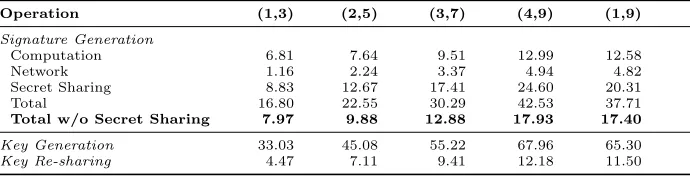
Table 3. Average (N = 1000) Nephele itemized signature generation times and (N = 100) key generation times for varying t and n (in milliseconds). Each column represents a different (t,n)-threshold setup.
Operation (1,3) (2,5) (3,7) (4,9) (1,9)
Signature Generation
Computation 6.81 7.64 9.51 12.99 12.58
Network 1.16 2.24 3.37 4.94 4.82
Secret Sharing 8.83 12.67 17.41 24.60 20.31
Total 16.80 22.55 30.29 42.53 37.71
Total w/o Secret Sharing 7.97 9.88 12.88 17.93 17.40
Key Generation 33.03 45.08 55.22 67.96 65.30
Key Re-sharing 4.47 7.11 9.41 12.18 11.50
three VMs (t= 1, n= 3). One VM took the role of the combiner, and the other two took the role of normal participants. The combiner did not interact with a client, but it initiated the protocol with random messages as if it had been. The results of these experiments are in Table 2. Our benchmarks measure the average signature generation time, itemizing the time spent in computation and sending data through the network. We also separately itemize the time spent secret sharing, since that can be computed offline in an optimized implementation.
Nephele incurs non-trivial computational overhead, taking 6.81 ms
com-pared to 2.32 ms for ECDSA. The dominating computational factors inNephele are the elliptic curve point multiplications and the exp-interpolation operations. Table 4 shows the time it takes to execute each of these operations for vari-ous (t,n)-threshold schemes. In every threshold scheme, they together consti-tute more than 80% of the total computation time. In a production version of
Nephele, the point multiplication could be sped up by using an elliptic curve
optimized for speed (for example, Curve25519 [3]). Further, the exp-interpolation operation could be implemented in a clever manner that reduces redundant com-putation. Note that the exp-interpolation is initially faster than the tabulated point multiplications, because the scalars used are initially very small. Even without these improvements, assuming secret sharing is conducted offline,
(1,3)-Nepheleis not significantly slower than ECDSA.
num-Table 4. Average (N = 1000) Nephelepoint multiplication and polynomial inter-polation times (in milliseconds). Each column represents a different (t,n)-threshold setup.
(1,3) (2,5) (3,7) (4,9) (1,9)
wi=G×ai 2.84 2.80 2.93 3.46 3.38
Rx= [β×µ−1]x 2.15 2.22 2.33 2.78 2.66
β= Exp-Interp(w1, . . . , wn) 0.70 1.49 2.97 5.20 5.08
Sum 5.69 6.51 8.23 11.44 11.12
% of Total Computation 83.55% 85.20% 86.54% 88.06% 88.39%
Table 5. Comparison of average signature generation time between Hermes and Nephele(in milliseconds).
(t,n) = (1,3) (t,n) = (2,5) (t,n) = (4,9)
Hermes[30] 12.03 12.04 15.88
Nephele 7.97 9.88 17.93
ber of participants, emphasizing the necessity to move this operation offline. The time spent waiting on network communications (ignoring secret sharing) increases with the number of participants as well, but not as significantly. How-ever, in an implementation that has optimized the point multiplications and exp-interpolations, the network communications might become the bottleneck of the protocol. Table 3 also shows the performance of Nephele’s key gener-ation and key re-sharing algorithms. Expectedly, the performance degrades as the number of participants increases. Note that key generation is a one-time cost and key re-sharing will be executed offline where performance is not as critical. Comparing the benchmarks of the (1,9)-threshold and (4,9)-threshold schemes, we see that increasingthas a much smaller effect on performance than increasing
n. Since the threshold t determines the security of the system, we recommend setting it to the theoretical maximum, n−1
2 , for a given n.
Table 5 compares our results with the performance results of Hermes, a comparable leakage-resilient system for RSA (from [30]). These results do not take into account secret sharing, as that can be done offline in both systems. We see thatNephele is faster in the lower threshold schemes, but is slower in the (4,9) scheme. This is due to the poor scaling of the exp-interpolation im-plementation inNephele. While this comparison gives insight into the relative performance of Nephele, there are significant differences between implementa-tions that must be noted:Hermesis written in C as an extension to OpenSSL and exclusively works with RSA, whereas Nephele is written in Python and works with ECDSA. Being written in a lower-level language, we expect
Her-mes to have a faster run-time execution. However, the results from Hermes
include the time it takes to establish an SSL connection, whereas the results
from Nephele do not. In addition, although ECDSA can outperform RSA in
not state the RSA key size used, but it is unlikely they picked a large enough one to see significant performance degradation.
6
Related Work
Nephele is an implementation of Threshold ECDSA that protects against a
range of practical attacks, including cache and other side-channel attacks, as well as full memory disclosure attacks of up totparticipant machines. A natural application scenario forNepheleis for cryptographic services run in the cloud, where additional participants can be created in a cheap and effective manner.
Algorithmic Countermeasures Protecting cryptographic implementations against side-channel leakage has been well-studied since the mid-nineties. Coun-termeasures originally proposed to protect fast modular exponentiation such as base and exponent blinding [22] or the Montgomery powering ladder [27] are now also widely used to protect elliptic curve cryptography [26, 7]. Various other methods to make scalar multiplication constant-time and constant execution flow have been proposed, e.g. [3, 20, 5]. Unlike the above countermeasures, our method even protects against memory disclosure and hence full compromise of up totparticipants. Furthermore, it forces an adversary to compromise at least
t+ 1 participants to recover a secret key. This means practical attacks will be-come harder, since, e.g., the co-location problem needs to be overbe-come t+ 1 times, not just once.
In addition, the key re-sharing limits the number of aggregatable observations per key. That means that many of the above countermeasures can and should be combined with Nephele: while the above countermeasures reduce the amount of observable leakage per execution, key re-sharing reduces the amount of ag-gregatable observations per key. Hence, in combination, they can thwart much stronger attacks. This is especially useful for attacks that succeed with a single observation (e.g. [37]), where key re-sharing by itself is not effective, and thus the security would entirely rely on the threshold property.
Nephele is more comparable to Hermes [30], which also uses threshold
cryptography to prevent various cloud-based attacks. UnlikeHermes, our work does not require a server out of the reach of the attacker that holds the secret key at all times. Instead,Nepheleis able to create, use, and re-share keysfully distributively, i.e. in a shared fashion in the cloud, without ever creating a single point of failure during the entire life cycle. A more complex and robust threshold implementation of ECDSA has been proposed to secure the protection of bitcoin wallets [14]. While their protocol is robust and requires n ≥ t+ 1 instead of
n≥2t+ 1, this comes at the cost of a huge performance overhead. Please note that they measure execution time in (single to double digit) seconds while we use (single to double digit) milliseconds.
Future Work Nephele currently only exists as a proof-of-concept implemen-tation and does not come as a drop-in replacement of the ECDSA engine of TLS for any of the current cryptographic libraries. In order to makeNephelea plugin for a cryptographic library like OpenSSL, the code needs to be entirely ported to C, which should give further performance benefits. Furthermore, TECDSA is not currently robust, meaning it cannot work unhindered in the presence of corrupted participants. Providing robustness can be achieved by using verifiable secret sharing instead of Shamir’s secret sharing. While the solution is simple, VSS requires significantly more network overhead than SSS, so research must be done on how to implement VSS efficiently.
7
Conclusion
We have developed Nephele, the first cross-VM side-channel resistant defense for ECDSA. We have analyzed the security of our protocol from a theoretical and practical perspective; our protocol remains secure in the presence of a lim-ited number of compromised machines, and thus resists cross-VM side-channel attacks. We also found Nephele to resist all other side-channel attacks, and, in fact, all memory disclosure attacks. We developed a realistic system model in which our protocol could be applied, and found the induced performance overhead is small.
References
1. Ben-Or, M., Goldwasser, S., Wigderson, A.: Completeness theorems for non-cryptographic fault-tolerant distributed computation. In: Proceedings of the Twen-tieth Annual ACM Symposium on Theory of Computing. pp. 1–10. STOC ’88, ACM, New York, NY, USA (1988)
2. Benger, N., van de Pol, J., Smart, N.P., Yarom, Y.: ”Ooh Aah... Just a Little Bit”: A Small Amount of Side Channel Can Go a Long Way. In: Batina, L., Robshaw, M. (eds.) Cryptographic Hardware and Embedded Systems — CHES 2014, LNCS, vol. 8731, pp. 75–92. Springer (2014)
3. Bernstein, D.J.: Curve25519: new diffie-hellman speed records. In: In Public Key Cryptography (PKC), Springer-Verlag LNCS 3958. p. 2006 (2006)
5. Brumley, B.B.: Faster software for fast endomorphisms. Cryptology ePrint Archive, Report 2015/036 (2015), http://eprint.iacr.org/
6. Brumley, B.B., Hakala, R.M.: Cache-timing template attacks. In: Matsui, M. (ed.) Advances in Cryptology — ASIACRYPT 2009, Lecture Notes in Computer Science, vol. 5912, pp. 667–684. Springer Berlin Heidelberg (2009)
7. Coron, J.S.: Resistance against differential power analysis for elliptic curve cryp-tosystems. In: Koc, C., Paar, C. (eds.) Cryptographic Hardware and Embedded Systems, LNCS, vol. 1717, pp. 292–302. Springer (1999)
8. Crane, S., Homescu, A., Brunthaler, S., Larsen, P., Franz, M.: Thwarting cache side-channel attacks through dynamic software diversity (2015)
9. of Excellence in Cryptology II, E.N.: ECRYPT II yearly report on algorithms and keysizes (2011-2012) (September 2012)
10. Domnitser, L., Jaleel, A., Loew, J., Abu-Ghazaleh, N., Ponomarev, D.: Non-monopolizable caches: Low-complexity mitigation of cache side channel attacks. ACM Trans. Archit. Code Optim. 8(4), 35:1–35:21 (Jan 2012)
11. Feldman, P.: A practical scheme for non-interactive verifiable secret sharing. In: Proceedings of the 28th Annual Symposium on Foundations of Computer Science. pp. 427–438. SFCS ’87, IEEE Computer Society, Washington, DC, USA (1987) 12. Gennaro, R., Jarecki, S., Krawczyk, H., Rabin, T.: Robust threshold dss signatures.
In: Proceedings of the 15th Annual International Conference on Theory and Ap-plication of Cryptographic Techniques. pp. 354–371. EUROCRYPT’96, Springer-Verlag, Berlin, Heidelberg (1996)
13. Gennaro, R., Rabin, M.O., Rabin, T.: Simplified vss and fast-track multiparty computations with applications to threshold cryptography. In: Proceedings of the Seventeenth Annual ACM Symposium on Principles of Distributed Computing. pp. 101–111. PODC ’98, ACM, New York, NY, USA (1998)
14. Goldfeder, S., Gennaro, R., Kalodner, H., Bonneau, J., Kroll, J.A., Felten, E.W., Narayanan, A.: Securing Bitcoin wallets via a new DSA/ECDSA threshold signa-ture scheme (June 2015), available at http://cryptolibrary.org/handle/21/456 15. Ibrahim, M., Ali, I., Ibrahim, I., El-sawi, A.: A robust threshold elliptic curve
digital signature providing a new verifiable secret sharing scheme. In: Circuits and Systems, 2003 IEEE 46th Midwest Symposium on. vol. 1, pp. 276–280 (2003) 16. Irazoqui, G., Eisenbarth, T., Sunar, B.: S$A: A Shared Cache Attack that Works
Across Cores and Defies VM Sandboxing—and its Application to AES. In: 36th IEEE Symposium on Security and Privacy (2015)
17. Irazoqui, G., Inci, M., Eisenbarth, T., Sunar, B.: Wait a minute! a fast, cross-vm attack on aes. In: Stavrou, A., Bos, H., Portokalidis, G. (eds.) Research in Attacks, Intrusions and Defenses, Lecture Notes in Computer Science, vol. 8688, pp. 299–319. Springer International Publishing (2014)
18. Jansma, N., Arrendondo, B.: Performance comparison of elliptic curve and rsa digital signatures. Tech. rep., University of Michigan College of Engineering (2004) 19. Johnson, D., Menezes, A., Vanstone, S.: The elliptic curve digital signature
algo-rithm (ecdsa). International Journal of Information Security 1(1), 36–63 (2001) 20. K¨asper, E.: Fast elliptic curve cryptography in openssl. In: Danezis, G., Dietrich,
S., Sako, K. (eds.) Financial Cryptography and Data Security, Lecture Notes in Computer Science, vol. 7126, pp. 27–39. Springer Berlin Heidelberg (2012) 21. Kim, T., Peinado, M., Mainar-Ruiz, G.: Stealthmem: System-level protection
22. Kocher, P.C.: Timing Attacks on Implementations of Diffie-Hellman, RSA, DSS, and Other Systems. In: Koblitz, N. (ed.) Advances in Cryptology — CRYPTO ’96, LNCS, vol. 1109, pp. 104–113. Springer (1996)
23. Kong, J., Aciicmez, O., Seifert, J.P., Zhou, H.: Deconstructing new cache designs for thwarting software cache-based side channel attacks. In: Proceedings of the 2Nd ACM Workshop on Computer Security Architectures. pp. 25–34. CSAW ’08, ACM, New York, NY, USA (2008)
24. Libert, B., Joye, M., Yung, M.: Born and raised distributively: Fully distributed non-interactive adaptively-secure threshold signatures with short shares. In: Pro-ceedings of the 2014 ACM Symposium on Principles of Distributed Computing. pp. 303–312. PODC ’14, ACM, New York, NY, USA (2014)
25. Liu, F., Yarom, Y., Ge, Q., Heiser, G., Lee, R.B.: Last-Level Cache Side-Channel Attacks are Practical. In: 36th IEEE Symposium on Security and Privacy (2015) 26. L´opez, J., Dahab, R.: Fast multiplication on elliptic curves over gf(2m) without
precomputation. In: Koc, C., Paar, C. (eds.) Cryptographic Hardware and Embed-ded Systems, LNCS, vol. 1717, pp. 316–327. Springer (1999)
27. Montgomery, P.L.: Speeding the pollard and elliptic curve methods of factorization. Mathematics of Computation 48, 243–264 (1987)
28. National Institute of Standards and Technology: FIPS PUB 186-4: Digital Signa-ture Standard (DSS) (Jul 2013)
29. NIST: Recommended elliptic curves for federal government use (July 1999) 30. Pattuk, E., Kantarcioglu, M., Lin, Z., Ulusoy, H.: Preventing cryptographic key
leakage in cloud virtual machines. In: 23rd USENIX Security Symposium (USENIX Security 14). pp. 703–718. USENIX Association, San Diego, CA (Aug 2014) 31. Pedersen, T.: Non-interactive and information-theoretic secure verifiable secret
sharing. In: Feigenbaum, J. (ed.) Advances in Cryptology — CRYPTO ’91, LNCS, vol. 576, pp. 129–140. Springer (1992)
32. van de Pol, J., Smart, N.P., Yarom, Y.: Just a little bit more. In: Nyberg, K. (ed.) Topics in Cryptology — CT-RSA 2015, Lecture Notes in Computer Science, vol. 9048, pp. 3–21. Springer International Publishing (2015)
33. Ristenpart, T., Tromer, E., Shacham, H., Savage, S.: Hey, you, get off of my cloud: exploring information leakage in third-party compute clouds. In: Proceedings of the 16th ACM conference on Computer and communications security. pp. 199– 212. ACM (2009)
34. Varadarajan, V., Zhang, Y., Ristenpart, T., Swift, M.: A placement vulnerabil-ity study in multi-tenant public clouds. In: 24th USENIX Securvulnerabil-ity Symposium (USENIX Security 15). pp. 913–928. USENIX Association, Washington, D.C. (Aug 2015)
35. Wang, Z., Lee, R.B.: New cache designs for thwarting software cache-based side channel attacks. In: Proceedings of the 34th Annual International Symposium on Computer Architecture. pp. 494–505. ISCA ’07, ACM, NY, NY, USA (2007) 36. Xu, Z., Wang, H., Wu, Z.: A measurement study on co-residence threat inside the
cloud. In: 24th USENIX Security Symposium (USENIX Security 15). pp. 929–944. USENIX Association, Washington, D.C. (Aug 2015)
37. Yarom, Y., Benger, N.: Recovering openssl ecdsa nonces using the flush+reload cache side-channel attack. Cryptology ePrint Archive, Report 2014/140 (2014), http://eprint.iacr.org/
39. Zhang, Y., Reiter, M.K.: D¨uppel: Retrofitting Commodity Operating Systems to Mitigate Cache Side Channels in the Cloud. In: Proceedings of the 2013 ACM SIGSAC Conference on Computer & Communications Security. pp. 827–838. CCS ’13, ACM, New York, NY, USA (2013)
A
Existing Tools for Secret Sharing
The following known techniques are used to share secrets in our protocol.
Shamir’s Secret Sharing (SSS) [11]: Given a secrets, choose a random poly-nomialf(x) with coefficients inZq of degreet, such thatf(0) =s. Give each
participantPi (wherei∈Z∗q) the value f(i) modq, as its share. We denote
this sharing as (s1, . . . , sn)
(t,n)
←→smodq.3 The secret can be reconstructed using polynomial interpolation overt+1 (or more) shares. SSS works because
t+ 1 points define a polynomial of degree t. Since SSS chooses a t-degree polynomial and distributesn > tcoordinates to the participants, as long as
t+ 1 participants collaborate, the polynomial will be able to be recovered. Evaluating the polynomial atx= 0 reveals the secret.
Joint Random Secret Sharing (JRSS) [31]: The goal of this technique is for a group of participants to collectively share a secret without knowledge of the secret. Each participant picks a random local secret and shares it with the group usingSSS. Each participant then adds all of the shares received from the participants, including its own. This sum is the joint random secret share. Note that the randomness introduced by a single honest participant is enough to keep the joint secret unknown (in the event that other participants pick non-random local secrets).
Joint Zero Secret Sharing (JZSS) [1]: Similar to JRSS, but each partici-pant locally shares 0 instead of a random value. Shares produced with this technique are used to blind potential weakpoints in the algorithm.
Ibrahim et al. [15] also proposed two verifiable secret sharing protocols for elliptic curve cryptography, Joint Random Verifiable Secret Sharing (EC-JRVSS) and Joint Zero Verifiable Secret Sharing (EC-JZVSS). These protocols extend JRSS and JZSS by having each party broadcast its polynomial coefficients and evaluation points, protected by EC scalar multiplication. Then all parties verify the correctness of each other’s polynomials and shares, adding robustness, but also significant performance overhead to the protocol.
B
Threshold ECDSA Signature Generation
The threshold ECDSA signature generation protocol is based on the threshold DSS signature generation protocol found in [12] and has first been proposed in [15]. Unsurprisingly, the fundamental difference between our protocol and
3
Algorithm 3TECDSA Signature Generation
Domain Parameters:CU RV E, cardinalityq, generatorG
Input: Messagemto be signed, private key sharedi∈Z∗q Output: Signature (r, s)∈Z∗q2form
Distributed Key Generation .JRSS/JZSS requirenbroadcasts.
1: Generate ephemeral key shareski←Z∗qwithJRSS
2: Generate mask sharesai←ZqwithJRSS
3: Generate masks sharesbi, ci←Zq2withJZSS
Signature Generation
4: e=H(m)
5: Broadcastvi=kiai+bimodqandwi=G×ai
6: µ= Interpolate(v1, . . . , vn) modq .[=kamodq]
7: β= Exp-Interpolate(w1, . . . , wn) .[=G×a]
8: (Rx, Ry) =β×µ−1 .[=G×k−1]
9: r=Rxmodq. Ifr= 0, go to step 1.
10: Broadcastsi=ki(e+dir) +ci modq
11: s= Interpolate(s1, . . . , sn) modq. Ifs= 0, go to step 1.
12: return(r, s)
theirs stems from the difference between ECDSA and DSA. This can be seen in steps 5 and 8 of Algorithm 3, in which instances of the ECDLP are con-structed instead of instances of the DLP. Note that this protocol outputs the computed signature to every participant. See Section 5 for a modified version that only outputs the signature to the initiating participant for efficiency. The threshold signature generation algorithm is given in Algorithm 3. We describe the algorithm in prose below. It is assumed that the secret key generation has already been performed and the message was distributed prior to initiating the algorithm. Each step of the algorithm is to be executed by every participant and ought to be carried out synchronously due to its interactive nature.
1. Generate ephemeral key shareski
The participants generate the ephemeral keyk, uniformly distributed inZ∗q,
with a polynomial of degreet, usingJRSS, which creates shares (k1, . . . , kn)
(t,n)
←→
kmodq. Shares ofkare to be keptsecretby each participant. 2. Generate mask sharesai
The participants generate a random value a, uniformly distributed in Zq,
with a polynomial of degreet, usingJRSS to create shares (a1, . . . , an)
(t,n)
←→
amodq. These are used to multiplicatively maskki. The shares of aare to
be keptsecretby the corresponding participant . 3. Generate mask sharesbi, ci
Execute two instances ofJZSS with polynomials of degrees 2t. Denote the
shares created in these protocols as (b1, . . . , bn)
(2t,n)
←→bmodqand (c1, . . . , cn)
(2t,n)
←→
cmodq. These are used as additive masks. The polynomial must be of degree 2tbecause the numbers being masked involve the products of two polynomi-als of degreet, doubling the number of shares required to recover the secret. The shares ofb andcare to be keptsecretby the participants.
5. Broadcast vi=kiai+bimodq and wi=G×ai
ParticipantPibroadcastsvi=kiai+bimodqandwi=G×ai. IfPidoes not
participate his values are set tonull. Notice that (v1, . . . , vn)
(2t,n)
←→kamodq. 6. Computeµ=Interpolate(v1, . . . , vn) modq
Interpolate() [12]: If {v1, . . . , vn}(n ≥ 2t+ 1) is a set of values, such that
at most t arenull and all the remaining ones lie on somet-degree polyno-mial F(·), then µ = F(0). The polynomial can be computed by standard polynomial interpolation.
7. Computeβ =Exp-Interpolate(w1, . . . , wn)
Exp-Interpolate() [12]: If {w1, . . . , wn}(n ≥ 2t+ 1) is a set of values, such
that at most t arenull and the remaining ones are of the formG×ai, where
theai’s lie on somet-degree polynomialH(·), thenβ =G×H(0). This can
be computed byβ =P
i∈V wi×λi =
P
i∈V (G×H(i))×λi, whereV is a
(t+ 1)-subset of the correctwi’s and λi’s are the corresponding Lagrange
interpolation coefficients. 8. Compute(Rx, Ry) =β×µ−1
9. Assign r=Rxmodq
Ifr= 0, go to step 1.
10. Broadcast si=ki(e+dir) +ci modq
IfPidoes not participate, its values are set tonull. Notice that (s1, . . . , sn)
(2t,n)
←→
k(m+dr) modq.
11. Computes=Interpolate(s1, . . . , sn) modq