The Bitcoin Backbone Protocol:
Analysis and Applications
∗Juan A. Garay Texas A&M University
Aggelos Kiayias†‡
University of Edinburgh, IOHK
Nikos Leonardos†§
National and Kapodistrian University of Athens.
August 14, 2020
Abstract
Bitcoin is the first and most popular decentralized cryptocurrency to date. In this work, we extract and analyze the core of the Bitcoin protocol, which we term the Bitcoinbackbone, and prove two of its fundamental properties which we call common prefixandchain quality in the static setting where the number of players remains fixed. Our proofs hinge on appropriate and novel assumptions on the “hashing power” of the adversary relative to network synchronicity; we show our results to be tight under high synchronization.
Next, we propose and analyze applications that can be built “on top” of the backbone protocol, specifically focusing on Byzantine agreement (BA) and on the notion of a public transaction ledger. Regarding BA, we observe that Nakamoto’s suggestion falls short of solving it, and present a simple alternative which works assuming that the adversary’s hashing power is bounded by 1/3. The public transaction ledger captures the essence of Bitcoin’s operation as a cryptocurrency, in the sense that it guarantees the liveness and persistence of committed transactions. Based on this notion we describe and analyze the Bitcoin system as well as a more elaborate BA protocol, proving them secure assuming high network synchronicity and that the adversary’s hashing power is strictly less than 1/2, while the adversarial bound needed for security decreases as the network desynchronizes.
Finally, we extend our analysis of the Bitcoin backbone protocol for synchronous networks with relative ease to the partially synchronous model, where the upper bound in the delay of messages is unknown to the honest parties, showing its security for a suitable range of parameter values.
1
Introduction
Bitcoin, introduced in [Nak08a], is a decentralized payment system that is based on maintaining a public transaction ledger in a distributed manner. The ledger is maintained by anonymous par-ticipants (“players”) called miners, executing a protocol that maintains and extends a distributed
∗An abridged version of this paper appears inProc. Eurocrypt 2015. †Research partly supported by ERC project CODAMODA, # 259152.
data structure called the blockchain. The protocol requires from miners to solve a “proof of work” (POW, aka “cryptographic puzzle” — see, e.g., [DN92, RSW96, Bac97, JB99]), which essentially amounts to brute-forcing a hash inequality based on SHA-256, in order to generate new blocks for the blockchain. The blocks that comprise the blockchain contain sets of transactions that are gener-ated at will by owners of bitcoins, who issue transactions that credit any entity of their choice who accepts payments in bitcoin. Payers broadcast transactions and miners include the transactions they receive into the blocks they generate. Miners are rewarded for maintaining the blockchain by receiving bitcoins; it is in this manner bitcoins are created and distributed among the miners who are the first recipients of newly minted bitcoins.
An important concern in Bitcoin (or any e-payment system for that matter) is the prevention of
double-spendingattacks. Specifically, in the context of Bitcoin, a double-spending attack can occur when the attacker initially credits an account, receives service or goods by the account holder, but then manages to reorganize the transaction ledger so that the transaction that credits the account holder is reverted. In this way, the attacker keeps her bitcoin while receiving services and thus she is able to spend it again somewhere else.
In [Nak08a], Nakamoto provides an initial set of arguments of why the Bitcoin system will prevent double-spending attacks. Specifically, he argues that if a payee waits for the transaction that gives her credit to advance into the blockchain a number ofkblocks, then the probability that an attacker can build an alternative blockchain that “reorganizes” the public blockchain (which contains the credit transaction) drops exponentially withk. Nakamoto argues this by modeling the attacker and the set of honest players as two competing actors performing a random walk moving toward a single direction with probabilistic steps. He demonstrates that the k blocks the payee waits are enough to ensure a negligible (in k) probability of the attacker catching up with the honest players.
Nevertheless, the above analysis can be easily seen to be oversimplified: in particular, it does not account for the fact that in Bitcoin’s decentralized setting the attacker may attempt to introduce disagreement between the honest miners, thus splitting their hashing power on different POW instances. Nakamoto himself appeared to recognize the relevance of agreement in the context of Bitcoin, arguing in a forum post [Nak08b] that actually “Bitcoin’s basic concept” of building and exchanging a blockchain is capable of solving Byzantine agreement (BA) [PSL80, LSP82] in the presence of an actively malicious adversary.1 However a thorough analysis establishing the exact security properties of the Bitcoin system has yet to appear.
Our results. In this paper we extract, formally describe, and analyze the core of the Bitcoin protocol. We call this protocol theBitcoin backbone, as we describe it in a way that is versatile and extensible and can be used to solve other problems as well — not just the problem of maintaining a public transaction ledger. The Bitcoin backbone protocol is executed by players that build a blockchain following the Bitcoin source code [Nak09] and allows a set of players to maintain a blockchain in a distributed fashion. The protocol is parameterized by three external functions
V(·), I(·), R(·) which we call the content validation predicate, the input contribution function, and the chain reading function, respectively. At a high level, V(·) determines the proper structure of the information that is stored into the blockchain,I(·) specifies how the contents of the blocks are formed by the players, andR(·) determines how a blockchain is supposed to be interpreted in the
1
In [Nak08b], Nakamoto refers to the problem as “Byzantine Generals,” which is often used to refer to the single-source version of the problem. Note that since more than one general may propose a time to attack this in fact is the case where every party has an input value, i.e., Byzantine agreement. In fact, in an anonymous setting such as Bitcoin’s, the single-source version is nonsensical. Note that in the traditional cryptographic setting, with trusted setup, the two problems are not equivalent in terms of the number of tolerated misbehaving parties t (t < nvs.
context of the application. Note that the structure, contents, and interpretation of the blockchain are not important for the description of the backbone protocol and are left to be specified by the three external functions above, which are application-specific (we provide examples of these functions in Section 5).
Analysis of the Bitcoin backbone protocol. We analyze the protocol in a static setting when the participants operate in a synchronous communication network (more details below and in Section 2; see also Section 7 for an extension of the analysis to the partially synchronous model [DLS88, PSS16]) in the presence of an adversary that controls a subset of the players. We assume that the protocol is executed by a fixed number n of players; note, however, that this number is not necessarily known to the protocol participants. The players themselves cannot authenticate each other and therefore there is no way to know the source of a message; we capture this by allowing the adversary to “spoof” the source address of any message that is delivered. We assume that messages are eventually delivered and all parties in the network are able to synchronize in the course of a “round.” The notion of round is not important for the description of the backbone protocol (which can also be executed in a loose and asynchronous fashion in the same way that Bitcoin works), however, it is important in terms of Bitcoin’s inherent computational assumption regarding the players’ ability to produce POWs.
Specifically, we assume that in a single round, all parties involved are allowed the same number of queries to a cryptographic hash function, as well as to communicate with the other participants. The hash function is modeled as a random oracle [BR93]. For simplicity we assume a “flat model,” where all parties have the same quota of hashing queries per round, sayq; the non-flat model where parties have differing hashing power capabilities can be easily captured by clustering the flat-model parties into larger virtual entities that are comprised by more than one flat-model player. In fact “mining pools” in Bitcoin can be thought of such aggregations of flat-model players. The adversary itself represents such pool as it controls t < n players; for this reason, the adversary’s quota per round is t·q hashing queries. Note that in this setting, the fact t < n/2 directly corresponds to the adversary controlling strictly less than half of the system’s total “hashing power” that all players collectively harness, thus, we will use terms such as “honest majority” and “(1/2)-bounded adversary” interchangeably.
In our analysis of the Bitcoin backbone protocol we formalize and prove two fundamental properties it possesses. The properties are quantified by parameterf that represents the probability of a successful POW calculation by an honest party during a round of protocol execution.
The common prefix property. We prove that if n−tt is suitably bounded below 1, then the blockchains maintained by the honest players will possess a large common prefix. More specif-ically, if an honest party “prunes” (i.e., cuts off) k blocks from the end of its local chain, the probability that the resulting pruned chain will not be a prefix of another honest party’s chain drops exponentially in the security parameter (see Definition 3 for the precise formulation of the property and Theorem 15 for the precise statement). The parameterf plays a critical role in the analysis of the property and should be small in order to approximate honest majority, i.e., allowingtto be close ton/2. A small choice forf, suggests also that the network synchro-nizes significantly faster than the rate of finding POW’s. On the other hand, when the network “desynchronizes” and f gets closer to 1, achieving provably a common prefix requires almost all parties to be honest.
Figure 1: An overview of the backbone protocol’s applications: Nakamoto’s BA protocol ΠnakBA, our BA protocols Π1BA/3 and Π1BA/2, and the public ledger protocol ΠPL. All properties must be satisfied
with overwhelming probability. In each box we state the name of the property as well as the maximum ratio of the adversarial hashing power that we can prove the protocol withstands (based on the corresponding backbone property). The value stands for a negligible quantity.
honest players; a higher ratio would be necessary to guarantee bigger percentages of blocks contributed by honest players in the blockchain. We also observe that this result is basically tight, i.e., that the adversary is capable of following a strategy (that deviates from the strategy of honest players) that enables the introduction of that many blocks in the blockchain, under a favorable (for the adversary) assumption on the propagation of adversarial blocks in the network.
While the above two security properties may seem rather abstract since they refer to properties of the data structure that is maintained distributedly by the parties, we demonstrate that they are in fact quite powerful and show that the Bitcoin backbone protocol armed with the above properties can be used as a basis for solving other problems, including the problem of distributively maintaining a “robust” public transaction ledger. In Figure 1 we show how the two properties relate to the properties of the applications that are explained below and is provided in order to assist the reader in conceptualizing the logic behind the security proofs of the applications.
In fact, a third property that is convenient to consider explicitly in conjunction with the above two and was introduced in follow-up work [KP15] ischain growth, which, at a high level, quantifies the number of blocks that are added to the blockchain during any given number of rounds. In our original exposition [GKL15], this property was not identified explicitly but rather proven and used directly in the form of a lemma. Nevertheless, identifying it as a separate property allows making more modular our proof arguments and for this reason we make it explicit in this version of the paper (cf. Section 3.2).
the chain quality property of the backbone protocol ensure Agreement and Validity (BA’s basic properties; see Section 2) with high probability, thus turning the Bitcoin backbone protocol into a probabilistic BA protocol.
Observe that for the above protocol to work the chain quality property should ensure that a majority of blocks in the blockchain originate from the honest players (otherwise Validity is lost). Our chain quality property enables this with overwhelming probability assuming the adversarial power is bounded by 1/3. This approach is different from Nakamoto’s proposal [Nak08b] for BA, which, as we also show, only guarantees Validity with overwhelming probability if the adversary has a negligible amount of hashing power. On the positive side, we stress that Nakamoto’s protocol fails gracefully when the adversarial power gets close to 50% as Validity can be shown with constant probability (but not overwhelming).
Public transaction ledgers and BA for honest majority. Next, we focus on how a “robust public transaction ledger” can be built on top of the Bitcoin backbone. We instantiate theV(·), I(·), R(·) functions so that parties form blockchains and act according to the following rules: each party (which in this context is called a “miner”) receives a set S of transactions on its input tape and attempts to insert those in its blockchain, omitting any transactions inS that are already included in it. (A Bitcoin transaction is, for example, a statement of the type “account A credits account
B a z number of bitcoins,” which is signed using the secret key that corresponds to account A’s Bitcoin address; each account has a unique Bitcoin address.) Reading a blockchain, on the other hand, amounts to returning the total sequence of transactions that is contained in the blockchain of the miner (and note that miners may disagree about the chain they report).
We show how the common prefix property and the chain quality property ensure two properties needed by the ledger, which we call Persistence and Liveness, assuming an honest majority and arbitrary adversarial behavior. Persistence states that once a transaction goes more thank blocks “deep” into the blockchain of one honest player, then it will be included in every honest player’s blockchain with overwhelming probability, and it will be assigned a permanent position in the ledger. On the other hand, Liveness says that all transactions originating from honest account holders will eventually end up at a depth more than k blocks in an honest player’s blockchain, and hence the adversary cannot perform a selective denial of service attack against honest account holders. For both properties to hold we require an honest majority (i.e., that the adversary’s hashing power is strictly less than 50%) assuming high network synchronicity (i.e., the duration of a round in terms of the number of computational steps the parties take towards finding a POW is close to 0). If this is violated, Persistence requires stricter bounds on adversarial hashing power in order to be preserved following the bounds of the common prefix property.
In the context of Bitcoin, our analysis implies that the Bitcoin backbone provides an operational transaction ledger under the assumptions: (i) the adversary controls less than half of the total hashing power, and (ii) the network synchronizes much faster relative to the POW solution rate, (iii) digital signatures cannot be forged. On the other hand, when the network desynchronizes our results cannot support that the ledger is maintained by assuming an honest majority. This negative result is consistent with the experimental analysis provided by Decker and Wattenhoffer [DW13], who predicted a drop below 50% in the required adversarial bound for any setting when information propagation is problematic. Our result also provides some justification for the “slow” rate of 10-minute increments used in Bitcoin block generation. Specifically, information propagation in the Bitcoin network is on the order of seconds2 so the ratio (essentially f) of this time window over the average 10-minute period is reasonably close to “small” and thus transaction persistence can be shown for roughly an honest majority. On the other hand, cryptocurrencies including Litecoin,
Primecoin and others, reacting to the demand to offer faster transaction processing, opted for a faster response rate (some as small as 1 minute), which results in more precarious situations, e.g.,
f >0.1, which is far from being sufficiently close to 0 and thus cannot support our analysis that a common prefix would be guaranteed by merely assuming an honest majority. We finally note that the Persistence and Liveness properties we put forth and prove should not be interpreted as proofs that all Bitcoin’s objectives are met. In particular, they do not guarantee that miners are properly incentivized to carry out the backbone protocol, and they can only offer guarantees in a setting of an honest majority amongst a fixed number of players as opposed to a setting where there is an ever changing population of parties acting rationally; see related work below as well as Section 8 for further discussion.
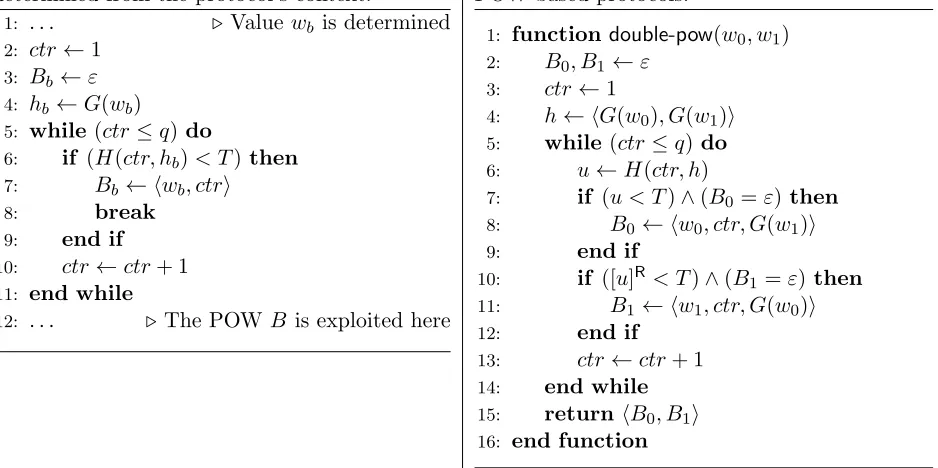
Next, we present a BA protocol assuming an honest majority, by suitably exploiting the prop-erties of the robust transaction ledger above. The protocol substitutes Bitcoin’s transactions with a type of transactions that are themselves based on POWs, and hence uses POWs in two distinct ways: for the maintenance of the ledger and for the generation of the transactions. We show that the ledger’s Persistence implies Agreement, and that Liveness implies Validity, because assuming the ledger is maintained for long enough, a majority of transactions originating from the honest parties will be included (despite the fact that honest parties may control a minority of blocks in the blockchain). The protocol requires special care in the way it employs POWs since the adversary should be incapable of “shifting” work between the two POW tasks that it faces in each round. To solve this problem, we introduce a special strategy for POW-based protocol composition which we call “2-for-1 POWs.”
The Bitcoin backbone in the bounded-delay model. In this version of the paper, we extend our analysis for the synchronous model with relative ease to the partially synchronous model [DLS88, PSS16], where, in a nutshell, instead of messages sent in a round being guaranteed to arrive by the end of the round, there is an upper bound of ∆ rounds for each message delivery event that is unknown to the honest parties. This new analysis is presented in Section 7. The analysis shows that the protocol is secure provided the difficulty level is in a favorable relation with respect to ∆. Treating ∆ as a separate parameter bounding the message passing delay enables to express the honest majority assumption also as a function of ∆ showing how approaching the 50% bound hinges on ∆ being sufficiently small.
Related work. Realizing a digital currency with a centralized entity but while achieving strong privacy was proposed early on by Chaum in [Cha82]. A number of other works improved various aspects of this concept, however the approach remained centralized. Nakamoto [Nak08a] proposed the first decentralized currency system based on POWs while relaxing the anonymity property of the payment system to mere pseudonymity. This work was followed by a multitude of other related proposals including Litecoin3, Ethereum4, to mention a few. Our analysis of the Bitcoin backbone covers all these works as well, since they are based on exactly the same protocol.
It is interesting to juxtapose our positive results to the results of Eyal and Sirer [ES14], who in-troduce an attack strategy called “selfish mining” that shows how the number of blocks contributed to the blockchain by an adversary can exceed the percentage of the hashing power the adversary possesses. Their results are consistent and complementary to ours. The crux of the issue is (in our terminology) in terms of the chain quality property, as its formulation is quite permissive: in particular we show that if the adversary controls a suitably bounded amount of hashing power, then it is also suitably bounded in terms of the number of blocks it has managed to insert in the blockchain that honest players maintain. Specifically, recall that we prove that the adversary may
3http://www.litecoin.com. 4
control at most a n−tt percentage of the blocks in the chain. For instance, if the adversary has less than 1/3 of the hashing power, then it will provably control less than 50% of the blocks in the honest players’ blockchain. As it can be easily seen, this does not guarantee that the rate of a party’s hashing power translates to an equal rate of rewards (recall that in Bitcoin the rewards are linearly proportional to the number of blocks that a party contributes in the chain). We define asideal chain qualitythe property that for any coalition of parties (following any mining strategy) the percentage of blocks in the blockchain is exactly proportional to their collective hashing power, i.e. nt. The chain quality property that we prove is not ideal and the results of [ES14] show that in fact there is a strategy that magnifies the percentage of a malicious coalition. Still, their mining attack does much worse than our bound. To close the gap, we sketch (cf. Remark 4) a simple selfish mining strategy that matches our upper bound and hence our chain quality result is tight in our model5 assuming the number of honest parties is large.
Byzantine agreement (BA, aka “consensus”) [PSL80, LSP82] considers a set of n parties con-nected by reliable and authenticated pair-wise communication links and with possible conflicting initial inputs that wish to agree on a common output in the presence of the disruptive (even ma-licious) behavior of some of them. The problem has received a considerable amount of attention under various models. In this paper we are interested in randomized solutions to the problem (e.g., [BO83, Rab83, BG93, FM97, FG03, KK09])6 as in the particular setting we are in, deterministic BA algorithms are not possible. In more detail, we consider BA in the anonymous synchronous setting, i.e., when processors do not have identifiers and cannot correlate messages to their sources, even across rounds, and, further, there is no trusted setup nor a limit to the number of messages delivered per round. Okun, motivated by earlier work [BSV+96], considered a slightly weaker model called “anonymous model without port awareness,” which matches the above except for imposing a limit on the number of messages per round and proved the aforementioned impossibility result, that deterministic algorithms are impossible for even a single failure [Oku05b, Oku05a]. In addi-tion, Okun showed that probabilistic BA is feasible in his setting by suitably adapting Ben-Or’s protocol [BO83] for the standard, non-anonymous setting (cf. [Oku05b])7; the protocol, however, takes exponentially many rounds. It turns out that by additionally assuming that the parties are “port-aware” (i.e., they can correlate messages to sources across rounds), deterministic protocols are possible and some more efficient solutions were proposed in [OB08].
The anonymous synchronous setting for BA without limits on messages per round and hence prone toSybilattacks [Dou02], was considered by Aspneset al.[AJK05] who pointed to the potential usefulness of proofs of work (e.g., [DN92, RSW96, Bac97, JB99]) as an identity assignment tool, in such a way that the number of identities assigned to the honest and adversarial parties can be made proportional to their aggregate computational power, respectively. For example, by assuming that the adversary’s computational power is less than 50%, one of the algorithms in [AJK05] results in a number of adversarial identities less than half of that obtained by the honest parties. By running this procedure in a pre-processing stage, it is then suggested that a standard authenticated BA protocol could be run. Such protocols, however, would require the establishment of a consistent PKI (as well as of digital signatures), details of which are not laid out in [AJK05].
In contrast, and as mentioned above, building on our analysis of the Bitcoin backbone
proto-5
Our model allows the unfavorable event of adversarial messages winning all head-to-head races in terms of delivery with honestly generated messages in any given round.
6
We remark that, in contrast to the approach used in typical randomized solutions to the problem, where achieving BA is reduced to (the construction of) a shared random coin, the probabilistic aspect here stems from the parties’ like-lihood of being able to provide proofs of work. In addition, as our analysis relies on the random oracle model [BR93], we are interested in computational/cryptographic solutions to the problem.
col, we propose two BA protocols solely based on POWs that operate in O(k) rounds with error probability e−Ω(k). The protocols solve BA with overwhelming probability under the assumption that the adversary controls less than 1/3 and 1/2 of the computational power, respectively.
The connection between Bitcoin and probabilistic BA was also considered by Miller and LaViola in [ML14] where they take a different approach compared to ours, by not formalizing how Bitcoin works, but rather only focusing on Nakamoto’s suggestion for BA [Nak08b] as a standalone protocol. As we observe here, and also recognized in [ML14], Nakamoto’s protocol does not quite solve BA since it does not satisfy Validity with overwhelming probability. The exact repercussions of this fact are left open in [ML14], while with our analysis, we provide explicit answers regarding the transaction ledger’s actual properties and the level of security that the Bitcoin backbone realization can offer.
We refer to [GK18] for a systematized overview of the consensus problem in the context of blockchain protocols.
Finally, related to the anonymous setting, the feasibility of secure computation without au-thenticated links was considered by Barak et al. in [BCL+11] in a more extreme model where all messages sent by the parties are controlled by the adversary and can be tampered with and modified (i.e., not only source addresses can be “spoofed,” but also messages’ contents can be altered and messages may not be delivered). It is shown in [BCL+11] that it is possible to limit the adversary so that all he can do is to partition the network into disjoint sets, where in each set the computation is secure, and also independent of the computation in the other sets. Evidently, in such system, one cannot hope to build a global ledger.
Summary of differences with [GKL15]. The most important difference in the current version of the paper compared to the original one [GKL15] is the complete rewrite of all our proofs, which now follow a much more streamlined and easier presentation. In particular, this version incorporates the concept of atypical executionthat we have in fact introduced in [GKL16, GKL17] (analysis of the backbone protocol with chains of variable difficulty) and which greatly simplifies our probabilistic analysis, concentrating it on a single theorem (specifically, Theorem 10, showing that most executions are typical).
The present version also includes the explicit treatment of security against adaptive adversaries, showing how to reduce the analysis to the case of static adversaries (Section 4.4). We also present an analysis of the Bitcoin backbone protocol in the partially synchronous model [DLS88] against static adversaries, where an unknown upper bound is imposed on message delivery (cf. Section 7). This model was considered by Pass et al. [PSS16]; nevertheless, here we show how our model can also extend to the bounded-delay setting and our proof strategy using typical executions can provide a simple security proof. This suggests that the notion of typical executions of [GKL16, GKL17] and the associated analysis approach are useful tools with the potential of wider applicability in the analysis of blockchain protocols.
In the current version we refer to the length of the hash function outputκas the (sole) security parameter, and refer toλ—typically the number of consecutive rounds for which a statement would hold—as the tail-bounds parameter. This way, makingλpolylogarithmic in the security parameter (e.g., Ω(log2(κ))) allows us to clearly express how blockchain properties and applications (e.g., consensus) are satisfied except with negligible probability after that many rounds.
built on top of the backbone protocol—(simple) BA protocols and a robust transaction ledger, respectively. Specifically, Section 5 covers Nakamoto’s (insufficient) suggestion for BA as well as our solution for 1/3 adversarial power, while in Section 6 we present our treatment of a robust public ledger (Section 6.1) formalizing the properties of Persistence and Liveness and how they apply to Bitcoin (Section 6.2). We also include in this section (Section 6.3) our BA protocol for 1/2 adversarial power. The extension of our analysis to the partially synchronous model is presented in Section 7, while some directions for future research are offered in Section 8.
2
Model and Definitions
In this section we define our notion of protocol execution and provide a definition of Byzantine agreement in our model. We will describe and analyze our protocols in a multiparty setting that em-ploys elements from previous formulations of secure multiparty computation (specifically, Canetti’s formulation of “real world” execution as in [Can00a] and [Can00b, Can01]). We adopt the nota-tion and defininota-tions of [Can00b, Can01] while we also employ ideas regarding the formulanota-tion of synchronous, proceeding in rounds, multiparty computation from [KMTZ13].
Programs involved in a protocol execution. The execution of a protocol Π is driven by an “environment” program Z that may spawn multiple instances running the protocol Π. The programs in question can be thought of as “interactive Turing machines” (ITM) that have com-munication, input and output tapes. An instance of an ITM running a certain program will be referred to as an interactive Turing machine instance or ITI. The spawning of new ITI’s by an existing ITI as well as the interaction between them is at the discretion of a control program which is also an ITM and is denoted byC. The pair (Z, C) is called a system of ITM’s, cf. [Can00b]. As in this latter paper we will be restricting our exposition to “locally polynomial-bounded” systems of ITM’s which ensures a polynomial-time execution overall [Can00b, Proposition 3]. Moreover, we will be using a more stringent control program C that will be forcing the environment to perform a “round-robin” participant execution sequence for a fixed set of parties.
Specifically, the execution driven by Z is defined with respect to a protocol Π, an adversary A
(also an ITM) and a set of parties P1, . . . , Pn; these are hardcoded in the control programC. The protocol Π is defined in a “hybrid” setting and has access to two “ideal functionalities,” which are two other ITM’s to be defined below, called therandom oracleand thediffusion channel. They are used as subroutines by the programs involved in the execution (the ITI’s of Π andA) and they are accessible by all parties once they are spawned.
Initially, the environment Z is restricted by C to spawn the adversary A. Each time the adversary is activated, it may send one or more messages of the form (Corrupt, Pi) to C. The control program C will register party Pi as corrupted, only provided that the environment has previously given an input of the form (Corrupt, Pi) to Aand that the number of corrupted parties is less or equal t, a bound that is also hardcoded inC. The first ITI party to be spawned running protocol Π is restricted by C to be party P1. After a party Pi is activated, the environment is restricted to activate party Pi+1, except whenPn is activated in which case the next ITI to be activated is always the adversaryA. Note that when a corrupted partyPiis activated the adversary
A is activated instead.
• The random oracle (RO) functionality. When queried by honest party Pi with a value x marked for “calculation” for the function H(·), assuming x has not been queried before, it returns a valuey which is selected at random from {0,1}κ; furthermore, it stores the pair (x, y) in the table of H(·). Each honest party Pi is allowed to ask q queries in each round as determined by the “diffuse” functionality (see below). On the other hand, each honest party is given unlimited queries for “verification” for the functionH(·). In a similar vein, the adversary A is given t0 ·q queries in each round as determined by the diffuse functionality wheret0 is the number of corrupted parties. No verification queries are provided to A. Note that q is a function of κ. We note that the functionality may maintain tables for functions other than H(·) as well (for instance, in our protocol descriptions, we will utilise a function
G(·)), but, by convention the functionality will impose query quotas to function H(·) only.
• The diffuse functionality. Initially, the functionality sets a variableround to be 1. It also maintains a Receive() string defined for each partyPi. A party is allowed at any moment to fetch the contents of its personal Receive() string. Moreover, when the functionality
receives an instruction to diffuse a messagem from party Pi it marks the party as complete for the current round; note that m is allowed to be empty. At any moment, the adversary
Ais allowed to receive the contents of all messages for the round and specify the contents of
the Receive() string for each party Pi. The adversary has to specify when it is complete
for the current round. When all parties are complete for the current round, the functionality inspects the contents of allReceive() strings and includes any messagesmthat were diffused
by the parties in the current round but not contributed by the adversary to the Receive()
tapes. The variable round is then incremented.
We note that by adopting the resource bounded computation modeling of systems of ITM’s by [Can00b, Can01] we obviate the need of imposing a strict upper bound on the number of messages that may be transmitted by the adversary in each activation. In our setting, honest parties, at the discretion of the environment, are given sufficient time to process all messages delivered via the diffuse functionality including all messages that are injected by the adversary. This is also facilitated by the fact that theq bound that is imposed on queries to H(·) is not imposed for hash verification (with foresight, the q-bound will be only imposed for hash computations during the proof of work stage of the protocol).
Note that the above formulation also reflects the fact that the communication graph is not fully connected and messages are delivered through “diffusion”, a communication means that reflects Bitcoin’s peer-to-peer structure. As evidenced by the above, our adversarial model in the network is “adaptive,” meaning that the adversary is allowed to take control of parties on the fly, and “rushing,” meaning that in any given round the adversary gets to see all honest players’ messages before deciding his strategy, and, furthermore, there is no definite source information that can be guaranteed for each delivered message. Note that the adversary cannot change the contents of the messages sent by honest parties nor prevent them from being delivered as restricted by the diffuse functionality. Effectively, this parallels communication over TCP/IP in the Internet where messages between parties are delivered reliably, but nevertheless malicious parties may “spoof” the source of a message they transmit and make it appear as originating from an arbitrary party (including another honest party) in the view of the receiver. Note that the adversary is permitted to abuse the diffusion mechanism and attempt to confuse honest parties by sending and delivering inconsistent messages to them (thus diffuse does not constitute a reliable broadcast).8
8
The parties’ inputs are provided by the environmentZ which also receives the parties’ outputs. Parties that receive no input from the environment remain inactive, in the sense that they will not act when their turn comes in each round. The environment activates parties in each round by writing to their input tape. Note that C forces the environment to give all parties an activation in round-robin fashion. In our exposition we will denote by Input() the input tape of each party.
The q-bounded synchronous setting. Based on the above, we can now use the notation
{exect,nΠ,A,Z(z)}z∈{0,1}∗ to denote the random variable ensemble that determines the output of the
environment Z on input z for a protocol Π that uses the two functionalities of random oracle and diffuse (we will only be concerned with such protocols). Moreover, we will use the notation
{viewP,t,nΠ,A,Z(z)}z∈{0,1}∗ to denote the random variable ensemble describing the view of party P
after the completion of an execution with environment Z, running protocol Π, and adversary A, on auxiliary input z∈ {0,1}∗.
In our exposition we are concerned with a “stand-alone” execution of Π and thus we will consider
z to be fixed to 1κ for κ∈N. For this reason we will simply refer to the ensemble by viewP,t,nΠ,A,Z.
If n parties P1, . . . , Pn execute Π, the concatenation of the view of all parties hviewΠPi,,t,nA,Zii=1,...,n
is denoted by viewt,nΠ,A,Z. With foresight, we note that, in contrast to the standard setting where
parties are aware of the number of parties executing the protocol, we are interested in protocols Π that do not make explicit use of the number of parties n or their identities. Further, note that because of the unauthenticated nature of the communication model the parties may never be certain about the number of participants in a protocol execution. Nonetheless note that the number of parties is fixed during the course of the protocol execution, as this is hardcoded in the control program C.
The parties’ limited ability to produce POWs is reflected in the limit imposed to all parties in their access of the function H(·). Parties are allowed to perform a number of queries q per round. We remark that this is a “flat-model” interpretation of the parties’ computation power, where all parties are assumed equal. In the real world, different honest parties may have different “hashing power;” nevertheless, our flat-model does not sacrifice generality since one can imagine that real honest parties are simply clusters of some arbitrary number of honest flat-model parties. The adversary A is allowed to perform t0 ·q queries per round, where t0 ≤ t is the number of corrupted parties. The environment Z, on the other hand, is not permitted any queries to H(·). The rationale for this, is that we would like to bound the “CPU power” [Nak08a] of the adversary to be proportionate to the number of parties it controls while making it infeasible for them to be aided by external sources or by transferring the hashing power potentially invested in concurrent or previous protocol executions. This underscores the fact that our analysis is in the standalone setting, where a single protocol instance is executed in isolation.
We will refer to all the above restrictions on the environment, the parties and the adversary as theq-bounded synchronous setting.
Properties of protocols. In our theorems we will be concerned with properties of protocols Π in the q-bounded synchronous setting. Such properties will be defined as predicates over the random variable viewt,nΠ,A,Z by quantifying over all possible adversaries A and environments Z
that are polynomially bounded. Note that all our protocols will only satisfy properties with a small probability of error in κ as well as in potentially other parameters. The probability space is determined by the random choices of the random oracle functionality as well as the private coins of all ITI’s.
Definition 1. Given a predicate Q and a bound q, t, n ∈ N with t < n, we say that the protocol
Π satisfies property Q in the q-bounded setting for n parties assuming the number of corruptions is bounded by t, provided that for all polynomial-time Z,A, the probability thatQ(viewt,nΠ,A,Z) is
false is negligible inκ.
Note that we will only consider properties that are polynomial-time computable predicates.
Byzantine agreement. As a simple illustration of the formulation above we define the properties of a Byzantine agreement (BA) protocol.
Definition 2. A protocol Π solves BA in the q-bounded synchronous setting provided it satisfies the following two properties:
Agreement. There is a round after which all honest parties return the same output if queried by the environment.
Validity. The output returned by an honest partyP equals the input of some partyP0 at round 1 that is honest at the roundP’s output is produced.
We note that in our protocols, the participants are capable of detecting agreement and further-more they can also detect whether other parties detect agreement, thus termination can be easily achieved by all honest parties. In the traditional cryptographic setting with no trusted setup, it is known that the problem does not have a solution if t ≥ n3 [Bor96]. Interestingly, one of our POW-based BA protocols works fort < n2, assuming only a simultaneous start without a PKI, the same bound that is achievable when a PKI is available.
The formulation of Validity above is intended to capture security/correctness against adaptive adversaries. The notion (specifically, the requirement that the output value be one of the honest parties’ inputs) has also been called “Strong Validity” [Nei94], but the distinction is only important in the case of non-binary inputs. In either case, it is known that in the synchronous cryptographic setting with trusted setup the problem has a solution if and only if n > |V|t, where V is the input/decision domain [FG03]. Our POW-based protocol also achieves this bound.
Remark 1. One may consider a model where a certain percentage of the honest parties is not always able to receive all messages broadcast on the network. We point out that such a situation is subsumed by our adversarial model: simply we let the adversary control these players and simulate them honestly while dropping messages from their incoming tape arbitrarily. Of course, to apply the theorems we prove, one should adjust the total power of the adversary accordingly and add these parties to the adversarial ones.
3
The Bitcoin Backbone Protocol
We start by introducing blockchain notation. Let G(·), H(·) be cryptographic hash functions with output in{0,1}κ. Ablock is any triple of the formB=hs, x, ctriwheres∈ {0,1}κ, x∈ {0,1}∗, ctr∈
Nare such that satisfy predicate validblockTq(B) defined as
(H(ctr, G(s, x))< T)∧(ctr≤q).
A blockchain, or simply a chain is a sequence of blocks. The rightmost block is the head of the chain, denoted head(C). Note that the empty string ε is also a chain; by convention we set head(ε) =ε. A chainCwith head(C) =hs0, x0, ctr0ican be extended to a longer chain by appending a valid block B = hs, x, ctri that satisfies s = H(ctr0, G(s0, x0)). In case C = ε, by convention any valid block of the form hs, x, ctri may extend it. In either case we have an extended chain
Cnew=CB that satisfies head(Cnew) =B.
The length of a chain len(C) is its number of blocks. Given a chainC that has length len(C) =
n >0 we can define a vectorxC =hx1, . . . , xnithat contains all the x-values that are stored in the chain such that xi is the value of the i-th block.
Consider a chain C of length m and any nonnegative integer k. We denote by Cdk the chain resulting from the “pruning” the k rightmost blocks. Note that for k≥len(C),Cdk =ε. If C
1 is a prefix of C2 we writeC1 C2.
We note that Bitcoin uses chains of variable difficulty, i.e., the value T may change across different blocks within the same chain according to some rule that is determined by the x values stored in the chain9. This is done to account for the fact that the number of parties (and hence the total hashing power of the system) is variable from round to round (as opposed to the unknown but fixed number of partiesn we assume). See Section 8 for further discussion. We are now ready to describe the protocol.
3.1 The backbone protocol
The Bitcoin backbone protocol is executed by an arbitrary number of parties over an unauthenti-cated network. For concreteness, we assume that the number of parties running the protocol is n; however, parties need not be aware of this number when they execute the protocol. As mentioned in Section 2, communication over the network is achieved by utilizing a send-to-all Broadcast
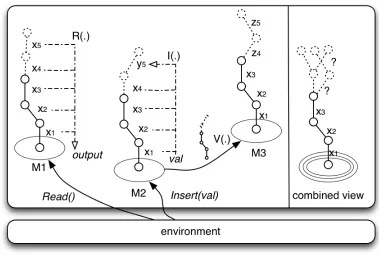
functionality that is available to all parties (and maybe abused by the adversary in the sense of delivering different messages to different parties). Each party maintains a blockchain, as defined above, starting from the empty chain and mining a block that contains the value s= 0 (by con-vention this is the “genesis block”)10. Each party’s chain may be different, but, as we will prove, under certain well-defined conditions, the chains of honest parties will share a large common prefix. (Figure 2 depicts the local view of each party as well as the shared portion of their chains.)
In the protocol description we intentionally avoid specifying the type of values that parties try to insert in the chain, the type of chain validation they perform (beyond checking for its structural properties with respect to the hash functions G(·), H(·)), and the way they interpret the chain. In our description, these actions are abstracted by the external functionsV(·), I(·), R(·) which are specified by the application that runs “on top” of the backbone protocol. We will purposely leave these functions undetermined in our description assuming they conform to the following specifications. We will provide explicit instantiations of them in Section 5. Briefly, they are described as follows:
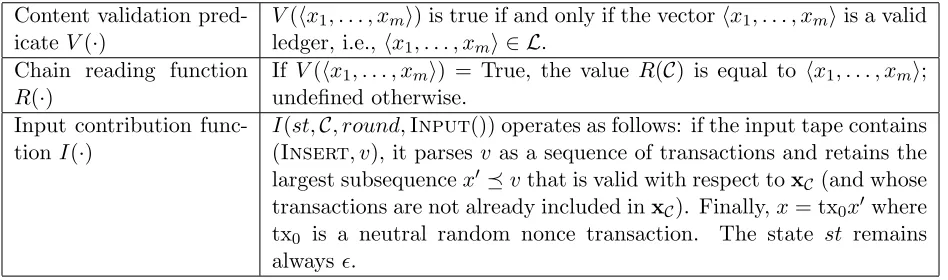
• Content validation predicate V(·). The content validation predicate receives as input the content of a chainC, denoted byxC, and will return 1 if and only if the contents are consistent
with the intended application implemented on top of the chain. In its simplest form, V(·) can ensure that the elements ofxC are of the proper type.
9
In Bitcoin every 2016 blocks the difficulty is recalibrated according to the time-stamps stored in the blocks so that the block generation rate remains at approximately 10 minutes per block.
10
Figure 2: Overview of the basic operation of the Bitcoin backbone protocol. Miner M1 receives from the environment a Read instruction that results in the application of the R(·) function on
the contents of its chain which are equal to the vector hx1, x2, x3, x4, x5i. Miner M2 receives from the environment anInsertinstruction and uses the function I(·) to determine the valuey5 that it subsequently successfully inserts in its local block chain by solving a proof of work; this results in a broadcast of the newly extended chain. Finally minerM3 receives the newly extended chain and validates it both structurally as well as using the content validation predicate V(·). M3 will adopt this chain if M3 deems it better than its local chain as specified by the backbone protocol. Note that the joint view ofM1, M2, M3 is inconsistent but there is agreement on the prefixhx1, x2, x3i.
• Input contribution functionI(·). It receives as input a tuple, (st,C, round,Input(),Receive()),
that stands respectively for state data st, current chain C, current round round, contents of input tape Input() and contents of network tape Receive(). Given these, it will produce
an updated state st0 as well as an input x that should be the next input to be inserted in a block. For instance, I(·) can be as simple as copying the contents of the input tape into x
and keepingst=, or performing a more complex operation that involves parsing C or even maintaining old input values that have not yet been processed as part of the statest.
• Chain reading functionR(·). It receives as input a chainC and provides an interpretation of it. In the simplest case it can be just returningxC and leaving it to the callee to process the contents of the chain.
In general our treatment will be independent of the exact operation of V, I, R apart from re-quiring the following minimal set of conditions.
Algorithm 1Thechain validation predicate, parameterized byq, T, the hash functionsG(·), H(·), and thecontent validation predicateV(·). The input is C.
1: function validate(C)
2: b←V(xC)
3: if b∧(C 6=ε) then . The chain is non-empty and meaningful w.r.t. V(·)
4: hs, x, ctri ←head(C)
5: s0←H(ctr, G(s, x))
6: repeat
7: hs, x, ctri ←head(C)
8: if validblockTq(hs, x, ctri)∧(H(ctr, G(s, x)) =s0) then
9: s0←s . Retain hash value
10: C ← Cd1 . Remove the head fromC
11: else
12: b←False
13: end if
14: until (C=ε)∨(b= False)
15: end if
16: return (b)
17: end function
2. Input Entropy. The probability of the event that two independent invocations ofI(st,C, round, v, w), wherest,C, round, v, w are arbitrary values consistent with the input of I(·), result in the same output valuex is negligible inκ.
The Bitcoin backbone protocol is specified as Algorithm 4. Before describing it in detail we first introduce the protocol’s three supporting algorithms.
Chain validation. The first algorithm, called validate performs a validation of the structural properties of a given chain C, cf. Algorithm 1. It is given as input the values q and T, as well as a hash function H(·). It is parameterized by the content validation predicateV(·). For each block of the chain, the algorithm checks that the proof of work is properly solved, that the counter ctr
does not exceed q and that the hash of the previous block is properly included in the block. It further collects all the inputs from the chain’s blocks and assembles them into a vector xC. If all
blocks verify and V(xC) is true then the chain is valid; otherwise it is rejected. As mentioned we
purposely leave the predicateV(·) undetermined.
Chain comparison. The objective of the second algorithm, calledmaxvalid, is to find the “best possible” chain when given a set of chains, cf. Algorithm 2. The algorithm is straightforward and is parameterized by a max(·) function that applies some ordering in the space of chains. The most important aspect is the chains’ length, in which case max(C1,C2) will return the longest of the two. In case len(C1) = len(C2), some other characteristic can be used to break the tie. In our case, max(·,·) will always return the first operand11; alternatively, other options exist, such as
11
Algorithm 2 The function that finds the “best” chain, parameterized by function max(·). The input is{C1, . . . ,Ck}.
1: function maxvalid(C1, . . . ,Ck)
2: temp←ε
3: for i= 1 to kdo
4: if validate(Ci) then
5: temp←max(Ci, temp)
6: end if
7: end for
8: return temp
9: end function
lexicographic order or picking a chain at random. The analysis we will perform will essentially be independent of the tie-breaking rule12.
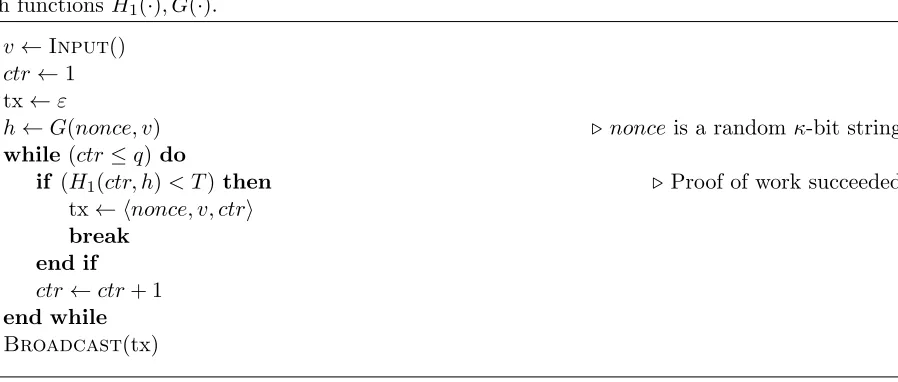
Proof of work. The third algorithm, calledpow, is the main “workhorse” of the backbone protocol, cf. Algorithm 3. It takes as input a chain and attempts to extend it via solving a proof of work. This algorithm is parameterized by two hash functions H(·), G(·) (which in our analysis will be modeled as random oracles),13 as well as two positive integers q, T; q represents the number of times the algorithm is going to attempt to brute-force the hash function inequality that determines the POW instance, andT determines the “difficulty” of the POW. The algorithm works as follows. Given a chain C and a value x to be inserted in the chain, it hashes these values to obtain h and initializes a counter ctr. Subsequently, it increments ctr and checks to see whetherH(ctr, h)< T; this is the only invocation of H(·) that is subject to the bound q. If a suitable ctr is found then the algorithm succeeds in solving the POW and extends chainC by one block insertingxas well as
ctr (which serves as the POW). If no suitable ctr is found, the algorithm simply returns the chain unaltered. (See Algorithm 3.)
The backbone protocol. Given the three algorithms above, we are now ready to describe the Bitcoin backbone protocol, cf. Algorithm 4. This is the protocol that is executed by the miners and which is assumed to run “indefinitely” (our security analysis will apply when the total running time is polynomial inκ). It is parameterized by two functions, the input contribution functionI(·) and the chain reading functionR(·), which is applied to the values stored in the chain.
Each miner starts a round with a local chainC(we say that the miner has chainCat this round) and checks its communication tape Receive() to see whether a “better” chain has been received
and in such case it adopts it resulting in chain ˜C (we say that the miner adopts chain ˜C at this round). Choosing the chain ˜C is done using themaxvalidfunction; note that it could be thatC = ˜C. Then, the miner attempts to extend ˜C by running the POW algorithmpow described above.
The value that the miner attempts to insert in the chain is determined by function I(·). The input to I(·) is the state st, the current chain C, the contents of the miner’s input tape Input()
(recall that they can be written by the environmentZ at the beginning of any round) and
commu-12
It is worth to point out that the behavior ofmaxvalid(·) is associated with some stability aspects of the backbone protocol and currently there are proposals to modify it (e.g., by randomizing it — cf. [ES14]). It is an interesting question whether any improvement in our results can be achieved by randomizing themaxvalidoperation.
13
Algorithm 3 The proof of work function, parameterized by q, T and hash functions H(·), G(·). The input is (x,C).
1: function pow(x,C)
2: if C=εthen .Determine proof of work instance
3: s←0
4: else
5: hs0, x0, ctr0i ←head(C)
6: s←H(ctr0, G(s0, x0))
7: end if
8: ctr ←1
9: B ←ε
10: h←G(s, x)
11: while (ctr ≤q) do
12: if (H(ctr, h)< T) then .This H(·) invocation subject to theq-bound
13: B ← hs, x, ctri
14: break
15: end if
16: ctr←ctr+ 1
17: end while
18: C ← CB .Extend chain
19: return C
20: end function
nication tape Receive(), as well as the current round number round. The protocol expects two
types of entries in the input tape, Read and (Insert, value); other inputs are ignored.
As mentioned, we purposely leave the functions I(·), R(·) undetermined in the description of the backbone protocol, as their specifics will vary according to the application. When the input x
is determined by I(·), the protocol attempts to insert it into the chain C by invokingpow. In case the local chainCis modified during the above steps, the protocol transmits (“broadcasts”) the new chain to the other parties. Finally, in case a Read symbol is present in the communication tape,
the protocol applies function R(·) to its current chain and writes the result onto the output tape
Output(). The round ends when the algorithm diffuses a message (⊥in case no message is to be
diffused).
3.2 (Desired) Properties of the backbone protocol
We next define the two main properties of the backbone protocol that we will prove. The first property is called thecommon prefix property and is parameterized by a value k∈N. It considers an arbitrary environment and adversary in theq-bounded setting, and it holds as long as removing
kblocks from an honest party’s chain results to a prefix of another honest party’s chain.
Definition 3(Common Prefix Property). The common prefix propertyQcp with parameterk∈N
states that for any pair of honest players P1, P2 adopting the chains C1,C2 at rounds r1 ≤ r2 in
Algorithm 4 The Bitcoin backbone protocol, parameterized by the input contribution function
I(·) and the chain reading function R(·). At the onset it is assumed “init= True”.
1: if (init) then
2: C ←ε
3: st←ε
4: round←1
5: init←False
6: else
7: C ←˜ maxvalid(C,any chainC0 found in
Receive())
8: if Input() containsRead then
9: writeR( ˜C) to Output() .Produce necessary output before the POW stage.
10: end if
11: hst, xi ←I(st,C˜, round,Input(),Receive()) . Determine thex-value.
12: Cnew←pow(x,C˜)
13: if C 6=Cnew then
14: C ← Cnew
15: Diffuse(C) . Broadcast the chain in case of adoption/extension.
16: else
17: Diffuse(⊥) . Signals the end of the round to the diffuse functionality.
18: end if
19: round←round+ 1
20: end if
We note that this is a stronger version of the common prefix property compared to the one orig-inally considered in [GKL15], where the property was stated forr1 =r2. The stronger formulation enables a more modular proof of the persistence property in Section 6.1 and for this reason we opt for it here. This was observed in [PSS16]. Note also thatP1 and P2 could be the same party.
The second property, which we call the chain quality property, aims at expressing the number of honest-player contributions that are contained in a sufficiently long and continuous part of an honest player’s chain. Specifically, for parameters`∈Nandµ∈(0,1), the rate of adversarial block contributions in a continuous part of an honest party’s chain of length at least ` is bounded by 1−µ.14 This is intended to capture that at any moment that an honest player looks at a sufficiently long part of its blockchain, that part will be of sufficient “quality,” i.e., the number of adversarial blocks present in that portion of the chain will be suitably bounded.
Definition 4 (Chain Quality Property). The chain quality property Qcq with parameters µ ∈R
and `∈ N states that for any honest party P with chain C in viewt,nΠ,A,Z, it holds that for any `
consecutive blocks of C the ratio of honest blocks is at leastµ.
It is easy to see that, in the absence of an adversary, any set of, say, h honest parties, obtain as many blocks as their proportion of the total hashing power, i.e.,h/n. We say that a protocol Π satisfies ideal chain qualityif this is the case for adversarial parties as well, i.e., µ= 1−t/n with
14
respect to those parties. The ideal chain quality is not achieved by the Bitcoin backbone protocol, cf. Remark 4.
A third property that is convenient to consider in conjunction to the above two and was intro-duced in follow up work, [KP15], to our original exposition ischain growth.
Definition 5 (Chain Growth Property). The chain growth property Qcg with parameters τ ∈R
and s∈N states that for any honest party P that has a chainC inviewt,nΠ,A,Z, it holds that after
any sconsecutive rounds it adopts a chain that is at leastτ ·sblocks longer thanC.
In our original exposition [GKL15] this property was not identified explicitly but rather proven and used directly in the form of a lemma. Nevertheless, as observed in [KP15], identifying it as a separate property, allows making more modular our proof arguments and for this reason we adopt it here as well.
4
Analysis of the Bitcoin Backbone
In this section we perform the analysis of the protocol presented in the previous section. We will first consider the case of static adversaries; then, in Section 4.4, we will show how an adaptive adversary reduces to a static one.
4.1 Definitions and Preliminary Lemmas
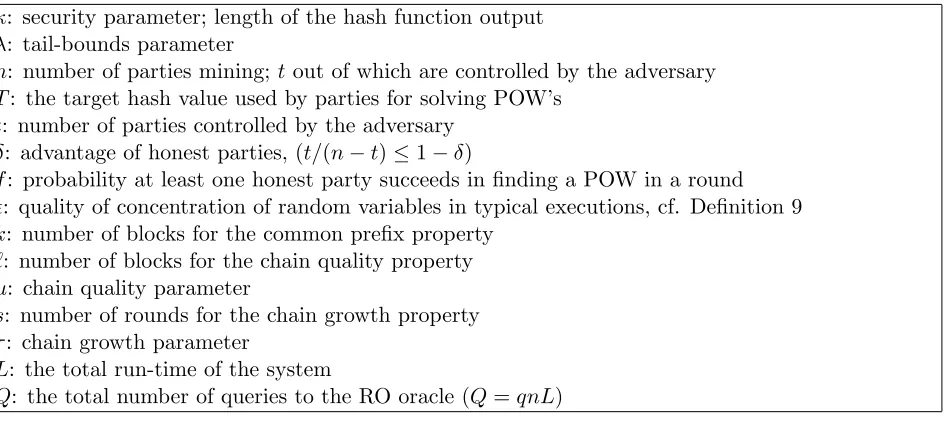
Let{0,1}κ be the range ofH(·). Recall thatnis the number of parties,tof which can be corrupted by the adversary. In the analysis we are going to assume that the honest parties are sufficiently greater in number than the parties the adversary controls. In particular, we are going to require the following (cf. Table 1 for the definition all of the relevant parameters).
Honest Majority Assumption. A number oftout of nparties are corrupted such thatt≤(1−δ)(n−t), where 3f+ 3 < δ≤1.
It will be useful for verifying some calculations to note that 3f+ 3 < δimplies (1 +)(1 +f)<
(1−)(1−f)(1 +δ)<(1−)(1−f)/(1−δ) andf, < 13.
We will call a query of a party successful if it submits a pair (ctr, h) such thatH(ctr, h) ≤T. For each roundi,j ∈[q], andk∈[t], we define Boolean random variablesXi, Yi andZijkas follows. If at roundian honest party obtains a POW, thenXi= 1, otherwiseXi = 0. If at roundiexactly one honest party obtains a POW, then Yi = 1, otherwise Yi = 0. Regarding the adversary, if at roundi, the j-th query of thek-th corrupted party is successful, thenZijk= 1, otherwiseZijk= 0. Define alsoZi =Ptk=1Pjq=1Zijk. For a set of roundsS, letX(S) =
P
r∈SXr and similarly define Y(S) andZ(S). Further, ifXi = 1, we calliasuccessful round and ifYi= 1, a uniquely successful
round. Uniquely successful rounds have the following important property.
Lemma 6. Suppose the k-th blockB of a chain C was computed by an honest party in a uniquely successful round. Then the k-th block a chainC0 either isB or has been computed by the adversary.
Proof. SupposeB0 is the k-th block of a chain C0 that has been computed by an honest party and
κ: security parameter; length of the hash function output
λ: tail-bounds parameter
n: number of parties mining; tout of which are controlled by the adversary
T: the target hash value used by parties for solving POW’s
t: number of parties controlled by the adversary
δ: advantage of honest parties, (t/(n−t)≤1−δ)
f: probability at least one honest party succeeds in finding a POW in a round
: quality of concentration of random variables in typical executions, cf. Definition 9
k: number of blocks for the common prefix property
`: number of blocks for the chain quality property
µ: chain quality parameter
s: number of rounds for the chain growth property
τ: chain growth parameter
L: the total run-time of the system
Q: the total number of queries to the RO oracle (Q=qnL)
Table 1: The parameters in our analysis. Positive integersn, t, L, s, `, T, k, κwhere logT is linearly related to κ; positive reals f, , δ, µ, τ, λ, where f, , δ, µ∈(0,1).
An important parameter of the protocol is the probability that at least one honest party com-putes a solution at given round. We denote this parameter by f and we have
(1−f)pq(n−t)< f =E[Xi] = 1−(1−p)q(n−t)< pq(n−t), (1)
wherep=T /2κis the probability of success of a single query. For the inequalities we used 1+x≤ex
(for all real x) and Bernoulli’s inequality (1 +x)α > 1 +αx (for reals x > −1 and α > 1). For example,
f
1−f =
1−(1−p)q(n−t)
(1−p)q(n−t) = (1−p)
−q(n−t)−1>(1 +p)q(n−t)−1> pq(n−t).
We now provide bounds for the random variables defined above,15 which relate their expectations tof. With respect to the honest parties we have
E[Yi]≥q(n−t)p(1−p)q(n−t)−1 > pq(n−t)[1−pq(n−t)]≥f(1−f)>
1−δ
3
f.
For the first inequality we estimate from below pretending that honest parties make allqqueries even after a successful one and summing over all queries the probability that it is the only successful one. The last inequality follows from the fact that x 7→ x(1−x) is increasing in (0,12), since
f < pq(n−t)< f(1−f)−1 < δ3(1−δ3)−1 ≤ 12 (we used the bounds onf above and the assumption 3+ 3f < δ ≤1). With respect to the expected number of blocks the adversary can compute in a single round we note the bound
E[Zi] =pqt= t
n−t ·pq(n−t)< t n−t·
f
1−f <
1 +δ 2
·f· t n−t.
15In previous versions of this paper, including [GKL15], we expressed the analysis using parametersα=pq(n−
t), β =pqt, γ=α−α2, f =pqn. Observe that using this notation and for the random variablesXi, Yi, Zi defined
above, it holds thatE[Xi]≤α,E[Yi]≥γ,E[Zi]≤β, leading to a more refined analysis. Also, the previous choice off
is an upper-bound onE[Xi+Zi]. Instead, now, we opt to definef asE[Xi] and drop the notationα, β, γ. We believe
The inequality follows from the bounds on f above.
We next prove the Chain Growth Lemma. It states that, at any round, the length of any honest party’s chain will be at least as large as the number of successful rounds. As a consequence, the chain of honest parties will grow at least at the rate of successful rounds, no matter what strategy the adversary employs.
Lemma 7(Chain Growth Lemma). Suppose that at roundr an honest party has a chain of length
`. Then, by round s≥r, every honest party has adopted a chain of length at least `+Ps−1
i=rXi.
Proof. By induction ons−r ≥0. For the basis (s=r), observe that if at roundr an honest party has16 a chainC of length `, then that party broadcast C at a round earlier than r. It follows that every honest party will receiveC by roundr.
For the inductive step, note that by the inductive hypothesis every honest party has received a chain of length at least `0 =`+Ps−2
i=r Xi by round s−1. When Xs−1 = 0 the statement follows directly, so assumeXs−1 = 1. Observe that every honest party queried the oracle with a chain of length at least`0 at rounds−1. If follows that all honest parties successful at rounds−1 broadcast a chain of length at least `0+ 1. Since`0+ 1 =`+Ps−1
i=rXi, this completes the proof.
We now define our typical set of executions. Informally, this set consists of those executions with polynomially many rounds and with the property that the sum of the X, Y, Z variables over any λ= Ω(κ) consecutive rounds does not deviate too much from its expectation.
First, we define a few bad events relevant to the properties of the hash function. In the random oracle model (as long as the execution is polynomially bounded in κ), these events occur with probability exponentially small in κ.
Definition 8. An insertion occurs when, given a chain C with two consecutive blocks B and B0, a block B∗ created after B0 is such that B, B∗, B0 form three consecutive blocks of a valid chain. Acopy occurs if the same block exists in two different positions. Aprediction occurs when a block extends one which was computed at a later round.
Definition 9(Typical execution). An execution is (, λ)-typical (or justtypical), for ∈(0,1) and integerλ≥2/f, if, for any setS of at least λconsecutive rounds, the following hold.
(a) (1−)E[X(S)]< X(S)<(1 +)E[X(S)] and (1−)E[Y(S)]< Y(S).
(b) Z(S)<E[Z(S)] +E[X(S)].
(c) No insertions, no copies, and no predictions occurred.
Theorem 10. An execution is typical with probability 1−e−Ω 2λf+κ−log(L)
.
Proof. First we note that the input entropy requirement on the input contribution function I(·), allows us to condition our probability space on the event that no two honest parties in a polynomially bounded execution queried theH(·) oracle with the same input. In this space, the variablesXi(and similarlyYiandZijk) are independent Bernoulli trials. Since each trial is successful with probability Θ(f), the result follows from the standard Chernoff bound. (Note also that E[Z(S)]<E[X(S)].)
For part (c) and i∈ {1,2,3}, letBi =hsti, xi, ctrii and gi =G(sti, xi). If the total number of rounds is L then it holds that there are at most Q = qnL queries posed to G and H. It follows that the probability of a collision occurring is Q2/2κ = e−Ω(κ−logQ). We observe now that if a
16
Recall that we say a party “has” a chainC∗
at roundr, if the value of variableC at line 7 of Algorithm 4 isC∗
, while it “adopts” a chainC∗
if the value of variable ˜C is equal toC∗
block extends two distinct blocks, then a collision has occurred. To see this, suppose block B3 extents two distinct blocks B1 and B2. Then st3 =H(ctr1, g1) = H(ctr2, g2); implying a collision either inH or inG, sinceB1 and B2 are distinct. It is not hard to see that an insertion or a copy imply the existence of a block that extends two distinct blocks (consider the first time such an event occurs). Finally, suppose a prediction occurs and block B2 extends a block B3 computed at a later round. This means that the hash value the oracle assigned B3 equals st2, which should be an answer of the oracle to a previous query. It follows that the probability a prediction occurs is at mostQ2/2κ =e−Ω(κ−logQ).
Remark 2. Choosing λ= Ω(log2κ), the execution fails to be typical with negligible probability in the security parameterκ. We are going to show that all the properties required for our applications hold for a typical execution.
The next two Lemmas are simple, but will make convenient the appeal to the properties of a typical execution.
Lemma 11. The following hold for any setSof at leastλconsecutive rounds in a typical execution.
(a) (1−)f|S|< X(S)<(1 +)f|S| and (1− δ3)f|S|<(1−)f(1−f)|S|< Y(S).
(b) Z(S)< n−tt·1−ff · |S|+f|S| ≤(1−2δ 3)f|S|.
(c) Z(S)<(1 +δ2)· t
n−t·X(S) +f|S|<(1− δ
2)X(S) and Z(S)< Y(S).
Proof. Parts (a) and (b) follow easily from the bounds shown in the beginning of this subsection. Part (c) uses the bounds of parts (a) and (b) and the assumption 3f + 3 < δ≤1.
Remark 3. From the above relations, one can see the importance of the parameter f and the way that the moderate hardness of proof of work is relevant to the analysis. In particular f should be large enough so thatE[X(S)] becomes sufficiently bigger than 0 to be useful. Iff is too small, (i.e.,
producing PoW’s is too hard) the honest participants will produce too few PoW’s for the system to make progress (with foresight, chain growth will be hurt, which in turn will hurt the liveness of the transaction ledger). On the other hand,f cannot be too large, because then the lower bound on Y
will be too small (as it depends multiplicatively on (1−f) as well as f). This means that uniquely successful rounds will not produce sufficiently many PoW’s to overcome the PoW’s produced by the adversary. In practice, this underscores the importance of calibrating the difficulty of the proof of work to maintain a suitable value of f within the range (0,1). Such calibration takes place in the Bitcoin system every 2016 blocks and attempts to keepf somewhere between 2–3% (assuming a full communication round takes place every up to 20 seconds).
A corollary of this lemma and the Chain Growth Lemma (Lemma 7) is the following theorem concerning the chain growth property.
Theorem 12 (Chain Growth). In a typical execution the chain growth property holds with param-eters τ = (1−)f and s≥λ.
Proof. Suppose that at a round r and honest party P has a chain C of length `. By the Chain Growth Lemma (Lemma 7), after srounds,P has adopted a chainC0 of length at least`+X(S),
where S = {i : r ≤ i < r+s}. By assumption, |S| ≥ λ and Lemma 11(a) applies. Thus, in a typical execution,X(S)>(1−)f|S|=τ ·s.