
A Modular Framework for Building Variable-Input-Length
Tweakable Ciphers
Thomas Shrimpton and R. Seth Terashima Dept. of Computer Science, Portland State University
{teshrim,seth}@cs.pdx.edu
Abstract. We present the Protected-IV construction (PIV) a simple, modular method for building variable-input-length tweakable ciphers. At our level of abstraction, many interesting design opportu-nities surface. For example, an obvious pathway to building beyond birthday-bound secure tweakable ciphers with performance competitive with existing birthday-bound-limited constructions. As part of our design space exploration, we give two fully instantiatedPIV constructions,TCT1 and TCT2; the latter is fast and has beyond birthday-bound security, the former is faster and has birthday-bound security. Finally, we consider a generic method for turning a VIL tweakable cipher (likePIV) into an authenticated encryption scheme that admits associated data, can withstand nonce-misuse, and allows for multiple decryption error messages. Thus, the method offers robustness even in the face of certain sidechannels, and common implementation mistakes.
Keywords: tweakable blockciphers, beyond-birthday-bound security, authenticated encryption, asso-ciated data, full-disk encryption
The proceedings version of this paper appears in Asiacrypt ’13. This is the full version.
1
Introduction
FK1
~
V~K2
FK1
~
IV XL
YL
XR
YR T
T
Fig. 1:ThePIV[F ,e Ve] tweakable cipher.
In-putT is the tweak, andX=XLkXR is a bit string, where|XL|=N and XR is any length accepted byVe. The filled-in box is
the tweak input. The main contribution of this paper is the Protected-IV
construc-tion (PIV), see Figure 1.PIVoffers a simple, modular method for building length-preserving, tweakable ciphers that:
(1) may take plaintext inputs of essentially any length;
(2) provably achieves the strongest possible security property for this type of primitive, that of being a strong, tweakable-PRP (STPRP);
(3) admit instantiations from n-bit primitives that are STPRP-secure well beyond the birthday-bound of 2n/2 invocations.
Moreover, by some measures of efficiency, beyond-birthday secure instantiations ofPIV are competitive with existing constructions that are only secure to the birthday bound. (See Table 1.) We will give a concrete instantiation of PIV that has beyond birthday-bound security and, when compared to EME [20], the overhead is a few extra modular arithmetic operations for eachn-bit block of input.
Tweakable ciphers with beyond birthday-bound security may have important implications for cryptographic practice. For ex-ample, in large-scale data-at-rest settings, where the amount of
At least two important applications have already made tweakable ciphers their tool-of-choice, namely full-disk encryption (FDE) and format-preserving encryption (FPE). Our work provides interesting new results for both FDE and FPE.
We also show that tweakable ciphers enable a simple mechanism for building authenticated encryption schemes with associated data (AEAD), via an extension of the encode-then-encipher approach of Bellare and Rogaway [8]. This approach has some practical benefits, for example, it securely handles the reporting of multiple types of decryption errors. It can also eliminate ciphertext expansion by exploiting any existing nonces, randomness, or redundancies appearing in either the plaintext or associated data inputs. Combined with our other results, encode-then-encipher overPIVgives a new way to build AEAD schemes with beyond birthday-bound security.
Background. Tweakable blockciphers (TBCs) were introduced and formalized by Liskov, Rivest and Wag-ner [24]. Ann-bit TBCEeis a family of permutations over {0,1}
n
, each permutation named by specifying a key and atweak. In typical usage, the key is secret and fixed across many calls, while the tweak is not secret, and may change from call to call; this allows variability in the behavior of the primitive, even though the key is fixed. A tweakable cipher1is the natural extension of a tweakable blockcipher to the variable-input-length (VIL) setting, forming a family of length-preserving permutations.
Since the initial work of Liskov, Rivest and Wagner, there has been substantial work on building tweakable ciphers. Examples capable of handling long inputs (required for FDE) include CMC [19], EME [20], HEH [38], HCH [14], and HCTR [41]. Loosely speaking, the common approach has been to build up the VIL primitive from an underlyingn-bit blockcipher, sometimes in concert with one or more hashing operations. The security guaranteed by each of these constructions become vacuous after about 2n/2 bits have been
enciphered. One of our main goals is to break through this birthday bound, i.e., to build a tweakable cipher that remains secure long after 2n/2bits have been enciphered.
ThePIVconstruction. To this end, we begin by adopting a top-down, compositional viewpoint on the design of tweakable ciphers, our PIV construction. It is a type of three-round, unbalanced Feistel network, where the left “half” of the input is of a fixed bit lengthN, and the right “half” has variable length. The first and third round-functions are anN-bit tweakable blockcipher (Fe), whereN is a parameter of the construction,
e.g. N = 128 or N = 256. The middle round-function (Ve) is itself a VIL tweakable cipher, whose tweak is
the output of first round.
It may seem as though little has been accomplished, since we need a VIL tweakable cipher Ve in order
to build our VIL tweakable cipher PIV[F ,e Ve]. However, we require substantially less of Ve than we do of
PIV[F ,e Ve]. In particular, the target security property forPIVis that of being a strong tweakable pseudorandom
permutation. Informally, being STPRP-secure means withstanding chosen-ciphertext attacks in which the attacker also has full control over all inputs. The attacker can, for example, repeat a tweak an arbitrary number of times. Our PIV security theorem (Theorem 1) says the following: given (1) a TBC Fe that is
STPRP-secure over a domain of N-bit strings, and (2) a tweakable cipher Ve that is secure against attacks
that never repeat a tweak, then the tweakable cipher PIV[F ,e Ve] is STPRP-secure. Thus, qualitatively, the
PIVconstruction promotes security (over a large domain) against a restricted kind of attacker, into security against arbitrary chosen-ciphertext attacks.
Quantitatively, the PIV security bound contains an additive term q2/2N, where q is the number of
timesPIVis queried. Now,N might be the blocksize nof some underlying blockcipher; in this case thePIV composition delivers a bound comparable to those achieved by existing constructions. ButN = 2npresents the possibility of using an n-bit primitive to instantiateFe and Ve, and yet deliver a tweakable cipher with
security well beyond beyond-birthday of 2n/2 queries.
As a small, additional benefit, thePIVproof of STPRP-security is short and easy to verify.
Impacts of modularity on instantiations. Adopting this modular viewpoint allows us to explore constructions ofFe andVe independently. This is particularly beneficial, since building efficient and secure instantiations of
1
VIL tweakable ciphers (Ve) is relatively easy, when tweaks can be assumed not to repeat. The more difficult
design task, of building a tweakable blockcipher (Fe) that remains secure when tweaks may be repeated, is
also made easier, by restricting to plaintext inputs of a fixed bit lengthN. In practice, when (say)N = 128 or 256, inefficiencies incurred byFe can be offset by efficiency gains inVe.
To make thing concrete, we give two fully-specifiedPIVtweakable ciphers, each underlain byn-bit block-ciphers. The first,TCT1, provides birthday-bound security. It requires only one blockcipher invocation and
some arithmetic, modulo a power of two, pern-bit block of input. In contrast, previous modes either require two blockcipher invocations pern-bit block, or require per-block finite field operations.
The second,TCT2, delivers security beyond the birthday-bound. When compared to existing VIL
tweak-able ciphers with only birthday-bound security, like EME∗ construction,TCT
2incurs only some additional,
simple arithmetic operations pernbit block of input. Again, this arithmetic is performed modulo powers of two, rather than in a finite field.
In bothTCT1 andTCT2, the VIL component is instantiated using counter-mode encryption, but over a
TBC instead of a blockcipher. The additional tweak input of the TBC allows us to consider various ‘tweak-scheduling’ approaches, e.g. fixing a single per-message tweak across all blocks, or changing the tweak each message block.2 We will see that the latter approach of re-tweaking on a block-by-block basis leads to a
beyond birthday-bound securePIVconstruction that admits strings of any length at leastN.
AEAD via encode-then-(tweakable)encipher. We have already mentioned FDE and FPE as the current, main applications of tweakable ciphers and blockciphers. But the ability to construct beyond birthday-bound secure tweakable ciphers with large and flexible domains motivates us to consider their use for traditional encryption.
Specifically, we build upon the “encode-then-encipher” results of Bellare and Rogaway [8]. They show that messages endowed with randomness (or nonces) and redundancy do not need to be processed by a authenticated encryption (AE) scheme in order to enjoy privacy and authenticity guarantees; a VIL strong-PRP suffices. This is valuable when typical messages are short, as there is no need to waste bandwidth upon transmitting an AE scheme’s IV and a dedicated authenticity tag.
We find that the tweakable setting gives additional advantages to the encode-then-encipher approach. First, the tweak can be used effectively to bind a message header to the ciphertext, enabling authenticated encryption with associated data (AEAD). Additionally, one can explore the effects of randomness, state or redundancy present in the message and the header inputs. For example, we will see that randomness and state can be shifted to the header without loss of security, potentially reducing the number of bits that must be processed cryptographically.
Our results show that AEAD schemes, built via encode-then-encipher over a tweakable cipher, can ac-commodate multiple decryption error messages. Multiple, descriptive error messages can be quite useful in practice, but have often empowered damaging attacks (e.g. padding-oracle attacks [40, 11, 32, 2, 16]) against AE schemes using blockcipher modes, CBC-mode in particular. These attacks don’t work against our AEAD schemes because, loosely, changing any bit of a ciphertext will randomize every bit of the decrypted string. Our work in this direction also has important implications for FPE [7, 9]. Motivated by the need to transparently insert an encryption layer into legacy systems with minimal changes to, e.g., database schemas or protocol specifications, FPE requires ciphertexts to have the same format as plaintexts; for example, both might be restricted to the set Σn, for some (often non-binary) alphabet Σ. This precludes inserting
dedicated IVs into ciphertexts, making encryption deterministic. One compensates by using associated data to tweak encryption, making tweakable ciphers and their security definitions a natural fit. Our work formally proves the intuitive ideas that unique associated data guarantees privacy in a more standard sense, and that checking redundancies, such as credit card Issuer Identification Numbers and checksums, provides authenticated encryption.
In addition, the Tor network is considering the use of tweakable ciphers in their onion-encryption scheme [27], where multiple layers of encryption make ciphertext expansion prohibitively expensive, and our results shed light on this application.
Related work. Researchers have developed three general approach for constructing tweakable ciphers from
n-bit blockciphers. Each approach has yielded a series of increasingly refined algorithms.
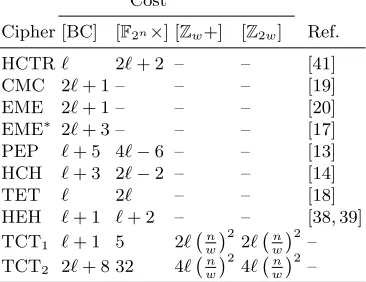
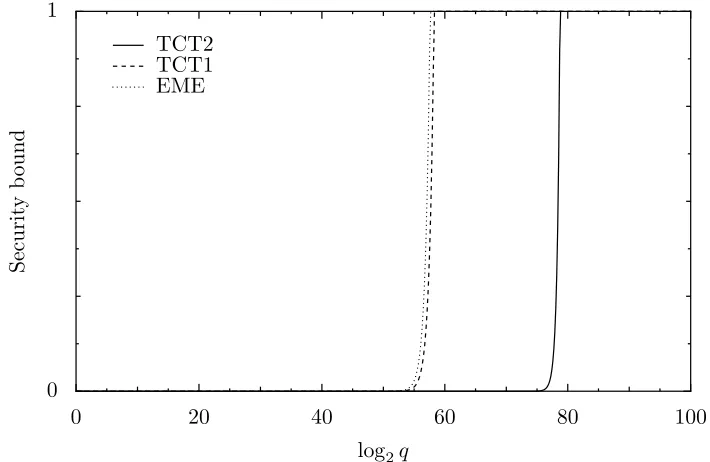
We contribute a new, top-down approach that leads us to the first beyond-birthday-bound secure tweak-able cipher suittweak-able for encrypting long inputs (i.e., longer than the blocksize of an underlying blockcipher). Table 1 and Figure 2 compare existing algorithms with our new TCT1 and TCT2 constructions in terms of
computational cost and security, respectively. Note that the finite field operations counted in Table 1 take hundreds of cycles in software [25, 4], whereas their cost relative to an AES blockcipher invocation is much lower in hardware [26].TCT1is the first tweakable cipher to require only a single blockcipher invocation and
no extra finite field multiplications for each additional n bits of input, while TCT2 is the first to provide
beyond-birthday-bound security (and still gets away with a fixed number of finite field multiplications). Cost
Cipher [BC] [F2n×] [Zw+] [Z2w] Ref.
HCTR` 2`+ 2 – – [41]
CMC 2`+ 1 – – – [19]
EME 2`+ 1 – – – [20]
EME∗ 2`+ 3 – – – [17]
PEP `+ 5 4`−6 – – [13] HCH `+ 3 2`−2 – – [14]
TET ` 2` – – [18]
HEH `+ 1 `+ 2 – – [38, 39] TCT1 `+ 1 5 2` n
w
2 2` n
w
2 – TCT2 2`+ 8 32 4` wn24` wn2–
Table 1: Tweakable ciphers and their computational costs for`n-bit inputs. Costs measured inn-bit blockcipher calls [BC], finite field multiplications [F2n×], and ring operations [Zw+] and [Z2w], for some word sizew. Typically,`= 32
for FDE, and we anticipaten= 128,w= 64.
The first approach for constructing tweakable ciphers, “encrypt-mix-encrypt”, is used by CMC [19], EME [20], and EME∗ [17], which employ two rounds of encryption separated by a light-weight “mixing layer”. CMC is the first in this line of work, and can be used to encrypt strings whose lengths are integral multiples ofn. EME improves on CMC by allowing encryption and decryption to be parallelized, and EME∗ extends the domain to include strings of arbitrary length.
Naor and Reingold [31] proposed the “hash-ECB-hash” approach, which sandwiches a layer of ECB-mode encryption between two invertible hashes. Informally, the role of the hashing layers is to diffuse the input. The PEP [13] mode of operation employs this approach. TET [18] and HEH [38] provide various improvements, notably in terms of performance. In each case, the two hashing layers require finite field multiplications. A variant of HEH described by Sarkar [39], however, manages to halve the number of multiplications that are required.
The final approach is “hash-CTR-hash”. Here, the hashing layers are not invertible, but provide the mechanism by which the first output bits become dependent on every input bit. Examples include HCTR [41], which initially offered rather poor security bounds, and HCH, which provides birthday-bound security and requires only a single blockcipher key. Chakraborty and Nandi [12] later gave a birthday-bound-security proof for HCTR.
When blockcipher calls are faster than two finite field multiplications, the encrypt-mix-encrypt approach appears most promising.
could without significant degradation of performance or security. These constructions overcome the birthday bound by using 2n-bit blockciphers as primitives, which are in turn constructed from ann-bit TBC. To our knowledge, CLRW2 [23] is the most efficientn-bit TBC with beyond-birthday-bound security that supports the necessary tweakspace (Minematsu’s TBC [28] limits tweak lengths to fewer thann/2 bits). Compared to TCT2, instantiating the LargeBlock constructions with this primitive ultimately requires an extra six finite
field multiplications for eachnbits of input. Thus, we suspect the LargeBlock designs would be impractical even if adding tweak support proves feasible.
A construction due to Coron, et al. [15], which we refer to as CDMS (after the authors), builds a 2n -bit TBC from ann-bit TBC, providing beyond-birthday-bound security in n. Like PIV, CDMS uses three rounds of a Feistel-like structure. However, our middle round uses a VIL tweakable cipher, and we require a weaker security property from the round. This allowsPIVto efficiently process long inputs. That said, CDMS provides an excellent way to implement a highly-secure 2n-bit TBC, and we will use it for this purpose inside of TCT2 to build Fe. (Nesting CDMS constructions could create (2mn)-bit tweakable blockciphers for any
m >1, but again, this would not be practical.) We note that Coron, et al. were primarily concerned with constructions indifferentiable from an ideal cipher, a goal quite different from ours.
The Thorp shuffle [30] and its successor, swap-or-not [21], are highly-secure ciphers targeting very small domains (e.g., {0,1}n for n ≤ 64). Swap-or-not could almost certainly become a VIL tweakable cipher, without changing the security bounds, by using domain separation for each input length and tweak in the underlying PRF. Essentially, one would make an input-length parameterized family of (tweakable) swap-or-not ciphers, with independent round-keys for each length. While still offering reasonable performance and unmatched security for very small inputs, the result would be wildly impractical for the large domains we are considering: swap-or-not’s PRF needs to be invoked at least 6b times to securely encipher ab-bit input (below that, the bound becomes vacuous against evenq= 1 query), and disk sectors are often 4096 bytes. Also, to matchTCT2’s security, the PRF itself would need to be secure beyond the birthday bound (with
respect ton).
Finally, we note that Rogaway and Shrimpton [37] considered some forms of tweakable encode-then-encipher in the context of deterministic AE (“keywrapping”), and our work generalizes theirs.
0
1
Securit
y
b
ound
0
20
40
60
80
100
log
2q
TCT2
TCT1
EME
Fig. 2: Security bounds for TCT1, EME and TCT2, all using an underlying 128-bit primitive and 4096-bit
2
Tweakable Primitives
Preliminary notation. LetN={0,1,2, . . .} be the set of non-negative integers. Forn∈N, {0,1}n denotes
the set of alln-bit binary strings, and{0,1}∗denotes the set of all (finite) binary strings. We writeεfor the empty string. Lets, t∈ {0,1}∗. Then|s| is the length ofsin bits, and |(s, t)|=|skt|, whereskt denotes the string formed by concatenating sandt. If s∈ {0,1}nm for somem∈N, s1s2· · ·sm←n sindicates that
eachsi should be defined so that |si|=n ands =s1s2· · ·sm. When nis implicit from context, it will be
omitted from the notation. Ifs=b1b2· · ·bn is an n-bit string (eachbi ∈ {0,1}), then s[i..j] =bibi+1· · ·bj,
s[i..] =s[i..n], ands[..j] =s[1..j]. The strings⊕tis the bitwise xor ofsandt; if, for example,|s|<|t|, then
s⊕t is the bitwise xor ofs andt[..|s|]. GivenR⊆Nandn∈Nwithn≤min(R), {0,1}R =S
i∈R{0,1} i
, and by abuse of notation,{0,1}R−n =S
i∈R{0,1} i−n
. Given a finite setX, we writeX←− X$ to indicate that the random variableX is sampled uniformly at random fromX. Throughout, the distinguished symbol⊥is assumed not to be part of any set except{⊥}. Given an integer nknown to be in some range,hnidenotes some fixed-length (e.g., 64-bit) encoding ofn.
Let H : K × D → R ⊆ {0,1}∗ be a function. Writing its first argument as a subscripted key, H is
-almost universal (-AU) if for all distinct X, Y ∈ D, Pr [HK(X) =HK(Y) ] ≤ (where the
probabil-ity is over K $
←− K). Similarly, H is -almost 2-XOR universal if for all distinct X, Y ∈ D and C ∈ R, Pr [HK(X)⊕HK(Y) =C]≤.
An adversary is an algorithm taking zero or more oracles as inputs, which it queries in a black-box manner before returning some output. Adversaries may be random. The notationAf⇒b denotes the event that an
adversaryAoutputsbafter running with oracle f as its input.
Sometimes it will be convenient to give pseudocode descriptions of the oracles with which an adversary can interact, as well as procedures that set up or otherwise relate to such interactions. These descriptions will be referred to asgames(borrowing from the Bellare-Rogaway game-playing framework [5]). Each game consists of a set of procedures, including a specialMainprocedure that takes an adversaryAas input. We define Pr [G(A)⇒y] as probability that theMainprocedure of gameGoutputsywhen given an adversary
Aas input. When noMainprocedure is explicitly given,Main(A) simply executesA, providing it with the remaining procedures as oracles (in some order that will be clear from context), and then returnsA’s output.
Syntax. LetKbe a non-empty set, and letT,X ⊆ {0,1}∗. Atweakable cipheris a mappingEe:K×T ×X → X
with the property that, for all (K, T)∈ K × T, Ee(K, T,·) is a permutation on X. We typically write the
first argument (the key) as a subscript, so that EeK(T, X) = Ee(K, T, X). As EeK(T,·) is invertible, we let e
EK−1(T,·) denote this mapping. We refer toKas thekey space,T as thetweak space, andX as themessage
space. We say that a tweakable cipherEe islength preservingif|EeK(T, X)|=|X|for allX ∈ X,T ∈ T, and
K∈ K. All tweakable ciphers in this paper will be length preserving. Restricting the tweak or message spaces of a tweakable cipher gives rise to other objects. When X ={0,1}n for some n >0, then Ee is atweakable
blockcipher with blocksize n. When |T |= 1, we make the tweak implicit, giving a cipher E: K × X → X, whereEK(·) is a (length-preserving) permutation overX and E−K1 is its inverse. Finally, whenX ={0,1}
n
and|T |= 1, we have a conventionalblockcipher E:K × {0,1}n→ {0,1}n.
Security notions. Let Perm (X) denote the set of all permutations on X. Similarly, we define BC(K,X) be the set of all ciphers with keyspaceK and message spaceX. WhenX,X0 are sets, we define Func(X,X0) to
be the set of all functionsf:X → X0. Fix a tweakable cipher
e
E:K × T × X → X. We define the tweakable pseudorandom-permutation (TPRP) and strong-TPRP (STPRP) advantage measures as
Advprpg
E (A) = Pr h
K $
←− K: AEeK(·,·)⇒1i−PrhΠ←−$ BC(T,X) : AΠ(·,·)⇒1i
Advsprpg
E (A) = Pr h
K $
←− K: AEeK(·,·),Ee−K1(·,·)⇒1 i
−PrhΠ $
←−BC(T,X) : AΠ(·,·),Π−1(·,·)
where, in each case, adversary A takes the indicated number of oracles. We assume that A never makes pointless queries. By this we mean that for both the TPRP and STPRP experiments, the adversary never repeats a query to an oracle. For the STPRP advantage measure, this also means that if Aqueries (T, X) to its leftmost oracle and receivesY in return, then it never queries (T, Y) to its rightmost oracle, and vice versa. These assumptions are without loss of generality. We define a related measure, the SRND advantage, as
Advsrndg e
E (A) = Pr h
K←− K$ : AEeK(·,·),Ee
−1 K (·,·)⇒1
i
−PrhA$(·,·),$(·,·)⇒1i
where the $(·,·) oracle always outputs a random string equal in length to its second input:|$(T, X)|=|X| for all T and X. As before, we assume that A never makes a pointless query. Here, these assumptions are not without loss of generality, but instead prevent trivial wins. Adversaries for the above three advantages arenonce-respecting if the transcript of their oracle queries (T1, X1), . . . ,(Tq, Xq) does not includeTi =Tj
for anyi6=j.
Now, fix a cipherE:K ×X → X. Then we define the pseudorandom permutation (PRP) and strong-PRP (SPRP) advantage measures
AdvprpE (A) = PrhK←− K$ : AEK(·)⇒1i−Prhπ $
←−Perm (X) : Aπ(·)⇒1i
AdvsprpE (A) = PrhK←− K$ : AEK(·),E−K1(·)⇒1i−
Prhπ←−$ Perm (X) : Aπ(·),π−1(·)⇒1i.
where, in each case, adversaryAtakes the indicated number of oracles. We assume without loss of generality, that the adversary does not make pointless queries.
For all security notions in this paper, we track three adversarial resources: the time complexity t, the number of oracle queriesq, and the total length of these queriesµ. The time complexity of A is defined to include the complexity of its enveloping probability experiment (including sampling of keys, oracle compu-tations, etc.), and we define the parameter t to be the maximum time complexity of A, taken over both experiments in the advantage measure.3
3
The
PIV
Construction
We begin by introducing our high-level abstraction,PIV, shown in Figure 1. LetT ={0,1}tfor somet≥0, and let Y ⊆ {0,1}∗ be such that ifY ∈ Y, then{0,1}|Y|⊆ Y. Define T0 =T × Y. Fix an integerN >0.
Let Fe:K0× T0× {0,1} N
→ {0,1}N be a tweakable blockcipher and let Ve:K × {0,1} N
× Y → Y be a tweakable cipher. From these, we produce a new tweakable cipherPIV[F ,e Ve] : (K0× K)× T × X → X, where
X ={0,1}N × Y. As shown in Figure 1, thePIVcomposition ofF ,e Ve is a three-round Feistel construction,
working as follows. On input (T, X), let X = XL kXR where |XL| = N. First, create an N-bit string
IV =FeK0(TkXR, XL). Next, use this IV to encipherXR, creating a stringYR=VeK(IV, XR). Now create
anN-bit stringYL=FeK0(TkYR,IV), and returnYLkYR as the value ofPIV[F ,e Ve]K0,K(T, X). The inverse PIV[F ,e Ve]−K10,K(T, Y) is computed in the obvious manner.
At first glance, it seems that nothing interesting has been accomplished: we took an N-bit TBC and a tweakable cipher, and produced a tweakable cipher with a slightly larger domain. However, the following theorem statement begins to surface what our abstraction delivers.
Theorem 1. Let sets T,Y,T0,X and integer N be as above. Let
e
F:K0 × T0× {0,1}N
→ {0,1}N be a tweakable blockcipher, and let Ve:K × {0,1}
N
× Y → Y be a tweakable cipher. Let PIV[F ,e Ve] be as just
3
described. LetA be an adversary makingq <2N/4 queries totalingµbits and running in timet. Then there
exist adversaries B andC, makingq and 2q queries, respectively, and both running in O(t)time such that Advsprpg
PIV[F ,eeV]
(A)≤Advsrndg e
V (B) +Adv g sprp
e
F (C) + 4q2
2N, where B is nonce-respecting and whose queries total µ−qN bits in length.
The first thing to notice is that the VIL portion of thePIVcomposition,Ve, need be SRND-secure against
nonce-respecting adversaries only. As we will see in the next section, it is easy to build efficient schemes meeting this requirement. Only the FIL portion,Fe, needs to be secure against STPRP adversaries that can
use arbitrary querying strategies. Thus thePIVcomposition promotes nonce-respecting security over a large domain into full STPRP security over a slightly larger domain.
The intuition for why this should work is made clear by the picture. Namely, ifFeis a good STPRP, then
if any part ofT orX is “fresh”, then the stringIV should be random. Hence it is unlikely that anIV value is repeated, and so nonce-respecting security of the VIL component is enough. Likewise when deciphering, if any part ofT, Y is “fresh”.
The term 4q2/2N accounts for collisions inIV and the difference between e
F and a random function. This is a birthday-bound term inN, the blocksize ofFe. Since most TBC designs employ (one or more) underlying
blockciphers, we have deliberately chosen the notationN, rather than n, to stress that the blocksize ofFe
can be larger than that of some underlying blockcipher upon which it might be built. Indeed, we’ll see in the next section that, given ann-bit blockcipher (and a hash function), we can buildFe withN = 2n. This
gives us hope of building beyond birthday-bound secure VIL STPRPs in a modular fashion; we will do so, and with relatively efficient constructions, too.
It will come as no surprise that, if one does away with the lower Fe invocation and returns IV kYR,
the resulting composition does not generically deliver a secure STPRP. On the other hand, itis secure as a TPRP (just not a strong TPRP). This can be seen through a straight-forward modification of thePIV security proof.
Proof. Fix a message space{0,1}S (S ⊆N), a tweakspaceT, and a non-negative integern≤min(S). LetA
be an adversary making at mostqqueries and running in timet. Halevi and Rogaway [20] show that Advsprpg
PIV[F ,eeV](A)
≤Advsrndg
PIV[F ,eeV](A) +
q(q−1) 2min(S)+1.
This result is essentially a PRF–PRP switching lemma for TBCs, and reduces our problem to that of boundingAdvsrndg
PIV[F ,eeV](A).
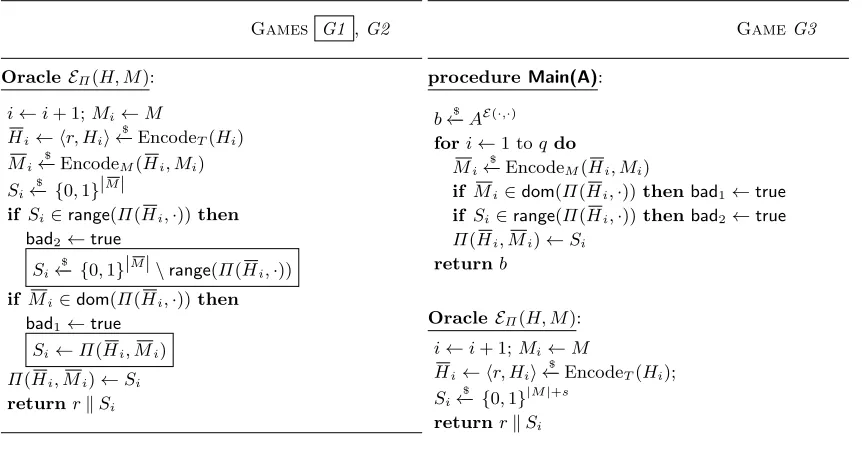
We begin in the information-theoretic setting, and consider E[Ve] = PIV[Π,Ve], where Π $
←−BC(N) is an ideal cipher. The oracles in Game 1 simulate E[Ve] and E[Ve]−1 using lazy sampling to define Π, so
PrhAE[Ve],E[Ve]−1⇒1 i
= Pr [ G1(A)⇒1 ].
In Game 2, we no longer resample “illegal” values when definingΠ. The only changes in the code occur after a boolean “bad” flag is set totrue; by the Fundamental Lemma of Game-Playing,
Advsrndg
E[Ve](A)≤
Pr [ G2(A)⇒1 ]−PrhA$(·,·),$(·,·)⇒1i+ Pr [ G2(A) ;bad
1∨bad2∨bad3]
Note that in Game G2, Ve is never queried using the same tweak twice. Hence we may consider a third
game (not shown), Game G3, in whichVe is replaced by an oracle $(·,·) that always returns a random string
equal in length to its second input. By a standard argument, there exists some nonce-respecting adversary
B makingqqueries and running inO(t) time such that
Pr [ G2(A)⇒1 ]−Pr [ G3(A)⇒1 ]≤Advsrndg e V (B).
We now have
Advsrndg
E[Ve](A)≤
Pr [ G3(A)⇒1 ]−PrhA$(·,·),$(·,·)⇒1i
However, note that now each the firstNbits of each oracle output (corresponding toZ0
i) are always uniformly
random in Game G2, and when we switch fromVe to $(·,·) in the next game, the remaining bits also become
uniformly random. Hence Pr [ G3(A)⇒1 ] = Pr
A$(·,·),$(·,·)⇒1
.
Games G1 ,G2
OracleE`(T, X): 200 j ←j+ 1
201 Tj ←TkX[N+ 1..] 202 IVj
$
←− {0,1}N\range(Π[Tj]) 203 Π[Tj](X[1..N])←IVj 204 IV ←IVj
205 if IVj∈ {IVi : i < j} then 206 bad1←true
207 IVj $
←− {0,1}N\ {IVi : i < j}
208 IVj←IV // Rollback to “real” value 209 Zi←Ve[IVj](X[N+ 1..])
210 T0
j ←TkZi
211 Z0
i $
←− {0,1}N
212 if IVj∈dom(Π[Tj0])then 213 bad2←true
214 Zi0←Π[Tj0](IVj) 215 else if Z0
i ∈range(Π[Tj0]) 216 bad3←true
217 Z0
i $
←− {0,1}N\range(Π[T0
j]) 218 Π[T0
j](IVj)←Zi0 219 returnZ0
ikZi
Oracle E`−1(T, Y):
220 j←j+ 1
221 Tj ←TkY[N+ 1..] 222 IVj
$
←− {0,1}N \dom(Π[Tj]) 223 Π[Tj]−1(Y[1..N])←IVj 224 IV ←IVj
225 if IVj∈ {IVi : i < j} then 226 bad1←true
227 IVj $
←− {0,1}N \ {IVi : i < j} 228 IVj ←IV
229 Zi←Ve[IVj]−1(Y[N+ 1..]) 230 T0
j ←TkZi
231 Z0
i $
←− {0,1}N
232 if IVj∈range(Π[Tj0])then 233 bad2←true
234 Z0
i←Π[Tj0]−1(IVj) 235 else if Z0
i ∈dom(Π[Tj0]) 236 bad3←true
237 Z0
i $
←− {0,1}N\dom(Π[T0
j]) 238 Π[T0
j](Zi0)←IVj 239 returnZ0
ikZi
Fig. 3: Game 1, which includes the boxed statements, simulatesPIV[Π,Ve] by defining Π through lazy
sam-pling. Game 2, which doesnotinclude the boxed statements, never invokesVe with the same tweak twice, and
the oracles in this game always return values with a randomn-bit prefix. All boolean variables are silently initialized tofalse.
Our final task is to bound the probability thatA sets abadflag in Game G2. The probability thatbad1
is set during query j is less than j/(2N −2j). Similarly, the probabilities of bad
2 and bad3 being set are
at most 2j/(2N −2j) and 2j/2N, respectively. Therefore the probability that at least one flag is set during
queryj is at most 3j/(2N−2j) + 2j/2N.
Taking the union bound overj∈1,2, . . . , qgives us Pr [ G1(A) ;bad1∨bad2∨bad3]≤q2
1.5 2N−2q +
1 2N
. Since q <2N/4, 1.5/(2N −2q)<3/2N. Collecting our previous results and using a standard argument to
return to the computational setting completes the proof:
Advsprpg
PIV[F ,eeV]
(A)≤Advsrndg e
V (B) +Adv g sprp
e
F (C) +
4q2
where C makes 2q queries,B makes qqueries of total length µ−qN bits without repeating a tweak, and both run inO(t) time.
4
Concrete Instantiations of
PIV
Instantiating a PIV composition requires two objects, a (fixed-input-length) tweakable blockcipherFe with
anN-bit blocksize, and a variable-input-length tweakable cipherVe. In this section we explore various ways
to instantiate these two objects, under the guidance of Theorem 1 and practical concerns.
Theorem 1 suggests setting N to be as large as possible, so that the final term is vanishingly small for any realistic number of queries. But for this to be useful, one must already know how to build a TBC Fe
with domain {0,1}N for a large N, and for whichAdvsprpg e
F (C) approachesq
2/2N. To our knowledge, there
are no efficient constructions that permit Advsprpg e
F (C) to be smaller than O(q
3/22n) when using an n-bit
blockcipher as a starting point. (A recent result by Lampe and Seurin [22] shows how to beat this security bound, but at a substantial performance cost.) A construction by Coron, et al., which will be discussed in more detail shortly, does meet this bound4while providing N = 2n.
So we restrict our attention to building TBC Fe with small N. In particular, we follow the common
approach of building TBCs out of blockciphers. Letting n be the blockcipher blocksize, we will consider
N =n, andN = 2n. In the former case, Theorem 1 only promises us security up to roughlyq= 2n/2, which
is the birthday bound with respect to the blockcipher. With this security bound in mind, we can use simple and efficient constructions of bothFe and the VIL tweakable cipher Ve. On the other hand, when N = 2n,
Theorem 1 lets us hope for security to roughlyq= 2n queries. To realize this hope we will need a bit more
from bothFeandVe, but we will still find reasonably efficient constructions delivering beyond birthday bound
security.
In what follows, we will sometimes refer to objects constructed in other works. These are summarized for convenience in Figure 10, found in Appendix A.
An efficient VIL tweakable cipher. We will start by considering general methods for constructing the VIL tweakable cipher, Ve. Recall that Ve need only be secure against adversaries that never repeat a tweak. In
Figure 4, we see an analogue of conventional counter-mode encryption, but over an n-bit TBC Ee instead
of a blockcipher. Within a call (T, X) to TCTR, each n-bit blockXi of the input X is processed using a
procedureTCTR[Ee]K(T, X):
X1, X2, . . . , Xν←n X fori= 1 toν
Ti←g(T, i);Zi← hii Yi←EeK(Ti, Zi)⊕Xi ReturnY1, Y2, . . . , Yν
procedureTCTR[Ee] −1 K(T, Y): Y1, Y2. . . , Yν←n Y
fori= 1 toν
Ti←g(T, i);Zi← hii Xi←Yi⊕EeK(Ti, Zi) ReturnX1, . . . , Xν
Fig. 4:The TCTR VIL tweakable cipher.
per-block tweakTi, this being determined by a functiong:T0×N→ T of the input tweakT and the block
indexi.
Consider the behavior of TCTR wheng(T, i) =T. The following result is easily obtained using standard techniques.
4
Theorem 2. Let Ee: {0,1} k
× T × {0,1}n → {0,1}n be a tweakable blockcipher, and let TCTR[Ee]K and
TCTR[Ee]−K1 be defined as above, with g(T, i) =T ∈ T. LetA be a nonce-respecting adversary that runs in
timet, and asks qqueries, each of length at most`n bits (so,µ≤q`n). Then for some adversaryB making
at mostq` queries and running in time O(t),Advsrndg
TCTR[Ee](A)≤Adv g prp
e
E (B) + 0.5q` 2/2n.
We note that the bound displays birthday-type behavior when`=o(√q), and is tightest when `is a small constant. An important application with small, constant` is full-disk encryption. Here plaintexts X would typically be 4096 bytes long, so if the underlying TBC has blocksizen= 128, we get`= 256 blocks.5
Extending tweakspaces. InPIV, the TBCFewill need to handle long tweaks. Fortunately, a result by Coron,
et al. [15] shows that one can compress tweaks using an-AU hash function at the cost of adding aq2term
to the tweakable cipher’s TPRP security bound. In particular, we will use (a slight specialization of) the NH hash, defined by Black, et al. [10]; NH[r, s]L takes r-bit keys (|L|=r), maps r-bit strings to s-bit strings,
and is 2s/2-AU. Please see Table 10 for the description. Given a TBC e
E,EeNH denotes the resulting TBC,
whose tweakspace is now the domain of NH, rather than its range.
4.1 Targeting efficiency at birthday-type security: TCT1
Let us begin with the case ofN =n. To instantiate then-bit TBCFeinPIV we refer to the pioneering TBC
work of Liskov, Rivest and Wagner [24], from which we draw the LRW2 TBC; please refer to Figure 10 for a description.
Before we give the TCT1 construction, a few notes. In Figure 10 we see that in addition to a blockcipher E, LRW2[H, E] uses an-AXU2 hash function, H, and so, in theory, it could natively accommodate large
tweaks. But for practical purposes, it will be more efficient to implement LRW2 with a small tweakspace, and then extend this using a fast -AU hash function.6 For the -AXU
2 hash function itself, we use the
polynomial hash polyH (also described in Table 10).
Now we are ready to give our TCT1 construction, which is birthday-bound secure for applications with
small plaintext messages (e.g. FDE).
TheTCT1Construction. Fixk, n >0, and letN =n. LetE: {0,1}k× {0,1}n → {0,1}n be a blockcipher,
and let polyHmn, and NH be as defined in Table 10. Then defineTCT1=PIV[F ,e Ve], where to obtain aτ n-bit
tweakspace and domain{0,1}{n,n+1,...,`n} we set:
1. n-bit TBCFe= LRW2[polyH2n, E]NH[(`+τ)n,2n], i.e. LRW2 with its tweakspace extended using NH. The
keyspace for Fe is {0,1} k
× {0,1}2n× {0,1}(`+τ)n, with key K0 partitioning into keys forE, polyH2n
, and NH[(`+τ)n,2n]. (Since NH supports only fixed length inputs, we implicitly pad NH inputs with a 1 and then as many 0s as are required to reach a total length of (`+τ)nbits.) The tweakspace forFe is
{0,1}{0,1,2,...,(`+τ−1)n}.
2. VIL tweakable cipherVe = TCTR [LRW2[polyHn, E]] with the TCTR functiong: {0,1} n
×N→ {0,1}n as g(T, i) = T. The keyspace for Ve is {0,1}
k
× {0,1}n, with key K partitioning into keys for E and polyHn. The tweakspace forVe is{0,1}
n
, and its domain is{0,1}{0,1,...,(`−1)n}.
Putting together Theorems 1,2, and results from previous works [10, 24], we have the following security bound.
Theorem 3 (STPRP-security of TCT1). Define TCT1 as above, and let A be an adversary making q <2n/4 queries and running in timet. Then there exist adversaries B and C, both running in time O(t)
and making (`−1)q and 2q queries, respectively, such that Advsprpg
TCT1[E](A)≤Adv prp
E (B) +Adv sprp E (C) + 32q2
2n +
4q2(`−1)2 2n .
5
Actually, slightly less than this when used in thePIVcomposition, since the firstN bits are enciphered byFe.
6 Indeed, one can show composing an-AU hash function with an0
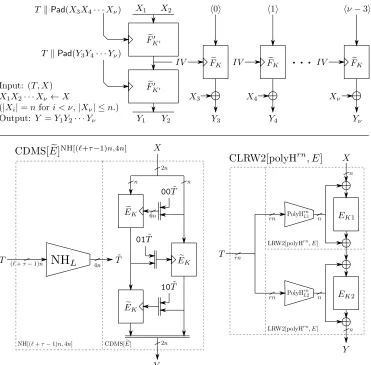
Fig. 5: TheTCT2 construction (top).TCT2 takesτ n-bit tweaks, and the input length is between 2n and `n bits, inclusive. Here,Feis implemented using the 2n-bit CDMS construction coupled with the NH hash function (bottom
left). BothVeand the TBCEeused inside of CDMS are implemented using CLRW2[polyHrn, E] (bottom right), with
r= 6 andr= 2, respectively. The functionPad mapsstosk10(`+1)n−1−|s|
Proof. Using Theorem 1 and security bounds from prior works,
Advsprpg
TCT1[E](A)≤
4q2
2n +Adv g srnd
e V (t
0, q) +Advsprp e F (t
0,2q)
≤4q
2
2n +
q(`−1)2
2n +Adv
g prp
LRW2[polyHn,E](t0,(`−1)q)
+
24q2
2n +
4q2
2n +Adv sprp E (t
0,2q)
≤4q
2
2n +
q(`−1)2
2n +
3q2(`−1)2
2n +Adv
prp
E ((`−1)q, t
0)+28q2
2n +Adv sprp E (t
0,2q)
≤32q
2
2n + +
q(`−1)2
2n +
3q2(`−1)2
2n +Adv
prp
E ((`−1)q, t
0) +Advsprp E (t
0,2q).
This algorithm requires 2k+ (3 +τ+`)nbits of key material, including two keys forEe. As we show at
the end of this section, we can get away with a single key forE with no significant damage to our security bound, although this improvement is motivated primarily by performance concerns.
Thus TCT1 retains the security of previous constructions (see Figure 2 for a visual comparison), uses
arithmetic in rings with powers-of-two moduli, rather than in a finite field. This may potentially improve performance in some architectures.
4.2 Aiming for beyond birthday-bound security: TCT2
Now let us consider thePIVcomposition withN = 2n. For the FIL component, we can use Coron et al.’s [15] CDMS construction to get a 2n-bit TBC from ann-bit TBC, and implement the latter using the CLRW2, a recent beyond-birthday-bound secure construction by Landecker, Shrimpton, and Terashima [23]. Table 10 describes both constructions.7 We again extend the tweakspace using NH. (To stay above the birthday
bound, we set the range of NH to{0,1}2n). Ultimately, settingFe= CDMS[CLRW2]NHis secure against up
to around 22n/3 queries.
CLRW2 also gives us a way to realize a beyond birthday-bound secure VIL component, namely Ve =
TCTR[CLRW2[E, H], at least for ` = o(q1/4). (We’ll see how to avoid this restriction, if desired, in a
moment.)
We are now ready to give our second fully concretePIVcomposition,TCT2, targeted at applications that
would benefit from beyond birthday-bound security. This algorithm requires us to nest four layers of other constructions, so we provide an illustration in Figure 5. Again we emphasize that the (admittedly significant) cost ofFecan be amortized.
TCT2 supportsτ n-bit tweaks and has domain{0,1}{2n,2n+1,...,`n}.
TheTCT2Construction. Fix k, `, n, τ > 0, and let N = 2n. Let E: {0,1}k × {0,1}n → {0,1}n be a
blockcipher, and let polyH`n, and NH be as defined in Table 10. Then defineTCT2=PIV[F ,e Ve], where:
1. Fe= CDMS
CLRW2[polyH6n, E]NH[(`+τ−1)n,4n]
, that is, the 2n-bit TBC CDMS
CLRW2[polyH6n, E]
with its tweakspace extended using NH. The keyspace forFeis{0,1} 2k
× {0,1}12n× {0,1}(`+τ−1)n, with keyK0partitioning into two keys forE, two keys for polyH6n
, and a key for NH[`n,4n]. The tweakspace forFe is{0,1}
τ n
. 2. Ve = TCTR
CLRW2[polyH2n, E]
, with the TCTR function g: {0,1}n×N→ {0,1}n as g(T, i) = T.
The keyspace for Ve is{0,1} 2k
× {0,1}4n with key K partitioning into two keys forE and two keys for polyH2n. The tweakspace forVe is{0,1}
2n
, and its domain is{0,1}{0,1,2,...,(`−2)n}. 7
We note that for CDMS[Ee], we enforce domain separation viaEe’s tweak, whereas the authors of [15] use multiple
TCT2 requires 4k+ (`+τ+ 15)n bits of key material. Putting together Theorems 1, 5, and results from
previous works [10, 15, 23], we have the following security result.
Theorem 4 (STPRP-security of TCT2). Define TCT2 as above, and let A be an adversary making q
queries and running in time t, where6q, `q < 22n/4. Then there exist adversaries B and C, both running
in O(t) time and making (`−1)q and 6q queries, respectively, such that Advsprpg
TCT2(A) ≤ 2Adv prp E (B) +
2AdvsprpE (C) +12q2 22n +
q(`−1)2
2n +
6`3q3 22n−2−`3q3 +
64q3 22n−2−63q3.
Proof. Using Theorem 1 and security bounds from prior works,
Advsprpg
TCT2(A)≤
4q2
22n +Adv g srnd
e V (t
0, q) +Advsprp e F (t
0,2q)
≤4q
2
22n +
q(`−1)2
2n +Adv g prp
CLRW2[H2n,E](t
0,(`−1)q,)
+
4q2
22n +
4q2
22n +Adv g sprp
CLRW2[H6n,E](t
0,6q,)
≤12q
2
22n +
q(`−1)2
2n +
6`3q3
22n−2−`3q3+
64q3
22n−2−63q3+ 2Adv prp E (t
0,(`−1)q) + 2Advsprp E (t
0,6q).
Some of the constants in this bound are rather significant. However, as Figure 2 shows,TCT2nevertheless
provides substantially better security bounds thanTCT1 and previous constructions.
4.3 Additional practical considerations
Several variations and optimizations onTCT1andTCT2are possible. We highlight a few of them here. None
of these changes significantly impact the above security bounds, unless otherwise noted.
Reducing the number of blockcipher keys. In the case ofTCT1, we can use a single key for both LRW2 instances
provided we enforce domain separation through the tweak. This allows us to use a single key for the underlying blockcipher, which in some situations may allow for significant implementation benefits (for example, by al-lowing a single AES pipeline). One method that accomplishes this is to replace LRW2[polyH2n, E]NH[(`+1)n,2n]
with LRW2[polyH3n, E]f(ε,·)and LRW2[polyHn
, E] with LRW2[polyH3n, E]f(·,ε). Here,f is a 2−n-AU
func-tion with keyspace {0,1}3n × {0,1}`n, taking inputs of the form (X, ε) (for some X ∈ {0,1}n) or (ε, Y) (for some Y ∈ {0,1}{0,1,...,`n}), and outputting a 3n-bit string. Let fL(X, ε) = 02nkX and fL(ε, Y) =
1nkNH[(`+ 1)n,2n]
L(Y). The functionf described here is a mathematical convenience to unify the
signa-tures of the two LRW2 instances, thereby bringing tweak-based domain separation into scope; in practice, we imagine the two instances would be implemented independently, save for a shared blockcipher key. We note thatTCT2 can be modified in a similar manner to require only two blockcipher keys.
Performance optimizations. If we need only a tweakable (FIL) blockcipher, we can use NH[`n,2n] in place of NH[(`+ 1)n,2n] by adjusting our padding scheme appropriately. We emphasize that in the TCTR portion, the polyH functions only need to be computed once, since each LRW2 invocation uses the same tweak. The corresponding optimizations apply toTCT2, as well.
A na¨ıve implementation of TCT2 would make a total 72 finite field multiplications during the two FIL
Handling large message spaces. Both TCT1 and TCT2 are designed with FDE applications in mind. In
particular, they require`to be fixed ahead of time, and require more than`nbits of key material.
These limitations are a consequence of using the NH hash function; however, a simple extension to NH (described by the original authors [10]) accommodates arbitrarily long strings. Fix a positive integerr and define NH∗L(M1M2· · ·Mν) = NHL(M1)kNHL(M2)k · · · kNHL(Mν)k h|M|modrni, where |Mi|=rn for
i < ν, |Mν| ≤ rn, and NHL abbreviates NHL[rn,2N]. Thus defined, NH∗ is 2−N-almost universal, has
domain {0,1}∗, and requires rn bits of key material. This modification shifts some of the weight to the polyH hash; we now require eight extra finite field multiplications for each additional rn bits of input. As long asr >4, however, we require fewer of these multiplications when compared to previous hash-ECB-hash or hash-CTR-hash constructions.
With these modifications, the final two terms in TCT1’s security bound (Theorem 3) would become
8q2/2n+600q2`2/r22n+4q2(`−1)2/2n, where`nis now the length of the adversary’s longest query,` >2.5r,
and the remaining terms measure the (S)PRP security of the underlying blockcipher. We also assume 2n≥rn,
so that |M|modrncan be encoded within a single n-bit block. Although the constant of 600 is large, we note that settingr= 16, for example, reduces it to a more comfortable size — in this case to less than three. The bound forTCT2 changes in a similar manner. (Note that if 2n−2≥rn, we can use a singlen-bit block
for both the tweak domain-separation constants andh|M|modrni.)
Beyond birthday-bound security for long messages. When`is not bounded to some small or moderate value, TCT2 no longer provides beyond-birthday-bound security. The problematic term in the security bound is q(`−1)2/2n. To address this, we return to TCTR (Figure 4) and consider a different per-block tweak function.
In particular, g(T, i) = Tk hii. In the nonce-respecting case, the underlying TBC Ee is then retweaked
with a never-before-seen value on each message block. Again, think about what happens whenEeis replaced
by an ideal cipher Π: in the nonce-respecting case, every block of plaintext is masked by the output of a fresh random permutation.8In other words, every block returned will be uniformly random. Thus we expect
a tight bound, in this case. Formalizing this logic yields the following theorem. Theorem 5. Let Ee: {0,1}
k
× T × {0,1}n → {0,1}n be a tweakable blockcipher, and let TCTR[Ee]K and
TCTR[Ee]−K1 be defined as above, with g: T0×N → T an arbitrary injective mapping. Let A be a
nonce-respecting adversary that runs in timet, and asksq queries of total length at most µ=σnbits. Then there exists some adversaryB making at most σqueries and running in time O(t)such that Advsrndg
TCTR[Ee](A)≤
Advgprp e E (B).
Consequently, using this variation of TCTR in Theorems 3 and 4 would remove the q(`−1)2 term from
the bounds, thereby lifting message length concerns. Note that if this change is made, g(T, i) needs to be computed up to`times per invocation, rather than just once. This problem may be mitigated by using the XEX [33] TBC in place of LRW2, which makes incrementing the tweak extremely fast without significantly changing our security bound.
When the above change are made, TCT1 and TCT2 offer efficient tweakable ciphers on an unbounded
domain, losing security guarantees only afterO(2n/2) (resp.,O(22n/3)) bits have been enciphered.
4.4 Instantiating PIV with conventional encryption
To further highlight the flexibility surfaced by our compositional approach, we point out that the VIL componentVe can be realized directly using conventional blockcipher-based encryption. Consider the
imple-mentation of V ,e Ve−1 shown in Figure 6. We recognize this immediately as counter-mode encryption, but
with the initial value T surfaced as an input to make it a tweakable cipher. (Rogaway [34] formalized this as a “nonce-based encryption scheme”.) Unfortunately, we cannot use the main PIV security statement, Theorem 1, with thisFe, because it is not SRND-security against nonce-respecting adversaries. Nonetheless,
8 Notice that one could use (say)Z
procedureVeK(T, X): X1, X2, . . . , Xb←n X fori= 1 tob
Yi←EK(hT+ii)⊕Xi ReturnY1, Y2, . . . , Yb
procedureVeK−1(T, Y):
Y1, Y2. . . , Yb←n Y fori= 1 tob
Xi←Yi⊕EK(hT+ii) ReturnX1, . . . , Xb
procedureGeK(T, X):
X1, X2, . . . , Xb←n X K←fK(T)
fori= 1 tob
Yi←EK(hT+ii)⊕Xi Return Y1, Y2, . . . , Yb
procedureGe−K1(T, Y):
Y1, Y2. . . , Yb←n Y K←fk(T)
fori= 1 tob
Xi←Yi⊕EK(hT +ii) ReturnX1, . . . , Xb
Fig. 6: Two VIL tweakable cipher constructions, based on conventional counter-mode encryption over ann-bit block-cipherE.
examination of the proof of Theorem 1 shows that it can be modified to work. To that end, we introduce a new notion of securityAdv^srnd$
e
E (A) = Pr h
K←− K$ : AEeK(·),eE−K1(·)⇒1 i
−Pr
A$(·),$(·)⇒1
. GivenEe with
tweakspaceT and message spaceX, the oracleEK takes a queryX ∈ X and: (1) samplesT $
←− T, (2) returns
EK(T, X). OracleE−K1 behaves likewise on input Y ∈ X, samplingT $
←− T and returning E−K1(T, Y). With
this, one can state an alternative composition theorem. Lemma 1. Let sets T,Y,T0,X, integer N, TBC
e
F and tweakable cipherVe be as described in Theorem 1.
Let Abe an adversary making q <2N/4 queries and running in timet. Then there exist adversariesB and
C, makingqand2qqueries, respectively, and both running inO(t)time such thatB is nonce-respecting and Advsprpg
PIV[F ,eeV](A)
≤ 52qN2 +Adv
^
srnd$
e
V (B) +Adv g sprp
e F (C).
Then a standard proof shows that theT BC in Figure 6 is SRND$-secure, up to a birthday bound, if E is secure as a PRP.
Lemma 2. LetE: {0,1}k× {0,1}n→ {0,1}n be a blockcipher, and letVe andVe−1 be as in Figure 6. LetA
be an adversary running in time t, and ask asking q queries, these totalling at most µ = σn bits. Then Adv^srnd$
e
V (A)≤σ
2/2n+Advprp
E (B), whereB asks at mostσ queries, and runs in timeO(t).
Thus, one could compose counter-mode encryption withFe based on LRW2 to build an efficient,
birthday-bound-secure STPRP.
Here we point out that there is much similarity between the SIV construction of Rogaway and Shrimp-ton [37], andPIVusing this counter-modeVe. Indeed, one can viewFeK0(TkX[N+ 1..], X[1..N)) as a special kind of PRF (one with invertibility properties), that takes input (T, X) and returns a “synthetic IV” for use in counter-mode. The second application ofFeK0 then serves to hide this synthetic IV in way that leaves it recoverable to those in possession of key K0. The SIV construction achieves both privacy and authenticity
by using the IV as a plaintext authenticator, too. In the next section, we’ll look at generic ways to build authenticated encryption with thePIVcomposition.
As a final topic in this section, we examine a folklore suggestion for increasing the security of this counter-mode construction, namely to “rekey” the underlying blockcipher, using a PRF f: {0,1}k × {0,1}n → {0,1}k to generate per-message keys, as shown in the construction of G,e Ge−1 in Figure 6. The idea of
rekeying formally addressed by Abdalla and Bellare [1]. Following their lead, we notice thatGeK(T, X) can
be computed as (1) K ←fK(T), (2) ReturnFeK(T, X). Recalling that, for any function f : K × S → S0,
the pseudo-random function (PRF) advantage of adversary A against f is defined to be Advprff (A) = PrhK←− K$ : AfK(·)⇒1i−Prhρ $
←−Func(S,S0) : Aρ(·)⇒1i, we have the following theorem.
Theorem 6 (Rekeyed CTR). Let E: {0,1}k× {0,1}n → {0,1}n be a blockcipher, and let Ve and Ve−1
be as just defined. Let f: {0,1}k× {0,1}n → {0,1}k be a function, and let Ge andGe−1 be as just defined.
bits (so, µ≤qmn). ThenAdv^srnd$
e
G (A)≤q m
2/2n+Advprp E (B)
+Advprff (C)where: (1)B asks at most
mqueries, and runs in time O(t), and (2)C asksq queries, and runs in time at mostO(t).
Thus, if the maximum number of blocks in a messagemis small, this rekeying approach seems to have the potential to give beyond birthday-bound SRND-security against nonce-respecting adversaries. In the case of full-disk encryption, say, it seems reasonable to believe that AdvprpE (t0,32) is very small whenn= 128, so
security forq264 seems possible. Although one needs a PRFf that remains secure for any suchq, which
is no small assumption.
In any case, the construction of the VIL tweakable cipher Ge violates a core principle of the tweakable
primitive abstraction, namely that tweak changes should be fast, and much faster than changing the key. But this example offers further support for the thesis put forward by Liskov, Rivest and Wagner, that if one wants to build a tweakable primitive, it is better to start with a tweakable primitive.
5
AEAD from Tweakable Ciphers
We now turn our attention to a new use of PIV (and other tweakable ciphers), that of building authenticated encryption with associated data (AEAD) [35] via a generalization of Bellare and Rogaway’s “encode-then-encipher” [8]. Bellare and Rogaway show that when messages are augmented with a nonce and redundancy, one can obtain authenticated encryption [6] simply by passing these encoded messages directly through an SPRP-secure blockcipher with a sufficiently large domain. (Similar tricks do not work if the primitive is merely IND-NM or IND-CCA secure [3].) We revisit encode-then-encipher in the tweakable setting. In particular, we precisely identify the salient properties of the mapping from header-message pairs (H, M) to tweakable cipher inputs (T, X), and explore where best to apportion state, randomness, and redundancy in this encoding.
Our results answer natural questions regarding the relationship between tweakable ciphers and nonce-based encryption. But there remains the question ofwhyone would adopt this method, given the existence of highly efficient AEAD schemes, such as OCB [36, 33]. In addition to its simplicity, there are two important, practical advantages of our approach:
(1) It admits the use of multiple decryption error messages, while remaining robust against side-channel attacks that seek to exploit them (e.g. padding oracles).
(2) It can eliminate bandwidth overhead by leveraging nonces, randomness and redundancy already present in plaintext inputs.
The first point holds because, loosely, changing any ciphertext bit results in randomizing every resulting plaintext bit. Thus, descriptive error messages, e.g. bad padding or bad seq number, cannot be leveraged to forge useful future ciphertexts. We also remark that, under our approach, nonce repetitions only leak equality of plaintexts.
As an example of the second point, messages in protocols that include sequence numbers, human-readable fields, or padding likely contain useful nonces and redundancy. In these cases, the encoding step of encode-then-encipher is implicit, acting as an assumedmodel for how information is encoded into bit strings before being passed down the stack to encrypt.
Before moving on to formal definitions for our encode-then-encipher scheme, we will provide a brief exam-ple of what we have in mind in order to motivate certain departures from the standard AEAD formulation. Given a headerH and a messageM, we need to encode (H, M) into a tweakable cipher input, (T, X). What if we choose a nonceN of some fixed length, set T =NkH, andX =N kM? We are already sendingH
down the wire, but our ciphertext cannot simply be C=EeK(T, X) because we also needN to decrypt. So
our ciphertext should be (N, C). In this example,T =NkH was an encoded header, andX =NkM was an encoded message. However, we wish to consider encoding schemes separately from tweakable ciphers, so we will discard the symbolsT andX in favor ofH andM, respectively. The mapping fromH toH =NkH
ourreconstruction information. (Note that the message encoding function needs the reconstruction informa-tion, and therefore has a different signature than the header encoding function; further, the reconstruction information should not depend onM). The recipient computesEeK−1(H, C) and verifies thatN is a prefix.
Authenticated encryption with associated data. An authenticated encryption scheme with associated data is a tuple Ψ = (K,E,D) consisting of a key-generation algorithm K, an encryption algorithm E, and a decryption algorithm D. For simplicity, we assume the key-generation algorithm K samples a key from a non-empty set of the same name. The encryption algorithm, which may be randomized or stateful, is a mapping E :K × H × M → R × {0,1}∗. Thus, encryption takes a keyK ∈ K, a header H ∈ H ⊆ {0,1}∗, and a message M ∈ M ⊆ {0,1}∗, and returns some reconstruction information R ∈ R, along with a ciphertext C. We write (R, C)←− E$ K(H, M) to mean running EK on (H, M), this returning (R, C). The
deterministic decryption algorithm is a mapping D:K × H × R × {0,1}∗→ M ∪Errors, where Errorsis a set such that M ∩Errors =∅. (We do not insist that |Errors|= 1.) For proper operation, we require that Pr [DK(H,EK(H, M)) =M] = 1 for allK∈ K,H ∈ HandM ∈ M. IfE is stateful, this must hold for all
states.
Let us discuss this formalization of AEAD. First, in practice the header H will be sent in the clear along with the ciphertext (e.g., when the header is needed for routing), but our encode-then-encipher AEAD schemes may encode H into some related H for internal use. If this encoding is non-deterministic, we use the reconstruction informationRto deliver whatever is needed by decryption to properly reconstruct thisH
from H. For example,R may consist of a counter, some random bits, or some redundancy. (It may also be the empty string.)
To avoid constructions that are trivially insecure by virtue of writing message or key bits into R, we require the following. Given any sequence of inputs {(Hi, Mi)}i≤q and any two sequences of possible
out-comes {(Ri, Ci)}i≤q and {(R0i, Ci0)}i≤q, we must have that for any H ∈ H, M, M
0 ∈ M, K, K0 ∈ K, and
r∈ R, Pr [R=r| EK(Hi, Mi) = (Ri, Ci) fori≤q] = Pr [R0=r| EK0(Hi0, Mi0) = (Ri0, Ci0) fori≤q] where (R, C)←− E$ K(H, M) and (R0, C0)
$
←− EK(H, M0), the states ofEK andEK0 being conditioned on the two tran-scripts, respectively. That is,R (hence, R0) can depend only on H, q, and coins tossed byE
K on the query
that generatesR.
Second, by allowing|Errors|>1, we let our AEAD schemes return multiple, distinct error messages. This can be useful in practice for, say, diagnostics within a protocol session. Often, allowing decryption to return multiple error messages has been problematic in practice; witness the various “padding oracle” attacks on SSL/TLS [40, 11, 32]. For our encode-then-encipher AEAD schemes, such attacks will not be a concern.
AEAD security notions. Our desired privacy notion is indistinguishability of ciphertexts from random bits. However, we do not require the recovery information to be random (e.g.,Rmight be a counter), so we modify the usual IND$-CPA notion slightly. To be specific, we measure the privacy of an AEAD scheme Ψ via the following advantage: AdvprivΨ (A) = PrhK←− K$ ;AEK(·,·)⇒1
i
−PrhK←− K$ ; A$K(·,·)⇒1 i
. Here, $K(·,·)
is an oracle that on input (H, M), computes (R, C) $
←− EK(H, C), samplesY $
←− {0,1}|C|, and returns (R, Y). The authenticity goal for our AEAD scheme is integrity of ciphertexts, INT-CTXT [6]. Namely, we define AdvintΨ -ctxt(A) = Pr
h
K←− K$ ;AEK(·,·),DK(·,··)Forgesiwhere the boolean eventForgesis true if and only ifA
asks a query (H, R, C) to itsDKoracle such that (1)DK(H, R, C)6∈Errors, and (2) no prior query toEK(·,·)
returned (H, R, C). Without loss of generality,Ahalts as soon asForgesbecomes true.
5.1 Encoding schemes
Informally, an encoding algorithm is responsible for reformatting its input, injecting randomness, state or redundancy, while decoding validates and distills out the original input data.
As mentioned earlier, we need two types of encoding functions. A header encoding function EncodeH :
H → Hmaps headers to encoded headers, possibly in some random or stateful fashion. We require there to be a non-empty setRand a bijectionh·,·i:R×H → Hwith the property that for allH, EncodeH(H) =hR, Hi
for some R ∈ R. In other words, we should always be able to recover H from EncodeH(H), and any
particular output of EncodeH(H) can be reconstructed fromH given the correspondingR. We call EncodeH
an (H,R,H)-encoder (leavingh·,·iimplicit).
A message encoding scheme EncodeMsg = (EncodeM,DecodeM) consists of a message encoding
func-tion EncodeM : H × M → M and a message decoding function DecodeM : H × M → M ∪ Errors.
We allow EncodeM to be randomized or stateful. We require DecodeM(H, M) = M ∈ M if and only if
Pr
EncodeM(H, M) =M >0 for some state of EncodeM; otherwise, DecodeM(H, M)∈Errors(note that
we allow, for example, DecodeM(H, M) = (⊥, H, M) ∈ Errors). The DecodeM algorithm must be
deter-ministic, and all algorithms should run in linear time. We call EncodeMsga (H,M,H,M,Errors)-encoding scheme.
We only consider encoding functions having an associated maximal stretch, defined to be the smallest
s∈ Nsuch that, for all H ∈ H, H ∈ H, andM ∈ M, |EncodeH(H)| ≤ |H|+s and
EncodeM(H, M)
≤
|M|+s.
Encoding scheme properties. Our encode-then-encipher AEAD security theorems will surface two key prop-erties of the encoding mechanisms. The first property speaks to the likelihood that an encoding scheme can be made to repeat outputs.
LetAbe an adversary that asksqqueries (not necessarily distinct) to an oraclef, receivingY1, Y2, . . . , Yq
in response, and that halts by outputting these values. (Think of f as a message– or header-encoding function.) Without loss of generality, we can assume A is deterministic. Letδ: N → [0,1] be a function.
Generalizing the definition from [8], we sayf is (d, δ)-colliding if Pr
Af⇒(Y
1, Y2, . . . , Yq) :∃i1< i2< . . . < id such thatYi1 =Yi2=· · ·=Yid
≤δ(q).
This notion is only defined ford≥2. Given a (d, δ)-colliding oracle, we may assume without loss of generality thatδ(0) =δ(1) = 0.
The second property captures the probability that a random string (of a given length) is a valid encoding. One can think of this as a measure of the density of encodings. Thus, let ∈ R be a real number. Then
the (H,M,H,M,Errors)-encoding schemeEncodeMsg= (EncodeM,DecodeM) is-sparse if for all positive
integersnand allH ∈ H,|{C∈ {0,1}n : Decode(H, C)6∈Errors}|/2n≤.
5.2 AEAD via encode-then-encipher
Now, let Ee: K × H × M → M be a tweakable cipher. Let EncodeH be a (H,R,H)-encoder, and let
EncodeMsg= (EncodeM,DecodeM) be an (H,M,H,M,Errors)-encoding scheme, for some non-empty sets
H,M, andR. From these, we define an encode-then-encipher AEAD scheme Ψ[EncodeH,EncodeMsg,Ee] in
Figure 7. As a simple example, let EncodeHprepend an 64-bit counterRto the headerH, and EncodeM(H, M)
returnMk080. Then Encode
His (2,0)-colliding, and EncodeMis 2−80-sparse (but (2,1)-colliding). We point
out that all authenticity checks implicitly take place inside of the DecodeM function.
Security theorems and discussion. Here we give the privacy and authenticity security statements for our encode-then-encipher AEAD scheme. We’ll give the statements first, and then discuss what they imply. Proofs follow the discussion.
Theorem 7. [Privacy.]Let Ψ =Ψ[EncodeH,EncodeMsg,Ee]be defined as in Figure 7. Letsbe the maximal
stretch of EncodeMsg, s0 be the maximal stretch of EncodeH, and define m as the length of the shortest M ∈ M satisfying DecodeM(H, M) 6= Errors for some H ∈ H. Let A be an adversary making q queries
totalingµbits, and running in timet. Then ifEncodeHis(d, δH)-colliding andEncodeMis(2, δM)-colliding
for someδM that is increasing and convex on {0,1, . . . , q}, there is an adversaryB such that
AdvprivΨ (A)≤Advgprp e E (B) +
δM(d−1) +
(d−1)(d−2) 2m+1
q d−1
+
δM(q) +
q(q−1) 2m+1
![Fig. 1: The PIV[ F,� V� ] tweakable cipher. In-put T is the tweak, and X = XL ∥ XR is abit string, where |XL| = N and XR is anylength accepted by V�](https://thumb-us.123doks.com/thumbv2/123dok_us/7896594.1310679/1.612.377.532.420.593/fig-tweakable-cipher-tweak-abit-string-anylength-accepted.webp)
![Fig. 3: Game 1, which includes the boxed statements, simulates PIV[Π, V� ] by defining Π through lazy sam-pling](https://thumb-us.123doks.com/thumbv2/123dok_us/7896594.1310679/9.612.74.540.132.475/fig-game-includes-boxed-statements-simulates-dening-pling.webp)


![Fig. 7: The AEAD scheme Ψ[Encode H, EncodeMsg, E�]. Reconstruction information R allows decryption toreconstruct H from the header](https://thumb-us.123doks.com/thumbv2/123dok_us/7896594.1310679/20.612.166.444.71.137/scheme-encode-encodemsg-reconstruction-information-allows-decryption-toreconstruct.webp)
![Fig. 9: Game G4 simulates the IND-CTXT experiment for SE[Π].](https://thumb-us.123doks.com/thumbv2/123dok_us/7896594.1310679/23.612.72.540.172.319/fig-game-simulates-ind-ctxt-experiment-se-p.webp)
