Simulated Performance Metrics of LTE systems for large number
of users
Radhakrishnan Subramanian
Associate Professor, Saveetha School of Engineering, Saveetha University, Chennai, India Department of Electronics and Communication ([email protected])
Abstract - Scheduling is the process of dynamically allocating resources to User Equipment (UE) in a telecommunications system. Several algorithms have been proposed for LTE networks and their performance under varying conditions of types of traffic, number of users, mobility etc., have been published. The purpose of this paper is to study, using a standard simulator, the performance of a few of the candidate schedulers in terms of the throughput, delay, packet loss ratio and fairness. Because of the ever- increasing number of subscribers competing for the LTE services, the quality metrics are studied for a larger number of UE’s than what is available in the literature.
Keywords – LTE, UE, eNB, FDD, TDD, MIMO, MAC, CQI, TTI, Video, VOIP, CBR, Latency, Fairness, QOS, throughput, Spectral Efficiency
I. INTRODUCTION
Long-Term Evolution (LTE) is a recent standard in wireless telecommunication. LTE supports several discrete carrier bandwidths, from 1.4 MHz to 20 MHz. It supports both Frequency Division Duplexing (FDD) and Time-Division Duplexing (TDD). The LTE technology offers several advantages over other wireless technologies in terms of high spectral efficiency, low latency, and unified and efficient all IP network architecture. It has an effective multicast and broadcast support. Furthermore, the LTE network caters to greater user mobility. Also, the antenna diversity (MIMO techniques) enhances the performance of the system.
To optimize the performance of the network in terms of Quality of Service (QoS) parameters like Throughput, Fairness, Delay and Packet loss, a number of scheduling algorithms have been proposed. Section 2 of this paper gives an overview of the most common scheduling strategies for LTE. Section 3 describes the simulation scenarios used in this paper and the next section presents the results for the quality metrics. The last section summarizes the key conclusions reached.
II. SCHEDULING SCHEMES FOR LTE
In any telecom network the resources have to be shared optimally to cater for the services required for the various users. The resources available in an LTE network are time and frequency and these resources have to be effectively shared across the multiple users of the system.
Scheduling refers to the methodology by which these resources are allocated in fair means across the different users. LTE offers a variety of scheduling procedures. Scheduling is an important mechanism in
LTE that facilitates the enhanced node-B (eNB) to decide which User Equipment (UEs) at any instant of time should be given resources to send or receive data.
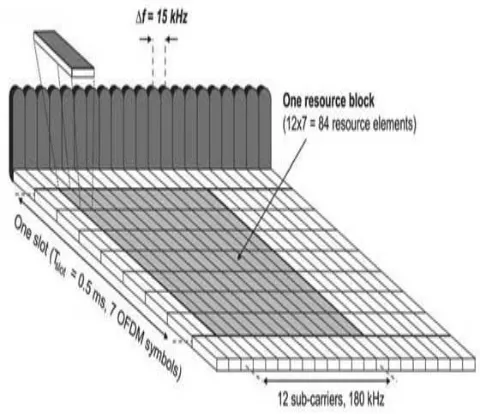
The following diagram depicts the manner in which the time and frequency resources are allocated in an LTE based system.
FIGURE 1: LTE downlink physical resource based on OFDM
In LTE the channels are used in a shared manner. The MAC layer performs the scheduling activity and combined with the time and frequency parameters which are sliced and allocated to the users various performance parameters like channel quality indicator (CQI) are used for this purpose. In LTE, scheduling is done on a sub-frame level (i.e. each 1 msec transmission time interval (TTI)).
In LTE environment the Packet scheduling mechanism and Link Adaptation mechanism work together. Link Adaptation monitors the Channel quality indicator (CQI) mechanism and adapts to different modulation and coding techniques based on the CQI value observed by the UE equipment during every CQI monitoring interval.
In this paper we have considered the performance of three of the scheduling mechanisms in the simulator, namely,
• Proportional Fair (PF) Scheduler
• Modified Largest Weighted Delay First (MWLDF) scheduler
FIGURE 2: THE LINK ADAPTATION STRATEGY
III. SIMULATION ENVIRONMENT
There are various simulators available for the simulation and study of the LTE networks. Some of them are the Matlab based simulator, Vienna Simulator, LTE-Sim and Qualnet. LTE-Sim is an open simulator developed to simulate LTE networks mainly contributed by G. Piro and F.Capozzi at "Politecnico di Bari".
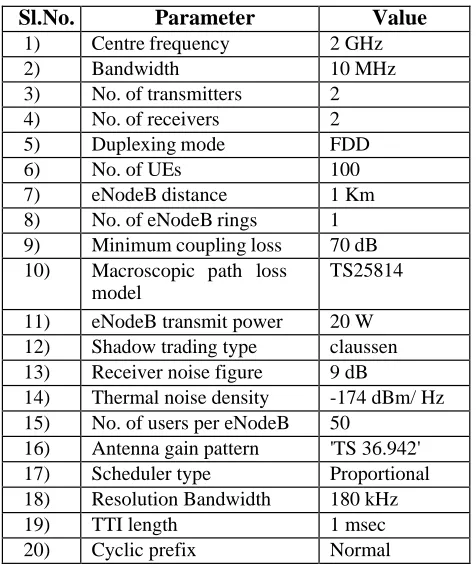
The following parameters are summarized in the table for the purpose of simulation
Sl.No. Parameter Value
1) Centre frequency 2 GHz
2) Bandwidth 10 MHz
3) No. of transmitters 2
4) No. of receivers 2
5) Duplexing mode FDD
6) No. of UEs 100
7) eNodeB distance 1 Km
8) No. of eNodeB rings 1
9) Minimum coupling loss 70 dB
10) Macroscopic path loss model
TS25814
11) eNodeB transmit power 20 W
12) Shadow trading type claussen
13) Receiver noise figure 9 dB
14) Thermal noise density -174 dBm/ Hz
15) No. of users per eNodeB 50
16) Antenna gain pattern 'TS 36.942'
17) Scheduler type Proportional
18) Resolution Bandwidth 180 kHz
19) TTI length 1 msec
20) Cyclic prefix Normal
TABLE 1: SIMULATION PARAMETERS AND THEIR
VALUES
IV. LTE -SIM SIMULATOR METHODOLOGY
Using the simulator we study several metrics that characterize the capabilities of the LTE network under consideration for various scheduling methodologies, different user conditions, different cell conditions that account for the cellular architecture, and various mobility conditions.
LTE-Sim has been designed to simulate uplink and downlink scheduling strategies in multi-cell and multi- user’s environments taking factors like user mobility, radio resource optimization, frequency reuse techniques and AMC aspects into consideration. As part of the LTE-Sim packets transported by a dedicated radio bearer are generated at the application layer by four different traffic generators:
Trace-based, VoIP, Constant bit rate (CBR), and Infinite- buffer.
In this paper the traffic based on the Video, VOIP and Infinite buffer based applications is studied.
V. SIMULATION OUTPUTS
The plots presented here capture the four different performance parameters for each of these three applications for the various LTE-scheduler scenarios, namely:
Throughput, Delay, Packet loss ratio and fairness index. The following i s a brief definition of these QOS parameters. In general terms, throughput is defined as the rate of production or the rate at which something can be processed.
Latency: The term latency refers to any of several
kinds of delays that are encountered in processing of network data.
In this document Delay is used as a synonymous term to Latency as the LTE-Sim simulator generates the metrics parameter as Delay.
Packet loss ratio: Packet loss is the failure of one
or more transmitted packets to arrive at their destination. This event can cause noticeable effects in all types of data networks.
Fairness: Fairness measures or metrics are used in
network engineering to determine whether users or applications are receiving a fair share of system resources. There are several mathematical and conceptual definitions of fairness.
Jain's fairness index is defined by the Raj Jain's equation
and this index rates the fairness of a set of values where there are users and is the throughput for the ith
and is not unduly sensitive to atypical network flow patterns.
The results are summarized for the Video, Infinite Buffer and VOIP payloads. We have listed Fairness Index, Delay, Packet loss ratio and throughput in bps. Finally the Spectral efficiency metric is plotted for all the three schedulers we studied.
Video Metrics:
Video fairness index: We observe the fairness index
ratio reduces from 25 users to 50 users and remains almost constant.
Video Delay: We observe the predominant red lines
and almost zero green and blue lines as the two other schedulers offer much less significant delays compared to the PF scheduler.
0 2 4 6 8 10 12 14
N1 (25) N2 (50) N3 (75) N4 (100)
Video delay in sec
PF Scheduler MWLDF Scheduler EXPF Schduler
Video Packet loss ratio: We observe the packet loss
ratio is almost similar for all the three schedulers.
0 0.2 0.4 0.6 0.8 1 1.2
N1 (25) N2 (50) N3 (75) N4 (100) Video Packet loss ratio
PF Scheduler MWLDF Scheduler EXPF Schduler
Video throughput in bps: We observe a
monotonous decrease in video throughput with the increase in the number of users from 0 to 100.
0 200000 400000 600000 800000 1000000 1200000
N1 (25) N2 (50) N3 (75) N4 (100) Video throughput in bps
PF Scheduler MWLDF Scheduler EXPF Schduler
Infinite Buffer metrics: We observe that
all the three schedulers behave almost similar for the Infinite buffer case.
0 0.0002 0.0004 0.0006 0.0008 0.001 0.0012
N1 (25) N2 (50) N3 (75) N4 (100) Infinite Buffer delay in sec
PF Scheduler MWLDF Scheduler EXPF Schduler
0 200000 400000 600000 800000 1000000 1200000 1400000 1600000 1800000 2000000
N1 (25) N2 (50) N3 (75) N4 (100)
Infinite buffer throughput
VOIP metrics:
VOIP Delay: It is observed that the delay is quite high
for the PF scheduler for the 100 users’ case.
0 0.02 0.04 0.06 0.08 0.1 0.12 0.14
N1 (25) N2 (50) N3 (75) N4 (100)
VOIP delay in sec
PF Scheduler MWLDF Scheduler EXPF Schduler
VOIP packet loss ratio: We observe the packet loss
rario increases monotonously with the increase in the number of users for all the three schedulers.
VOIP Fairness Index: We observe the Fairness Index
reduces monotonously with the increase in the number of users as depicted in the bar chart.
VOIP throughput: The VOIP throughput increases
monotonously with the increase in the number of users for all the three schedulers.
Spectral Efficiency: Spectral efficiency remains
VI. CONCLUSION
We find PF scheduler as not good for Video applications. Video throughput tends to show a sharp decrease under all schedulers. Another observation is that the number of users has hardly any effect on Infinite buffer metrics as expected. One of the striking results is that under PF scheduler, the VOIP delay raises steeply when the number of users go up from 75 to 100. VOIP fairness index interestingly dips down as the number of users decrease and then raises again
VII. REFERENCES
1) Simulating LTE Cellular Systems: an Open Source Framework, Giuseppe Piro, IEEE TRANS. VEH. TECHNOL., OCT. 2010
2) An Efficient Resource Block Allocation in LTE
System, Rupinder Kaur, Manoj Kumar,
International Journal of Advanced Research in Computer Science and Software Engineering, Volume 3, Issue 10, October 2013
3) R.Ravi and S. Bhat, Int. J of Science and
Research, vol 3, no. 6, pp 2419 (2014)
4) Radio Resource Scheduling in 3GPP LTE: A
Review Davinder Singh and Preeti Singh, Int. Journal of Engineering Trends and Technology (IJETT) – Volume 4 Issue 6- June 2013
Radhakrishnan Subramanian completed Masters in Digital