Robust and Efficient Routing Protocol based on routing
agent for QoS in WSN
Jawaharin Basha
,
Shah Aqueel Ahmed
Professor of ECE.
Principal, Mansoora College of Engineering.
Lords Inst. of Tech. Science. Malegaon. Dist. Dhule. M. S..
Hyderabad.
Email: [email protected].
Email: [email protected]
Syed Abdul Sattar
Professor & Dean of Academics
Royal Institute of Technology & Science.
Email:
[email protected]
Abstract
In this paper an agent based routing approach is proposed, based on IEEE802.11 protocol. In this protocol, different priority classes can be assigned for different traffics, and nodes in the network can participate in channel contention
adaptively, and nodes perform backoff
mechanism adaptively. Analysis and simulation result show that compared with model MAC protocol, proposed protocol provides better QoS support for higher priority traffics, solves hidden terminal problems, and also considers the fairness issues between different network nodes.
Keywords: Network, Accommodative, Topology, 802.1, Network Traffic, MAC Protocol, DCF.
I INTRODUCTION
Ad Hoc network is an autonomous system without a network infrastructure where all nodes are capable of movement and have a wireless device to receive and dispatch [1]. With the fast development of information technology, the demand of people for mobile communication is increasing greatly. Because of the application environment and multimedia services transmission in the network, all of these are needed to support Quality of Service (QoS) [2]. In contrast to traditional wired networks, unreliable radio medium, shared wireless channel, limited bandwidth, distributed control and node mobility makes it very difficult to provide effective QoS in Ad hoc networks.
In these days wireless services such as WLAN, Bluetooth, and home network are getting popular all around the world. Because of its already well-organized network architecture, IEEE 802.11 WLAN services are most successful and based mechanism [3-10]. In order to overcome those, several network-aware QoS mechanisms
have been proposed as extensions to EDCF,
including the Accommodative EDCF (AEDCF). AEDCF extends the basic EDCF by making it more accommodative taking into account network condition, i.e., collision rate. Relative priorities are provisioned by adjusting the size of the Contention Window (CW) of each traffic class according to the collision rate after each successful transmission or access in a distributed manner, hence it does not guarantee QoS [1], [2]. In order to support QoS, the Enhanced DCF (EDCF) is introduced in the upcoming IEEE 802.11le standard. It improves the legacy DCF access mechanism to offer differentiated channel access to categorized traffic. This per-priority differentiation used by EDCF ensures better becoming important. Therefore the interests and researches of WLAN technologies are increasing. Especially, the requests for various multimedia services and the Quality of Service (QoS) support for these services are expanding so that the research relative to Medium Access Control (MAC) is progressing rapidly.Devices based on this protocol have been widely applied, which operated in many real working areas. DCF (Distributed Coordination Function) is the basic medium access mechanism of 802.11, while all of the nodes support this mode
by default. Based on CSMA/CA (Carrier Sense Multiple Access with Collision Avoidance) protocol, DCF uses a “best effort” delivery model, and all the stations in a Basic Service Set or all the data flows from the same station compete the resources and channel with the same priority. It does not support real time traffic, as its random backoff mechanism cannot provide deterministic upper bounds on channel access delays. Thus, it will result in the whole performance degradation [4]. Many medium access schemes have been proposed for IEEE 802.11 to provide some QoS enhancement for real time traffics. In this paper, we propose an accommodative QoS MAC protocol based on IEEE802.11, which used IEEE 802.11e channel-free wait time and backoff mechanism for reference. This protocol can provide some QoS enhancement using following aspects:
(1) Priority Assignment;
(2) Nodes participate in channel contention adaptively;
(3) Accommodative backoff mechanism.
II NETWORK TRAFFIC CATEGORIES
The IEEE 802.11e medium access control (MAC) standard provides distributed service differentiation or Quality-of- Service (QoS) by employing a priority system [2].Network traffic is classified into four different priority levels or access categories (ACs). Nodes maintain separate queues for each AC and packets at the head-of-line (HOL) of each queue contend for channel access using AC specific parameters. Such a mechanism facilitates differentiated QoS where high priority, performance sensitive traffic such as voice and video applications will enjoy less delay and greater throughput, compared to low priority traffic (e.g., file transfer). The QoS features in IEEE 802.11e raise two related concerns. First, these mechanisms can often be unfair and inefficient from the perspective of nodes carrying low priority traffic. Second, selfish nodes can gain enhanced performance by classifying low priority traffic as high priority, potentially destroying the QoS capability of the system.
Α) Quality of Service
During the last decade, the multitude of advances attained in terminal computers, along with the introduction of mobile hand-held devices, and the deployment of high speed networks have led
to a recent surge of interest in Quality of Service (QoS) for multimedia applications. Computer networks able to support multimedia applications with diverse QoS performance requirements are evolving. To ensure that multimedia applications will be guaranteed the required QoS, it is not enough to merely commit resources. It is important that distributed multimedia applications ensure end-to-end QoS of media streams, considering both the networks and the end terminals. The degradation in the contracted QoS is often unavoidable, thus there is a need to provide real-time QoS monitoring that not only is capable of monitoring the QoS support in the network but that can also take actions in real-time manner to sustain an acceptable mulreal-timedia presentation quality when the QoS level degrades. Presently, there are various kinds of networks; wired and wireless that co-exists with each other. These networks have QoS characteristics that are drastically different and whose degree of variability of the different QoS parameters, such as bandwidth, delay and jitter, differ considerably.
III SYSTEM ARCHITECURE
A) DCF Protocol
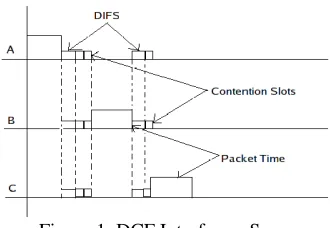
In DCF protocol collision detection cannot be done. The reason for this is that when a station is transmitting data the power of transmission is so high that even if someone is transmitting at that time the power of transmitted data of the first station will overwhelm the other station's signal and hence the first station will never detect a collision. Because of this stations waiting for the channel to become free cannot start transmitting as soon as they sense that the channel is free because if they do so then the probability of collision occurring is very high and they will not even be able to detect it. Hence, DCF protocol uses following rules:
1. Listen before transmission (Carrier Sense) 2. Backoff before transmission.
3. Backoff on collision.
As shown in the figure below:
Figure 1. DCF Interframe Space
B) Accommodative QoS MAC Agent protocol Based
In this paper, we propose an accommodative QoS MAC agent protocol based on IEEE802.11 protocol, which used IEEE 802.11e channel-free wait time and backoff mechanism for reference. This agent protocol can provide some QoS enhancement using following aspects:
(1) Priority Assignment;
(2) Nodes participate in channel contention adaptively;
(3) Accommodative backoff mechanism.
(1) Priority Assignment
This paper will assign different priority classes for different traffics. Real time traffics, such as video and audio, have higher priority class, marked as PC=0; other data traffics have lower priority class, marked as PC=1.
(2) Nodes Participate In Channel Contention Accommodative
This paper introduces a new concept— transmission license. It is used only to indicate the authority of channel contention, which is like the token in the network, but it does not have specific frame structure. Only the node which holds transmission license can participate in channel contention. We use queue packet loss ratio of node to estimate the network load. According to the ratio, the node is determined by whether it can participate in channel contention or not. Every node keeps two set of parameters– the number of loss packets and the total number of packets that are sent in the queue during a constant period (i.e. a fixed number of slot times). These parameters are updated periodically. They are reset to zero when a period ends, then restarted when the next period starts. Let Lossrate[i] be the queue packet loss ratio at step i (for each update period) computed according to the following formula:
Lossratep[I] = Nlp[I]/Nsp[I] (2)
As in (2), i refers to the ith update period, Nlp[i] stands for the number of packets lost in the transmission queue during the period i, Nsp[i] stands for the total number of packets sent in the queue during the period i.
In the initial phase, every node is assigned a transmission license. Thus, every node has the authority to channel contention. During the progress of packet transmission, every node estimates the current network load by calculating queue packet loss rate in this period. Here we use
lth to stand for the maximal threshold of queue packet loss rate. When the queue packet loss rate of a node is greater than this threshold, it shows that current network load is high. In that case, this node gives up the transmission license held, which means that the node loses the authority to channel contention, and also will not have the authority to send packet. Thus, it cannot estimate current network load. After fixed time, this node will obtain transmission license again automatically, then it will continue to participate in channel contention and repeat above procedures. The fixed time should not be too long in order to get good estimation and should not be too short, otherwise it would be meaningless.
To provide different traffics for different priority classes, we set different thresholds for different priority classes, namely lth[PC]. PC refers to the priority class that had been introduced previously. To access channel first, the higher priority node has higher threshold, i.e. lth[0]>lth[1], which makes it easier for lower priority node to give up transmission license than for higher priority node. The node gives up and obtains transmission license according to the network load, which lessens the number of nodes participating in channel contention, and also reduces unnecessary energy wasted when the network load is higher. Furthermore, the higher priority node can access channel first by setting different thresholds for different priority classes.
(3) Accommodative Backoff Mechanism
In DCF, CWmax and CWmin of each node are both set by the same value. This paper provides to set different Cwmin and CWmax with different priority classes. e.g., sound and video with higher priority class, the value of CWmin and CWmax is set to smaller. Through decreasing backoff slot time, we can decrease the delay to improve the probability to access channel for higher priority node. On the contrary,
when transmitting data frame with lower priority class, we can set larger CWmin and CWmax. AIFS, CWmin and Cwmax should be set synthetically according to the priority class. Then we can ensure that the node with higher priority class can get authority to access channel first. In DCF, CW is always doubled after any unsuccessful transmission until it is increased to CWmax. When the network load is lower, it will bring channel resource unnecessary waste. When the network load is much higher, changing contention window into double size maybe cannot lighten the channel pressure. Then it will lead to unnecessary collision again, and also waste energy. So we use an accommodative backoff mechanism along with the network load. After each unsuccessful transmission of packet of priority class, the new CW of this class is increased with a Persistence Factor PF[i]. CW is updated as follows:
CWnew = (CWold +1)*PF[i] - 1 (3)
As in (3), CWnew stands for new contention window value after the transmission failed. CWold stands for contention window value before the transmission failed. PF[i] will get different values according to different priority classes. When PF[i] equals 2, this equation above will get the same result with Binary Exponential Backoff (BEB) equation. The i still refers to the i update period. Like AIFSN introduced before, PF[i] will based on requriement change along with the network load. So is the estimate of the network load. All of these are compared between queue packet loss rate of this period and average packet loss rate of the former five periods.
(1) If Lossrate[i]<Lossrateavg, add 1 to PF[i] value with higher priority node, and decrease 1 from PF value with lower priority node Thus, when the network load is lower, after unsuccessful transmission of lower priority node, the increase of the contention window gets smaller, while the probability of lower priority node channel access enhanced comparatively.
(2) If Lossrate[i]>=Lossrateavg, decrease 1 from PF[i] value with higher priority node, and add 1 to PF[i] value with lower priority node, which ensures that higher priority node still can access channel when the network load is higher. The initial PF[i] value is different from different priority
classes, and is set different maximum and minimum PFmax, PFmin. Keeping in mind that the PF[i] should not exceed PFmax or PFmin. Detail setting is shown as table 1.
Table1 1. The Value Of Cw And Pf With Each Priority Classes
AP CW CWmax CWmin PF Pfmax Pfmin
0 15 1 15 2 3 2
1 31 1023 31 4 6 3
IV RESULTS
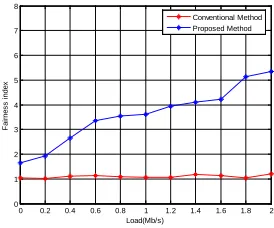
We choose the typical 4 nodes topology structure in Ad Hoc networks. We compared proposed agent protocol with IEEE 802.11 in terms of throughput, average delay and fairness analysis. The simulation results obtained by four nodes topology are shown in Fig.4. Hidden terminals existing in the network is shown below.
Figure . 4nodes network topology
Transmission from link 0 to 1 is higher priority traffic, while transmission from link 2 to 3 is lower priority traffic. Fig.4 shows that in IEEE802.11, regardless of higher priority or lower priority traffic transmitted, when packet rate is larger, link 2 to 3 has larger occupancy probability than link 0 to 1. However, the traffic of link 0 to 1 transmitted has higher priority class that is needed to provide QoS support.
0.2 0.4 0.6 0.8 1 1.2 1.4 1.6 1.8 2 0
0.1 0.2 0.3 0.4 0.5 0.6 0.7 0.8 0.9 1
Load (Mb/s)
T
hr
oughput
(
M
b/
s
)
0->1 High priority with proposed protocol 2->3 low priority with proposed protocol 2->3 Low priority with conventionla protocol 0->1 Hight priority with conventional protocol
Figure 2 .Analysis of throughput of each
link in 4 node network
0.2 0.4 0.6 0.8 1 1.2 1.4 1.6 1.8 2 0
0.5 1 1.5 2 2.5 3 3.5 4 4.5 5
Load (Mb/s)
D
el
ay
0->1 High priority with proposed protocol 2->3 low priority with proposed protocol 0->1 Hight priority with conventional method 2->3 Low priority with conventional method
Figure 3. Analysis of delay in each link.
0 0.2 0.4 0.6 0.8 1 1.2 1.4 1.6 1.8 2 0
1 2 3 4 5 6 7 8
Load(Mb/s)
F
ai
rnes
s
i
ndex
Conventional Method Proposed Method
Figure 4. Analysis of fairness in 4 nodes network
V CONCLUSIONS
Proposed agent protocol has priority assignment, nodes in the network can participate in channel contention as per requirements and nodes perform backoff mechanism works and responses according to the network load. The analysis and simulations show that the agent protocol can provide better QoS support for higher priority traffic in the network. It solves hidden terminal problem, increases the use of the channel, and also considers fairness issues in terms of using of limit channel bandwidth.
VI REFERENCES
[1] S. Corson and J. Macker. Mobile Ad Hoc Networking (MANET): Routing Protocol Performance Issues and Evaluation Considerations [EB/OL]. (1999-01) [2009-02]. http://www.ietf.org/rfc/rfc2501.txt [2] Prasabt Mohapatra, Li Jian, Gui Chao. QoS
in Mobile Ad Hoc Networks [M]. IEEE Wireless Communications. USA: IEEE, 2003: 44-52.
[3] IEEE Std 802.11b-Wireless LAN medium access control(MAC)and physical
layer(PHY)specications:Higher Speed
Physical Layer(PHY)in the 2.4 GHZz Band[S],1999
[4] C. Chaudet, D. Dhoutaut, and I. Gu′erin-Lassous. Performance issues with ieee. 802.11 in ad hoc networking. IEEE Communication Magazine, 43(7), July 2015. [5] D. J. Deng and R. S. Chang, "A Priority
Scheme for IEEE 802.11 DCF Access Method,” IEICE Trans. Commun., E82-B(1), Jan. 1999, pp. 96- 102.
[6] J. L. Sobrinho and A. S. Krishnakumar, “Quality-of-Service in Ad Hoc Carrier Sense Multiple Access Wireless Networks,” IEEE J. Sel. Areas in Commun., Vol. 17(8), Aug. 1999, pp.1353-1368
[7] A. Pal, A. Dogan and F. Ozguner, “MAC layer protocols for real-traffic in ad-hoc networks,” Proc. IEEE Intl. Conf. Parallel Processing, 2002.
[8] A. Pal, Distributed MAC Layer Protocols for Real-Time Communication in Ad-Hoc Wireless Networks, M.S. Thesis, Ohio State University, 2001.
[9] IEEE 802.11 TGe packet. Wireless LAN Medium Access Control (MAC) Enhancements for Quality of service (QoS)[S], 802.11e Draft3.1,2013.
[10] Lamia Romdhani,Qiang Ni,Thierry Turletti; Adaptive EDCF Enhanced Service Differentiation for IEEE802.11Wireless Ad-Hoc Networks[A] [M];IEEE Wireless Communications and Networking; 2003,2:1373- 1378