© 2015, IRJET.NET- All Rights Reserved
Page 2288
Load Frequency Control for Two Area Deregulated Power System Using
ANN Control
Mr. Najmuddin Moulaali Jamadar
1, Mr. A. Ram Reddy
21
Student, Electrical & Electronics engineering, Siddhartha Institute of Engineering Technology, Telangana, India
2Associate Professor, Electrical & Electronics engineering, Siddhartha Institute of Engineering Technology,
Telangana, India
---***---Abstract -
In this paper work we analyze and designAutomatic load frequency control of two area power system using Artificial Neural Network (ANN) base PI Control, generation control is becoming increasingly important in view of increased load demand & reducing generating resources. The increasing load demands are posing serious threats to reliable operation of power systems. As we all that Maintaining power system frequency at constant value is very important for the quality of the power generating equipment and the utilization equipment at the customer end. The job of automatic frequency regulation is achieved by governing systems of individual turbine- generators and Automatic Generation Control (AGC) or Load frequency control (LFC) system of the power system. The healthy and undamaged operation of generator needs the control of the following parameters: (a) Frequency to be maintained constant (b) the tie line power to be maintained between specified limits. If the above parameters are maintained with in desired limits the generation control is said to be most effective. The main objective of automatic generation control is to maintain the balance between the generation and demand of a particular power system. A power system model has been simulated within a MATLAB environment. A comparative study between the frequency responses of the system using ANN Based PI Control has been proposed.
Key Words:
Artificial Neural Network, Automatic
Generation Control, Load Frequency Control, Area
Control Error
1. INTRODUCTION
Power system is a complex nonlinear system and it consists of several interconnected subsystems or control areas (CA). Frequency of power system and active power flow between CAs deviate in time. Those deviations are caused by differences between generation and consumption in a CA. In each CA, load-frequency control (LFC) ensures maintenance of the area’s frequency at desired constant value. It also ensures following of scheduled active power interchange with the neighbor CAs.
A numerical measure of CA’s deviation from the regular behavior is area control error (ACE) signal, which is a combination of frequency deviation in the CA and active power flow variations in the tie lines with the neighbor areas. The goal of LFC is to ensure ACE signal in to be zero. Sliding mode control (SMC) is a particular type of variable structure control. In SMC, the task of the control system is firstly to drive (reaching phase), and then to keep the system state on the desired sliding surface (sliding phase). The first step in applying SMC algorithm is choosing an appropriate sliding surface. The sliding surface is a sub-manifold in the state space and it specifies the desired system behavior.
The second step is choosing an appropriate control law. The chosen control law makes the system state to the sliding surface and then keeps it on the sliding surface. There are two main advantages of this approach. Firstly, the dynamics of the system in sliding mode are determined only with parameters of the chosen sliding surface. Secondly, the system’s dynamics in sliding mode are insensitive to particular class of uncertainties.
© 2015, IRJET.NET- All Rights Reserved
Page 2289
1.1 Two Area Deregulated System
A two-area electric power system with a wide range of parametric uncertainties is given to illustrate the proposed method. To show effectiveness of the proposed method and also comparison purposes, a PI type controller optimized by GA is also designed. The simulation results visibly show the validity of Artificial Neural Network (ANN) based controller in comparison with PI controller. In a deregulated system if under deregulated environment, it was felt that the electric utility will try to innovate something for the betterment of service and in turn save its costs and maximize the profit. By means of this, the utility will try to ensure that it will maintain its customer base in spite of competition. And in this two area network the power exchange between these two areas can be done by using the tie line between these two lines Area control error is also represented by using this tie line.
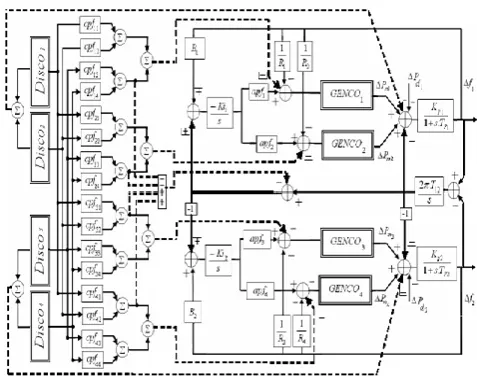
Consider a two-area system in which each area has two GENCOs and two DISCOs in it. Let GENCO1, GENCO2, DISCO1, and DISCO2 be in area I and GENCO3, GENCO4, DISCO3, and DISCO4 be in area II as shown in given figure1.
Fig -1: Block diagram of two area system
The two area interconnected power system is shown in fig1 where Δf1 and Δf2 refers to the frequency deviations in area 1 and area 2 respectively in Hz and ΔPd1 and ΔPd2 are the load demand increments. In most of the studies earlier the researchers have used the dynamic model of the power system a dynamic model with state variables is derived.
Deregulation has many impacts on power system network operation and control. The number of power transactions among the utilities has increased and many Independent Power Producers (IPPs) now have a rich market for competition especially in the green power market.
Deregulation is pushing for extensive inter and intra utility information exchange, integration, consolidation, dissemination, and open access.
DISCO1, DISCO2, DISCO3 and DISCO4 are the four distribution companies and GENCO1, GENCO2, GENCO3 and GENCO4 are the four Generating companies used in the two deregulated system represented below. Here the load distribution is based on the contracted participation factors represented in Disco Participation Matrix (DPM). Here in this case it of two area we need area participation matrix also that is also mentioned and care should be taken the total sum must be equal to one.
Fig -2: Two area Deregulated system
After the simulation of the above diagram the steady state response of the system is obtained
Fig -3: Response of the two area deregulated system without controller
2. ARTIFICIAL NEURAL NETWORK CONTROL
© 2015, IRJET.NET- All Rights Reserved
Page 2290
Here, first the learning is performed, and then the trained ANN is implemented to the process which is under control. Nguyen and Widrow have shown in a novel approach the use of this method for backing up a trailer in a two dimensional plane. Kong and Koskotried also the same approach, but used the truck kinematic equation instead of truck emulator as used by Nguyen. Beau- fays et al. have used this method for load frequency control in power systems. Generally, the off-line method is applicable to a process with explicit mathematical formulation.
The second category includes the controllers that use on-line learning. Chen has investigated on-on-line learning for adaptive control, although his method is only applicable to single input, single output linearized systems. It is shown that the learning process makes this controller an adaptive one. On-line learning has been successfully used for underwater vehicle control as reported. The proposed learning algorithm and the network architecture provides stable and accurate tracking performance. For the on-line learning method, the mathematical formulation of the process under the control is needed.
Schiffmann have reported a comparative study for an ANN on-line controller and a P-I controller. The results show that the ANN controller is very effective. In their study the plant is treated as an additional and non-modifiable layer of the network and only simple qualitative knowledge of the plant is necessary.
The on-line training makes an ANN controller an adaptive controller. The learning process based on the back propagation, adjusts the ANN parameters (weights) such that the output follows its reference value.
2.1 On-Line Training
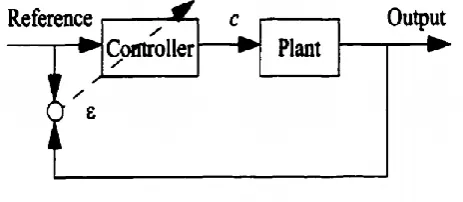
Assume that a single input single output plant is cascaded to a neural network (feed forward connection). The single input single output plant is connected as a last level to the ANN, and can be taken as the last processing unit of this network, i.e. we can imagine that the whole system starting from input to the output of the plant is an additional processing unit (neuron) to the network. The last processing unit of this augmented network does not have a characteristic like the other ANN neurons, in fret the characteristics is non-linear and time-dependent and not explicitly known. As already explained in 6.1, the learning algorithm tries to set the system weights in order to make the output of the network be equal to some desired quantity. Thus by connecting an ANN as a controller connected to the input of the plant and implementing the learning process to adjust the weights, it is theoretically possible to make the plant output follow the reference order, provided that the network parameters and weights get adjusted by the output error.
Using a feed forward system for control purposes, a self-supervised learning system must be used. Of the three proposed methods, specialized learning seems to be the best and is chosen for this study. This method requires knowledge of the Jacobean matrix of the plant. For a single input single output plant, the Jacobean reduces to derivative of the input-output function of the plant
Fig -4: On-line training
2.2 Off-Line Training
Off-line training is not an adaptive process, but it is fastest to implement, because the weights are not changed in the field. One promising method for on-line training is using the recurrent ANN, and the method is briefly presented in this section. This model is trained in the manner shown in figure6.7. This method is applied by Nguyen and recently is used for load-frequency control. The process is outlined as follows.
In this approach, before training the neural network controller, a separate neural network, which is called an emulator, is trained to behave like the plant. Training the emulator is similar to plant identification in control theory, except that the plant identification here is carried out by using the method of back-propagation.
© 2015, IRJET.NET- All Rights Reserved
Page 2291
3. SIMULATION AND RESULTS OF THE SYSTEM
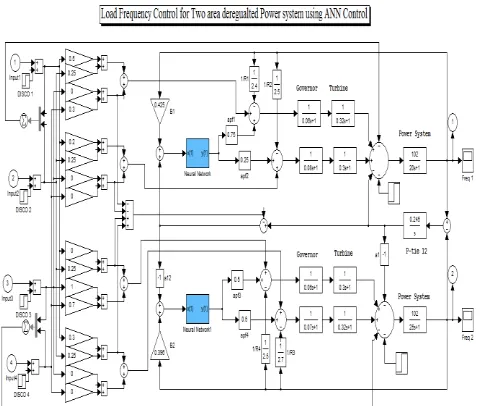
Fig -6: Load Frequency Control for Two Area Deregulated Power System Using ANN Control
This simulation consist of ANN control for load frequency control the control block consist of following subsystem.
Fig -7: Control Scheme
The results of ANN controller are compared with fuzzy and PI controller and it is found to the response of the ANN controller is superior to both of them which is shown as below.
Fig -8: Deviation of Frequency (Hz) in area1
Fig -9: Deviation of Frequency (Hz) in area2
4. CONCLUSIONS
Modified LFC in the deregulation, is an important issue in the power system studies. An Artificial Intelligence based Controller for the LFC problem in deregulated power system is proposed using the modified LFC scheme in this paper.
© 2015, IRJET.NET- All Rights Reserved
Page 2292
A continuous time control law is proposed. The proposed controller is validated through simulation of load-frequency control in two area power system. System in sliding mode is robust to system parameters variations and has no steady state error of area’s control error signal. The results of the system with Conventional controller and the proposed Controller are compared for better understanding.
Proposed strategy is very effective and guarantees good robust performance against parametric uncertainties, load and parameter changes.
REFERENCES
[1] System and Control by stanislaw h. zak.
[2] F.L. Lewis and V.L. Syrmos, Optimal control, Prentice Hall, Englewood Cliffs, New Jersey, 1995.
[3] J.Kumar, Kah-Hoe Ng and G. Sheble, “AGC Simulator for price-based Operation Part 1: A model, “IEEE Trans. On Power Systems, vol. 12, no. 2, May. 1997. [4] [4] C. Edwards and S. Spurgeon, Sliding Mode Control:
Theory and Applications. Taylor and Francis, 1998. [5] Q. Ha, “A fuzy sliding mode controller for power
system load-frequency control,” in Second International Conference on Knowledge-Based In- telligent Electronic Systems, 1998, pp. 149–154. [6] M. Yang and H. Lu, “Sliding mode load-frequency
controller design for dynamic stability enhancement of large-scale interconnected power systems,” in Proceedings of the IEEE International Symposium on Industrial Electronics, Bled, Slovenia, 1999, pp. 1316– 1321.
[7] Optimization Toolbox User’s Guide, The Mathworks, INC., 2000.
[8] V.Donde, A pai and I.A. Hiskens, “Simulation and Optimization in a LFC System after Deregulation, “IEEE Trans. On Power Systems, vol. 16, no.3, pp. 481-489, Aug. 2001A. Karnik, “Performance of TCP congestion control with rate feedback: TCP/ABR and rate adaptive TCP/IP,” M. Eng. thesis, Indian Institute of Science, Bangalore, India, Jan. 1999.
[9] F. Okafor, “Variable structure unit vector control of electric power generation,” African Journal of Science and Technology - Science and Engineering Series, vol. 1, no. 4, pp. 78–86, 2001.
[10]D.Rerkpreedapong and A. Feliachi, “Decentralized Load Frequency Control for Load Following Services, “IEEE Power Engineering Society Winter Meeting, vol. 2, no.1, pp 1252-1257, Jan. 2002.
[11]G. Monsees, “Discrete-time sliding mode control,” Ph.D. dissertation, Delft University of Technology, Netherlands, 2002.
[12]A.Khaki Sedigh, Modern Control Systems, University of Tehran Press, 2003.
[13]F. Liu, Y.H.Song, J.Ma, S.Mei and Q Lu, “Optimal Load Frequency Control in restructured power Systems,”
IEE Proceedings Generation, Transmission and Distribution, vol. 150, no. 1, pp. 87-95, Jan. 2003 [14]B. Stojkovi´ , “An original approach for
load-frequency control – thec winning solution in the second UCTE synchronous zone,” Electric Power Systems Research, vol. 69, no. 1, pp. 59–68, April 2004.
[15]M. Alrifai, “Decentralized controllers for power system load frequency control,” ICGST International Journal on Automatic Control and System Engineering, vol. 5, no. 2, pp. 1–16, 2005
[16]A. Demiroren and H.L. Zeynelgil, “GA application to optimization of AGC in tree-area power system after deregulation,” Electrical Power and Energy Systems, vol.29, no.3, pp.230-240, March. 2007.
[17]H. Shayeghi, H.A.Shayanfar and O.P. Malik, “Robust Decentralized Neutral Networks Based LFC in a Deregulated Power System,” Electric Power Systems Research, vol. 77, pp 241-251, April.2007.
[18]Y. Rebours, D. Kirschen, M. Trotignon, and S. Rossignol, “A surve of frequency and voltage control ancillary services-part I: Technical features,” IEEE Transactions on Power Systems, vol. 22, no. 1, pp. 350– 357, February 2007.
[19]K. Vrdoljak, N. Peri´ , and I. Petrovi´ , “Estimation and prediction incc load-frequency control,” in Internationl Conference on Power Engineering, Energy and Electrical Drives, Setubal, Portugal, 2007. [20]K. Vrdoljak, V. Teˇ ak, and N. Peri´ , “A sliding surface
design for robustzc load-frequency control in power systems,” in Proceedings of the Power
BIOGRAPHIES
Mr. Najmuddin Moulaali Jamadar Qualification: B.E. Electrical, M.tech Electrical power System Student in Siddhartha Institute of Engineering & Technology, Ibrahimpatnam ,RR-Dist. Hyderabad
Mr. A Ram reddy