See related article on page 30.
Cite as: Can Urol Assoc J 2015;9(1-2):23-9. http://dx.doi.org/10.5489/cuaj.2699 Published online February 5, 2015.
Background
Erectile dysfunction (ED) is a highly prevalent condition, which affects the physical and psychosocial well-being and quality of life (QoL) for thousands of Canadian men, their partners, and families. The Canadian Study of Erectile Dysfunction identified 49.4% of men over 40 with ED, with other studies showing that 5% to 20% of men have
moder-ate to severe ED.1-3 Contemporary treatment options include
highly effective, minimally invasive therapeutic agents – most commonly oral therapies using phosphodiesterase type 5- (PDE5) inhibitors. Second-line self-injection with vasoactive agents, vacuum erection devices, and surgical approaches with inflatable penile prostheses offer ED management with high potential for patient and partner treatment satisfaction. Most cases of ED in Canada are identified and effectively
treated by primary care physicians (PCPs).4 Evidence-based
diagnostic and therapeutic approaches, including effective
Anthony J. Bella, MD, FRCSC;
*Jay C. Lee, MD, FRCSC;
†Serge Carrier, MD, FRCSC;
§Francois Bénard, MD, FRCSC;
¥Gerald B. Brock, MD, FRCSC
±*Greta and John Hansen Chair in Men’s Health Research, Assistant Professor of Urology, Department of Surgery, University of Ottawa, Ottawa, ON; †Clinical Assistant Professor, University of Calgary, Calgary,
AB; §Associate Professor, Department of Surgery, Urology Division, McGill University, Montreal, QC; ¥Chair, Division of Urology, Department of Surgery, Université de Montréal, Montreal, QC; ±Professor of
Surgery, Western University, London, ON
2015 CUA Practice guidelines for erectile dysfunction
Summary of recommendations
• Erectile dysfunction (ED) is the preferred clinical term describing the persistent or recurrent inability to achieve and maintain a penile erection of sufficient rigidity to permit satisfactory sexual activity for at least 3 months.
• The initial diagnosis and treatment of ED is most com-monly performed in Canada by primary care physicians (PCPs).
• PCPs, urologists, internists, psychiatrists, and other treat-ing healthcare professionals should be encouraged to ini-tiate an open dialogue of sexual issues to identify men with ED who may not otherwise volunteer their sexual concerns.
• Frequently a careful history, physical exam, serum glu-cose or hemoglobin A1C, lipid profile and optional hor-monal testing facilitate the diagnosis of ED and effective therapy. Patient history can differentiate ED from other male sexual dysfunctions, including ejaculatory disorders (premature ejaculation and other abnormalities), hypo-gonadism, disorders of orgasm, and Peyronie’s disease.
• Organic (physical) causes of ED are present in most men, but situational or psychosocial contributing factors often
play a contributory role. Addressing these issues may enhance treatment efficacy.
• Underlying risk factors associated with ED are common to cardiovascular disease in general, and should be identi-fied during evaluation as they may represent the initial clinical sign of generalized endothelial disease (vascular insufficiency). Evaluation of family history, nicotine use, blood pressure, lipid profile, and glucose is required or should be documented if previously performed. Active management of identified cardiac risk factors should be instituted (i.e., smoking cessation, blood pressure treat-ment).
• Once reversible causes of ED are ruled out, a trial of oral medication is recommended as first-line therapy, based on treatment efficacy, side effect profile, and minimal invasiveness. Specialized testing and referral are generally reserved for cases where oral first-line treatments fail or are not appropriate, of if greater insight into the etiology is desired by the patient/physician.
• Second-line therapies, although more invasive than oral agents, are generally well-tolerated and effective.
oral agents like the PDE5-inhibitors, has allowed for a shift of ED management from a historical surgical approach to contemporary medical management. Family physicians, urologists, internists, endocrinologists, cardiologists, and other medical specialists are approached by couples with ED requesting treatment more frequently. In many cases longstanding relationships exist between the couple and their treating physician, fostering an important therapeu-tic alliance which may translate into improved clinical response to the selected treatment approach. A shared-care model for the treatment of ED is a valid concept and also may reflect optimal utilization of healthcare resources
in the Canadian healthcare environment.4,5 This
shared-care model is one in which PCPs initially identify and treat patients with ED and refer primarily those individuals who have incomplete responses or require more invasive or specialized testing and treatment. The combined experi-ence and knowledge of PCPs coupled with the diverse ED knowledge of the specialist can ideally result in optimal care for the patient.
In the contemporary model of ED care delivery, urologists remain an essential resource for several important reasons:
1. Referral requested for the difficult-to-treat, oral-refractory cases.
2. Second-line intracavernous and intraurethral vasoac-tive therapy may be outside of the practice pattern of some PCPs and therefore require urologic care. 3. In some cases anatomical penile deformity
(Peyronie’s disease or post-trauma) may play an important role in the ED and more frequently require operative correction.
4. In a small but definable population (often men with severe vascular disease or poorly controlled diabe-tes), a trial of nonsurgical approaches may not suc-ceed, requiring surgical options in the difficult-to-treat group.
5. Patients with congenital venous leak as the cause of their ED require urologic care. These patients are usually young and do not respond to PDE5-inhibitors. 6. Specific tests performed by urologists may be
indi-cated at the request of the patient or his partner or for medico-legal issues.
7. Ongoing research into the basic and clinical conse-quences of ED is performed in urologic laboratories and clinical practices
As presented in this document, the Canadian Urological Association (CUA) Guidelines Committee has updated the CUA Erectile Dysfunction Guidelines using a Canadian per-spective. Suggestions were based on peer-reviewed literature through 2015, and the ED recommendations from the World Health Organization (WHO)-endorsed 2010 International Consultation on Sexual Medicine, the International Society for Sexual Medicine, the Sexual Medicine Society of North
America, and evolving research on new approaches to ED
management.4,6-7
Global management objectives
1. To help the patient and partner establish their objec-tives of treatment.
2. To select diagnostic tests based on presenting com-plaints and goals of therapy.
3. To use diagnostic tests in a cost-effective and mean-ingful manner which would affect choice of treat-ment as well as help to identify and disqualify certain contributory health problems.
4. To provide a diagnosis and understanding of the likely etiology of the ED to the patient and partner. 5. To identify ED etiologies which may affect patient
morbidity and mortality (if not previously identified), including screening for vascular risk, and facilitate access to the most appropriate healthcare providers for definitive management.
6. To offer treatment choices with comprehensive infor-mation on cost, likelihood of success and common side effects.
7. To initiate therapy with the least invasive option which would satisfy the patient and partner goals of treatment.
8. To provide patients with information and ongoing support to maximize treatment success.
9. To re-establish the couples’ ability to achieve and maintain sexual intimacy in the most natural man-ner possible.
10. To choose approaches which are reversible when-ever possible.
Management approach: Diagnosis
Overview
The CUA supports the view that the general framework for the evaluation of patients with any type of sexual
dysfunc-tion should follow the same basic principles.3,4,6 The sexual
history should ascertain the severity, onset, and duration of the problem, concomitant medical or psychosocial fac-tors, and bother to the patient and partner (if applicable). In-person interview is often supplemented with question-naires or potential web-based methods. The manner of sexual inquiry is important and should reflect a high level of sensitivity and regard for each individual’s unique ethnic, cultural, and personal background.
dis-ease, lifestyle factors including illicit drug use, quality of partners relationship).
2. Determine the timing of onset, nature of the prob-lem, and significance to the partner (if applicable). The patient (with or without their partner) will guide whether treatment is desired.
3. Identify whether a potentially reversible cause to the ED exists (medications), stress, depression, hormonal abnormalities including androgen, thyroid and pitu-itary, tobacco, excessive alcohol use, drug abuse, and partner-specific issues). Testosterone profile is appro-priate at the ED diagnosis if hypogonadism suspected, but screening is not recommended for all ED patients. 4. Establish a likely underlying etiology based on his-tory, physical exam, and lab testing. Obtaining or confirming recent blood pressure measurements, lipid profile, and glucose/HgBA1C are highly rec-ommended.
A commonly used schema is:
• Vascular
• Endocrine
• Neurological
• Situational
• End organ (penile deformity – Peyronie’s disease or
trauma)
• Mixed (Most cases have an underlying organic cause
or causes; similarly most men will subsequently report anxiety, stress, and depression as a conse-quence of ED.)
Methodology
1. History and clinical questioning (most important component of the ED evaluation).
2. Focused physical examination (directed at anatomic, vascular and neural systems essential for erections). 3. Use of formalized questionnaire instruments (e.g.,
Sexual Health Inventory for Men [SHIM], Appendix-http://journals.sfu.ca/cuaj/index.php/journal/article/ view/2699/2022) is recommended but not manda-tory, as the questionnaires are useful in establishing baseline function, ED severity, evaluate treatment response, and in most cases questionnaire results do not add significantly to duration of the doctor-patient encounter.
4. Laboratory investigations: serum glucose, lipid pro-file, and in select cases hormonal screening (total testosterone/bioavailable testosterone).
5. Consultation with subspecialists (endocrinology, psy-chology, cardiology).
6. Specialized tests:
• Combined injection and stimulation test (CIS)
• Duplex ultrasound with vasoactive penile injection
• Nocturnal penile tumescence testing (NPTR)
(Rigiscan)
• Dynamic infusion cavernosography and
caver-nosometry (DICC)
• Penile and pelvic angiogram
Diagnosis history
Obtaining a diagnostic history is the cornerstone of the eval-uation of sexual dysfunction and ED. The history will provide the likely diagnosis in most cases.4,6,8 A supportive healthcare professional allows the couple to relate their concerns and express their goals of treatment in an unhurried manner. A monogamous, heterosexual relationship should not be assumed. Potential etiologies for sexual dysfunction include a wide range of organic and medical factors, but multiple psychological or interpersonal factors (i.e., anxiety, depres-sion, relationship distress) can be causal or contributory.
General domains of the history
• Determine specifics related to ED (onset, severity,
sig-nificance and situations) and desire, arousal, orgasm, and ejaculation.
• Sexual desire, relationship issues, stressors at home and
work.
• Genital pain or altered shape.
• Lifestyle factors: smoking, substance use/abuse,
seden-tary lifestyle.
• Comorbid conditions: hypertension, peripheral vascular
disease, diabetes, obesity, and renal disease.
• Pelvic surgery, radiation or trauma.
• Medications.
• Psychiatric illness or conditions.
Questionnaires
Use of validated questionnaires may be beneficial. These tools can be patient self-administered and provide much of the above information in an efficient non-threatening
manner, while being time-saving and cost-effective.6 There
are validated instruments designed to evaluate sexual and erectile function. The greatest utility of these questionnaires may be in establishing a response to therapy and determin-ing overall satisfaction with drug use over a specified length of time (i.e., 4 weeks). The most common questionnaire is the SHIM (Appendix-http://journals.sfu.ca/cuaj/index.php/
journal/article/view/2699/2022).9
Physical exam
abnor-malities (e.g., Peyronie’s plaques), endocrine signs, and pos-sible comorbidities (neurological, vascular, and pospos-sible
life-threatening conditions).10 An association exists between
erectile dysfunction and peripheral vascular disease, as well as ED and the potential development of coronary artery
dis-ease.11 Assessment should include body habitus (secondary
sexual characteristics), peripheral circulation (ED is a predic-tor of cardiovascular morbidity and mortality, findings con-sistent when controlled for confounders), neurological and
genitourinary systems.10 Testicular examination is important
to ensure testes/testis presence and to examine consistency of the testicle (i.e., atrophy, hypogonadism). The identifica-tion of penile deformities may be best achieved in the erect state, but is most commonly examined by stretching the penis to make the Peyronie’s plaque(s) more pronounced. The physical examination can also be a source of embarrass-ment or discomfort for some patients; therefore, every effort should be made to ensure privacy and personal comfort.
Laboratory testing
Overview
The recommendations by the International Society for Sexual Medicine’s International Consultation on Sexual Medicine suggest that laboratory tests for men with sexual problems may include fasting glucose, lipid profile and, in select cases, a hormone profile. Hormone profiles are used to identify or confirm specific etiologies (e.g., hypogonadism) or to assess the role of potential medical comorbidities or concomitant illnesses.6,12
Assessment for occult diabetes may be performed with a fasting glucose or HbA1c. Although recommended by the WHO consensus panel, the lipid screen is considered an optional component of the Canadian ED assessment but is suggested as a valuable addition to the evaluation and good
general practice.2
Hormonal profile screening remains a controversial aspect of the routine evaluation of ED. There is a general guideline agreement that in a man with ED and hypoactive desire, incomplete response to PDE5-inhibitor treatment, and in all men with known diabetes (as suggested by 2013 Canadian
Diabetes Association guidelines)2 testing and potential
treat-ment for low levels of testosterone is appropriate. In men with normal desire and ED the need for global testing is controversial and currently undetermined. In the appropri-ate patient, once treatment with exogenous testosterone is initiated, ongoing follow-up is mandatory according to pub-lished guidelines.12,13
For men with diabetes, the 2013 Canadian Diabetes Association guidelines also support annual review of sexual function and determination of testosterone levels.
Optional testing such as thyroid-stimulating hormone (TSH), luteinizing hormone (LH) and follicle-stimulating hormone (FSH), prolactin, complete blood count (CBC), and urinalysis are considered complementary and not felt to be mandatory in the evaluation of ED in most cases, but are
added when dictated by clinical context.3,6,10
Specialized testing
1. Psychological/psychiatric assessment
These assessments often provide important complementary insight into relationships and situational causes to ED. The lack of widespread availability and cost limit their use in most cases of ED treatment. The primary goals of psychotherapy are to reduce or eliminate performance anxiety, to understand the context in which men or a couple function sexually, to imple-ment psycho-education in order to modify sexual scripts, and
to reduce premature discontinuation of pharmacotherapy.3,6,14
2. NPTR
NPTR is a minimally invasive means to measure and record nighttime erectile events (nocturnal penile tumescence), but has limited availability in Canada and costs are not covered by most provinces. Nocturnal penile tumescence and rigidity testing using Rigiscan should take place for at least 2 nights, measuring 2 to 5 overnight erections. A functional erectile mechanism is indicated by an erectile event of 60% rigidity recorded on the tip of the penis lasting for 10 minutes. NPTR’s greatest utility is in medico-legal cases and in investigative pharmacological studies to assess
treatment impact.15
3. Vascular testing
A variety of vascular tests exist. Penile duplex cavernous artery flow determination after corporal injection of
vaso-active agents is commonly performed.16 Use of ultrasound
DICC aims to define how well the penile blood-trapping
mechanism (the veno-occlusive mechanism) works.17 In
brief, dye and fluid are delivered into the penis to induce an erection. Measurement of the rise and fall of intra-penile pressure with radiologic visualization of the veins draining the penis determine whether a competent or incompetent veno-occlusive mechanism exists.
The most invasive diagnostic test is an arteriography. It is reserved generally for cases of high-flow priapism or planned vascular bypass. A penile angiogram allows visualization of the penile circulation and directs embolization for the unusual case of penile injury induced high-flow priapism.
4. Endocrinological tests
There is still controversy on the ideal endocrine workup
for men with ED.3,6 A morning
total testosterone or bioavailable testosterone is logical in men with: decreased sexual interest, delayed ejaculation, reductions in ejaculate volume, failure of PDE5-inhibitor treatment, and
men with ED and diabetes.13
Free testosterone measurements have significant intra-assay vari-ability which limits their clini-cal utility in Canada and is not recommended. Bioavailable tes-tosterone is clinically useful and recommended, but is not avail-able in all areas of Canada; as well, patients may incur a cost for a bioavailable testosterone assay. Calculated bioavailable testoster-one (which requires a morning total testosterone, albumin and sex-hormone binding globulin) is an acceptable substitute for measured bioavailable testoster-one if it is not available or cost-prohibitive.
5. Neuro-physiological testing
This form of testing generally allows us to measure the sacral reflex arc, an indirect measure of the perineal neural integrity, and has limited clinical availability and utility.18
Treatment options
Overview
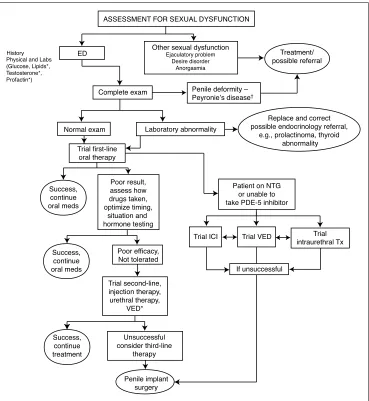
Management of ED most often will occur concurrently with lifestyle modification and treatment of organic or psycho-sexual dysfunctions. Patients and partners are made aware of efficacy, risks and benefits of appropriate treatments, taking into consideration preferences and expectations. Oral ther-apy failure may often be salvaged by patient re-education on PDE5-inhibitor use and optimization of dosing. Stepwise progression from oral agents through second- and third-line therapies occurs as needed (Fig. 1).
1. Oral therapy (on-demand or daily dosing). Given the differences between oral agents, the choice of
ED
ASSESSMENT FOR SEXUAL DYSFUNCTION
Other sexual dysfunction
Normal exam Laboratory abnormality
Trial first-line oral therapy
Patient on NTG or unable to take PDE-5 inhibitor
Trial ICI Trial VED Trial intraurethral Tx
Replace and correct possible endocrinology referral,
e.g., prolactinoma, thyroid abnormality
Unsuccessful consider third-line
therapy
Fig. 1. Management of erectile dysfunction. †Consider first-line ED treatment for men with ED and Peyronie’s disease. *Optional testing.
which initiating PDE5-inhibitor you should use may be influenced by several factors, including timing or frequency of intercourse, and interactions with food or alcohol (Table 1).3,6,19-21
2. Testosterone replacement therapy in men with doc-umented hypogonadism is an option. Testosterone may be used alone for hypogonadism, or in combi-nation with oral PDE5-inhibitor therapy when ED is present.20-21
3. Sexual counselling (this may represent a spectrum of approaches from a simple open discussion with the PCP to psychologist, sexual therapists and/or psy-chiatrists).3,6
4. Local therapy (intracavernous or intraurethral agents).2,3,6,22
5. Vacuum erection device therapy.23
6. Surgery.3,6,23 a. Penile implant.
b. Peyronie’s surgical repair.
c. Vascular bypass procedure (generally reserved for young men after traumatic arterial penile vas-cular injury).
Conclusions
1. A careful history and physical exam are the essential elements of the ED workup in most cases.
2. Basic screening tests include the identification of car-diac risk factors and blood tests. The following tests are recommended: serum fasting glucose, lipids and testosterone (if indicated).
3. A stepwise treatment approach using the least inva-sive option is suggested.
4. In some cases where greater detailed information is desired or failure of the initial oral medication is encountered, trials of more invasive second-line treatment or investigations may be appropriate. 5. Surgery should be reserved for men in whom less
invasive reversible treatment has not succeeded or is contraindicated.
6. Treatment should be individualized and patient fol-low-up should be arranged to assess the efficacy of treatment.
Competing interests: Dr. Bella is a member of the advisory boards for Lilly, Actavis, American Medical Systems, and Coloplast. He is also a member of the Speakers’ Bureau for Lilly and CUA (accredited CME speaker) and a co-principal investigator and cofounder of the PROPPER (Prospective Registry of Outcomes with Penile Prosthesis for Erectile Restoration) registry. Dr. Lee is a member of
Table 1. Comparison of the properties of PDE5-inhibitors
Property Sildenafil Tadalafil Vardenafil
>TMAX 30–120 minutes (median 60 minutes) 30–360 minutes (median 120 minutes) 30–120 minutes (median 60 minutes)
T ½ 4 hours 17.5 hours 4 hours
Absorption Fatty meals cause a mean delay in TMAX of 60 minutes Not affected by food Fatty meals cause a reduction in CMAX
Available Doses 25 mg, 50 mg, 100 mg PRN 2.5 mg, 5 mg daily5 mg, 10 mg, 20 mg PRN 10 mg oral dissolvable tablet2.5 mg, 5 mg, 10 mg, 20 mg PRN
Maximum Dose 100 mg daily 20 mg daily 20 mg daily
Efficacy Each of the PDE5 inhibitors offers similar efficacy.
Dose adjustments may be needed
• Patients >65 years old • Hepatic impairment • Renal impairment
• Concomitant use of potent cytochrome P450 3A4 inhibitors, such as ritonavir and erythromycin • Concomitant use of cimetidine
• Patients >65 years old • Hepatic impairment • Renal impairment
• Concomitant use of potent cytochrome P450 3A4 inhibitors, such as ritonavir and erythromycin
• Patients >65 years old • Hepatic impairment • Renal impairment
• Concomitant use of potent cytochrome P450 3A4 inhibitors, such as ritonavir and erythromycin
Contraindications
• Any patient using organic nitrates either regularly or intermittently • Known hypersensitivity to any
component of the tablet
• Any patient using organic nitrates either regularly or intermittently
• Known hypersensitivity to any component of the tablet
• Any patient using organic nitrates either regularly or intermittently
• Known hypersensitivity to any component of the tablet
Use with alpha blockers Concomitant use of selective alpha blockers does not present a risk for significant hypotension. There is a potential risk of significant hypotension when using non-selective alpha blockers.
Side effects (5 most common in order of frequency when compared to placebo)
Headache, flushing, dyspepsia, nasal congestion, alteration in colour vision
Headache, dyspepsia, backpain, myalgia, nasal congestion
Headache, flushing, rhinitis, dyspepsia, sinusitis
the advisory boards for Abbott and Lilly. He has also received grants from Abbott, Lilly and Actavis and is participating in a clinical trial with Lilly. Dr. Carrier is a member of the advisory boards for Astellas, Eli Lilly Canada, Pfizer Canada, Abbott, Novartis, and Actavis. He is also a member of the Speakers’ bureau for Eli Lilly Canada, Pfizer Canada, Abbott, Merck, and Actavis. He is participating in clinical trials with Astellas and Eli Lilly Canada.Dr. Bénard is a member of the advisory boards and part of the Speakers’ Bureau for Abbott, Astellas, Pfizer, Lilly, Paladin, and Actavis. He has received payment for talks from Abbott, Astellas, Pfizer, Lilly, Paladin, and Actavis. He also has investments in many pharmaceutical companies through his diversified retirement plan. He is also currently participating in a clinical trial with Allergan. Dr. Brock is a member of the advisory boards and part of the Speakers’ Bureau for Lilly, Coloplast, AMS, GSK, Abbott, and Actavis. He has also received payments and grants from these same companies.
This paper has been peer-reviewed.
References
1. Grover SA, Lowensteyn I, Kaouache M, et al. The prevalence of erectile dysfunction in the primary care setting: Importance of risk factors for diabetes and vascular disease. Arch Intern Med 2006;166:213-9. http://dx.doi.org/10.1001/archinte.166.2.213
2. Brock G, Harper W; for Canadian Diabetes Association Clinical Practice Guidelines Expert Committee. Erectile dysfunction. Can J Diabetes 2013;37:S150-2. http://dx.doi.org/10.1016/j.jcjd.2013.01.041 3. Hatzimouratidis K, Amar E, Eardley I, et al. Guidelines on male sexual dysfunction: Erectile dysfunction and
premature ejaculation. Eur Urol 2010;57:804-14. http://dx.doi.org/10.1016/j.eururo.2010.02.020 4. Canadian Urological Guidelines Committee. Erectile dysfunction practice guidelines. Can J Urol
2002;9:1583-87.
5. Costa P, Grandmottet G, Mai HD, et al. Impact of a first treatment with phosphodiesterase inhibitors on men and partners’ quality of sexual life: Results of a prospective study in primary care. J Sex Med
2013:10;1850-60. http://dx.doi.org/10.1111/jsm.12186
6. Montorsi F, Adaikan G, Becher E, et al. Summary of the recommendations on sexual dysfunctions in men.
J Sex Med 2010;7:3572-88. http://dx.doi.org/10.1111/j.1743-6109.2010.02062.x 7. Porst H, Burnett A, Brock G. SOP conservative (medical and mechanical) treatment of erectile dysfunction.
J Sex Med 2013;10:130-71. http://dx.doi.org/10.1111/jsm.12023
8. Brock G. Diagnosing erectile dysfunction could save your patient’s life. Can Urol Assoc J 2014;8:S151-2. http://dx.doi.org/10.5489/cuaj.2311
9. Ramanathan R, Mulhall J, Rao S, et al. Predictive correlation between the International Index of Erectile Function (IIEF) and Sexual Health Inventory for Men (SHIM): Implications for calculating a derived SHIM for clinical use. J Sex Med 2007;4:1336-44. http://dx.doi.org/10.1111/j.1743-6109.2007.00576.x
10. Ghanem HM, Salonia A, Martin-Morales A. SOP: Physical examination and laboratory testing for men with erectile dysfunction. J Sex Med 2013;10:108-10. http://dx.doi.org/10.1111/j.1743-6109.2012.02734.x
11. Jackson G, Nehra A, Miner M, et al. The assessment of vascular risk with erectile dysfunction: the role of the cardiologist and general physician. Int J Clin Prac 2013;67:1163-72. http://dx.doi.org/10.1111/ ijcp.12200
12. Meuleman EJ, Hatzichristou D, Rosen RC, et al. Diagnostic tests for male erectile dysfunction revis-ited. Committee Consensus Report of the International Consultation in Sexual Medicine. J Sex Med
2010;7:2375-81.
13. Morales A, Bella AJ, Chun S, et al. A practical guide to diagnosis, management and treatment of testos-terone deficiency for Canadian physicians. Can Urol Assoc J 2010;4:269-75.
14. Schmidt HM, Munder T, Gerger H, et al. Combination of psychological intervention and phosphodisterase-5 inhibitors for erectile dysfunction: A narrative review and meta-analysis. J Sex Med 2014;11:1376-91. http://dx.doi.org/10.1111/jsm.12520
15. Nocturnal penile erections. The role of RigiScan in the diagnosis of vascular erectile dysfunction. J Sex Med 2010:9;3219-26.
16. Sikka SC, Hellstrom WJ, Brock G, et al. Standardization of vascular assessment of erectile dysfunc-tion: Standard operating procedures for duplex ultrasound. J Sex Med 2013;10:120-9. http://dx.doi. org/10.1111/j.1743-6109.2012.02825.x
17. Glina S, Ghanem H. SOP: corpus cavernosum assessment (cavernosography/cavernosometry). J Sex Med
2013;10:111-4. http://dx.doi.org/10.1111/j.1743-6109.2012.02795.x
18. Giuliano F, Rowland DL. Standard operating procedures for neurophysiologic assessment of male sexual dysfunction. J Sex Med 2013;10:1205-11. http://dx.doi.org/10.1111/jsm.12164
19. Smith WB, McCaslin IR, Gokce A, et al. PDE5 inhibitors: Considerations for preference and long-term adherence. Int J Clin Pract 2013:67:768-80. http://dx.doi.org/10.1111/ijcp.12074
20. Alhathal N, Elshal AM, Carrier S. Synergistic effect of testosterone and phosphodiesterase-5 inhibitors in hypogonadal men with erectile dysfunction: A systematic review. Can Urol Assoc J 2012;6:269-74. http://dx.doi.org/10.5489/cuaj.11291
21. Oral phosphodiesterase-5 inhibitors and hormonal treatments for erectile dysfunction: A systematic review and meta-analysis. Ann Intern Med 2009;151:650-61. http://dx.doi.org/10.7326/0003-4819-151-9-200911030-00150
22. Coombs PG, Heck M, Guhring P, et al. A review of an intracavernosal injection therapy program. BJU Int
2012;110:1787-91. http://dx.doi.org/10.1111/j.1464-410X.2012.11080.x
23. Hellstrom WJ, Montague DK, Moncada I, et al. Implants, mechanical devices, and vascular surgery for erec-tile dysfunction. J Sex Med 2010;7:501-23. http://dx.doi.org/10.1111/j.1743-6109.2009.01626.x